Utilizing corpus stylistics to facilitate literary analysis: An assessment of the effectiveness of semantic domains in identifying
major literary themes in a selection of Charles Dickens novels Wasem Mohamed Abdulkhalek Ibrahim
Department of Basic Sciences, Applied College,
Princess Nourah bint Abdulrahman University, Riyadh, SAUDI ARABIA
[email protected] Published: 30 June 2022
To cite this article (APA): Ibrahim, W. M. A. (2022). Utilizing corpus stylistics to facilitate literary analysis: An assessment of the effectiveness of semantic domains in identifying major literary themes in a selection of Charles Dickens novels. AJELP: Asian Journal of English Language and Pedagogy, 10(1), 114-138. https://doi.org/10.37134/ajelp.vol10.1.9.2022
To link to this article: https://doi.org/10.37134/ajelp.vol10.1.9.2022
Abstract: This paper argues that corpus linguistic procedures can be considered an addition to the analytical inventory of traditional stylistics. It aims to explore how corpus linguistic procedures, particularly semantic domains, can be effective in detecting major literary themes in fiction. In order to do so, five corpora have been compiled: a corpus for each of the four novels of Charles Dickens’
selected (i.e., Oliver Twist, David Copperfield, Great Expectations and Our Mutual Friend) and a compiled corpus combining all four novels. Wmatrix 5, with the BNC Sampler-Written as a reference corpus, is used to extract the key semantic domains in each corpus respectively. The literature on the selected novels is consulted to identify the major themes; it is then verified whether these themes are reflected in the corpus analysis, and, finally, the extent to which the procedure is effective in reflecting the major literary themes is explored. The findings confirm the effectiveness of the procedure of analysing semantic domains in studying literary texts, particularly in relation to their themes.
Keywords: Charles Dickens, corpus stylistics, semantic domains, WMatrix5
INTRODUCTION
Corpus linguistics ‘‘approaches the study of language in use through corpora […]. A corpus is a large, principled collection of naturally occurring examples of language stored electronically’’ (Bennett, 2010, p. 2). It can be defined as ‘‘dealing with some set of machine- readable texts which is deemed an appropriate basis on which to study a specific set of research questions’’ (McEnery & Hardie, 2012, p. 1). Its goal is to describe ‘‘the patterns of language use in the target textual domain’’ (Biber, 2011, p. 15). It ‘‘serves to answer two fundamental research questions: 1. What particular patterns are associated with lexical or grammatical features? 2. How do these patterns differ within varieties and registers?’’
(Bennett, 2010, p. 2). According to Leech (1992), ‘‘corpus linguistics ... defines not just a newly emerging methodology for studying language, but a new research enterprise, and in fact a new philosophical approach to the subject’’ (Leech, 1992, p. 106). However, there is a debate among scholars whether corpus linguistics is a methodology (see Meyer, 2002;
McEnery & Hardie, 2012; Taylor, 2008) or a theory in its own right (see Gilquin, 2010).
McEnery and Gabrielatos (2006, p. 34) refer to this debate stating that while some scholars
‘‘assert that corpus linguistics is not a branch of linguistics, nor a linguistic theory, but a methodology’’, others argue that it ‘‘is more than just a methodology’’.
‘‘In the effort to bring corpus linguistic tools to bear on literary linguistic analysis, many recent publications have begun to map out new possibilities’’ (Toolan, 2006, p. 181).
The use of computer-assisted textual analysis in the field of stylistics has given rise to a new field termed ‘‘corpus stylistics’’ (Sinclair, 2007; Mahlberg, 2007b). McIntyre (2015) highlights the difference between corpus stylistics and corpus linguistics stating that ‘‘corpus stylistics is simply corpus linguistics with a different object of study (literature as opposed to non-literary language)’’, and that it makes itself unique by using qualitative tools and techniques of stylistics to analyze texts with the help of computational methods (McIntyre, 2015, p. 60). Mahlberg (2014, p. 378-380) also draws attention to the fact that corpus stylistics links principles from corpus linguistics and literary stylistics. A corpus-based work is highly quantitative in nature, but when combined with qualitative analysis, both help us to reach a higher degree of understanding of literary works or any other selected data (Semino
& Short, 2004, p. 7).
Mahlberg and Smith (2010, p. 450) describe corpus stylistics as ‘‘an emerging field that aims to combine questions from literary stylistics with approaches from corpus linguistics’’. It constitutes an ‘‘interface of corpus linguistics and literary stylistics’’, which
‘‘employs methods and approaches of corpus linguistics and links them with concerns in literary stylistics and literary criticism’’ (Mahlberg, 2010, p. 295). Corpus Stylistics allows
‘‘a combination of quantitative and qualitative analysis of literary texts’’ (Mahlberg, 2013, p.
355). It is generally defined as employing ‘‘corpus linguistic methods to support the analysis of textual meanings and the interpretation of texts’’ (Mahlberg, 2013, p. 346). It allows ‘‘for the quantification of recurring linguistic features to substantiate qualitative insights and vice versa’’ (O’Keeffe, 2006, p. 50).
‘‘[T]he value of applying corpus methods’’ in studying literature, which is the core of corpus stylistics, ‘‘is defined through the links that can be made between quantitative findings and qualitative analysis’’ (Mahlberg, 2010, p. 295). O’Halloran (2007a, p. 241) adds that
‘‘[t]he value of the corpus stylistic approach … is that it can help reveal such subtleties that even some close readings may not detect’’. ‘‘Corpus stylistics provides new insights into narrative texture and demonstrates the importance of recurrent linguistic features in shaping meaning’’ (Hunt & Carter, 2012, p. 27). It aims to ‘‘typically explore interpretations of literary texts identified in conventional readings but which may be hard to substantiate by traditional methods’’ (Hunt & Carter, 2012, p. 30). According to McIntyre (2010, p. 180), corpus stylistics is an approach that ‘‘employs the service or the evidence elicited from corpus linguistics to support literary analysis, transforming it from a basic, subjective claim- and-quote strategy …. into evidence-based objectivity that encompasses linguistic features’’.
Thus, it ‘‘enables us to address what has long been an issue with the analysis of prose fiction
… the problem of length and the fact that most prose texts are simply too long for the stylistician to deal with’’ (Mahlberg & McIntyre, 2011, p. 205). ‘‘[T]he application of the methods of corpus linguistics to text analysis has made it possible to place the selection and description of stylistically significant features on a firmer empirical footing’’ (Semino, 2011, p. 543). When ‘‘both quantitative and qualitative techniques of analysis are employed’’, [t]he consequent strengths of such an analysis lie both in its scope and reliability’’ (Murphy, 2007, p. 67). ‘‘[E]mpirical corpus evidence can usefully provide substantiation of such initial evaluations of literary works’’ (O’Halloran, 2007b, p. 33), or in other words, it ‘‘can provide textual substantiation to impressionistic interpretation’’ (Widdowson 2008, p. 294). Indeed, corpus stylistics has enabled analysts ‘‘to test empirically claims about the language of
literature, to search for and provide evidence from texts, to establish the norms of literary and non-literary style, and to have in-depth insights into the texts’ structures and meanings’’
(Keshabyan-Ivanova, 2014, p. 59).
Since its inception, scholars have been interested in using corpus stylistic techniques.
Examples of corpus stylistic studies include Adolphs (2006), Adolphs and Carter (2002), Biber (2011), Culpeper (2002, 2009), Fischer-Starcke (2010), Hoover (1999, 2002), Hori (2004), Lawson (2000), Louw (1993), Mahlberg (2007a, 2007b), McEnery et al. (2006), McIntyre (2008), McIntyre and Walker (2010), O’Halloran (2007a, 2007b), Romaine (2010), Scott (2006), Scott and Tribble (2006), Semino and Short (2004), Sinclair (2004), Starcke (2006), Stubbs (2001, 2005), and Toolan (2006).
Semino and Short (2004) investigated speech, thought and writing presentation in a corpus of late 20th century fictional and non-fictional works. Stubbs (2005) looked at clusters in Conrad’s Heart of Darkness. Starcke (2006) concentrated on clusters in Austen’s Persuasion. Mahlberg (2007) studied clusters in a corpus of Dickens’ works. Culpeper (2009) investigated characterization in Shakespeare’s Romeo and Juliet addresses the usefulness of Wmatrix’s ability to compare texts at the grammatical and semantic level. Mclntyre’s (2010) analysis of Reservoir Dogs utilized the semantic functionality of Wmatrix to study characterization by examining keywords and key semantic categories. Archer and Bousfteld (2010) also used Wmatrix to explore the main characters in Shakespeare's King Lear. Leech (2008, p. 162-78) used Wmatrix to analyse Virginia Woolf’s The Mark on The Wall. Ho (2011) used a number of corpus tools (including Wmatrix) in her analysis of Fowles’ The Magus. Walker (2010) examined keywords and semantic domains in Julian Barnes’s novel Talking it Over. Mahlberg and McIntyre (2011) demonstrated the interplay of qualitative and quantitative methods in their corpus stylistic analysis of Ian Fleming’s novel Casino Royale.
This paper supports the argument that integrating corpus procedures in the toolkit of traditional stylistics or manual literary analysis would enhance analysis and enable analysts to deal with large amounts of data. In addition, it assesses the corpus procedure of semantic domains and reveals its effectiveness in identifying major literary themes. In order to do so, it investigates to what extent semantic fields can identify the literary themes in four of Charles Dickens’ novels, namely: Oliver Twist, David Copperfield, Great Expectations and Our Mutual Friend.
The ‘‘limits and pitfalls’’ of corpus stylistics are acknowledged by its practitioners (Mahlberg 2007b, p. 222). The most common problem is difficulty in obtaining either digital copies of literary texts or the right to use the available ones. Fortunately, the texts of Charles Dickens’ works are all in the public domain, having been made available in digital form via Project Gutenberg1. For the purposes of this paper, the four selected works of Charles Dickens have been downloaded from the Project Gutenberg website and compiled into five separate text corpora (one for each novel and one combined corpus).
Wmatrix: What it offers and how it works
Corpus stylistics is not only based on the availability of large collections of machine-readable texts, but also on computer software programs, such as, for example, Wmatrix (Rayson, 2003, 2008, 2021), which is used primarily in this paper. Wmatrix2 is a software tool for
1 Project Gutenberg is an online book catalogue that offers over 45,000 ebooks. They are all accessible and free to download. For further details see http://www.gutenberg.org/.
2 See http://ucrel.lancs.ac.uk/wmatrix.html for further details
corpus analysis and comparison which provides a web interface to the CLAWS3 (Constituent Likelihood Automatic Word-tagging System) and USAS4 (UCREL5 Semantic Analysis System) corpus annotation tools. It allows researchers to investigate the frequency and distribution of word forms and lemmas, keywords, grammatical word classes and semantic domains. Researchers can upload their own corpora to Wmatrix and click on the tag wizard which will automatically tag/annotate the uploaded files/corpora grammatically by CLAWS and semantically by USAS. Once the tagging process is complete, each word in the corpus will be separated, numbered and assigned different kinds of tag codes (i.e., Frequency, Semantic tags, and POS tags).
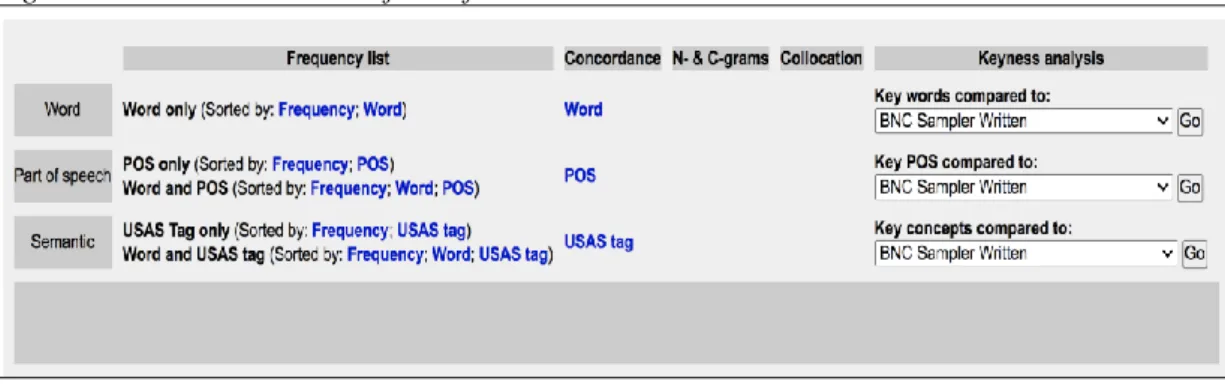
Wmatrix has two interfaces: simple and advanced. The simple interface consists of four functions: extracting wordlists, identifying frequencies, searching for a particular word, and extracting keyword clouds, which display the significance of each keyword by allocating it an appropriate font size. The advanced interface offers more tags, particularly semantic and part of speech tags.
Figure 1: The Advanced Interface of Wmatrix
The semantic tagger in Wmatrix is used in this study. In the semantic tagging/annotation process, USAS assigns a semantic tag to each word in the corpus. According to Rayson (2003, p. 66), the semantic tags are composed of:
1. An upper-case letter indicating general discourse field 2. A digit indicating a first subdivision of the field
3. A decimal point followed by a further digit to indicate a finer subdivision (optional) 4. One or more ‘pluses’ or ‘minuses’ to indicate a positive or negative position on a
semantic scale (optional)
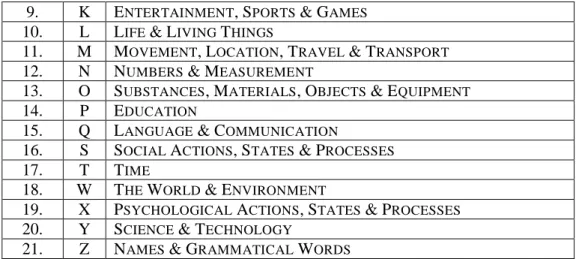
USAS includes 21 major semantic domains, as shown in Table 1 below.
Table 1: Semantic fields of USAS – Adapted from Rayson (2003) 1. A GENERAL &ABSTRACT TERMS
2. B THE BODY & THE INDIVIDUAL
3. C ARTS &CRAFTS
4. E EMOTION
5. F FOOD &FARMING
6. G GOVERNMENT &PUBLIC
7. H ARCHITECTURE,BUILDINGS,HOUSING & THE HOME
8. I MONEY &COMMERCE
3 See http://www.comp.lancs.ac.uk/ucrel/claws/ for further information.
4 See http://www.comp.lancs.ac.uk/ucrel/usas/ for further information.
5 University Centre for Computer Corpus Research on Language.
9. K ENTERTAINMENT,SPORTS &GAMES
10. L LIFE &LIVING THINGS
11. M MOVEMENT,LOCATION,TRAVEL &TRANSPORT
12. N NUMBERS &MEASUREMENT
13. O SUBSTANCES,MATERIALS,OBJECTS &EQUIPMENT
14. P EDUCATION
15. Q LANGUAGE &COMMUNICATION
16. S SOCIAL ACTIONS,STATES &PROCESSES
17. T TIME
18. W THE WORLD &ENVIRONMENT
19. X PSYCHOLOGICAL ACTIONS,STATES &PROCESSES
20. Y SCIENCE &TECHNOLOGY
21. Z NAMES &GRAMMATICAL WORDS
These major domains are refined and expanded into 232 semantic categories6. Figure 2 below provides an example showing how the major domains of money & commerce (I), entertainment, sports, & games (K), and life & living things (L) are expanded into subcategories.
Figure 2:. An illustration of the expansion of three semantic domains
The investigation of semantic domains is particularly useful in corpus stylistics. Many studies have employed the USAS component of Wmatrix (see, for example, McIntyre &
Walker, 2010; Murphy, 2007; and Walker, 2010, 2012). It should be noted, however, that, to
6 See https://github.com/UCREL/Multilingual-USAS/blob/master/English/USASSemanticTagset.pdf for the complete Semantic Tagset.
my knowledge, no other study has used Wmatrix to study the effectiveness of the semantic domains procedure in identifying the major literary themes in Charles Dickens’ works.
METHODOLOGY
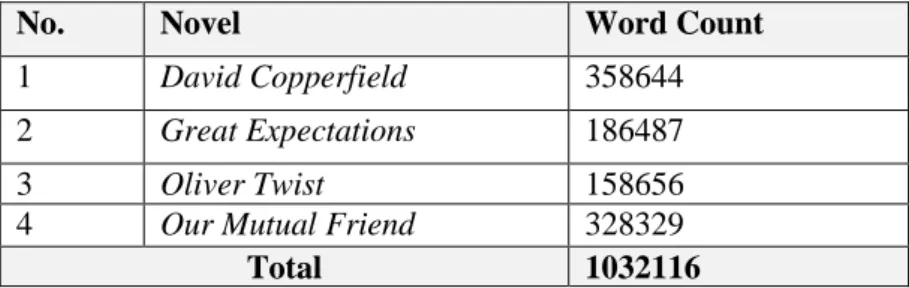
This paper aims to investigate the following research issues: (1) whether the semantic domains (provided by WMatrix5) relate to the major themes of literary text(s); and (2) the similarities and/or differences between the results of corpus analysis in relation to semantic domains and the traditional critical reviews of the selected novels. To achieve this aim, four novels of Charles Dickens were downloaded from the website of Project Gutenberg (See Table 2 below).
Table 2: A list of the selected novels and their word counts
Each novel was saved as a plain text file. Then, the four novels were compiled into one large corpus also saved as a plain text file. Using the BNC Sampler-Written (a subset of the BNC - British National Corpus - consisting of about one million words) as a reference corpus, the key semantic domains of the selected novels and the compiled corpus were identified by the WMatrix5 semantic tagger. Finally, the categories of the semantic fields were examined and compared to the identified literary themes suggested in the literature.
RESULTS
Literary critics argue that Charles Dickens’ novels offer deep insights into the spirit of the Victorian age through addressing themes such as social class, poverty, child labor, morality, education, self-actualization, and so on7. Dickens was
“one of the first popular writers who brought pictures of what is called common life into fashion. It is he who has been mainly instrumental in leading the present generation of authors to disregard to a great extent the pictorial advantages of life on the upper levels of society, and to find a counter picturesqueness in the experiences of the poor” (Oliphant, 1862, in Wall, 1970, p. 158).
Charles Dickens was born in 1812 into a bourgeois family as his father, John Dickens, worked in the Naval Pay Office and earned a good salary (Johnson, 1977, p. 13). However, due to his merrymaking, Dickens’ father went bankrupt and was sent to the debtors’ prison, and so the family became poor. As the eldest son, Dickens, who was 11 years old, had to work as a child laborer in a blacking warehouse. This painful experience led Dickens to deeply sympathize with poor and oppressed people, especially children. After his father’s
7 Analysis of Charles Dickens’s Novels – Literary Theory and Criticism (literariness.org) https://literariness.org/2019/04/02/analysis-of-charles-dickenss-novels/
No. Novel Word Count
1 David Copperfield 358644
2 Great Expectations 186487
3 Oliver Twist 158656
4 Our Mutual Friend 328329
Total 1032116
release from prison, Dickens was sent to study at the Wellington House Academy for two years. Then, he had to drop school and work again as his father faced financial problems for the second time. He successively managed to work in many jobs: a junior clerk at a law office, a freelance reporter in a newspaper office and a stenographer in the court. Dickens’
early work experience and suffering helped him to understand the hardships of the people, especially the heavy burden on the poor, and inspired many of his novels (Johnson, 1977).
“[N]o other writer of the English language except Shakespeare has left so many types of characters as Dickens has done” (Trollope, 1870, in Wall, 1970, p. 180).
“Dickens’ world was richly populated with a variety of characters drawn from different social structures and often his moral vision is engaged through the mechanism of caricature. […] Dickens’ novels also show, at the same time, a remarkable awareness of contemporary social issues” (Choudhury, 2009, p. 5).
Several critics have identified Dickens as a writer for “the people” because his characters are ordinary people: lawyers, clerks, merchants, hotel owners, craftsmen, criminals, servants and workers (Ackroyd, 1990, p. xiv). Indeed, Dickens’ characters embody people from all occupations and social classes in 19th century Britain.
“His range is very varied. He has attempted to describe every kind of scene in English life, from quite the lowest to almost the highest…Mr. Dickens’s novels aim to delineate nearly all that part of our national life which can be delineated”
(Bagehot, 1858, in Wall, 1970, p. 124).
One of the major themes in Dickens’ novels is child labor and suffering. “No one, at any rate no English writer, has written better about childhood than Dickens. […] no novelist has shown the same power of entering into the child’s point of view” (Orwell, 1968, p. 423- 424). In Dickens’ works, “the figure of the child and the topic of childhood have always loomed large” (Merchant & Waters, 2015, p. 1). He portrayed “how children were perceived by the Victorians and how the phenomenon of increasing child labor did fit into this particular perception” (Schuster, 2014, p. 7). Dickens’ amazing talent for portraying the world of children is evident in his vivid child characters in novels like Oliver Twist, David Copperfield, and Great Expectations. Dickens’ miserable childhood had an impact on his portrayal of the darkness of the social reality faced by poor children. Ackroyd (1990) explained this idea as follows:
“There is something in Dickens’s infancy, something which cannot now be recovered or understood, some primal fear which left him casting about for images with which to express it and which gave him as a novelist that sensitivity to the adult world which is most often to be found in the eyes of a frightened child” (Ackroyd, 1990, p. 54).
Dickens also criticized the social system. As George Orwell (1968) puts it:
“Fasten upon this or that minor abuse, expose it, drag it into the open, bring it before a British jury, and all will be well – that is how he sees it…There is no clear sign that he wants the existing order to be overthrown, or that he believes it would make very much difference if it were overthrown” (Orwell, 1968, p. 416).
It seems that Dickens’ criticism of the social system is almost exclusively moral. His main target of criticism is not the social system but human nature which he was much concerned to improve. Therefore, Dickens stresses the need for reformation, through focusing on morality (Orwell, 1968, p. 427).
“It seems that in every attack Dickens makes upon society he is always pointing to a change of spirit rather than a change of structure …. His approach is always along the moral plane… Useless to change institutions without a ‘change of heart’
– that, essentially, is what he is always saying” (Orwell, 1968, p. 427).
Morality is emphasized in Dickens’ works. Dickens’ focus on morality might be attributed to his Christian puritanism. He advocated what he thought to be typically Christian moral values: love, mercy, benevolence and so on. According to Walder (1981, p. 208), Dickens’ ‘‘knowledge of the Bible … as well as the Book of Common Prayer, is testified to by frequent, accurate and often surprisingly relevant allusion throughout his works.” Dickens attempted to convey charity as a kind of Christian virtue. Charity “means more than the simple human virtue of benevolence, or giving alms to the poor; it implies the more general motive of Christian love, expressed as a love of God and one’s neighbor” (Walder, 1981, p.
45). As George Orwell (1968, p. 417) explains, Dickens’ “whole ‘message’ is one that at first glance looks like an enormous platitude: If men would behave decently the world would be decent.” Indeed, Dickensian humanitarianism is reflected in his calling for mercy, universal love and forgiveness, and opposing all kinds of evil, violence and oppression in his novels (Orwell, 1968). “[T]he novels of Dickens can all be reduced to one phrase, to wit: Be good, and love” (Taine, 1856, in Wall, 1970, p. 103). Dickens strove to create a sense of ‘‘human solidarity’’ through shared experience and emotions to evoke in his readers a sense of collective responsibility for social problems (Bell, 2000, p. 126-127).
The German philosopher Karl Marx valued the critical realism of Victorian novelists, particularly Dickens.
The … graphic and eloquent pages have issued to the world more political and social truths than have been uttered by all the professional politicians, publicists, and moralists put together… (Raina, 1986, p. 137)
This is true of Charles Dickens, whose works offer deep and enlightening insights into the spirit of the 19th century.
A Corpus-assisted Analysis of Dickens’ Selected Works
In this section, the corpus-assisted analysis is conducted as follows: (1) the semantic domains are identified in each selected work using WMatrix 5; and (2) the extracted semantic domains are compared to the literary themes suggested in critical reviews of Dickens’ works (Churchill, 1975; Wall, 1970).
Oliver Twist
Oliver Twist is set in a workhouse and discloses the cruel, greedy and egotistic nature of Victorian industrial society. It tells the story of the miserable childhood of an abandoned orphan, Oliver Twist. As a child, he was mistreated, beaten, and forced to join the diabolic underworld of criminal life. He ran away and always preserved his positive outlook despite his suffering. Morality is the overarching theme of this novel since it depicts a conflict between good and evil, exposes and punishes vice, and advocates public morality. It revealed the poor conditions of workhouses and orphanages, and reflected how they were devoid of
compassion. It also reflected on the financial discrepancies between the social classes, portraying the lives of both the lower classes who inhabit the London underworld, and of the rich aristocrats. It also tackles the themes of thought and belief in criticizing the Church of England for not providing enough care for the poor who sought their help.
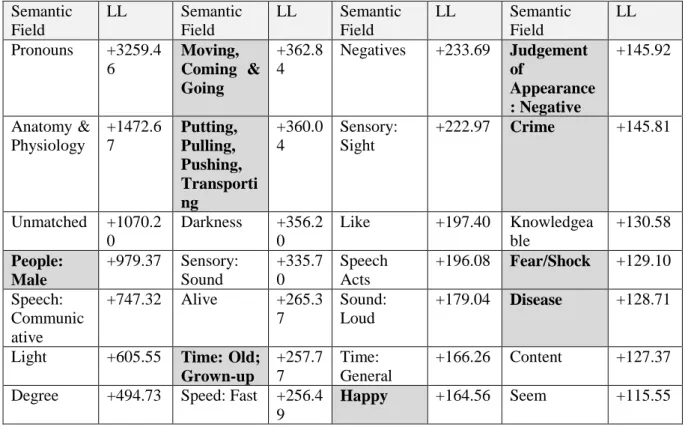
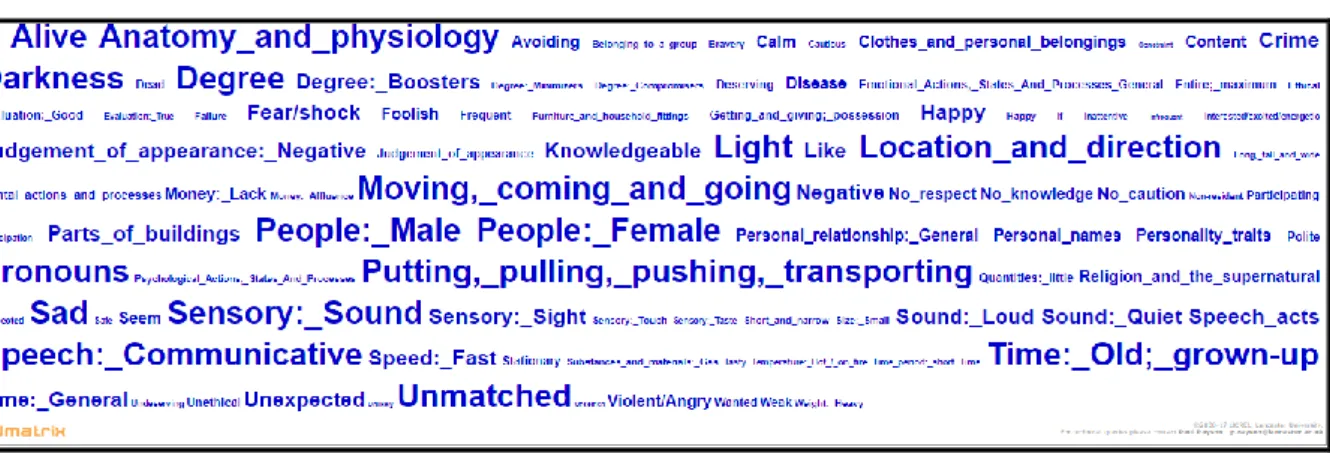
The semantic categories/fields extracted from the text of Oliver Twist are shown in Figure 3 and listed in Table 3.
Figure 3: Semantic clouds in Oliver Twist
As shown in Figure 3, the bigger the font size of a semantic field, the more significant it is in the text. This makes it easier for anyone to get a general idea about the major components of the story: the setting, inhabitants of the story world, events and so on.
Table 3: Wmatrix Semantic Tagging of Charles Dickens’ Oliver Twist Semantic
Field
LL Semantic
Field
LL Semantic Field
LL Semantic
Field
LL Pronouns +3259.4
6
Moving, Coming &
Going
+362.8 4
Negatives +233.69 Judgement of
Appearance : Negative
+145.92
Anatomy &
Physiology
+1472.6 7
Putting, Pulling, Pushing, Transporti ng
+360.0 4
Sensory:
Sight
+222.97 Crime +145.81
Unmatched +1070.2 0
Darkness +356.2 0
Like +197.40 Knowledgea ble
+130.58 People:
Male
+979.37 Sensory:
Sound
+335.7 0
Speech Acts
+196.08 Fear/Shock +129.10 Speech:
Communic ative
+747.32 Alive +265.3 7
Sound:
Loud
+179.04 Disease +128.71
Light +605.55 Time: Old;
Grown-up
+257.7 7
Time:
General
+166.26 Content +127.37 Degree +494.73 Speed: Fast +256.4
9
Happy +164.56 Seem +115.55
Location &
Direction
+481.90 Degree:
Boosters
+252.3 6
Unexpected +153.44 Money:
Lack
+108.79
Sad +466.61 Parts of
Buildings
+245.3 5
Sound:
Quiet
+152.28 Violent/Ang ry
+104.75
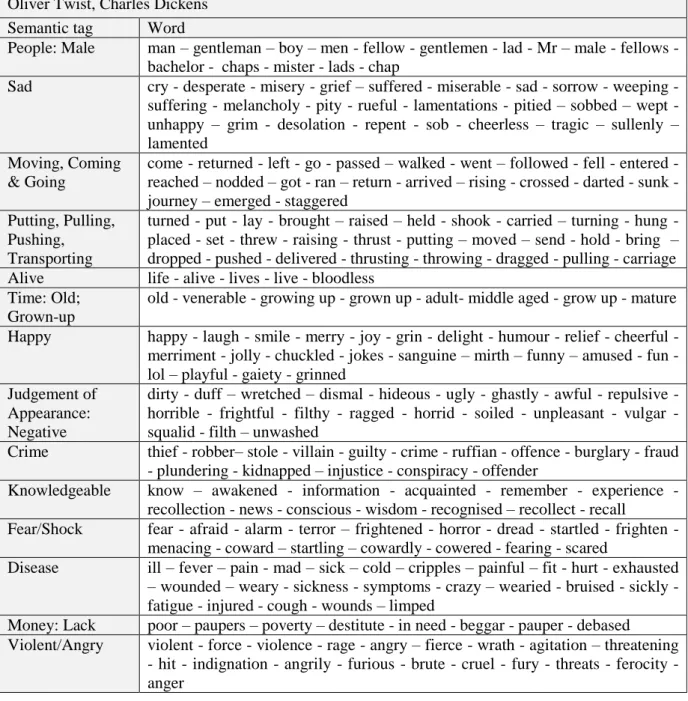
Table 3 lists the semantic categories according to their statistical significance. The semantic categories which are relevant to the major literary themes in the story are highlighted in the table. Table 4 provides a list of the significant words used in the text to reflect each category.
Table 4: Oliver Twist: Significant words in each semantic category Oliver Twist, Charles Dickens
Semantic tag Word
People: Male man – gentleman – boy – men - fellow - gentlemen - lad - Mr – male - fellows - bachelor - chaps - mister - lads - chap
Sad cry - desperate - misery - grief – suffered - miserable - sad - sorrow - weeping - suffering - melancholy - pity - rueful - lamentations - pitied – sobbed – wept - unhappy – grim - desolation - repent - sob - cheerless – tragic – sullenly – lamented
Moving, Coming
& Going
come - returned - left - go - passed – walked - went – followed - fell - entered - reached – nodded – got - ran – return - arrived – rising - crossed - darted - sunk - journey – emerged - staggered
Putting, Pulling, Pushing, Transporting
turned - put - lay - brought – raised – held - shook - carried – turning - hung - placed - set - threw - raising - thrust - putting – moved – send - hold - bring – dropped - pushed - delivered - thrusting - throwing - dragged - pulling - carriage Alive life - alive - lives - live - bloodless
Time: Old;
Grown-up
old - venerable - growing up - grown up - adult- middle aged - grow up - mature Happy happy - laugh - smile - merry - joy - grin - delight - humour - relief - cheerful -
merriment - jolly - chuckled - jokes - sanguine – mirth – funny – amused - fun - lol – playful - gaiety - grinned
Judgement of Appearance:
Negative
dirty - duff – wretched – dismal - hideous - ugly - ghastly - awful - repulsive - horrible - frightful - filthy - ragged - horrid - soiled - unpleasant - vulgar - squalid - filth – unwashed
Crime thief - robber– stole - villain - guilty - crime - ruffian - offence - burglary - fraud - plundering - kidnapped – injustice - conspiracy - offender
Knowledgeable know – awakened - information - acquainted - remember - experience - recollection - news - conscious - wisdom - recognised – recollect - recall Fear/Shock fear - afraid - alarm - terror – frightened - horror - dread - startled - frighten -
menacing - coward – startling – cowardly - cowered - fearing - scared
Disease ill – fever – pain - mad – sick – cold – cripples – painful – fit - hurt - exhausted – wounded – weary - sickness - symptoms - crazy – wearied - bruised - sickly - fatigue - injured - cough - wounds – limped
Money: Lack poor – paupers – poverty – destitute - in need - beggar - pauper - debased Violent/Angry violent - force - violence - rage - angry – fierce - wrath - agitation – threatening
- hit - indignation - angrily - furious - brute - cruel - fury - threats - ferocity - anger
The semantic category People: Male (+979.37) relates to the inhabitants of the story world and shows that it was dominated by males. The significance of the category Time:
Old; Grown-up (+257.77) can be accounted for by the fact that the story is told from the perception of a child who is controlled by grown-ups and that the story depicts his life
journey as he grows up. The semantic categories Sad (+466.61), Judgement of Appearance:
Negative (+145.92), Fear/Shock (+129.10), Disease (+128.71), and Money: Lack (+108.79) relate to the miserable life and work conditions of the protagonist, and hence, to the themes of child labor and poverty. The categories Crime (+145.81) and Violent/Angry (+104.75) relate to the mistreatment and cruelty the protagonist suffered from and also the life of crime he was forced to join. The category Happy (+164.56) is related to the protagonist’s positive outlook despite his suffering. The categories Moving, Coming & Going (+362.84) and Putting, Pulling, Pushing, Transporting (+360.04) relate to the actions and, hence the main events, in the story. Hence, the semantic categories reflect plot elements and relate to the themes of morality, criminality, child labor and poverty.
David Copperfield
Dickens’ David Copperfield is a bildungsroman which depicts the hardworking and the moral and spiritual development of its protagonist, David Copperfield. The novel highlights the themes of injustice in the educational system, marriage, morality, financial discrepancies between social classes, and the miserable conditions of the working class.
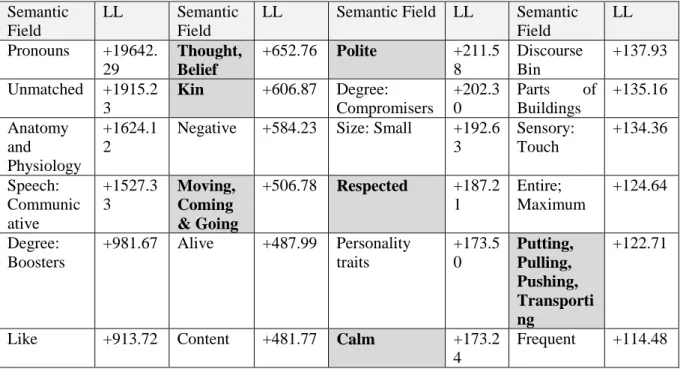
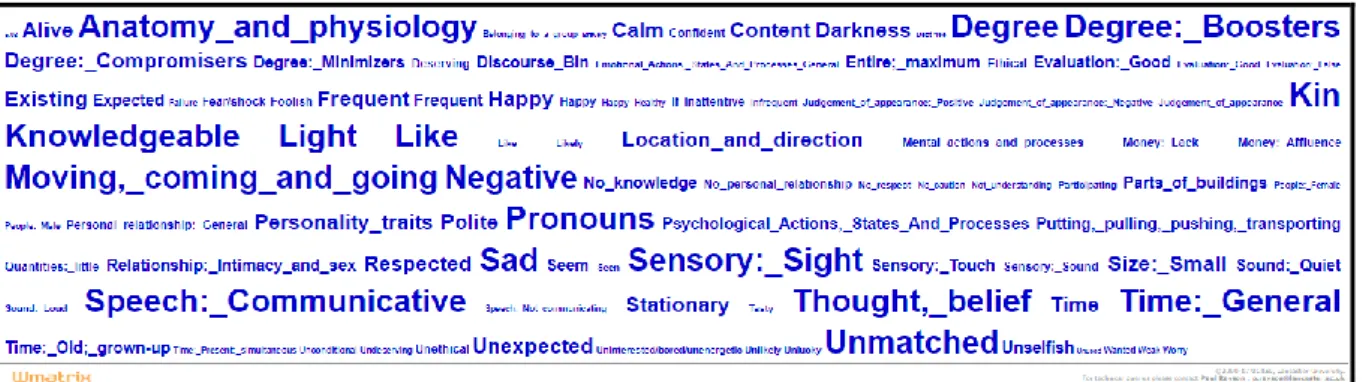
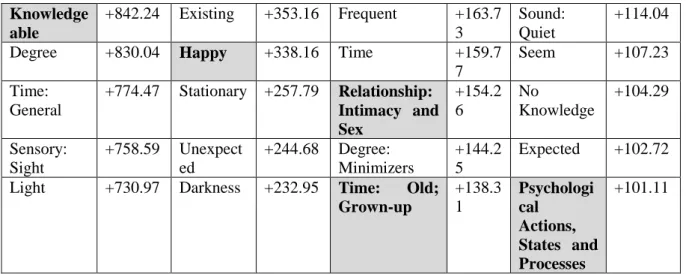
Figure 4 and Table 5 provide the extracted semantic categories in the text. Table 6 provides a list of the words reflecting each semantic category in the text.
Figure 4: Semantic clouds in David Copperfield
Table 5: Wmatrix Semantic Tagging of Charles Dickens’ David Copperfield Semantic
Field
LL Semantic
Field
LL Semantic Field LL Semantic Field
LL Pronouns +19642.
29
Thought, Belief
+652.76 Polite +211.5
8
Discourse Bin
+137.93 Unmatched +1915.2
3
Kin +606.87 Degree:
Compromisers
+202.3 0
Parts of Buildings
+135.16 Anatomy
and Physiology
+1624.1 2
Negative +584.23 Size: Small +192.6 3
Sensory:
Touch
+134.36
Speech:
Communic ative
+1527.3 3
Moving, Coming
& Going
+506.78 Respected +187.2 1
Entire;
Maximum
+124.64
Degree:
Boosters
+981.67 Alive +487.99 Personality traits
+173.5 0
Putting, Pulling, Pushing, Transporti ng
+122.71
Like +913.72 Content +481.77 Calm +173.2
4
Frequent +114.48
Knowledge able
+842.24 Existing +353.16 Frequent +163.7 3
Sound:
Quiet
+114.04
Degree +830.04 Happy +338.16 Time +159.7
7
Seem +107.23
Time:
General
+774.47 Stationary +257.79 Relationship:
Intimacy and Sex
+154.2 6
No
Knowledge
+104.29
Sensory:
Sight
+758.59 Unexpect ed
+244.68 Degree:
Minimizers
+144.2 5
Expected +102.72 Light +730.97 Darkness +232.95 Time: Old;
Grown-up
+138.3 1
Psychologi cal
Actions, States and Processes
+101.11
Table 6: David Copperfield: Significant words in each semantic category David Copperfield, Charles Dickens
Semantic tag Word
Knowledgeable know- remember- recollect- knowledge- remembrance- informed- aware- experience- conscious- recall- information- recollection- looking back- famous- news- memorable- recalled- recognized- wisdom- recognition- recollections- inform- recalling- informing- experiences- spies- identify- informs- recognizing- expert
Thought, Belief think- felt- believe- opinion- considered- wonder- suppose- supposed- impression- regarded- belief- thinks- suspicion- conviction- suspect- musing- conceived- attitude- views- opinions
Kin aunt- mother- family- father- wife- sister- married- brother- son- papa- daughter- husband- engaged- mama- uncle- marriage- niece- cousin- marry- nephew- widow- Mrs- the old man- marrying- families- parents- wedding- parent- godmother- brothers- mothers- grandfather – father-in-law - widower- twin- husbands- offspring- bride- son in law- great aunt- brother in law- great grandfather- sister in law- fathers
Moving, Coming &
Going
returned- went- go- come- left- walked- passed- trot- return- entered- journey- rising- followed- nodded- come back- went away- went in- departure- steps- advanced- voyage
Happy happy- smile- laughing- delighted- cheerful- joy- delight- relief- smiled- cheerfully- merry- laughter- humour- amused- cheer up- happily- gaily- jest- cheerfulness- joyfully- joke- grin
Polite thanked- grateful- compliments- gratitude- gracious- compliment- polite- gentlemanly- indebted- propriety- decently- complimentary- politely- civilities- courtly- pleasantry
Respected respect- admiration- dignity- praise- honoured- honour- admire- homage- respecting- esteem- glorified- reverence- deference- admirable
Calm rest- softly- gentle- calm- peace- resting- patience- rested- placid- cordiality- soothing- gentility- soothed- rests- serenity- gentler- reposed- soothe- serene Relationship:
Intimacy & Sex
love- kiss- in love- embrace- romantic- intimacy- hug- fell in love- intercourse- hugged- hugging- sweetheart- fall in love- sweethearts- suitor- sleeps with- love making- live together
Time: Old;
Grown-up
old- grown up- grew up- matured- grow up- grown- growing up- dated- middle aged- old age- superannuated- mature- established- patrician- mature
Putting, Pulling, Pushing, Transporting
put- turned- brought- lay- shook- held- bear- set- raised- turning- sent- carried- moved- thrown- dropped- put down- send- shed- seated- lifted up- squeeze- fetch- hanging- pushed
Psychological Actions, States and Processes
mind- state of mind- instinctively- instinct- trance
The semantic categories Knowledgeable (+842.24) and Thought, Belief (+652.76) relate to the themes of the protagonist’s self-development and education. Kin (+606.87) and Relationship: Intimacy & Sex (+154.26) reflect the themes of family and marriage. The protagonist’s psychological state, positive outlook and maturity are reflected in the categories Happy (+338.16), Calm (+173.24), and Psychological Actions, States & Processes (+101.11). The themes of morality and social class are conveyed by the categories Polite (+211.58) and Respected (+187.21). The protagonist’s progress into maturity is reflected by the semantic category Time: Old; Grown-up (+138.31). This category may also refer to older inhabitants of the story world. The categories Moving, Coming & Going (+506.78) and Putting, Pulling, Pushing, Transporting (+122.71) reflect the actions which propel the plot. As such, the semantic categories show that David Copperfield discusses the themes of education, marriage/family, morality, and self-development to maturity.
Great Expectations
Dickens’ Great Expectations portrays the journey of its protagonist, Philip Pirrip (Pip) from childhood into youth. The major themes conveyed by the novel include morality, self- development, the social class system, and crime. Figure 5 and Table 7 provide the extracted semantic categories in the text. Table 8 provides a list of the words reflecting each semantic category in the text.
Figure 5. Semantic clouds in Great Expectations
Table 7: WMatrix Semantic Tagging of Charles Dickens’ Great Expectations Semantic Field LL Semantic
Field
LL Semantic Field
LL Semantic Field
LL
Pronouns +1295
1.68
Time:
General
+423.2 1
People:
Male
+209.9 3
Polite +134.03 Anatomy &
Physiology
+1122.
50
Location &
Direction
+384.7 7
Frequent +189.0 8
Time +127.51
Light +794.5 9
Moving, Coming &
Going
+379.7 0
Parts of the Buildings
+182.1 5
Money:
Affluence
+126.51
Speech:
Communicative
+671.7 8
Putting, Pulling, Pushing &
Transporti ng
+324.5 2
Discourse Bin
+181.3 1
Clothes
&
Personal Belongin gs
+123.59
Sensory: Sight +647.6 4
Degree:
Boosters
+315.2 3
Like +181.1
0
Content +112.19
Degree +488.6
9
Darkness +283.5 2
Sad +161.9
9
Sensory:
Touch
+92.83
Negative +446.0
0
Thought, Belief
+233.8 2
Degree:
Compromise rs
+148.1 7 Knowledgeable +441.8
2
Alive +226.6
2
Unexpected +146.0 9
Table 8: Great Expectations: Significant words in each semantic category
Great Expectations, Charles Dickens Semantic tag Word
Knowledgeable know - remember - knowledge - remembrance - information - aware - informed - recognized - acquainted - experience - recalled - remembered - news - memorable – recognition - recall - recollect – identify – wisdom Moving, Coming
& Going
go - come - returned - left - passed - walk – leave - fell - coming - entered - rising - crossed - nodding - tumbling - movement - steps - arrival – journey - staggered – rolled - approached - scattered - ascended - creep - drifting Putting, Pulling,
Pushing, Transporting
put – held - lay - turned - bring - shook - threw - seated - placed – pulled - hanging - pushed - removed - dropping - carriage – shipping - dragged
Thought, Belief thought - felt - believe - considered - opinion - supposed - suspicion - impression - meaning - conscience - judgement - attitude
People: Male man – boy - gentleman – fellow - chap - Mr - bachelor - lad - male - manhood - manly
Sad cried - miserable - suffered - melancholy - desperate - sulky - despair – mourning - regret - dejected - unhappy - remorse - grim - suffering - wept - sorrowful - sad - miserably - gloomily
Polite thanked - grateful - compliments - polite - gracious - gratitude - apologetically – compliment - thanks - peasantry - indebted
Money:
Affluence
fortune - fortunes - treasure Clothes &
Personal Belongings
pocket - dress - clothes - boots - hat - wore - coat - put on - sleeve – suit - gloves - shoes - bag - purse - cloak - apron - waistcoat - trousers - veil - jewels - shroud – crown - skirts – brooch - knitting - tailor
The semantic categories Knowledgeable (+441.82) and Thought, Belief (+233.82) reflect the protagonist’s self-development. The high statistical significance of the categories Moving, Coming & Going (+379.70) and Putting, Pulling, Pushing & Transporting (+324.52) convey an idea about the nature of the plot as full of events and actions. The category People: Male (+209.93) informs us that most of the inhabitants of the story world
are males. The category Sad (+161.99) reflects the miserable conditions of the inhabitants of the story world and may relate to the theme of social class. The category Money: Affluence (+126.51) reflects the theme of social class and may potentially relate also to the theme of criminality. The category Polite (+134.03) relates to the theme of morality. Finally, the category Clothes and Personal Belongings (+123.59) may relate to the theme of criminality particularly stealing, which is evident through the use of words such as ‘pocket’, ‘purse’,
‘jewels’, and ‘brooch’. It may also relate to the female inhabitants of the story world through references to items of clothes and actions stereotypically linked with women such as ‘dress’,
‘apron’, ‘veil’, ‘skirts’, ‘brooch’, and ‘knitting’.
Our Mutual Friend
Our Mutual Friend criticizes moral and social problems, particularly, the wide gaps between the social classes, crime, and corruption. It also tackles the theme of family and marriage in Victorian society. Figure 6 and Table 9 provide the extracted semantic categories in the text. Table 10 provides a list of the words reflecting each semantic category in the text.
Figure 6: Semantic clouds in Our Mutual Friend
Table 9: WMatrix Semantic Tagging of Charles Dickens’ Our Mutual Friend Semantic Field LL Semantic
Field
LL Semantic Field
LL Semantic Field
LL
Pronouns +10782.
94
Darkness +380.1 9
Money:
Lack
+205 .50
Respected +144 .58 Unmatched +3931.0
5
Sensory:
Sight
+372.2 9
Content +193
.98
No Respect +142 .58 Anatomy &
Physiology
+1864.4 9
Alive +355.1
2
Speech Acts +183 .88
Unethical +139 .31 Speech:
Communicative
+1059.4 6
Location &
Direction
+343.2 2
Unexpected +179 .82
Sensory:
Touch
+131 .57
Negative +1002.9
9
People:
Male
+335.9 9
Ethical +169 .53
Personal Relationship : General
+120 .95
Light +824.68 Putting,
Pulling, Pushing &
Transporti ng
+299.1 1
Kin +167
.67
Deserving +118 .46
Like +785.20 Moving, +285.6 Frequent +164 Degree: +110
Coming &
Going
4 .84 Compromise
rs
.86 Degree +620.60 Thought,
Belief
+278.1 0
Judgement of
Appearance : Positive
+154 .53
Sensory:
Sound
+103 .97
Time: General +431.95 Sad +238.0 1
Foolish +150
.13
Quantities:
Little
+102 .44 Knowledgeable +414.19 Money:
Affluence
+220.6 4
Size: Small +148 .74
Confident +100 .60 Work &
Employment:
Professionalism
+395.13 Polite +212.2 0
Seem +147
.25
Calm +96.
41
Table 10: Our Mutual Friend: Significant words in each semantic category Our Mutual Friend, Charles Dickens
Semantic tag Wordlist
Knowledgeable know – remember – knowledge – aware - information - acquainted- remembrance – news – recall – experience – recollect - wisdom - recognized – awakened - recollection
Work &
Employment:
Professionalism
secretary- reputation- secretaries- reputations- gatekeeper- colleagues
People: Male man- gentleman- boy- Mr- men- fellow- gentlemen- chap- fellows- boys- male- manly- lad- bachelor- Mister- lads- chaps
Putting, Pulling, Pushing, Transporting
put- turned- brought- held- set- lay- shaking- carriage- turn- raised- removed- seated- borne- thrown- delivered- hung- pick up- took down- twisted- stuck- deposited- put into- tossed- turns- stretched out.
Moving, Coming &
Going
returned- come- go- left- passed- walk- sat down- followed- comes- pass- return- steps- arrived- move- nod- come home- wandering- rolled- laid down- departed- floating- fallen- advancing- slipped
Thought, Belief think- feel- believe- opinion- suppose- wonder- suspicion- regarded- attitude- meaning- trust- impression- distrust- musing- guess- find- meditating- reason- assumed- deemed- deliberation
Sad cried- melancholy- miserable- glum- mourning- wept- sad- grim- desperate- weeping- unhappy- gloomily- suffering- despair- suffered- miseries- cries- regret- downcast- burst into tears- embarrassing- misery- sobbing
Money: Affluence fortune- fortunes- riches- treasure- richest- fortune hunter
Polite thankful- gracious- grateful- compliments- polite- thanked- compliment- thank- thanks- politely- politeness- gratitude- apologetic- complimentary- graciously- courteous- apologetically- thanking- complimented- indebted- thankfulness- refined- good manners- decently- well bred- courtesy
Money: Lack poor- beggars- poverty- insolvent- pauper- beggar- destitution- in need- needy- hard up- broke- beggar- penniless
Ethical honour- fair- honourable- noble- respectable- forgive- moral- gallant- virtue- justified- virtuous- virtues- forgiveness- justly- unimpeachable- honours- justification- excusable- chivalrous- integrity- honourably
Kin father- sister- husband- wife- daughter- family- brother- mother- married- godmother- marry- son- marriage- parent- bride- mum- marrying- wedding- daughters- fathers- aunt- bridegroom- mamma
Judgement of pleasant- pretty- lovely- comfortable- beautiful- charming- handsome-
Appearance:
Positive
delicate- grand- neat- clean- nice- majestic- attracted- beauty- grace- radiant- impressive- adorable- charmed- fashionable- gorgeous
Respected respect- dignity- admiration- honoured- deference- dignified- homage- submissively- estimable- flattered- praises- honorary
No Respect disgrace- contempt- scorn- disdain- degraded- irreverent- disgraced- humiliation - derision- profane- disdained
Unethical rogue- mercenary- wicked- betrayed- rascal- cheat- reproachful- disgraceful- fiddle- swindlers- sin- traitor- corruption- vices
Personal Relationship:
General
friend- partner- meet- acquaintance- companion- comrade- escort- friendship- mate- playmate
Confident confidence- trust- emphatic- peace of mind- confident- reassuring- trustfulness
The semantic categories Knowledgeable (+414.19) and Thought, Belief (+278.10) relate to the themes of self-development and education. The theme of the gap between the social classes is quite significant and is reflected in the categories Work & Employment:
Professionalism (+395.13), Sad (+238.01), Money: Affluence (+220.64), Money: Lack (+205.50), and Respected (+144.58). The category People: Male (+335.99) reflects the fact that the majority of the inhabitants in the story world are males. The categories Putting, Pulling, Pushing & Transporting (+299.11) and Moving, Coming & Going (+285.64) reflect the amount of action in the story. The theme of morality is highlighted in the story through the categories Polite (+212.20), Ethical (+169.53), No Respect (+142.58), Unethical (+139.31), and Confident (+100.60). The theme of family is conveyed by the categories Kin (+167.67) and Personal Relationship: General (+120.95). Finally, the category Judgement of Appearance: Positive (+154.53) relates to the theme of family/relationships. It may, however, reflect the theme of social class, which is evident in the use of these words: ‘grand’, ‘majestic’, ‘grace’, and ‘fashionable’.
The Combined Charles Dickens’ Corpus
Figure 7 and Table 11 provide the extracted semantic categories in the combined corpus of the four texts. Table 12 provides a list of the words within each of these semantic categories.
Figure 7: Semantic clouds in Charles Dickens’ combined corpus
Table 11: Wmatrix Semantic Tagging of Charles Dickens’ Combined Corpus
Semantic Field LL Semantic Field
LL Semantic Field LL Semantic Field
LL
Pronouns +26807. People: +639 Sensory: +218.0 Foolish +169