Web Based Clinical System for UTP Panels
by
John Emmanuel Edmund
Dissertation submitted in partial fulfillment of the requirements for the
Bachelor of Technology (Hons)
(Business Information Systems)
JANUARY 2009
Universiti Teknologi PETRONAS
Bandar Seri Iskandar 31750 Tronoh
Perak Darul Ridzuan
Approved by,
(Aliza Sarlan)
CERTIFICATION OF APPROVAL
Web Based Clinical System for UTP Panels
by
John Emmanuel Edmund
A project dissertation submittedto the Business Information Systems Programme
Universiti Teknologi PETRONAS in partial fulfillment of the requirements for the
BACHELOR OF TECHNOLOGY (HONS) (BUSINESS INFORMATION SYSTEMS)
UNIVERSITI TEKNOLOGI PETRONAS TRONOH, PERAK
January 2009
CERTIFICATION OF ORIGINALITY
This is to certify that I am responsible for the work submitted in this project, that the original work is my own except as specified in the references and acknowledgements, and that the original work contained herein have not been undertaken or done by
unspecified sources or persons.
JOHN EMMANUEL EDMUND A/L EDMUND
n
ABSTRACT
Health institutions like clinics and hospitals can improve in their efficiency through
implementation ofan information system where tedious paper work can be avoided and vital information regarding patients can be retrieved immediately between different clinics. Malaysian Clinics are yet to fully discover the advantages of implementing information systems in helping and supporting the business process and daily
operations.
Therefore, this project aims at conducting research on common business processes among UTP panel clinics, to develop a web-based clinical information sharing system for UTP panels and to conduct research on distributed system issues &development for the system. This helps towards early and fast diagnosis and gives possible treatment plans for patients and a networking between clinics.
There are, however, a few problems or drawbacks. As business processes are done manually by clinics which increase the tendency for errors, lack ofdata sharing between clinics regarding the same patient has hindered the research as there is no reference of medical records from previous clinics or hospitals regarding patients when they seek
medical treatment in a different clinic.
Various techniques were involved in requirement gathering namely research, interview,
observation and questionnaire. The Prototyping model approach which consists of building an experimental system rapidly was used for the systems development. The implementation of Web Based Clinical System for UTP panels can ensure reduced
tendencies for errors, save time and space for recording & storing when dealing withpatient's information and medical records and at the same time increases the patients'
convenience.
i n
ACKNOWLEDGEMENT
In completion ofmy final year project and report, I would like to convey my gratitude to numerous people who have been helping me, giving me advises and continuous
guidance throughout the whole project.
First and foremost I would like to thank God for beingwith me all this while. Whenever
I felt tensed up and lost in this project, I thank God for guiding me through the
obstacles. With God all things are possible.
I'm very thankful to Ms. Aliza Sarlan for being such a great supervisor to me, always there to give me advices and correcting my mistakes. She never lost her patience in guiding and teaching me things and I really have gained a lot from her. At the same
time Ms. Aliza never doubted my potentials and gave the support which I needed to successfully fulfill my final year project.
I would like to thank my friends for providing me with some feedbacks and critics in the development of my project and of course, they are always there helping me whenever I face any difficulties. I would like to thank my family as well for giving me
moral support all this while.
Lastly, I would like to express my gratitude towards the doctors and clinical staffs of UTP panel clinics all over Perak for sparing their precious time to be interviewed and answer questionnaires as well as test the system created. Without them, it's not likely
that this project will run smoothly and completed in time.IV
TABLE OF CONTENTS
CERTIFICATION OF APPROVAL i
CERTIFICATION OF ORIGINALITY ii
ABSTRACT iu"
ACKNOWLEDGEMENT iv
TABLE OF CONTENTS v
LISTOF FIGURES viii
LIST OF TABLES «
CHAPTER 1: INTRODUCTION 1
1.1 Background of Study 1
1.2 Problem Statement 2
1.3 Objective of Study 4
1.4 Scope of Study 4
CHAPTER 2: LITERATURE REVIEW 5
2.1 Clinics 5
2.2 Business Process 5
2.3 Information System 6
2.4 Health Information System 6
2.5 Web Based Concept 7
2.6 Distributed Database Concept 9
2.6.1 Data Replication 10
2.6.2 Fragmentation 11
2.6.3 Data Aggregation 11
2.7 Information Technology Implementation Issues 12
CHAPTER 3: METHODOLOGY 13
3.1 Requirement Gathering 13
3.2 System Development 14
3.3 Gant Chart 16
3.4 Tools Required 16
CHAPTER 4: RESULTS AND DISCUSSION 17
4.1 Data Gathering and Analysis 17
4.1.1 Interview Sessions 18
4.1.2 Questionnaires 20
4.1.3 Observations 22
4.2 Results and Discussion 22
4.2.1 Present Activity Diagram 22
4.2.2 Proposed Activity Diagram 25
4.2.3 UseCase Diagram 28
4.2.4 Class Diagram 30
4.2.5 Sequence Diagram 32
4.3 System Architecture 33
4.4 Distributed Systems Issues andImplementation 35
4.4.1 Security 35
4.4.2 Transparency 36
VI
4.4.3 Heterogeneity 4.4.4 Openness 4.5 System Prototype
4.5.1 Main Login 4.5.2 Choose Patient 4.5.3 Patient Registration 4.5.4 Diagnosis and Treatment 4.6 System Testing
4.6.1 Unit Testing 4.6.2 Integration Testing 4.6.3 Acceptance Testing
CHAPTER 5: CONCLUSION AND RECOMMENDATION
5.1 Conclusion 5.2 Recommendation
REFERENCES APPENDIX A APPENDIX B APPENDIX C APPENDDC D
v n
37 38
38
39 39 40 42 43
44
46
47
49
49 50
51
53
54
55
56
LIST OF FIGURES
Figure 2.1: Proposed GP-Soft System Architecture 8
Figure 3.1: Prototype Methodology I5
Figure 3.2: Gantt Chart 16 &53
Figure 4.1: Comparison ofAutomated Systems 21
Figure 4.2: Activity Diagram for the present Web Based Clinical System 23 Figure 4.3: Activity Diagram for the proposed Web Based Clinical System 26 Figure 4.4: Patient Information Transfer between UTP Panel Clinics and UTP 27 Figure 4.5: Use Case Diagram for the proposed Web Based Clinical System 28 Figure 4.6: Class Diagram for the proposed Web Based Clinical System 30 Figure 4.7: Sequence Diagram for the proposed Web Based Clinical System 32 Figure 4.8: Web Based Clinical System Client-Server Architecture 34 Figure 4.9: Main Login for the proposed Web Based Clinical System 39 Figure 4.10: Choose Patient for the proposed Web Based Clinical System 40 Figure 4.11: Patient Registration for the proposed Web Based Clinical System 41 Figure 4.12: Diagnosis &Treatment for the proposed Web Based Clinical System 42 Figure 4.13: Initial design ofthe Diagnosis &Treatment for the proposed Web 47
Based Clinical System
viii
LIST OF TABLES
Table 3.1: Tools and Software Used 16
Table 4.1: List of small and medium sizedUTP panel clinics in Perak 17 Table 4.2: List of small and medium sized UTP panelclinics around Malaysia 54 Table 4.3: The Roles of Actors for the Diagnosis & Treatment System 29
IX
CHAPTER 1 INTRODUCTION
1.1 BACKGROUND OF STUDY
Health issues are something which every individual face in theirlife one day or another.
Health institutions are set up to accommodate these health issues. Health institutions consist of clinics and hospitals. Clinics are defined as a medical establishment run by
several specialists working and sharing the same facilities which is devoted to the
diagnosis and care of outpatients by Wikipedia [1].Clinics need information systems now more than ever before to help in the decision making, control and management processes to give doctors and clinical staff the advantage in the medical field. Clinical information systems are becoming increasingly important nowadays. It can help towards early and fast diagnosis and possible treatment plans for patients. Hence reducing time needed to process patient's information.
Clinics are improving on their medical equipments, facilities as well as efficiency in their daily operations and business processes. Clinics are progressing forward as time goes by and more people prefer to go to clinics rather than hospitals. There are a few reasons which are identified. Firstly, clinics are conveniently located and easily available to patients. For example, the nearest hospital to UTP is about a 20 minute drive away but the nearest clinic is just within walking distance.
People prefer to go to clinics rather than hospitals if they are just having minor health problem. For example, would you go all the way to hospital and go through all those complicated procedures just to consult the doctor and get some flu medicine?
1
Furthermore, government hospitals are big and are divided into various departments to
deal with different conditions. It is a very time consuming and tedious process to go tothe hospital unless it is a serious problem. The hassle of waiting and being given the proper care and attention as needed by each patient in a hospital would not be as efficient as compared to clinics. Some hospitals have too many outpatients to attend to and may result in insufficient doctors and nurses catering to the patients needs.
Contrary to hospitals, climes are smaller yet they are able to cater to a variety of illnesses and emergencies in short duration and faster. The convenience and availability
of clinics are the main reasons why people prefer to visit clinics rather than hospitals.The small size, convenience and availability of clinics make them more versatile compared to hospitals.
As mentioned, clinics are improving in their efficiency. But how is this accomplished?
Well, this is done through the implementation of an information system. Information system is a system of persons, data records and activities that process the data and
information in an organization, and it includes the organization's manual and automatedprocesses.
1.2 PROBLEM STATEMENT
Many clinics around Malaysia are yet to discover the advantages of implementing information systems in helping and supporting the business process and daily operations in clinics. Nowadays there is growing demand in the healthcare industry to automate their business processes and daily operations. Furthermore with the improvements in technologies, these demands achievable which couldn't be dreamt possible few years
back.
There are few drawbacks to the current way the daily business processes are done which will be identified here. Firstly most of these business processes are done manually by clinics and without the usage of a computerized or automated system. Many clinics are
still recording patients information on paper [2] what more the doctors in recording the patient's medical records like symptoms, diagnosis and treatments. The manual processes are very messy and bring about tremendous hassle to the doctors and clinical
staff and not to mention inefficient in recording patient's information, medical
background etc [2]. This increases tendency for errors when doctors and clinical staffs
manually deal with patient's information. Wrongly writing down the patients treatment,difficulty in reading the doctor's hand writing and so on are examples of the problem
identified.
Besides that there is no systematic approach to storing patient's personal details, information, medical background and so on which are recorded on papers and stored in files for future references [2]. An automated system is vital in order to improve the business processes. Unavailability of patients information, illegibility, disorganization of massive amount of patients information, and lack of privacy are some of the important limitations of a manual business process in other words paper based or
without an automated system for the business process [2].
The third problem identified is the lack of data sharing between clinics regarding the patient's information, medical backgroimd etc. There is no reference of medical records from previous clinics, hospitals or even doctors regarding patients when seeking medical treatment in a different clinic. This makes it hard for patients when visitmg a new clinic. The patients would have to explain and describe their previous medical records, symptoms, medications etc which leads to the fourth problem statement.
Patients find it difficult to describe to the doctors about their previous medical records like symptoms, diagnosis, treatment and medication given by the prior doctors. Doctors cannot rely solely on patients to provide their medical history. Some patients are not well versed to be able to describe their medical history, symptoms, medication etc. In addition the same patients will have to go through the hassle of registering their personal details again for different clinics. Data sharing among clinics are becoming increasingly important for the benefit of doctors and not to mention patients as well.
In short, it is an alternative to paper works and doctors can trace back information on
particular patient easily too. Just one click and all the information will be displayed on
the screen. Besides, information system makes easier for clinics to communicate among each other. If one patient is being transferred from one clinic to another, with
information system, it will be made easier for the other hospital to retrieve information
on that particular patient.
1.3 OBJECTIVES OF STUDY
This project has few objectives which are listed as below:
1. To conduct research study on common business processes among UTP panel
clinics
2. To developa web-based clinical system for UTP panels
3. To conduct research on distributed system issues & development for the system
1.4 SCOPE AND OTHER AREA OF STUDY
The project will concentrate on UTP panel clinics which can be categorized as small or medium sized clinics. There is quite a number of UTP Panel clinics scattered around Perak and the scope is narrowed down further to focus on UTP Panels in the Ipoh
vicinity.
CHAPTER 2
LITERATURE REVIEW
2.1 CLINICS
Clinics are defined as a medical establishment run by several specialists working and sharing the same facilities which is devoted to the diagnosis and care of outpatients by Wikipedia [1].There are many types of clinics ranging from children clinics to eye specialistwhich has various sizes from small, medium to large.
2.2 BUSINESS PROCESS
A business process is "a logically related set of tasks performed to achieve a defined business outcome [3]. The authors view a business process as a set of coordinated activities, enacted by human or software agents that exchange knowledge resources to achieve business objectives [3]. Businesses engaged in shared inter-organizational business processes need to share important information and knowledge to increase the other company's knowledge [3]. This statement by the author also relates to the topic of this project where clinics will need to share patient's information with other business, in this case other clinics to increase both parties' information and knowledge base.
There are few benefits in implementing a shared business process as stated by the authors. First of all, it includes reduced total inventory costs and secondly, enhanced operational efficiency through coordination of allocated resources, activities, and roles in a value chain [3].
Unavailability ofpatients information, illegibility, disorganization ofmassive amount of patients information, and lack of privacy are some of the important limitations of a manual business process in other words paper based business process [2]. Business processes can be done manually by having to do paper work or it can be done automatically by having a computerized information system for example Health
Information System (HIS), Clinical Decision Support System (DSS) etc.2.3 INFORMATION SYSTEM
Information systems (IS) have a major role to intra and inter organizational by ensuring the collection, storage, sharing and the integrity of the data within the organization [4].
The authors also defined federated information systems (FIS) which represent a set of autonomous systems, which share their data and are organized to cooperate through a federator. The federator is a centralized system, with a model of control, which is
responsible of the communication between various sites [4]. The article also explains the capability of the FIS in terms of data sharing information system and how the
federator serves as the system which organizes the sharing capabilities of the data [4].Computer based systems helps healthcare providers use information to make better
decisions have been developed and implemented [2].
2.4 HEALTH INFORMATION SYSTEM (HIS)
The author discussed that the success of healthcare depends critically on the collection, analysis and seamless exchange of clinical, billing, and utilization information or knowledge within and across the above organizational boundaries [5]. The author expresses the importance of HIS to the success of healthcare. Based on this journal, a significant IT challenge in the clinical practice is to integrate several disparate, standalone, information repositories into a single logical repository [5]. This integration of several standalone repositories is suggested to create a single point of access by user.
The authors discusses on the E-Health system. E-health improves the relationship
between patients and doctors and provides online education for both patient and physician through online resources, and sharing information especially for remote patients' [6]. Moreover, e-health also improves efficiencies, reduces cost and improves
the quality of health service delivery [6].
The authors define computer-based application as a system which helps the user to make better decisions [2]. By the word better here meaning improved quality of care and reduced cost without compromising the quality [2].
2.5 WEB BASED CONCEPT
Modern Internet technology has collapsed geographical boundaries for global information sharing. The authors discussed that a Web-based messaging is a better way for communication compared to standard e-mail applications because the message can be automatically categorized and routed to the appropriate staffs [6]. Besides that, functions like electronic delivery for laboratory results, appointments, online referral, prescription renewal, and billing can be created, implemented and used easily as long as
the users are connected to the Internet with web-based application [6].
The authors discussed on the first web-based system to combine patient management, patient accounting and communication tools into an all-in-one solution [7]. This initial explanation of this system by the author relates to the development of the project. The web-based system can provide easy access to the user using Internet/Intranet and operating system independent [7]. This explanation here proves the capability to develop the web-based system by using the distributed database concepts.
The system supports a centralized control data on the server and provides information sharing and distributed data management through the network structure. GP-Soft can be installed on any platform system and is supported by a back-end database system [7].
This GP-Soft is a best example of how the web based clinical system for UTP panel will
be developed. But the web site will be created by using the distributed database concept which is different from the GP- Soft system developed by the authors. Figure 2.1 below
shows the proposed GP-Soft system architecture.GP's at office X
mm jj|sr~nyfo-"
SP (bj Proposed GP-5afi Centralised patient record Each patient - One record Only
4
" - visit
*4
GP's at office Y
reqtigs: dSa Jf^ LrJ #*.—~—*
Figure 2.1: Proposed GP-Soft System Architecture
According to the authors, a key challenge for independent databases that are distributed
over the Internet is to provide mechanisms for interoperability to facilitate resource discovery, access, distributed processing and integration [8]. The author discusses the challenges that may arise whencreating a distributed system over the internet.Interoperability is also an issue in order to provide mechanisms for distributed database over the internet. The author also discussed on improved interoperability of Web-based information systems and increased automation in information processing were the original motivations for the development of the Semantic Web. The Semantic Web brings, in particular, challenges to the integration of independent heterogeneous distributed databases over the Internet [8].
2.6 DISTRIBUTED DATABASE CONCEPT
Advances in distributed service-oriented computing and Internet technology have formed a strong technology push for outsourcing and information sharing among business and in this project among it refers to clinics. According to the authors, distributed database stores logically related data in two or more physically independent sites connected through a network or internet [9].
The authors have written a journal regarding A Three-Level Architecture for Distributed Web Information Systems. The authors argued that in case of database distribution, it will obtain a further separation between a global database level and an
operational level, which will become available locally at each node of a network [10].
The authors added that by using to exploit the well known approach of two-stack machines to realize this operational level. The major addition is to extend the two-stack machines in such a way that distribution, generalized remote procedure calls, parallelism and communication are supported [10].
The author emphasizes the need for large-scale data sharing between autonomous and possibly heterogeneous decentralized systems on the Web gave rise to the concept of Peer to Peer database systems in the journal Distributed Databases and Peer to Peer Databases: Past and Present [11]. The author discussed the pass and present type of databases in terms of data sharing with peer to peer method [11].
The author also discussed on the integration of workstations in a distributed environment enables a more efficient function distribution in which application programs run on workstations, called applications servers, while database functions are handled by dedicated computers, called database servers [4]. This federator concept which is stated by the author can be used in development of the project by using the distributed concept.
The authors discussed that enterprises and organizations have great interest in sharing
their data and extracting interesting knowledge. Data sharing in the health sector is also becoming increasingly important [12]. For instance, many insurance companies collect
data on disease incidents, seriousness of the disease, and patient background and thereis great interest in sharing their data through a data aggregation service [12]. With the technological advancement today, organizations are leveraging to share data and this is also applicable to clinics. Clinics are beginning to realize the importance of information
to their clinics and even hospitals. A distributed data sharing mechanism across privatedatabases would greatly facilitate such data aggregation outsourcing services as stated
by the author [12].
Ideally, the authors wish to share certain statistical data and extract the knowledge from the private databases without revealing any additional information of each individual database apart from the aggregate result that is permitted [12]. In the article, the authors
describe two scenarios for outsourcing data aggregation services and present a set ofdecentralized peer-to-peer protocols for supporting data sharing across multiple private
databases while minimizing the data disclosure among individual parties [12].This finding and research by theauthors canbe used or implemented for this project.In a nutshell these projects are all about data sharing between clinics butthere are only
permitted to share certain information regarding certain issues. For example the payment made between patients and those clinics does need to be shared across to other
clinics sharing the system and certain information which the patients and doctors agree upon will be made disclosed for other clinics to view.2.6.1 Data Replication
The authors in the journal discuss Update propagation strategies to improve freshness in lazy master replicated databases discuss that the concept of Lazy
replication has been used as an alternative solution in several types of
applications such as on-line financial transactions and telecommunication10
systems. In this case, mutual consistency is relaxed and the concept of freshness
is used to measure the deviation between replica copies [13]. This article proves the usage of lazy replication in other systems. Ester and Eric explains the usage
of freshness in the measure of calculation and determining the replicated data.
Besides that Ester and Eric states that data replicationand freshness is when it is updated to a primary copy can be propagated towards a slave node as soon as
they are detected at the master node without waiting for the commitment of the
update transaction [13]. Now with explanation from the article data can be replicated or copied without waiting for the userto update the data.2.6.2 Fragmentation
The authors discussed on one of the concepts of distributed database which is fragmentation [9]. The database can be divided into fragments of horizontally or vertically which can be allocated to different computer or servers on the network. This concept here elaborates how the data from one location of the clinic can be fragmented and replicated to the server without interfering with the clinic's private data.
2.6.3 Data Aggregation
Enterprises and organizations have great interest in sharing their data and extracting interesting knowledge [12]. Data sharing in the health sector is also becoming increasingly important in today technology advancement world [12].
Take insurance companies as an example where they collect data on disease incidents, seriousness of the disease, and patient background and there is great interest in sharing their data through a data aggregation service [12].
11
2.7 INFORMATION TECHNOLOGY IMPLEMENTION ISSUES
Effectiveness and efficiency of Health Care Information Systems (HIS) will become one of the main challenges in health care [14]. According to the World Health
Organization (WHO, 2006), momentous enhancements are being made in healthcare
due to information and communication technologies (ICT) [14]. ICT's support clinical
care, patient education, facilitates scientific advancement of the field, and improves the
work flow of various functions in the healthcare [14]. Applying strong theoretical
perspectives into existing and emerging electronic practices of HIS will facilitate the opening of the black box of technology and what circumstances theory can guide the
implementation, use and acceptance of ICTs in the health care context [14].The major issue that was identified from the article is the security issue. The
communications among users in healthcare through the Internet or Intranet involve sensitive information either through wired or wireless media [14]. These requirements like authentication of user and patients of the system and also confidentiality of not disclosing sensitive information are important in order to protect patient's privacy during and after the communication whereby the datamust be keptsafe [14].12
CHAPTER 3 METHODOLOGY
3.1 REQUIREMENT GATHERING
The initial step before system development is requirement gathering. Requirement gathering is the process of gathering various information which is use to outline the development ofthe system. There are few techniques used in this requirement gathering
process.
First is the research technique. This technique involves searching many mediums for gathering necessary information regarding the system requirement and development.
Mediums mentioned include the Internet, journals, research papers, conferences papers, articles, magazines etc.
Next is the interview technique. Interviews are the process of gathering information from the users on a face to face basis. The questions are more of an open endedquestion where the end user is required to give more in-depth explanation about certain issues.
Interviews have been held with the end user of the system which is the doctors, clinical
staff and patients. The system's requirements, constraints and goals are established by
consultation with system end users. Interview sessions have been done for at least 6 clinics under the scope of this project which is UTP panels in Ipoh. The interviews have been done personally and separately for all the system end users starting with the doctors of the clinics then to the clinical staff and lastly, the patients themselves.Besides that, there is also the observation technique. Observations have beendone more widely than the interviews. Observation involves watching the system end users
13
perform the daily task and business processes in that environment. Moreover,
observations are used to gather information which couldn't be captured by just having interviews. Furthermore, the observationincludes the gathering of informationabout thecurrent business processes in the clinics which are for example the patient registration, diagnosis, treatment, medicine dispensary process etc. The steps, procedures and time for each business processes are observed, recorded and analyzed to find ways for
improvement.
Lastly is the questionnaire technique. This technique have been used to gather
information from user about the current system and business processes but it is done ina more precise way and on paper rather then general, open ended questions which require explanations. The questions are targeted to require the end user to rate the
functionality of the previous system or even askthe user to answer a simple yes or no to the question provided.3.2 SYSTEM DEVELOPMENT
In the system development, a specific methodology is required in guiding the overall process flow. The methodology that has been used for the system development is the
prototyping model approach. This prototyping methodology has been chosen becauseprototyping consists of building an experimental system rapidly and is inexpensive for
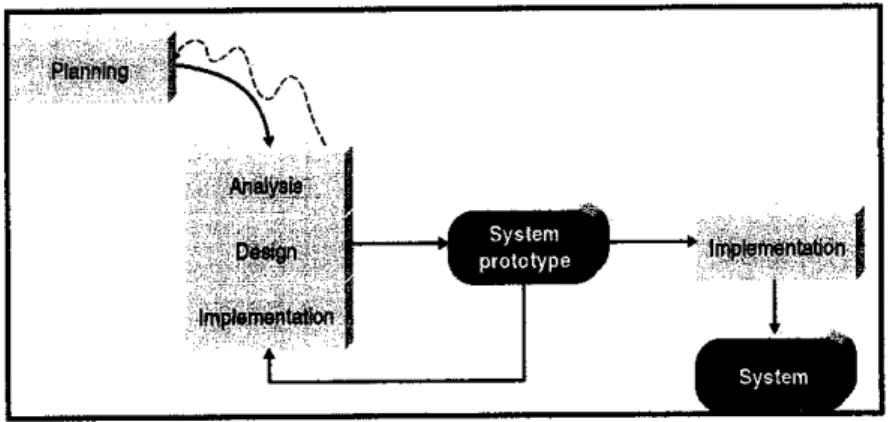
the end users to evaluate and give feedback [15]. Other than that, prototyping has the advantage of being able to follow the end users requirements when creating the system.With that stated, the steps required to build the system by using the prototype methodology has be repeated over and over again until the system meets the end users final requirement. Figure 3.1 shows the prototyping methodology.
This method is also suitable because the phases involved move from sequence to another sequence and it performs analysis, designing, testing and implementing phase concurrently and all these three phases has been repeated until the final system is complete as shown in figure 3.1.
14
Planning
System
prototype "*" linpleftieritatidn
i
Figure 3.1: Prototype Methodology
In the planning phase, all the activities has been planned according to a timeline from
research, interviews, observation to analysis of this information to the development of aprototype to implementation of the system. The tasks and its timeline are recorded in
the Gantt chart which is shown in Figure 3.2 in Appendix A.
The analysis phase follows after the planning phase which gathers and analyses the requirements from the requirement gathering techniques mention in section 3.1 above.
The information andrequirements which are gathered has beenanalyzed andused in the next phase to create the prototype system. This phase will also define the scope and limitation of the system. All the elements of the system and business processes have been identified. After identifying, the analysis phase has put the elements together to make up a modeling method for the system which are:
• Activity Diagram
• Use Case Diagram
• UML Class Diagram
• Sequence Diagram
The next phase is the design phase. In this phase the architecture and user interface has been designed. The user interface has been designedto meet the end users requirements.
The architectural design is the process of designing the database, the server, the connections the platform and identifying the software and tools which has been used in
15
the development ofthe system. A prototype has been created inthis phase. A quick and dirty prototype has been created from the initial minimum user requirement.
Lastly is the implementation phase where the initial prototype has been completed and tested by the end user. The users were encouraged to work with the system to determine how well the prototype meets their needs and suggest and give feedback for improving the prototype. If the prototype system meets the users' needs, the prototype is fully implemented inthe end user environment. But if the prototype system does not meet the user requirements, the prototype is changed, revised and refined according to the user suggestions and feedbacks. After the prototype is revised the process returns to the cycle again from analysis to re-designing the prototype system as shown in Figure 3.1.
3.3 GANTT CHART
Please referto Figure 3.2 in Appendix A to viewthe Ganttchart.
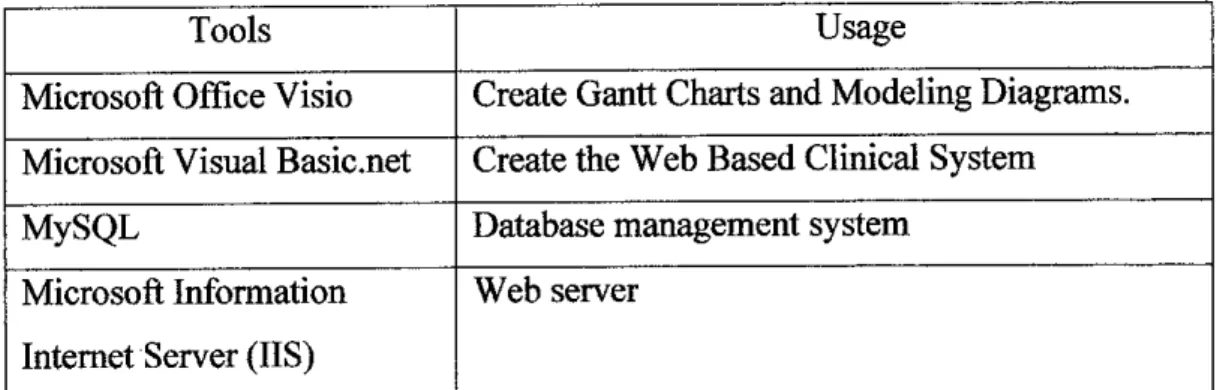
3.4 TOOLS AND SOFTWARE USED
Tools Usage
Microsoft Office Visio Create Gantt Charts and Modeling Diagrams.
Microsoft Visual Basic.net Create the Web Based Clinical System
MySQL Database management system
Microsoft Information Internet Server (IIS)
Web server
Table 3.1: Tools and Software Used
16
CHAPTER 4
RESULTS AND DISCUSSION
4.1 DATA GATHERING & ANALYSIS
This chapter discussed the data gathered and findings ofthe research that has been done for the project. The findings were based on the activities that has been done like the interview sessions, questionnaires and observations from UTP panel clinics around the
vicinity of Perak.
Clinics Observation Questionnaire Interview
Klinik Raghu Klinik Dr. Najiha
Klinik Dr. Zakaria dan Rakan
• V •
Kumpulan Perubatan Ar-
Ridzuan
^ S
Klinik Safri & Hamimah • S •
Perak Medical Centre V */
Poliklinik Permai S S
Poliklinik Dr. Azhar &
Rakan - Rakan
S S
Table 4.1: List of small and medium size UTP panel clinics in Perak
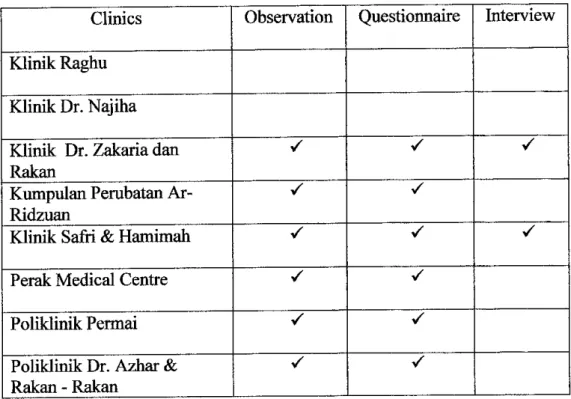
Table 4.1 is an extraction from Table4.2 in Appendix B. Table 4.2 shows the full list of
UTP panel clinics with the size and location of each clinic. Table 4.1 represented an
17
extraction from Table 4.2 of clinics which fell in the scope of this project. Table 4.1 also showed how these clinics responded to the requirement gathering process. The next session was dividedto interviewsessions, questionnaires and lastly observations.
4.1.1 Interview Sessions
Based on the Table 4.1, there were only 2 clinics which I was able to interview which are Klinik Safri & Hamimah and Klinik Dr. Zakaria dan Rakan. The interview questions were attached in Appendix C for reference.
Firstly was the interview session for Klinik Dr. Zakaria dan Rakan. The response received from the doctors and nurses were very good. The doctor was willing to be interviewed. The interview session took an extimate hour to
complete.
The clinics business process were all done manually, there is no computerized
system for any of the business processes. There was however a computer with
internet connection for the doctor's personal usage only. The doctor stated that the reason for not having any automated system is because manual systems are simpler and easier.
The clinics has an average of 30-40 patients on a daily basis. Since there were no automated system in place at this clinics, the patient registration and diagnosis and treatment business process were done manually. The doctor did not agree on implementing an automated system at the clinic but recomended that there is a system to display where the patients file is kept. The doctor also disagreed on an automated system for diagnosis and treatment. He felt that manually writing patients diagnosis and treatments are much easier.
The doctor stated that he did not agree to sharing patients information, he said that it is unprofessional for the a doctor to share the patient's information. Every
18
doctors has their own opinion on this, some may agree while others disagrees.
Most important issue about sharing patients information was the permission of
the patients themselves.
Klinik Safri & Hamimah was where the second interview session took place.
This interview session hade a total opposite answers from the previous clinic.
The interview was conducted with Dr. Safri. This clinic is one of the 5 branches of Klinik Safri & Hamimah. The interview session took 2 hours to complete. Dr.
Safri was very responsive and coorperative for the interview session.
Clinic Safri emphasized on the patient diagnosis and treatment as the most crucial business process because was is a service industry and with this must
have good public relations. Most of their daily business processes were done
manually except the patients registration. The patients registration businessprocess were a semi automated system. The patients IC and name are stored in a computer. The patient's information was stored manually in a file and the
location if this file is saved in the computer. The nurses then retrieved the whereabouts of where patients file was basedon their IC number and name.
There was an internet connection at the clinic in order to cater to ING panel
patients. The clinics had an online system which enabled them to trace patients who were insured medically for example ING. The clinic has about 25-40 patients on a daily basis.
Currently the diagnosis and treatment business process was done manually. The doctor wrote the diagnosis and treatments on a paper and stored the paper for future usage. Dr. Safri however, strongly agreed with the notion of implementing an automated system in his clinics. He strongly agreed because of a few reasons. Firstly was that the hassle of manually writing patients details and information could be dramatically reduced. Another reason is that when a situation where a patient works here and stay another place. So there is no need
19
for telephone calls between the two different doctors regarding patient's previous diagnosis and treatments. The third reason is that the patients don't
need to struggle to explain to the doctor on their diagnosis which most patients are unable to explain. The doctor is just able to retrieve from the system thepatients relevant information, diagnosis etc only with the permission and
approval of the patients.
Dr. Safri added that a follow up system could be done which was similar to a scheduling appointment system. The system notified the nurse or doctor to inform the patients if there were any appointments or necessary check up. This can help to build good rapport with the patients. Patients needed constant reminding on their appointments.
Regarding data sharing between clinics, Dr. Safri had the total opposite opinion from the previous clinic. He strongly agreed on data sharing between clinics but this could only happen with the approval of patients first. He stated there was nothing to hide regarding patient diagnosis and treatment and on that matter any medical information regarding certain patients.
4.1.2 Questionnaires
From Table 4.1, 9 questionnaires were gathered back from the 6 clinics. The data from the questionnaires were tabulated and translated into meaningful graphs. From the data that was gathered 5 out of the 6 clinics have at least 1 automated system in place at their clinics.
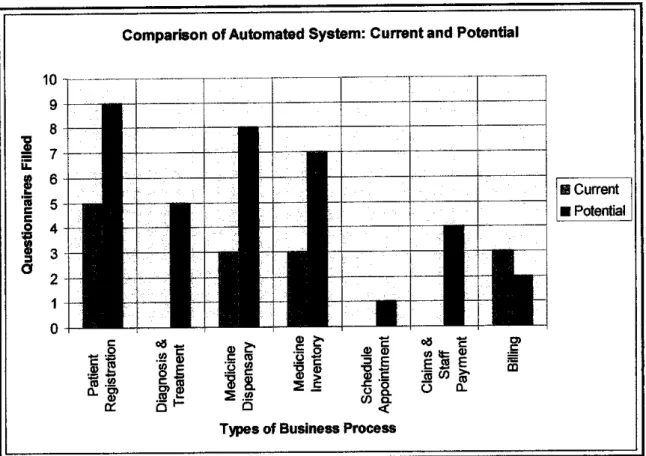
Figure 4.1 shows the comparison of automated systems currently used with potentially implemented and used. There was an increase in the potential number of automated system preferred by doctors and nurses when compared to the current automated system available. The most required automated system that all of the clinics agree is the patient registration system, followed by the
20
*
3
o
medicine dispensary and inventory. The reason was that these systems were
used most regularly on a daily basis. This system could help clinical staffs and doctors register patients more efficiently as well as dispense medicine and keep
track of the medicine inventory. Please refer to Appendix D for the questionnaire.10 9 8 7 6 5 4 3 2 1 0
Comparison of Automated System: Current and Potential
ii
73 .sea. o>
a) cc K
0) fr
C CQ
5 a
-£ o
E
0) §
0) c
jC o
o a
(A S
<
Types of Business Process
o8 •£
EJSE
o CD 0_
c
CQ
S Current
• Potential
Figure 4.1: Comparison of Automated Systems
Regarding the diagnosis and treatment business process, currently there are no automated diagnosis and treatment business process in most of the UTP panel clinics. The doctor records the patient's diagnosis and treatment on papers and kept the records in a file and stored in racks. There is a high increase for the implementation of an automated diagnosis and treatment business process when compared between the currently used and potentially used business processes.
21
There are potentials to implement an automated system for the diagnosis &
treatment business process. An automated system for the diagnosis and
treatment business process has brought about benefits. The benefits are reducedtendency for errors, saved time and space for recording & storing patient
informationand medical records and lastly increased patient convenience.
4.1.3 Observations
This section is about my personal observation when gathering information from the listed UTP panel clinics in Table 4.1. Ail of the clinics had 1 doctor on duty at all times with few nurses assisting. Some of the clinics had a substitute doctor to stand in for them. The data and information about patients are all stored in files. Most of them were organized by IC numbers of their patients. Each clinic had their own way to organize the patient's data. From what I could notice, it tookquite some timeto retrieve the patient dataand information.
4.2 RESULTS AND DISCUSSION
This section refers to the system analysis of the current and proposed web based clinical system. Modeling methods for the system are discussed in this section. The business processes are illustrated in the modeling diagrams which consist of the current and proposed activity diagram, use case diagram, class diagram and sequence diagram of the web based clinical system for UTP panels. Each modeling diagram explicitly provides a graphical representation to model the web based clinical system from analysis through implementation.
4.2.1 Present Activity Diagram
Figure 4.2 shows the present stages of how the business processes are carried out on a daily basis. All of the stages showed above are done manually by the clinical staffs. There are no computerized systems in place to help in simplifying
22
the identified business processes. The only computerized system which was identified in the research phase covers the medicine inventory business process.
There are no computerized systems for the patient registration and diagnosis and treatment business processes in most of the UTP panel climes.
Old Fatten!
CRetrieve Retard
A
Yes
±
Diagnosis )
Patient Registration
1
<>
™,.„„„^>/N^
/Uixlate / CreaiaN
\ New Diagnosis,*
New Patient
±-
/Create New V Record
•ew\
No
Figure 4.2: Activity Diagram for the present Web BasedClinical System
With that being stated the patient's details, symptoms, diagnosis, treatments etc are all recorded and kept in files. This method here posses a difficulty when retrieving details regarding a patient in addition to that it consumes time as well
as storage spaces.
23
Each time a patient comes in the nurses have to search for the patient's file manually among the thousands that have accumulated across the years. The problem of miss labeling and losing the patients details is common for some clinics like finding a needle in a hay stack. After retrieving the patient's details, they are registered before consulting with the doctor. The doctor then views and updates the patient's information regarding their symptoms, diagnosis,
treatments etc if necessary.
An issue arises when a patient's details stored at another clinic. Bear in mind
that the clinics that are being referred to are UTP panels and patients are UTPstaffs. For example if the patient's illness is a continuous condition and the previous diagnosis is vital for the current doctor to know about. The doctor has
to ask the other clinic for this patient's prior particulars. This is quite
troublesome plus not knowing what other problems may arise for instances the
doctors are unable to provide the needed information, the files are misplaced or maybe even unable to contactthe doctors.The doctor then has to base his (her) diagnosis and treatments based on the
patient's explanation of their symptoms, previous diagnosis, treatments and
medicine taken. This may go well if the patient is well aware of his previous information but not many are able to recall this kind of vital information. Some may not know how to explain their symptom properly or even give a goodexplanation about their prior diagnosis, medicine taken etc. This issue here is
being addressedby the proposed system.
The prototype is built to accommodate the clinics to save and retrieve the patients' information easily and effectively. This prototype also includes retrieving the patient's previous medical records from any UTP panel clinics previously visited by the patients from the remote database. This here has eliminated the hassle and pain of paperwork and also saves as well as minimizes the storage spaces for files in clinics.
24
Patient registration are also made simple with the web based clinical system where the patients are now able to just provide their IC number to register and the clinical staffs and doctors will be able to view the patients details. The
patients have to provide their authorization key to the doctor in order to allow
the doctor to view their previous medical records like symptoms, diagnosis andtreatments.
4.2.2 Proposed Activity Diagram
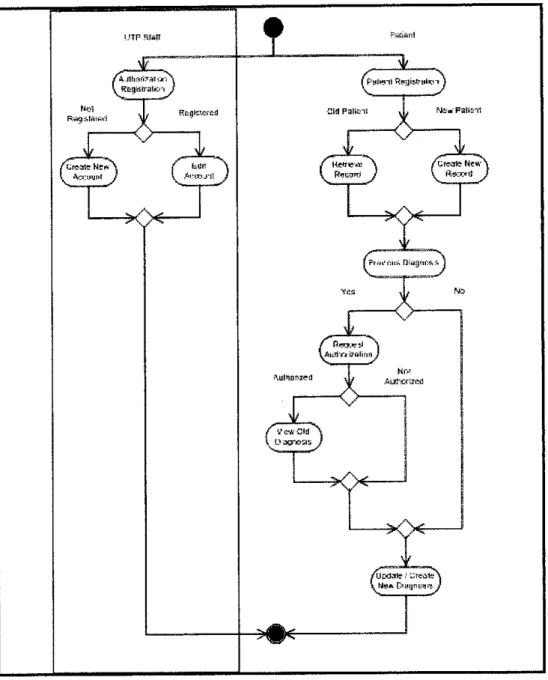
Figure 4.3 gives a picture of the Proposed Web Based Clinical System. The activity diagram is divided into two categories. These two categories are performed by the same user but with different roles which is firstly as an UTP staff and secondly as a patient who is visiting the clinic. The reason being is that, before being able to provide authorization to the doctors who can view their previous medical records, UTP Staffs has to register their authorization account.
This authorization registration is not part of the Web Based Clinical System rather it is part of another system. So with that stated, the authorization registration is the first step that each UTP Staff needs to perform in order to allow the doctors to view their previous medical records from other clinics from
the remote database.
The right side of figure 4.3 represents UTP staffs as patients. Patient registration is the first business process which the patients have to go through when visiting the panel clinics. The patients can either be an old or new patient visiting the clime. If the patient is an UTP staff, the nurses will retrieve the patient's personal details from the remote database (located at UTP) provided that the patient gives their IC number. The patient's personal details like name, address, phone number, email etc will be displayed in the system. Then the nurses will be able to edit this detail if there are any incorrect or outdated information. The retrieved personal details can be saved in the local database at the clinic whether the patient is a new patient or an old patient updating their personal details.
25
1
( P'sltsil RnyisfrHl^T J
Hagnawed
>
Cl-Wne«i:\ /tr«rts HewS
l^.:mj-n^)
^ O
Figure 4.3: Activity Diagram for the proposed Web Based Clinical System
Next after the registration process, the patient will consult with the doctor. The doctor will determine whether the patient's previous medical record is needed or not for the doctor to diagnose and provide treatment to the patient. This decision by the doctor is the representation of the "previous diagnosis" step in the proposed activity diagram in figure 4.3. If the doctor decides that the previous diagnosis is not needed then the doctor proceeds to create new diagnosis which also represents the last step in the activity diagram. In create new diagnosis, the
26
doctor will record the patient's symptoms, diagnosis and treatment into the
system which isthen saved inthe remote and local database for future reference
if needed.
The doctor will request for authorization from the patient to view the patient's
previous medical records which is shown in the activity diagram as "request
authorization". Once authorized by the system (a valid patient authorization) then the doctor will be able to viewthe previous medical records and proceed byeither creating a new medical record for the patient based on the previous
medical records retrieved.
^
Clinic Local Daiatase
Figure 4.3 Patient Information Transfer between
UTP Panel Clinics and UTP
Clitlic retrieve & save information In
daabana
Clink: Systwri
Clinic request & receive patierl infomiaikir Ihmugh Ihe Internet
- Ctcp/ip) *-
L Internet )
UTP retrieve & savii information In
database
UTP Local DatahBse (Main
Database)
Pagel
Figure 4.4: Patient Information Transferbetween UTP Panel Clinics and UTP
Figure 4.4 gives a picture of how the patient's information is transfer over the internet. The users of the system are the clinical staffs and doctors at the clime.
The Web Based Clinical System will store information on both the local and remote database which is situated in UTP. Figure 4.8 in the system architecture gives a better representation of how the client-server architecture is used in the Web Based Clinical System for UTP panels.
27
4.2.3 Use Case Diagram
Patlenl/UTP Stall
0
6
6
Old Patienl
Mow Pa lion I
Web Based Clinical System for UTP Panels
Nurse
Figure 4.5: Use Case Diagram for the proposed Web Based Clinical System
28
Actors Roles
Nurse
1. Patient
Registration
<Uses>: Retrieve patient's records.
<Uses>: Create new patient's records.
<Extend>: Update patient's records.
2. Login Registration
Create new username & password which grant clinical staff access to the system.
Patient
3. Authorization
Registration
Create an account by registeringa username & password.
Grant doctors the access to the patient's previous records.
4. Patient
Authorization
Allow doctors to access the patient's records with the patient's approval only. Patients will provide username
& password. Patients approve the doctor's to view their old diagnosis etc.
5. Patient
Registration
Patient details are recorded. New patients are required to create new records. Old patients' records are retrieved and can be updated.
Doctor
6. Login Registration
Create new username & password. Grant clinical staff access to the system.
7. Check Previous
Diagnosis
<Uses>: Doctors check the patient's previous diagnosis for better understanding of the patient's condition.
<Include>: Doctor updates the patients diagnosis etc from the previous diagnosis. Doctors are able to create new diagnosis etc if there is no relation to the previous
ones.
<Extends>: Doctors are able to view patient's old diagnosis etc with authorization from the patient first.
UTP Human Resource
8. Update Staff
Information
UTP HR updates the staffs personal details. This personal detail is retrieved by clinics when patient registration takes place.
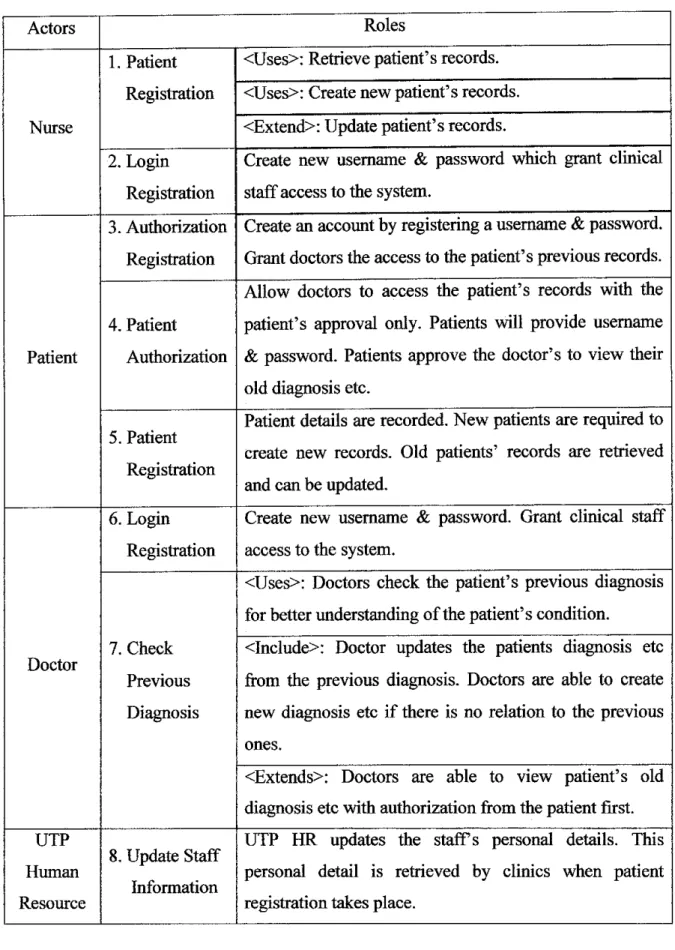
Table 4.3: Roles of Actors for the proposed Web Based Clinical System
29
4.2.4 Class Diagram
Person
♦Name
♦iC/BsrthCert
♦Age
♦Address
*PhonB#
♦AddPersonO
♦DeletePersonO
♦UpdatePerson^)
♦Ratreive Record!)
^ 1
Patient
. Doctor works Clinic
♦"PatJD +Category
♦Dept
♦Doc ID
♦Specialization
♦Name
♦Address
*Phone#
+has 1 -i ' 1
♦Updatelnfo()
m ^ 1 - ' ••
i j —
A
r 1 ♦has
♦UserName
♦Password
♦SecQues
♦SecAns
P:amily Member Login
Diagnosis & Treatment ♦CI^Password +Cli_SecQues
♦RequestAuthorization!)
♦CreateNew()
♦EditAutfit>riZ8lion()
uccupanon
+V1SIIJD +VisitDate
♦VisitTime
♦Symptoms
♦Diagnosis
♦Treatment
♦RequestDetaHsf) tCreats Newt)
♦EditDetailsO
♦View(J
♦Updated
♦CreateNewQ
Figure 4.6: Class Diagram for the proposed Web Based Clinical System
Figure 4.6 represents the Web Based Clinical System class diagram. There are a total of 9 objects in the class diagram. Each object has attributes and methods.
The database in figure 4.6 represents the Clinical System Database situated in
UTP.
Person is the generalization of Patient and Doctor. Person attributes consist of name, IC (birth cert), age, address, phone no and email. There are 4 methods
identified for the Person object which are add, delete and update person and retrieve record. The user can add, delete and update person (patient or doctor)30
details in the Person object. The user can also retrieve the person's record. These
4 methods are inherited by the Patient, Doctor and Family Member objects.There are few attributes which are unique from Patient, Doctor and Family
Member. Patient has patient ID (which is UTP staff ID), category and dept. In addition, Family Member object has relation and occupation attributes.
Meanwhile the Doctor object attributes consists of doctor ID and specialization.
Next is the Authorization object which consist of username, password and secret question attributes. There are 3 methods for the Authorization object which are request authorization, create new and edit authorization. The authorization table is only created in the remote database which stores all UTP staff authorization
details.
The Login object has 3 attributes and 3 methods. Clinic username, clinic password and clinic secret question represent the attributes. Meanwhile the
methods are the same as the Authorization object which consist of request
details, create new and edit details. The Login table is only created in the local
database of every UTP panel clinic whose uses the system.Next is the Clinic object where the clinic details are stored. The attributes consist ofname, address and phone no. besides that there is only one method for this object which is update info method. This method allows the user to add,
delete and update information regarding the user's clinic.
The Diagnosis & Treatment object is a representation of a many-to-many
relationship between Patient and Doctor objects where one or many patients has one or many doctors and via versa. This object has 6 attributes which are visit date, visit time, symptoms, diagnosis, treatment and treatment cost. There are 4 methods belonging to this object which are view, update, and create new. The view method allows user to view the patients record in other words the user will be able to retrieve the patients previous medical record. Next is the update
31
method which allows the user to add on to the previous medical record. Create new on the other hand enables the user to create new records (consist of symptoms, diagnosis and treatment) onthe patients.
4.2.5 Sequence Diagram
77
Patient / UTP Staff
77 TJ
Nurse Doctor
Provide Uaetf*m» & Password I) Lcgln Authorized [Not Authorized] i
.-t + -
Providn UserMame & Password ()
K T -,
K
Chock Pasjent Details Q
LoginAuthorized[NotAuBiorizadl
_1 L.
PaltefllFiagtetration ()
Gel Pslieot Details [)
Bfist |RetfBiveS Updaiel DDnt£xfet[CroatBNeH
T ~ ~ - - - r - T i
•+ h
Hequosl Provluus Diagnosis ()
k
Provklo Authorizatim ()
|6_„.
!«
lAutnorliflilon Registrseoiif) Check Roglalratlon (EditAccount]
f *-•-,
id« Account]
ViewPrevitstaDiagnosis[Update,Cteale New]
Create New Diagnosis (1
Lnain ninnmsisftTr«filn»nt
Figure 4.7: Sequence Diagram for the proposed Web Based Clinical System
Figure 4.7 gives an illustration of how the system interacts between the users
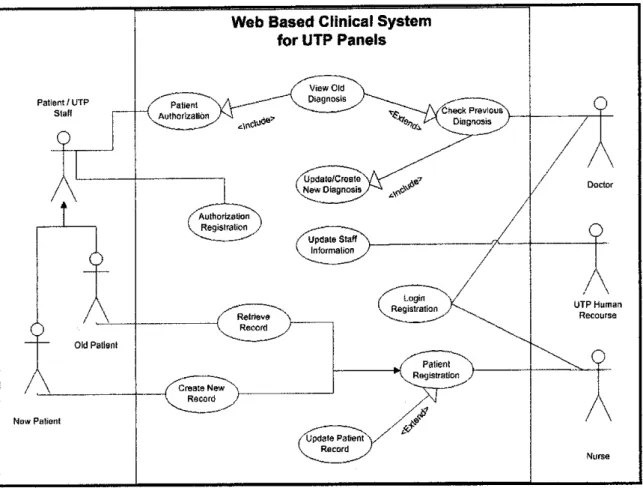
and the database. The actors are representations of users from the use case diagram shown in figure 4.5 and the objects are representations of tables from
the class diagram in figure 4.6.
Firstly the login process which involves the nurse, doctor and the Login table.
The user (clinical staff and doctors) provides the username and password to
32
access the system. If the login is verified then the user is granted access to the system. Ifnot authorized then the user are not given access to the system.
Secondly is the patient registration process which involves patient, nurse and the Patient table. The patient registers with the nurse by providing their IC number and the nurse checks in the system. The system communicates with the Patient table to retrieve the patient's details if there are any. If the patient's details exist
then the details are retrieved and the details can be updated if needed.
Next is the request previous diagnosis process which involves the doctor, patient, the Authorization table and the Diagnosis &Treatment table. The doctor requests to view the patient's previous medical record which requires the patient to provide the doctor with their authorization. Ifauthorized the doctor is able to view the patient's previous medical records and the doctor can either update the previous medical record or the doctor can create new record. Ifthe doctor is not authorized then he can straight away proceed by creating a new medical record
for the patient.
The authorization registration involves the UTP staff and the Authorization table. Before being able to provide the doctors with the authorization, the UTP staff needs to register and create an authorization account. This account will be used when they visit the clinics and the doctor will be able to view the previous
medical record with the correct authorization of the patient.
43 SYSTEM ARCHITECTURE
Figure 4.8 is a conceptual design which defines the structure of the web based clinical system. Client-server architecture is used to represent the structure of the system. The patient's details and information are transferred from the remote database to the clinic over the internet. Similarly, the clinic saves the patients details and information to the
remote and also the local databasethrough the use of the internet.
33
Patients' latest information and medical records are updated to the remote database for
future usage. Clinics also save the patients information and medical records to the local database. The reason is to keep a back up copy of the patient's information and medical records, just in case if the remote database can't be access to due certain error or ifthe patient is no longer an UTP staff. The patient's information and medical records can
still be access through the local database.
LOCAL SITE
(CLINIC A)
Patients information transaction
Clinic updates information in REMOTE DB
REMOTE SITE
(UTP)
Figure 4.8: Web Based Clinical System Client-Server Architecture
A database is created at the clinic's location which is labeled the local database in figure 4.8. This database is created for each UTP panel clinics which means every panelhas an identical local database. More clinics can be added to the network without any major