The Agricultural Modernization of the Socialist Republic of Vietnam, 1945 - 1996
A lecture series held at the Asian Center, University of the Philippines-Diliman, Quezon City on February 5-14, 2001. Organized by Prof. Milagros R. Espinas with the assistance of Asian Studies 252 Class, sponsored by the Southeast Asian Studies Regional Exchange Program (SEASREP, Manila Secretariat).
Bui Tat Thang
I. The Collectivized Agriculture in Vietnam Before the Reform (Doi moi)
An Overview on the Role and Features of Vietnam's Agriculture
The Natural Conditions
Vietnam is located in the Indochinese Peninsula, sharing inland borders with China, Laos and Cambodia. The terrain gradually descends from the North to the South, from the West to the East, traversed by numerous but short rivers and springs.
The North and South regions have differing climate. The North has four clearly differentiated seasons: spring, summer, autumn and winter, while the South l:.as two: wet and dry seasons. There are usually droughts during the dry season and floods during the wet season. Vietnam also suffers from many heavy storms that cause severe damages to life and property.
Like other Southeast Asian countries, Vietnam is a monsoon country with hot, humid and rainy climate favorable to the development of plants and animals. Vietnam also has many diversified animal and botanical resources.
These natural conditions have created both advantages and disadvantages for the development of a modern agriculture.
The Economic Features
In 1999, Vietnam has a population of 7 6 milhon people. The country occupies an area of 331,690 square km. The population density is about 210 people per square km. (equivalent to that of the Philippines and double the number ofthat in Thailand). However, the area of cultivated land per capita is the lowest in the world.
The area of cultivated land accounts for only 21% of the territorial area and the
92 Thang
average area of cultivated land per capita is about 0.14 ha. In the Red River Delta, the average area of cultivated land per capita is only 0.06 ha.
Up to now, agriculture still attracts nearly 80% of the population and over 70%
of the labor force. Agriculture annually brings about 30% of GDP ( 40% from 1985 to 1990 and 26% from 1997 to 1998). Cultivation has a major role in agriculture: in 1990 it accounted for 75% and in 1998 it accounted for 80% ofthe agricultural output value. Rice growing is traditional and it controls nearly the whole agricultural production.
Because 3/4 of the natural area is hilly and mountainous, rice production mainly concentrates in two major regions, namely:
a) The Mekong River Delta which accounts for 48% of the rice growing land and 53% of the rice output of the whole country, including 16 million people, who comprise 21% of the national population; and
b) The Red River Delta which accounts for 15% of the rice growing land and 19% of the rice output of the whole country
Therefore, the two major rice regions account for more than 60% of the rice growing land and more than 70% of the rice output.
The Cultural and Social Features
Vietnam's history is closely connected to the anti-aggression wars (1,000 years ofNorthem colonization, nearly 100 years under French colonization and, in modem times, the war of resistance to the United States). Rice growing, flood control and resisting natural disasters also created the traditions of the Vietnamese. Strongly influenced by Confucianism, Vietnam is one of the countries practising a Confucian civilization. The Vietnamese people are industrious, with a sense of solidarity, nationalism and of community and village.
The Establishment of Collective Agriculture in Vietnam
Vietnam's Agriculture under French Colonization
In 1858, French troops started attacking Son Tra Peninsula (in Danang province) in their invasion of Vietnam. In 1884, after the Patenot Agreement was signed, Vietnam officially became a French colony. Colonization lasted until Vietnam gained its independence on September 2, 1 Q45. Hence, Vietnam was under French colonial domination for nearly a century.
The Agricultural Modernization of the Socialist Republic of Vietnam 93
Vietnam's economy during this period was developed with the influence of Western civilization. The development focused on the following:
Improvement of the traffic system including roadway, railway, waterway and some marine ports;
Development of industry including the mining of coal and .tin, and the building of thermo-electricity plants and industrial consumer product plants;
Expansion of plantation for coffee and rubber in the Southeastern part of the South and Tay Nguyen (Central highland); and
Importation and development of the Western capitalist macket economic relations
How~ver, the size of the abovementioned economic units was very small.
Basically, Vietnam's economy under French colonization was poor and based on backward agriculture. More than 90% of the population were farmers, making life mainly by growing rice. The poverty and the lack of development in agriculture was reflected in the following aspects:
• Cultivation techniques: Cultivation was done on non-irrigated land. The source of water for cultivation relied on flowing streams and raining water.
The local strain of rice had low yield and fertilizer was rarely used. The average yield of rice was only more than 1 ton per ha. annually.
• Social relations: In agriculture, feudal relations still existed. Hence, Vietnam had a semi-feudal colonist society. The landowner class accounted for 2%
of the population, but possessed 52% of the total land. Farmers accounted for over 90% of the population, but they owned only 36% of the total land.
Fifty-nine percent of the farmer households were landless.
Distribution relations: The rent was very high. Fifty percent of the total output of agricultural products went to annual rental. Food output per capita was low and tended to decrease in the early years of the century. In 1890, it was 3 31 kg. per capita per year; in 1913, it was only 314 kg; in the South in 1937, it dropped to 272 kg., while in the North it was 211 kg. But in the 50 years from 1890 to 1939, the French ¥Xported 57.8 million tons of rice from Indochina, most of which came from Vietnam. That means, on an average, 1 million tons were exported per year, and in 1937, the highest amount of 1. 72 million tons were exported. It was also the year that the food output per capita dropped to 272 kg. as earlier mentioned.
The rice export in Indochina in general, and in Vietnam, in particular, was not a result ofhigh agricultural intensive-farming, but was a result of extreme
94 Thang
exploitation. The farmers' lives. were very poor.
Living standard: Farmers suffered from hunger. From 1905 to 1945, in the Red River Delta, the dike was broken 16 times. Ninety-five percent of the population remained illiterate. The average life expectancy was less than 20 years old.
From 1940 to 1945, during World War II, Vietnam also suffered from the Japanese fascist occupation. Throughout that time, Japan took 3.5 million tons of food. The exploitation and crop losses led to a terrible famine in 1945. More than 2 million people in the Red River Delta died of hunger (equal to 20% of the then population in the North).
Thus, Vietnam's agriculture during the time of French colonization was very backward, exploitation was at its worst, so the farmers were very poor. In comparison with other colonies in Asia, like Taiwan or Korea, the development level ofVietnamese agriculture was much lower.
The Period of Economic Recovery and Land Reform
Historical background
After the Democratic Republic ofVietnam (now known as the Socialist Republic ofVietnam) was established on the 2nd of September 1945, French troops re-occupied the South. In December 1946, the war expanded to the whole country and lasted for 9 years, until the victory ofthe Dien Bien Phu campaign in 1954.
During this period, Vietnam had a wartime economy. In 1954, accot:ding to the Geneva Agreement on Indochina, Vietnam was divided into two regions-the North and the South-with different political mechanisms and bordered by the 17th Parallel.
While the South remamed capitalist, the North embraced socialism. Since then, the North implemented socialism's collectivized agriculture. This will be discussed at length later on. The South continued on a wartime economy until 1975.
Land Reform
Land reform was especially outstanding in the industrial and agricultural State s economic policies with the view to build a new economy. Land reform also had great meaning in society: it meant abolishing the feudal ruling mechanism in the rural areas, bringing about land to farmers.
During the war of resistance agamst the French (before land reform was carried out), the government followed this guideline: "Carrying out a war of resistance and
The Agricultural Modernization ofthe Socialist f?.epublic of Vietnam 95
building the country at the same time," with the ann or providing essential needs for the war of resistance. Agriculture as food supplier had an especially important meaning. The most important policy for agriculture at this time was the Government's Decree, which was issued in July 1949 and was about reducing rent, reducing income tax and clearing debts for farmers. The Decree stipulated the following:
Reducing 25% of the land rent that farmers had to pay in comparison to the pre-revolution period (in August 1945)~
• Eliminating debts that farmers incurred during the pre-revolution period;
Reducing the interest rate to 18% of the loan in cash; 20% of the loan in rice. (Before the revolution, the interest rate was very high, usually 100%, even 150%);
Applying a new tax policy for the harvested rice output. Farmers had to pay 6-10% of the total rice output, middle-Class farmers had to pay 15- 20%, and landowners had to pay 30- 50%; and
Giving a part of public land to farmers for cultivation.
The rent-reducing policy was good news to the farmers. On the one hand, they were more willing to work. On the other hand, they believed in the revolution and were more willing to join the war of resistance. They understood that the revolution brought about benefits of its own. This was one of the important reasons for the victory of the nine-year war of resistance against the French.
As the war of resistance against the French reached the final stage, land reform began. In November 1953, the Vietnam Communist Party Central Committee reached a decision on land reform. A month after, the National Assembly approved the Law on Land Reform and oh 19th December 195 3, Ho Chi Minh signed a decree issuing the Law on Land Reform and land reform officially started. First, land reform was carried out experimentally in 53 communes in the three provinces of Thai Nguyen, Bac Giang and Thanh Hoa. The experiment on land reform ended in 1954 when the war of resistance against the French succeeded and Vietnam was temporarily divided into North and South regions. The North started to build socialism by first trying to recover the economy that was damaged by the:war. Hence, the period from 1955 to 1957 was called the postwar economic recovery period. During the war, 140~000
ha. of land were not cultivated, water systems were damaged, hundreds of thousands of cattles were killed, and hundreds of thousands of people in the Red River Delta emigrated to the South. The'life of the people was disrupted.
During the economic recovery period, land reform was carried out in large scale, starting in February 1955 and ending in the middle of 1958. A total of81 0,000
96 Thang
ha. ofland were confiscated from landowners and redeemed to allocate to 2,101, 13 8 farmer households, including 8,323,636 people, equal to 72.8% of the total farmer households. The land reform experiment also took away 1,846,000 farming tools, 106,448 cattles and 14,565 houses from the landowners. The landowner class was abolished; land and farming tools were given to farmers. With land reform, the landlords became the laborers, who earned money by working and no longer by exploiting other laborers. Almost all of the former landlords had the ordinary farmers as their neighbors and farmers had land to cultivate. Hence, the land reform in the North of Vietnam was considered the most thorough land reform. There was an tmprecede.1ted great change in the history of Vietnam's rural areas.
However, mistakes could not be avoided during the implementation of land reform, causing very serious damages to society. For instance, the same rate was charged to landowners regardless of the size of land owned. Therefore, in many cases, in poor villages, people owning a small area of land were recognized as landowners. And in the war of resistance against the French, many patnotic landowners who provided financial contributions to the war were treated like other landowners. This mistake was discovered and corrected at the right time by the Party and the government.
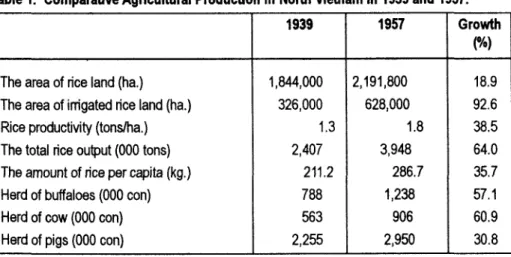
Despite the mistakes, generally, the mission of land reform was completed, specifically, the giving land to farmers. The farmers' greatest dream of owning land came true. Land reform became a strong motivation that encouraged farmers to produce willingly. The concrete result of agricultural production in the North in 1957 (the year ending the economic recovery period) was compared with the agricultural production in 1939 (the most developed year of the French colonization) and this can be seen in Table 1.
Table 1. Comparative Agricultural Production in North Vietnam in 1939 and 1957.
1939 1957 Growth
('/o)
The area of rice land {ha.) 1,844,000 2,191,800 18.9
The area of inigated rice land {ha.) 326,000 628,000 92.6
Rice productivity {tons/ha.) 1.3 1.8 38.5
The total rice output {000 tons) 2,407 3,948 64.0
The amount of rice per capita {kg.) 211.2 286.7 35.7
Herd of buffaloes {000 con) 788 1,238 57.1
Herd of cow {000 con) 563 906 60.9
Herd of pigs {000 con) 2,255 2,950 30.8
The Agricultural Modernization of the Socialist Republic of Vietnam 97
Hence, after 3 years, the North completed the task of recovery in its postwar agricultural economy.
The Agricultural Collectivization in North Vietnam
The concept then was: in order to build socialism, it is necessary to carry out three revolutions at the same time:
The revolution of science and technology, with the view to build an advanced production force;
The revolution of production relations: eliminating private ownership and building the public ownership mechanism; and
The revolution of ideology and culture
The agriculture cooperative is one· of the main components of the production relations revolution, with the view to build the socialist economy. Regarding ideology, the concept then was that private ownership means capitalism and public ownership (public and collective ownership) means socialism. The socialist economy must be an economy based on the mechanism of public ownership. Hence, building socialism in the North meant carrying out agricultural collectivization. But the problem is why the revolution of production relations in agriculture focused mainly on building cooperatives rather than state farms.
The concept then of production relations revolution was this: On the one hand, as the landowner class was abolished, land was allocated to farmers, and "the sea of petty farmers" was created. More than two million farmer households who were allocated land in the land reform program became more than two million small size independent production units. Although they had land and a new motivation for the development of production. the development was not equal. A part of them became rich and exploited other people. Another part became poor and had to sell their land and to work as laborers. Therefore, according to V.L Lenin (1967), the small commodity production of petty farmers created the capitalism every hour and every day. Production cannot liberate the farmers from the situation of poverty and oppressiOn.
On the basis of this concept, The 14th Meeting of Central Committee of Communist Party (The 2"d tenure, 1958) confirmed that "the main task of the North is to promote the socialist revolution, the immediate task is to speed up the socialist reform of the farmers' private economic sector."
On the other hand, in order to build the great socialist production, agriculture
98 Thang
must be the base for the industry's development. Hence, agriculture must be re- organized to yield high productivity. That means the revolution must be carried out in agricultural production. The revolution is aimed at building large-sized agricultural production, starting from the reform of small-sized private agriculture.
Because the farmer class is different from the worker class, the farmers cannot be dispossessed of land in the same way as the landowner and capitalist classes.
Teaching farmers to turn from the private ownership mechanism to the public ownership mechanism must involve following the voluntary principle and must be suitable to the people's knowledge. Therefore, the mechanism of cooperatives meets this requirement. The mechanism of cooperatives is a form of public ownership but lower than the form of state ownership. Hence, V.I. Lenin said, "The collective cultivation is like the transitional step from the small agriculture to the great collective agriculture."
Based on the experiment of cooperatives, from the end of 195 8, the cooperative movement was expanded in a large scale with 4,800 cooperatives and, after only two years, in 1960, it was basically finalized. In 1960, 41,000 cooperatives were built, including 2.4 million farmer-households, accounting for 85.8% of the total households and 76% of the land in the North. Most of the newly-built cooperatives were the low-level cooperatives. Land and production materials were mainly owned by farmers. They contributed their land and production materials and shared their work. When the products were distributed, the share of the land was distributed as 25% of the total products. The rest was distributed according to the share of work.
With this type of distribution, farmers could easily go back to the individual production.
Therefore, since 1961, the Party and the State were moving in the direction of getting these cooperatives from the low level to the high level. The movements in management and cultivation technique Improvement in cooperatives were motivated.
The content of the improvement included the following:
• Land was publicly owned by the cooperative and private ownership was abolished;
• The size of the cooperatives was expanded from dozens ha. to hundreds ha.
of tillable land per cooperative;
• Advanced cultivating techniques were applied. New strams were applied to cultivation and animal husbandry, the water system was built, improved tools and machines were used, electrification was carried out and chemical fertilizer was used;
• The management of labor, plan and accountancy was improved~ and
The Agricultural Modernization of the Sotia/ist Republic of Vietnam 99
Distribution according to work was carried out.
During the late 1960s and early 1970s, the cooperative fann basically covered rural areas in the North with 95% of the fanner-households and more than 90% of the tillable land. Most cooperatives were changed into high-level cooperatives. The number of high-level cooperatives used to be 84.6%, but in 1975, it increased to 94.4%. The small number oflow-level cooperatives existed in some mountainous areas.
Hence, before the liberalization of the South and national unification in 1975, agriculture in the North was collectivized. The central and close management of the cooperative enabled the government to mobilize the labor force, with the view to assist the frontline and to stabilize the rear base. Therefore, in the historical context of the war, the cooperative had positive socioeconomic effects. However, the agriculture then was not able to provide enough food for society's demand. The State had to annually import (or to get aid and loans for) hundreds of thousand tons of food to compensate for the deficiency. The people's food demand was satisfied at a minimum level.
The Agricultural Collectivization in the Whole Country after 1975
After the South's liberation and subsequent national unification, the agricultural collectivization model in the North was expanded to cover the whole country. From September 1975 (or five months after the South's liberation), the 24th Meeting of the Central Committee of the Communist Party (the 3rd tenure) started the task of reforming the production relationship and building of the public ownership mechanism in the South. The implementing method was basically similar to that applied in land reform and the previous cooperative movement in the North. Hence, the cooperative movement was rapidly implemented.
In 1979, around 1,023 cooperatives were built in the Central provinces. In Central Highland provinces, 164 cooperatives and 2, 180 producing groups were established, accounting for 70o/o- 90% of the fanner households. Therefore, in these two regions, the agricultural collectivization process was basically finalized.
In the South, the situation was different. In 1979, only 271 cooperatives and 12,437 producing groups were built, including 491,364 households (equal to 31%
of the total fanner households) or 453,400 ha. of land (equal to 24% of the total tillable land). So, at the end of 1970, the model of cooperatives mostly covered the whole agricultural sector in the South, in particular, and in the whole country, in general.
100 Thang
However, the agricultural collectivization in the South took place in a different context from that of the North 15 years ago. Previously, the differences in the collectivization process were curbed due to the war. In the economic reconstruction in time of peace, these differences were clearly shown. In fact, the agricultural collectivization process was not smooth. Farmers in many areas strongly opposed the policies of the cooperative movement. They cut industry crops, and sold or damaged machines. Moreover, the opposition tended to expand and this started a stagnant period that led to an agricultural crisis.
The State-owned Sector in Agriculture
Apart from building cooperatives, the State also established some state-owned farms, mainly in the mountainous areas, growing industry crops like pineapple, tea, rubber, pepper, sugarcane, orange and cattle feed. In 1975, in the North,.there were 115 state-owned farms, including 103,700 ha. of agricultural land, with 92,000 laborers growing 23,900 ha. of industry crops. Annually, 2.6% of the total value of agricultural output were produced. In the early years of the 1990s, throughout the whole country, there were 475 farms and 400 farms experimenting with agricultural crops, including 1.6 million ha. of land for cultivation. Annually, about 5% ofthe total value of agricultural output were produced. The state-owned farms were mainly established in two ways: (1) taking over old plantations; and (2) moving a military unit to construct the economy, so that there were some farms controlled by the military.
The government generally invested more on the state-owned farms than on the agricultural cooperatives. Some main industry crops were produced by the state- owned farms. For example, in the 1980s, the state-owned farms planted 210,000 ha. of land to rubber (equal to 99% of the rubber area in the whole country), producing 98% oflatex rubber products; 40,000 ha. ofland to coffee (45% of the coffee area) producing 20,000 tons of coffee beans per year (equal to 17% of the output); and 21,000 ha. of land to tea (equal to 35% of the tea area), producing over 50,000 tons of fresh tea leaves (equal to 44% of the tea output).
There were many contributions in terms of agricultural output, but for many reasons, including social and security reasons, and mainly because of the centrally- planned red-tape mechanism, most farms suffered losses. The system of farms also faced great challenges in the development process.
The Agricultural Modernization ofthe Socialist Republic of Vietnam 101 The Crisis of Underproduction in the Collectivized
Agriculture in Vietnam
As mentioned earlier, the construction of the collectivized agriculture was carried out in the North since the early years of the 1960s. But for over a decade after and until 1975, the cooperatives existed and developed in the context of war and they accomplished the rare task of stabilizing the agricultural base and supporting the frontline.
However, since the national unification, the expansion of the cooperative model in the North was carried out rapidly but immediately it showed weaknesses. These weaknesses were seen in the cooperative movement in the North in the early years of the 1960s. But due to the war, these were hidden because the objective of the resistance war became much more vital than the problem of the economy. In time of peace, the economy became the key problem. From 1975 to 1980, as the eollectivization model of the North was expanded to cover the whole country, collectivized agriculture went into recession and crisis. The increased level of recession and crisis was directly proportional to the expansion of the cooperative model.
As mentioned earlier, until 1979 the cooperative mechanism covered the whole country (excluding the Mekong River Delta). But since that year, the crisis involving the cooperative model started. After some years, the cooperatives tumbled. In the South, the rapid collectivization elicited strong opposition from farmers. They left the land and stopped doing farm work. The area of tillable land in 1980 was down to 24,500 ha. as compared to 1978. Food output was down to 41,000 tons. At the end of 1980, there were only 137 cooperatives and 3, 739 producing groups in the South. Many cooperatives only existed nominally.
In the North, after nearly 20 yea.s of the cooperative mechanism, 15 years of which were times of war, from 1976 to 1979, the agricultural economy started to decline. Farmers were not willing to work, and they even left the land. The crisis in agriculture really started.
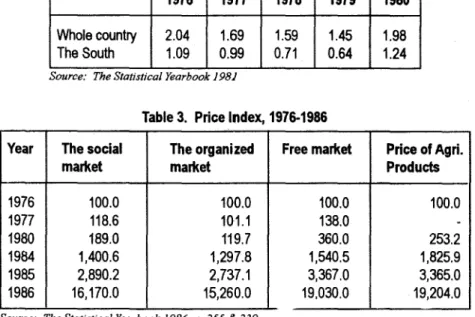
From 1975 to 1980, the area ofland for cultivation, the rice output and the rice productivity mostly did not increase, but even decreased in some years. Meanwhile, the population increased rapidly (the postwar population boom), so food per capita was really low. (See Figure 1 and Case Study 1 ), Annually; the State nad to import a great amount of food to meet the people's demand (see Tables 2-3). Annually, over 1 million tons of food were imported (about 0.2 milbon tons of rice and 1 rnillion tons of flour and wheat).
102 Thang
Figure 1. Rice per person (kg/person) in the North, 1960-1981
300
242
250 222 226 217 22S
319 211
178 179 178
1SO
1.00
511
0
Source: The Statistical Yearbook 1985
Table 2. Distribution of Food, 1976-1980 (million ton) 1976 1977 1978 1979 1980 Whole country 2.04 1.69 1.59 1.45 1.98 The South 1.09 0.99 0.71 0.64 1.24
Source: The Stat1st1cal Yearbook 1981
Table 3. Price Index, 1976-1986
Year The social The organized Free market Price of Agri.
market market Products
1976 100.0 100.0 100.0 100.0
1977 118.6 101.1 138.0
-
1980 189.0 119.7 360.0 253.2
1984 1,400.6 1,297.8 1,540.5 1,825.9
1985 2,890.2 2,737.1 3,367.0 3,365.0
1986 16,170.0 15,260.0 19,030.0 19,204.0
Source: The Statistical Yearbook 1986; p. 255 & 239
The reasons for the recession and crisis in agriculture, and the decline of cooperatives include the following:
1. Cooperatives· were established too rapidly, breaking the "voluntary"
principle. The "voluntary" principle of the voluntary was considered the most important principle of the cooperative formation. In the hope of energizing the cooperative movement and rapidly bringing it to completion,
The Agricultural Modernization of the ,",'ocialist Republic of Vietnam 103
considerttd as the objective of the socialist economic construction, compelling measures were taken in the implemention process. Hence, in terms of psychology, farmers opposed this way of doing things.
2. The low-level cooperatives were rapidly elevated to the high level, thereby seriously breaking the principle of suitability, which was an important principle of the cooperative formation. It has been shown that with handicraft-producing tools and low management capacity, the village-sized cooperative was too great and not suitable. With this size, farmers were unable to see that their output was directly related to their daily work.
Hence, the effect of economic benefits to work was not brought into full play.
3. In the long term, farmer opposition would occur. Though land reform brought land to them, they were put into the cooperatives, so, the farmers felt that their gains from the revolution were being taken away. While their economic life was improved due to land ownership, they had to contribute to the cooperatives_ thus their motivation for economic benefits was not maintained.
4. In the industrialization process, agriculture was regarded as the base for industrial development. There was a disparity between the price of agricultural products (the State set a low price) and the price of industrial products (the State set a high price) in order to support industry. Though the State invested in agriculture, the proportion was much smaller than what the State invested in industry. Agriculture is supposedly a capital- mobilizing resource for industry, but with the high-level cooperatives farmers were not encouraged to produce because they felt they suffered a· loss.
5. The condition of interminable food shortage was a problem that the State solved through the policy of food self-supply. Besides this, there were policies on trade isolation and trade restriction. As a result, as agricultural products were produced, farmers did not know what to do with them. Hence, motivation was dampened again by the centrally-planned mechanism.
6. In cooperative management, cooperative members had the right to decide what to produce, ·how many and where to sell. In fact, the collective ownership was not different from state ownership. The State controlled the cooperatives through administration methods. That means assigning what to produce, and how many, and what products should be sold to the State at the price fixed by the State. Farmers did not have the right to produce and sell their products freely.
7. Finally, the quantitative distribution mechanism of cooperatives failed to encourage farmers to work willingly. This is the most important reason
104 Thang
because it negated the production motivation. Whether cooperatives produced much or little, the rest that was distributed to farmers was only a minimum. The State collected products according to the amount of products produced. This distribution mechanism did not encourage farmers to try to produce more. There is a proverb that states, "Without working and without paying is much better than working without paying." The prominent English classic economist Adam Smith quoted this proverb in the book The Wealth of Nations published in 1776.
In conclusion, from a poor and backward beginning, Vietnam's agriculture moved to a nev. development stage through the land reform. After that, the cooperative model with collective ownership replaced private ownership. In the cooperative mechanism, Vietnam's agriculture changed and developed much more than in the previous time but generally, agriculture did not produce enough food. Annually, hundred thousand tons of food had to be imported. The cooperative system under the centrally-planned mechanism negated the production motivation, leading to the stagnation and crisis at the end of the 197 Os and the early 1980s. In that context, the reform in the economy, in general, and in agricultural production, in particular, had started.
( 'ase Study 1
Vu Thang Agriculture Cooperative
The Vu Thang Agncultun.: Cooperative in Kien Xuong district Thai Binh province was one of som~.: typ1cally advanced cooperatives in the Red River Delta in the North before the doi 111111 process. At that time, the cooperative's manager was a National Assembly delegate.
In the 1980s, Vu Thang was a village-sized cooperative, with 287 ha. of cultivable land, 971 households and 3,812 people, of whom there were l,4l4laborers. Hence, an individual in Vu Thang owned only 696 square meters and 5 people per 1 ha. of tillable land. Like other cooperatives in the Red River Delta then, Vu Thang Cooperative mainly grew rice and raised pigs. Besides this, there were some handicraft jobs.
Establishing the Cooperative
In the begitming, the establishment of the cooperative faced a lot of difficulties and the size had to be changed many times. Because of unstable organization, the
The Agricultural Modernization of the .Socialist Republic of Vietnam 105
production could not develop, and many farmer households withdrew from the cooperative. In early 1964, about 40% ofthe households left the cooperative.
At that time, the Vietnam Communist Party's Central Committee had campaigned for the consolidation of cooperatives. Vu Thang implemented the combination of four small cooperatives (with the size of a hamlet) into one village-sized cooperative.
Then, the production was organized according to the centrally-planned mechanism.
The cooperative implemented the following:
Building water system after the implementation of the village-sized cooperative. This involved reliance on communal labor on the basis ofland communal. ownership, the cooperative carried out the building of irrigation and drainage systems. In 1965, each laborer did 127 cubic meters of irrigation work. During a period of 13 years (from 1964 to 1977), 43 km.
of ditch for irrigation and drainage was built, totaling 1.2 million cubic meters, with each laborer digging 65 cubic meters annually.
Increasing the amount of organic fertilizers (because of the shortage of chemical fertilizers). The cooperative asked each laborer to sell 3. 6 tons of cattle manure to the cooperative annually. The households with 2 laborers had to sell 6.4 tons, while 3 laborers had to sell 9 tons.
• Applying new strains to grow. In 1965, the area grown with new strains accounted for only 2. 7%. In 1966, new strains accounted for 12%, for 61%
in 1969, and for 100% after 1970. Before introducing new strains on a large scale, the cooperative conducted experiments using 1.8 ha. to test new strains.
Hence, the cooperative followed the right direction of traditional rice cultivation.
The Vietnamese proverb, "The first thing is water, the second is fertilizer, the third is labor and the fourth is strain" refers to essential requirements of rice cultivation.
In terms of animal husbandry, the cooperative organized a communal pig-raising fann apart from animal husbandry in individual households.
Production Output
Rice Output
Rice output per one ha. of cultivable land increased. This increase was mainly due to the water system, helping the cooperative to harvest 2 crops per year in the whole area of rice growing land.
Rice output per 1 ha. of cultivable land annually was up from 2.0 tons in 1964
106 Thang
to 5.1 tons in 1965, 8.2 tons in 1970 and 9.6 tons in 1974. Since 1975, Vu Thang has gained 10 tons per ha. annually, as the leading cooperative in the North.
Pig Raising
As food from rice production increased, food from animal husbandry also improved. The State mobilized to consider husbandry a key industry. Responding to this movement, Vu Thang became one of the many cooperatives that strongly developed husbandry as an industry. Consequently, the value of husbandry output increased from 1.5% ofthe total output value ofthe cooperative in 1965 to 7.3% in 1966, 16.6% in 1971 and 20.4% in 1971. Meat output from 1959 to 1964 was only 12 kg. per ha. but in 1965, it went up to 17 kg. in 1970, it was 96 kg. in 1974,363 kg; and in 1977, 3 72 kg.
Labor Structure
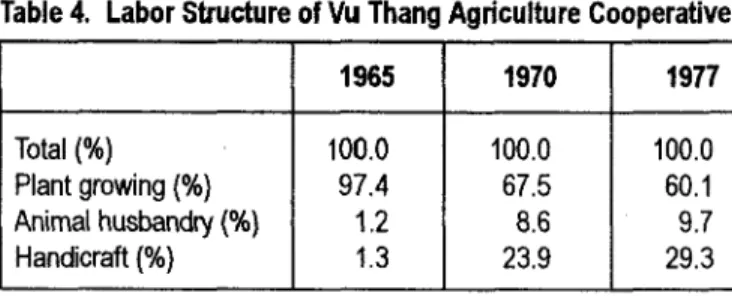
The labor structure within the cooperative as presented in Table 4, changed with the labor decrease in rice growing. Meanwhile, labor in animal husbandry and handicraft increased.
Table 4. Labor Structure of Vu Thang Agriculture Cooperative
1965 1970 1977
Total(%) 100.0 100.0 100.0
Plant growing(%) 97.4 67.5 60.1
Animal husbandty (%) 1.2 8.6 9.7
Handicraft(%) 1.3 23.9 29.3
Distribution Mechanism and the Cooperative Members' Life
Basically, the living standard of cooperative members depends on the total annual output, the population growth rate and the taxes paid to the State. Let us consider each factor.
Population growth rate: Because of the mrrow land and numerous people, like other cooperatives in the Red River Delta, Vu Thang implemented two ways to control the population growth rate. The first way was to limit the natural population growth rate. In 1965, the natural population growth rate was 3. 0%, but in 1977, it dropped to 1. 7%. This means that after 13 years, the natural population growth rate decreased by 1.3%. The second way
The Agricultural Modernization of the Socialist Republic of Vietnam 107
was to send people to build new economic areas in other provinces. From 1965 to 1977, 1,490 people were sent to build new economic areas in Dai Tu, Dinh Hoa (Bac Thai) and Kien Giang (in the South).
The result was that in 1977, the population was down by 110 people when compared with 1965.
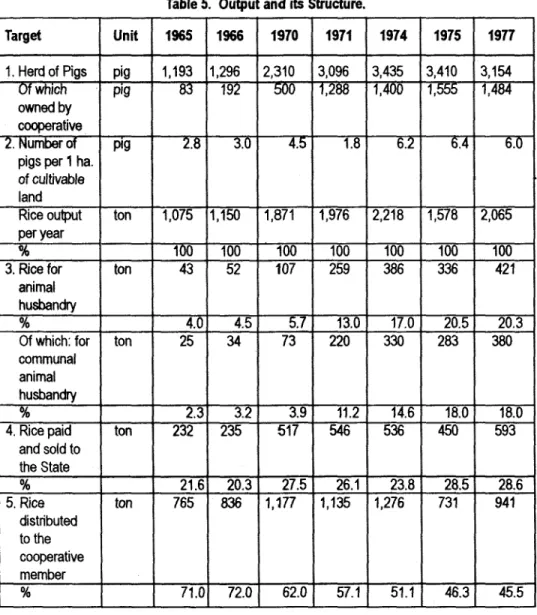
Rice output and distribution structure of rice output are given in Table 5.
Table 5 shows that rice for animal husbandry and rice paid to the State accounted for an increasingly high proportion; from 197 5 to 1977, it accounted for more than
Table 5. Output and its Structure.
Target Unit 1965 1966 1970 1971 1974 1975 1977
1. Herd of Pigs pig 1,193 1,296 2,310 3,096 3,435 3,410 3,154
Of which prg 83 192 500 1,288 1,400 1,555 1,484
owned by cooperative
2. Number of ptg 2.8 3.0 4.::> 1.8 6.2 6.4 6.0
pigs per 1 ha.
of cultivable land
Rice output ton 1,075 1,150 1,871 1,976 2,218 1,578 2,065 per year
% 100 100 100 100 100 100 100
3. Rice for ton 43 52 107 259 386 336 421
animal husbandry
% 4.0 4.5 5.7 13.0 17.0 20.5 20.3
Of which: for ton 25 34 73 220 330 283 380
communal animal husbandry
% 2.3 3.2 3.9 11.2 14.6 18.0 18.0
4. Rice paid ton 232 235 517 546 536 450 593
and sold to the State
% 21.6 20.3 27.5 26.1 23.8 28.5 28.6
5. Rice ton 765 836 1,177 1,135 1,276 731 941
distributed to the cooperative member
% 71.0 72.0 62.0 57.1 51.1 46.3 45.5
1os
Thangone half of the rice output of the cooperative. Hence, though population decreased, an average food per capita could not increase continuously and still stayed at a low level. The average monthly rice per.capita in 1974 was 26 kg. in 1975 it was 16 kg.
and in.l977 it was 20 kg.
In the distribution mechanism of the cooperative, the grade A laborers were distributed with 30 kg. of rice per month, the grade B had 27 kg. per month, while the laborers aged 13 to 15 were distributed with 18 kg. per month and those aged 10 to 12 were distributed with 15 kg. per month. Meanwhile, social welfare was expanded. For example, children had three meals in kindergarten without paying money, they could also have free medical examination and treatment at healthcare centers, while old homeless people were taken cared of.
The distribution mechanism of the cooperative.also saw to it that the rice left after paying to the State and spending for animal husbandry was dist1 i~uted. The amount of rice paid to the State changed every year and accounted for an increasingly high proportion, However, The amount of rice gained by farmers did not increase in a directly proportional way to the amount oflabor in the year. From 1959 to 1964, an average number of working days per one laborer per year was only 180, in 1970 it was 332 and in 1977 it was 346.
The quantitative distribution mechanism shows that it is clearly egalitarian, and thus failed to encourage laborers. Clearly, the organization of the cooperative in the direction of compulsory labor and egalitarian distribution warned of the danger of the inability to develop for a long time and of the crisis of cooperative mechanism.
Case Study 2
Oinh Gong Agriculture Cooperative
The Dinh Cong Cooperative in Thieu Yen district, Thanh Hoa province, is an agriculture cooperative that is generally· regarded as typically advanced, with. the size of a village covering 396 ha. of cultivable land, 882 households, 3,930 people and 1 ,266laborers. The average area of cultivable land per capita of the cooperative is 93Q square meters. The average area of other cooperatives in the district, in particular, and in the Red River Delta, in general, is about 900 square meters, with 3. 4 laborers per one ha. of cultivable land.
Establishing the Cooperative
The cooverative was established in .1959, and at first it included three hamlet-
The Agricultural Modernization of the Socialist Republic of Vietnam 109 sized cooperatives. The initial technical facility was still in poor condition. Only one crop was harvested in the cultivated land. Life was very difficult. The average food per capita per month was only 9 kg of rice. Every year, the State had to provide 20 tons of rice to Dinh Cong for hunger relief. During the off-season, 50- 60% of the total labor force of the cooperative went to other areas to find jobs.
In 1970, three hamlet-sized cooperatives were combined into a single village- sized cooperative. After the merger, the cooperative mobilized 40,000 working days for the construction of water system. Consequently, the rice output was 5.06 tons per ha. in that year, 1. 8 times higher than in 1969. An average food output per capita increased from 160 kg. in 1969 to 360 kg. in 1970. Meanwhile, 290 tons of rice was paid to the State.
The cooperative also encouraged animal husbandry, producing organic fertilizer for rice growing. In 1978, 16 tons of organic fertilizer was applied to one ha. of growing land, four times more, in comparison with the amount in 1969. In 1974, the_ number of pigs raised by the cooperative was 1,000, doubling the number in 1970, and in 1978, the number was 1,200. The amount of gross pork sold to the State was 30.5 tons in 1974, trebling the number in 1970; in 1978, it was 32 tons, 3.1 times higher than in 1970.
The use of new strains was implemented in 1973. Hence, the average rice output increased 8% per year in the 1970s. This is high level compared with the output in the Red River Delta.
The Support from the State
Unlike other cooperatives, the establishment of the Dinh Cong cooperative was linked to the support from the higher level, directly from the district level and the provincial level, in order to develop cooperative movement especially in the period from 1976 to 1978.
The huge material and financial support from the State was aimed at setting up the Dinh Cong cooperative as an advanced model, as shown in two major resources.
First, the state provided cheap input resource from the district for the cooperative's production. However, the resource was limited. This priority was basically a favorable factor, in comparison with the other cooperatives, because the State had monopoly to provide input resource. For instance, from 1976 to 1978, each ha. of cultivated land was provided by the State with the following :
1. Nitrogenous fertilizer: 400 kg. (3 .5 times higher than the average level of the district)~
110 Thang
2. The amount of phosphate and potassium fertilizer was 5 times higher than the average level of the district;
3. Oil for water pump: 1, 120 tons per year (accounting for 50% of the total oil and petrol resource of the district);
4. On the average, one ha. of cultivating land got 450 dong of loan from the State (2.5 times higher than the average level of the district).
Second, the state subsidized the financial resource of the cooperative in two ways: 440,000 dong (non-refundable) was given directly to the cooperative for 3 years, from 1976 to 1978. Of this amount, 53% was for production investment and 4 7% was for social and cultural work. The subsidy was eight times higher than the average level ofthe whole district. The other support resource was indirectly given via "orders" with low cost input and the State also guaranteed the purchase of output at a favorable price, thus enabling the cooperative to freely sell its products in the market.
However, it is noted that the economic efficiency gained did not correspond to the higher investment. For example, though the amount of nitrogenous fertilizer sold to the cooperative by the State in 1978 was up 110% compared with 1975, the commercial rice output was up by only 33%. In 1978, on the average, the State collected one ton of rice from Dinh Cong and provided 370 kg. of nitrogenous fertilizer, 440 kg. of phosphate fertilizer, 63 kg. of potassium fertilizer and 70 kg. of machine oil. In comparison with 197 5, these amounts were two to three times higher.
Therefore, Dinh Cong became a model for advanced cooperatives, relying mainly on support from the State. Hence, this is also one of the important reasons why the multiplication of the typically advanced models did not extend to .the whole agricultural sector.
II. The Process of Reform in the Agricultural Policy:
Performance and Reasons
Reform (Doi moi) in Agriculture:
The Beginning of Economic Reform in Vietnam
Starting from the "Bottom-Up"
We learned that the nature ofthe agricultural crisis at the end ofthe 1970s and the early 1980s was the crisis of the cooperative mechanism. The agricultural
The Agricultural Modernization of the Socialist Republic of Vietnam I l l
production organization in cooperatives was not suitable to the real situation and it failed to encourage production. Hence, the way out of the situation had to be found.
The situation required another approach, which was absolutely new.
At the end of 1979, in the Doan Xa cooperative in Kien Thuy district, now known as Do Son district (Hai Phong province), managers and cooperative members agreed to quietly carry out a new management method: contracting prqducts. Actually, this method was not new in the market economy, but in the condition of the centrally- planned mechanism, it was not accepted. In that context, if the upper level knew what was going on, the cooperative members would be in trouble. Hence they had to quietly "do unauthorizedly." Now this activity is called "crossing the barriers" of the grassroots level. One of the most remarkable characteristics of economic reform in Vietnam is that it was carried out from the bottom going up. Enjoyably, the phenomenon of crossing the barriers and unauthorized implementation in Vietnam's agriculture accidentally coincided with the reform (also from the agriculture of China).
In 1978, in a village of Phong Duong district, An Huy province (in China), people also "crossed the barriers," contracting out products in the same way. It is noted here that Vietnam's cooperative model is similar to that of the Chinese. Perhaps in the same environment, the same way and the same level, the solution is also the same.
The way to "contract out products" is simply this: Previously, a cooperative managed the whole agricutural production process, and it controlled and assigned work for each person. Now, a cooperative assigns some work for farmers, but the cooperative only manages some work. Land is still a common property of the cooperative. Basically, the rice production process includes preparing the soil, cultivating it, caring for it and harvesting. Firstly, the cooperative still takes on the work of selecting rice strains, preparing the soil, and doing the irrigation. The caring and harvesting work is contracted out to farmers. However, in order to take care of rice plants, the cooperative still takes on the work of supplying water (ensuring the agricultural irrigation system), fertilizer and insecticide. After harvesting, farmers have to hand in their products to the cooperative at the agreed amount, and they then distribute the products according to the contracted amount. When the amount of the products is more than the contracted amount, fanriers get the excess amount.
In contrast, when the contracted amount is not reached, farmers have to rriake up the balance. Naturally, the farmers have to first agree that the contracted amount is not so low that it affects the rice amount that the cooperative has to hand in to the State; and that the contracted amount is not so high that farmers cannot meet it. The result is unexpected. Farmers not only hand in enough amount of rice to the State but they also get a larger amount than before. When farmers everywhere leave the
112 Thang
land, or work half-heartedly and the production result is low, the farmers in Doan Xa village (Kien Thuy district, now known as Do Son district, HaiPhong province) have another image. The farmers are willing to work and, thanks to the contraction system, their life has considerably improved.
The " Upper Level" Agreement
During the crisis at the end of the 1970s, in August 1979, the Vietnam Communist Party Central Committee had its 6th Meeting (the 4th tenure) and stated the direction
The Agricultural Modernization of the .S'ocialist Republic of Vietnam 113
of ''releasing" business production. The nature of releasing was to ease the close regulations of the centrally-planned mechanism by first considering the low purchasing price fixing system of agricultural products from farmers. The meeting also mentioned the combination of three interests, and emphasized the interest of laborers.
On the occasion of the "easing" direction, HaiPhong City reported to the Central about the ''experiment" of product contract and drew out experiences from this system. After a short time, in January 1981, VCP Central Secratariat issued Instruction No. 100 CTffW on implementing the contracting work and "contracting out products to labor groups and laborers" in agricultural cooperatives, which was called ''product contract" for short. With this instruction, the product contraction system was applied to the whole country in the field of agricultural production.
This is the most important starting stage of the whole reform process.
Hence it can be commented preliminarily as follows:
l. The reform in agriculture was the starting point of Vietnam's economic reform;
2. The starting point of the doi moi process was to "ease" the hard regulations of the centrally planned mechanism. Arranging the orders of interests, and emphasizing the material interests oflaborers, encouraged farmers to work willingly;
3. The acceptance of the market price (the rice purchasing price) shows that the State's price fixing is not appropriate. Accepting the market price is also accepting the market's role in fixing price, and this is also the start of the transition process to the market economy in Vietnam;
4. One of the typically important characteristics of the doi moi process in Vietnam is that it was carried out from the bottom-up. The "fence passmg' of cooperatives was the starting point. Then, this process was accepted by the Central and the State issued reform policies according to this direction.
114 Thang
Some Important Milestones of the Reform in Agricultural Policies
The following comprise some important milestones of the reform in agricultural policies:
Instruction No. 100 CTITW (in January 1981) of Vietnam Communist Party Central Secratariat
While cooperatives, management and distribution systems were totally maintained, Instruction No. 100 CT/TW of Vietnam Communist Party Central Secratariat on improving the contracting system and expanding "the product contract to labor group and laborers" in agricultural cooperatives ("product contract") decentralized the production management and assigned farmers to decide some work and to move to the free market. Therefore, the product contracting was an amendment of the former management system. In comparison with the former management system, product contracting was more useful for farmers.
The Instruction confirmed that "the major direction to improve the product contraction in agricultural cooperatives is: much encouraging laborers' legitimate interests and making people who joined some work in the management and production process of the cooperatives become fond of the final products."
In the contracting system, a cooperative gave a certain area of land to a labor group and laborers do three steps: cultivating, caring, harvesting~ and then handing in the harvested products to the cooperative (product contract). The amount of products was usually the average amount of the three nearest years. Therefore, "the product contract was a form of production management and paying wage, directly linking laborers' responsibilities and interests with the final products."
This Instruction also aimed at stopping the situation that "leaders forbid, workers do unauthorizedly."
Instruction No. 100 CT/TW also forbade the situation of "total contraction"
(assigning farmers to take on the whole production process). "It is not allowed to assign land to cooperative members for self-willed use, to assign land to individual cooperative members to take on from the step of ploughing fields to harvesting."
In the context of the cooperatives in the centrally-olanned mechanism, Instruction No. 100 CT /TW was really a big change, creating new motivation for the recovery of agricultural production.
The (Jfh Congress of Vietnam's Communist Party (December 1986)
This was the Congress marking the most important change in the doi moi process
The Agricultural Modernization of the Socialist Republic of Vietnam 115 because it was comprehensive and thorough.
The Congress started to break off the centrally-planned mechanism and officially started economic reform, moving to the market economy in Vietnam. The important or landmark directions ofthe reform were:
1. Recognizing Vietnam's economy as a multi-sector economy, including private ownership. This is completely different from the centrally planned- economy;
2. Recognizing Vietnam's commodity economy means to recognize the market mechanism;
3. Recognizing Vietnam's economy as an open economy;
4. Deciding to concentrate priorities in the fields of producing export goods, consumption goods and food. Three great economic programs stated in the 5111 Congress (March 1982) have been realized.
The renovation framework of the 6th Congress has opened room for a series of reforms in the following years. During the years from 1986 to 1990, the objective was to produce food. This was to meet the food demand of the whole society and to have a reserve of food. In 1990, 22-23 million tons of food (in rice) was targetted for production, with an average of about 20-20.5 million tons to produce annually, an increase of 3-3 .5 million tons as compared to the average amount per year during the period from 1980 to 1985. However, actual production reached 21.5 million tons of food of which 19.2 to 19.7 million tons of rice, on the average, were produced from 1986 to 1990, a volume lower than the stated plan.
Other objectives of the 6th Congress include: To carry out a policy system encouraging food production; to finalize the final product contraction system to labor group and laborers; to ensure essential material together with stabilizing the appropriate contraction amount, creating favorable conditions for producers to get contraction and to invest with the view to overweigh the contracted amount~ to grant agricultural tax exemption for a certain period to encourage farmers to increase crops and to expand the area of cultivated land. The Congress also stated that besides tax obligation, the economic relations between the State and cooperatives must be carried out through selling and purchasing contracts undertaken by the State's business organizations according to the principle of equality and at par.
Apart from contracts being ensured, it is necessary to sell and buy accordmg to the officially agreed price.
Therefore, besides renovation steps according to the market direction, the 6th Congress still considered the cooperative an agricultural economic unit in rural areas.
116 Thang
Resolution No.1 0- NQITW dated 51h April 1988 of the Politburo of Vietnam Communist Party Central Committee on Reforming the Agricultural Economic Management.
Regarding agricultural production, Resolution No.1 0 of the Politburo was the most important and decisive landmark of the agricultural economic management reform. With this Resolution, Vietnam's agriculture moved from that of a food importer to a rice exporter.
Unlike Instruction No.lOO CTffW (1981) ofthe Vietnam Communist Party's Central Secretariat, Resolution No.I 0 NQffW ( 1988) of the Politburo provides a policy on the comprehensive agricultural economic management reform rather than the reform of contraction in agricultural cooperatives. Actually, this is a step of concretizing the reform policies of the 6th Congress (1986) in agriculture. The basic advantage of Resolution No.I 0 NQffW IS the common framework of the economic reform stated by the 6th Congress. The field of agriculture is realistic in applying the contraction system since 1981. Especially, the reality of agricultural development shows the weaknesses of the product contraction policy in accordance with Instruction No. 100 CT/ TW.
One of the greatest weaknesses of Instruction No.100 CTffW was that as it was applied to reality, the contracted output which farmers had to hand-in was not stable. Moreover, the contracted amount usually tended to increase overtime. Usually, the Vietnam Communist Party's Central Committee demanded that the rice target must be handed-in to the provincial level. In order to ensure production, higher targets were set for the provinces, for the districts, for the communes, for the production groups, and for cooperative members. Therefore, the contracted amount usually tended to be higher year after year. Finally, farmers had to suffer, all because they could not reach the target by themselves. The high contracted amount led to the farmer's walk-out from their land in 1987-1988. They did not want to cultivate anymore, not even to harvest. The situation where farmers owed the cooperatives or did not have enough rice to hand-in happened in many areas.
In that context, Resolution No. 10 NQ/TW on reforming the agricultural management was timely in bringing about a new growth motivation for Vietnam's farmers and agriculture.
Based on the reassessment of the agricultural development situation after Instruction No.IOO CT/TW, Resolution No.IO NQ/TW on the agricultural management reform stated new requirements as follows:
I. Moving the self- sufficient agriculture to commodity agriculture;
2. Correctly solving the relationships in terms of interests, especially ensuring
The Agricultural Modernization ofthe Socialist Republic of Vietnam 117
the legitimate interests of producers;
3. Expanding democracy and giving prominence to the law; and 4. Reforming, in terms of organization and officers.
Therefore, this Resolution emphasized the development of market mechanisms and re-arranged the order of interests. Previously, the order of priorities was: the social interest- collective interest- individual interest. Now the order was reversed, with the individual interests of laborers on top of the list.
In order to meet the abovementioned requirements, some methods were applied in production organization.
Reforming the State-Owned Farms
By moving the state economic units in agriculture to the self-controlled mechanism, self- supporting business, self-responsibility for loss and profit, it meant abolishing the state subsidy for these units. The Resolution clearly shows that at the end of 1989, a unit which could not evolve would be disbanded or moved to another appropriate ownership. After readjusting the size, the old area of land had to be returned to the local authority in order to be given to another cooperative, household or individual. It was forbidden to extort the cultivated land of farmers to establish the state-owned farms. Hence, the state-owned farms were not subsidized and did not have the privilege of belonging to the state.
Reforming Agricultural Cooperatives
The Resolution clearly defined cooperatives and producing groups:
1. As the voluntary economic organization of farmers;
2. As operating according to the principle of self-control, and self-responsible for production efficiency; and
3. As having legal status, equal before the law with other economic units.
Therefore, "apart from the task of paying tax, the trade relationship between cooperatives, producing groups and the state economic organizations is an equal relationship that satisfies both buyers and sellers."
Defining the position of cooperatives was important because, previously, the principle of voluntary and democracy was violated. Because the State wanted t~
rapidly construct cooperatives in large sizes, the State had taken many compelling measures. Coop~ratives and farmers had to accept the downward management.
118 Thang
In terms of the contracting system and the income distribution system in cooperatives, the Resolution aimed at pursuing the following:
1. To continue implementing the product contracting system to the group of households and farmers' households. In cultivation, the contracting system was basically given to households or cooperative members' households.
Hence, this is the first time that the household has been considered a basic economic unit of the agricultural economy in rural areas;
2. To readjust the area of contracted land and to ensure that the contractors can cultivate in an appropriate and suitable area for 15 years, the.contracted amount is stable for 5 years. The contracted time is stable and longer;
3. It is not necessary to assign farmers to do three steps (cultivating, caring and harvesting), but maybe much more. The farmer household is ensured to get more than 40% of the contracted output. Management regulation is eased;
4. To carry out the distribution principle according to the work and contribution of cooperative members and to overcome the egalitarianism and subsidy situation. Previously, the distribution in cooperatives was carried out only according to the work, disregarding other elements, such as capital; and 5. To encourage the state servants and cooperative members to improve the
household economy.
The Private Economy in Agriculture
l. The State recognized the long-term existence and positive effects of the private economy; acknowledged the legal status, ensured the equal right in interests and obligations in laws of the private economic units. All false ideas about the private economy were abolished.
2. If private households changed wasteland into cultivated land, they have the right to use the land for 15-20 years and are given the right to use it continuously until the next generation.
3. Private households and private companies have the right to employ according to the requirement of production development and the labor law of the State.
4. Excluding the products which must pay tax, private households have the right to sell their products freely in any area where they can get profits.
In conclusion, Resolution No. 10 NQ!fW basically defined the new principles of the agricultural economic management, thus it considers the farmer household as
The Agricultural Modernization of the Socialist Republic of Vietnam 119 a local economic unit of agriculture~ the farmers have the right to do business and produce: and besides the task of paying tax, the type of relationship between farmers and the State and other economic organizations is the market relationship. Therefore, Resolution No. 10 NQ/TW had liberalized all ties for farmers and encouraged them to produce. Consequently, after one year ( 1989), Vietnam became a rice exporter.
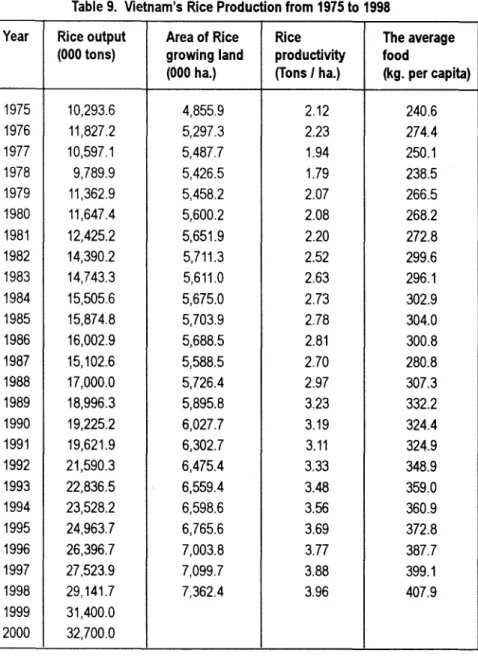
The rice output in 198 8 increased by two million tons (equal to 13% ), as compared to 1987. In 1989, the rice output was up by nearly two million tons (equal to 12%), as compared to 1988, when the average food per capita increased by 9.3%, as compared to 1987: in 1989, it increased by 8%, as compared to 1988. Vietnam exported 1. 4 million tons of rice for the first time in 198 9. This was higher than the previous average annual imported amount.
Laws Related to Land
The Doi moi process from 1986 is the period when the State strengthened management by laws, firstly through the promulgation of laws. Regarding the doi moi process in agricultural policies, the promulgation of laws related to land, in general. and to agricultural land, in particular, is very meaningful and completely regarded as an important landmark in the doi moi process. There are important laws related to the use of agricultural land.
The Law on Land
The Law on Land was first approved by the National Assembly of the Socialist Republic of Vietnam in July 1993. The Law stipulates that land is a very precious national natural resource. Clause 1 of the Law on Land stipulates that: "Land belongs to the people's ownership controlled by the State." The State allocates land to organizations, households and individuals, to use stably in the long term. The State also leases the land to organizations, households and individuals.
Clause 3 stipulates the right of land users. "Households, individuals who are allocated land have the right to assign, to transfer, to lease, to inherit and to mortgage the land use right." With five rights, the land use right is now more liberal than before. However, there is not the right of (private) ownership. This is really a very important point in the policies on land management, in general, and on agricultural land, in particular.
Clause 44 specifies that: "The annual growing land limit of each household is not over 3 ha."
Before its implementation, the Law on Land was amended once and expanded, with the view to concretize and to facilitate implementation in December 1998.
120 Thang
The Law on Tax for Agricultural Land Use
The Law on Tax for Agricultural Land Use was also approved by the National Assembly at the same time as the Law on Land (in July 1993), with the view to use agricultural land effectively, and to ensure the equality in the contribution of land users into the State's budget.
The law stipulates that all organizations and individuals that use land in agricultural production have to pay tax on agricultural land use. Households who are given the land use right, but do not use land, still have to pay agricultural land tax.
The basis of calculating tax for agricultural land use includes:
1. Area (small and large sizes);
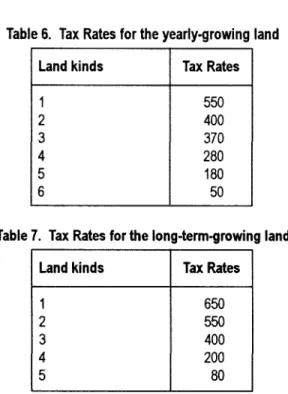
2. Kinds of land (6 kinds broadly distinguished into good or bad); and 3. The tax rate is fixed by kg. of rice per one unit of area of each land kind.
Clause 9 of the Tax for Agricultural Land Use tabulates the one year tax rates according to kg. of rice per ha. of each land kind as shown in Tables 6 and 7.
Table 6. Tax Rates for the yearly-growing land
Land kinds Tax Rates
1 550
2 400
3 370
4 280
5 180
6 50
Table 7. Tax Rates for the long-term-growing land
Land kinds Tax Rates
1 650
2 550
3 400
4 200
5 80
Clause 17 specifies that the tax on agricultural land use must be calculated in rice, and paid in cash. The price of rice for tax purposes is regulated by the Provincial