Alternative Sweetener Among the Faculty and Staff of the College of Agriculture at Benguet State University. Benguet State University, La Trinidad, Bernguet.
Adviser: Andrew K. Del-ong, BS
ABSTRACT
This study was conducted at Benguet State University La Trinidad, Benguet from January 2010 to February 2011 to determine the awareness, factors and considerations and level of level acceptability of stevia powder among the respondents. There were 60 respondents of the study who were coffee drinkers of the faculty and staff of the College of Agriculture.
The study revealed that some of the respondents have no idea on what stevia is, however;
upon learning on the nutritional value most of respondents are willing to buy and prefer stevia than artificial sweeteners.
The respondents are health conscious individual who prioritized the health value of the sweetener they are using, however many respondents’ acceptance on stevia is affected by their perception and they are only willing to buy if stevia powder is available in the market.
Stevia powder is a healthy sweetener that must be promoted well specially for the diabetic and over weight individual and for those who have problems on their blood sugar. Stevia is a healthy option for sweetener to coffee that has a point of promotion as to sweetness, aroma, taste, appearance, and color so, other further studies must be conducted to widen the scope of respondents and to meet the target market outside Benguet State University.
INTRODUCTION
Rationale
Around the world, many people consume sugar on a daily basis which is not good for their health. Some people use regular sugar, artificial sweeteners, sugar supplements and many other forms of sugar. Some of these may be good for them and some may not, because excessive consumption of sugar is linked to obesity and tooth decay. Eating sugar also triggers the body’s insulin response and leaves you feeling tired, sluggish, and craving for more that leads to high incidence in diabetes. Many believe that most cases of diabetes are inherited, that if a person is predisposed, the disease would emerge sooner or later depending on the person’s health and lifestyle.
The Geneva-based World Health Organization (WHO) reported that diabetes which is a serious disease is becoming increasingly common, especially in developing countries. In recent years, diabetes is fast emerging as "the epidemic of our time." Data show that around 120 to 140 million people suffer from diabetes worldwide, and that this number may well double by the year 2025.
By 2025, most people with diabetes will be in the aged 65 years or more. In developing countries most will be in the aged 45 to 65 years range meaning, they will be affected in their most productive years, WHO deplores. In Southern Asia, diabetes is considered as one of the top 10 causes of death. In the Philippines, diabetes claims at least 5,000 lives each year. The DOH (Department of Health) reported that diabetes mortality rate has increased by 92% over a 10-year period. Unknowingly, many Filipinos who are afflicted with diabetes do not know the early signs of the disease and even don't know if they have the disease already. "Many of the patients die because it is already too
late to remedy the situations,” many doctors say. This disease has no cure. What doctors can do is just control the onset a little later because the disease is more manageable among older people.
Most of us have heard the good advice that we need to eat less sugar. However,
despite the numerous warnings by health authorities of the ill effects of sugar, the majority of the population is still consuming sugar on a daily basis in some form or another. Sugar is both a broad category and a misleading one. Let's examine it for our health's sake. We do not have to consume white, refined sugar to be consuming sugar.
Sugar includes glucose, fructose (as in fruit sugar), lactose (as in milk), sucrose (as in table sugar), maltose or malts (as in rice malt and honey), jam (contains concentrated juice, which is high in fruit sugar), maple syrup, corn syrup, palm sugar (traditionally used in macrobiotic cooking), and the very deceiving organic brown sugar, which is not all that different from white sugar. Even alcohol is a sugar. All of these sugars are problematic in many different ways. Sugar is a major culprit in the case against obesity.
Consuming even a teaspoon of sugar a day would cause metabolic imbalances that contribute to obesity. Sugar is to be avoided, not only by the obese but by healthy individuals as well (Anonymous, 2010).
The wonderful thing is that we do not have to give up the sweetness of sugar in order to be healthy; we just need to replace it with better alternatives. While giving up sugar is very difficult, replacing it is now very easy. There are two natural, organic sugar alternatives that are sweet, easy to use and cook with – stevia and xylitol. They may sound like chemicals but they are completely natural and have been proven not only safe but beneficial for our well-being.
The best one to use is Stevia (Stevia rebaudiana) from the Asteraceae family, which was rediscovered by Dr. Bertoni in 1888. Stevia is a herb that has been used as a sweetener in South America for hundreds of years. It is calorie-free, which means it has no effect on our bodies' production of insulin. Stevia, in its powdered concentrate, is 300 times sweeter than sugar, so only tiny amounts are needed for sweetening. It is widely used all over the world. In Japan, for example, it claims 41% of the sweetener market, including sugar, and was used in Japanese Diet Coke until the company replaced it with aspartame (Skae, 2008).
The sweetening property of stevia is ideal to satisfy the needs of sweetening food and to control the daily sugar intake for those suffering problems related to metabolic disorders like diabetes and for problems of sugar consumption either for intolerance or high weight problems.
Dieters and health conscious individuals are resorting to the power of herbal medicines rather than going for expensive treatments of today’s modern medicine.
Through observation, many people are becoming aware about their health and prefer to lead a natural way of living, while others are just victims of self – neglect that is too common these days.
Statement of the Problem
This study will try to seek answers to the following:
1. What is the awareness of stevia powder among the faculty and staff of the College of Agriculture at Benguet State University?
2. What are the factors and considerations that would influence them to accept stevia powder as a sugar substitute in coffee?
3. What is the level of acceptability of stevia powder as a sweetener in their coffee through sensory evaluation?
Objectives of the Study
This study will mainly attempt to do the following:
1. Determine the awareness of stevia powder among the faculty and staff of the College of Agriculture at Benguet State University.
2. Identify the factors and considerations that would influence them to accept stevia powder as a substitute coffee sweetener.
3. To determine their level of acceptability of stevia powder as a sweetener in coffee through sensory evaluation.
Importance of the Study
Popularizing the consumption of stevia powder as a substitute sweetener especially in coffee among the faculty and staff of the College of Agriculture at Benguet State University (BSU) is a great opportunity. Since BSU is identified as a center in Organic Agriculture, it must lead the way not only in the production of organic crops but also in the actual consumption or patronization of organically grown and produced commodities as well as items made from them. And this should rightly start within the College of Agriculture, the University’s flagship college.
The high incidence of obesity which usually results or triggers more serious illnesses like diabetes is usually attributed to unhealthy diet and physical inactivity. Sugar is really the culprit in the case against obesity. We cannot deny the fact that we use and eat foods rich in sugar as a part of our daily living so, the study is concerned on
promoting the advantages of using the herb stevia to our human health and how could we consider it as a good diet than using artificial sweetener and refined sugar especially to our coffee. We should really avoid taking high calories, fats and sugar that could be deposited in our body leading us in killing ourselves softly.
Since coffee is one of the most important partners of most peoples’ meal as well as a major routine in their daily activity, popularizing the use of stevia powder as an alternative coffee sweetener would mean that they would continue enjoying sipping coffee without necessarily sacrificing their health from the ill-effects of sugars.
Scope and Limitations of the Study
This study included both the teaching and non-teaching personnel of the College of Agriculture at Benguet State University. The researcher would have wanted to include all the 74 personnel of the said college, unfortunately some of them don’t drink coffee and others are either on leave or were on official business trip. Respondents who served as the evaluators of the coffee drinks that were sweetened with three different sweeteners were limited to those who were drinking coffee.
Due to financial constraints on the part of the researcher, only the white and brown cane sugars (refined sugars) were used as the coffee sweeteners that were compared with stevia powder.
.
REVIEW OF LITERATURE
Historical Background of Stevia
The Guarani Indians had known for centuries about the unique advantages of kaa he-he (a native term which translates as "sweet herb"). These native people knew the leaves of the wild stevia shrub (a perennial indigenous to the Amambay Mountain region) to have a sweetening power unlike anything else; they commonly used the leaves to enhance the taste of bitter mate (a tea-like beverage) and medicinal potions, or simply chewed them for their sweet taste. The widespread native use of stevia was chronicled by the Spaniards in historical documents preserved in the Paraguayan National Archives in Asuncion. Historians noted that indigenous peoples had been sweetening herbal teas with stevia leaves "since ancient times."
Bertoni (1905), the director of the College of Agriculture in Asuncion, the first who learned "this very strange plant" from Indian guides while exploring Paraguay's eastern forests in 1887. It was 12 years before he was presented with tangible evidence -- a packet of stevia fragments and broken leaves received from a friend who had gotten them from the mate plantations in the northeast. He subsequently announced his discovery of the "new species" in a botanical journal published in Asuncion. Bertoni named the "new" variety of the Stevia genus in honor of a Paraguayan chemist named Rebaudi who subsequently became the first to extract the plant's sweet constituent. A fragment of the leaf only a few square millimeters in size suffices to keep the mouth sweet for an hour, a few small leaves is sufficient to sweeten a strong cup of coffee or tea."It wasn't until 1903, however, that Bertoni discovered the live plant, a gift from the parish priest of Villa San to make a complete study” -- the publication of which appeared
in December, 1905. What he found was enough to convince him that "the sweetening power of kaa he-e is so superior to sugar that there is no need to wait for the results of analyses and cultures to affirm its economic advantage … the simplest test proves it”.
In 1908, a ton of dried leaves was harvested, the very first stevia crop. Before long, stevia plantations began springing up, a development that corresponded with a marked reduction in the plant's natural growth area due to the clearing of forests by timber interests and, to an extent, the removal of thousands of stevia plants for transplantation. Stevia was first brought to the attention of the U.S. government in 1918 by a botanist for the United States Department of Agriculture (USDA) who said he had learned about stevia while drinking mate and tasted it years later, finding it to have a
"remarkable sweetness."
According to Gates (2000), American Trade Commissioner George S. Brady presented to the USDA a "new sugar plant with great commercial possibilities in 1921”. Brady took note of its no toxicity and its ability to be used in its natural state, with only drying and grinding required. He also conveyed the claims that it was "an ideal and safe sugar for diabetics.
Fletcher (1931), a United States Government Researcher described the extract of stevia as "the sweetest natural product” yet found, which was called as the stevioside in 1931. As the couple of decades passed by, the enterprising Japanese had discovered just how useful stevioside really was. The Japanese either banned or strictly regulated artificial sweeteners during the 1960s, consistent with a popular movement away from allowing chemicals in the food supply. They soon discovered the ideal replacement for both sugar and its synthetic substitutes which is the refined stevia extracts.
Originally introduced to Japan in 1970 by a consortium of food-product manufacturers, stevioside and other stevia products quickly caught on. By 1988, they reportedly represented approximately 41% of the market share of potently sweet substances consumed in Japan. In addition to widespread use as a tabletop sweetener, like the packets of saccharin ("Sweet-n-Low") and aspartame ("Equal") commonly found in the United States, stevia was also used by the Japanese to sweeten a variety of food products, including ice cream, bread, candies, pickles, seafood, vegetables, and soft drinks.
Stevia's safeness was proven through extensive scientific testing. The spread of the stevia phenomenon was not limited to Japan. Today it is also grown and used in approximately 10 other countries outside South America, including China, Germany, Malaysia, Israel and South Korea (Gates, 2000).
Stevia in the Philippines
Stevia is not that popular to Filipinos, few may knew it but the rest has no idea at all. But if you search from the internet about stevia it is well known and used in other countries, like Japan who have used it for almost 25 years.
Within the country, stevia is also being propagated, manufactured, and distributed. However it is not on a large scale or commercial basis since many of the producers are households. Some of the organic farmers are also venturing with stevia but their main purpose is for personal use and not for marketing.
The biggest stevia production in the Philippines can be found at the organic farm plantations in Bulacan and Nueva Ecija. The owner of said plantations is Mrs. Maura de Leon, the CEO and President of Glorious Industrial Development Corporation. She came
from a family of farmers in Bulacan area. Her daughter who is working in Brazil got interested with stevia plant, hence during one of her vacations in the Philippines she brought with her seeds of stevia and suggested to her mother to propagate it. According to Mrs. de Leon, it was not an easy task. She had hard times growing stevia for it is so sensitive because the plant must really adopt the climate and the types of soil as well as the stages of its growth are new to her. During hot weathers the leaves are easily wilt. She really invested a lot of money on her first few tries and almost gives up, but her father gave an encouraging tip and after five years of trying, she finally was able to have full knowledge on how to care for her stevia plant. She employs organic farming in her farm.
Her stevia plantation was the first to propagate the plant by the year 2005.
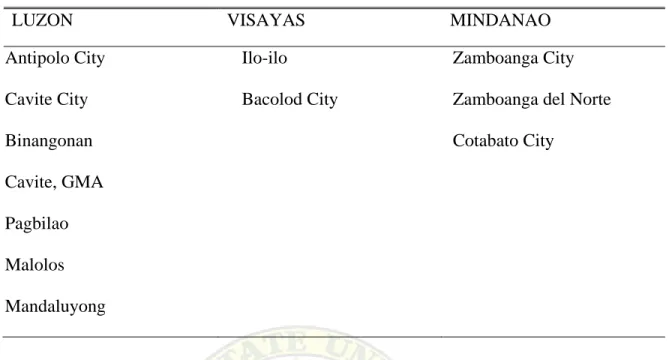
The operator of the stevia plantation was the Glorious Industrial and Development Corporation, a manufacturer and distributor company. As of now, the exclusive distributor of the first stevia powder in the Philippines is the Trinergy International Incorporated (Table1), a domestic corporation duly organized and existing under the virtue of the Philippne laws of the Philippines with principal office at Kennedy Building, Santos St. Antipolo City.
From the tags of Kapuso Mo Jesicca Soho (2010) entitled “Sweet Alternative” it was stated that because of higher price of sugar it is not only diabetes that can attack a person but also high blood pressure .There are a lot of sweeteners that is much better than sugar, more healthier, and is of equal cost or even cheaper. Several establishments are using alternative sweeteners, like the restaurant at Tagaytay that uses honey rather than sugar in sweetening their products. A woman named Ofel uses stevia leaves to sweeten her coffee and teas. From what was featured in Jesicca Soho’s program, there are many
Table 1. Trinergy sub centers in the Philippines
LUZON VISAYAS MINDANAO
Antipolo City Cavite City Binangonan Cavite, GMA Pagbilao Malolos Mandaluyong
Ilo-ilo
Bacolod City
Zamboanga City Zamboanga del Norte Cotabato City
households propagating stevia at their backyards for their personal usage. They harvest the leaves, boil it and mix it with their coffee as sweeteners or to sweeten foods. For them, stevia is a natural, healthy, and cheaper option to use than sugar that has higher price in the market and getting the bad side effects after a longer continuous use.
There were also testimonies from Malolos, Bulacan testifying that the product is good and it really improves their health situations. Mrs. Perales, a 67 years old woman who is suffering from diabetes said that by using stevia in her coffee for almost two months, the swelling of her feet was removed. According to her she used stevia while taking her other food supplements. She also used it to improve the taste of the food she is cooking rather using monosodium glutamate or “vetsin”. Another testimony coming from Liezel was that she often experienced stomach ache because of “kabag”. Because of using stevia in her drink while taking her medicine, she was able to ease the pain .She also uses stevia when she has a fever taking 1 sachet for 5 ml of water and she noticed that her fever temperature went down immediately so, she continuously used stevia in her
diet until her fever was gone. Dreiw, a 3 year old girl use stevia when she has diarrhea as an alternative to Oresol (1 sachet for 1 liters of water) and her mother really find it effective. In Paoleen’s case she has difficulty taking out her bowel movement because of constipation. She put one sachet of stevia powder in a cup of water before going to the comfort room and because of this, she find it very helpful she was able to take her bowel movement normal.
At Baguio City, you can find the plant being sold at Baguio Orchidarium for P30.00/pot. Sometimes you can spot sellers of unlabelled stevia powder price at P10.00/sachet especially around the Baguio Public Market and Burnham Park. Through the information gathered by the researcher, only a few knew what is all about stevia and the rest has no idea at all. Some just want to try the sweetness if it is really good; others just want to try out of curiosity. Based from those who tried the product if you just put a little amount of stevia powder in a cup of coffee it really taste sweet. Some also want the product but the problem is its availability in the market.
At the Demo Organic Farm of Benguet State University stevia propagation has been started. Some residents also here in La Trinidad are planting stevia and used its leaves in sweetening their coffee.
Popular or common names of sugar used by Filipinos:
Brown sugar - A sweet crystalline or powdered substance, white when pure, consisting of sucrose obtained mainly from sugar cane and used in many foods, drinks, and medicines to improve their taste.
- called table sugar.
White sugar - is made out also from sugar cane but chemically based not like muscovado which is produced organically.
Honey - sweetener made by bees but when heated it’s like other sugars that can affect our health cause the enzymes that metabolize the sugar is destroyed.
Muscovado - is brown sugar, moist sugar which is organically produced and cooked without chemicals.
Splenda - Splenda is the brand name of a product sweetened by means of sucralose, a substance derived from sucrose
Coconut sugar - Coconut sap sugar is derived not from the nut but from the toddy / sweet sap (tuba)
- Sap oozing out from the inflorescence is collected
- The sap is boiled, and concentrated, to form granulated sugar
Sugarcane - juicy canes whose sap is a source of molasses and commercial sugar; fresh canes are sometimes chewed for the juice
Glucose - A colorless to yellowish syrupy mixture of dextrose, maltose, and dextrins containing about 20 percent water, used in confectionery, alcoholic fermentation, tanning, and treating tobacco.
- Also called starch syrup.
Molasses - A thick syrup produced in refining raw sugar and ranging from light to dark brown in color Sucrose - a disaccharide of glucose and fructose from
sugar cane, or other sources; used as a food and sweetening agent and pharmaceutical aid.
Safety Studies about Stevia
The following are relevant studies on stevia:
1. FDA Approves Stevia as a Safe Food Additive
The US Food and Drug Administration (FDA) have approved the herb stevia (Stevia rebaudiana) as a safe food additive. Prior to this official approval from the FDA, several companies, including food giants Cargill and Coca-Cola, PepsiCo, and Wisdom Natural Brands, performed reviews self-affirming GRAS (generally recognized as safe) status of stevia as a natural, no-calorie sweetener. Cargill, of Minneapolis, Minnesota, issued a press release announcing that it has received a “no objection”
notification from FDA, verifying that the stevia extract used in the company’s sweetener TruviaTM is “generally recognized as safe”. FDA’s conclusion is consistent with United Nations and the World Health Organization’s assessment from earlier this year that rebaudioside A is safe for use as a general sweetener” (Blumenthal, 2008).
In related developments, the governments of Australia and New Zealand approved stevia as a food additive in October, following the approval of stevia by the United Nations and World Health Organization’s Joint Expert Committee on Food Additives (JECFA) in June, after an extensive multi-year review of the safety of the natural sweetener. The JECFA approval relates to stevia extract containing 95% stevia glycosides.
2. Assessment of the Carcinogenicity of Stevioside in Rats"
According to the study of Dr. K. Toyoda and colleagues, from the Division of Pathology, National Institute of Health Sciences in Tokyo, Japan that in a period of 104
weeks (two years), three groups of lab rats -- 50 males and 50 females -- were tested.
One group received stevioside in a concentration that constituted 2.5 percent of its daily diet; the second group received a concentration that constituted 5 percent of its diet. The third group, which served as the control, received no stevoiside. The rats who received the stevioside weighed less than those in the control group. When the organs and tissues of the rats were examined under a microscope, there was almost no difference between those who were given stevia and those who were not. One interesting difference, however; was that the females who took stevioside had a decreased incidence of breast tumors, while the males displayed a lesser incidence of kidney damage. The researchers state, "It is concluded that stevioside is not carcinogenic in rats under the experimental conditions described" (Sahelian and Gates, 1999).
It was concluded that no significant dose-related changes were found in the growth, general appearance, hematological and blood biochemical findings, organ weights, and macroscopic or microscopic observations, as a result of feeding male and female F344 rats with Stevia rebaudiana extracts at levels up to 1% of their feed for about two years. This study involved nearly 500 test animals that were treated for up to two years. The highest dose level administered to the animals represented some 100 times the estimated daily intake of this sweet material in the human diet. The results obtained are supportive of the safety of Stevia rebaudiana extracts, stevioside and rebaudioside A when consumed as sucrose substitutes by human populations (Kinghorn, 1997).
3. Acute Toxicity
Purified extracts of Stevia rebaudiana have been subjected to acute toxicity tests in rats and mice, the results of which endorse the use of these materials for human
consumption. In a study performed in the United States, no evidence of acute toxicity was observed when separate 2 g/kg doses of the S. rebaudiana sweet glycoside constituents, stevioside, rebaudiosides A-C, dulcoside A, and steviolbioside were administered to mice. The results of these acute toxicity studies in rodents do not predict any potential risk for human populations by the ingestion of S. rebaudiana extracts and constituents. Acute toxicity was not demonstrated when separate 2 g/kg doses were administered to mice by oral intubation, indicating that a concentrated extract of stevia is less than 1/10 as toxic (acute) as caffeine"(Gates, 2000).
4. Other Related Safety Studies
There has never been a complaint that Stevia, in any of its consumable forms, has caused any harmful side effects in the 1500 years of use in Paraguay and about 20 years in Japan. Scientists who have studied Stevia state that it is safe for human consumption.
Following extensive research Dr. Daniel Mowrey reported:
"More elaborate safety tests were performed by the Japanese during their evaluation of stevia as a possible sweetening agent. Few substances have ever yielded such consistently negative results in toxicity trials as have stevia. Almost every toxicity test imaginable has been performed on stevia extract [concentrate] or stevioside at one time or another. The results are always negative. No abnormalities in weight change, food intake, cell or membrane characteristics, enzyme and substrate utilization, or chromosome characteristics. No cancer, no birth defects, no acute and no chronic untoward effects. Nothing! (May, N.D.).
According to the Herb Research Foundation, numerous scientists, and tens of millions of consumers throughout the world, especially in Japan, claimed that the herb is
safe and intensely sweet, which could make it a popular no caloric sweetener. Rob Mc Caleb, president, Herb Research Foundation, Boulder, Colo., USA said that as a scientist with over 15 years in researching the safety of stevia and of many other plants used as food or food ingredients, he can assure that our conclusions in these various studies indicates that stevia is safe for human consumption as per intended usage, that is, as a sweetener. The petition cites over 120 articles about stevia written before 1958, and over 900 articles published to date. In this well-chronicled history of stevia, no author has ever reported any adverse human health consequences associated with consumption of stevia leaf.
Scary Truth About Sugar
First of all, in 1973 the American Journal of Clinical Nutrition published a study by A. Sanchez et al, "Role of sugars in human neutrophilic phagocytosis", November, 1180-1184, showing that ingesting 100 grams of simple sugar lowers white blood cell activity for up to five hours. He got this result using processed honey, table sugar, and processed orange juice. This translates into a 50% reduction in the ability of white blood cells to engulf bacteria. The immune suppressing effect begins within ten minutes of ingesting the sugar. Lowered white blood cell activity means your immune system and its ability to fight infection, is impaired. The general public believes that the orange juice they buy at the store is healthy. However, once the fresh squeezed juice has been pasteurized, it no longer has any live enzymes, and the vitamin and mineral content has been greatly reduced. In essence, the processing of the juice renders it the same as refined white sugar, because it does not contain the life-giving substances which help the natural sugar to be metabolized. Honey would give the same result unless it is raw, “Unheated”
honey. This means that in the processing of the honey, the temperature cannot exceed 96 degrees Fahrenheit, or the live enzymes in the honey will be destroyed as well. Since most people do not drink fresh squeezed orange juice, or go to the trouble to make sure their honey is unheated during processing, they are feeding their body’s pure sugar without knowing it. Now think about the amount of sugars that the average person gets in their daily diet, it’s no wonder that so many people are sick these days. Their immune systems are constantly operating below their optimum levels.
In this study according to Ringsdorf (1977), found that drinking 24 ounces of cola depressed the activity of a kind of white blood cell call a neutrophil that eats bacteria and he found that this reduction in activity lasted for at least five hours. Another good study was also conducted by Bernstein et al (1977) called Depression of lymphocyte transformation following oral glucose ingestion.
Jones (1999) found that sugar increases adrenalin, a stimulating hormone secreted by the adrenal glands. It was also found that this adrenalin increase was far more pronounced in children than in adults, which might account for why children often have hyperactivity problems when their diet contains refined sugars. When sugar is constantly in the diet; the pancreas must constantly produce insulin. When sugar is continually overused, the pancreas eventually wears out and is no longer able to clear sugar from the blood, and diabetes is often the result. This tendency toward diabetes rises severely after menopause. Also, for some people, they have enough insulin but the cells have become insulin-resistant, so they do no absorb the insulin to facilitate absorption of glucose.
According to Massey (1988), calcium loss through the urine doubles when a soft drink containing sugar is consumed. Cola drinks containing both caffeine and sugar
caused the greatest calcium and bone loss in these subjects. White, refined sugar is also bleached with Chlorine Bleach, a substance that many people are sensitive to. Chlorine, when it combines with organic compounds, converts to Dioxin, a lethal chemical. No one should ever consume any substances that have been exposed to chlorine or chlorine bleach, or use paper products that have been bleached. High fructose corn syrup is a liver toxin. It is metabolized in the body the same way alcohol is metabolized. Now, alcohol is metabolized by the brain, and so you get effects that you can recognize, we call it intoxication. Effects like impaired judgment, slowed response time impaired motor function, etc. But fructose is not metabolized by the brain, so you don't notice that is affecting your body the same way alcohol is. Drinking a can of soda does the same thing to your liver that drinking a can of beer does. And you are allowing your kids to drink this every day. You may be a person who doesn't believe in drinking because it destroys our body, but the soda is destroying our body just as much.
When the fructose breaks down in your body, it causes fatty liver disease which raises your cholesterol, and it actually deactivates a substance in your body that prevents high blood pressure, so you get hypertension and high blood pressure, and then you become insulin resistant and develop diabetes. As long as you ingest anything containing fructose or sucrose (table sugar) you will be unable to cure yourself of high blood pressure, heart disease or diabetes. It also causes kidney disease which contributes to diabetes and high blood pressure as well. The small blood vessels in the kidney become damaged and even though you might be taking something to lower your blood pressure, because of the kidney damage your heart has to continue to pump the blood through at a higher pressure. The kidney also starts to retain sodium as a result of the damage. So,
drinking sodas must stop if you want to be really health. Drinking fructose raises Uric acid levels, which also increases diabetes and high blood pressure. Uric acid levels should be between 3 and 5.5 mg/dl in the blood. Eating whole fruits does not cause the same problem as high fructose corn syrup and table sugar, because the fruits contain vitamins, minerals, and antioxidants which help metabolize the fructose. While high fructose corn syrup is the number one food substance which creates the metabolic syndrome of diabetes, high blood pressure, liver disease, kidney disease, and vascular disease, the number two food substance is the yeast used to make beer (Snelson, 2010).
Cancer cells love sugar. It’s their preferred fuel. The more sugar you eat, the faster cancer cells grow. Your pancreas responds to sugar by releasing insulin, the hormone that escorts sugar into your cells. When you eat refined simple sugars, such as white table sugar, candy, cookies, or other sugar-laden foods, your blood sugar levels rise very quickly. Your pancreas responds by releasing a lot of insulin. That’s not good. High insulin levels are one of the biggest risk factors and promoters of breast cancer. Women with high insulin levels have an 83 percent greater risk of breast cancer. When it comes to breast cancer, insulin is no friend. One of the biggest reasons is due to the fact that both normal breast cells and cancer cells have insulin receptors on them. When insulin attaches to its receptor, it has the same effect as when estrogen attaches to its receptor; it causes cells to start dividing. The higher your insulin levels are, the faster your breast cells will divide; the faster they divide, the higher your risk of breast cancer is and the faster any existing cancer cells will grow. There's another wound that insulin can inflict, too. It attacks a portion of the estrogen cycle, making more estrogen available to attach to the estrogen receptors in breast tissue (Horner, N.D.).
In other words, when your insulin levels are up, free-estrogen levels are up, too.
And both of them speed up cell division. That’s why high insulin levels increase your risk of breast cancer so much (Snelson, 2010).
Some of the other effects of sugar on the body are:
1. Increases overgrowth of Candida yeast organism 2. Increases chronic fatigue
3. Can trigger binge eating in those with bulimia 4. Increases PMS symptoms
5. Increases hyperactivity in about 50% of children 6. Increases tooth decay
7. Increases anxiety and irritability
8. Can increase or intensify symptoms of anxiety and panic in susceptible women
9. Can make it difficult to lose weight because of constantly high insulin levels, which causes the body to store excess carbohydrates as fat.
Reasons on Craving Sugar
You may crave sugary foods for many reasons. As I explained earlier, refined sugar stresses the pancreas and depletes the body's supplies of chromium. A common symptom of chromium deficiency is sugar cravings. And satisfying these cravings further lowers chromium and increases cravings. And eating sweets is just plain pleasurable.
Chocolate, for example, has been found to stimulate the production of serotonin, the feel- good brain chemical. But the human body is drawn to carbohydrates for reasons other than instant gratification. Carbohydrates are necessary for metabolic processes in our
body. Whole, unrefined carbohydrates like grains break down into sugar when chewed.
After proper chewing, grains will taste sweet. Grains contain B vitamins and magnesium;
these nutrients are important co-factors in hundreds of metabolic processes in the body.
And the sweetness of the foods that contain B-vitamins and magnesium may create a conditioned response to these foods. In other words, sweetness makes your body think you are getting beneficial vitamins and minerals. But when we get empty carbohydrates like sugar with no other nutrients, “the body craves more and more to try to meet its nutrient demands.
So, if your body needs these vitamins and minerals and is attracted to carbohydrates to get them, and if instead of a whole grain you eat a refined empty product, then you will probably keep craving carbohydrates until you get the vitamins and minerals you need. That's why many doctors recommend B-complex vitamins and magnesium supplements help to control carbohydrate addiction. Of course, eating organic whole grains would be the optimum solution.
Another cause of sugar cravings is a yeast overgrowth, also known as candidaisis.
Candida is yeast that is naturally present in the human body. But some things, such as antibiotics and too much sugar in the diet can cause the yeast to multiply, leading a number of health problems, from vaginal yeast infections to severe fatigue. And this yeast, when present in abnormally high numbers, can cause strong cravings for sweet, starchy foods, causing the problem to perpetuate.
Sometimes it requires a little detective work to find the hidden sugars in foods.
The following is a list of 82 common names for sugar that you may encounter in ingredients of your favorite foods (Dean, 2008).
1.Amasake 23.Lactose 45.Honey 67.Ribose rice
syrup 2.Apple sugar 24.Levulose 46.Inver sol 68.Rice malt 3.Barbados sugar 25.“Light†sugar 47.Malted barley 69.Rice sugar 4.Bark sugar 26.Dextrin 48.Maltodextrins 70.Rice sweeteners 5.Barley malt 27.Dextrose 49.Maltodextrose 71.Rice syrup solids 6.Barleymalt syrup 28.Diglycerides 50.Maltose 72.Saccharides 7.Beet sugar 29.Disaccharides 51.Malts 73.Sorbitol 8.Brown rice syrup 30.D-tagalose
Glucitol
52.Mannitol 74.Sorghum 9.Brown sugar 31.Glucoamine 53.Mannose 75.Sucanat 10.Cane juice 32.Gluconolactone 54.Maple syrup 76.Sucanet 11.Invert sugar 33.Glucose 55.Microcrystalline
cellulose
77.Sucrose 12.Isomalt 34.Glucose polymers 56.Molasses 78.Sugar cane 13.Karo syrups 35.Xylitol 57.Monoglycerides 79.Trisaccharides 14.Cane sugar 36.“Lite†sugar 58.Monosaccharide 80.Turbinado sugar 15.Caramelized foods 37.Malitol 59.Nectars 81.Unrefined sugar 16.Carbitol 38.Malt dextrin 60.Pentose 82.White sugar 17.Carmel coloring 39.Glycerides 61.Polydextrose
18.Carmel sugars 40.Glycerine 62.Polyglycerides 19.Concentrated fruit
juice
41.Glycerol 63.Powdered sugar 20.Corn sweetener 42.Glycol 64.Raisin juice 21.Corn syrup 43.Hexitol 65.Raisin syrup 22.Date sugar 44.High-fructose corn
syrup
66.Raw sugar
Stevia: A Better Alternative to Sugar and Artificial Sweeteners
Most medical experts would agree that one of the best ways to improve your health is to reduce your sugar intake. Doing this can help decrease one’s chances of getting diabetes and being overweight or obese, both epidemics in this country with adults and children alike. Considering these facts, since 1985, childhood diabetes has increased ten-fold. The Centers for Disease Control predicts that if this trend continues,
one out of every three children born beginning in 2000 will develop diabetes in their lifetime.
The average American ingests over 150 lbs. of sugar annually! That represents whopping 30-50 lb. bags of sugar each year! In reality, much of this sugar is in the form of high fructose corn syrup prevalent in foods because it’s much cheaper than sucrose, common tabletop sugar. While some might think that artificial sweeteners are the best solution to curb our love affair with sugar, others disagree. Artificial sweeteners do eliminate the high calories and carbohydrates associated with sugar, however many believe that these alternatives are unsafe and are actually worse than sugar. So is there yet another alternative available?
If there were an all-natural sweetening ingredient that’s been used safely for over 30 years in other parts of the world for food applications and diabetes management with no ill effects, would you be interested? Well, such a substance does exist and it’s called stevia. Using stevia, an all-natural alternative to sugar and artificial sweeteners, is gaining increasing popularity worldwide. Stevia rebaudiana, its botanical name, is derived from a plant in the chrysanthemum family grown primarily in South America and Asia. The plant’s intense sweetening qualities are complex molecules called steviosides that are glycosides made of glucose, sophorose and steviol. These are what make stevia up to 300 times sweeter than sugar and non-caloric. These glycosides do not get absorbed into the body; rather simply pass through leaving no calories. The Japanese have used stevia in food applications from soft drinks to soy sauce since the 1970s and recent reports indicate that stevia commands up to an incredible 50% share of Japan’s commercial sweetener market. Moreover countries like Brazil use stevia for the treatment for diabetes. The
advantages to stevia are numerous, so the following are the most frequently cited. In its pure form, it’s non-caloric and doesn’t affect glucose levels, an advantage for diabetics and hypoglycemics. Also, it has no carbohydrates or fat, so it’s great for dieters, especially those watching carbohydrates intake. Unlike artificial sweeteners, high quality stevia has little aftertaste when measured properly. It has no known side effects like some chemical sweeteners and has been safely consumed around the world for decades.
Actually, stevia’s original medicinal uses date back centuries ago with the Paraguan Indians who mixed the herb in teas for its healing properties. Since stevia is sugar-free, candida sufferers can use it. Health conscious consumers take advantage of stevia to avoid sugar and help prevent diabetes and obesity because it lowers blood pressure and regulates glucose levels.
Stevia can be used as a healthy substitute in most sugar applications, including baking and cooking since it is heat stable. The average conversion rate of sugar to stevia is one cup of sugar per one teaspoonful of pure stevia extract. Clearly very little stevia is needed to replace sugar. When used in beverages, stevia dissolves quickly and easily and, depending on your taste preference, only a pinch is needed. The real challenge to using stevia effectively knows what ingredients to use in a recipe to make up for the volume and consistency lost with the elimination of sugar, especially in baked goods. That’s why it’s a good idea to find stevia cookbooks with proven recipes when you’re starting out.
Finally, stevia is not appropriate in recipes that require sugar caramelizing or browning like meringues. Stevia is available in many forms including liquid, teas, plants/leaves, pure white and green powdered extract and powdered blends with different fillers. In baking, the pure extract is used primarily and, in some cases, the liquid variety.
Widespread use of sugar and artificial sweeteners are at dangerous levels. The negative side effects and controversial studies regarding their proposed safety suggest that another alternative is desirable and necessary. Stevia may be a welcome option for those who want to ingest more natural ingredients with no known side effects, no calories, no carbohydrates, no fat, no affect on glucose levels and no sugar or artificial sweeteners.
Stevia may also be advantageous in the prevention and treatment of diabetes, obesity and other health conditions (Jobs, 2005).
Definition of Terms
1. Acceptability- Refer to an individual’s acceptance or satisfaction of a product that is new to them like the stevia powder through sensory evaluation as to its sweetness, aroma, taste, appearance, color, and respondent’s general acceptability.
2. Artificial sweeteners- these are the categories of nonnutritive, high-intensity sugar substitutes or chemically based sugar.
3. Natural sweetener - An alternative that can be derived in our nature like the herb stevia.
4. Stevia Powder - a natural sweetener which has no calories, no fats, no sodium, no carbohydrates, but is 300 times sweeter than regular sugar and according to extensive research and experiments it has no side effects claimed yet.
Acceptability of Stevia Powder
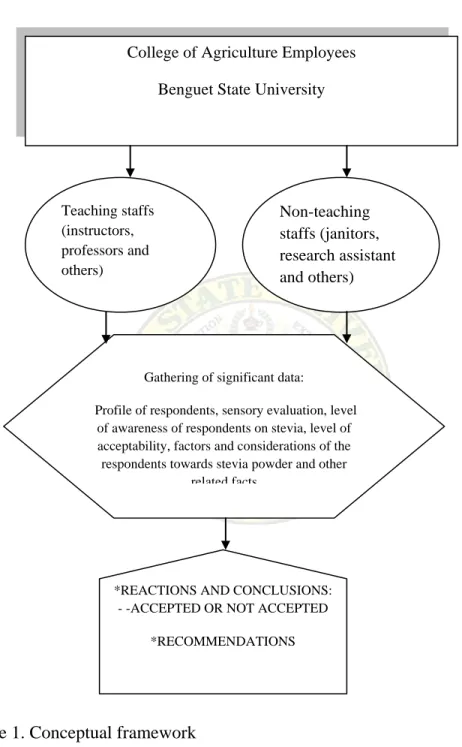
The study was conducted among faculty and staff of the College of Agriculture at Benguet State University (Figure 1). The data to be gathered shows whether stevia powder is acceptable or not by the respondent.
Acceptability of Stevia Powder
Figure 1. Conceptual framework
College of Agriculture Employees Benguet State University
Teaching staffs (instructors, professors and others)
Non-teaching staffs (janitors, research assistant and others)
Gathering of significant data:
Profile of respondents, sensory evaluation, level of awareness of respondents on stevia, level of acceptability, factors and considerations of the respondents towards stevia powder and other
related facts
*REACTIONS AND CONCLUSIONS:
- -ACCEPTED OR NOT ACCEPTED
*RECOMMENDATIONS
METHODOLOGY
Locale and Time of Study
The study was conducted at the College of Agriculture, Benguet State University La Trinidad, Benguet from January 2010 to February 2011.
Respondents of the Study
The respondents of the study were the faculty and staff of the College of Agriculture at Benguet State University who are coffee drinkers. There were 60 respondents that were randomly selected.
Data Collection
A survey questionnaire was initially used to identify who are coffee drinkers among the faculty and staff of the College of Agriculture. The researcher went from office to office in the various departments in the College including the Dean’s Office.
From among the 74 faculty and staff, the researcher was able to come up with 60 respondents who subsequently participated in a sensory evaluation.
Data Gathered
The data gathered included the level of awareness of stevia powder among the respondents, factors and considerations that may affect them in accepting stevia as an alternative to sugar, and their level of acceptability to stevia as a coffee sweetener.
Data Analysis
The data gathered were consolidated, tabulated, and analyzed using frequency counts, averages, percentage, and friedman tests.
RESULTS AND DISCUSSION
General Profile of the Respondents/Evaluators
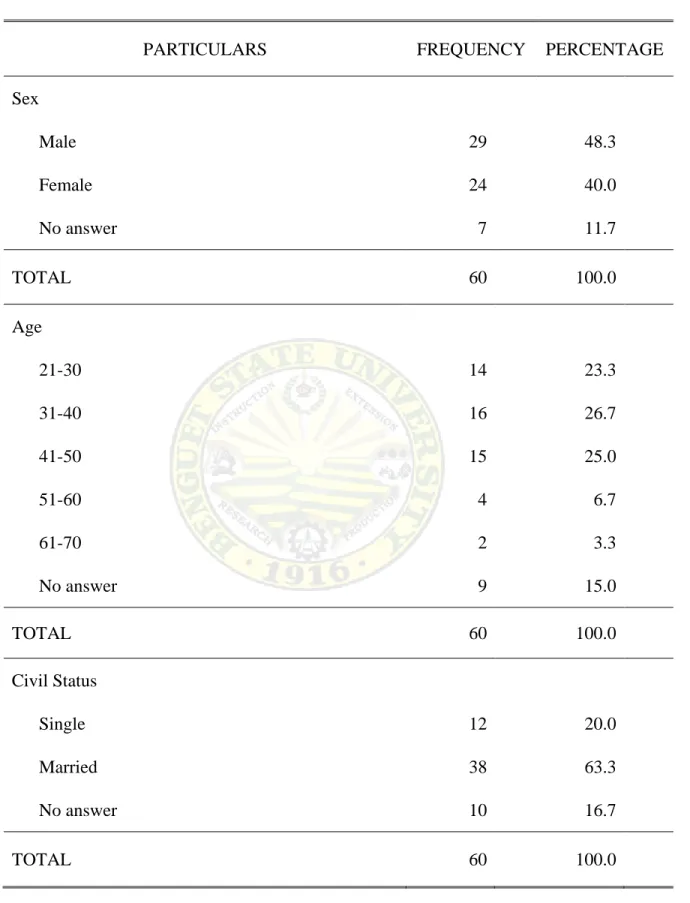
Table 2 shows the personal profile of the respondents in terms of sex, civil status, age, ethnic affiliation, religious affiliation and household monthly average income.
Sex. Although not all respondents indicated their sex, those who did, there were slightly more males (29%) than females (24%).
Age. Likewise, not all respondents also indicated their age. But from those who did are predominantly distributed almost equally among the age brackets 31-40, 41-50, and 31-50, respectively. Results indicate that most of the respondents are in the prime of their teaching lives.
Civil status. Similarly, few respondents failed to indicate their civil status. Still majority (63.3 %) from among those who did indicate are married.
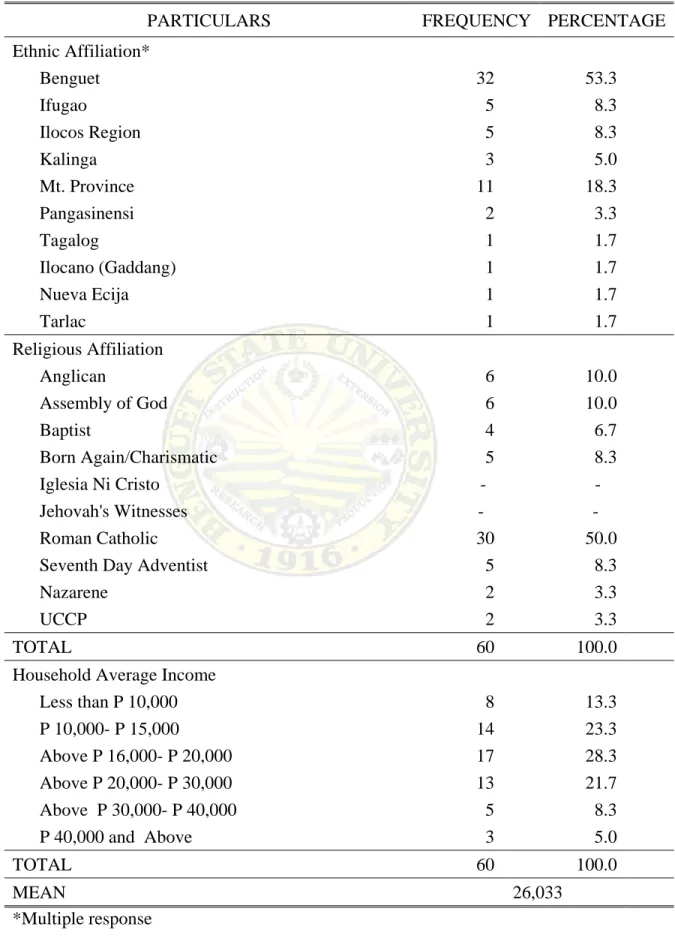
Ethnic affiliation. Majority (53.3%) of the respondents came from Benguet, This is understandable since Benguet State University which is the study area is located within the province of Benguet. It can further be noted that a significant number came from the other provinces of the Cordillera; however none came from the provinces of Abra and Apayao.
Religious affiliation. All of the respondents are Christians, with the half (50%) being Roman Catholics.
Monthly income. The mean household income of the respondents is PhP 26,033.
In can be noted that although others are receiving less than PhP 10,000 (more or less the non-teaching staff), quite a few are realizing above PhP 40,000.
Table 2. General profile of the respondents
PARTICULARS FREQUENCY PERCENTAGE
Sex
Male 29 48.3
Female 24 40.0
No answer 7 11.7
TOTAL 60 100.0
Age
21-30 14 23.3
31-40 16 26.7
41-50 15 25.0
51-60 4 6.7
61-70 2 3.3
No answer 9 15.0
TOTAL 60 100.0
Civil Status
Single 12 20.0
Married 38 63.3
No answer 10 16.7
TOTAL 60 100.0
Table 2. Continued…
PARTICULARS FREQUENCY PERCENTAGE Ethnic Affiliation*
Benguet 32 53.3
Ifugao 5 8.3
Ilocos Region 5 8.3
Kalinga 3 5.0
Mt. Province 11 18.3
Pangasinensi 2 3.3
Tagalog 1 1.7
Ilocano (Gaddang) 1 1.7
Nueva Ecija 1 1.7
Tarlac 1 1.7
Religious Affiliation
Anglican 6 10.0
Assembly of God 6 10.0
Baptist 4 6.7
Born Again/Charismatic 5 8.3
Iglesia Ni Cristo - -
Jehovah's Witnesses - -
Roman Catholic 30 50.0
Seventh Day Adventist 5 8.3
Nazarene 2 3.3
UCCP 2 3.3
TOTAL 60 100.0
Household Average Income
Less than P 10,000 8 13.3
P 10,000- P 15,000 14 23.3
Above P 16,000- P 20,000 17 28.3
Above P 20,000- P 30,000 13 21.7
Above P 30,000- P 40,000 5 8.3
P 40,000 and Above 3 5.0
TOTAL 60 100.0
MEAN 26,033
*Multiple response
Distribution of Respondents on the Type of Coffee they Consume
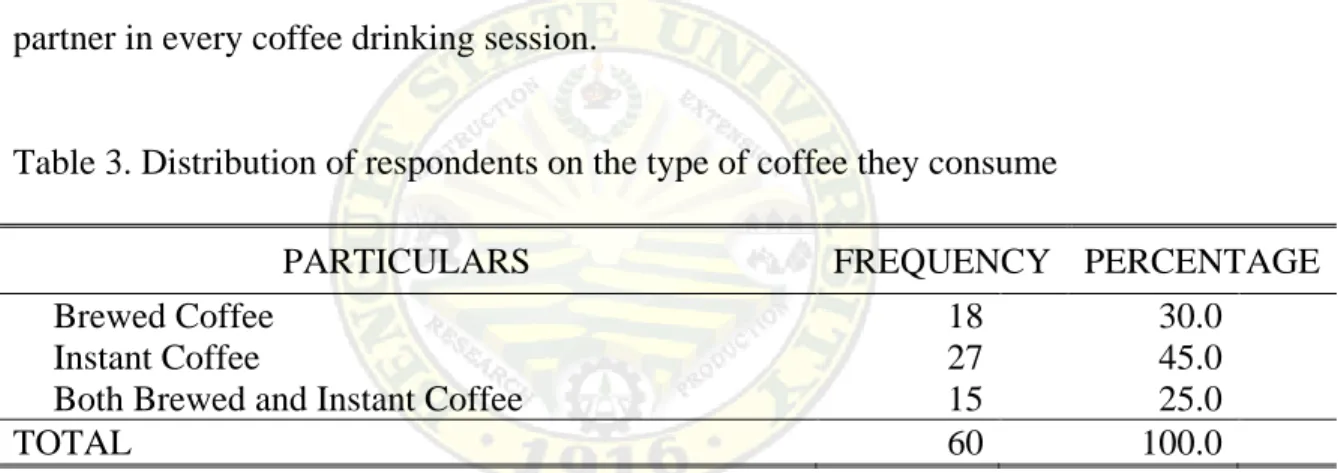
Table 3 shows that more (45%) from among the respondents prefer to consume instant coffee. Others (30%) want the brewed one, the rest prefers both.
Distribution of the Respondent on the Frequency of Using Sugar in their Coffee
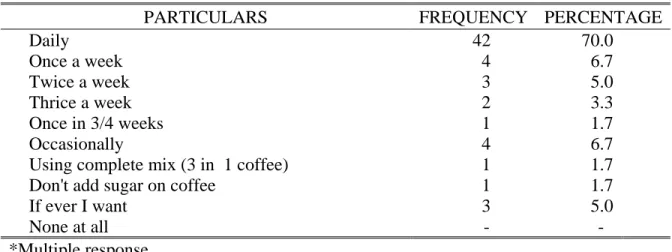
Although not all of the respondents are drinking coffee daily, all except one put a sweetener on their coffee drinks every time they would drink coffee, with the majority (70%) doing it on a daily basis (Table 4). This shows that sweetener is an important partner in every coffee drinking session.
Table 3. Distribution of respondents on the type of coffee they consume
PARTICULARS FREQUENCY PERCENTAGE
Brewed Coffee 18 30.0
Instant Coffee 27 45.0
Both Brewed and Instant Coffee 15 25.0
TOTAL 60 100.0
Table 4. Distribution of the respondent on the frequency of using sugar in their coffee PARTICULARS FREQUENCY PERCENTAGE
Daily 42 70.0
Once a week 4 6.7
Twice a week 3 5.0
Thrice a week 2 3.3
Once in 3/4 weeks 1 1.7
Occasionally 4 6.7
Using complete mix (3 in 1 coffee) 1 1.7
Don't add sugar on coffee 1 1.7
If ever I want 3 5.0
None at all - -
Distribution of the Respondent on the Type of Coffee Sweetener they Used
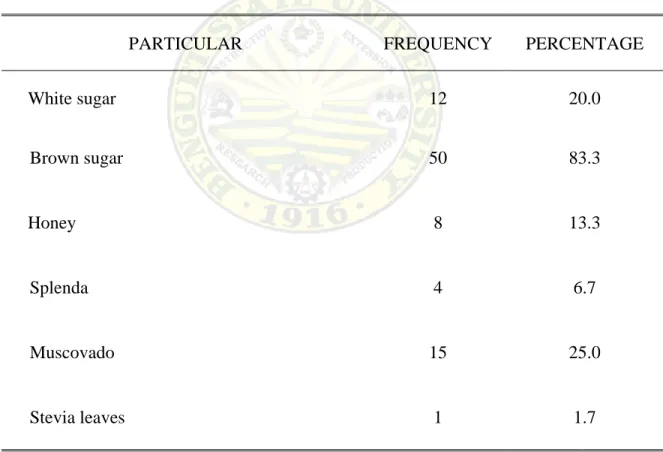
The most commonly used coffee sweeteners among the respondents is brown sugar (83%). This was followed by muscovado (25%) which is even higher than the traditionally popular white sugar which is being used by only 20%. It is quite interesting to note that a significant number is using honey (13.3%). Moreover, one respondent is also using stevia leaves. Results imply that more and more among the respondents are becoming aware of the beneficial effects of organic sweeteners (Table 5).
Table 5. Distribution of the respondent on the type of coffee sweetener they used
PARTICULAR FREQUENCY PERCENTAGE
White sugar 12 20.0
Brown sugar 50 83.3
Honey 8 13.3
Splenda 4 6.7
Muscovado 15 25.0
Stevia leaves 1 1.7
*Multiple response
Number of Teaspoons of Sugar Used by the Respondents per Cup of Coffee
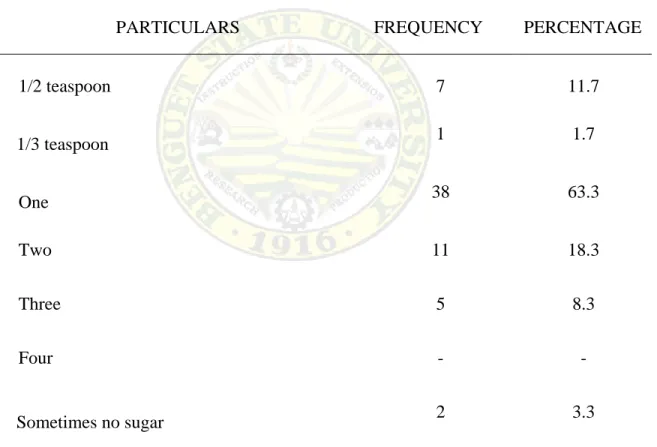
Majority (63.3%) of the respondents put one teaspoon of sugar in their cups of coffee. An 18.3% puts two and an 8.3% put as much as three teaspoons, indicating that a significant number among the respondents are quite heavy sugar users which are not actually good for their health (Table 6). On the other hand, it is quite interesting to note that at least 3.3% sometimes do not put sugar on their coffee.
Table 6. Number of teaspoons of sugar used by the respondents per cup of coffee
PARTICULARS FREQUENCY PERCENTAGE
1/2 teaspoon 7 11.7
1/3 teaspoon 1 1.7
One 38 63.3
Two 11 18.3
Three 5 8.3
Four - -
Sometimes no sugar 2 3.3
*Multiple response
Distribution of Respondents as to Whether Sugar is an Important Component in their Coffee Drinks
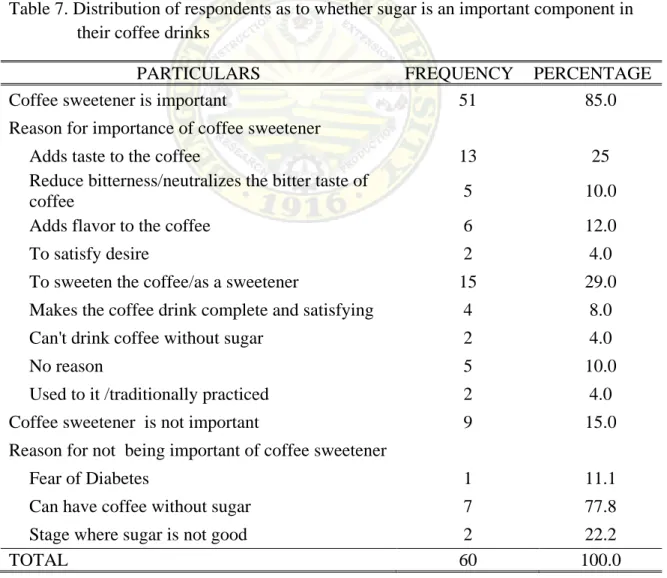
Most (85%) of the respondents claimed that sugar is an important component in their coffee drinks primary due to what it can do the coffee that include its sweetening power, adding taste as well as flavor, in reducing the bitterness of coffee, and others.
On the other hand, it can be noted that for those who claimed that sweetener is not important is basically because of the reason that they can drink their coffees even without a sweetener (Table 7). Furthermore, those respondents whose ages are above fifty years old claimed that sugar is not good for them.
Table 7. Distribution of respondents as to whether sugar is an important component in their coffee drinks
PARTICULARS FREQUENCY PERCENTAGE
Coffee sweetener is important 51 85.0
Reason for importance of coffee sweetener
Adds taste to the coffee 13 25
Reduce bitterness/neutralizes the bitter taste of
coffee 5 10.0
Adds flavor to the coffee 6 12.0
To satisfy desire 2 4.0
To sweeten the coffee/as a sweetener 15 29.0
Makes the coffee drink complete and satisfying 4 8.0
Can't drink coffee without sugar 2 4.0
No reason 5 10.0
Used to it /traditionally practiced 2 4.0
Coffee sweetener is not important 9 15.0
Reason for not being important of coffee sweetener
Fear of Diabetes 1 11.1
Can have coffee without sugar 7 77.8
Stage where sugar is not good 2 22.2
TOTAL 60 100.0
Respondents’ Criteria in Choosing Coffee Sweetener
As shown in Table 8, the majority (71.7%) of the respondents consider primarily the health benefits they could get from the sweetener as foremost criteria in choosing the sweetener to use. A significant 35% consider the sweetness and appearance of the sweetener, while 18.3% consider the side effect of the sweetener to their body indicating that they are health conscious individuals.
On the other hand, factors like the price of the sweetener and their budgets do not significantly affect the respondents’ choice of sweetener.
Table 8. Respondents’ criteria in choosing coffee sweetener
PARTICULARS FREQUENCY PERCENTAGE
Health Benefits 43 71.7
SSide effects 11 18.3
Sweetness and Physical appearance 21 35.0
Helps them to sleep 1 1.7
Budget 1 1.7
Availability 2 3.3
Cost 2 3.3
None at all 1 1.7
*Multiple response
Distribution of Respondent as to What is Sugar to Them
To the majority (63.3%) of the respondents, sugar to them is basically a food sweetener. A significant 23.3% consider it a valuable energy provider (Table 9).
However, a noted 16.7% consider it as not good for one’s health for it can cause diabetes and obesity. According to nutrition researchers (2009) sugar is a silent killer for it is a factor that can cause diabetes, overweight and other related diseases that can be obtained by consuming too much sugar.
Table 9. Distribution of respondent as to what is sugar to them
PARTICULARS FREQUENCY PERCENTAGE
Valuable energy provider 14 23.3
Food sweetener 38 63.3
Not good for it can cause diabetes ,
overweight and other related diseases 10 16.7
Enhances/improve the taste of food 2 3.3
To satisfy my coffee drinking session 1 1.7
*Multiple response
Respondents’ Willingness and Reason to Buy Natural Alternative Sweetener
Given the information on the nutritional value as well as beneficial components of stevia powder, the respondents were asked whether they are willing to try and use said product in their coffee drinks. Table 10 shows that most (85%) are willing to try and use the stevia powder in their coffee drinks. Their willingness is primarily influenced by the health benefits they could derived from the product. Still, others would do it out of curiosity or since it is new to them (both 7.8%). Others consider it affordable thus they are willing to try it (5.9%).
For those who are not willing to try and use it (15%) reasoned out that they would want to know more about the product, considered it as not a basic need, or simply they have no reason at all.
Results simply imply that the nutritional value of any product especially those new to consumers, is one of the foremost considerations that may influence consumers to try and use it.
Respondent’s Awareness About Stevia as an Alternative to Sugar
As to the respondents’ awareness towards stevia, almost half (48.3%) do not have an idea at all about stevia. A significant 23.3% claimed it as just like table sugar; just like other artificial sweetener (6.7%); others say it is just an appetizer (10%), it should be noted however that not a few (13.3%) said that it is a healthy, natural herbal, organic sweetener that is good for the health (Table 11). The finding shows that although many know nothing about stevia, still a considerable number is aware that it is a beneficial
Table 10. Respondents’ willingness and reason to buy natural alternative sweetener
PARTICULARS FREQUENCY PERCENTAGE
Willing to buy alternative sweetener 56 93.3
Reasons for willingness to buy
Health Benefits 23 41.1
Taste matters 3 5.4
Good for diabetics 1 1.8
It is healthier substitute to sugar 9 16.1
To avoid side effects 1 1.8
Diabetic and health conscious individual 2 3.6
Afraid of diabetes 1 1.8
Affordability 4 7.1
Natural sweetener 1 1.8
As long as information’s are true 1 1.8
No answer 13 23.2
Not willing to buy 4 6.7
Reason for not buying
Not a basic need 2 50.0
Like the content of sugar 1 25.0
Not that familiar 1 25.0
TOTAL 60 100.0
Table 11. Respondent’s awareness about stevia as an alternative to sugar
PARTICULARS FREQUENCY PERCENTAGE
Just like table sugar 14 23.3
Just like other artificial sweeteners 4 6.7
An appetizer 6 10.0
A healthy and natural sweetener 1 1.7
It is Economical 1 1.7
Good for health 2 3.3
A good alternative course 1 1.7
Produced organically/organic sweetener 2 3.3
Herbal sweetener 3 5.0
No idea at all 29 48.3
Medicine 1 1.7
*Multiple response
Acceptability of the Various Coffee Sweetener Based on Nutritional Value
Based on the nutritional value of the given sweeteners eighty percent prefer stevia, honey(41.7%), muscovado (13.3%), brown sugar (6.7%), (5%) white sugar , splenda (1.75%).This implies that stevia is accepted by the majority of the respondents when based on their nutritional value (Table 12).
Distribution of the Respondent’s Willingness to Try and Use Stevia Powder
It shows that majority (85%) of the respondents are willing to try and use stevia on their coffee for the reason that it is good for the health, for curiosity with the product, to avoid diseases caused by using sugar, stevia is natural, and for its characteristics and affordability however, some of them did not mention their reason. Fifteen percent of the respondents are not willing to buy stevia for they want to know more information about the product, it is not part of their basic needs and some of them do not want to use it as of now (Table 13).
Table 12. Acceptability of the various coffee sweetener based on nutritional value
PARTICULARS FREQUENCY PERCENTAGE
Stevia 48 80.0
Brown Sugar 4 6.7
White sugar 3 5.0
Muscovado 8 13.3
Splenda 1 1.7
Honey 25 41.7
*Multiple response
Table 13. Distribution of the respondents willingness to try and use stevia powder
PARTICULARS FREQUENCY PERCENTAGE
Willingness to try and use stevia 51 85.0
Reason for willingness to try
Good for the health 10 19.6
Something new 4 7.8
It is natural 2 3.9
Sounds healthy 1 2.0
health benefits 8 15.7
Curiosity with the product 4 7.8
Economical substitute to sugar 1 2.0
To avoid diseases caused by too much sugar 3 5.9
Almost all sugar are artificially made 1 2.0
Characteristics and affordability 3 5.9
Healthier option 1 2.0
Natural alternative sweetener 2 3.9
Good for diabetics 2 3.9
No reason 10 19.6
Not willing to try and use stevia 9 15.0
Reasons for not trying
No reason 3 33.3
Not now 1 11.1
Not a basic need 1 11.1
Know more information about the product 4 44.4
TOTAL 60 100.0
Considerations of Respondents in Consuming a New Product like Stevia
Before consuming a new product or unfamiliar one, there are things to be considered. On the part of the respondents, the major considerations that they consider before consuming stevia powder includes the product’s perceived health value, its availability in the market, and affordable price (Table 14). Other significant considerations include the product’s safeness to consume, if suggested by acquaintance, and depends on the outcome from tasting or trying it (sensory evaluation).
Others would still consider consuming it out of curiosity; and others would depend on the scientific evidence on the beneficial claims regarding the product.
Factors Affecting the Respondents on Accepting Stevia as an
Alternative Coffee Sweetener
Consumer’s preference to consume a certain food items is influenced by several factors. For Stevia powder, several factors are identified by the respondents that they only accept stevia as an alternative sweetener depending on their perception (idea or thoughts about stevia), personal and psychological factor (personal wants base on experience and motives), traditions (table sugar is more known or it is more traditionally used), behaviors ( attitudes of other people towards stevia), cultural factor (beliefs towards what people must eat ) and other respondents looks on the affordability of the product, social interest, and benefits derived from the product (Table 15).
Table 14. Considerations of respondents in consuming a new product like stevia
PARTICULARS FREQUENCY PERCENTAGE
Availability of the product in the market 38 63.3 Suggestion of friends, family and other trusted
individual 13 21.7
Perceive health value 39 65.0
Safe and no therapeutic claim 16 26.7
Curiosity with the product 3 5.0
Affordable price 29 48.3
Depends on sensory evaluation 9 15.0
Scientific evidence that stevia is really good
for diabetes 1 1.7
If necessary 1 1.7
All of the above 1 1.7
*Multiple response
Table 15. Factors affecting respondents in accepting stevia as an alternative coffee sweetener
PARTICULARS FREQUENCY PERCENTAGE
Traditions 14 23.3
Behaviors 10 16.7
Cultural 6 10.0
Social Interest 4 6.7
Personal or psychological factors 25 41.7
Perception 34 56.7
Price /Affordability of the product 5 8.3
Based on the product information 1 1.7
Seems I don't need as of the moment 2 3.3
Benefits of the product 1 1.7
Know more about the product 2 3.3
Respondents Willingness to Buy and Consume Stevia Powder Based on Price Equivalency
Most (80%) of the respondents are willing to consume stevia powder. A significant number (33.5%) mentioned that stevia powder is still affordable if equated to the price of white and brown sugar (Table 16). Considering the price of stevia powder per sachet (1 g) which is PhP6.00 pesos (good for a cup of coffee) or the 1 box (50 g) which is PhP300.00 pesos having 50 cups in all comparing to brown sugar and white sugar in 1 sachet (10g = .91 pesos) and one pack has 100 sachets (1000g) equivalent to 100 cups of coffee per pack is worth 91.00 pesos but stevia is still affordable for them. Some respondents have said, “You can’t count the cause given by this natural sweetener than those regular sugars being used especially in the future when you get of age which could be more expensive going for medications than avoiding it earlier as possible”. On the other side other respondents want to buy but considering it’ as not their basic need and at the same time they can take coffee without sugar so no need for them to use any sweetener on their coffee.
Level of Acceptability of Stevia Powder as Coffee Sweetener Throuigh Sensory Evaluation
The result on the level of acceptability of stevia powder as an alternative coffee sweetener compared with brown and white sugar among the respondents through sensory evaluation. The evaluation towards the acceptability of stevia powder was based on sweetness, aroma, taste, appearance, color and general acceptability.
Acceptability ratings used in the sensory evaluation were the following:
5=extremely like, 4=like, 3=neutral (neither like nor dislike), 2=dislike, 1= extremely dislike. In the study codes are used where Cup A is the brown sugar, Cup B as the white sugar and Cup C as the stevia powder.
Acceptability as to Sweetness
The white sugar, brown sugar and stevia powder has no statistical difference as to sweetness at 5% level of significance (Table 17). This attests that the respondents accept the sweetness of stevia as a coffee sweetener as to the sweetness of white and brown sugar.
Table 16. Respondents willingness to buy and consume stevia powder based on price equivalency
PARTICULARS FREQUENCY PERCENTAGE
Willing to consume stevia powder 48 80.0
Reasons
Health benefits 20 41.7
Healthier option 12 25.0
Affordable price 16 33.3
Not willing to use stevia 12 20.0
Reasons for not willing to use stevia
Uncertain need to know more about the product 5 41.7
Not part of my basic need 5 41.7
Not yet 2 16.7
TOTAL 60 100.0