The campaign was promoted in various ways free of charge thanks to the partnerships made for the Be RICEponsible campaign. A study was also conducted on the effectiveness of the implementation of half a cup of rice in Cebu City. The results of the study showed that out of 22 food establishments, only 15 (68%) are aware of the half-cup ordinance and therefore implement it.
But of the 15 who said they already serve half a cup of rice, only 6.7% have half a cup of rice on their menu. The aim of the research was mainly to demonstrate and test rice and rice-based agricultural innovations. Initial results of the study showed that PsB Rc82 had the highest yield under submerged conditions with the Rice Straw + Chicken Manure setup, at 4.22 tons/ha, while the vermicompost setup had only 4.06 tons/ha.
Initial results of the study showed that soil conditioner setup had a significantly higher number of tillers per square meter at 42 tillers and 36 tillers for the control setup. Hakate served as foliar fertilization of the rice plant in a 50:50 ratio with synthetic fertilizer (recommendation suggested by Hakate Technician). Manipulation (HB), reduced tillage technology (RTT) and conventional farming were the main focus of the study.
The yield per hectare in the 2015 dry season is lower compared to the wet season due to the high incidence of stem blight in PhilRice CES and even nearby.
Advocacy and Capacity Building of Rice Farming Communities
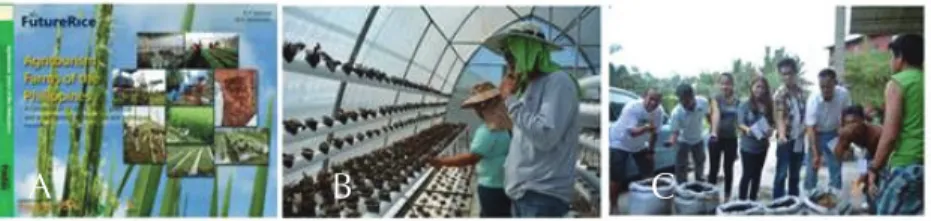
Also integrated into the program of Project IPaD is the education for out-of-school youth of barangays Maligaya and Mabini. FutureRice farm where farmers are invited to discuss their best practices and solutions to some of the common problems in caring for rice plants. The FutureRice team helps organize these events and takes care of the Rice Crop Manager treatment, where farmers get recommendations for better nutrient management.
Proper use of machinery, nutrient management, hands-on experience and high-tech farm technologies are among the smart farming practices included in the training. Within the scope of this study is the construction of the electronic Farmer's Center, the Information Center, two (2) teaching huts and toilets (financed by the IPaD Project) which will be used to provide services to farmers such as holding seminars and trainings . This study also works on developing educational materials for farmers such as booklets for guidance in organic rice farming, Rice Crop Manager and also various Clean GPS technologies and practices applied on the FutureRice farm for DS and WS.
This study promotes the various Clean GPS farming technologies and practices applied in FutureRice farm. Communication and Social Change Issues in Using Clean GPS JLZA Libed and RF Barroga. The campaign message most favored in the study will be used to promote this technology in the next planting season.
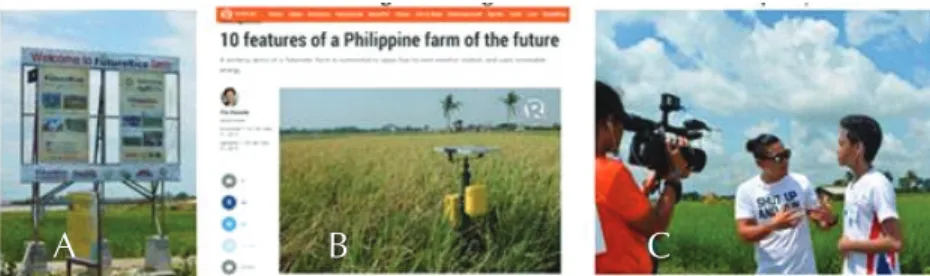
Weak 'till!' was favored for its clarity, appeal, catchiness and the association of the cartoon image with the one on the actual RCM website/app. This study focuses on the development of the FutureRice farm as the first rice-based agritourism farm in the Philippines. PhilRice employees, Lakbay Palay visitors and other guests enjoyed kayaking in the water chute system of FutureRice while appreciating the view of rice crops around the area.
One of the main attractions this year was the rice straw sculptures made by interns from De La Salle-Araneta University, as part of their OJT program at FutureRice. An important highlight of the agritourism component of the program is the rice field art in the wet season 2015. The rice field art with the image of Dr. Jose Rizal used the varieties NSIC Rc222 and purple rice.

Farm Automation Thru the Use of ICTs
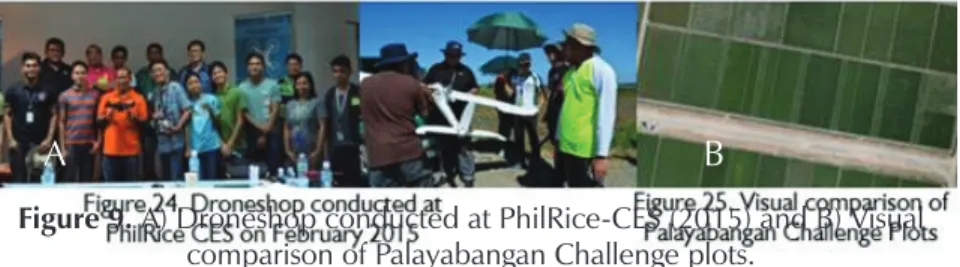
Won two research poster presentation awards - 3rd place at FCSSP 2015, 2nd place at Rice RnD Conference 2015. Development of UAV based Remote Sensing Platform for Rice RnD NL Caballong and RF Barroga. Work on the specification and procurement of equipment and materials necessary for the establishment of UAV service for PhilRice research.
Proof of Concept - UAV imagery provides researchers and stakeholders with a better view of the farm to help them with the results of their experiments, make certain measurements and make more sound decisions. One of the basic advantages of using UAV images is the quick measurement of damaged area is the plot. Demonstration of Automated Water Management Technology NL Caballong, JL De Dios, AC Arocena and HD Cayaban.
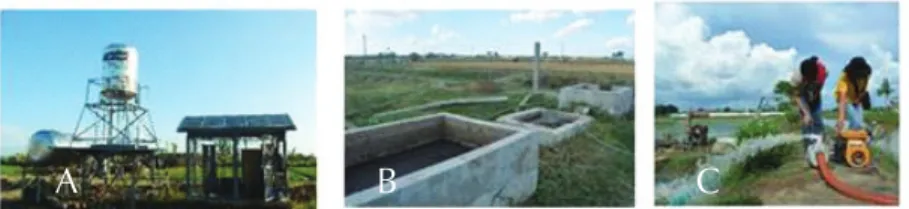
Water management as an essential key in rice cultivation can be supported remotely via an open-source electronics platform. This study shows prototypes intended for efficient and effective water management of rice-based agricultural systems. Demonstrated the prototype water level monitoring model being developed at the PhilRice Information Systems Division under the leadership of Mr. Jovino L. De Dios.
It uses a Raspberry-Pi as a processing unit, an ultrasonic sensor as a water level sensor and solar energy to provide electricity. Laser and GPS technologies are some of the ICTs that can be used to level fields. This study reactivates PhilRice's laser land leveling equipment and demonstrates it in actual operation.
With the help of PhilRice management, the PhilRice laser land leveling system was reactivated. Presentation of a weather monitoring system for use in agriculture NL Caballong, MJP Ancheta, J Tallada and RF Barroga. The purpose of this study is to extend the captured weather data and become useful to the surrounding community by developing a local weather service using AWS as a data source and develop a web application to monitor the ASTI-PhilRice weather stations.
Development And Establishment Of Palayamanan Plus-Nucleus Estate Strategy (PALAYAMANAN PLUS-
The yield of the first harvest of maize on an area of 2,000 m2 was 738 kg of fresh green maize, while the second harvest yielded 1,185 kg. In a maize + mung bean cropping system, rice after rice produced 378 kg of green maize + 27.75 kg of mung bean seeds on an area of 1,000 m2. Garlic-maize+mungbean cultivation system (1000 m2) 170.02kg garlic, 91kg green maize and the mung bean was plowed under as green manure.
The raised beds were planted with vegetables such as kangkong, pechay, eggplant, pepperoni, green beans, broad beans, mustard, lettuce, tomatoes, okra and amaranth. The income achieved was quite low because the soil in the raised beds is still in the process of conditioning and the released fish were lost due to heavy rains during the wet season. Fruit vegetables were eggplant, kangkong, bean, ampalaya and okra with an income of 3484.00.
The main activity in the mushroom production component is the production of oyster mushroom (Pleurotus florida). In addition to mushroom, 400 bags of charred rice husk (CRH) were produced as a by-product during pasteurization of mushroom fruit bags. The CRH was used as a soil conditioner in our vegetable production and some are sold at PhP30.00/. bag.
The vermicomposting component has not yet been operational due to delayed construction of facilities. DAE - days after emergence DAS - days after sowing DAT - days after transplanting DBMS - database management system DDTK - disease diagnostic toolkit DENR - Department of Environment and Natural Resources. IPDTK - Insect Pest Diagnostic Toolkit IPM - Integrated Pest Management IRRI - International Rice Research Institute IVC - In Vitro Culture.
MET – multiple environment trial MFE – male fertile environment MLM – mixed effects linear model Mg – magnesium. MRT – Mobile Rice TechnoClinic MSE – male-sterile environment MT – minimum tillage mtha-¹ - metric ton per hectare MYT – multi-site yield trials N – nitrogen. NCT – National Cooperative Testing AKU – National Food Authority NGO – non-governmental organization NE – natural enemies.
RQCS – Rice Quality Classification Software RS4D – Rice Science for Development RSO – Rice Sufficiency Officer RFL – Rain fed lowland RTV – Rice tungro virus.