ABSTRACT. Using Saleth and Dinar’s water governance framework, the study characterized irrigators’ associations and examined how they operate and how they are managed. A total of 128 association presidents were surveyed in ten provinces in the Philippines and were asked about their knowledge and perception on the organization, natural resource policies, and water status in the locality.
The National Irrigation Systems (NIS) still has a formal structure as influenced by the National Irrigation Administration (NIA), but it is assuming the characteristics of the Communal Irrigation Systems (CIS) management because of the paradigm shift to participatory irrigation management. The CIS, on the other hand, may remain to be an informal organization that is mimicking the character of the NIS, or it may become more formal in operation.
The irrigators’ associations were guided by institutional processes in water pricing. They differed on the basis and the average amount charged, and on modes of collection. Pricing did not reflect the
________________________
1University Researcher, Community Innovations Studies Center, College of Public Affairs and Development (CPAf), University of the Philippines Los Baños (UPLB),
Laguna, Philippines
2Professor, Institute for Governance and Rural Development (IGRD), CPAf, UPLB, Laguna, Philippines
3Professor, Division of Social Sciences, College of Arts and Sciences, University of the Philippines Visayas (UPV), Iloilo City, Philippines
4Professor, College of Management, UPV, Iloilo City, Philippines
5Professor, Institute of Management Faculty, University of the Philippines Baguio, Benguet, Philippines
6Assistant Professor, IGRD, CPAf, UPLB, Laguna, Philippines
*Corresponding author: (+63 49) 536-3284, [email protected]
Comparative Analysis of the
National and Communal Irrigation Systems’ Water Governance:
The Philippines Case
MIRIAM R. NGUYEN1*, AGNES C. ROLA2 , ROSALIE ARCALA-HALL3 , JOY C. LIZADA4 , CORAZON L. ABANSI5 , and MYRA E. DAVID6
true value of water with amounts set arbitrarily, and collections aimed at partial or full cost recovery.
Water administration is concerned with governance of water organization, policy and decision making, functional capacity, and government’s level of influence on the water organization.
Water managers of NIS and CIS had dissimilar perceptions on irrigation water quality and quantity. Water laws (surface water, forest, and land use) were viewed to have moderate to very strong linkage. Water rights were perceived to be common or shared equally by community members. Arising mainly from water scheduling/distribution, conflicts were resolved within the association or at the barangay (village) government.
Keywords: irrigation, water governance, communal irrigation system, national irrigation system, Philippines
INTRODUCTION
In most developing countries, irrigation accounts for at least 70 percent of all water that is consumed (Frederick, 2006).
With increasing scarcity of water due to environmental degradation coupled with rising demand for water in various sectors, use of water as an input to agricultural production becomes limiting.
Water, as an input to production, has many issues. First is the economic return of irrigation water per unit of production that reveals the inefficient use of water in this sector (Schneekloth, Bauder, Hansen, n.d.; Schneekloth, Norton, Clark, & Klocke, 2001).
Second is the focus of agricultural research, which is to make irrigation water use more efficient for technological innovations to minimize wastage (Levidow et al., 2014). And third, which is the focus of this paper, is irrigation water governance that can improve efficiency in water use (Huppert, 2000).
Water governance refers to a “range of political, social, economic, and administrative systems that are in place to develop and manage water resources, and the delivery of water services at different levels of society” (Global Water Partnership, 2003 in Bucknall, Damania, & Rao, 2006). Two core values of governance that surfaced in literature are inclusiveness (members of a group receive equal treatment) and accountability (if things go wrong, those in authority must answer for the group and must be credited if things go well) (Bucknall et al., 2006).
Water governance covers understanding the structure of institutional arrangement under which it operates, and determines who makes decisions and who benefits from these decisions. Globally, there are different models of irrigation water governance, e.g., collaborative management, decentralized and user-centered participatory management, and participatory irrigation management and development, among others.
Franks, Cleaver, Manganga, and Hall (2013) analyzed irrigation water governance in Tanzania by looking at the system of resources, arrangements for access, and outcomes for people and ecosystems. They concluded that development of water resources had been successful because of assured water supply, improved livelihoods, and increased landholdings. In Nepal, water governance was done through cooperation and collaborative management shifting towards decentralized and user-centered participatory management (Sijapati & Prasad, 2014). Similarly, Cambodia adopted the principle of participatory irrigation management and development as well as integrated water resources management. However, discrepancies in the actual governance practices and recommended principles were observed.
The participatory approach was utilized when management was delegated to the community level, i.e., the Farmer Water User Community. However, the Khmer Rouge’s hydraulic mission was used to manage infrastructure projects for large-scale irrigation (Chea, Nang, Whitehead, Hirsch, & Thompson, 2011).
In the Philippines, agricultural demand for water is estimated to be 80 percent of total water demand (Dayrit, n.d.).
However, it remains to have lower priority than domestic water.
In fact, only 47 percent of potentially irrigable areas (3.16 M ha) are irrigated. Worse, shortage of water supply impedes all efforts to augment irrigated areas.
Currently, the irrigation sector is faced with low water-use efficiency attributed to technical and institutional deficiencies.
According to Dayrit (n.d.), the irrigation sector’s major problems are 1) insufficient water control structures needed for equitable and timely water deliveries in the system; 2) irrigation systems not designed to prevent flooding during the wet season; 3) increased siltation of irrigation systems due to watershed degradation and severe erosion during typhoons; 4) irrigation facilities not properly maintained resulting to inefficient water usage; and 5) deficient water management due to weakness in institutions.
Ironically, a large chunk of government budget allocated to agriculture goes to irrigation development. Investments in irrigation development had been increasing since 2008 (Inocencio, David, & Briones, 2014). This means that the state still continuously shoulders the financial burden of the irrigation sector. Recently, this trend is being reversed by transferring the management of irrigation facilities to irrigation associations, especially among National Irrigation Systems (NIS), through the Irrigation Management Transfer (IMT) policy. Management of Communal Irrigation Systems (CIS), on the other hand, should be turned over to the local government units (LGUs) as stipulated in the Agriculture and Fisheries Modernization Act of 1997 and the Local Government Code of 1991.
Two major types of irrigation systems operate in the country: the NIS and the CIS. The NIS scheme has been established and is being maintained by the National Irrigation Administration (NIA). In this type of irrigation system, farmers have to pay an irrigation service fee (ISF) to cover operation and maintenance (O&M) expenditures. The fees collected by NIA should cover costs for O&M and investment. The CIS scheme, on the other hand, has been established either by farmers or by NIA. After project
completion, NIA will turn over the management to the irrigators’
association for O&M (Lauraya & Sala, 1995; Jopillo & delos Reyes, 1998). Unless it can pay the equity (30% of investment), the CIS irrigators’ association has to pay amortization to NIA for the recovery of investment for irrigation facility.
In adherence to the current trend of participatory irrigation management, NIA is now veering away from managing the NIS; thus, letting the irrigators’ associations (IAs) govern by themselves. CIS, on the other hand, is using the less formal and customary rules in governing irrigation water. The primary aim of the two systems is to provide irrigation water to association members at the time it is most needed. Ensuring that water is available at the most critical times is a fundamental issue of governance mechanisms.
This paper aimed to compare the operation of NIS and CIS, and how IAs govern the systems. The NIS may have best practices that can be adopted by the CIS or vice versa. The ideal situation is for both the NIS and the CIS to have a mechanism of governance that is relevant, effective, and adequate to the needs of the members. The paper also determined the water managers’
level of knowledge and perception on the organization, natural resource policies, and water status in the locality. The governance of irrigation water may be gleaned from the quality and quantity of irrigation water in the study areas.
The Irrigation Water Governance Framework
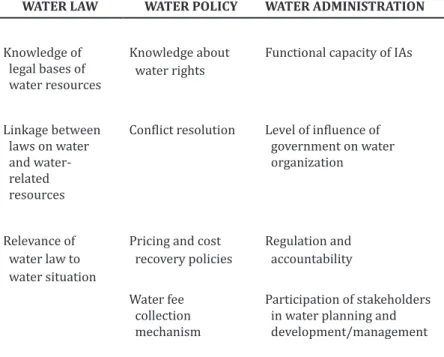
This study used the water governance framework adapted from Saleth and Dinar (2005) to describe irrigation water governance in the Philippines. The elements of the framework considered were the unbundled components of the water laws, water policies, and water administration (Table 1).
Variables of the water law component include knowledge of irrigation water managers on the legal basis of water resources;
linkage between laws on water and water-related resources;
and relevance of water laws to water situation. Variables on
water policies of the organization consist of the water managers’
knowledge on water rights, conflict resolution, pricing and cost recovery policies, and water fee collection mechanisms. Finally, the variables for water administration include the functional capacities of IAs, influence of the government on water organization, regulation and accountability in water resource utilization, and participation of stakeholders in water planning and development/management.
The role of water managers is critical. They must ensure water security and availability. They should see to it that water supply is adequate for water users. For instance, the water district manager has to make sure that clean, potable, and safe water is available to clients while also making certain that the needs of other sectors are met. These sectors include the industrial,
Table 1. Summary of variables in the water governance study based on Saleth and Dinar’s (2005) framework
WATER LAW WATER POLICY WATER ADMINISTRATION
Knowledge of legal bases of water resources
Knowledge about
water rights Functional capacity of IAs
Linkage between laws on water and water- related resources
Conflict resolution Level of influence of government on water organization
Relevance of water law to water situation
Pricing and cost
recovery policies Regulation and accountability Water fee
collection mechanism
Participation of stakeholders in water planning and development/management
business, and agricultural sectors. In the same manner, the IA has to make sure that irrigation water is available and distributed to farms of its members at the right time.
METHODOLOGY Data Sources
Both primary and secondary data were used. The primary data were generated from a survey of more than 300 water managers (water districts, local government-based water system, community-based water system, private water utility organization, and irrigation systems) in ten provinces throughout the country.
For this study, the responses of a subset of 128 IA presidents were examined. Comparative analysis of responses of 64 NIS and 64 CIS irrigators’ association presidents or their representatives was undertaken. Secondary data were sourced from NIA and IA records, and other publications.
Sampling and Data Collection
A sampling frame was obtained by listing all the irrigators’
associations, both CIS and NIS, in each of the ten provinces. The respondents representing congressional districts of each province were selected.
Primary data were gathered through surveys of the IA presidents in the different municipalities categorized by level of development as non-rural and rural1. In the absence of the IA president, the next in rank who manages the affairs of the association was considered as respondent. A respondent was replaced when a CIS-IA of an irrigators’ association was no longer operating and no officer was willing to be interviewed. Secondary data, on the other hand, were collected from NIA, IAs, and other related agencies.
Survey Sites
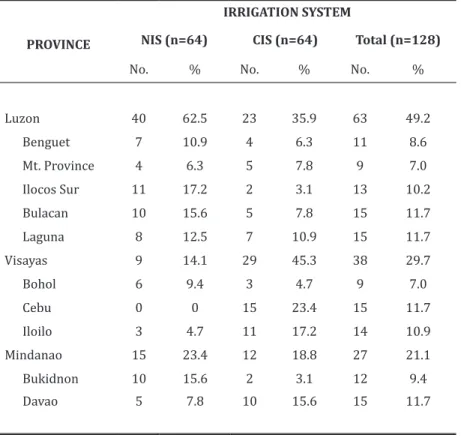
The municipalities surveyed from the 10 provinces covered Benguet, Mt. Province, Ilocos Sur, Bulacan, and Laguna in Luzon; Bohol, Cebu, and Iloilo in Visayas; and Bukidnon and Davao in Mindanao. The irrigation systems were categorized by type as NIS and CIS (Table 2).
Table 2. Distribution of respondents by province and type of irrigation system
PROVINCE
IRRIGATION SYSTEM
NIS (n=64) CIS (n=64) Total (n=128)
No. % No. % No. %
Luzon 40 62.5 23 35.9 63 49.2
Benguet 7 10.9 4 6.3 11 8.6
Mt. Province 4 6.3 5 7.8 9 7.0
Ilocos Sur 11 17.2 2 3.1 13 10.2
Bulacan 10 15.6 5 7.8 15 11.7
Laguna 8 12.5 7 10.9 15 11.7
Visayas 9 14.1 29 45.3 38 29.7
Bohol 6 9.4 3 4.7 9 7.0
Cebu 0 0 15 23.4 15 11.7
Iloilo 3 4.7 11 17.2 14 10.9
Mindanao 15 23.4 12 18.8 27 21.1
Bukidnon 10 15.6 2 3.1 12 9.4
Davao 5 7.8 10 15.6 15 11.7
Data Analysis
Descriptive analyses such as frequencies, means, and percentages were used in the study. There were also cross- tabulations and Likert scales. Whenever applicable, Chi-square test was done to determine if there is significant difference between the two groups, NIS and CIS.
RESULTS AND DISCUSSION
The Role of the National Irrigation Administration
The National Irrigation Administration (NIA), a government-owned and controlled corporation (GOCC), is responsible for the irrigation development and management in the Philippines. By virtue of Republic Act (RA) 3601, NIA was created in June 1963. The NIA charter was later amended by a Presidential Decree (PD) 552 in September 1974 and PD 1702 in 1980, which increased its capitalization and broadened its authority.
Traditionally, NIA is the key agency that provides irrigation water. The elevation of NIA as a separate corporate body in 1963 followed the international trend of hydrocracies, with financial backing from the West, emerging in Third World countries (Molle, Mollinga, & Wester, 2009). Wrestled from the Bureau of Public Works and Irrigation Department, the NIA grew into a large bureaucracy with considerable capitalization (i.e., from PhP300 M in 1963 to PhP2 B in 1974 and to PhP10 B in 1980) under the Marcos dictatorship. With technical support from the US Bureau of Reclamation and financial infusions from international lending institutions (i.e., World Bank and Asian Development Bank) as well as aid agencies (i.e., USAID and JICA), NIA undertook big dam construction projects. Irrigation also extended the reach of the national government to remote areas; thus, further contributing to centralization (Panella, 2004).
The PD 522 in 1974 expanded NIA’s scope of activities to include the management of CIS and the construction of
multipurpose drainage facilities. Consonant with an earlier state- centric focus, NIA’s operations were heavily subsidized by the state, and its irrigation fees were set by the national government.
The 1980s saw significant changes in NIA’s operations, such as increased water charges; reduced control over irrigators’
associations, which were given water rights; divestiture of agency responsibility over irrigators’ associations through graduated stage contracts; and the introduction of participatory irrigation management approaches in its field operations (Panella, 2004).
Decentralization efforts after 1986 further eroded NIA’s control over irrigation associations as responsibility over communal irrigation management was transferred to the LGUs. The continued reliance of LGUs on NIA for technical assistance in managing communal irrigation systems and continued channeling of foreign-funded projects through NIA ensured the agency’s continuous relevance.
However, populist politics under former President Joseph Estrada in 1998 resulted in the drastic cut in irrigation fee, reducing NIA’s revenue base and increasing its dependence again on government subsidy to cover personnel expenses. To date, NIA is beleaguered by low irrigation fee collection and poor performance in meeting its targets (Gutierrez, 2013).
The Irrigation Systems
The Philippines has three irrigation systems, namely:
national, communal, and private. This paper focuses on the large (i.e., NIS) and medium irrigation systems (i.e., CIS).
NIA has constructed NIS covering more than 1,000 ha.
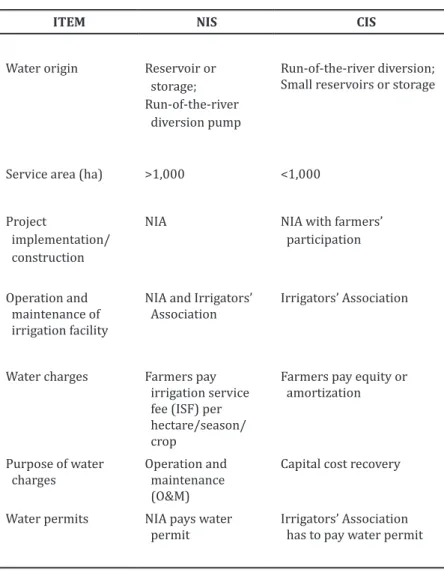
The construction and implementation of the operation of the NIS are responsibilities of NIA (Oprecio, 2005). The O&M of NIS are performed by both NIA and IAs. In terms of water charges, farmers pay irrigation services fee per hectare per season (Table 3). The official policy of NIS is to “recover O&M and at least partial construction costs from farmers subject to their ability to pay.”
Table 3. Water origin, service area, O&M, and water charges of irrigation systems
ITEM NIS CIS
Water origin Reservoir or storage;
Run-of-the-river diversion pump
Run-of-the-river diversion;
Small reservoirs or storage
Service area (ha) >1,000 <1,000
Project
implementation/
construction
NIA NIA with farmers’
participation
Operation and maintenance of irrigation facility
NIA and Irrigators’
Association Irrigators’ Association
Water charges Farmers pay irrigation service fee (ISF) per hectare/season/
crop
Farmers pay equity or amortization
Purpose of water
charges Operation and
maintenance (O&M)
Capital cost recovery
Water permits NIA pays water
permit Irrigators’ Association has to pay water permit
Covering 1,000 ha or less are the CIS that have been built by farmers over the years and more recently by NIA. Construction of CIS irrigation project is done by NIA with the participation of IA members. Upon completion of the project, the CIS is turned over to the IA for O&M. If farmers are unable to pay the equity (30%) for the investment cost of the irrigation facility, they have to pay amortization for the construction cost for a period not exceeding 50 years (Jenkins, Pastor, & Panuccio, 1994). In other words, the CIS is a self-liquidating system.
As of 2013, there were about 245 NIS with a total service area of 821,598 ha. The CIS numbered 10,651 covering 598,473 ha. Of the total irrigated area, 24.5 percent are NIS, 19.1 percent are CIS, and 6.5 percent are the private irrigation scheme (PIS)2. About 1.678 M ha or only 55.59 percent of the 3.1 M ha are considered irrigable land in the Philippines (3% slope devoted to rice and corn), which have been developed for irrigation. A World Bank study reported that there are still 6.1 M ha irrigable areas, which include those that are relatively more difficult to irrigate (i.e., up to 8% slope).
The policy on water charges differs according to the irrigation technology with a bias against the CIS. Whereas the government fully subsidizes the NIS construction cost and about half of O&M, CIS farmers are required to shoulder O&M as well as contribute 10 percent of construction costs in cash or in kind, and to repay the balance without interest for a period of not more than 50 years. Such differential rate of subsidization is not only inequitable, but it also increases farmers’ demand for NIS relative to the lower cost CIS (David, 1995).
As of 2012, NIA operated and maintained 217 NIS nationwide with a total service area of 793,638 ha (Castro, 2004).
In the same year, NIA maintained and operated 9,651 CIS. As of December 31, 2013, there were 245 NIS and 10,651 CIS with service areas of 821,598 ha and 598,473 ha, respectively. In December 2014, irrigation development reached 56.57 percent with 1,311,546 ha of potential irrigable areas remaining to be developed. Such backdrop provided an interesting setting to study the governance of NIS and CIS.
Results of the Irrigation Systems Water Governance Survey
The next section presents the results of the survey among 128 IA presidents in selected provinces throughout the country.
Demographic profile of respondents. About 50 percent of the IA respondents are from Luzon, 30 percent are from Visayas, and 21 percent are from Mindanao (Table 2). Most of the IA presidents in both irrigation systems are male with a mean age of 55 years old for NIS and 58 years for CIS. In terms of educational attainment, Table 4 shows that more than 70 percent of the respondents have reached secondary (33%) and tertiary education (41%).
Table 4. Sex, mean age, and education of respondents by type of irrigation system
CHARACTERISTICS IRRIGATION SYSTEM
NIS CIS
Male respondents
(percent) 92.2 92.2
Mean age (in years) 55.1 57.8
Education (percent)
Elementary 18.8 21.9
High school 40.6 32.8
College 35.9 40.6
Others 4.7 4.7
Water managers’ perception on water quality and quantity. Water quality measures the condition of water, such as chemical, physical, and biological characteristics relative to the requirements of its intended use. These uses include drinking, farming, fish production, industry, recreation, and agriculture.
More frequently, there are quality standards for compliance.
Islam and Shamsad (2009) cited that quality of irrigation water may affect plant growth directly through toxicity or deficiency, and indirectly through altering plant availability of
nutrients. For Frenkel (1979), good water quality potentially allows maximum yield under good soil and water management practices. Poor quality of irrigation water often leads to problems on increased salinity, low soil permeability, deterioration of soil structure, and contamination of soil with potentially toxic substances.
In this study, water quality was rated using indicators of total suspended solids (TSS), Escherichia coli (E. coli), biochemical oxygen demand (BOD), dissolved oxygen (DO), and nutrient level.
Respondents were asked to rate the absence or presence of human or animal feces in water, with a scale of 1-5 with 5 as serious problem. They were also asked to rate TSS, with a scale of 1-5 with 5 as being a high TSS. BOD was indicated by the presence of biodegradable materials as food or fecal matter, with a rating of 1-5 with 5 as high. On the other hand, the indicator for DO was the absence or presence of aquatic animals in the water, with a rating of 1-5 with 5 for none or less aquatic animals. Lastly, the presence of water hyacinths was the indicator for nutrients in the water, with a scale of 1-5 with 5 for more water hyacinths. Meanwhile, scarcity and seasonality of water supply were used as indicators for water quantity.
Though water quality is not so much a concern for irrigation water unlike domestic water supply, it is interesting to determine the perceptions of respondents on the quality of irrigation water. The overall rating for water quality is 2.4, interpreted as moderately good. The IA presidents had no significant difference on the water quality ratings of NIS (2.6) and CIS (2.2) as seen in Table 5.
In terms of water quantity, water scarcity, which is the insufficiency of available water resource in a locality, may be caused by the increasing demand for water and depletion of water resources. Seasonality of water, on the other hand, pertains to the fluctuation in the flow and volume of water in the area within the year. Respondents were asked to rate the supply and the seasonality of water in the area for the past five years.
Table 5. Ratings of irrigation association presidents on water quality, quantity, and strength of legal linkages between surface water and the environment
INDICATOR
IRRIGATION SYSTEM OVERALL MEAN RATINGS
PEARSON SQUARE CHI-
(X2)
NIS CIS
Water quality 2.60 2.20 2.40 0.040
Water quantity 3.75 4.04 3.90 0.011
Legal linkage between surface water and land use
3.70 3.80 3.75 0.030
Legal linkage between surface water and forest
4.00 3.80 3.91 0.000
Note: Chi-square figures are not significant
Interpretation: Water Quality Water Quantity Legal Linkage 2.00 & below Very good Very poor Very weak
2.01 - 2.60 Moderately good Poor Weak
2.61 - 3.20 Slightly good Slightly good Strong
3.21 - 3.80 Poor Moderately good Moderately strong
3.81 & over Very poor Very good Very strong
Notably, water quantity ratings were higher for CIS (4.04, very good) as compared with the NIS rating (3.75, moderately good). Overall rating for water quantity in the study areas was 3.9, interpreted as very good (Table 5).
Knowledge and perception about water laws.
There are water rules and ordinances at the local level, which have implications on the roles of water managers, specifically irrigators’ association presidents. These are rules on maintaining clean water; measures on mitigating water pollution and actions against water pollution; rules on setting water use rates; rules
on establishing water organizations; and rules on protecting and managing watersheds. Meanwhile, rules on water usage in the locality are mostly on the provision of irrigation water, surface water, and public water use, among others.
Linkages exist between laws on water and water-related resources such as surface water, forest, and land use. The water managers were asked about this linkage. Rules and ordinances on surface water are related to certain rules and ordinances on land use that are affecting the irrigation system. Ordinances on land use such as those pertaining to agriculture or specific to the production of sugarcane, banana, rice, or corn have implications on the irrigation system as these will determine the extent of irrigation water requirement or demand. Some of those mentioned by the respondents include mining, kaingin (slash-and-burn farming), and quarrying, agriculture, and water for irrigation purposes only.
Respondents had an over-all mean rating of 3.75 (moderately strong) on the linkage between surface water and land use. On the other hand, respondents perceived that the legal linkage between the surface water and forest was very strong (3.91). However, the Chi-square statistic to test whether there was a difference in the rankings of the NIS and the CIS showed insignificant coefficients (Table 5).
Knowledge and perception about water rights and conflict resolution practices. Water right is the right of a person or group to use water from a water source. It emanates from a person’s ownership of a land within which a water form is located or his/her land is situated along the bank of a nearby water body.
Water rights are given to a group or an individual to regulate the use and enjoyment of surface or ground water.
IAs have exclusive water rights as provided in the locality’s water law. However, majority of the respondents (62%) said that they did not have exclusive rights. These water rights were either individual (35%) or group/collective (65%).
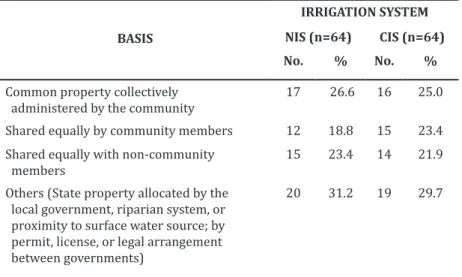
More than half (27% of NIS and 25% of CIS) of the IA managers perceived that water rights are based on the belief
that water is a common property and should be collectively administered by the community. However, more CIS respondents (23%) believed that water rights should be shared equally by community members as contrasted with 19 percent of the NIS. In fact, more NIS respondents (23%) viewed water as a resource to be shared even to non-members of the community as compared with the 22 percent of the CIS respondents who believed so. About one-third (31%) of the NIS respondents as compared with the 30 percent of CIS perceived that water is a state property, and thus, should be allocated by the local government; and that water right is based on the riparian system or through legal arrangement with the government like the issuance of permit or license (Table 6).
Table 6. Knowledge and perception of respondents on the basis of general water rights
BASIS
IRRIGATION SYSTEM NIS (n=64) CIS (n=64)
No. % No. %
Common property collectively
administered by the community 17 26.6 16 25.0
Shared equally by community members 12 18.8 15 23.4 Shared equally with non-community
members 15 23.4 14 21.9
Others (State property allocated by the local government, riparian system, or proximity to surface water source; by permit, license, or legal arrangement between governments)
20 31.2 19 29.7
Meanwhile, conflicts may arise among members of an IA or between an IA member and non-IA member. Among the major causes of conflicts among IA members were the non-payment or late payment of water dues and scheduling of water delivery/
distribution. These conflicts were usually resolved within the IA or in the barangay (village) local government. A number of NIS respondents resolved conflicts with the help of the NIA.
Conflicts at the association level (21%) or at the barangay LGU level (55%) were usually resolved through amicable settlement, e.g., meetings and dialogues (34%), negotiation (15%), and agreements on the rotation of water delivery (9%).
When indigenous peoples (IPs) were involved in the conflict, the council of elders of the ancestral tribe was engaged in conflict resolution.
There were customary or traditional practices (9%) of resolving conflicts in the community. Dialogues/meetings were conducted with the lupon or council of elders and community where agreements are made. General assembly meetings may be called towards resolution of conflicts. Conflicts emanating from water scheduling or distribution were resolved by assigning water use schedule. Majority (52%) of the respondents found these practices very effective in resolving conflicts.
In case of inter-municipality or trans-boundary conflicts, dialogues between elders in the community and the LGU officials were conducted. Meetings within groups of barangays and dialogues between zones were also carried out, whenever necessary. These results suggest that while conflicts arose, these were solved by informal means. The State was not a key player in the resolution of conflicts.
Water pricing. Survey respondents were also asked about water pricing and cost recovery and mechanisms for water fee collection. Below are the results of the survey.
Pricing and cost recovery. Fees collected by NIA from IAs should cover costs for operation, maintenance, and investment within a reasonable time, but in practice, fees just cover capital cost recovery confined to the communal sector. These fees are usually expressed in kilograms of palay (unmilled rice). The rates are estimated per season and depend on the origin or source of water (e.g., river diversion, pumps, or reservoir).
Table 7. Irrigation fees based on cropping season by type of irrigation system, per hectare
CROPPING
SEASON
IRRIGATION SYSTEM MODE OF PAYMENT
NIS CIS
Wet season
(Mean price in PhP) 1,035.75 -
1,328.70 676.31 - 955.00 Palay or cash Dry season
(Mean price in PhP) 1,192.85 -
1,875.00 766.38 - 1,257.00
Water rates set by water organizations were generally based on cost and a margin of profit for future activities or expansion of services. Both NIS and CIS had higher rates during the dry season. It was higher when water was sourced from a reservoir and highest when a water pump was used. Results from the survey show that charges for water ranged from 0 to PhP3,000/
unit. Water rate in this paper also includes charges for the water system since a number of IAs manages community-based water system. This is true to 22 percent of NIS and 23 percent of CIS IAs.
In general, bases of the irrigation water charges include partial or full cost recovery of IS investment or depending on NIA, where rates now become arbitrary.
Mechanisms for water fee collection. Based on the results in Table 8, many of the respondents cited diverse collection mechanisms. Most members of the CIS paid after every cropping (36%). In some IAs, the treasurer of the organization collected the fees (19% of NIS and 20% of CIS), while some NIS managers (12%) said that the bills were distributed house-to-house by no less than the IA president himself.
Water organization and administration. The survey also covered water administration, functional capacity of IA managers, level of influence of the government and other bodies on the water organization, and regulation and accountability.
Results of the survey are shown below.
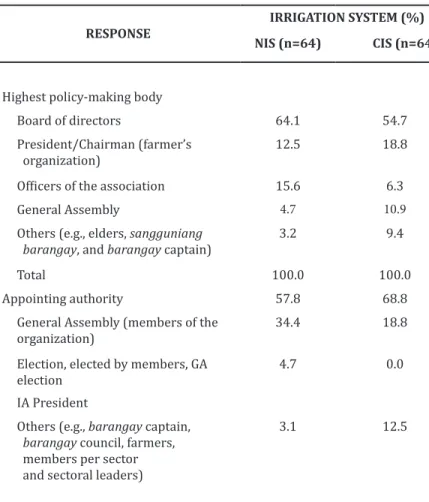
Water administration. The board of directors (BODs) was mentioned as the highest policy making body of the associations for both irrigation systems. The chair of the BODs was usually elected (Table 9). However, there were instances when the chair was appointed or the barangay captain assumed the position. More respondents from the CIS mentioned the chair as being appointed by other authority. There were times when the council of elders automatically became the policy-making body, especially in the CIS. Appointment authority was a privilege of the IA president and the general assembly members. The term of office of the policy- making body of the water organization ranged from one to six years, but mostly for one to three years.
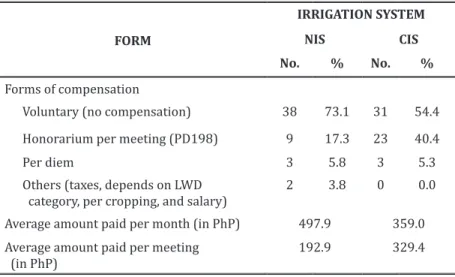
While more than half (52%) of the respondents said that these policy-making body members worked for free, some IAs were able to compensate them in the form of honorarium (Table 10). The NIS manager had a higher monthly pay than the CIS manager, however, the CIS manager had more meetings as compared with the NIS manager.
Table 8. Mechanisms for water fee collection
MECHANISM
IRRIGATION SYSTEM NIS (n=64) CIS (n=64)
No. % No. %
Calendar collection; every month collected
in meetings; collection after every cropping 11 17.2 23 35.9 Treasurer collects fees from association;
members pay to treasurer/secretary 12 18.7 13 20.3 Bills distributed to farmers or house-to-
house by the IA president 8 12.5 2 3.1
Others (during general assembly meetings, purok president collects the payment, pays the barangay treasurer monthly, IA collects, remits to NIA - gets 40% collection after deducting O&M costs and
amortization/ staggered basis)
33 51.6 26 40.6
Table 9. Highest policy-making body and appointing authority for administration of the policy-making body
RESPONSE IRRIGATION SYSTEM (%)
NIS (n=64) CIS (n=64)
Highest policy-making body
Board of directors 64.1 54.7
President/Chairman (farmer’s
organization) 12.5 18.8
Officers of the association 15.6 6.3
General Assembly 4.7 10.9
Others (e.g., elders, sangguniang
barangay, and barangay captain) 3.2 9.4
Total 100.0 100.0
Appointing authority 57.8 68.8
General Assembly (members of the
organization) 34.4 18.8
Election, elected by members, GA
election 4.7 0.0
IA President
Others (e.g., barangay captain, barangay council, farmers, members per sector and sectoral leaders)
3.1 12.5
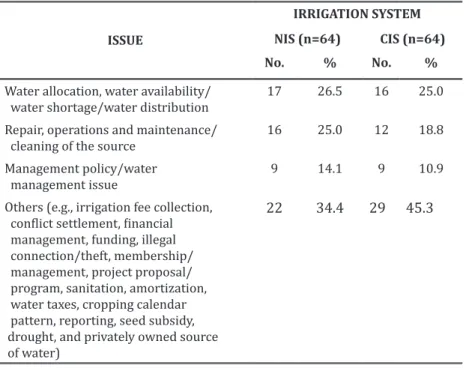
The IAs conducted regular monthly meetings or when there was a need. The frequency of board meetings ranged from 1 to 24 times a year. NIS-IAs were observed to have held more meetings, while more CIS-IAs held meetings once a month. During meetings, issues that had to be addressed and decided upon by the policy-making body of the IA were discussed. Table 11 presents the major issues cited by both the NIS and the CIS, which included the following: repair, O&M, and cleaning of water source;
collection of irrigation fees; water allocation and availability;
association policies/management issues; and others (cropping calendar/pattern, seed subsidy, drought).
Table 11. Major issues discussed during IA meetings
ISSUE
IRRIGATION SYSTEM NIS (n=64) CIS (n=64)
No. % No. %
Water allocation, water availability/
water shortage/water distribution 17 26.5 16 25.0 Repair, operations and maintenance/
cleaning of the source 16 25.0 12 18.8
Management policy/water
management issue 9 14.1 9 10.9
Others (e.g., irrigation fee collection, conflict settlement, financial management, funding, illegal connection/theft, membership/
management, project proposal/
program, sanitation, amortization, water taxes, cropping calendar pattern, reporting, seed subsidy, drought, and privately owned source of water)
22 34.4 29 45.3
Table 10. Forms of compensation and average amount paid
FORM
IRRIGATION SYSTEM
NIS CIS
No. % No. %
Forms of compensation
Voluntary (no compensation) 38 73.1 31 54.4 Honorarium per meeting (PD198) 9 17.3 23 40.4
Per diem 3 5.8 3 5.3
Others (taxes, depends on LWD
category, per cropping, and salary) 2 3.8 0 0.0 Average amount paid per month (in PhP) 497.9 359.0 Average amount paid per meeting
(in PhP) 192.9 329.4
Table 12. Major trainings attended by the respondents
TRAINING
IRRIGATION SYSTEM NIS (n=64) CIS (n=64)
No. % No. %
Basic leadership development course 10 15.6 7 10.9 Technical (production technologies,
water management, etc.) 15 23.4 26 40.6
IA /cooperative management/
administration/bookkeeping 11 17.2 8 12.5
Financial management/computing
for payments 8 12.5 8 12.5
Strategic management 5 7.8 1 1.6
Policy making 1 1.6 3 4.7
Others (no response, not applicable) 14 21.9 11 17.2
The members of the policy-making body of the IAs were able to attend trainings (Table 12). Most CIS attended technical trainings. Trainings on technical matters included pest management, early cropping system, water management, and use of drought-resistant varieties. On the other hand, most of the NIS respondents have attended basic leadership development course; some have attended trainings on financial management/
computing for payments; while others have undergone training on IA management/administration and bookkeeping. In general, most members of the policy-making body of the IAs attended these trainings.
Functional capacity. Functional capacity of IA managers may be gauged by their performance of their major functions such as planning and design; implementation of plans; financial management; O&M; environmental monitoring; research, training, and/or extension activities; inter-agency relationships; and public
Table 13. Respondents’ rating on the functional capacity of IAs
FUNCTION MEAN RATING
NIS CIS
Planning and design 3.98 (VS) 3.99 (VS)
Implementation 3.87 (VS) 3.93 (VS)
Financial management 3.45 (S) 3.66 (S)
Operation and maintenance 3.62 (S) 4.06 (VS)
Environmental monitoring 3.51 (S) 3.70 (S)
Research, training, and extension 3.06 (MS) 3.07 (MS)
Interagency relationships 3.57 (S) 3.83 (VS)
Public relations accountability 3.63 (S) 3.84 (VS)
Overall Rating 3.59 (S) 3.76 (S)
Interpretation:
2.00 & below Very weak (VW) 3.21 - 3.80 Strong (S) 2.01 - 2.60 Weak (W) 3.81 & over Very strong (VS) 2.61 - 3.20 Moderately strong (MS)
relations. These were rated by the respondents in terms of the level of strength or weakness (Table 13). Mean rating of the NIS respondents ranged from 3.06 (moderately strong for research, training, and extension) to 3.98 (very strong for planning and design). For the CIS respondents, mean ratings ranged from 3.07 (moderately strong for research, training, and extension) to 4.06 (very strong for environmental monitoring). Looking at the overall rating of the IAs for functional capacity, the NIS had lower rating of 3.59 as compared with the CIS at 3.76.
Level of influence of the government and other bodies on the water organization. National and regional offices of the National Water Resources Board (NWRB), NIA, Department of Environment and Natural Resources (DENR), Department of Agriculture (DA), Department of the Interior and Local Government (DILG), Laguna Lake Development Authority (LLDA), and others had influence on the associations. Similarly, local institutions such as the LGU and the council of elders had influence on the associations. This
Table 14. Respondents’ ratings on the level of influence of government institutions on IAs
INSTITUTION/BODY IRRIGATION SYSTEM
NIS CIS National government e.g., NWRB, NIA,
DA, DENR, DILG, LLDA 4.20 (VHI) 4.30 (VHI)
Regional offices of national government 3.50 (HI) 3.60 (HI)
Municipal government 3.80 (HI) 3.50 (HI)
Barangay council 3.50 (HI) 3.60 (HI)
Statutory bodies 2.90 (MI) 2.10 (LI)
IP/Council of elders 3.10 (MI) 2.20 (LI)
Interpretation:
2.00 & below No influence (NI) 3.21 - 3.80 High influence (HI) 2.01 - 2.60 Least influence (LI) 3.81 & over Very high influence (VHI) 2.61 - 3.20 Moderate influence (MI)
influence may be in the O&M of the organization or on the use and protection of water resource (Table 14).
Respondents rated this level of influence with the following: (1) national government agencies were rated to have
“very high influence” by both the non-rural and rural respondents in both NIS and CIS; (2) regional offices were rated to have
“high influence on the associations;” (3) local government units (municipal and barangay) were rated to have “high influence;”
(4) statutory bodies were rated to have “moderate influence”
by the NIS and to have “no influence” or have “low influence” by the CIS respondents; (5) IP council of elders were rated to have
“moderate influence” by the NIS and to have “low influence” by the CIS. Hence, for the respondents, national government agencies had the highest influence in the IAs, although the LGUs had high level of influence on them.
Regulation and accountability. Table 15 shows
the respondents’ rating on the effectiveness of regulatory mechanisms at the implementation stage. Overall, the regulatory
Table 15. Respondents’ rating on the effectiveness of the regulatory mechanisms at the implementation stage
FUNCTION MEAN RATING
NIS CIS
Legal regulations (both national
and local regulations) 3.66 (E) 3.71 (E)
Administrative directions 3.96 (VE) 4.03 (VE)
Pollution control agencies 3.49 (E) 3.58 (E)
River boards/river councils 3.43 (E) 2.78 (ME)
Basin/watershed organizations 3.53 (E) 2.32 (LE)
Withdrawal restrictions 3.02 (ME) 3.16 (ME)
(water rights, quota)
Limits on moving water across regions
(surface water) 3.35 (E) 2.87 (VE)
Overall Rating 3.49 (E) 3.21 (E)
Interpretation:
2.00 & below Not effective (NE) 3.21 - 3.80 Effective (E) 2.01 - 2.60 Less effective (LE) 3.81 & over Very effective (VE) 2.61 - 3.20 Moderately effective (ME)
mechanisms were perceived to be effective by both NIS and CIS respondents. From the regulatory mechanisms, legal regulations and administrative directions were helpful to the NIS and CIS managers in the implementation stage.
In terms of administrative directions, regulatory mechanisms were recognized by both NIS (3.96) and CIS (4.03) managers as very effective. Regulation mechanisms of pollution control agencies were rated to be effective by both types of managers. Regulatory mechanisms of river boards/councils were rated effective by the NIS and moderately effective by the CIS respondents. The regulatory mechanism of the basin/watershed
organization was also rated effective by the NIS and less effective by the CIS. Withdrawal restriction mechanisms were rated as moderately effective by the respondents of both systems. The mechanism on moving water across areas was perceived to be effective by the NIS and very effective by the CIS.
As revealed in Table 16, the overall effectiveness of legal provisions of accountability in administrative operations was rated as effective by both NIS and CIS. Administrative supervision was perceived to be very effective by both types of irrigation systems. Most accountability provisions were rated higher by the CIS relative to the ratings of the NIS. It can be deduced; therefore, that from the legal provisions of accountability, the administrative supervision was appreciated the most in water organizations, especially by the CIS. Legal provision in financial auditing was appreciated, but not as much compared with administrative supervision. Also, NIS farmers may find work auditing to be less necessary in their organization compared with the CIS farmers.
This was perhaps because the latter needed to work to pay NIA with the required maintenance fees even without some legal provisions. The very effective rating given to a grievance council by CIS farmers in both non-rural and rural provinces suggest that this body had been serving its function and/or it was needed by their organization. The very effective rating on monitoring procedure for water allocation by the CIS can have the same explanation. Legal provision on having meetings attended by heads of water organizations was perceived to be effective mostly by CIS managers. This may also suggest the need to have more of such meetings within their organization.
Summary Measures of Irrigation Water Governance
Three other items were asked from the respondents to summarize the water governance in their organizations. These were 1) the relevance of the existing water laws to the current water situation faced by the managers; 2) the linkage between water policy of the organization and the water law set by the
Table 16. Respondents’ rating on effectiveness of legal provisions of accountability as translated administratively
ACCOUNTABILITY PROVISION MEAN RATING
NIS CIS
Administrative supervision 4.01 (VE) 3.98 (VE)
Financial auditing (public accounts
committee) 3.72 (E) 3.66 (E)
Work auditing 3.63 (E) 3.91 (VE)
Grievance council 3.41 (E) 3.88 (VE)
Monitoring procedures for sectoral
and regional water allocation 3.68 (E) 3.83 (VE) Inter-ministerial committees (joint
meeting of heads of different units within the water organization)
3.17 (ME) 3.51 (E)
Overall rating 3.60 (E) 3.80 (E)
Interpretation:
2.00 & below Not effective (NE) 3.21 - 3.80 Effective (E) 2.01 - 2.60 Less effective (LE) 3.81 & over Very effective (VE) 2.61 - 3.20 Moderately effective (ME)
LGUs, if any; and 3) the adequacy of the administrative set-up to operationalize the water policy and water law. Water policy was limited to water pricing, while the water law was about water rights.
Results in Table 17 show that respondents in the CIS rated the relevance of the existing water laws to the current water situation in the locality higher than those in the NIS. However, respondents in the NIS rated the reflective nature of water policy regarding water law higher than the respondents in the CIS. They had similar ratings in the adequacy of the administrative set-up of the organization to operationalize the water law and water policy.
Table 17. Irrigation managers’ rating on relevance of the existing laws to the current water situation, linkage between water policy and water law, and adequacy of administrative set-up to operationalize water policy and water law
INDICATOR
IRRIGATION SYSTEM OVERALL MEAN RATINGS
PEARSON SQUARE CHI-
(X2)
NIS CIS
Relevance of the existing water laws to the current water situation in the locality
3.70 4.00 3.90 0.021
Linkage between water policy of the organization and water law set by the LGU
3.90 3.76 3.83 0.005
Administrative set-up to operationalize water policy and water law
3.86 3.84 3.85 0.091
Note: Chi-square figures are not significant
Interpretation: Relevance Linkage Administrative set-up 2.00 & below Not relevant Not reflective Not adequate 2.01 - 2.60 Less relevant Less reflective Less adequate 2.61 - 3.20 Moderately relevant Moderately reflective Moderately adequate 3.21 - 3.80 Relevant Reflective Adequate
3.81 & over Very relevant Very reflective Very adequate
This implies that the NIS still had the formal structure as an influence of the NIA. On the other hand, the CIS may be informal, but it was becoming more formal in operation, mimicking the character of the NIS. With the paradigm shift to participatory management of irrigation water, the NIS was also assuming the characteristics of informal management of the CIS.
CONCLUSIONS AND RECOMMENDATIONS
Irrigation water organizations were guided by various institutional processes in the pricing of water. They differed in the average amount charged (higher among NIS), in the bases of charging, and in the modes of collection. Pricing did not reflect the true value of water as shown by amounts that were set arbitrarily, and collections aimed at partial cost recovery or full cost recovery.
Thus, it is recommended that NIA should revisit its water pricing policy.
Conflicts that occurred among water organization members were usually resolved at the organization level. These were mostly on the non-payment of dues, water scheduling, and water distribution. Collection of irrigation fees and organization dues remains to be a challenge to some IAs, which calls for designing mechanism to improve collection efficiency.
Water administration is concerned with the governance of the water organization. In this study, governance included its policy making body, how the members were compensated, their decisions and actions, trainings attended, functional capacity, and the level of influence of the government and other bodies.
It also entailed the effectiveness of the regulatory mechanisms at the implementation stage; the effectiveness of legal provisions of accountability as translated administratively; the relevance of existing water laws to the current situation faced by the managers;
the linkage between water policy of the organization and the water law set by LGUs; and adequacy of administrative set-up to operationalize the water policy on water pricing and water law (water rights).
The BODs of the organization, elected through the general assembly, was the highest policy making body in most of the national and communal irrigation systems. Their term of office was mostly from one to three years. On both NIS and CIS, more than half of the BODs served without compensation, while those with compensation were paid per month or per meeting. The average compensation per month of the NIS BODs was higher
(PhP497.00) than that of CIS (PhP359.00). Likewise, the average honorarium per meeting of the CIS and NIS were PhP329.41 and PhP192.86, respectively.
The issues discussed during BOD meetings were similar for both NIS and CIS such as management policy and operation and maintenance. Majority of the BODs of the NIS and CIS have attended trainings on leadership, production technologies, water management, cooperative management, bookkeeping, and financial management with a few training on strategic management and policy-making. The overall rating on the functional capacity of NIS and CIS managers was strong. Meanwhile, their research, training, and extension capability was moderately strong.
The level of influence of the national government such as NWRB, NIA, DA, DENR, and DILG was noted by both NIS and CIS managers as very high, while the influence of regional offices of the national government and local government units was high.
Overall, the regulatory mechanisms at the implementation stage were perceived to be effective by both NIS and CIS managers.
Specifically, they rated administrative directions as very effective and withdrawal restrictions such as water rights and quota as moderately effective. Notably, regulatory mechanism on basin/
watershed organizations was perceived as less effective by CIS managers.
The NIS and CIS managers noted that the overall legal provisions of accountability in administrative operations was effective. Particularly, they rated administrative supervision as very effective. In addition, for CIS-IA managers, work auditing, grievance cells and monitoring procedures for sectoral and regional water allocation were very effective legal provisions of accountability in administrative operations. On the other hand, the NIS managers perceived inter-ministerial committees as moderately effective.
For the water governance situation in irrigation systems, the IA managers perceived that the existing water laws were
very relevant to the current situation in their locality, the linkage between their organization’s water policy and the water law set by the LGUs was very reflective, and the administrative set-up to operationalize water policy and water law was very adequate.
Although the overall rating on the functional capacity of IA managers in both NIS and CIS was strong, a significant number of the BODs have not undertaken any training courses. All members of the Board should undergo relevant training courses to capacitate them, particularly in research, training, and extension.
The effectiveness of regulatory mechanisms on water rights needs to be improved. Therefore, seminars or fora on water rights should be continuously conducted for the IA managers of both NIS and CIS.
Finally, the managers of the CIS rated the relevance of existing laws to the current water situation higher than the NIS managers. However, the NIS managers rated the reflective nature of water policy regarding water law higher than the CIS managers. They rated similarly the adequacy of the organization’s administrative set-up to operationalize the water law and water policy. This implies that the NIS still has a formal structure as influenced by NIA, but it is assuming the characteristics of CIS management because of the paradigm shift to participatory irrigation management. The CIS, on the other hand, may remain to be an informal organization that is mimicking the character of the NIS, or may become more formal in operation.
ACKNOWLEDGMENT
The authors thank the Emerging Interdisciplinary Research Program (EIDR) of the University of the Philippines System for the generous support in the research and writing of this article (OVPAA –EIDR Code 2-003-121010).
LITERATURE CITED
Bucknall, J., Damania, R., & Rao, H. (2006). Good governance for good water management. Environment Matters.
Washington, D.C.: The World Bank Group.
Castro, V. (2004). Analysis of the water pricing policy in selected irrigator’s associations of four provinces, Philippines.
MS Field Study, University of the Philippines Los Baños, Laguna, Philippines.
Chea, C., Nang, P., Whitehead, I., Hirsch, P., & Thompson, A.
(2011). Decentralized governance of irrigation water in Cambodia: Matching principles to local realities. Working Paper Series No. 62. Phnom Penh, Cambodia: Cambodia’s Leading Independent Development Policy Research Institute (CDRI).
David, C. (1995). Philippine irrigation development: Overview, determinants, and policy issues. Discussion Paper Series No. 95-26. Manila, Philippines: Philippine Institute of Development Studies.
Dayrit, H. (n.d.). The Philippines: Formulation of a National Water Vision. FAO publication. Retrieved from www.fao.org/
docrep on April 30, 2015.
Franks, T., Cleaver, F., Manganga, F., & Hall, K. (2013). Evolving outcomes of water governance arrangements: Smallholder irrigation on the Usangu Plains, Tanzania. Environment, Politics and Development Working Paper Series, Paper No.
62. Department of Geography, King’s College, London.
Frederick, K. D. (2006). Irrigation efficiency, a key issue: More crops per drop. In P. P. Rogers, M. Ramom Llamas, and L. Martinez- Cortina (Eds.). Water Crisis: Myth or Reality? London/
Leiden/New York/Philadelphia/Singapore: Taylor and Francis.
Frenkel, H. (1979). Assessment of water quality for irrigation.
ACTA Hortic. 89: 29-30.
Gutierrez, N. (2013). Disappointed Aquino scolds NIA for poor performance. Retrieved from www.rappler.com/
nation/32200-disappointed-aquino-scolds-nia-for-poor- performance on October 2, 2013.