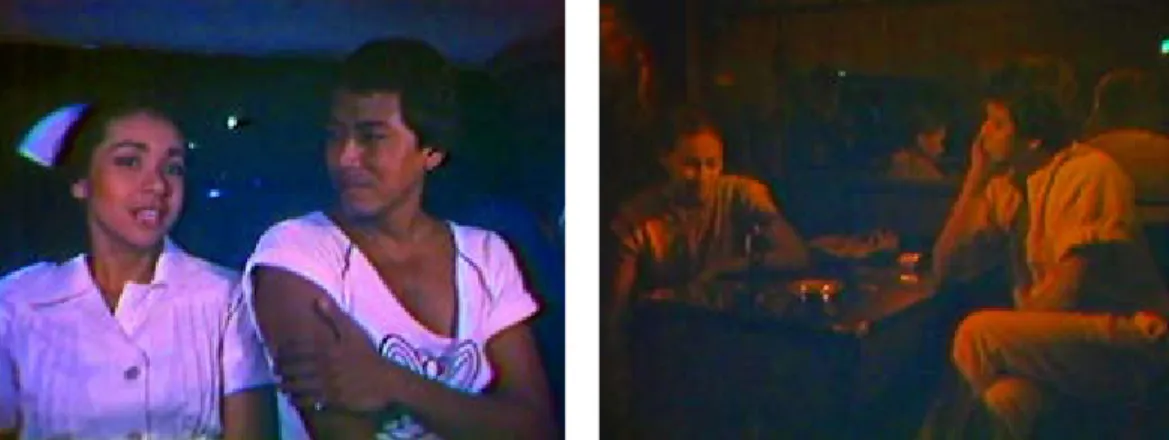
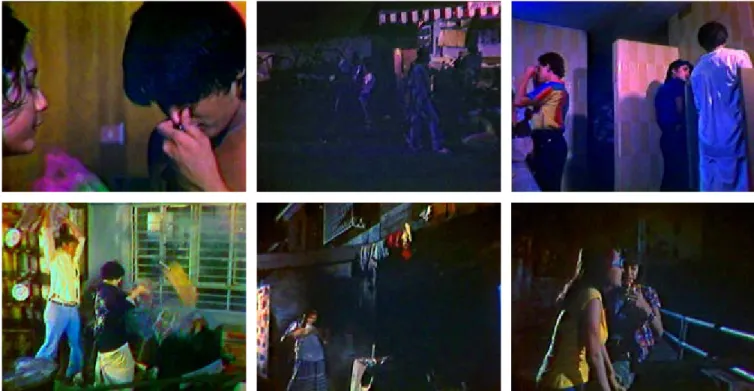
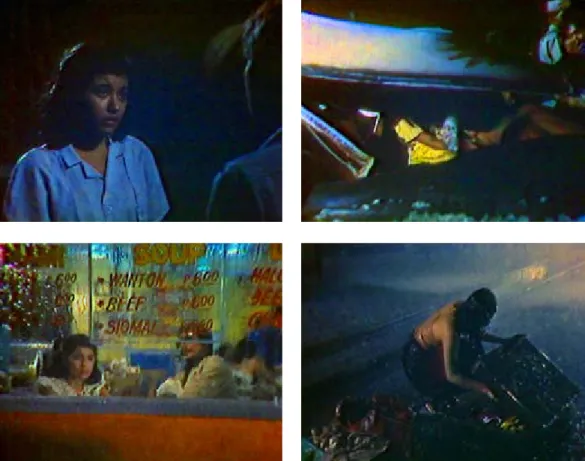
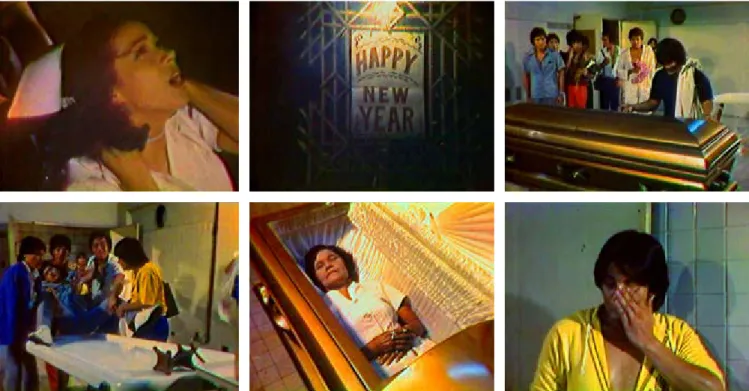
In the organization's official anthology for the 1980s, the Manila by Night review concludes that "The film's technical aspects are not exactly first-rate, but they are well above average" (Bautista 158); it then qualifies the statement by beginning with "What is more important is". To better understand Bernal's documentary strategies in Manila by Night, visual samples in the form of frame shots will be presented alongside then (and perhaps still) contemporary markers, along with a cursory discussion of the same technical elements. David / Film Plastics in Manila at Night 46 . the subject relates her intimate thoughts and feelings) to another character in the text.6.

Documentary Effects
The answer can be chosen in the next section, which will review several groups of footage that show how Manila at Night used not only ethnographic research techniques to develop the content, but also documentary stylistics to present these findings in a relevant way, so to speak - that is, on a way that would not be mistaken for film fiction, but could easily be identified as film documentation. The film is consistent in crossing the axis between characters to fit social commentary into the scene, like the previous example to show the couple's closeness to their own children and then to show how any voyeur can easily peek through their bedroom window and, just like camera, violates their privacy. Although the practice has become commonplace in postmodernist literature, it is still safely enshrined in film practice in the sense that either the work must be documentary (and therefore reflexive markers may be permitted along with other "mistakes" in the production) or it must be marked as a fiction within a fiction (with Billy Wilder's Sunset Blvd. as the original model).
Yet one of the least noticed aspects of Nashville is its closing sequence: when the crowd, shaken by an assassination, is comforted, consoled, and otherwise mesmerized by the unexpected emergence of a new talent, the coverage becomes distinctly documentary- like without warning, with camera and sound crew captured as they move around and certain "raw" lens and lighting adjustments (eg stretch-focused telephoto shots) included in the footage. In Manila by Night these indicators appear literally, as light sources directed straight into the camera (fig. 10; see also one of the shots with a window in the background in fig. 8). Al Tantay (husband of Rio Locsin, who plays Bea) prepares for a death scene; Marissa Delgado, who once played a prostitute in an earlier Bernal film, plays a nurse on set; in an earlier scene (cf. fig. 8), the only character destined for death, Adelina (whose masquerade Bea and Manay are about to expose), peers anxiously into a mirror.
Delgado is seen applying and touching up her own make-up in a hand mirror – creating a connection between her and Adelina Macapinlac, whose transition in the film would be in the opposite direction, from nurse to sex worker; to strengthen the connection, they launched the actress Adelina, Alma Moreno in Ligaw. In its compositional aspects, Manila by Night shares Nashville's technical presupposition—which expanded on a long-dormant formal innovation in film: deep focus, hailed by André Bazin as a method that resolved an earlier debate in cinematic essentialism—however whether the specificity of the medium lay in the (originally shallow) shots or in the meaningful juxtaposition of these shots through montage. The challenge Altman set himself - delineating about two dozen protagonists in a regular production - was possible only with the introduction of high-speed film stock.
Altman's innovation will extend to sound design, which will be discussed in subsequent sections.
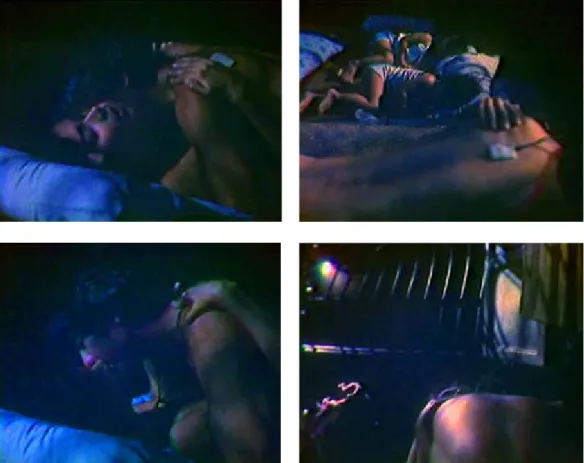
Manila by Night had a large enough ensemble to allow certain characters to speak in certain ways. Bea, the blind masseuse hoping for the kind of salvation Virgie had achieved, wallows in the same frustration and rage, to the extent of betraying the only person who truly loved her. Adelina is Virgie in reverse, in the sense of having been unable to rise in social status as well as in accepting and maintaining her nightlife profession, while feigning respectability in her masquerade as a nurse in the town hospital.
In contrast to these overtly contradictory female characters, the straight men are unusual only in that they reject the then-standard Western statement of exclusive heterosexuality, and instead (following the logic of the prison - cf. Fleisher and Krienert) consider conquest their of gay admirers. as an enhancement of their sense of machismo. And while we can generally see characters like Manay and Kano as embodying a middle ground - male and female in the same presence, in a way that has become increasingly acceptable even in modern contemporary cinema - this kind of compromise- by definition is fraught with dangers and difficulties, although it is fascinating how Bernal guides their characterization with a keen understanding of their strengths and weaknesses.7 In Manay's case, the trade-offs are more according to a character trying to cope with a surprising group of several types of survivors in the urban jungle, while making sure he gets his share of the available beefcake. In the case of the film, this would have been Magna Tech Omni Studio, as acknowledged in the closing credits.).
Rather, what led to Bernal's films, beginning with Aliw and Manila by Night, was a fusion of seemingly contradictory values of documentary "noise" (in the sense of small talk, rather than non-human or lifeless dissonant sounds) that in the studio was created, just as its characters on a narrative level also embodied severe and unstable contradictions. This argument has been subjected to a number of possible deconstructive qualifiers, in the sense, for example, that sound per se is also associated with patriarchal interdiction.
In this sense, he went a step further than using sound within the standard feminist argument that it is the female counterpart of the image (cf. Lawrence). The first example of pop music in Manila by Night is a live performance of Crosby, Stills, Nash & Young's "Teach Your Children" at a folk music cafe, and unlike in Aliw, this separation between diegetic pop and non-diegetic prog-electronica is maintained. Typical of the wit behind the selections is the insertion of Festival's harmless-because-fluffy disco version of "Don't Cry for Me, Argentina," from the Andrew Lloyd Webber musical Evita (also the name of one of the characters , a client) of Manay) - which was banned in the Philippines due to its reference to Imelda Marcos at the time.
As an example, we could inspect two examples of how sound and music are interwoven to provide commentary on the dialogue, both in this case involving the film's queer characters. Jeff Beck's prog-jazz number, "Full Moon Boogie", places the action in the "cool" present, while the sound of the Space Invaders video arcade game played by Kano foreshadows a more individualistic and self-absorbed future, even as the two engage in a age-old debate about the merits and demerits of true love. In this example, the interplay between the sound elements is more complicated, with some elements, such as dialogue, functioning as music and vice versa, according to high modernist precepts (Adorno and Eisler 27-30).
The diegetic disco track, Lipps, Inc.'s "Funkytown," presumably played on park speakers, ironically contrasts the angsty exchange between Manay and Febrero, the comments of Manay's gay friends, and the pleas of the circle of cultists. City,” is recited by the real-life poet himself, but in this case it serves as the equivalent of the classic Hollywood non-diegetic musical commentary that really serves to remind the audience that despite all its shattered dreams, Manila will continue to hold out as it had done previously.
Open closure
Since formal higher education in film in the Philippines did not begin until 1984, when the institution now known as the Philippine Film Institute first opened its Bachelor of Arts in Film program, candidates of previous generations had to prepare themselves. and arrangements with individual practitioners (Vasudev 17). Around the time Bernal was arranging his film training, Avellana had already begun to focus on what turned out to be an extensive specialization in documentary production, beginning in the mid-1950s with Si Mang Anong and culminating in the international prize in 1969 for The Survivor ("Alternative Cinema"), with his brother Jose Avellano and a growing circle of similarly dedicated practitioners; Indeed, Bernal became the secretary of the Philippine Film Society, which is headed by documentary filmmaker Ben Pinga (Vasudev 17). A further claim to Bernal's interest would be the timing of his literature and philosophy studies in France, where the influence of cinéma vérité practitioners would be felt in the stylistic experiments of the Nouvelle Vague.
The context of the discussion was that the next Filipino to make a Cannes debut would be Mike de Leon, whose technical prowess was considered superior to Bernal's. His emphasis on this detail in the film's reception can attest to his motivation as much as his appreciation for viewers who could accurately read his aesthetic intentions. It may be necessary at this point to provide a helpful description of the highlights of the story so that the reader can follow the characters that will be mentioned in the upcoming examples.
Calvin Pryluck refers to the crisis in cinéma vérité where "the method of obtaining consent is stacked in the filmmaker's favor" as "the presence of the film crew with official sanction is subtly coercive" (256). Interim Board of Censors for Motion Pictures (IBCMP), Office of the President, Republic of the Philippines.