How Do We Finance Universal Health Care
in the Philippines? *
RAMON PEDRO P. PATERNO
The Policy Questions
This paper addresses the following health policy questions:
• How much will universal health care (UHC) cost?
• Can we generate the needed revenues?
• What would be the optimal combination of tax generated revenues and social health insurance (SHI) premium generated revenues to meet the financial cost of UHC?
• Should the SHI premiums for the informal sector be contributory or non- contributory (subsidized through taxes)?
refined in the course of recent global developments regarding how developing countries can best achieve universal coverage rapidly. The original question had an underlying issue of whether UHC should be financed primarily through a tax-funded national health service or through SHI. There is, however, a fine line distinguishing a tax-funded national health service and a social health insurance-financed system.
* The author would like to acknowledge the research assistance furnished by Julian Canero, MD;
The original question, “How do we finance UHC in the Philippines?” has
The World Health Organization (WHO) has in fact suggested that the path towards universal coverage would either be tax-financed or social health insurance-based, or a combination of both (Carrin 2004); the Department of Health’s Health Care Financing Strategy 2010–2020 echoes this (DOH 2010a). The Philippines’ path would most likely be a combination of both given its historical development of a tax-funded Department of Health (DOH) and a premium-based Philippine Health Insurance Corporation (PhilHealth).
Recognizing that health is both a human and constitutional right and that there is a need to address increasing health inequities and disparities among regions and income groups, the present administration under President Benigno S. Aquino III has committed to achieve universal health care in the Philippines by the end of his term in 2016 (DOH 2010b). The Aquino Health Agenda (AHA) and the DOH’s Kalusugan Pangkalahatan (KP) both recognize three basic health system problems that have to be addressed: low financial protection for the poor, low access by the poor to quality health services (access to quality health facilities), and difficulties in achieving the Millennium Development Goals by 2015 (DOH 2011).
To address the low financial protection afforded the poor, the AHA called for a revitalized and refocused national health insurance program that would lead to an expansion of coverage by the enrollment of the poorest of the poor with premiums subsidized by the national government, and mandatory enrolment of the informal sector with sharing of premium payments between the informal worker and the local government unit (LGU). The AHA specifically calls for the informal sector to pay PHP100 per month, which PhilHealth plans to raise to PHP200 per month (PhilHealth 2011).
Recent developments in the global experience in SHI have raised the issue of the impact of a contributory SHI for the informal sector on the ability of a developing country to achieve universal coverage rapidly. Contributory means that the informal sector is expected to pay the premium for SHI coverage.
Presuming that the administration will commit the necessary funding for UHC, the question and its derivatives therefore arise: how should the Philippines finance a health care system that can ensure access to quality health care for all Filipinos?
How Do We Finance Universal Health Care
in the Philippines? *
RAMON PEDRO P. PATERNO
The Policy Questions
This paper addresses the following health policy questions:
• How much will universal health care (UHC) cost?
• Can we generate the needed revenues?
• What would be the optimal combination of tax generated revenues and social health insurance (SHI) premium generated revenues to meet the financial cost of UHC?
• Should the SHI premiums for the informal sector be contributory or non- contributory (subsidized through taxes)?
refined in the course of recent global developments regarding how developing countries can best achieve universal coverage rapidly. The original question had an underlying issue of whether UHC should be financed primarily through a tax-funded national health service or through SHI. There is, however, a fine line distinguishing a tax-funded national health service and a social health insurance-financed system.
* The author would like to acknowledge the research assistance furnished by Julian Canero, MD;
The original question, “How do we finance UHC in the Philippines?” has
The World Health Organization (WHO) has in fact suggested that the path towards universal coverage would either be tax-financed or social health insurance-based, or a combination of both (Carrin 2004); the Department of Health’s Health Care Financing Strategy 2010–2020 echoes this (DOH 2010a). The Philippines’ path would most likely be a combination of both given its historical development of a tax-funded Department of Health (DOH) and a premium-based Philippine Health Insurance Corporation (PhilHealth).
Recognizing that health is both a human and constitutional right and that there is a need to address increasing health inequities and disparities among regions and income groups, the present administration under President Benigno S. Aquino III has committed to achieve universal health care in the Philippines by the end of his term in 2016 (DOH 2010b). The Aquino Health Agenda (AHA) and the DOH’s Kalusugan Pangkalahatan (KP) both recognize three basic health system problems that have to be addressed: low financial protection for the poor, low access by the poor to quality health services (access to quality health facilities), and difficulties in achieving the Millennium Development Goals by 2015 (DOH 2011).
To address the low financial protection afforded the poor, the AHA called for a revitalized and refocused national health insurance program that would lead to an expansion of coverage by the enrollment of the poorest of the poor with premiums subsidized by the national government, and mandatory enrolment of the informal sector with sharing of premium payments between the informal worker and the local government unit (LGU). The AHA specifically calls for the informal sector to pay PHP100 per month, which PhilHealth plans to raise to PHP200 per month (PhilHealth 2011).
Recent developments in the global experience in SHI have raised the issue of the impact of a contributory SHI for the informal sector on the ability of a developing country to achieve universal coverage rapidly. Contributory means that the informal sector is expected to pay the premium for SHI coverage.
Presuming that the administration will commit the necessary funding for UHC, the question and its derivatives therefore arise: how should the Philippines finance a health care system that can ensure access to quality health care for all Filipinos?
The Context The Philippine Health Financing Situation
The Philippines faces major health financing issues similar to other countries of the WHO Western Pacific Region. They are: chronic underfunding, inequitable sourcing of funding (low public spending leading to high out-of-pocket spending), efficiency issues in terms of allocation of limited financial resources, and payment mechanisms leading to higher health care costs. In addition, there is fragmentation and overlap of the various health financing institutions—DOH, PhilHealth, and LGUs.
Underfunding of the Health System
From 1995 to 2007 the Philippines’ total health expenditure (THE) as a nation had ranged from 3.4 to 3.7 percent of gross domestic product (GDP). In 2007, the Philippines spent PHP235 billion or 3.5 percent of GDP on health (figure 1). The black line tracks the Philippines’ health expenditure. The grey line tracks what it should have been at 5 percent of GDP.
WHO recommends 5 percent of GDP as public or government health expenditure. Evidence within the Asia Pacific Region, which covers the 37 countries of the WHO Western Pacific Region and the 11 countries of the WHO South-East Asia region, suggests that the percentage of households experiencing catastrophic health expenditures tend to decrease significantly when public health expenditure is greater than 5 percent of GDP (WHO 2009, appendix 1).
Figure 1. The Philippinesʼ total health expenditure (THE), 1995-2007
T H E 5 % G D P
1995 1996 1997 1998 1999 2000 2001 2002 2003 2004 2005 2006 2007 350
300 250 200 150 100 50 0
year
billion pesos
Government share (both national and local) of THE had steadily decreased from the year 2000 and was only PHP61 billion, or 26.6 percent, of THE in 2007;
Philhealth’s share had risen, but at a very slow rate, and had even decreased from 2005 to only PHP20 billion, or 8.5 percent, of THE. As a result, out-of-pocket share had risen to 54.3 percent (PHP127 billion) of THE in 2007 (figure 2).
Figure 2. Trends in out of pocket spending versus Philhealth and government share in Total Health Expenditure
Source: National Statistical Coordination Board 2007
Almost half of THE in 2007, or around PHP110 billion out of PHP235 billion, was spent on pharmaceuticals.
The National Statistical Coordination Board (NSCB) has updated the national health accounts for the years 2004-2008 and presented these at the 12th National Forum on Health Research for Action on November 14, 2011 (figure 3). This latest update, however, only covers the years 2004-2008, and hence 2007 figures were used above to show trends from 1995.
year
percentage
The Context The Philippine Health Financing Situation
The Philippines faces major health financing issues similar to other countries of the WHO Western Pacific Region. They are: chronic underfunding, inequitable sourcing of funding (low public spending leading to high out-of-pocket spending), efficiency issues in terms of allocation of limited financial resources, and payment mechanisms leading to higher health care costs. In addition, there is fragmentation and overlap of the various health financing institutions—DOH, PhilHealth, and LGUs.
Underfunding of the Health System
From 1995 to 2007 the Philippines’ total health expenditure (THE) as a nation had ranged from 3.4 to 3.7 percent of gross domestic product (GDP). In 2007, the Philippines spent PHP235 billion or 3.5 percent of GDP on health (figure 1). The black line tracks the Philippines’ health expenditure. The grey line tracks what it should have been at 5 percent of GDP.
WHO recommends 5 percent of GDP as public or government health expenditure. Evidence within the Asia Pacific Region, which covers the 37 countries of the WHO Western Pacific Region and the 11 countries of the WHO South-East Asia region, suggests that the percentage of households experiencing catastrophic health expenditures tend to decrease significantly when public health expenditure is greater than 5 percent of GDP (WHO 2009, appendix 1).
Figure 1. The Philippinesʼ total health expenditure (THE), 1995-2007
T H E 5 % G D P
1995 1996 1997 1998 1999 2000 2001 2002 2003 2004 2005 2006 2007 350
300 250 200 150 100 50 0
year
billion pesos
Government share (both national and local) of THE had steadily decreased from the year 2000 and was only PHP61 billion, or 26.6 percent, of THE in 2007;
Philhealth’s share had risen, but at a very slow rate, and had even decreased from 2005 to only PHP20 billion, or 8.5 percent, of THE. As a result, out-of-pocket share had risen to 54.3 percent (PHP127 billion) of THE in 2007 (figure 2).
Figure 2. Trends in out of pocket spending versus Philhealth and government share in Total Health Expenditure
Source: National Statistical Coordination Board 2007
Almost half of THE in 2007, or around PHP110 billion out of PHP235 billion, was spent on pharmaceuticals.
The National Statistical Coordination Board (NSCB) has updated the national health accounts for the years 2004-2008 and presented these at the 12th National Forum on Health Research for Action on November 14, 2011 (figure 3). This latest update, however, only covers the years 2004-2008, and hence 2007 figures were used above to show trends from 1995.
year
percentage
Figure 3. Total Health Expenditure in billion pesos, 2004-2008 Source: Clariño 2011
With the readjusted figures, THE in 2007 was PHP256.7 billion, up from the previous figure of PHP235 billion; THE in 2008 reached PHP295.5 billion.
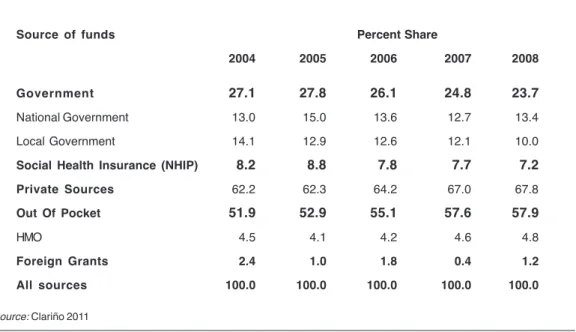
Government share had decreased to 23.7 percent (national government, 13.4 percent and local government, 10.4 perent), and PhilHealth’s share decreased to 7.2 percent from 8.2 percent in 2004. Out-of-pocket share had worsened to 57.9 percent in 2008 (table 1).
TABLE 1. Distribution of health expenditure by source of funds
Source of funds Percent Share
2004 2005 2006 2007 2008
Government 27.1 27.8 26.1 24.8 23.7
National Government 13.0 15.0 13.6 12.7 13.4
Local Government 14.1 12.9 12.6 12.1 10.0
Social Health Insurance (NHIP) 8.2 8.8 7.8 7.7 7.2
Private Sources 62.2 62.3 64.2 67.0 67.8
Out Of Pocket 51.9 52.9 55.1 57.6 57.9
HMO 4.5 4.1 4.2 4.6 4.8
Foreign Grants 2.4 1.0 1.8 0.4 1.2
All sources 100.0 100.0 100.0 100.0 100.0
Source: Clariño 2011
year
billion pesos
WHO regional data suggest that countries with less than 20 percent out-of- pocket health expenditures exhibited a low percentage of households with catastrophic health expenditures. Above 20 percent, the percentage of households experiencing catastrophic health expenditures begins to rise, with the increase becoming significant when the share is greater than 30 percent (WHO 2009, appendix 2).
Allocative Efficiency
As a country, we are not spending enough on public health and primary care.
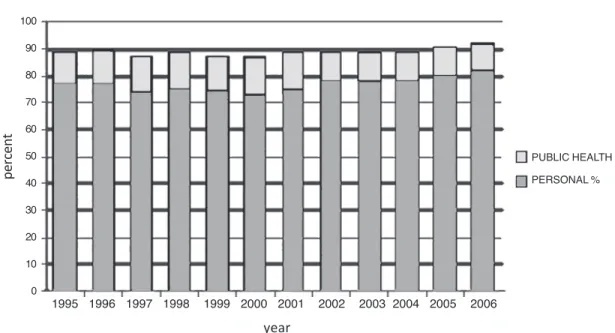
We spend from 73 to 78 percent of our national health expenditure on personal care versus 11 to 14 percent for public health. The Philippine Health Sector Reform Agenda had envisioned that, as government hospitals exercised fiscal autonomy and were allowed to charge user fees and retain income (in large part from Philhealth reimbursements), they would need less and less government subsidies; this in turn would lead to a shift of the DOH budget from hospital subsidy to more funding for public health programs. As can be seen in figure 3, this shift did not happen as the public health expenditure has remained fairly constant at about 11-14 percent of THE. One explanation for this is that both personal care and public health are underfunded given that our THE is significantly below the WHO recommended 5 percent of GDP, so that any increase in one will be absorbed without any resultant shifting of funds.
This pattern of inefficient allocation of limited financial resources is problematic and reflective of Western Pacific regional trends, as the WHO has noted.
[Eighty percent] of essential care and 70% of desirable health interventions can be delivered at the primary level but an average of only 10% of health resources are used for primary care in Asia… six countries in the Asia Pacific region spent less than 20% on primary health care.
The Philippines spent about 11% on public health care. By comparison, in 11 OECD countries, outpatient care costs averaged 28% (WHO, 2009).
Figure 3. Total Health Expenditure in billion pesos, 2004-2008 Source: Clariño 2011
With the readjusted figures, THE in 2007 was PHP256.7 billion, up from the previous figure of PHP235 billion; THE in 2008 reached PHP295.5 billion.
Government share had decreased to 23.7 percent (national government, 13.4 percent and local government, 10.4 perent), and PhilHealth’s share decreased to 7.2 percent from 8.2 percent in 2004. Out-of-pocket share had worsened to 57.9 percent in 2008 (table 1).
TABLE 1. Distribution of health expenditure by source of funds
Source of funds Percent Share
2004 2005 2006 2007 2008
Government 27.1 27.8 26.1 24.8 23.7
National Government 13.0 15.0 13.6 12.7 13.4
Local Government 14.1 12.9 12.6 12.1 10.0
Social Health Insurance (NHIP) 8.2 8.8 7.8 7.7 7.2
Private Sources 62.2 62.3 64.2 67.0 67.8
Out Of Pocket 51.9 52.9 55.1 57.6 57.9
HMO 4.5 4.1 4.2 4.6 4.8
Foreign Grants 2.4 1.0 1.8 0.4 1.2
All sources 100.0 100.0 100.0 100.0 100.0
Source: Clariño 2011
year
billion pesos
WHO regional data suggest that countries with less than 20 percent out-of- pocket health expenditures exhibited a low percentage of households with catastrophic health expenditures. Above 20 percent, the percentage of households experiencing catastrophic health expenditures begins to rise, with the increase becoming significant when the share is greater than 30 percent (WHO 2009, appendix 2).
Allocative Efficiency
As a country, we are not spending enough on public health and primary care.
We spend from 73 to 78 percent of our national health expenditure on personal care versus 11 to 14 percent for public health. The Philippine Health Sector Reform Agenda had envisioned that, as government hospitals exercised fiscal autonomy and were allowed to charge user fees and retain income (in large part from Philhealth reimbursements), they would need less and less government subsidies; this in turn would lead to a shift of the DOH budget from hospital subsidy to more funding for public health programs. As can be seen in figure 3, this shift did not happen as the public health expenditure has remained fairly constant at about 11-14 percent of THE. One explanation for this is that both personal care and public health are underfunded given that our THE is significantly below the WHO recommended 5 percent of GDP, so that any increase in one will be absorbed without any resultant shifting of funds.
This pattern of inefficient allocation of limited financial resources is problematic and reflective of Western Pacific regional trends, as the WHO has noted.
[Eighty percent] of essential care and 70% of desirable health interventions can be delivered at the primary level but an average of only 10% of health resources are used for primary care in Asia… six countries in the Asia Pacific region spent less than 20% on primary health care.
The Philippines spent about 11% on public health care. By comparison, in 11 OECD countries, outpatient care costs averaged 28% (WHO, 2009).
Figure 4. Total health expenditure by use of funds 1995–2006 Source: National Statistical Coordination Board 2007
Payment Mechanisms
A fee-for-service payment mechanism remains the dominant form of reimbursement mechanism of Philhealth, constituting 90 percent of reimbursement for hospital claims (Paterno 2007). In fee-for-service schemes, the more services the provider gives, the more the provider is paid. This has led to overprovision of services and higher cost of health care.
PhilHealth is now in the process of implementing case payments schemes where a fixed negotiated amount will be paid for 23 clinical cases. This will initially cover sponsored beneficiaries in PhilHealth’s no balance billing (NBB) program in all government hospitals. The list of cases covered by case payments will gradually be expanded.
Fragmented Health Financing System
Government health spending is fragmented among hundreds of stakeholders:
DOH, LGUs (provincial governors and municipal and city mayors), and PhilHealth with different health financing philosophies, mandates, and responsibilities. The
1995 1996 1997 1998 1999 2000 2001 2002 2003 2004 2005 2006 100
90 80 70 60 50 40 30 20 10 0
PUBLIC HEALTH PERSONAL %
year
percent
LGUs comprise 81 provinces, 136 cities, and 1,495 municipalities. DOH finances retained hospitals and national health programs. LGUs use their internal revenue allotments to finance their health facilities and services. The provinces finance the provincial and district hospitals. Municipalities are in charge mainly of public health and primary care. PhilHealth pays for services of DOH, LGUs, and private health facilities. There is often an overlap with what PhilHealth reimburses and what the DOH and LGUs provide. The private sector, comprising more than half of service providers and hospitals, have their own largely unregulated fee schedules (Department of Health 2010a).
The Path to Universal Health Care
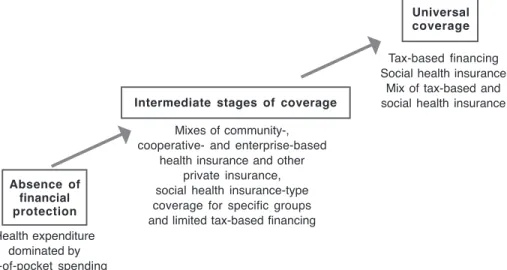
Carrin et al. (2008) described the path to universal coverage from an initial stage of a health system characterized by the absence of financial protection with a dominance of out-of-pocket expenditures to an intermediate stage of coverage characterized by a mixture of predominantly out-of-pocket payments, community- based health insurance initiatives, and limited social health insurance and tax-based spending to the stage of universal coverage characterized by a predominance of a tax- or social-health-insurance-funded health system, or a combination of both.
Figure 5. Key health financing options on the path to universal coverage Source: Carrin and James 2004
Absence of financial protection
Universal coverage
Intermediate stages of coverage
Tax-based financing Social health insurance
Mix of tax-based and social health insurance
Health expenditure dominated by out-of-pocket spending
cooperative- and enterprise-based health insurance and other
private insurance, social health insurance-type coverage for specific groups and limited tax-based financing
Mixes of community-,
Figure 4. Total health expenditure by use of funds 1995–2006 Source: National Statistical Coordination Board 2007
Payment Mechanisms
A fee-for-service payment mechanism remains the dominant form of reimbursement mechanism of Philhealth, constituting 90 percent of reimbursement for hospital claims (Paterno 2007). In fee-for-service schemes, the more services the provider gives, the more the provider is paid. This has led to overprovision of services and higher cost of health care.
PhilHealth is now in the process of implementing case payments schemes where a fixed negotiated amount will be paid for 23 clinical cases. This will initially cover sponsored beneficiaries in PhilHealth’s no balance billing (NBB) program in all government hospitals. The list of cases covered by case payments will gradually be expanded.
Fragmented Health Financing System
Government health spending is fragmented among hundreds of stakeholders:
DOH, LGUs (provincial governors and municipal and city mayors), and PhilHealth with different health financing philosophies, mandates, and responsibilities. The
1995 1996 1997 1998 1999 2000 2001 2002 2003 2004 2005 2006 100
90 80 70 60 50 40 30 20 10 0
PUBLIC HEALTH PERSONAL %
year
percent
LGUs comprise 81 provinces, 136 cities, and 1,495 municipalities. DOH finances retained hospitals and national health programs. LGUs use their internal revenue allotments to finance their health facilities and services. The provinces finance the provincial and district hospitals. Municipalities are in charge mainly of public health and primary care. PhilHealth pays for services of DOH, LGUs, and private health facilities. There is often an overlap with what PhilHealth reimburses and what the DOH and LGUs provide. The private sector, comprising more than half of service providers and hospitals, have their own largely unregulated fee schedules (Department of Health 2010a).
The Path to Universal Health Care
Carrin et al. (2008) described the path to universal coverage from an initial stage of a health system characterized by the absence of financial protection with a dominance of out-of-pocket expenditures to an intermediate stage of coverage characterized by a mixture of predominantly out-of-pocket payments, community- based health insurance initiatives, and limited social health insurance and tax-based spending to the stage of universal coverage characterized by a predominance of a tax- or social-health-insurance-funded health system, or a combination of both.
Figure 5. Key health financing options on the path to universal coverage Source: Carrin and James 2004
Absence of financial protection
Universal coverage
Intermediate stages of coverage
Tax-based financing Social health insurance
Mix of tax-based and social health insurance
Health expenditure dominated by out-of-pocket spending
cooperative- and enterprise-based health insurance and other
private insurance, social health insurance-type coverage for specific groups and limited tax-based financing
Mixes of community-,
Tax-based versus Social Health Insurance Revenue Generation for Financing Universal Health Care
The main advantages of generating revenues for health through taxes, if properly designed and collected, are that the burden of contribution is more progressive and it usually incurs less administrative costs. Coverage is by virtue of citizenship or residence. A tax funded national health service has more direct ways of containing costs. Its major disadvantage is that tax revenues generally go to general appropriations, and the government health agency has to compete with the other government agencies for the appropriate budgetary allocation for health (Normand 2009). This may however be offset by an automatic appropriation for health. If there is an automatic appropriation for debt servicing, then there is a moral and ethical basis for automatic appropriation for health, given that health as a human right is universally accepted.
The major advantages of financing UHC through social health insurance are that SHI can generate additional funds for the health sector and that the funds raised through SHI premiums are earmarked for health. On the other hand, the disadvantage of SHI is higher administrative costs, especially in countries where the employed formal sector is not fully developed and where there is a large informal sector and many indigents. Coverage is dependent on identification, enrollment, and collection of premiums. Historically SHI started in Germany. It took Germany 47 years to achieve 50 percent coverage and another 58 years to achieve 88 percent coverage. This was because of the difficulty of covering the informal sector (Carrin and James 2004).
SHI, because of its nature as an insurance system, pays for personal care. Public health services, which should cover the whole population, are expected to be paid from general taxation revenues. Therefore there would still be a need to generate revenues from taxes to pay for population-based health interventions, such as health promotions, safe water and sanitation, or services that require high or almost universal population coverage, such as immunization.
The major disadvantage of SHI is that premium contributions are less progressive than income tax payments. Formally employed workers bear the burden of financing universal coverage as they are triple taxed in the form of automatically deducted
income tax, automatically deducted SHI premiums as payroll tax, and indirect taxes, such as value added tax.
Another unintended negative effect of SHI is that it might relieve the pressure on the Department of Finance to allot the necessary budget for health, lulled into the belief that SHI (PhilHealth) will be able to generate the necessary revenues for the health sector. It is a given that PhilHealth has always been viewed as having the key role in health financing reforms, notwithstanding its less than 10 percent share in total health expenditure. To quote Wagstaff (2007),
Embarking down the SHI road is likely to take the pressure off the finance ministry to raise revenues for health. There is a risk that the difficulties of achieving UHI (Universal Health Insurance) through SHI become apparent only after years of trying, by which time the finance ministry will have come to think of the health system as contributory, one not needing tax-financed subsidies (underscoring supplied). By contrast, if the health ministry is engaged with the ministry of finance…it is not inconceivable that a case for extra resources could successfully be made.
Whatever financial route a country takes to achieve universal coverage (through taxes or SHI or a combination of both), the World Health Report 2010 summarizes what countries must do: raise sufficient funds, reduce the reliance on direct payments to finance health services, and improve efficiency and equity.
The Key Role of PhilHealth in Health Financing
Since 2001, the Health Sector Reform Agenda, the National Objectives for Health (NOH) 2005-2010 and Fourmula One, the DOH Health Care Financing Strategy 2010-2020, and now the Aquino Health Agenda have all looked to PhilHealth as having the key role in health financing reform:
• Health care reforms will focus on making the National Health Insurance Program (NHIP) the major payer of health services (HSRA)
• The flagship program of health financing (NOH)
• The lead implementer of health financing reform (Fourmula One)
Tax-based versus Social Health Insurance Revenue Generation for Financing Universal Health Care
The main advantages of generating revenues for health through taxes, if properly designed and collected, are that the burden of contribution is more progressive and it usually incurs less administrative costs. Coverage is by virtue of citizenship or residence. A tax funded national health service has more direct ways of containing costs. Its major disadvantage is that tax revenues generally go to general appropriations, and the government health agency has to compete with the other government agencies for the appropriate budgetary allocation for health (Normand 2009). This may however be offset by an automatic appropriation for health. If there is an automatic appropriation for debt servicing, then there is a moral and ethical basis for automatic appropriation for health, given that health as a human right is universally accepted.
The major advantages of financing UHC through social health insurance are that SHI can generate additional funds for the health sector and that the funds raised through SHI premiums are earmarked for health. On the other hand, the disadvantage of SHI is higher administrative costs, especially in countries where the employed formal sector is not fully developed and where there is a large informal sector and many indigents. Coverage is dependent on identification, enrollment, and collection of premiums. Historically SHI started in Germany. It took Germany 47 years to achieve 50 percent coverage and another 58 years to achieve 88 percent coverage. This was because of the difficulty of covering the informal sector (Carrin and James 2004).
SHI, because of its nature as an insurance system, pays for personal care. Public health services, which should cover the whole population, are expected to be paid from general taxation revenues. Therefore there would still be a need to generate revenues from taxes to pay for population-based health interventions, such as health promotions, safe water and sanitation, or services that require high or almost universal population coverage, such as immunization.
The major disadvantage of SHI is that premium contributions are less progressive than income tax payments. Formally employed workers bear the burden of financing universal coverage as they are triple taxed in the form of automatically deducted
income tax, automatically deducted SHI premiums as payroll tax, and indirect taxes, such as value added tax.
Another unintended negative effect of SHI is that it might relieve the pressure on the Department of Finance to allot the necessary budget for health, lulled into the belief that SHI (PhilHealth) will be able to generate the necessary revenues for the health sector. It is a given that PhilHealth has always been viewed as having the key role in health financing reforms, notwithstanding its less than 10 percent share in total health expenditure. To quote Wagstaff (2007),
Embarking down the SHI road is likely to take the pressure off the finance ministry to raise revenues for health. There is a risk that the difficulties of achieving UHI (Universal Health Insurance) through SHI become apparent only after years of trying, by which time the finance ministry will have come to think of the health system as contributory, one not needing tax-financed subsidies (underscoring supplied). By contrast, if the health ministry is engaged with the ministry of finance…it is not inconceivable that a case for extra resources could successfully be made.
Whatever financial route a country takes to achieve universal coverage (through taxes or SHI or a combination of both), the World Health Report 2010 summarizes what countries must do: raise sufficient funds, reduce the reliance on direct payments to finance health services, and improve efficiency and equity.
The Key Role of PhilHealth in Health Financing
Since 2001, the Health Sector Reform Agenda, the National Objectives for Health (NOH) 2005-2010 and Fourmula One, the DOH Health Care Financing Strategy 2010-2020, and now the Aquino Health Agenda have all looked to PhilHealth as having the key role in health financing reform:
• Health care reforms will focus on making the National Health Insurance Program (NHIP) the major payer of health services (HSRA)
• The flagship program of health financing (NOH)
• The lead implementer of health financing reform (Fourmula One)
“Expand coverage, increase benefit payments, include outpatient benefits, use alternative forms of payment mechanisms, improve marketing to increase beneficiary knowledge about PhilHealth benefits, and improve information system”—these are not new but have been the mantra since 2001 and are now being repeated by the Aquino Health Agenda. Kalusugan Pangkalahatan, the DOH’s program to achieve universal health care, echoes the Aquino Health Agenda.
Inability of PHIC to Achieve its Mandate
There is a consensus among the major stakeholders in health that PhilHealth has acted more as a commercial health insurance rather than a social health insurance, and has failed in its primary mandate to ensure all Filipinos of financial access to at least basic health services (Lim 2011).
President Aquino, in his State of the Nation Address last year, already pointed out the major shortcomings of PhilHealth: controversial population coverage, mainly inpatient benefits, low financial risk protection, and low utilization by the poor who need it most. However, he also called for universal PhilHealth coverage in three years.
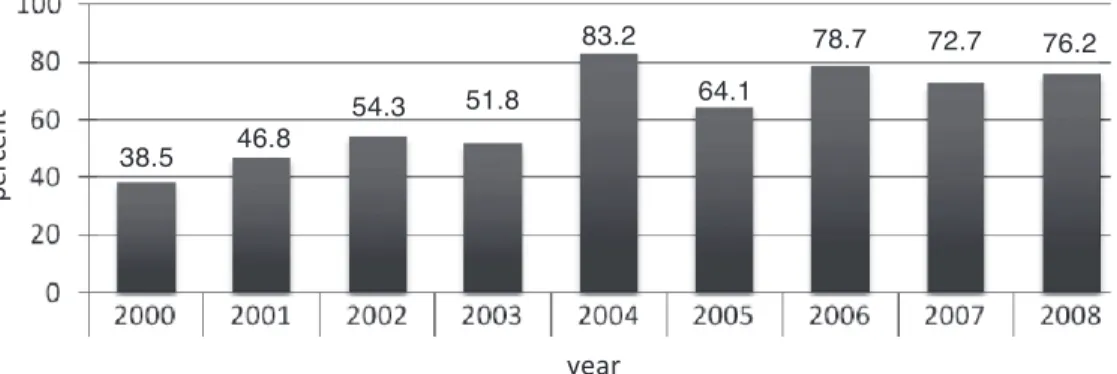
Figure 6. PhilHealth population coverage Source: Romualdez et al. 2011, 36–43
PhilHealth’s coverage has hovered around 50 percent for many years, then dramatically shot up to 83.2 percent of the population in 2004, almost universal by the PhilHealth self-defined universal coverage of 85 percent. The year 2004 was an election year when the administration distributed PhilHealth cards during the
38.5 46.8 54.3 51.8
83.2
64.1
78.7 72.7 76.2
year
percent
campaign. As most LGUs had not budgeted the premiums associated with these PhilHeath cards, coverage suddenly dropped to 64.1 percent in 2005 (figure 6).
For the most part, increases in population coverage depended on national government subsidy for the sponsored program, rising and falling depending on the budget outlay for the sponsored member premiums.
The Need for Universal Health Care Beyond Universal PhilHealth Coverage
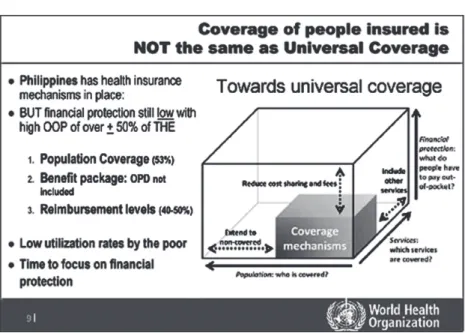
Henk Bekedam (2011), in his presentation on behalf of the WHO-Western Pacific Regional Office (WPRO) during the Presidential Forum on Health Financing and Universal Coverage on May 3, 2011, summarized the limitations of PhilHealth coverage. He showed the wide gaps in the three dimensions of coverage: breadth, depth, and height (figure 7).
The breadth of coverage refers to the percent of the population covered. WHO- WPRO is still generous, granting PhilHealth 53 percent population coverage. The National Demographic and Health Survey 2008 gave only a 38 percent population coverage, corroborated by a Social Weather Stations survey done in January 2010.
The depth of coverage is shallow: PhilHealth benefits are mainly inpatient benefits with minimal outpatient benefits. The major stakeholders in health and the Aquino Health Agenda itself urgently call for PhilHealth to roll out comprehensive benefits to include outpatient benefits, including medicines.
The height of coverage or financial protection remains low, with PhilHealth reimbursement levels at 40-50 percent of hospitalization costs. This low level is also being eroded by out of hospital purchases which are not reimbursed by PhilHealth (Quality Improvement Demonstration Studies 2006).
We would like to add a fourth dimension: utilization by the poor. As can be seen from figure 6, utilization by the poor is low.
PhilHealth coverage must be viewed in these four dimensions. When PhilHealth coverage covers all Filipinos, provides comprehensive inpatient and outpatient benefits, including outpatient medicines, gives financial protection up to 70 percent of hospitalization costs, applies no balance billing, and is utilized by the poor, only then will PhilHealth universal coverage be equivalent to universal health care.
“Expand coverage, increase benefit payments, include outpatient benefits, use alternative forms of payment mechanisms, improve marketing to increase beneficiary knowledge about PhilHealth benefits, and improve information system”—these are not new but have been the mantra since 2001 and are now being repeated by the Aquino Health Agenda. Kalusugan Pangkalahatan, the DOH’s program to achieve universal health care, echoes the Aquino Health Agenda.
Inability of PHIC to Achieve its Mandate
There is a consensus among the major stakeholders in health that PhilHealth has acted more as a commercial health insurance rather than a social health insurance, and has failed in its primary mandate to ensure all Filipinos of financial access to at least basic health services (Lim 2011).
President Aquino, in his State of the Nation Address last year, already pointed out the major shortcomings of PhilHealth: controversial population coverage, mainly inpatient benefits, low financial risk protection, and low utilization by the poor who need it most. However, he also called for universal PhilHealth coverage in three years.
Figure 6. PhilHealth population coverage Source: Romualdez et al. 2011, 36–43
PhilHealth’s coverage has hovered around 50 percent for many years, then dramatically shot up to 83.2 percent of the population in 2004, almost universal by the PhilHealth self-defined universal coverage of 85 percent. The year 2004 was an election year when the administration distributed PhilHealth cards during the
38.5 46.8 54.3 51.8
83.2
64.1
78.7 72.7 76.2
year
percent
campaign. As most LGUs had not budgeted the premiums associated with these PhilHeath cards, coverage suddenly dropped to 64.1 percent in 2005 (figure 6).
For the most part, increases in population coverage depended on national government subsidy for the sponsored program, rising and falling depending on the budget outlay for the sponsored member premiums.
The Need for Universal Health Care Beyond Universal PhilHealth Coverage
Henk Bekedam (2011), in his presentation on behalf of the WHO-Western Pacific Regional Office (WPRO) during the Presidential Forum on Health Financing and Universal Coverage on May 3, 2011, summarized the limitations of PhilHealth coverage. He showed the wide gaps in the three dimensions of coverage: breadth, depth, and height (figure 7).
The breadth of coverage refers to the percent of the population covered. WHO- WPRO is still generous, granting PhilHealth 53 percent population coverage. The National Demographic and Health Survey 2008 gave only a 38 percent population coverage, corroborated by a Social Weather Stations survey done in January 2010.
The depth of coverage is shallow: PhilHealth benefits are mainly inpatient benefits with minimal outpatient benefits. The major stakeholders in health and the Aquino Health Agenda itself urgently call for PhilHealth to roll out comprehensive benefits to include outpatient benefits, including medicines.
The height of coverage or financial protection remains low, with PhilHealth reimbursement levels at 40-50 percent of hospitalization costs. This low level is also being eroded by out of hospital purchases which are not reimbursed by PhilHealth (Quality Improvement Demonstration Studies 2006).
We would like to add a fourth dimension: utilization by the poor. As can be seen from figure 6, utilization by the poor is low.
PhilHealth coverage must be viewed in these four dimensions. When PhilHealth coverage covers all Filipinos, provides comprehensive inpatient and outpatient benefits, including outpatient medicines, gives financial protection up to 70 percent of hospitalization costs, applies no balance billing, and is utilized by the poor, only then will PhilHealth universal coverage be equivalent to universal health care.
Figure 7. The three dimensions of coverage Source: Bekedam 2011
The Social Determinants of Health and the Health Systems Approach to UHC
Increasing financial resources for health is necessary but not sufficient to achieve universal health care. Reforms must address the whole health system, including the other five building blocks of the health system: health governance with an overarching philosophy of addressing health inequities, health information to provide evidence for health governance, health regulation, organization of health services, and the production of competent and motivated health human resources to provide the needed quality health services.
The social determinants approach to health, on the other hand, stipulates that health systems improvement only accounts for some 30 percent of improvement in health status, while socio-economic development would account for the 70 percent of the improvement in health status (McKinlay and McKinlay 1987; McKeown 1975). Universal health care will not succeed if the country does not implement a national development plan that leads to inclusive growth.
Financing UHC How Much Will UHC Cost?
Three methodologies are used to calculate the cost of universal health care, based on: a) WHO’s recommended 5 percent of GDP, b) capitation calculations using the cost per capita of the essential health package, and c) projection using the revised 2008 National Health Accounts THE figures.
Based on Percentage of GDP
One way of estimating the cost of UHC would be to calculate it based on the WHO recommendation of 5 percent of GDP. Table 2 shows how much UHC would cost if total health expenditure would reach 5 percent of GDP by 2015.
TABLE 2. Target Scenarios for increasing Total Health Expenditure to 5% GDP by 2015
Year
2007 2011 2013 2015
GDP* in current price 6,647 9,018 10,549 12,341
(billions of pesos)
THE as percent of GDP 3.5% 4% 4.5% 5%
THE in billions of pesos 235 361 475 617
* Projected GDP taken from IMF World Economic Outlook Database April 2010
Another way would be to estimate how much outpatient and inpatient services would cost per capita and come out with an amount that must be raised either by PhilHealth premiums or general taxes.
Figure 7. The three dimensions of coverage Source: Bekedam 2011
The Social Determinants of Health and the Health Systems Approach to UHC
Increasing financial resources for health is necessary but not sufficient to achieve universal health care. Reforms must address the whole health system, including the other five building blocks of the health system: health governance with an overarching philosophy of addressing health inequities, health information to provide evidence for health governance, health regulation, organization of health services, and the production of competent and motivated health human resources to provide the needed quality health services.
The social determinants approach to health, on the other hand, stipulates that health systems improvement only accounts for some 30 percent of improvement in health status, while socio-economic development would account for the 70 percent of the improvement in health status (McKinlay and McKinlay 1987; McKeown 1975). Universal health care will not succeed if the country does not implement a national development plan that leads to inclusive growth.
Financing UHC How Much Will UHC Cost?
Three methodologies are used to calculate the cost of universal health care, based on: a) WHO’s recommended 5 percent of GDP, b) capitation calculations using the cost per capita of the essential health package, and c) projection using the revised 2008 National Health Accounts THE figures.
Based on Percentage of GDP
One way of estimating the cost of UHC would be to calculate it based on the WHO recommendation of 5 percent of GDP. Table 2 shows how much UHC would cost if total health expenditure would reach 5 percent of GDP by 2015.
TABLE 2. Target Scenarios for increasing Total Health Expenditure to 5% GDP by 2015
Year
2007 2011 2013 2015
GDP* in current price 6,647 9,018 10,549 12,341
(billions of pesos)
THE as percent of GDP 3.5% 4% 4.5% 5%
THE in billions of pesos 235 361 475 617
* Projected GDP taken from IMF World Economic Outlook Database April 2010
Another way would be to estimate how much outpatient and inpatient services would cost per capita and come out with an amount that must be raised either by PhilHealth premiums or general taxes.
Based on the Essential Health Package Proposal
There is a proposal for an essential health package (EHP) for the Philippines drafted by a multidisciplinary group headed by Dr. Jaime Z. Galvez-Tan (2010) and supported by the WHO country office. It has been submitted to the DOH.
The proposed EHP is based on a working inter-local health zone (ILHZ) consisting of a district hospital with four to five cooperating municipal health centers.
Under a devolved set up, the municipal health centers are independent of the district hospital, which is organizationally under the authority of the province. The ILHZ was proposed by the DOH as a voluntary coming and working together of the district hospital and four to five cooperating municipal health centers.
The EHP builds on what is currently being provided by our municipal and city health centers, namely: maternal health and reproductive health services, Integrated Management of Childhood Illnesses (IMCI) including immunization and nutrition programs, prevention and treatment of common infectious disease, and prevention and treatment of non-communicable diseases (with very limited medicines). In addition, the EHP proposed to include the following: oral health, community mental health, emergency care, necessary diagnostic laboratory exams up to the district hospital level, and the provision of essential drugs for both communicable and non- communicable diseases. What is different with this EHP proposal is that the cost was estimated based on an ILHZ model serving a catchment population of 200,000.
Starting with an actual ILHZ, the cost was computed for the existing personnel and infrastructure, then adjusted for the projected number of contacts based on the proposed EHP using international utilization rates and time needed per contact.
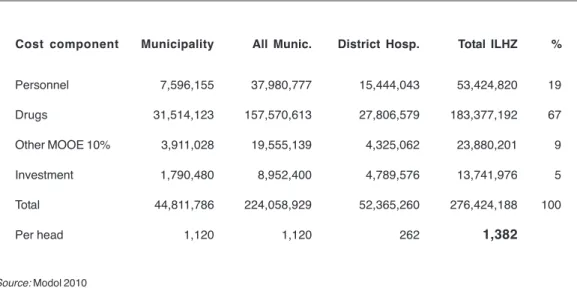
Providing EHP was then estimated to cost PHP1,382 per person, and this included personnel, drugs, maintenance and other operating expenses (MOOE), and capital investment for facility enhancement. This per capita cost covered the above costs for the five participating municipalities and the district hospital.
For 2012, the total cost for the country would be population multiplied by the capitation figure, that is, 97.6 million Filipinos times PHP1,382 equals PHP135 billion for outpatient services from the barangay health stations to the level of a district hospital (population figure from the Commission on Population as cited in Crisostomo 2012). For 2015, with a projected population of 103 million, EHP would cost at least PHP142 billion.
TABLE 3. Total and per capita costs of the Essential Health Package
Cost component Municipality All Munic. District Hosp. Total ILHZ %
Personnel 7,596,155 37,980,777 15,444,043 53,424,820 19
Drugs 31,514,123 157,570,613 27,806,579 183,377,192 67
Other MOOE 10% 3,911,028 19,555,139 4,325,062 23,880,201 9
Investment 1,790,480 8,952,400 4,789,576 13,741,976 5
Total 44,811,786 224,058,929 52,365,260 276,424,188 100
Per head 1,120 1,120 262 1,382
Source: Modol 2010
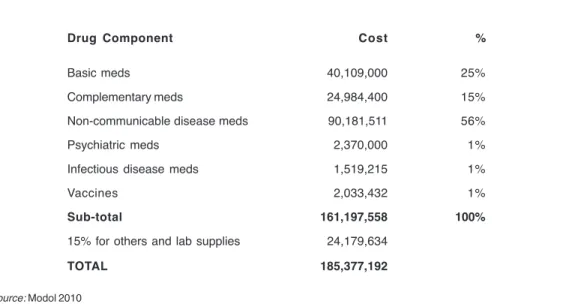
Interestingly, drugs make up 67 percent of the cost, and 56 percent of the cost of drugs were for treating non-communicable diseases, mainly hypertension and diabetes. Providing vaccines would only make up 1 percent of the drug component costs; treating infectious diseases would make up 1 percent, and treating mental patients another 1 percent, as shown in table 4.
TABLE 4. Cost of drugs of the essential health package
Drug Component Cost %
Basic meds 40,109,000 25%
Complementary meds 24,984,400 15%
Non-communicable disease meds 90,181,511 56%
Psychiatric meds 2,370,000 1%
Infectious disease meds 1,519,215 1%
Vaccines 2,033,432 1%
Sub-total 161,197,558 100%
15% for others and lab supplies 24,179,634
TOTAL 185,377,192
Source: Modol 2010
Based on the Essential Health Package Proposal
There is a proposal for an essential health package (EHP) for the Philippines drafted by a multidisciplinary group headed by Dr. Jaime Z. Galvez-Tan (2010) and supported by the WHO country office. It has been submitted to the DOH.
The proposed EHP is based on a working inter-local health zone (ILHZ) consisting of a district hospital with four to five cooperating municipal health centers.
Under a devolved set up, the municipal health centers are independent of the district hospital, which is organizationally under the authority of the province. The ILHZ was proposed by the DOH as a voluntary coming and working together of the district hospital and four to five cooperating municipal health centers.
The EHP builds on what is currently being provided by our municipal and city health centers, namely: maternal health and reproductive health services, Integrated Management of Childhood Illnesses (IMCI) including immunization and nutrition programs, prevention and treatment of common infectious disease, and prevention and treatment of non-communicable diseases (with very limited medicines). In addition, the EHP proposed to include the following: oral health, community mental health, emergency care, necessary diagnostic laboratory exams up to the district hospital level, and the provision of essential drugs for both communicable and non- communicable diseases. What is different with this EHP proposal is that the cost was estimated based on an ILHZ model serving a catchment population of 200,000.
Starting with an actual ILHZ, the cost was computed for the existing personnel and infrastructure, then adjusted for the projected number of contacts based on the proposed EHP using international utilization rates and time needed per contact.
Providing EHP was then estimated to cost PHP1,382 per person, and this included personnel, drugs, maintenance and other operating expenses (MOOE), and capital investment for facility enhancement. This per capita cost covered the above costs for the five participating municipalities and the district hospital.
For 2012, the total cost for the country would be population multiplied by the capitation figure, that is, 97.6 million Filipinos times PHP1,382 equals PHP135 billion for outpatient services from the barangay health stations to the level of a district hospital (population figure from the Commission on Population as cited in Crisostomo 2012). For 2015, with a projected population of 103 million, EHP would cost at least PHP142 billion.
TABLE 3. Total and per capita costs of the Essential Health Package
Cost component Municipality All Munic. District Hosp. Total ILHZ %
Personnel 7,596,155 37,980,777 15,444,043 53,424,820 19
Drugs 31,514,123 157,570,613 27,806,579 183,377,192 67
Other MOOE 10% 3,911,028 19,555,139 4,325,062 23,880,201 9
Investment 1,790,480 8,952,400 4,789,576 13,741,976 5
Total 44,811,786 224,058,929 52,365,260 276,424,188 100
Per head 1,120 1,120 262 1,382
Source: Modol 2010
Interestingly, drugs make up 67 percent of the cost, and 56 percent of the cost of drugs were for treating non-communicable diseases, mainly hypertension and diabetes. Providing vaccines would only make up 1 percent of the drug component costs; treating infectious diseases would make up 1 percent, and treating mental patients another 1 percent, as shown in table 4.
TABLE 4. Cost of drugs of the essential health package
Drug Component Cost %
Basic meds 40,109,000 25%
Complementary meds 24,984,400 15%
Non-communicable disease meds 90,181,511 56%
Psychiatric meds 2,370,000 1%
Infectious disease meds 1,519,215 1%
Vaccines 2,033,432 1%
Sub-total 161,197,558 100%
15% for others and lab supplies 24,179,634
TOTAL 185,377,192
Source: Modol 2010
The National Health Accounts do not disaggregate the health expenditure for hospitals from the provincial level up to the regional and national hospitals. However, Dr. Alvin Caballes (2009), who was involved with the DOH monograph, “An Appraisal of the Policy Environment for Philippine Hospital Sector Development,” estimates hospital expenditure to be about 34 percent of THE. If we take the projected GDP for 2012 at PHP9.75 trillion, THE would amount to PHP390 billion and 34 percent of this equals PHP132 billion for hospital expenditures. We would therefore need at least PHP135 billion to cover basic health services at the ILHZ and PHP132 billion for hospital services from the provincial level up, or a total of PHP267 billion as THE for 2012.
The minimum amount of PHP267 billion is needed for 2012 for universal health care financed and delivered through the public health care delivery system.
For 2015 it would be at least PHP282 billion. Costs would be higher because services are also delivered through the large private health sector.
The revised National Health Accounts of 2008 gave a THE of PHP295 billion.
From 2004 to 2008, the annual growth rate of THE was 12 percent. Given this growth rate, THE in 2012 may go as high as PHP465 billion and PHP653 billion by 2015. Five percent of the 2015 projected GDP equals PHP617 billion.
Options for UHC Financing Schemes in the Philippines Option A: UHC with Contributory Premiums for the Informal Sector or the Near Poor
This is the option taken by the DOH as expressed through its main health agenda, Kalusugan Pangkalahatan (KP). The KP road map sets the launch phase to reach the end of 2011, the scale-up phase to be from 2012 to 2013, and the sustainability phase to go from 2014 to 2016.
Financial protection will be increased through a refocused and revitalized PhilHealth. PhilHealth’s strategic directions for 2011–2016 describes how financial protection will be increased through reforms in provider payment mechanisms, benefit design, and provider accreditation.
Expanded Population Coverage
The KP targets the sustained enrolment of 15 million families. The national household targeting system would identify 5.3 million families belonging to the lowest quintile income group, and their premiums would be subsidized by the national government, with improved benefits for the PhilHealth sponsored program.
A total of 2,552 government health facilities in areas where most of the poor are found would be upgraded. Implementation of focused public health services would be scaled up starting in identified 12 priority areas (Bayugo 2012).
Enrolment of the informal sector will be compulsory. A mechanism for this is to require proof of PhilHealth membership for any government transaction, including business permits, licenses, etc. The informal sector will be segmented into informal sector professionals and informal sector non-professionals. Informal sector professionals will have to pay premiums based on their income, which can be based on their income tax returns (ITRs). The premium of the non-professional segment will be jointly paid by both the informal workers and by their respective local government units.
Comprehensiveness of Benefits
PhilHealth will roll out its outpatient benefits to cover medicines, including those for hypertension, diabetes, and asthma. The DOH has a similar program with treatment packs for hypertension and diabetes using PHP500 million from the National Planning and Policy Division (NPPD) budget (Ona 2011).
Increase in Philhealth Premium Rates
PhilHealth will increase its premiums, and therefore its premium collections.
It will triple its benefit payments by 2015.
In the recently concluded National Academy of Science and Technology roundtable discussion (RTD) on updates on universal health care held last February 21, 2012, Dr. Robert So presented the projections for PhilHealth benefit payments (table 4). Premium collection by PhilHealth is projected to increase to PHP50
The National Health Accounts do not disaggregate the health expenditure for hospitals from the provincial level up to the regional and national hospitals. However, Dr. Alvin Caballes (2009), who was involved with the DOH monograph, “An Appraisal of the Policy Environment for Philippine Hospital Sector Development,” estimates hospital expenditure to be about 34 percent of THE. If we take the projected GDP for 2012 at PHP9.75 trillion, THE would amount to PHP390 billion and 34 percent of this equals PHP132 billion for hospital expenditures. We would therefore need at least PHP135 billion to cover basic health services at the ILHZ and PHP132 billion for hospital services from the provincial level up, or a total of PHP267 billion as THE for 2012.
The minimum amount of PHP267 billion is needed for 2012 for universal health care financed and delivered through the public health care delivery system.
For 2015 it would be at least PHP282 billion. Costs would be higher because services are also delivered through the large private health sector.
The revised National Health Accounts of 2008 gave a THE of PHP295 billion.
From 2004 to 2008, the annual growth rate of THE was 12 percent. Given this growth rate, THE in 2012 may go as high as PHP465 billion and PHP653 billion by 2015. Five percent of the 2015 projected GDP equals PHP617 billion.
Options for UHC Financing Schemes in the Philippines Option A: UHC with Contributory Premiums for the Informal Sector or the Near Poor
This is the option taken by the DOH as expressed through its main health agenda, Kalusugan Pangkalahatan (KP). The KP road map sets the launch phase to reach the end of 2011, the scale-up phase to be from 2012 to 2013, and the sustainability phase to go from 2014 to 2016.
Financial protection will be increased through a refocused and revitalized PhilHealth. PhilHealth’s strategic directions for 2011–2016 describes how financial protection will be increased through reforms in provider payment mechanisms, benefit design, and provider accreditation.
Expanded Population Coverage
The KP targets the sustained enrolment of 15 million families. The national household targeting system would identify 5.3 million families belonging to the lowest quintile income group, and their premiums would be subsidized by the national government, with improved benefits for the PhilHealth sponsored program.
A total of 2,552 government health facilities in areas where most of the poor are found would be upgraded. Implementation of focused public health services would be scaled up starting in identified 12 priority areas (Bayugo 2012).
Enrolment of the informal sector will be compulsory. A mechanism for this is to require proof of PhilHealth membership for any government transaction, including business permits, licenses, etc. The informal sector will be segmented into informal sector professionals and informal sector non-professionals. Informal sector professionals will have to pay premiums based on their income, which can be based on their income tax returns (ITRs). The premium of the non-professional segment will be jointly paid by both the informal workers and by their respective local government units.
Comprehensiveness of Benefits
PhilHealth will roll out its outpatient benefits to cover medicines, including those for hypertension, diabetes, and asthma. The DOH has a similar program with treatment packs for hypertension and diabetes using PHP500 million from the National Planning and Policy Division (NPPD) budget (Ona 2011).
Increase in Philhealth Premium Rates
PhilHealth will increase its premiums, and therefore its premium collections.
It will triple its benefit payments by 2015.
In the recently concluded National Academy of Science and Technology roundtable discussion (RTD) on updates on universal health care held last February 21, 2012, Dr. Robert So presented the projections for PhilHealth benefit payments (table 4). Premium collection by PhilHealth is projected to increase to PHP50