45
FINANCIAL ATTITUDE TOWARDS BUDGETING, SAVING, BORROWING, AND INVESTING AMONG STUDENTS OF A PRIVATE HIGHER EDUCATION
INSTITUTION
Lucio T. Encio, Roldan P. Pescos and Patrocinio G. Pudadera, Jr.
Joanna C. Andana, Manilyn D. Arnaiz, Jia Kriselda S. Cartagena, Jobelle Anne P. Jarbadan, Daphniee V. Posing and Krystal Mae L. Ramos
A BSTRACT
his study, which aimed to determine the financial attitude towards budgeting, saving, borrowing, and investing among students of a private higher education institution in Iloilo City, utilized the descriptive research design. The stratified random sampling method was used in choosing the 256 respondents who were drawn from a population of 714 which consisted of 382 third-year and 332 fourth-year students who had taken a course in Personal Finance. The data needed in this study were gathered using the researcher-made questionnaire. The frequency count, percentage and standard deviation were used for descriptive statistics. The t-test and the ANOVA, set at .05 level of significance, were used for inferential statistics. The results revealed that students had favorable attitude towards budgeting, saving, borrowing, and investing but the t-test computations revealed that a significant difference was noted when respondents were grouped according sex. A significant difference also existed in students’ attitude towards borrowing when grouped according to age which, therefore, resulted in the rejection of the null hypotheses. However, no significant difference was noted when respondents were grouped according to year level but when grouped according to age, there was no significant difference in students’
attitude only towards budgeting and saving. Likewise, the ANOVA computations showed significant differences in students’ attitude towards saving when grouped according to course specialization but no significant differences in students’ financial attitude towards budgeting, saving, borrowing, and investing when respondents were grouped according to course specialization and monthly allowance which led, therefore, to the acceptance of the null hypothesis.
Keywords: Financial Attitude, Budgeting, Investing
I
NTRODUCTIONBackground and Rationale of the Study Students in the Department of Business Administration of a private higher education institution in Iloilo City are
required to take courses in accounting and finance to ensure that they are trained to develop the right attitude towards
T
46 budgeting, saving, borrowing, and
investing.
According to a 2015 report by the Consumer Financial Protection Bureau, the goal of financial literacy is to establish the feeling of control among Filipinos over their finances so that they would be able to freely make courses of action aimed at building greater life satisfaction (CFPB, 2015, as cited in McGurran, 2021).
During the 4th Financial Literacy Education Stakeholders’ Expo, Bejamin Diokno, a former governor of the Bangko Sentral ng Pilipinas (BSP), reported that based on a 2015 World Bank (WB) survey, Filipinos have the lowest financial literacy in the region at 25% in comparison to 59%
in Singapore, 52% in Myanmar, and 36%
in Malaysia, among others. Accordingly, both the 2015 World Bank (WB) survey and Central Bank's 2019 financial inclusion survey revealed that only few Filipino adults answered correctly questions on financial literacy.
In the light of the foregoing problem, it is believed that there is a need for the government and the private sectors to proactively supplement educational programs to develop financial attitude towards budgeting, saving, borrowing, and financing among Filipinos to make them more financial resilient so that they can be more productive, and contribute more meaningfully to nation-building, with the end in view of providing benefits not only to people but also to the national economy.
Research Problem
The Bachelor of Science in Business Administration (BSBA) curriculum of a private higher education institution was revised in June, 2018 with the integration of personal finance into curriculum and
instruction, aimed at boosting students’
financial attitude towards budgeting, saving, borrowing, and investing.
The researchers were business administration students of a private higher education institution in Iloilo City. They decided to conduct this study, in collaboration with their business education teachers, to investigate students’ attitude towards budgeting, saving, borrowing, and investing which can be used as bases for the review and enhancement of business education curriculum.
Objectives of the Study
This study aimed to determine the attitude towards budgeting, saving, borrowing, and investing among business administration students (BSBA) of a private higher education institution in Iloilo City for Academic year 2021-2022.
Specifically, this study sought answers to the following objectives:
1. Describe the profile of the respondents in terms of age, sex, year level, course specialization, and monthly allowance.
2. Describe the financial attitude towards budgeting, saving, borrowing, and investing among business administration students of a private education institution when respondents are grouped according to age, sex, year level, course specialization, and monthly allowance.
3. Determine if there are significant differences in the financial attitude towards budgeting, saving, borrowing, and investing among business administration students of a private education institution when respondents are grouped according to age, sex, year level, course specialization, and monthly allowance.
47 Hypothesis
Based on the foregoing objectives, the following hypothesis was advanced and tested at .05 level of significance:
There are no significant differences in the in the financial attitude towards budgeting, saving, borrowing, and investing among business administration students of a private education institution when respondents are grouped according to age, sex, year level, course specialization, and monthly allowance.
Theoretical Framework
This study was anchored on social learning theory which emphasizes importance of observing, modelling, and imitating the behaviors, attitudes, and emotional reactions of others. Social learning theory considers how both environmental and cognitive factors interact to influence human learning and behavior (Bandura, 1977, as cited in McLeod, 2016). In social learning theory, Bandura agrees with the behaviorist learning theory of operant conditioning.
The operant conditioning is a method of learning that uses rewards (benefits) and punishment (disadvantages) to modify behavior or attitude. The operant conditioning is exemplified by students’
financial attitude towards budgeting, saving, borrowing, and investing deemed
beneficial to their financial well-being which is likely to be repeated while students’ financial attitude deemed disadvantageous to their financial well- being will rarely occur. As applied in this study, if the business administration students have favorable financial attitude towards budging, saving, borrowing, and financing, they will be able to manage their financial resources effectively because it is assumed that students’ financial attitude towards budgeting, saving, borrowing and investing is the foundation of an individual’s relationship with money, and it is a lifelong journey of learning as it is believed that it is the key to success when it comes to money management.
Conceptual Framework
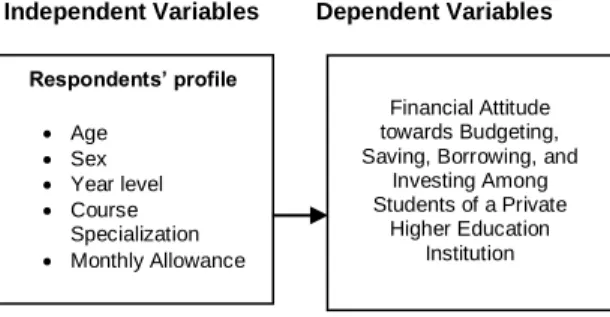
The independent variable in this study was the respondents’ profile in terms of age, sex, year level, course specialization, and monthly allowance. The dependent variable was business students’ financial attitude towards budgeting, savings, borrowing, and investing. It was hypothesized that business students’
financial attitude would not vary significantly when respondents are grouped according to their personal profile.
Figure 1 shows the hypothesized interplay of study variables.
Independent Variables Dependent Variables
Financial Attitude towards Budgeting, Saving, Borrowing, and
Investing Among Students of a Private
Higher Education Institution Respondents’ profile
Age
Sex
Year level
Course Specialization
Monthly Allowance
Figure 1. Attitude towards Budgeting, Saving, Borrowing, and Investing Among Students of a Private Higher
Education Institution
48 Significance of the Study
The results of the study would provide significant benefits to the following:
Students. Business students in a private higher educational institution would gain significant benefits from the results of this study because they were trained to enhance their financial attitude towards budgeting, saving, borrowing, and financing to become financially resilient so that they would be more rational in making sound financial decisions and eventually become more productive citizens in nation- building.
Parents and guardians. The parents and guardians of business students would be benefited from this study because they have the empirical data that could be used in giving advice to their children to boost their financial attitude, perspectives, and practices.
Administration. The administration of a private higher education institution would find significant benefits from this study because educational reforms and curriculum enhancement programs that would be implemented based on the results of the study can improve students’
financial attitude towards budgeting, saving, borrowing, and financing so that they would become resilient members of society.
Government. The government, especially the Commission on Higher Education (CHEd), would greatly benefit from the results of the study which could serve as their basis in the monitoring and enhancement of the Bachelor of Science in Business Administration (BSBA) curriculum.
Future researchers. The results of this would provide significant benefits to other researchers because the
methodology, findings, and conclusions in this study could be used as their bases when conducting similar or related studies in the future.
Definition of Terms
The following key terms used in this study were defined conceptually and operationally to ensure clearer understanding:
Age. Age is defined as the measure of the time elapsed from date of live birth to a specific point in time (Australian Bureau of Statistics, 2021). In this study, age refers to the number of years the respondent has lived from the date of birth up to the date of data collection, classified as 20-22 and 23 and above.
Financial attitude. Financial Attitude can be defined as personal inclination towards financial matters. It is an ability to plan ahead and maintain a savings account that matters (Rai, et.al (2019). In this study, students’ financial attitude towards budgeting, saving, borrowing, and was measured using the following mean scores, similar to 5-point Likert scale such as 1.0 – 1.80 as “very unfavorable,” 1.81 – 2.60 as “unfavorable,” 2.61 -3.40 as
“moderate” 3.41 – 4.20 as “favorable,” and 4.21 – 5.0 as “very favorable.”
Borrowing. Borrowing means to take money from a source, with a formal agreement that the funds will be repaid by a certain date and, usually, in stated regular installments (Curtis, 2022). In this study, borrowing includes, among others, traditional bank loans, personal loans from family or friends, and the use of credit cards, measured using the following mean scores, similar to 5-point Likert scale such as 1.0 – 1.80 as “very unfavorable,” 1.81 – 2.60 as “unfavorable,” 2.61 -3.40 as
49
“moderate” 3.41 – 4.20 as “favorable,” and 4.21 – 5.0 as “very favorable.”
Budgeting. It is how an individual manages his or her expenses and savings to reach a certain amount of time, and allows or provides a particular amount of money in a budget to allocate expenses (Ganti, 2021). In this study, budgeting refers to the knowledge of respondents in making a financial plan on how to properly allocate and disburse funds, measured using the following mean scores, similar to 5-point Likert scale such as 1.0 – 1.80 as
“very unfavorable,” 1.81 – 2.60 as
“unfavorable,” 2.61 -3.40 as “moderate”
3.41 – 4.20 as “favorable,” and 4.21 – 5.0 as “very favorable.”
Course specialization. Course specialization refers to the direction or focus of the study in the undergraduate program (My Degree Guide, 2021). In this study, major course refers to the subject areas the main field of concentration of the degree in Bachelor of Science in Business Administration (BSBA) such as business management, financial management, marketing management, and entrepreneurship.
Investing. Investing means putting money to work for a period of time in some sort of project or undertaking in order to generate positive returns (Picardo, 2022).
In this study, investing refers to the amount of money spent by students for their education, treated as an investment in human capital which incurs costs such as school fees, costs of text books and learning materials, costs of accommodation and travel while studying in school, measured using the following mean scores, similar to 5-point Likert scale such as 1.0 – 1.80 as “very unfavorable,”
1.81 – 2.60 as “unfavorable,” 2.61 -3.40 as
“moderate” 3.41 – 4.20 as “favorable,” and 4.21 – 5.0 as “very favorable.”
Saving. It refers to the money that a person has left over after subtracting out the consumer spending from the disposable income over a given time period (Kagan, 2022). In this study, saving represents a net amount of money after deducting all expenses and obligations paid from the total sources of funds, measured using the following mean scores, similar to 5-point Likert scale such as 1.0 – 1.80 as “very unfavorable,” 1.81 – 2.60 as “unfavorable,” 2.61 -3.40 as
“moderate” 3.41 – 4.20 as “favorable,” and 4.21 – 5.0 as “very favorable.”
Sex. Sex refers to characteristics observed and recorded at birth or infancy (Australian Bureau of Statistics, 2021). In this study, sex refers to biological characteristics of respondents, categorized as male or female.
Monthly allowance. It refers to the money that is given to someone on a monthly basis in order to help them pay for the things they need (Collins Dictionary, 2013). In this study, monthly allowance refers to the amount of money provided to the students by their parents or guardians.
Year level. Year level refers to students’ class cohort and the level at which the students spend most of their time at school (Education Counts, 2022).
In this study, year level refers to students’
level in college, classified as third year and fourth year.
Scope and Limitations of the Study This study, which aimed to determine the financial attitude towards budgeting, saving, borrowing, and investing among business administration students of a private higher education institution in Iloilo
50 City for Academic Year -2021-2022,
utilized the descriptive research design.
The respondents involved this study were 256 students who were drawn from a population of 714 students in the Department of Business Administration of a private higher education institution in Iloilo City, consisting of 382 third-year students and 332 fourth-year students who had taken a course in Personal Finance. A stratified random sampling method was also used to ensure that the third and fourth year students were proportionately
represented. The data needed in this study were gathered using the researcher-made questionnaire which was administered to the target respondents through Google forms. The gathered data were encoded in the computer using the statistical package for social sciences (SPSS) software. The frequency count, percentage, the mean, and the standard deviation were used for descriptive statistics. The t-test and one-way analysis of variance (ANOVA), were all set at .05 level of significance.
R
ELATEDL
ITERATURE/S
TUDIESThis section presents the review of literature and studies related to the present investigation.
Attitude
In psychology, an attitude refers to a set of emotions, beliefs, and behaviors toward a particular object, person, thing, or event. Attitudes are often the result of experience or upbringing. They can have a powerful influence over behavior and affect how people act in various situations. While attitudes are enduring, they can also change (Susman, 2022).
According to Pankow (2003) attitude is defined as a measure of a good situation in the mind, opinion, and assessment of the individual against what he experienced. The statement is in accordance with the opinion expressed by Robbins & Judges (2008) that states that attitude is a statement that is evaluative of objects, individuals, and events experienced. Ersha et al. (2016) revealed
that attitude is a measure of the individual's perspective regarding the world he lives in.
Financial Attitude
Financial attitude can be defined as personal inclination towards financial matters. It is an ability to plan ahead and maintain a savings account that matters (Rai, et al. (2019). Financial attitude is important because the higher the financial attitude a person has, the better he will be in managing his finances. Locus of control itself is used to see how someone manages events, which in this study is personal finance. Therefore financial attitudes can be defined as a condition experienced by individuals regarding finance which is then applied in their attitudes. This is in accordance with the theory revealed by Marsh (2006) which states that the financial attitude refers to how the individual views his personal financial problems which are reviewed based on the response to a statement or opinion. In their research Herdjiono and
51 Damanik (2016) state that financial
attitudes have a relationship to financial problems. Therefore, the financial attitude is considered to affect the financial behavior of individuals. Besri (2018) notes that financial attitude has six concepts including the following:
Obsession. Individual perception of money and future plans regarding management.
Power. In this case, money is used as a tool to control others. In other words, money can solve the problems being faced.
Effort. Individuals who get money from the business they have done.
Dissatisfaction. Feelings are not satisfied with the amount of money they have.
Storage. There is a tendency to not spend money.
Security. The view that money is better kept privately rather than by using financial services, such as banks and cooperatives.
Locus of Control
Locus of control appears in Rotter's social learning theory (1966) which suggests that there are several factors that influence a person in learning, one of which is expectancy, which means someone's expectation or expectation that reinforcement will arise in certain situations. The concept of expectancy is what gave birth to the term locus of control.
Locus of control is a concept that refers to an individual's beliefs about events that occur in his life (Larsen and Buss 2002).
Furthermore Larsen & Buss, (2010) defines locus of control as a concept that describes a person's perception of responsibility for events in his life.
According to Munir & Sajid, (2010) locus of control is a reflection of an individual's tendency to believe that he controls events that occur in his life (internal) or control over events that occur in his life originating from other things, for example the power of others (external). Kutanis, Mesci & Ovdur (2011) states that the locus of control includes the idea that throughout life an individual analyzes an event as a result of his behavior or the individual believes that the event is the result of coincidence, fate or force beyond their control. Based on previous research conducted by Robbins (2008) locus of control has a relationship with the beliefs and perspectives of individuals regarding an event and whether the individual can control that event. Therefore, Robin (2014) defines the locus of control as an individual's perspective on the causes of success and failure in doing a job.
Locus of control is very important in every individual; as a positive individual belief, it is sure to achieve the goals that had been set. It can be concluded that the higher the locus of control, the better the financial satisfaction. Based on the results of McGee's (2013) research, locus of control is very influential in achieving large profits by believing in one's own strength.
According to Dusane Kesavayuth, Kaung Myat Ko, and Vasileios Zikos locus of control is important for in taking risks when risk-taking affects someone in making a decision.
In this study, researchers used three independent variables including financial literacy, financial attitudes, and locus of control but the dependent variable used in this study is financial satisfaction.
Financial literacy is a fundamental understanding that an individual has
52 regarding financial aspects and in itself is
seen through some basic individual knowledge of personal finance, savings and loans, insurance, and investment.
Through a good understanding of finances, it is hoped that the public will be able to manage finances wisely. Financial attitude is an attitude that is raised when an individual views his personal financial problems as measured through a question or opinion. Financial attitude itself has six concepts including obsession, strength, energy, dissatisfaction, storage, and security. The higher the financial attitude a person has, the better he will be in managing his finances. Locus of control itself is used to see how someone manages events, which in this study is personal finance.
Financial Literacy
Financial literacy refers to financial knowledge that helps individuals to take financial decisions concerning budgeting, saving, borrowing, and investing and these decisions are geared towards financial freedom that leads to an overall sense of financial well-being (Remund, 2010).
There are a variety of ways to define financial literacy but Remund suggested that the four most common operational definitions of financial literacy are budgeting, saving, borrowing, and investing (Remnud, 2010).
Financial literacy is the foundation of an individual’s relationship with money, and it is a lifelong journey of learning. The earlier you start, the better off you will be because education is the key to success when it comes to money (Fernando, 2021).
The lack of financial literacy can lead to a number of pitfalls, such as
accumulating unsustainable debt burdens, either through poor spending decisions or a lack of long-term preparation. This, in turn, can lead to poor credit, bankruptcy, housing foreclosure, or other negative consequences. Becoming financially literate involves learning and practicing a variety of skills related to budgeting, managing and paying off debts, and understanding credit and investment products. Basic steps to improve your personal finances include creating a budget, keeping track of expenses, being diligent about timely payments, being prudent about saving money, periodically checking your credit report, and investing for your future (Fernando, 2021).
Related Studies
Foreign Studies
A number of researchers have expressed the opinion that financial attitude plays an important role in determining one's financial satisfaction (Davis & Schumm, 1987b: Joo,
1998; Porter, 1990). Previous research indicates that, in general, individuals who have strong perceptions and support financial attitudes tend to be more satisfied with financial satisfaction.
Candra and Memarista (2015) argue that financial attitude has a significant influence on financial satisfaction.
Generally, students who have a good financial attitude, money planning techniques, arrangements, and ways to control money can be implemented well too so that it will strengthen the financial satisfaction of the individual. The study is in line with the research of Falahati, Sabri, and Paim (2012) who argue that financial
53 attitude has a significant influence on
financial satisfaction.
De Almieda, et al. (2021) conducted a study which addressed whether overindebted and non-overindebted consumers differ in their attitude toward money (specifically, the degree to which consumers care about money and feel difficulties keeping track of their money) and how this attitude impacts three different financial behavior categories:
record keeping (e.g., recording spending in writing), adjusting balance (e.g., trying to find ways to decrease one’s expenses to match income), and monitoring balance (e.g., monitoring one’s spending to see if it is in line with what is expected).
Overindebted consumers were recruited via an NGO for consumer defense and were categorized (whenever possible) into two subgroups: consumers who became overindebted due to internal causes (e.g., bad financial management) and consumers who became overindebted due to external causes (e.g., unemployment).
Non-overindebted consumers were a convenience sample. Non-overindebted consumers showed more positive attitudes toward money than both groups of overindebted consumers and overindebted due to external causes showed more positive attitudes than overindebted consumers due to internal causes. All groups share similar financial management behaviors except for monitoring balance, which was more frequent among non-overindebted consumers. Furthermore, a regression analysis indicates that money attitudes helped explain financial behavior differences between consumers above and beyond their indebtedness status.
Consumers’ attitude predicted financial
behaviors, even when controlling for relevant socioeconomic variables (education, income, age, and gender).
Further analyses comparing money attitudes and financial behavior for the three subgroups (non-overindebted, overindebted due to internal causes, and overindebted due to external causes) showed no differences.
Local Studies
Gasapo (2019) conducted a study entitled, “Critical Analysis of Laws Affecting Migrant Workers and Overseas Filipino Workers.” This study was conducted covering laws which affect the migrant and overseas Filipino workers and that of their families. The study gave importance to the welfare of the migrant and overseas Filipino workers through upholding their rights and privileges as an employee working in a different state with different laws. The promotion of financial literacy among migrants and their families has become an area of convergence of the programmes and initiatives of the government to stir savings, investments, and remittances brought into the country by these workers which contributed to the stability of economic growth in the country, thus, quoting them as the country’s modern heroes.
Dalipe (2013) conducted a study entitled, “Teachers’ Debts and their Correlates” that aimed to determine teachers’ debts and their correlates among 68 public secondary schools in the Division of Aklan. This study provided an interesting finding that awareness and attitude towards spending, debt acquisition, and debt management had no influence on the amount of monthly expenditure and cumulative debts of the
54 teachers. Teachers with higher
expenditure were found to have higher debts. The Theory of Reasoned Action (TRA) and Theory of Planned Behavior (TPB) explain that those who spend more and beyond their means were aware that they need to borrow money in order to cover up their expenses. To avoid being indebted, teachers believe that they must
have sound financial management, higher salary, and healthy lifestyle. It was then recommended that teachers must be taught how to prepare strict monthly budget plan and should attend lectures on money and debt management which deemed helpful to teachers for them to develop spending and saving plan based on their situation, resources, and goals.
M
ETHODOLOGYResearch Design
The researchers utilized a descriptive research design. Descriptive research design aims to obtain information to systematically describe a phenomenon, situation, or population. More specifically, it helps answer the what, when, where, and how questions regarding the research problem (Voxco, 2021).
Descriptive research design was considered an appropriate design for this study this study simply describes the financial attitude towards budgeting, saving, borrowing, and investing among business administration students of a private higher education institution.
Respondents of the Study
The respondents in this study were 256 students who were randomly chosen from a population of 714, consisting of 382 third year and 332 fourth year students in the Department of Business Administration of a private higher education institution. A stratified random sampling method was also used to ensure that all major fields or course specialization were proportionately represented. The respondents, who had taken a course in Personal Finance and
agreed to voluntarily participate in this study with a written Informed Consent Form, were included as respondents of the study. However, those students who had not taken a course in Personal Finance and those who were involved as participants in the pilot-testing, were also excluded as final respondents in this study.
Research Instrument
The researcher-made questionnaire was used to gather the data needed in this study. The questionnaire consisted of three parts. Part I was for the data needed on the personal profile of respondents in terms of age, sex, course specialization, and monthly allowance. Part II was the main questionnaire to determine students’
financial attitude towards budgeting, saving, borrowing, and investing. The main questionnaire on financial attitude was answerable by the following:
5 Strongly agree which means that the respondent has very favorable financial attitude
4 Agree which means that the respondent has favorable financial attitude
3 Fairly agree which means that the respondent has moderate financial attitude
2 Disagree which means that the respondent has unfavorable financial attitude
1 Strongly disagree which means that the respondent has very unfavorable financial attitude
55 Content Validity
The questionnaire was submitted for content validity to three experts, namely, a research teacher, a master’s degree holder of business administration, and an online business owner. They assessed the content of the questionnaire based on criteria for validating the research instrument (Good & Scates, 1972, as cited in Oducado, 2020).
Reliability of the Instrument
After the questionnaire was found valid, it was administered for pilot-testing to 40 business administration students of a private higher education institutions.
Those who participated in the pilot-testing were excluded as respondents in this study. The Cronbach alpha was used to determine the reliability of the questionnaire which revealed a reliability coefficient of 0.722, indicating that the questionnaire was reliable because the reliability coefficient between 0.70 to 1.0 is considered reliable (Fraenkel, Wallen, and Hyun, 2012).
Ethical Considerations
The respondents in this study were involved voluntarily without any coercion or compulsion. They gave their written informed consent after they were made to clearly understand that the information gathered in this study shall be kept with utmost confidentiality in accordance with the Data Privacy Act. Also, the respondents were clearly informed that they have the right to withdraw their participation anytime without requiring from them any explanation.
Data Gathering Procedure
Before conducting this study, the researchers asked permission from the Business Administration Department of a private higher education institution and obtained the alphabetical lists of third and fourth-year business administration students. In accordance with the University policy, permission to administer the questionnaires through Google forms, was sought from the Office of the University President upon the recommendation for approval by the Department Chair and College Dean through the Office of the Vice President for Academic Affairs.
Data Processing Procedure
The data gathered in this study were encoded using the Statistical Package for Social Sciences (SPSS) software. The data on financial attitude towards budgeting, saving, borrowing, and investing were statistically treated using the parametric test statistics and interpreted as follows:
Mean Score Interpretation 4.21-5.00 Very favorable attitude 3.41-4.20 Favorable attitude
2.61-3.40 Moderately favorable attitude 1.81-2.60 Unfavorable attitude
1.00-1.80 Very unfavorable attitude
Statistical Data-Analysis Procedure The following were the statistical tools used:
Frequency Count and Percentage.
The frequency count and percentage were used to describe the profile of the third and fourth-year business administration students in terms of age, sex, year level, course specialization, and monthly allowance.
56 Mean. The mean was used to
describe students’ financial attitude towards budgeting, saving, borrowing, and investing.
Standard Deviation. The standard deviation was used to determine the homogeneity or heterogeneity of responses of the 256 respondents who were involved in this study.
Independent Samples t-test. The t- test was utilized to determine the significant differences in students’ financial attitude towards budgeting, saving, borrowing, and investing when respondents were grouped according to two categories of variables such as sex.
One-way Analysis of Variance (ANOVA). The ANOVA was employed to determine the significant differences in students’ financial attitude towards budgeting, saving, borrowing, and investing when respondents were grouped according to course specialization and monthly allowance since the variables have three or more categories.
All inferential statistics were set at .05 level of significance.
R
ESULTSThe gathered data were statistically treated, presented, analyzed, and interpreted as shown below:
Profile of Respondents
Table 1 presents the profile of the respondents. When the respondents were grouped according to age, 217 (84.77%) belonged to the age group 20-22 years old, and 39 (15.23%) were over 22 years old.
This implies that majority of respondents were between 20-22 years old.
As to sex, 69 (26.95%) were male and 187 (73.05%) were female. This implies that female students outnumbered their male counterparts.
As to year level, 137 (53.52%) of the respondents were in the third year and 119 (48.46%) were in the fourth year which means that the number of third-year students were slightly higher than their fourth-year cohorts.
When grouped according to course specialization, 116 (45.41%) were business management major, 107 (41.79%) were enrolled in financial management, 29 (11.32%) in marketing, and 4 or 1.56% in entrepreneurship. This implies that the most number of students specialized in business management and the least number of were in entrepreneurship.
When grouped according to monthly allowance, 70 (27.34%) received P1,000.00 and below; 97 (37.90%), between P1,001.00 to P3,000.00; 53 (20.73%), P3,001.00 to P5,00.00; and 36 (14.06%) had over P5,000.00. This implies that most students have monthly allowance of P1,001.00 to P3,000.00 but the least have a monthly allowance higher than P5,000.00.
57 Table 1
Profile of the respondents by Categories of Personal Characteristics Categories of Personal Characteristics f % Age
20 – 22 years old 217 84.77
Over 22 years old 39 15.23
Sex
Male
69 26.95
Female 187 73.05
Year Level
Third Year 137 53.52
Fourth Year 119 46.48
Course Specialization
Business Management 116 45.31
Financial Management 107 41.79
Marketing Management 29 11.32
Entrepreneurship 4 1.56
Monthly Allowance
P1,000 and below 70 27.34
P1,001 – P3,000 97 37.90
P3,001 – P5,000 53 20.70
Over P 5,000 36 14.06
Students’ Financial Attitude towards Budgeting when Grouped according to Personal Profile
The financial attitude among BSBA students towards budgeting when grouped according to personal profile was statistically treated and analyzed using the mean and the standard deviation is presented in Table 2.
As to age, the 20-22 years old had a mean of 3.73 (SD=0.38) while those over 22 years old had a mean of 3.77 (SD=0.41), both described as favorable attitude.
When the respondents were grouped according to sex, the male had a mean score of 3.63 (SD=0.38) and the female got 3.77 (SD=.037) which means that both male and female respondents had favorable attitude.
As to year level, the third-year students had a mean of 3.72 (SD=0.36) while the fourth year had 3.77 (SD=0.39),
implying that both groups have favorable attitude.
When grouped according to categories of course specialization, the business management group had the mean of 3.75 (SD=0.38), financial management had 3.76 (SD=0.36), marketing management had 3.57 (SD=0.29), and entrepreneurship got 3.75 (SD=0.62), all with favorable attitude.
As to monthly allowance, students with monthly allowance of P1,000.00 and below, obtained a mean of 3.73 (SD=0.45), P1,001.00–P3,000.00 had 3.70 (SD=0.34), P3,001.00-P5,000.00 had 3.76 (SD=0.38), and those with higher than P5,000.00 got 3.75, implying that all groups had favorable attitude.
The combined standard deviations ranging from 0.28 to 0.62 indicated a wide dispersion from the group mean which could imply that the respondents were heterogeneous in their responses.
58 Table 2
Students’ Financial Attitude towards Budgeting when Grouped according to Personal Profile
Categories of Personal Profile f Mean SD Interpretation Age
20-22 years old Over 22 years old
217 39
3.73 3.73
0.37 0.41
Favorable attitude Favorable attitude Sex
Male Female
69 187
3.63 3.76
0.38 0.37
Favorable attitude Favorable attitude Year Level
Third Year Fourth Year
137 119
3.72 3.74
0.36 0.39
Favorable attitude Favorable attitude Course Specialization
Business Management Financial Management Marketing Management Entrepreneurship
116 107 29
4
3.75 3.76 3.57 3.68
0.38 0.36 0.29 0.62
Favorable attitude Favorable attitude Favorable attitude Favorable attitude Monthly Allowance
P1,000 and below P1,001-P3,000 P3,001-P5,000 Over P5,000
70 97 53 36
3.73 3.70 3.76 3.75
0.45 0.34 0.38 0.28
Favorable attitude Favorable attitude Favorable attitude Favorable attitude Scale:
Mean Interpretation
4.21-5.00 Very favorable attitude 3.41-4.20 Favorable attitude
2.61-3.40 Moderately favorable attitude 1.81-2.60 Unfavorable attitude
1.00-1.80 Very unfavorable attitude
Students’ Financial Attitude towards Saving when Grouped according to Personal Profile
The financial attitude among BSBA students towards saving when grouped according to personal profile is shown in Table 3.
As to age, the f 20-22 years old obtained a mean score of 4.19 (SD=0.38), described as “highly literate” while those over 22 years old had 4.31 (SD=0.39) which shows a “very favorable attitude.”
As to sex, the male had “favorable attitude” with a mean of 4.04, (SD=0.39) while the female had “very favorable attitude” with a mean of 4.26 (SD=0.37), which means that the female respondents
had more favorable attitude than their male counterparts.
When grouped according to year level, the third-year students had a mean of 4.17 (SD=0.38), described as “highly literate”, while the fourth year showed “very favorable attitude” with a mean of 4.24, (SD=0.39).
When grouped according to course specialization, the business management had ‘favorable attitude” with a mean of 4.18, (SD=0.40), financial management had “very favorable attitude” with mean score of 4.26, (SD=0.36), marketing management got a mean of 4.04, (SD=0.38) described as “favorable attitude”, and entrepreneurship had a
59 mean of 4.40, (SD=0.40) described as
“very favorable attitude.”
As to monthly allowance, students with monthly allowance of P1,000.00 and below, showed “favorable attitude” a mean of 4.19, (SD=0.42), with P1,001.00- P3,000.00 had a mean of 4.20, (SD=0.38) described as “very favorable attitude,” with P3,001.00- P5,000.00 had “very favorable
attitude” with a mean of 4.21, (SD=0.37), and those with higher than P5,000.00 had
“very favorable attitude” with a mean of 4.23, (SD=0.37).
The combined standard deviations ranging from 0.36 to 0.42 revealed a wide dispersion from the group that could be imply that the respondents were heterogeneous in their responses.
Table 3
Students’ Financial Attitude towards Saving when Grouped according to Personal Profile Categories of Personal Profile n Mean SD Interpretation Age
20-22 years old Over 22 years old
217 39
4.19 4.30
0.38 0.39
Favorable attitude Very favorable attitude Sex
Male Female
69 187
4.04 4.26
0.39 0.37
Favorable attitude Very favorable attitude Year Level
Third Year Fourth Year
137 119
4.17 4.24
0.38 0.39
Favorable attitude Very favorable attitude Course Specialization
Business Management Financial Management Marketing Management Entrepreneurship
116 107 29
4
4.18 4.26 4.04 4.40
0.40 0.36 0.38 0.40
Favorable attitude Very favorable attitude Favorable attitude Very favorable attitude
Monthly Allowance P1,000 and below P1,001-P3,000 P3,001-P5,000 Over P5,000
70 97 53 36
4.19 4.20 4.21 4.23
0.42 0.38 0.37 0.37
Favorable attitude Very favorable attitude Very favorable attitude Very favorable attitude
Students’ Financial Attitude towards Borrowing when Grouped according to Personal Profile
The financial attitude among BSBA students towards borrowing when grouped according to personal profile is presented in Table 4.
When grouped according to age, the 20-22 years old had a mean score of 3.64 (SD=0.47), described as having “favorable attitude” while the group of over 22 years old 3.87 (SD=0.54), indicating a “favorable attitude.”
As to sex, the male showed “favorable attitude” with a mean of 3.54, (SD=0.39) and the female had “favorable attitude”
with ta mean of 3.71 (SD=0.50).
When grouped according to year level, the third-year students had a mean of 3.61, (SD=0.46), that indicates
“favorable attitude” while the fourth year showed “very favorable attitude” with a mean of 3.73, (SD0=.50).
As to course specialization, the business management students revealed
“favorable attitude” with a mean of 3.58,
60 (SD=0.48), financial management had
“favorable attitude” with mean score of 3.74, (SD=0.50), marketing management students had a mean of 3.67, (SD=0.37), indicating “favorable attitude” and the entrepreneurship majors with a mean of 3.98, (SD=0.49) displayed a “favorable attitude.”
When grouped according to monthly allowance, students with monthly allowance of P1,000.00 and below are described as “highly literate” with a mean of 3.66, (SD=0.50), those with P1,001.00-
P3,00.00 showed a mean of 3.68, (SD=0.53) that means “favorable attitude,”
with P3,001.00- P5,000.00 had a “very favorable attitude” with the mean of 3.68, (SD=0.42), and those with monthly allowance higher than P5,000 showed a
“favorable attitude” with a mean of 3.65, (SD=0.43).
The combined standard deviations ranging from 0.37 to 0.53 indicated a wide dispersion from the group means that the respondents were not homogenous in their responses.
Table 4
Students’ Financial Attitude towards borrowing when Grouped according to Personal Profile
Categories of Personal Profile n Mean SD Interpretation Age
20-22 years old Over 22 years old
217 39
3.64 3.87
0.47 0.54
Favorable attitude Favorable attitude Sex
Male Female
69 187
3.54 3.71
0.40 0.50
Favorable attitude Favorable attitude Year Level
Third Year Fourth Year
137 119
3.61 3.73
0.46 0.50
Favorable attitude Favorable attitude Course Specialization
Business Management Financial Management Marketing Management Entrepreneurship
116 107 29
4
3.58 3.74 3.67 3.97
0.48 0.50 0.37 0.49
Favorable attitude Favorable attitude Favorable attitude Favorable attitude Monthly Allowance
P1,000 and below P1,001-P3,000 P3,001-P5,000 Over P5,000
70 97 53 36
3.66 3.67 3.68 3.65
0.42 0.38 0.37 0.37
Favorable attitude Favorable attitude Favorable attitude Favorable attitude
Students/ Financial Attitude towards investing when Grouped according to Personal Profile
The financial literacy among BSBA students in terms of investing when respondents were grouped according to personal profile are revealed in Table 5.
When grouped according to age, the 20-22 years cohorts obtained a mean
score of 3.54 (SD=0.43) that means they have “favorable attitude” while those over 22 years old had a mean of 3.61 (SD=0.53), which indicated a “favorable attitude.”
As to sex, the male revealed
“favorable attitude” with a mean of 3.51, (SD=0.33) and similarly the female group
61 also showed “favorable attitude” with a
mean of 3.63 (SD=0.52).
When grouped according to year level, the third-year students had a mean of 3.56 (SD=0.47), described as “favorable attitude,” and likewise also with the fourth year who shared the same “favorable attitude” with a mean of 3.68, (SD=0.53).
As to course specialization, business management with a mean of 3.62, (SD=0.57), financial management with mean of 3.92, (SD=0.72), marketing management with a mean of 3.52, (SD=0.28), and entrepreneurship with a mean of 3.62, (SD=0.48), all showed
“favorable attitude.”
When grouped according to monthly allowance, students with monthly allowance of P1,000.00 and below with a mean of 3.63, (SD=0.52), P1,001.00- P3,000.00 with a mean of 3.69, (SD=0.43), P3,001.00 P5,000.00 with a mean of 3.72, (SD=0.39), and with higher than P5,000.00 with a mean of 3.69, (SD=0.38), all indicated a “favorable attitude.”
The combined standard deviations ranging from 0.27 to 0.72 indicated a narrow dispersion from the group mean which could be implied that the respondents were homogenous in their responses.
Table 5
Students’ Financial Attitude towards investing when Grouped according to Personal Profile
Categories of Personal Profile n Mean SD Interpretation Age
20-22 years old Over 22 years old
217 39
3.54 3.61
0.43 0.53
Favorable attitude Favorable attitude Sex
Male Female
69 187
3.51 3.63
0.33 0.52
Favorable attitude Favorable attitude Year Level
Third Year Fourth Year
137 119
3.56 3.68
0.47 0.53
Favorable attitude Favorable attitude Course Specialization
Business Management Financial Management Marketing Management Entrepreneurship
116 107 29
4
3.62 3.92 3.52 3.62
0.57 0.72 0.28 0.48
Favorable attitude Favorable attitude Favorable attitude Favorable attitude Monthly Allowance
P1,000 and below P1,001-P3,000 P3,001-P5,000 Over P5,000
70 97 53 36
3.63 3.69 3.72 3.69
0.45 0.43 0.39 0.38
Favorable attitude Favorable attitude Favorable attitude Favorable attitude
Significant Difference in Students’
Financial Attitude
The t-test computations of BSBA students’ financial attitude towards budgeting, saving, and borrowing are displayed in Table 6.
When grouped according to age, the results showed that students’ financial attitude towards budgeting (p-value = 0.96), saving (p-value= 0.10), investing (p- value=0.56), indicated that no significant difference existed between the age group
62 of 20-22 years old and over 22 years old,
but a significant difference existed in students’ attitude towards borrowing (p- value=0.01) when respondents were grouped according to age.
As to sex, students’ financial attitude towards budgeting (p-value =0.01), saving (p-value=0.000), borrowing (p- value=0.01), and investing (p-value
=0.02), indicated that a significant difference in students’ financial attitude
was noted between the male and female cohorts.
When grouped according to year level, the results showed that students’
financial attitude towards budgeting (p- value =0.72), saving (p-value= 0.11), borrowing (p-value=0.06), and investing (p-value=0.43), indicated that there was significant difference in students financial attitude when respondents were grouped according to third year and fourth year levels.
Table 6
Significant Difference in Students’ Financial Attitude towards Budgeting, Saving, Borrowing and investing when grouped according to Age, Sex, and Year Level
Financial Literacy
Age Sex Year Level
p-
value Interpretation p-
value Interpretation p-
value Interpretation Budgeting 0.96 Not Sig. 0.01* Significant 0.72 Not Sig.
Saving 0.10 Not Sig. 0.00* Significant 0.11 Not Sig.
Borrowing 0.01* Significant 0.01* Significant 0.06 Not Sig.
Investing 0.56 Not Sig 0.02* Significant 0.43 Not Sig
*P≤ 0.05 significant at .05 level
Significant Differences in Students’
Financial Attitude towards Budgeting, Saving, Borrowing, and Investing when Grouped according to Course Specialization
The ANOVA computations on differences in students’ financial attitude towards budgeting, saving, borrowing, and investing when grouped according to course specialization and monthly allowance are revealed in Table 7.
As to course specialization, students’
financial attitude towards budgeting (p- value=0.10), borrowing (p-value= 0.06),
and investing (p-value= 0.10) indicated no significant differences in students’ financial attitude towards budgeting, borrowing, and investing but significant differences were noted in students’ attitude towards saving (p-value= 0.03).
On the other hand, when the respondents were grouped according to monthly allowance, no significant differences were noted in students’
financial attitude towards budgeting, saving, borrowing, and investing which revealed the p-value of 0.81, 0.96, 0.99, and 0.89, respectively.
63 Table 7
Significant Differences in Students’ Financial Attitude towards Budgeting, Saving,
Borrowing, and Investing when Grouped according to Course Specialization and Monthly Allowance
Dimensions of Course Specialization Monthly Allowance Financial Literacy p-value Interpretation p-value Interpretation
Budgeting 0.10 Not Significant 0.81 Not Significant
Saving 0.03* Significant 0.96 Not Significant
Borrowing 0.06 Not Significant 0.99 Not Significant
Investing 0.10 Not Significant 0.89 Not Significant
*p≤ 0.05 significant at .05 level
Discussion
The respondents’ profile showed the dominance of the 20-22 years old (84.77%), and of female respondents (73.05%); the third year group (53.52%) was slightly higher than the-fourth year; the business management group (45.41%) had the most number of students, while entrepreneurship had the least (1.56%);
and most respondents had monthly allowance between P1,001.00 to P3,000.00 (37.90%). This implies that there was preponderance of 20-22 years old group and female cohorts among business management students. In terms of course specialization, the entrepreneurship constitutes the minority group which implies the need to further enhance students’ recruitment in the entrepreneurship program.
Generally, students have favorable attitude towards budgeting, saving, borrowing, and investing. This finding corroborates the result of the study conducted by Dalipe (2013) which suggests that teachers must have sound financial management to avoid being indebted. It was then recommended that they must be taught how to prepare strict monthly budget plan and should attend seminars and lectures on money and debt management which was deemed helpful to teachers for them to develop spending and saving plan based on their situation, resources, and goals.
The t-test computations revealed that no significant difference existed in students’ financial attitude towards budgeting, saving, and investing when respondents were grouped according to age which leads to the acceptance of the null hypothesis. A no significant difference was noted in all dimensions of students’
attitude towards budgeting, saving, borrowing, and investing when grouped according to year level; hence, the null hypotheses is accepted. However, a significant difference was noted in students’ financial attitude towards borrowing when respondents were grouped according to age which resulted in the rejection of the null hypothesis.
Interestingly, all dimensions of students’
financial attitude towards budgeting, saving, borrowing, and investing revealed a significant difference when respondents were grouped according to sex, and therefore, the null hypothesis is rejected.
The ANOVA computations showed that there were significant differences in students’ financial attitude towards saving when respondents were grouped according to course specialization; thus, the null hypothesis is rejected. However, no significant differences were noted in students’ financial attitude towards budgeting, borrowing, and investing when respondents were grouped according to course specialization, but when grouped according to monthly allowance, no significant differences are noted in all
64 dimensions such as budgeting, saving,
borrowing, and investing.
Conclusions
1. The majority of business administration students are in third year, female, and between 20-22 years old, with business management as the most predominant specialization and entrepreneurship as the least dominant course of specialization, and the most number of students receive a monthly allowance of more or less P3,000.00.
2. Generally, students have favorable financial attitude towards budgeting, saving, borrowing, and investing.
3. Significant differences exist in students’ financial attitude towards borrowing when grouped according to age but when grouped according to sex significant differences are noted in students’ financial attitude towards budgeting, saving, borrowing, and investing.
4. No significant difference exists in students’ financial attitude towards budgeting, saving, and investing when grouped according to age and no significant difference is further noted in all dimensions of students’ financial literacy when grouped according to year level.
5. When grouped according to course specialization, no significant differences in
students’ financial attitude towards budgeting.
Recommendations
Based on the foregoing conclusions, the following were the recommended courses of action:
1. It is recommended to encourage more student enrollment in entrepreneurship through an effective career guidance and student recruitment with the view of developing students to become more resilient as future business entrepreneurs.
2. Review and enhance the business administration curriculum to provide more emphasis in course content and delivery of instruction on matters related to budgeting, saving, borrowing, and investing for the holistic development of students in terms of their financial attitude towards budgeting, saving, borrowing and investing to help them become resilient citizens in the future.
3. Involve entrepreneurs and businessmen to participate in the review and revision of business administration curriculum to solicit their valuable inputs.
4. Provide students with symposia on personal finance to further enhance students’ financial attitude towards budgeting, saving, borrowing, and investing with the end of making them more financially resilient.
R
EFERENCESAustralian Bureau of Statistics (2021).
Census data release plans.
https://www.abs.gov.au/statistics/sta ndards/age-standard/latest-release Australian Bureau of Statistics (2021).
Standard for sex, gender, variations of sex characteristic and sexual orientation variables.
https://www.abs.gov.au/statistics/sta ndard-sex-gender
Collins English Dictionary (2013). Monthly allowance. https://www.
collinsdictionary.com/dictionary/
english/monthly-allowance Curtis, G. (2022). The best ways to
borrow money. Investopedia.