U NIVERSITY OF THE P HILIPPINES
V I S A Y A S
LAND USE DEVELOPMENT AND INFRASTRUCTURE PLAN
2021-2030
Iloilo City Campus
2023
Edited by Rhodella Ibabao, Rio Lemana, Michelle Ann Loredo, Alan Dino Moscoso Frances Marie Nievales, Christian Rodeo Pancrudo, & Mark Andrew Parcia
Online ISSN: 2984-861X
Copyright ©2023 by the University of the Philippines Visayas (UPV) Miagao
All rights reserved. No part of this publication may be reproduced, stored in a retrieval system, or trans- mitted, in any form or by any means, electronic, mechanical, photocopying, recording or otherwise, except as permitted by the Philippine Technology Transfer Act of 2009 and UPV guidelines and procedures on intellec- tual properties, without the prior permission of the publishers.
Published by University of the Philippines Visayas Miagao, Iloilo, Philippines
Email address: [email protected] Website: https://www.upv.edu.ph.ph/
Edited by: Rhodella Ibabao, Rio Lemana, Michelle Ann Loredo, Alan Dino Moscoso Frances Marie Nievales, Christian Rodeo Pancrudo, Mark Andrew Parcia
This publication is published irregularly.
Online ISSN: 2984-861X
MASTER DEVELOPMENT PLAN 2021-2030
ILOILO CITY CAMPUS CREDITS
For funding the project
UP System thru the General Appropriations Act 2021
For project direction and providing the resources needed to sustain the planning process
UP Vice President for Planning Elvira A. Zamora and her staff at the Office of the Vice President for Develop- ment; UPV Chancellor Clement Camposano; the Vice Chancellors; and, the College Deans.
For GIS-map production
Alan Dino Moscoso; Christian Rodeo Pancrudo; Mark Andrew Parcia; Luis Rabut III; Rio Lemana; and, Scott Nelson Fines.
For technical writing
Elfred John Abacan; Jenelie Acosa; Mary Jane Bermejo; Vicente Balinas; Jerilee Pachoco-Cameña; Rhea Su- bong-Espina; Scott Nelson Fines: Rhodella Ibabao; Milyn Leghid; Rio Lemana; Michelle Ann Loredo; Mario Morano; Alan Dino Moscoso; Ann Selma Morata; Frances Marie Nievales; Christian Rodeo Pancrudo; Mark Andrew Parcia; Cherlie Ripano; and, Penny Lane Ybanez.
For document lay-out
Carlson Alelis; Thyrza Celeste Cababasay, Ricar Francisco; Rhodella Ibabao; Rio Lemana; Alan Dino Moscoso;
Christian Rodeo Pancrudo; Mark Andrew Parcia; and, Mary Ann Sedero.
For sharing their technical expertise
Nicanor Babiera; Keith Cameña; Jeffrey Conlu; Eva Marfil; Christian Nagaynay; Her She Pausa; Sirikit Posadas;
Wilfredo Sy, Jr.; and, Franz Thomas Zaragoza.
For making the interview guide and survey instruments and organizing the stakeholder consultations Jenelie Acosa; Ma. Elisa Baliao; Cristabel Rose Parcon; Rhodella Ibabao; and, the LUDIP-Admin support group
The UPV offices/staff that provided inputs and shared their data for the various sectoral analysis and plans OC-OSA; OVCA-ASU; OVCA-CDMO; OVCA-HRDO; OVCA-SWUS; OVCAA-OUR; OVCRE; OVCPD-FRAS; OVCPD- PDS; OVCPD-PDT; OVCPD-SARP; OVCPD-SDRP; and, the College Secretary’s Office of all colleges
For the government agencies and LGUs that shared their data and maps
DENR-EMB; DENR-MGB; DILG; DHSUD; LGU-Iloilo City; LGU-Miagao, Iloilo; NEDA; PPDO-Iloilo; and, UPRI.
For their participation in stakeholder consultations
All heads and staff under the Office of the Chancellor, Office of the Vice Chancellor for Administration, Office of the Vice Chancellor for Academic Affairs, Office of the Vice Chancellor for Research & Extension; Office of the Vice Chancellor for Planning & Development; Deans and staff from the College of Management, College of Arts and Sciences, College of Fisheries and Ocean Sciences, School of Technology; officers and members of the University Student Councils, UP All Workers’ Union, and UPV Alumni Association Iloilo Chapter; and, UPV- Miagao Diploma in Urban and Regional Planning students Classes of 2021 and 2022.
MASTER DEVELOPMENT PLAN 2021-2030
ILOILO CITY CAMPUS PREFACE
The Land Use Development and Infrastructure Plan (LUDIP) for the Iloilo City campus is a document that represents the culmination of field studies, analyses, and recommendations about the nature of future development in UPV Iloilo City campus from 2021-2030. The document provides an inven- tory of existing land use, a summary of goals and objectives, an analysis of demographic conditions, and a description of long range plans and projects for land uses, zoning, and infrastructure. In 2011, the UP Board of Regents (BOR) approved the land use plan of the city campus. In 2021, planning efforts were made to review existing documents and create a Land Use Development and Infra- structure Plan to comply with RA 11396 (LUDIP Act) or the SUCS Land Use Development and Infra- structure Plan. The UP Board of Regents approved the LUDIP for the Iloilo City campus during its 1374th meeting on September 29, 2022.
With the BOR approval, the Plan will serve as:
• a unified statement of desirable development policies;
• a framework to guide the orderly growth and development of the campus while protecting and enhancing important open spaces and historic and cultural landscapes in the context of an inclusive and participatory planning process;
• an information document for the university’s constituents, local elected officials, investors, and other interest groups concerning the key programs and projects related to instruction, research, and public service; and,
• a reference material when reviewing site plan proposals.
A supplementary zoning regulation will be drafted to complement the LUDIP as to how property in specific zones can be used according to specific uses, lot size, placement, density, and the height of structures.
MASTER DEVELOPMENT PLAN 2021-2030
ILOILO CITY CAMPUS
TABLE OF CONTENTS
CHAPTER 1. Profile of UP Visayas and of lloilo City 5
1.1 History and Mandate of the University Iloilo City Campus
• History of Acquisition
• Milestones in Campus Land Use Planning
• Current Governing Board Inter-Department bodies
• Academic Programs and Services Offered
• Recognition and Awards
5 10 11 12 13 14
1.2 Demographic Profile General Population 15
1.3 Geographic Location of the SUC and its Campuses
• Geography
• Transportation and Connectivity in Iloilo City
• Physical Characteristics
• Watershed Profile
• Built Heritage
• Vulnerabilities and Risks
17 17 20 22 22 24 24 CHAPTER 2. Existing Conditions of the Iloilo City Campus 29 2.1 Physical features and Environmental Conditions
• Nearby Airports, Ports and Terminals
• Biophysical Environment
• Physical and Location Characteristics
• Season
• Topography
• Potential Natural Catastrophes Human-Induced Hazard
• Sensory
• Land classification
29 29 29 29 33 33 34 34 34
2.2 Population Projection 34
2.3 Inventory of Landholdings
• Current Land Uses
• Campus Core
• Academic Zone
• Academic Support Zone
• Residential Zones
• Community Services Zone
• Programmed Open Spaces
36 36 38 38 39 39 39 39 2.4 Facilities and Structures
• Power Consumption
• Community Shared Spaces
• ICT
• Access to & Within the University
• Parking Areas
• Waste Management
• Existing Solid Waste Management
• Waste Water Management
• Storage Facilities
39 44 45 46 46 48 50 50 51 52
MASTER DEVELOPMENT PLAN 2021-2030
ILOILO CITY CAMPUS
TABLE OF CONTENTS
CHAPTER 3. Analysis of Existing Condition 60
3.1 UP Visayas Vision, Mission, Goals and Objectives
• Office of the Chancellor (5-Point Agenda)
• Office of the Vice Chancellor for Administration (OVCA)
• Office of the Vice Chancellor for Academic Affairs (OVCAA)
• Office of the Vice Chancellor for Planning and Development (OVCPD)
• Office of the Vice Chancellor for Research and Extension (OVCRE)
• College of Arts and Sciences (CAS)
• College of Fisheries and Ocean Sciences (CFOS)
• College of Management (CM)
• School of Technology (SoTech)
60 61 61 62 62 69 75 75 75 75
3.2 Vision - Reality Gap Results 76
3.3 Key Concerns and Recommendations 83
3.4 Analysis of Existing Conditions of Facilities 83
CHAPTER 4. Policies, Guidelines, and Proposed Land Uses 101
4.1 Policies 101
4.2 Guidelines 105
4.3 Proposed Land Uses
• Historical Overly Zone
• Academic Zone
• Campus Core
• Academic Support Zone
• Residential Zone
• Community Service Zone
• Programmed Open Spaces
• Resource Generation Zone
110 116 116 116 116 117 117 117 117
CHAPTER 5. Investment Programming 118
5.1 Projects, Programs and Activities (PPAs) Identified 118
5.2 The Investment Programming Process
• Level 1 Ranking Process
• Level 2 Ranking Process
• Criteria
• Participants
• Scoring and Ranking of Projects, Programs, and Activities (PPAs)
• Results
119 119 120 120 120 121 121
5.3 Spatial Development Based on Investment Programming 121
5.4 Results of the Investment Programming Workshop 121
5.5 Sources of Funds for the PPAs 122
5.6 Project Briefs 123
CHAPTER 6. Site Development and Infrastructure Plan 136
MASTER DEVELOPMENT PLAN 2021-2030
ILOILO CITY CAMPUS
TABLE OF CONTENTS
CHAPTER 7. Institutional Coordination and Monitoring of Projects 156 7.1 Monitoring and Evaluation Mechanisms for LUDIP and the PPAs 156 7.2 Financing the Monitoring and Evaluation Mechanism for LUDIP and the PPAs 160 Annexes for Chapters 2 and 5
Admin Order for the Creation of the UPV TWG LUDIP for Miagao and Iloilo City Campuses Key References
Sample List of LUDIP Activities
List of Figures
Figure 1.1 Organizational Chart of University of the Philippines Visayas Figure 1.2 Location Map of LGU
Figure 1.3 Vicinity Map of the Iloilo City Campus
Figure 1.4 Transport Corridors and Hubs of LGU Iloilo City
Figure 1.5 Zoning of the UPV Iloilo City Campus Properties by the LGU-lloilo City Figure 1.6 Watershed Map of Iloilo City
Figure 1.7 Heritage Overlay of LGU Iloilo City
Figure 1.8 Top 5 barangays most at-risk of drought in Iloilo City Figure 1.9 Flood Hazard Map of UPV Iloilo City campus
Figure 1.10 Storm Surge Hazard overlay with Land Use of Iloilo City Figure 2.1 Aerial view of the UPV Iloilo City Campus Property
Figure 2.2 Aerial view of the UPV Iloilo City Campus from Delgado Street...
Figure 2.3 Orthomosaic photo of the UPV Iloilo City Figure 2.4 Existing Land Use in Iloilo City Campus
Figure 2.5 Actual UPV Iloilo City Road Circulation Network Map Figure 2.6 Actual Parking Areas in Iloilo City Campus
Figure 2.7 Actual Facilities Map of UPV Iloilo City Campus Figure 2.8 Actual Power System Map of UPV Iloilo City Campus Figure 2.9 Actual Water Line Map of UPV Iloilo City Campus Figure 2.10 Actual Wastewater Disposal and Drainage Map of UPV...
Figure 2.11 Actual Communication and Fiber Optic Backbone Map of UPV...
Figure 2.12 Actual Fire Protection and Evacuation System Map of UPV...
Figure 2.13 Actual Accessibility for Person with Disability Map of UPV...
Figure 3.1 Actual Facilities Hazard Map in the UPV Iloilo City Campus Figure 4.1 Bubble Diagram for Iloilo City Campus
Figure 4.2 Proposed Land Use Map of the University of the Philippines...
Figure 6.1 Lay-out of the power system upgrading for UPV Iloilo City Campus Figure 6.2 Perspective for the Proposed Campus Circulation Path
Figure 6.3 Perspective of the New Administrative Service Building Figure 6.4 Lay-out of the proposed Alumni Center Building
Figure 6.5 Perspective of the Proposed Adaptive Reuse of the Old High School Building Figure 6.6 Perspective for the proposed Adaptive Reuse of the Woman's Club
Figure 6.7 Proposed Facilities Map of the University of the Philippines Figure 6.8 Proposed Campus Mobility and Circulation Map
12 18 19 21 22 23 24 26 27 28 30 31 32 38 47 48 53 54 55 56 57 58 59 95 110 111 137 138 140 141 142 143 144 145
MASTER DEVELOPMENT PLAN 2021-2030
ILOILO CITY CAMPUS
TABLE OF CONTENTS
Figure 6.9 Proposed Facilities Map and Land Use Map
Figure 6.10 Proposed Building Uses Map in the Iloilo City Campus Figure 6.11 Proposed Development Action Plan Map
Figure 6.12 Proposed Gate Access Map in the Iloilo City Campus Figure 6.13 Proposed Open Spaces Map Iloilo City Campus Figure 6.14 Proposed Power System Map of Iloilo City Campus Figure 6.15 Proposed Water Line System Map
Figure 6.16 Proposed Communication Fiber Optic Backbone Map
Figure 6.17Proposed Fire Protection and Emergency Evacuation System Map Figure 6.18 Proposed Wastewater Disposal and Drainage System Map Figure 7.1. Flow Chart of Monitoring and Evaluation Mechanism of LUDIP
146 147 148 149 150 151 152 153 154 155 157 List of Tables
Table 1.1 Timeline of Key Developments of UP Visayas Table 1.2 History of Campus Land Use Planning
Table 1.3 Degree Programs Offered for A.Y. 2020-2021 in UPV Iloilo City Campus Table 1.4 Recognitions Conferred to the University
Table 1.5 Population Distribution by Affiliation, Sex, & Academic Year College of Management Table 1.6 Population Distribution by Affiliation, Sex, & Academic Year
Table 1.7 Other REPS and Administrative Staff not included in CM ...
Table 1.8 Average growth rates used to project populations Table 1.9. Actual (AY 2011-2012 to AY 2020-2021) and Forecasted Table 2.1 Summary of natural hazards assessment in the UP Visayas...
Table 2.2 Number of Admitted Dormers in Balay Ilonggo from AY 2011-2012 to AY 2022-2023 Table 2.3 General Population (AY 2011-2012 to AY 2020-2021 Faculty, REPS, Staff...
Table 2.4 Description of Iloilo City Campus Property
Table 2.5 Area of Actual Land Use for UPV Iloilo City Campus Table 2.6 Facilities in UPV Iloilo City Campus
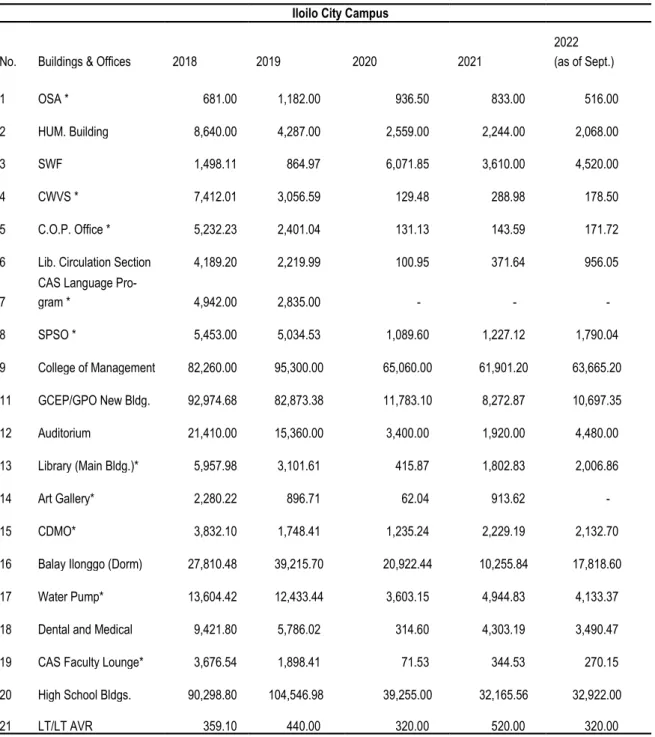
Table 2.7 Assessment of Buildings and Utilities in UP Iloilo City Campus Table 2.8 Annual Power Consumption per Building from 2018-2022 (kwh) Table 2.9 Iloilo City Campus Access Points
Table 2.10 Roads Surface Type and Conditions in the Iloilo City Campus Table 2.11 Pathways Surface Type and Conditions
Table 2.12 Operational Definition of Terms of the Building Conditions Table 2.13 Volume of Solid Waste Generated
Table 2.14 Volume of Wastewater Generated Table 3.1 Vision Reality Gap Analysis: OVCPD Table 3.2 Vision-Reality Gap Analysis: OVCRE
Table 3.3 Vision-Reality Gap Analysis: College of Management
Table 3.4 Key Sectoral Concerns with Land Use and Infrastructure Planning Table 3.5 Results of Risk Assessments of Facilities
Table 3.6 Results of Risk Assessment of Lifeline Utilities
Table 4.1 Comparison of BOR-Approved, Actual, and Proposed Land Uses Table 5.1 Details of PPAs for Funding
Table 5.2 Project Brief for the Old High School Building Table 5.3 Project Brief for The Woman's Club
Table 5.4 Proposal Form of Capital Outlay for Infrastructure
Table 5.5 Project Brief for Adaptive Reuse of the Old High School Building Table 5.6 Proposal Form of Capital Outlay
Table 7.1 Institutional Coordination and Monitoring Matrix Table 7.2 Work Plan for UP Visayas
6 11 13 14 15 15 16 16 17 33 34 35 36 37 40 42 44 46 49 49 50 51 52 63 69 76 83 96 100 112 119 123 125 127 130 132 160 171
MASTER DEVELOPMENT PLAN 2021-2030
ILOILO CITY CAMPUS
CHAPTER 1: Profile of UP Visayas and of Iloilo City 1.1 History and Mandate of the University
The University of the Philippines Visayas was established by the Board of Regents on May 31, 1979, in re- sponse to the need to accelerate the development of fisheries and marine resources of the country. The con- cept of a new autonomous university of the UP System, as conceived in 1975, was to be realized by means of expanded fisheries education, research, and extension service programs with its main campus in Miagao, Iloilo, and with the College of Fisheries as its flagship-college.
On October 30, 1980, Executive Order No. 628 operationalized the UP Visayas as an autonomous unit of the University of the Philippines System, which was to consist of the College of Fisheries, College of Arts and Sciences, Institute of Fisheries Development and Research, Brackishwater Aquaculture Center, School of Development Management, Graduate School, School of Technology and such other units as may be ap- proved and funded pursuant to the provisions of the General Appropriations Act.
As the fourth autonomous university of the UP system, UP Visayas aims to 1) develop excellence and leader- ship in fisheries and marine education, research and extension in the country, 2) expand opportunities for professional and technical training to the rural areas, 3) contribute to professional and technical training for the rural areas, 4) contribute to rural development through relevant instructional, research and extension pro- grams in management, education, engineering, health and related fields, and 5) preserve and enhance the national and Visayan cultural heritage.
The University of the Philippines (UP) Iloilo was established right after World War II, on 18 December 1945 through a resolution of the Municipal Board of Iloilo. Officially, opening on 1 July 1947, the University of the Philippines Iloilo College (UPIC) became the first campus of the UP system in the Province of Iloilo. Its initial offering was for the third and fourth-year high school students and the first and second-year college levels. It became a full-fledged college in 1954 then changed its name to UP College Iloilo (UPCI). It started offering undergraduate and graduate degree programs, and a complete high school (Proposed Land Use Plan [LUP]
for Iloilo City Campus, 2011).
As a leading university in Western Visayas, it is envisioned to be the regional center for professional and con- tinuing education as well as a regional center for culture and the arts (Proposed LUP for Iloilo City Campus, 2011).1
____________________
1http//sites.google.com/site/upvgpo/up-visayas-hiistory-goals-and-objectives
Timeline Key Notes
1945
Mayor Fernando Lopez and the Iloilo City Council passed Resolution 485 appealing for a Junior College of the University of the Philippines to be established in Iloilo
(December 18) (https//: www.upv.edu.ph).
1947
The Iloilo City Council approved Resolution 461 formally donating the pre-war city hall and its site of 10.8 hectares for the exclusive use of UP Iloilo College (April 8). The University of the Philippines Iloilo College (UPIC) was formally opened with Dr. Tomas Fonacier as the first Dean (July 1) (https//: www.upv.edu.ph).
The university started offering classes for the Lower Division Level for 3rd and 4th year high school students and Upper Division for 1st and 2nd year college levels, the first of its kind in the country.
1948
UPIC was given 41 lots and 1 building by the Iloilo City Government thru a Deed Do- nation.
Iloilo City council's Resolution 753 (July 14) and Resolution 782 (July 23) formally set the legal transfer of the city hall building and adjoining site from the city government’s ownership to UP (https//: www.upv.edu.ph).
1949
Iloilo City Mayor Vicente Ybiernas and UP President Bienvenido Gonzales made legal and definite the use of the city hall building and site by UPIC through the "Deed of Do- nation" signed by both parties (August 24) (https//: www.upv.edu.ph).
1954 UPIC was renamed UP College Iloilo
1964 Deed of Donation was signed donating to UP 1,6174 has. of land in Taklong Island,
MASTER DEVELOPMENT PLAN 2021-2030
ILOILO CITY CAMPUS
Table 1.1 Timeline of Key Development of UP Visavas
Timeline Key Notes
1965
The University of the Philippines was given 11 land grants in Visayas, Mindanao, and Luzon thru RA 4514 which established the Institute of Fisheries Development and Research within the College of Fisheries
The university acquired a total land area of 106.4263 at Brgy. Camaligan, Batan, Aklan through the RA 4514: An Act to Establish an Institute of Fisheries Develop- ment and Research within the College of Fisheries of the University of the Philippines dated 19 June 1965. The aforementioned land was ceded, conveyed, and transferred in full ownership to the University of the Philippines by the Bureau of Lands of the Department of Agriculture and Natural Resources dated 12 August 1968 per Original TCT P-933 with Special Patent No. 1208 dated 19 June 1965.
The area in Brgy. Camaligan, Batan is now called the Batan Mariculture Center un- der the Institute of Aquaculture of the College of Fisheries and Ocean Sciences.
1973
The University of the Philippines Visayas Tacloban College in Tacloban City was es- tablished as one of the regional units of the UP system during the 833rd meeting of the UP Board of Regents on July 2, 1973.
1975
UPV was conceived to be an autonomous unit that would become the Philippine's premiere institution for fisheries and marine science education and research during the term of UP President Onofre D. Corpus.
1978-1982 Region VI -Western Visayas was established as the site of the new UP unit under the Philippines Five–Year Development Plan.
1979 The University of the Philippines in the Visayas became an autonomous unit during the 914th meeting of the Board of Regents (May 31).
1980
UP Visayas was operationalized with its main campus in Miagao and the College of Fisheries as its flagship college thru Executive Order No. 628 by President Ferdinand Marcos (October 30).
1981
The site development and construction of the Miagao Campus through the Sixth Edu- cational Loan of the Philippine Government was approved by the World Bank (September).
MASTER DEVELOPMENT PLAN 2021-2030
ILOILO CITY CAMPUS
Timeline Key Notes
1983
UPV underwent reorganization thru EO 9 for the following Executive Offices: Office of the Chancellor, Office of the Vice Chancellor for Planning and Development, Office of the Vice Chancellor for Administration, and Office of the Vice Chancellor for Academic Affairs.
The UP College Tacloban was placed under the administrative supervision of the University of the Philippines Visayas through Executive Order No. 4.
UPV granted tenurial use right thru a Memorandum of Agreement of UPV with the Protected Area Management Board of Taklong Island National Marine Reserve (TINMaR).
1986
UP Cebu College (renamed UP Visayas Cebu College) and UP Tacloban College (UP Visayas Tacloban College) were integrated into regional campuses under the UP Visayas administration.
1988
The College of Fisheries was transferred from UP Diliman to UPV followed by its reor- ganization. The former departments became institutes - Institute of Aquaculture, Insti- tute of Fish Processing Technology, Institute of Marines Fisheries and Oceanology, and Institute of Fisheries Policy and Development Studies (May).
The College of Fisheries transferred to Miagao campus under Chancellor Rogelio Juliano and Dean Efren Ed C. Flores.
1990
The College of Arts and Sciences-Division of Humanities and Division of Social Sci- ences and School of Technology transferred from Iloilo City to Miagao during the term of Chancellor Francisco Nemenzo (June).
1993
The Division of Physical Sciences and Mathematics and the Division of Biological Sciences transferred from the city campus to Miagao. The Office of the Dean and the complete transfer of the College of Arts and Sciences from Iloilo City to Miagao took place in May 1993.
2001
Diwata ng Dagat, a sculpture made by Napoleon V. Abueva, was unveiled on the university’s 55th Foundation Day (July 25). The sculpture has become a landmark of the UPV campus.
MASTER DEVELOPMENT PLAN 2021-2030
ILOILO CITY CAMPUS
Timeline Key Notes
2008
A report was made on the socio-economic profile of the occupants and structures outside the fenced area but within the UPV property in the Iloilo City campus under Chancellor Glenn Aguilar.
2010
The University of the Philippines Cebu College was declared as an autonomous unit under the Office of the President of the University effective January 2011 by the Board of Regents (September 24).
2020
The UP Visayas Extension Campus in Pandan, Antique is given to UP Visayas to manage the property with the UP system as the owner during the 1353rd special meeting of the UP Board of Regents on Sept 2.
Sources: Proposed Land Use Plan for the University of the Philippines Property in Iloilo City, 2011; UP Tacloban College Profile; UPV EO 9-1983. The table only shows key events relevant to LUDIP. For details, please refer to Pa- dayon nga Maragtas sang UP sa Visayas: 75 Years of the UP Presence in Iloilo and Beyond, 2022.
As the national university (UP Charter, Republic Act 9500), UP shall perform its unique and distinctive leader- ship in higher education and development. It shall:
1. Lead in setting academic standards and initiating innovations in teaching, research, and faculty development.
2. Serve as a graduate university.
3. Serves as a research university in various fields of expertise and specialization.
4. Lead as a public service university.
5. Protect and promote the professional and economic rights and welfare of its academ- ic and non-academic personnel.
6. Provide opportunities for training and learning in leadership, responsible citizenship, and the development of democratic values, institutions and practice.
7. Serve as a regional and global university in cooperation with international and scien- tific unions, network of universities, scholarly and professional associations in the Asia – Pacific region and the world.
8. Provide democratic governance in the University (Source: UP Charter, Republic Act, 9500).
As of 2022, the University of the Philippines Visayas has three (3) degree-granting campuses namely UP Visa- yas Miagao, UP Visayas Iloilo City, and UP Visayas Tacloban College. UP Visayas Miagao remains the flag- ship campus and the center of administration.
MASTER DEVELOPMENT PLAN 2021-2030
ILOILO CITY CAMPUS
The Republic Act of 4514 has authorized the Institute of Fisheries and Research under the College of Fisheries to maintain experiment and demonstration stations with field offices at suitable places in the Philippines. Full ownership was given to the University of the Philippines for suitable parcels of public land along the coast not otherwise reserved and not exceeding five hundred hectares per parcel in each of the following places: Rizal, Bataan, Sorsogon, Cagayan, Pangasinan, Polillo Island, Panay Island, Palawan, Sulu, Leyte, and Davao (Section 5, RA 4514).
ILOILO CITY CAMPUS
History of Acquisition
The present UPV Iloilo City Campus sits on a donated property to UP by the Iloilo City government. The Deed of Donation was signed on 24 August 1949. The City of Iloilo, represented by Mayor Vicente Ybiernas, donated a building (formerly the “City Hall”) and 41 portions of lots to UPIC. The two salient points in the Deed of Donation are as follows:
1. Exclusive use of the area for “school and school site purposes”.
2. The area cannot be alienated, sold, mortgaged, or in any manner encumbered (Proposed LUP for Iloilo City Campus, 2011, p.3).
With its strategic location, UPV Iloilo City Campus has played significant roles in Western Visayas historically, academically, socially, and economically. It has envisioned itself as the center for professional and continuing education, culture, and the arts. However, the development of academic infrastructures in the property has been minimal and limited within the fenced area since its acquisition. This is due to land titling concerns and the presence of occupants and structures in the lots donated by the Iloilo City Government to UP. The enact- ment of Republic Act 11396 or the SUCs Land Use Development and Infrastructure Plan (LUDIP) is one mech- anism to enhance the learning environment for its constituents. The LUDIP will also respond to the challenges related to campus development, especially with regard to the presence of occupants and of institutional and business establishments in the donated lots.
MASTER DEVELOPMENT PLAN 2021-2030
ILOILO CITY CAMPUS
Milestones in Campus Land Use Planning
Table 1.2 History of Campus Land Use Planning of UP Iloilo City Property.
Policy Key Notes
Memo 93-23 in 1993
Chancellor Flor J. Lacanilao directed the division of the city campus into two: the Professional Education and College of Management and the creation of a committee tasked as a recommendatory body on the allocation and management of spaces.
AO No. 96-50 in 1996
Chancellor Arsenio S. Camacho issued the order for the constitution of the UPV Iloilo City Campus Development Committee, tasked to consolidate the land use plans within the fenced area, and created a team to conceptualize the development of the Graduate School Building.
AO 181 in 2002
Chancellor Ida M. Siason issued the order for the creation of a committee to plan for the entire UPV Iloilo City property that included properties outside the fenced area.
Consultation and forums were done with the UPV community and constituents of the barangays affected, respectively.
2008
A multi-agency committee headed by UPV VCPD Crispino A. Saclauso, conducted the profiling of the informal settlers outside the fenced area in partnership with ICUPAO, PCUP, and HUDCC and discussed the options for the property from what is legal to socially responsible for all concerned.
2010
VCPD Alice Joan G. Ferrer the review and adoption of previous plans and crafting of the draft after public consultations on the general plan for the property for submission to the Board of Regents. The plan submitted was to maximize the utilization of the whole property.
Source: Land Use Plan for the University of The Philippines Property in Iloilo City, 2011.
MASTER DEVELOPMENT PLAN 2021-2030
ILOILO CITY CAMPUS
Current Governing Board
The current organizational structure of the University of the Philippines Visayas was created thru EO 09-1983 and by later issuances by the UP Board of Regents. The structure also represents the executive offices and colleges that perform core. There are committees and teams that perform add-on functions in support of those offices and colleges performing line functions. The Chancellor issues administrative orders for the creation of these committees and teams.
Figure 1.1 Organizational Chart of University of the Philippines Visayas
MASTER DEVELOPMENT PLAN 2021-2030
ILOILO CITY CAMPUS
Academic Programs and Services Offered
The academic programs in UPV Iloilo City for the Academic Year (A.Y.) 2020 – 2021 are shown in Table 1.3.
Three (3) undergraduate programs, five (5) Graduate programs from different colleges including those that are based on the Miagao campus, and one (1) Post Baccalaureate.
Table 1.3 Degree programs offered for A.Y. 2020-2021 in UPV Iloilo City Campus.
The UPV Iloilo City Campus also offers Secondary Education and Senior High School with the following aca- demic tracks:
• Accountancy, Business, and Management (ABM)
• Humanities and Social Science (HUMSS)
• Science, Technology, Engineering, and Mathematics (S.T.E.M.)
As of A.Y. 2021-2022, the University of Philippines College of Law and the University of the Philippines Visa- yas Iloilo City Campus have jointly offered Juris Doctor. The pioneer batch will include students from Iloilo, Ak- lan, Cebu, Bohol, Leyte, Butuan, Cagayan de Oro, Zamboanga, and Davao.
The executive offices, colleges, and other administrative offices provide extension services to the larger public through the following initiatives:
• The Balay-Balay Child Minding Center run by the Gender and Development Program Office un- der the Office of the vice Chancellor for Research and Extension;
• Community Outreach Program (programs, projects, and activities to raise community awareness of social and political issues as well as the appreciation of one's cultural heritage);
Program Degree
Undergraduate
BS Accountancy
BS Business Administration (Marketing)
Graduate
Master of Management Master of Chemistry
Master of Education (with eight majors) Master of Biology
Post-Baccalaureate Diploma in Urban and Regional Planning Source: UPV CRS August 19, 2019
MASTER DEVELOPMENT PLAN 2021-2030
ILOILO CITY CAMPUS
• Continuing Education Program (seminars, workshops, conferences, forums, and other non- degree training activities for different clientele groups). UP Visayas has been hosting the annual International Conference for Fisheries and Aquatic Sciences since 2015 and the biennial Pagtib- ong: The UPV International Conference on Intangible Heritage since 2017;
• Consultancy and Technical Services Program (professional services rendered to specific clien- tele groups, individuals, or organizations);
• Technology Packaging and Information Dissemination Program (translation, dissemination/
transfer of research findings and other significant information); and
• Contests, programs, celebrations, in commemoration of local, national and internationally signifi- cant events).
Recognition and Awards
The university has been designated by the Commission on Higher Education (CHED) as a Centre of Excellence in Fisheries Education confirming the flagship program of the University. The university has also received local and international recognitions and awards in a variety of scholastic and public service initiatives. The table be- low presents a few of these recognitions.
Type of Assess- ment
Program Assessing/
Accrediting Body
Recognition Received
Date Conferred Validity Period Institutional College of Fish-
eries and Ocean Scienc- es
Commission on Higher Educa- tion (CHED)
Centre of Excel- lence in Fisher- ies Education*
01 January 2016 present
Institutional College of Fish- eries and Ocean Scienc- es
Commission on Higher Educa- tion – National Agriculture and Fisheries Edu- cational System (CHED-NAFES)
National Univer- sity of Fisheries
**
19 June 2009 present Table 1.4 Recognitions Conferred to the University by CHED
*as per CHED CMO No. 38, series of 2015, as amended by CHED College of Fisheries and Ocean Sciences CMO No. 03, series of 2019
** as per CHED CMO No. 18, series of 2009
MASTER DEVELOPMENT PLAN 2021-2030
ILOILO CITY CAMPUS
1.2 Demographic Profile
General Population
The UPV Iloilo City campus general population is composed of faculty, Research, Extension and Professional Staff (REPS), administrators, and students from the UP high school students, College of Management under- graduate and graduate students. The faculty, REPS, and administrators have steadily increased while the number of students shown in the table below has experienced slight changes over the years.
*To follow
MASTER DEVELOPMENT PLAN 2021-2030
ILOILO CITY CAMPUS
Table 1.5 Population Distribution by Affiliation, Sex, and Academic Year in the College of Management Academic
Year Faculty REPS and Admins Students
Male Female Total Male Female Total Male Female Total
AY 2011-2012 10 20 30 3 6 9 268 749 1017
AY 2012-2013 10 23 33 3 6 9 251 769 1020
AY 2013-2014 10 24 34 2 6 8 305 798 1103
AY 2014-2015 10 24 34 2 6 8 292 778 1070
AY 2015-2016 10 25 35 4 6 10 322 797 1119
AY 2016-2017 11 20 31 4 6 10 293 646 939
AY 2017-2018 11 20 31 4 6 10 262 529 791
AY 2018-2019 13 21 34 3 7 10 237 547 784
AY 2019-2020 13 22 35 3 7 10 222 551 773
AY 2020-2021 13 20 33 3 8 11 204 613 817
Table 1.6 Population Distribution by Affiliation, Sex, and Academic Year in CAS-Division of Profes- sional Education/UP High School in Iloilo
Academic Year Faculty REPS and Admins Students*
Male Female Total Male Female Total Male Female Total
AY 2011-2012 9 16 25 5 7 12
AY 2012-2013 11 14 25 5 8 13
AY 2013-2014 10 14 24 4 8 12
AY 2014-2015 11 16 27 4 8 12
AY 2015-2016 12 16 28 3 8 11
AY 2016-2017 17 14 31 2 7 9
AY 2017-2018 17 14 31 2 7 9
AY 2018-2019 17 21 38 7 8 15
AY 2019-2020 17 19 36 7 9 16
AY 2020-2021 18 18 36 6 8 14
The graduate students’ population in the Iloilo City campus has been increasing except for the last four (4) years when it has slightly decreased. The undergraduate population declined during the A.Y. 2016 – 2017 and A.Y. 2017 – 2018 as an impact of the implementation of the K-12 curriculum. This decrease is also reflected in the enrollment of undergraduate students in the College of Management. There are no enrollees for the years 2016 and 2017. During those two (2) years, enrollment in high school continues to increase mainly due to students who opted to enroll in UP Senior High School.
The College of Management (CM) undergraduate program will be transferring to Miagao by the First Sem AY 2022 – 2023. Only the graduate programs of the CM will be retained on the city campus. Thus, the popula- tion in the city campus is expected to decrease in the next ten years. The population projection of the CM personnel and students is reflected in the LUDIP of UPV Miagao campus. The population trends and summary are shown in the tables and figures in the succeeding pages.
MASTER DEVELOPMENT PLAN 2021-2030
ILOILO CITY CAMPUS
Population Growth Rate
Miagao Campus with CM Male Female
Faculty 3.78 3.50
REPS and Admin 0.10 7.43
Central Administration 3.17 2.52
Undergraduate and Graduate Student 9.13 6.04
Iloilo City Campus
Faculty 2.62 3.46
REPS and Admin 2.83 3.30
CM Graduate Student 14.70 8.80
Table 1.8 Average growth rates used to project populations
Table 1.7 Other REPS and Administrative Staff not included in CM and Prof Ed/UPHSI but in the City Campus
Academic Year REPS and Admins
Male Female Total
AY 2011-2012 24 36 60
AY 2012-2013 20 38 58
AY 2013-2014 17 38 55
AY 2014-2015 16 36 52
AY 2015-2016 17 37 54
AY 2016-2017 16 34 50
AY 2017-2018 12 31 43
AY 2018-2019 14 32 46
AY 2019-2020 15 31 46
AY 2020-2021 14 37 51
1.3 Geographic Location of the SUC and its Campuses
Geography
UPV Iloilo City is in the Province of Iloilo, on the island of Panay. The island is bounded by Sibuyan and Visa- yan seas with abundant marine resources. A region is rich not only with natural sources but also in culture and heritage.
MASTER DEVELOPMENT PLAN 2021-2030
ILOILO CITY CAMPUS
Academic Year CM Graduate Students
Male Female Total
AY 2011-2012 60 98 158
AY 2012-2013 53 95 148
AY 2013-2014 78 128 206
AY 2014-2015 65 108 173
AY 2015-2016 91 129 220
AY 2016-2017 100 148 248
AY 2017-2018 121 195 316
AY 2018-2019 103 190 293
AY 2019-2020 109 214 323
AY 2020-2021 81 169 250
Forecasts
AY 2021-2022 93 184 277
AY 2022-2023 107 200 307
AY 2023-2024 123 218 341
AY 2024-2025 141 237 378
AY 2025-2026 162 258 420
AY 2026-2027 186 281 467
AY 2027-2028 213 306 519
AY 2028-2029 244 333 577
AY 2029-2030 280 362 642
AY 2030-2031 321 394 715
For the students, the projections are based on their 9.13% and 6.04% average growth rate for male and female students from AY 2011 – 2012 to AY 2015 – 2016. Table 4 shows the actual and projected number of students in the City Campus.
Table 1.9. Actual (AY 2011-2012 to AY 2020-2021) and Forecasted (AY 2021-2022 to 2030- 2031) Graduate Student Populations in the Iloilo City Campus
Figure 1.2 Location Map of LGU of Iloilo City
MASTER DEVELOPMENT PLAN 2021-2030
ILOILO CITY CAMPUS
Figure 1.3 Vicinity Map of the UPV Iloilo City campus
The Province of Iloilo occupies the southern and northeastern portions of Panay Island. It is bounded by the Province of Capiz and Jintotolo Channel in the north; Panay Gulf and Iloilo Strait in the south; the Visayan Sea and Guimaras Strait in the east; and the Province of Antique in the West (Province of Iloilo, 2018, p.2).
Metro Iloilo is composed of Iloilo City and the municipalities of Pavia, Oton, Leganes, and Sta. Barbara, Caba- tuan, and San Miguel. Iloilo city serves as the regional capital of Western Visayas, an international gateway with an international airport in Sta. Barbara – Cabatuan and seaport in Iloilo City. It is a host to tertiary educa- tion and health institutions, ICT-BPM companies, a tourism hub, and a center for meetings, incentives, confer- encing, and exhibitions (MICE) (NEDA, 2017-2022).
Iloilo City is a highly urbanized area that is composed of six political districts. Jaro is the biggest district which comprises 39% of the total land area or 2,672.00 hectares. The City Proper is the smallest district which has a total land area of 413.50 hectares and constitutes only six percent of the entire Iloilo City. As of November 2007, the land distribution in Iloilo City in terms of district land areas has updated of 7,834 hectares based on the approved base map as evaluated by the DENR Land Management Bureau (LMB), Manila. However, the area of land distributed by the district is not yet available at present (CLUP Iloilo City, 2021, p.11).
MASTER DEVELOPMENT PLAN 2021-2030
ILOILO CITY CAMPUS
Iloilo City campus, being the site of the Old City Hall in the City proper District is a community where the build- ing’s old and new areas are in harmony. Its development adheres to the city’s mission of cultural heritage preservation and its goal to preserve culture and the arts (CLUP Iloilo City, 2021). The numerous art deco buildings preserved in the central business district and guided by the Iloilo City Heritage Ordinance embody the high regard for heritage preservation. According to the USAID report (2013), the port city of Iloilo is the com- mercial, cultural and intellectual hub of the island.
The City will remain as the residential, commercial, financial, governance, and educational hub not only for Guimaras Island and the six “satellite” municipalities but also for the entire Western Visayas (Iloilo City CLUP, 2021, p 42). It shall also continue its functional roles as follows:
• seat of regional governance
• financial capital of the region
• commercial, trading, and industrial hub
• center of education
• logistics hub
• capital of the Metro Iloilo-Guimaras Region (Iloilo City CLUP, 2021, p 33).
The roles that Iloilo City plays in the region place the faculty, students, researchers, and its graduates at a competitive advantage for educational, research, and employment opportunities.
Transportation and Connectivity in Iloilo City
As the regional center, Iloilo City can be accessed by land, sea, and air travel as seen in the Transport Corri- dors and Terminal hub of Iloilo City map. The neighboring municipalities and provinces can be reached by land through the five (5) radial roads, namely Iloilo-Antique (R-1) Road, Mandurriao-San Miguel-Alimodian- Maasin-Cabatuan (R-2) Road, Sen. Benigno S. Aquino, Jr. Avenue (R-3), Iloilo-Capiz (New Route) (R-4) Road and Iloilo City-Leganes-Dumangas Coastal (R-5) Road.
There are also bus and van terminals located within the boundaries of the cities that serve those routes. Trav- eling within the city is possible through Public Utility Jeepneys (PUJ), taxis, cars, tricycles, trisikads, bicycles, and pedestrian access.
By sea, travelers to and from Iloilo City to cities like Manila and Cebu can pass through the Fort San Pedro port while those plying the Iloilo – Bacolod route use the Iloilo Fast craft and RORO terminal in Lapuz, Iloilo City.
There are also ferry terminals that serve passengers going to and from Guimaras Island located at Parola Port and Ortiz streets.
MASTER DEVELOPMENT PLAN 2021-2030
ILOILO CITY CAMPUS
By air travel, there are regular flights by major airlines to and from key cities like Manila, Cebu City, and Davao via Iloilo International Airport located at the Municipality of Cabatuan approximately 19 kilometers northwest of the city (NWRB, 2013). The Iloilo International Airport also caters to international flights from two (2) Southeast Asian countries, Hong Kong and Singapore. The UPV Iloilo City campus is accessible to land, air, and sea modes of transportation.
Figure 1.4 Transport Corridors and Hubs of LGU Iloilo City shows the transportation terminal on the bound- aries between the city and the province and major roads connecting the districts of the city to the CBD.
MASTER DEVELOPMENT PLAN 2021-2030
ILOILO CITY CAMPUS
Physical Characteristics
The city is relatively flat with 90% of the land area’s elevation of 2.64 meters above sea level and 10% elevation of 5.19 meters above sea level. It has a slope of between 0-3 percent which means level to nearly level areas.
The variety of soil types in the city is hydrosol, sand beach, Sta. Rita clay, and Sandy loam.
Watershed Profile
Iloilo City is part of the Tigum – Aganan Watershed and the primary source of water for its residents. Its deteri- orating state caused by pollution, riverbank erosion, and urban migration has compromised the lives and liveli- hood of the people within the watershed. The water quality is poor and the groundwater faces salt-water intru- sion (USAID, 2013).
The Tigum—Aganan Watershed’s natural topography ranges from mountainous areas to flood and coastal plains, covering a total area of 434 square kilometers.
Figure 1.5 Zoning of the UPV Iloilo City Campus Properties by the LGU-Iloilo City.
MASTER DEVELOPMENT PLAN 2021-2030
ILOILO CITY CAMPUS
Land use is generally described as mountain environment or upland forest for the municipalities of Maasin, Alimodian, and Leon; lowland area for Cabatuan, Santa Barbara, San Miguel, Pavia, and Oton; and coastal/
sea environment for Iloilo City and Oton. (Salas, Tigum Aganan Watershed Case Study, no year) Its two major rivers are the Tigum and Aganan Rivers, which combine as the Jaro River before draining into the ocean. The Tigum River is the primary source for 73% of the total water supplied by the Metro Iloilo Water District (MIWD) to its franchise area; while the Aganan River is the major source of irrigation water supplied by the National Irrigation Administration to farmers in the TAW (USAID, 2013).
Figure 1.6 Watershed Map of Iloilo City LGU showing the watershed boundaries and its run-off (Iloilo City CLUP 2021, p. 6)
MASTER DEVELOPMENT PLAN 2021-2030
ILOILO CITY CAMPUS
Built Heritage
The areas with brown colors in the figure below show the sites of cultural importance in Iloilo City. Most of these structures have been preserved, conserved, and are accessible for education enrichment. The Old City Hall in the University of the Philippines Iloilo City Campus is one of these cultural landmarks.
Vulnerabilities and Risks
Vulnerability, as defined by United Nations, is brought about by factors such as environmental, physical, social, and economic that contribute to the susceptibility of an individual, community, assets, or systems during the impact of hazards2. Risk, on the other hand, is the probability of harm that could result damaged to lives, prop- erty, livelihood, or the environment (UNDP, 2010).
Figure 1.7 Heritage Overlay of LGU Iloilo City (Iloilo City CLUP, 2011-2030)
____________________
2http://www.un-spider.org
MASTER DEVELOPMENT PLAN 2021-2030
ILOILO CITY CAMPUS
According to the Community Based Adaptation and Resilience Against Disasters (CBARAD II) Project report, Iloilo City is vulnerable to two kinds of hazards - natural and human-induced which have great impacts on its populace and its urban environment. Its typically flat area made it susceptible to flooding for several years al- ready. It also enumerated the natural hazards that affect Iloilo City which are typhoons, storm surges, floods, earthquakes, tsunamis, liquefaction, and sea level rise. Some of the human-induced hazards on the other hand are a salt-water intrusion, contamination of groundwater, and fire.
Iloilo City has a relatively low elevation of 2.64 meters above sea level situated along the coast. Moreover, Iloilo City has been identified as an alluvial fan. Highly dense populations are located within the coastal areas and along the Iloilo River, making these communities highly susceptible to flooding and storm surges (Manila Ob- servatory CDRA Report).
Further, an integrated vulnerability analysis was done by combining the social vulnerability index with specific hazards, particularly flooding, drought, storm surge, and public health emergency or pandemics (e.g. COVID- 19). The city planning office identified the barangays/areas prone to these four hazards based on exposure data. Putting these together with the social vulnerability analysis, the overall vulnerability of each barangay was analyzed.
In 2020, among the four hazards, the pandemic brought about by the virus causing COVID-19 and flooding threatened the largest portion of the Iloilo city population. At the same, the barangays prone to flooding and COVID-19 also have the highest number of vulnerable populations, specifically females, old dependents, and persons with disability compared to the other barangays. For flooding, this implies that in areas where the haz- ard is highly likely to occur, there is a relatively higher number of people who will have difficulty evacuating on their own. Thus, the risk of injuries or even death is higher for these barangays during extreme flooding events compared with other barangays.
The table below shows the areas that are most at-risk of the four hazards in 2020. It should be emphasized that for COVID-19, the areas identified here in 2020 may not be the same at other times. The barangays within or adjacent to the UPV campus are not included in the identified barangays.
MASTER DEVELOPMENT PLAN 2021-2030
ILOILO CITY CAMPUS
Table 1.5 Most at-risk barangays in Iloilo City, considering Hazard - Exposure – Vulnerability in the year 2020.
Hazard Top 5 at-risk Barangays
Flooding San Isidro,Tabuc Suba Jaro, Dungon A, Calubihan, Dungon B Drought Tacas, Lanit, Navais, Sooc, Hinactacan
Storm Surge San Juan, Calumpang, Calaparan, Sto. Nino Norte, Sto. Nino Sur
COVID-19 San Juan, Rizal Pala Pala 2, Tanza Baybay, Bo. Obrero, Benedicto Pale Source: National Resilience Council, 2020
Figure 1.8 Top 5 barangays most at-risk of drought in Iloilo City in 2020 (Source: NRC, 2020)
MASTER DEVELOPMENT PLAN 2021-2030
ILOILO CITY CAMPUS
The barangays most at-risk of drought are Tacas, Lanit, and Sooc found in the districts of Jaro and Mandurriao.
The Tigum – Aganan Watershed is the source of water, including domestic use for Iloilo City residents. Pro- longed drought affects the water level in the Tigum River. Thus, many households in Iloilo City rely on ground- water wells for potable water to be used for cooking and drinking.
Iloilo City is moderately susceptible to flood, as per records from the Mines and Geosciences Bureau. This means that the affected areas will likely experience flood heights between 0.5 to 1 meter and a duration of 1 to 3 days. This occurs during prolonged and extensive rainfall in the area. The UPV Iloilo City campus has a moderate susceptibility to flooding based on NRC’s records in 2020.
Figure 1.9 Flood Hazard Map of UPV Iloilo City campus
MASTER DEVELOPMENT PLAN 2021-2030
ILOILO CITY CAMPUS
Figure 1.10 Storm Surge Hazard overlay with Land Use of Iloilo City (Source: NRC, 2020)
The UPV Iloilo City campus has high susceptibility to storm surges being proximately located near the coast.
With the campus’ susceptibility to flooding and storm surges, the university adopts the program and projects of the Iloilo City government under its Community-Based Disaster Risk Reduction and Management approach.
MASTER DEVELOPMENT PLAN 2021-2030
ILOILO CITY CAMPUS
2.1 Physical features and environmental conditions
Nearby Airports, Ports, and Terminals
The UP Visayas Iloilo City campus is located near the center of Iloilo City and is highly accessible by land and sea from nearby provinces and municipalities. There are transport terminals around the boundaries of the city for buses, vans, and Public Utility Jeepneys (PUJs). PUJs and taxis ply the routes to and from the UP campus to the transport terminals. The general transportation and connectivity in Iloilo City are discussed in Chapter 1.
When traveling by plane to the nearby Iloilo International Airport, Point-to-Point buses and vans are available in the transport terminal that is located in two (2) commercial establishments within the new Central Business District of Iloilo City in Mandurriao District. Those traveling by sea to the campus can also take the PUJs and taxis from the domestic port and fast craft vehicles at the seaports.
Biophysical environment
The UPV Iloilo City campus is made up of residential and commercial buildings and major city roads most of these structures are occupied by non-UP constituents. But within its academic area of 4 hectares alongside the educational and support facilities are several old trees and vegetation keeping the campus a bit cool on sunny days.
Physical and locational characteristics
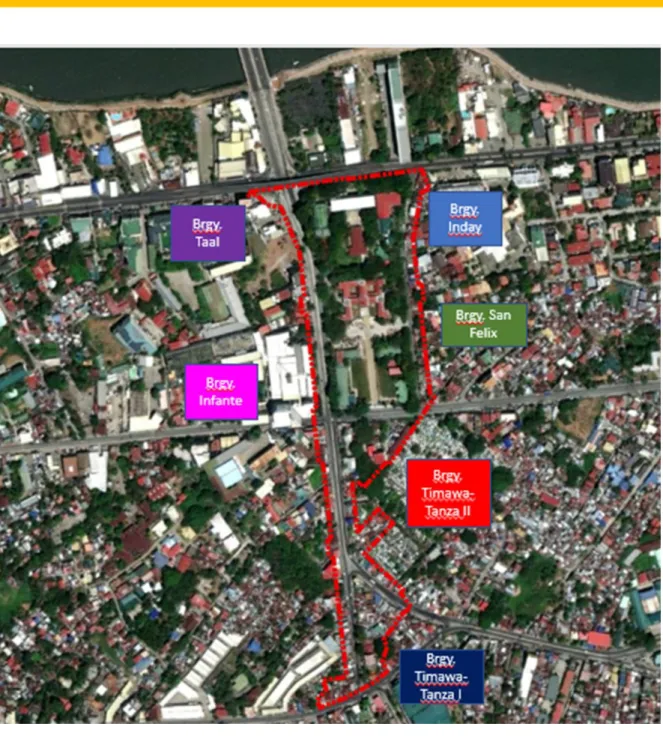
The UP property in Iloilo City is located in the City Proper District of Iloilo City and is 10.8663 hectares. The fenced area of 4 hectares containing the current facilities and buildings is bounded by Gen. Luna St, Ybiernas St, Delgado St., and West Avenue (within yellow lines in Figure 2.1). These are major roads that make the property highly visible and accessible. The lots outside the fenced area are within the jurisdiction of the follow- ing Barangays Inday, Infante Zone 6, San Felix, Taal, Timawa-Tanza Zone 1, and Timawa- Tanza Zone 2.
CHAPTER 2: Existing Conditions of the Iloilo City Campus MASTER DEVELOPMENT PLAN
2021-2030
ILOILO CITY CAMPUS
Figure 2.1 Aerial view of the UPV Iloilo City Campus Property occupying areas of different barangays in the city .
Source: UPV-OVCPD, 2021
MASTER DEVELOPMENT PLAN 2021-2030
ILOILO CITY CAMPUS
Figure 2.2 Aerial view of the UPV Iloilo City Campus from Delgado Street showing the redevelopment of the campus core which includes the Main Building, Oblation, and University Avenue
Source: UPV-OVCPD, 2021.
MASTER DEVELOPMENT PLAN 2021-2030
ILOILO CITY CAMPUS
Figure 2.3 Orthomosaic photo of the UPV Iloilo City property showing the zoning and boundaries of the eight barangays within the university property.
Source: UPV-OVCPD, 2021
MASTER DEVELOPMENT PLAN 2021-2030
ILOILO CITY CAMPUS
Season
Iloilo City has a dry season from December to June and wet season from July to November along the southern- northern part of the province and a portion of the central part. The annual rainfall for 2017 is 2,197.9 mm. The minimum temperature is 24.6 °C and the maximum temperature is 30.6 °C for year 2017 (Iloilo Provincial Pro- file, 2018).
Topography
The land area is relatively flat with a slope ranging from 0 - 3%, like most areas in the city. The average eleva- tion is 2.64 meters above sea level, which makes certain portions of the Iloilo City campus prone to flooding.
Potential natural catastrophes
The campus core and the academic area are vulnerable to a variety of natural hazards (University of the Philip- pines Visayas Iloilo City Natural Hazards for Climate Change Adjusted Disaster Management report). These areas are affected by low, medium, and high hazards. The table below shows the results of the different haz- ards within the 40,000 square meters of campus core and academic area.
Table 2.1 Summary of natural hazards assessment in the UP Visayas Iloilo City Campus.
Hazard Results of Assessment
Flooding A total of 6.4% of the land area is exposed to flooding for the RCP 4.5 2049 5-year scenario. The area affected will increase by 93% for the year 2079 100-year RRP scenario.
Liquefaction The whole land area is 100% exposed to liquefaction. The majority it is or 75.4% is exposed to a medium probability of liquefaction. All of its buildings are fully exposed to liquefaction.
Severe wind Based on PAGASA’s severe wind hazard maps, the trend increases from 20 to 500 years period with severe winds of 88.1 – 117 kph, and all of the build- ings are fully exposed. This makes the heritage structure vulnerable.
Tsunami
No impact was observed on the campus of the tsunami hazard. The overlay analysis showed that the campus boundary did not intersect with the hazard zones.
Storm Surge The campus is not susceptible to storm surges based on the overlay analy- sis. The campus boundary did not intersect any of the hazardous zones for storm surge.
Source: University of the Philippines Visayas Iloilo City Natural Hazards for Climate Change Adjusted Disaster Man- agement Report.
MASTER DEVELOPMENT PLAN 2021-2030
ILOILO CITY CAMPUS
Human-Induced Hazard
The city campus within the 40,000 sq. meters area has built structures with no fire safety installations. A few buildings do not have sprinklers, fire extinguishers, fire doors, fire action notices, and escape signage. A small fire truck cannot pass through the existing pathways. Fire is the city campus’ human-induced hazard.
Sensory
The Iloilo City campus’ location along major thoroughfares make the campus vulnerable to noise and to air pol- lution from passing vehicles, especially to buildings located beside these roads. The trees on the campus, how- ever, help reduce the noise and air pollution coming from the vehicles outside the fenced area.
Land classification
The 10.8663-hectare property, as indicated in the Deed of Donation, in the Iloilo City campus is classified as alienable and disposable land. These are also prime lots located in the commercial area of the city. Walking distance from the campus are hospitals, hotels, and other higher educational institutions.
2.2 Population Projection
The city campus has one dormitory for students, faculty, staff, and visitors. The table below shows the sex- segregated data of the users of Balay Ilonggo from 2011 to 2022. During the height of very strict health re- strictions (AY 2020 to 2021), the dorm was closed to users and has just opened for first semester of AY 2021- 2022.
Table 2.2 Number of Admitted Dormers in Balay Ilonggo from AY 2011-2012 to AY 2022-2023
MASTER DEVELOPMENT PLAN 2021-2030
ILOILO CITY CAMPUS
Academic Year Balay Ilonggo
1st Semester 2nd Semester
F M F M
AY 2011-2012 45 21 46 23
AY 2012-2013 29 37 28 37
AY 2013-2014 57 25 51 23
AY 2014-2015 59 25 59 25
AY 2015-2016 56 26 55 25
AY 2016-2017 55 22 54 21
AY 2017-2018 56 21 57 20
AY 2018-2019 53 28 49 26
AY 2019-2020 49 26 57 23
AY 2020-2021 N/A N/A N/A N/A
AY 2021-2022 N/A N/A N/A N/A
AY 2022-2023 27 12 - -