
The better a gender analysis is adapted to the project's goals and the local context, the more useful the results and recommendations. Questions guiding this process refer to the scope of the research (i.e. community or village level, how many villages and the rationale for this selection) and to the relationship to the data collection methods (i.e. who will be selected to participate in focus group discussions and why? .Focus group discussions are group discussions on a specific topic where the discussion is guided, monitored and recorded by a facilitator.
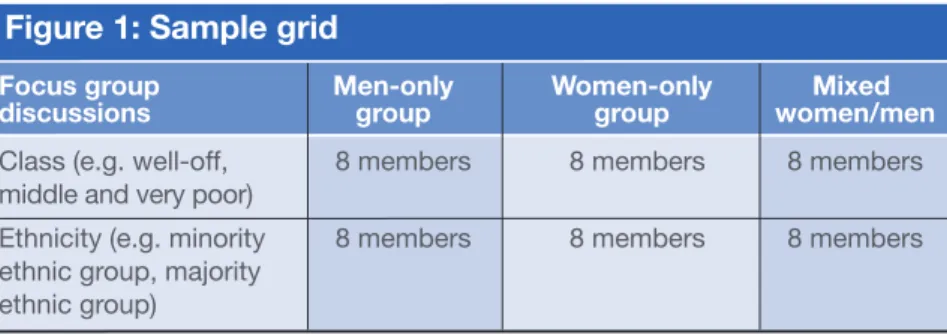
To capture the subtle differences within a group, focus group discussions can be organized according to social groups so that tailor-made questions can be designed (e.g. one group of poor women from a particular ethnic group).
Conducting qualitative gender analysis
For example, households and communities may have more than one livelihood activity such as agriculture, fishing and livestock, plus non-farm occupations. Researchers may need to conduct interviews and focus group discussions with each group to avoid overlooking subtle differences that may explain degrees of disadvantage or privilege. Data collected through interviews or focus group discussions do not require statistical data analysis, however, researchers should take detailed notes or record interviews to capture the essence of responses.
Addressing intersectionality as the core of gender analysis is of added value as it helps capture the diversity of women's and men's lives and provides a more complete understanding of gendered power relations.
When to conduct a gender analysis
If it is not possible to do a gender analysis at the start of a project, it can be done as a special study. Many country programs were unable to conduct a full gender analysis at the priority project sites as part of the resilience analysis process. The Grant Facility for Special Studies to Enhance Gender Mainstreaming in MFF Country Programs provided the opportunity to conduct a gender analysis at each MFF field site.
Whether or not a gender analysis is carried out at the start of a project, it is always important to disaggregate data by gender and track all follow-up data where people are the unit of measure to see if gender differences in participation are increasing or decreasing. access to and control over resources and the exercise of rights and benefits.
How do we do gender analysis?
Gender analysis uses standard social science quantitative and qualitative data collection and analysis methods to answer research questions about how gender differences and inequalities will affect project outcomes and how the project will affect the opportunities and status of men and women. The main difference between a gender analysis and other forms of operational and formative social research is that gender analysis requires that different social groups of men, boys, women and girls participate equally in the research by answering questionnaires and participating in focus groups, interviews, and other qualitative data collection exercises. The analysis must also provide an understanding of why these gaps and inequalities exist, how they are maintained and reproduced, and how they affect the opportunities and aspirations of men and women.
The final step in the gender analysis examines how the identified differences limit or facilitate desired changes in knowledge, practice and access to decision-making for improved resilience of coastal ecosystems and communities.
Key domains for analysis
Finally, the analysis should also include how social groups of women and men try to change their lives and the conditions under which they live. The analysis identifies gender-based constraints and opportunities that have the potential to hinder or facilitate improved resilience. For example, in many places women are limited in management decision-making because they lack basic education and self-confidence.
It will be useful to understand how and why these rights are unequal and how social groups of women and men experience and apply them. Gender roles, responsibilities, time and lived experience: Information about the norms that influence men's and women's behavior and structure the activities in which they participate, their social status, the importance assigned to their work, roles and responsibilities. Information about the emotional experiences of different social groups of women and men can include loss, nostalgia, uncertainty, response to threats and stress of various kinds.
Participation and decision-making: Information on different types, forms and levels of participation including decision-making by men and women of different social groups. Factors affecting the participation and decision-making of men and women of different social groups may include education, access to information and skills, and information on how existing patterns of participation and decision-making affect opportunities to recognize and respond to interests and the needs of men and women. Cultural norms, beliefs and perceptions: Information about the cultural belief system or norms about what it means to be a member of an ethnic group, poor or rich, young or old, male or female in this society.
They also facilitate or limit men's and women's access to education, services, economic and other opportunities, mobility and behavioral expectations. Laws, regulations and institutional practices: Information about the formal and informal rights of men and women and how they are affected differently by the policies and rules that govern institutions.
Gender constraints analysis
Analysis of project opportunities and constraints for gender equality based on applicable laws, regulations and institutional arrangements. For example, women have little influence in community decision-making processes regarding coastal and fisheries resource management and livelihood development compared to men. The second step is to identify the gender-based factors that contribute to the state of inequality and link the limiting factors to the outcome.
For example, women have limited ability to influence community decision-making processes regarding coastal and fisheries resource management and livelihood development because fishing is considered a male domain, women's work is largely unpaid and therefore not recognized in the value chain, and women have limited time to participation in community meetings, as their primary role is to take care of household needs. Once the constraints have been identified, the next step is to prioritize those most likely to affect program outcomes that can be addressed within the project and, when addressed, will contribute to greater gender equality. Gender inequalities arise from the different and unequal treatment of women and men, articulated through economic, social and political institutions that systematically reinforce unequal roles, decisions, rights and opportunities.
In most societies, structural inequalities place women at a disadvantage compared to men, who generally enjoy greater exercise of power and access to opportunities. Certain groups of women and men, based on wealth, education, race, caste, ethnicity, and age among other social variables, may be more or less advantaged than others.
How will the results of the gender analysis be used?
The toolkit serves as a reference point to collect data to understand gender issues in coastal resource management. The toolkit consists of two documents: i) the topic guide that provides a set of illustrative topics that require in-depth discussion, and ii) a set of illustrative questions that can be used to guide data collection. Both documents serve as a menu offering a range of topics and questions for understanding gender issues in coastal resource management.
Application of the toolkit
Topic guide
Overview of the local area and its connection with coastal resources l Overview of the local area in the current situation (calls: social groups, key livelihood opportunities, access to basic services such as education, health care and mobility, presence of NGOs and community organizations, dominant groups , the position of men and women in different social groups in the area). See activity profile matrix). l Reasons for activities to be carried out in certain ways. prompts: Who decides on roles and why?. Are role changes frequent or rare?). l An overview of who benefits and loses from these activities. prompts: . benefits such as identity, livelihood, money, training and knowledge, network or any other benefits perceived by the community).
See access and control matrix. l Overview of what happens as a result of role and resource allocations. Participation and decision-making in coastal resource management l Overview of the structures available to discuss coastal resources.
Overview and situation analysis
Information about the norms that influence men's and women's behavior and structure their activities, roles and responsibilities. This dimension captures information about men's and women's different roles, the timing and place where their activities take place, their ability to participate in economic, political and social activities, and their decision-making (time, space and mobility, household and community division of labor, participation rates in different activities and roles). To what extent do women's groups influence decisions related to the management of coastal and fisheries resources, agricultural resources or forest resources.
Information on the different types, forms and levels of participation and decision-making by men and women from different social groups (see Annex 3, Typologies of participation). Factors affecting the participation and decision-making of men and women from different social groups (eg education, access to information, skills). Information on how existing patterns of participation and decision-making affect opportunities to recognize and respond to the interests and needs of men and women.
Are there cultural, social, religious or other restrictions on women's participation in community meetings and decision-making? Note: The purpose of these questions is to understand what influences the participation of men and women in community decision-making processes. Do women's groups participate in or influence decisions about the management of coastal and fisheries resources, agricultural resources or other communal resources (eg health care facilities).
What are the differences in men's and women's opportunities to access education at all levels? They also facilitate or limit men's and women's access to education, services and economic opportunities. What types of tasks are considered women's work at the family and community level and outside the community.
Information about the different formal and informal rights of men and women and how they are affected differently by the policies and rules governing institutions.
COVER SHEET FOR KEY INFORMANT INTERVIEWS
COVER SHEET FOR COMMUNITY DISCUSSIONS/PRA ACTIVITY
Climate change impacts on coastal ecosystems and small-scale fisheries
Reproductive Roles (examples)Annex 3a
Productive Roles (examples)Annex 3b
Livelihood activities Capture fishing (caught fish, shrimp, crabs or crustaceans) Collecting/manual collection from wetlands (e.g. snails, frogs, crabs). Wood collecting Collecting non-timber forest products (this can also be aquatic plants) or forest users (for example collecting non-timber forest products) Peat collecting Hunting.
Typology of ParticipationAnnex 4
