The flagship agrarian reform program of the Philippines was envisioned to improve the well-being of farmers and farm workers. It proposes a reframing of the criteria used to evaluate such programs in the context of an external funding agency such as the Peace and Equity Foundation (PEF). The Malaga Cuenca Agrarian Reform Cooperative (MACARBEN) in La Castellana, Negros Occidental is a former beneficiary of the PEF.
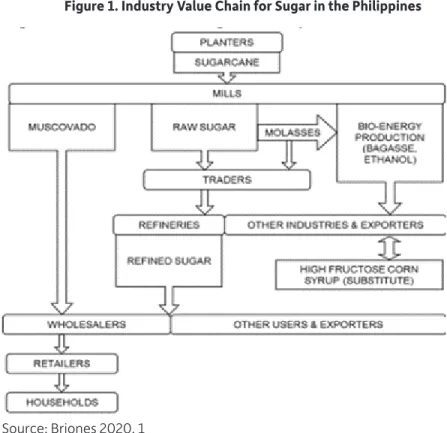
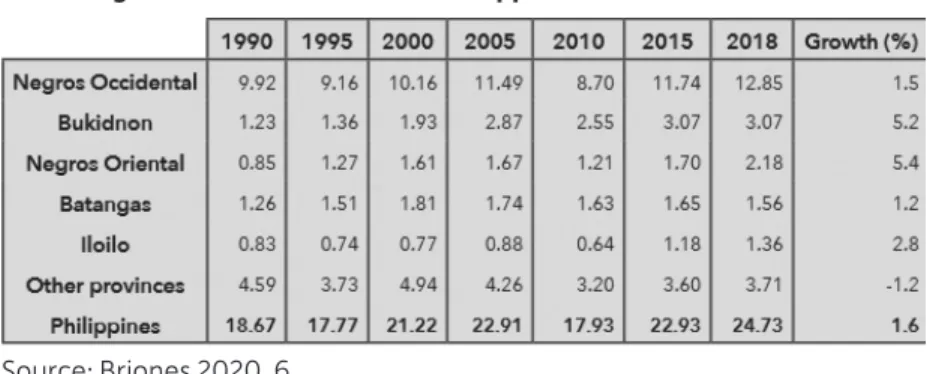
From being one of the top export crops produced by the country (SRA 2012), sugarcane is now only the 5th largest contributor to national gross domestic product (GDP) as of 2019 (PHP 35 million) compared to the top crop rice (Palay ) (PHP 305 million) (PSA 2020a; Figure 2). Recognizing "the sugar industry [as] an important component of the socio-economic and political fabric of the country" (SRA 2012), President Cory Aquino signed Executive Order 18, which created the Sugar Regulatory Administration (SRA) (Office of the President 1986) bring about. ).
Area Context
10659, or the Sugar Cane Industry Development Act of 2015, the SRA aims to "improve the working conditions of the labourers" (SRA 2012) as well as to improve productivity. Here, some of the country's most powerful families control extensive sugar plantations that are worked by landless agricultural workers. Unlike other areas of the Philippines, which tend to be dominated by tenant farming systems, the haciendas of Negros are worked by temporary and permanent landless workers called sakadas, who are based on site in the haciendas without tenure rights or options for alternative employment. .
Among the few borrowers, most of them still complained about high interest rates and inadequacy of the loan amounts. Although government bodies such as the DA and the SRA hold seminars and training, only 27 percent of respondents were able to participate. Depending on the capacity of the mills, the sharing scheme between the miller and the farmer usually varies between 30–35 percent and 65–70 percent respectively.
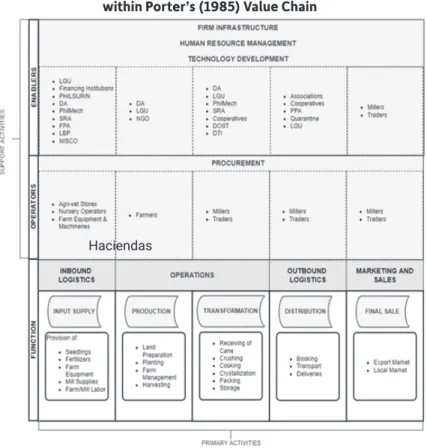
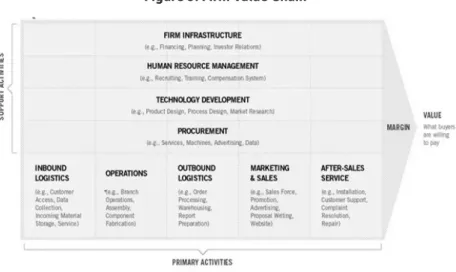
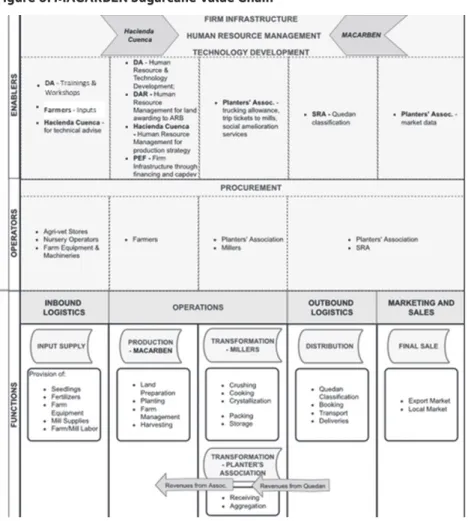
These groups facilitate the sale of sugarcane quedans between the farmer and the milling company. Meanwhile, all houses still do not have access to water (MACARBEN distributes water in the area through its water system project, which is implemented with the support of the municipal local government). This form of value chain will be the framework of analysis for this case study (M4P 2008).
However, due to the limitations of fieldwork during the pandemic, we decided to rely on second-hand data from MACARBEN's funder, PEF.
PEF-MACARBEN Case Study
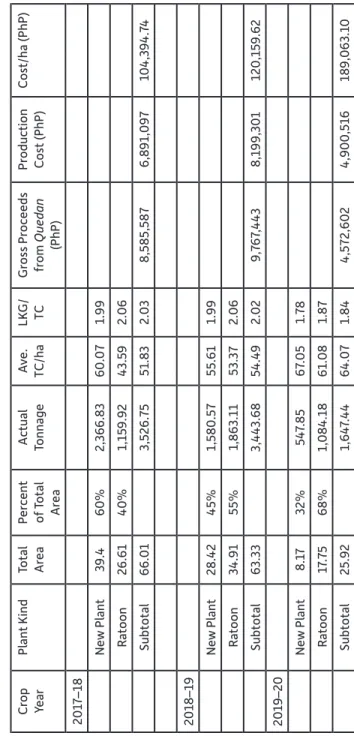
Moreover, this time frame captures a crucial milestone in the organizational development of MACARBEN as an ARB cooperative—. Although the entry point for this case study is still the ARBs, the data to be analyzed comes from their financial records and resource utilization documented by the PEF as MACARBEN's partner in the chain. In addition to the redistribution of the leased 80 hectares, these members also requested that their farm share in the original block farm of 63 hectares also be distributed.
However, more recent baseline data from the cooperatives in the area show that some farmers had incomes of around PhP 8,000 to PhP 10,000 per cycle. So the PhP 20,400 payout per member in the last crop cycle can be considered higher than the average payout in the area, even though it is lower than their most profitable year.6. The wage is also dependent on the availability of labor in the area, which can sometimes be scarce.
Cuenca, their former landowner, guided the ARBs in their production strategy, especially in the initial stages of the transition. As with any agrarian reform program, PEF aims to alleviate poverty in the design of its initiatives. Smallholder farmers valued this access to affordable financing the most, as it curbed their dependence on informal lenders charging high interest rates.7 The firms' infrastructure was a gap in the value chain.
On the other hand, in a collectively managed BF where income is shared equally, the higher the number of farm owners in the consolidated farming, the lower their share dividend.
Discussion
The different definitions of AR have given rise to a wide range of positions and possible solutions to the matter (Putzel 1993), and the majority of recent efforts point to improvements in productivity and efficiency. The perspective of this study is that while improving the productivity and efficiency of ARBs is important, a complementary understanding of the ARB transition from farm worker to farmer can provide useful policy insights. Another option is to implement a right-of-first-refusal policy, meaning that farmers with individual titles must first offer their property to the cooperative before selling it outside.
Pedro Ogatis strongly recommends that the sale or lease of a farmer member's individual title is subject to their financial obligations to the DAR. Part of CARP's mandate was to end unfair property practices, which began with the encomienda system established during Spanish colonization and continued through the modern hacienda system. This transition is made even more difficult in the context of the expansion of agrarian reform programs, due to the multidimensionality of asset specificity (De Vita, Tekaya, and Wang 2011).
Specificity is not only in the resources provided, such as physical land, but also in skills, information and processes. Finally, a successful transition may also require examining farmers' personal relationships or their sense of stewardship with the land and with each other. For example, the Earth for Food framework looks at the farmer's relationship to the land and its ability to provide not only economic stability through the value chain, but also access to food itself and nutritional security.12 This can be influenced by the type of crop that the farmer plants and harvests. .
We draw this framework from Indigenous peoples' strong relationship with their land, which serves not only as a sustainable and climate-resilient food source, but also from their identity as stewards of the land (Woodley et al. 2009).
Recommendations
In addition to improvements in economic returns through effective productivity and efficiency measures, the alternative approach hopes to achieve renewed and strengthened roles in the value chain and cultivate a strong sense of stewardship of the land to help meet the growing need for more effective agrarian reforms. Although the increase in income from block farming was still unable to pull the ARBs out of poverty, it increased the well-being and happiness of the farmers. However, to more accurately reflect farmers' welfare, a measure that could be considered is labor productivity.
While TC or LKG are only able to show how much a hectare of land can produce, labor productivity measures, or tons of cane or sack produced per farm worker per season, are considered by farmers as an important production factor, especially now that they own the land. them to. The development of a tool to assess the general level of community organization and self-determination will also help in assessing the necessary support that a prospective or newly formed group may need to help make their transition to farm/land ownership smoother and to make better. An instrument to determine how ARBs see the value13 of their allocated land can provide insight into the readiness of an ARB organization to make coherent decisions.
If not, would it be more efficient for them to "outsource" the productive use of their land and skills, such as contracting their former owner to manage the land they own. Due to the specificity of assets and the lack of information on the part of ARBs, high levels of uncertainty encourage "contracting" or vertical integration decisions, which go against the spirit of agrarian reform to empower small farmers. While block farming is a viable solution for ARB land consolidation, feasibility studies can be conducted to investigate the optimal level/size of block farming that allows them to benefit from scale-up.
13 This can be seen against the tendency of the ARB to sell or lease the land or the tendency of the farmer to continue cultivating the land for agricultural purposes.
Conclusion
Analysis of Sugarcane Supply/Value Chain in Some Major Sugarcane Producing Provinces of the Philippines." Quezon City: Sugar Regulatory Administration. The Philippine Sugar Industry: What to Do." Los Baños: Institute of Crop Science, College of Agriculture, University of the Philippines Los Baños. Philippine Agrarian Reform in the 21st Century.” In Land Grabbing, Conflict, and Agrarian-Environmental Transformations: Perspectives from East and Southeast Asia.
Toward an Affective Politics of Hope: Lessons from the Philippine Land Struggle.” Environment and Planning E: Nature and Space. Will the Philippines return to its net sugar exporter status? In Fiji/FAO Asia-Pacific Sugar Conference. They contain findings on issues that are in line with the core agenda of research programs under the University of the Philippines Center for Integrative and Development Studies (UP CIDS).
Angara, UP Center for Integrative and Development Studies (UP CIDS) is a policy research unit of the university that connects disciplines and scholars in several units of the UP system. It publishes policy briefs, monographs, webinar/conference/forum proceedings, and the Philippine Journal for Public Policy, all of which can be downloaded for free from the UP CIDS website. Escaping the Middle-Income Trap: Chains for Change examines the overall problem of the Philippines' lack of competitiveness due to low and stagnant productivity and dysfunctional supply chains in the agricultural sector.
The program aims to examine the relationship of inclusion and competitiveness in the country's efforts to achieve sustainable growth by looking at inclusive business models in agricultural value chains and by addressing the marginalization of small farmers and producers.
Program Editors
Editorial Staff