MAGCIANO, MAY FLOR P. APRIL 2009. Possibilities and Constraints to Caliking, Atok, Benguet Smallholder Coffee Producers in Entering the Specialty Coffee Market.
Benguet State University, La Trinidad, Benguet.
Adviser: Marie Klondy T. Dagupen, PhD.
ABSTRACT
This study was conducted to describe the specialty coffee market in Baguio City, identify the requirements of specialty coffee shops on Arabica coffee, determine the profile, emerging possibilities and, possible constraints of smallholder coffee producers of Caliking, Atok, Benguet in entering the specialty coffee market.
The local specialty coffee shops in Baguio City bought Arabica coffee from coffee retailers while others have their own supplier. There is an opportunity for the farmers to target the specialty coffee shops as their direct customers. The specialty coffee shops have standards in buying Arabica coffee. Some were willing to buy Arabica coffee bean from the farmers as long as the Arabica coffee bean pass their standards. The quality of coffee beans that the specialty coffee shops buy is very important and must not be neglected.
Arabica coffee production is one of the major sources of income in Caliking, Atok, Benguet. The primary constraint to entering the specialty coffee market was the difficulty in meeting the standards set by buyers. The respondents described some problems related to quality in terms of defective bean characteristics. There is a potential
market but not all passed the standards.
Page
Bibliography. . . i
Abstract . . . i
Table of Contents . . . iii
INTRODUCTION Background of the Study . . . 1
Statement of the Problem . . . 5
Objectives of the Study . . . 5
Scope and Limitation of the Study . . . 6
REVIEW OF LITERATURE World Coffee Industry . . . 7
Philippine Coffee Industry . . . 7
Demand for Coffee . . . 8
Cordillera Coffee Industry . . . 9
Coffee in a Specialty Sector . . . 11
Philippine Specialty Coffee Shops . . . 12
Homegrown Coffee-Shop Brands . . . 16
Specialty Coffee . . . 17
Requirements for a Specialty Coffee . . . 18
Quality Coffee . . . 20
Smallholder Coffee Growers . . . 22
Organizations of Specialty Coffee Shops . . . 22
METHODOLOGY
Locale and Time of the Study . . . 24
Research Instrument . . . 24
Respondents of the Study . . . 24
Data Analysis . . . 25
RESULTS AND DISCUSSION The Specialty Coffee Market . . . 26
The Specialty Coffee Market in Baguio City . . . 27
Coordination/Relationships of Coffee Shops with Suppliers . . . 27
Sources of the Baguio City Specialty Coffee Shops for Arabica Coffee . . . 28
Requirements of Baguio City Specialty Coffee Shops for Arabica Coffee . . . 28
Background Information of the Coffee Growers . . . 31
Trainings Attended Related to Coffee Production and Marketing . . . 31
Organizational Affiliations . . . 31
Year Started with Arabica Coffee Production . . . 33
Number of Coffee Trees at Start of Operation and in 2008 According to Arabica Coffee Variety . . . 34
Sources of Seedlings . . . 35
Volume of Production . . . 37
Source of Capital . . . 38
Sources of Information on Coffee . . . 38
Possibilities in Entering the Specialty Coffee Market . . . 42
Constraints to Entering the Specialty Coffee Market . . . 42
SUMMARY, CONCLUSIONS AND RECOMMENDATIONS Summary . . . 44
Conclusions . . . 45
Recommendations . . . 46
LITERATURE CITED . . . 47
APPENDIX A. Letter to the Respondents . . . 50
B. Interview Schedules . . . 52
C. Pictures . . . 56
INTRODUCTION
Background of the Study
More and more people are learning to appreciate coffee drinking not just as an
“after dining” practice or a morning ritual, but as part of an emerging lifestyle. Coffee has become a convenient and easily available drink, driven by the youth sector drinking more coffee, the introduction of several brands and variants of fresh and instant coffee and, the proliferation of coffee shops. Coffee shops provide not only brewed coffee, but also a complete array of both hot and cold coffee variants, giving the retail consumer more choices and ways of drinking coffee (Henson, 2007).
As world consumption of both coffee beans and ground coffee continue to increase, domestic coffee consumption likewise increases at 2.25 percent per year.
Anenias (2001) attributes this trend to the proliferation of coffee specialty shops and the active marketing and promotion of varied coffee products among the younger, busier generation.
Euromonitor (2005) reported that consumers are becoming more accustomed to brewed coffee rather than just instant coffee. The emergence of specialty coffee shops has brought about this consumer preference. These specialty coffee shops sell both convenience and ambience. Coffee drinking is now seen as an emerging lifestyle, an opportunity for conversation and socialization, and an appeal to the Filipino culture for relationships and friendships. Coffee shops can now provide this unique atmosphere for this new social trend and consumer behavior.
As such, on-trade volume growth of coffee has improved marginally from 2004 to approach 6 percent of total volume sales in 2005. It is important to note that on-trade
sales of coffee mainly come from the chain specialist coffee shops, as the smaller and mostly independent foodservice outlets still purchase coffee from retail outlets rather than through the foodservice channel. Marketing branded coffee thus becomes a key to success in the coffee shop industry (Henson, 2007).
The Specialty Coffee Association of America (SCAA, 2006) refers to specialty coffee as the highest-quality green coffee beans roasted to their greatest flavor potential by true craftspeople and then properly brewed to well-established standards. The same group explained that specialty coffee tastes better than instant or mass-produced coffee because it is made from coffee beans grown only in ideal climates and prepared according to exacting standards. Specialty coffee possesses a richer and more balanced flavor. Omaña (2006) wrote that the specialty coffee shop industry in the Philippines is seen to sustain its growth of 10 percent to 20 percent yearly for the next three to five years. The market for specialty coffee shops was estimated to be at least P2.6 billion in 2004. Foreign brands accounted for 69 percent of the market; the rest are local brands.
Arabica variety, which is the major raw material for the specialty coffee shop industry, thrives well in high elevation areas and grows well in the Cordillera Mountains in Luzon and of Mindanao Region (Sunstar, 2005). Despite of the Arabica coffee’s potential, the product remains as a secondary crop produced and traded in negligible quantities due to the lack of understanding and appreciation of the real value and potentials of the Arabica coffee. Developing the Arabica coffee industry will provide sustainable livelihood opportunities to 60 percent of the region’s agricultural farmers while promoting organic farming, environmental protection and biodiversity
enhancement by empowering various stakeholders to be globally competitive but culturally grounded (PIA-CAR, 2008).
The Cordillera region has 14,417 coffee growers with a total of 2,147.77 hectares of land planted with Arabica coffee. In 2007, the growers harvested a total of 1,675.23 tons. Benguet has harvested 562.86 metric tons with an area of 642.49 hectares and 10,733 growers (PIA-CAR 2008).
Atok, one of the 13 municipalities in Benguet Province, which is about 30 km from the capital town of Benguet, is a coffee producing town with coffee production as one of the major sources of income of most families particularly in Barangay Caliking (Suan, 2008). However, all of the coffee producers are considered as smallholders defined by Murray-Prior and Batt (2007) as “those who generally cultivate a few trees or a few hectares among their substitute food crops.” Coffee is raised in Caliking for commercial purposes as an alternative for vegetable production that is being challenged with the problem of unstable prices (Suan, 2008).
Caliking, a barangay in Atok, Benguet is one of the main suppliers of Arabica coffee in Benguet. Caliking has an estimate of 318 smallholder coffee growers as of May 2008. The area planted with coffee trees are 52.35 hectares with 83,755 coffee bearing trees. There are 37.50 hectares with 60,002 non-bearing coffee trees. In 2007, the coffee growers produced 15,318 kilograms of coffee bean (Benguet Agricultural Profiling Survey, 2008).
The Arabica coffee beans are usually planted organically in a sense that the coffee growers do not use fertilizer and pesticide in growing their plants. The varieties of
Arabica coffee commonly planted in the area are Arabica Typica, Yellow Bourbon, Red Bourbon, and San Ramon.
At present, the prevailing price in the market is 130 Php/kilogram. However, the Cordillera Coffee Company, a popular specialty coffee shop operating in Baguio City and so far the only specialty coffee shop buying Arabica coffee directly from the farmers, had set a higher price of Php150/kilogram. Suan (2008) wrote that on January 5, 2005, Frank Young, an American who is the owner of the Cordillera Coffee Company, visited Atok and observed that there are lot of coffee plantations in the place. He was interested to buy their coffee but could not transact with all the individual growers. He then suggested that the farmers organize an association of all the growers so that he could transact with the association. Thus, farmers organized the Belis-Sayet Coffee Growers Association. For its part, Cordillera Coffee Company is committed to serving the best Philippine mountain coffee. Fair trade became its primary endeavor, seeking to make a difference in the lives of indigenous farmers by buying their coffee produce for above-market prices (Abaño, 2008).
The rapid growth in the international specialty coffee market is an opportunity for smallholders to improve economic returns in a number of developing countries. Global consumers and specialty coffee buyers are demanding greater product quality, traceability and compliance with environmental and social standards. However, smallholder producers are unable to meet these requirement and government agencies do not have the capability to support smallholders meeting these greater demand (Neilson, 2007).
This study then, will help improve the capacity of the smallholder based coffee industry in Barangay Caliking, Atok, Benguet to successfully participate in the local and
international specialty coffee market. This study is expected to stimulate the interest of smallholder coffee producers in Atok, Benguet to look forward to the specialty coffee market as a major outlet and to entering this industry, and thus, work out strategies to satisfy the quality requirements of this market. This means, advancing their knowledge that can aid them in producing and marketing Arabica coffee bean.
The findings of the study could serve as reference and basis for researchers and students who are conducting related studies and, reference for agencies and institutions that support the coffee production in the Cordillera region.
Statement of the Problem
The rapid growth of the specialty coffee shop industry has increased the demand for Arabica coffee, their main raw material. Hence, there is a need to study the specialty coffee market in Baguio City and the emerging possibilities and possible constraints of smallholder coffee producers in Caliking, Atok, Benguet entering the specialty coffee market. This is in order for the farmers to develop production and marketing strategies to meet the growing market demand for good quality coffee beans.
Objectives of the Study
The objectives of this study were to:
1. Describe the specialty coffee market in Baguio City.
2. Identify the requirements of specialty coffee shops in Baguio City for Arabica coffee.
3. Determine the profile of the smallholder coffee producers in Caliking, Atok, Benguet.
4. Determine the possibilities of smallholder coffee producers in Caliking, Atok, Benguet to enter the specialty coffee shops market.
5. Determine the possible constraints of smallholder coffee producers in Caliking, Atok, Benguet to enter the specialty coffee shops market.
Scope and Limitation of the Study
The study presents a picture of the coffee specialty market based on secondary data and interview to managers of the coffee specialty shops in Baguio City. The coffee shops in Baguio City are seen as possible buyers of coffee not only within the Baguio City market but also in other branches outside the region. While there are other Arabica growing municipalities in Benguet, the research focused in Caliking, Atok, Benguet. The research was conducted from November 2008 to March 2009.
REVIEW OF LITERATURE
World Coffee Industry
Coffee is the second most traded commodity in the world - second to petroleum.
Thus, the countries within the coffee belt have taken to harvesting the highly valued crop, and for many, coffee has become one of their biggest income earners (Anonymous, 2008). Coffee is the second most important product in the international commerce based on volume traded, and it is estimated to be the first because of value (Dayawen et al., 2006).
Philippine Coffee Industry
About 200 years ago, the Philippines was on the list of the world's top coffee producers - the country was once the fourth largest coffee producing nation. Today, the Philippines produces only .012 percent of the world's coffee supply (Anonymous, 2008).
While the Philippines is one out of 53 countries that can produce coffee, the country supplies only less than one percent to the world market (Tabangcura, 2008).
According to the International Coffee Organization (ICO), the total coffee production of the Philippines jumped from 126,280 tons in year 2000 to 143,120 tons in year 2001. The Philippines is one of the few countries in the world where all these coffee varieties exist. Robusta accounts for 75 percent of the country’s total production, and Arabica 5-10 percent. Other varieties such as Excelsa and Liberica, account for the remaining 15-20 percent. The value of coffee imports is estimated to be about $2 billion a year, one percent of total world trade (Dayawen et al., 2006).
The local coffee industry is weighed down by a shortage in local production amid a growing consumption of coffee in the country. This was according to Philippine Coffee Board Co-Chairperson Pacita Juan in an article written by De Vera (2008).
Demand for Coffee
The Euromonitor Global Marketing Database (2006) reported that coffee drinking is becoming even more widespread among children, particularly those from lower- income households. Youngsters acquire an early attachment to coffee, as well as brand loyalty and increased consumption at an early stage. This practice contributed to the rising retail sales of instant coffee since it was readily available at almost all local retail outlets in 2005.
An impressive growth in hot beverage drinking benefited greatly from the progressively busy lifestyles of Filipinos in urban areas, specifically students, young professionals and households with working mothers. These busy lifestyles see coffee drinking not only as a means to keep wide-awake, but also as a reason to hang out more with friends and colleagues, thus driving up local coffee consumption (Henson, 2007).
Data cited by the Philippine Coffee Board shows that more and more Filipinos are drinking coffee, as consumption of premium or specialty coffee is increasing annually by 20 percent, while that of ready-to-drink coffee is growing 5 percent yearly. Filipinos are among the biggest consumers of coffee products in Asia (De Vera, 2008). Filipinos consume 75,000 metric tons of coffee every year but only produce 35,000 metric tons, meaning half of the coffee they consume is imported (Tabangcura, 2008).
Coffee plantations from the country’s 22 coffee-producing provinces could only churn out a total of around 30,000 metric tons per year, which are not enough to satisfy
the local demand for coffee of around 65,000 metric tons annually. The current situation is very different from the country’s coffee-production capacity in the past, when it used to be the fourth largest exporter of coffee. The Philippine Coffee Board attributed the drop in local production to the decline of coffee prices in global market a few years ago, pushing many Filipino farmers to plant other more profitable crops instead. Thus, most of the local coffee product manufacturers instead import coffee beans from Vietnam and Indonesia (De Vera, 2008).
Pacita Juan of the Philippine Coffee Board in De Vera (2006) said that the global coffee market has grown since, and coffee could now be sold at a high of about Php100 to Php200 per kilo from a low of only between P30 to P80 some years ago. Further, coffee shop owners in Manila can make about 80 cups from a kilo of ground coffee and sell them for Php55 each. Roasted ground coffee is sold for at least PhP170/kilo in the local market (Tabangcura 2008).
Cordillera Coffee Industry
Coffee production is a lucrative business in CAR. The cool climate of the Cordillera is suitable for the production of the Arabica coffee (Dayawen et al., 2006).
Malanes (2008) wrote that the Benguet Arabica belongs to the heirloom Typica variety sought by local and international gourmet buyers. Grown in temperate uplands like Benguet and Mountain Province, Arabica coffee promises a local and world market potential. As such, it has been included as one of the top five priority commodities identified by the DA and DTI as the region’s model commodity under the One-Town- One-Product (OTOP) program.
The total area of production for coffee as of 2001 is 751.77 hectares for the whole CAR, 223.89 hectares of it is in Benguet. Out of the 751.77 hectares, farmers could only produce 300 kilograms of coffee beans per hectare (Tabangcura, 2008). CAR has an existing 7,781 hectares used for coffee production and another 3,000 hectares as potential expansion area. As of 2008, there are about 7,927.25 hectares of coffee plantations and 4,295 hectares potential coffee farms. Statistics of the Department of Agriculture (DA) show that the North Central Luzon of which Cordillera is clustered ranked third nationwide in terms of production area (Malanes, 2008).
Institutions such as BSU assume functions in trying to expand the Arabica Coffee industry, to empower the major stakeholders especially the farmers and, to help advance the technology of coffee production. Tabangcura (2008) reported that Tom Killip, Presidential assistant to the Cordillera, assured that there will be no problem on the marketing of coffee since “there is great demand for this product domestically and internationally” citing that two years ago, green beans was sold for Php 70/kilo and now it is Php 180/ kilo. Arabica is known for its elegance and complex flavor and is known to have higher quality than Robusta and any other varieties. It has the potential to capture premium markets such as the US, Germany, Canada and Japan (Abaño, 2008). Of all the Arabica coffee now planted in the Cordillera, the Arabica typica variety is the best in terms of taste and aroma. It is the same variety, which was first introduced in the highlands and adopted by growers in Benguet and Fedilisan, Sagada, Mountain Province.
Benguet Arabica typica coffee is an heirloom coffee. It has remained this long because it is not only the best. It is also a heritage crop and to make it a competitive consumable commodity among the people and a gift to Filipinos and the world, and the next
generation as well, is certainly a current challenge. There really is a need to do more in terms of breeding, production, processing and packaging to promote Benguet coffee for would-be farmers and entrepreneurs (Domoguen, 2008).
Coffee in a Specialty Sector
Coffee is a product that lends itself to differentiation. There is a wide diversity of flavors and aromas that emerge from different coffee growing soils, climates, tree varieties, cultivation and, processing methods, all of which impact quality. The natural variation of coffee places it in a widening spectrum of differentiated food products, which include wines, beers, and cheeses among others (Roseberry, 1996).
The specialty sector is a broad term to cover coffees “which either command a premium price over other coffees or are perceived by consumers as being different from widely available mainstream brands of coffee.” This sector includes coffees that have niche market characteristics or have other certifications that attract premiums (Murray- Prior and Batt, 2007).
Specialty coffee entails the need for trade and procurement strategies different from the mainstream supply chains that deliver regular coffee. Mainstream coffee supply chains are characterized by a large number of intermediaries and a system of market relations that give greater market power to the import side than to the export side resulting in a proportionally greater share of total export earnings accruing to importing companies (United Nations, 2003).
Roast coffee comes in many forms, but the mainstream market is for blended coffee with the coffees coming from many sources, which are often interchangeable.
Essentially, roasters in this market blend to a taste and price. Then, the market is very
competitive. Many coffees that do not have particular characteristics to set them apart end up in a market where they face stiff competition. Concentration has been less pronounced in this sector because of the recent expansion in what can be called the specialty sector. A coffee’s suitability for a niche market depends on whether it meets certain quality and availability characteristics. The price will tend to increase with increasing quality and decreasing availability. Examples of price being determined by exclusivity include Café Chon from Vietnam and Civit coffee from the Philippines. Both are extremely rare because the beans are manually extracted from the feces of foxes and native cats that have consumed the beans (Murray-Prior and Batt, 2007).
Philippine Specialty Coffee Shops
Coffee chains offer a relaxed, social ambiance, trendy and visually appealing equipment, and well-mannered staff and crew that are as critical to their popularity as the coffee products they sell. Because of these attributes, consumer patronage has grown enormously which resulted to the proliferation of coffee shops across the country, a trend likely to continue (Henson, 2006). Specialty coffee shops trace their roots from the coffee shops of Europe in the 16th and 17th century upon the introduction of coffee which became a popular drink. In the United States, specialty coffee shops are said to have been popularized by Starbucks Coffee, which has more than 10,000 outlets worldwide, with 93 located in the Philippines operated by its franchisee Rustan Coffee Corporation (Omaña, 2006).
Specialty coffee shops in the Philippines are expected to continue growing in coming years in terms of number of outlets, transactions and sales value. With Starbucks gaining more popularity and other specialty coffee shops following, more such outlets are
likely to appear in the market. The strong growth is mainly attributed to good consumer demand, as coffee drinking has become a very popular social activity. Increasingly, Filipino consumers are settling for a good coffee instead of alcohol on a night out. Coffee shops have become a status symbol for younger consumers. Working people find these specialty coffee shops to be convenient places for afternoon business meetings. With the growing popularity of coffee drinking in the country, Filipinos have started to be more discriminating in their preferences for coffee. Multinational chains dominate specialist coffee shops in the Philippines. Led by Starbucks, specialist coffee shops have been enjoying robust growth since appearing in the late 1990s. Other popular foreign franchised specialist coffee shops include Seattle’s Best, The Coffee Bean and Tea Leaf and UCC Coffee. Figaro Coffee Company, the most popular local specialist coffee shop in the Philippines, was actually established earlier than Starbucks in the country.
Recognizing the good growth potential for specialist coffee shops, many Filipino companies and even growers of locally produced coffee beans have opened their own businesses. The support of the local government and agriculture sector has also helped to rejuvenate the Philippine coffee industry (GAIN Report, 2007).
The total number of specialty coffee shop outlets or branches has reached more than 300 as of February 2006. The outlets are located mainly in Metro Manila and in key cities such as Baguio, Cebu, and Davao. The large number of outlets is attributed mainly to the growing specialty coffee shop chains. As of February 2006, the Philippine specialty coffee shop industry consisted of at least 15 major players - 10 are foreign and five are local brands. The foreign brands include Café Nescafe, The Coffee Bean and Tea Leaf, Dome Café, Gloria Jean's Coffees, McCafe, San Francisco Coffee Co., Seattle's
Best Coffee, Segafredo Zanetti Espresso, Starbuck's Coffee and UCC Coffee. Local companies have managed to get the master franchise for the operation of these foreign specialty coffee shops in the country. Some of the outlets are owned and operated by other companies through sub-franchising offered by the master franchise holders. The local brands are Bo's Coffee Club, Figaro Coffee Company, Mocha Blends, The Coffee Beanery and, The Coffee Experience. Other local specialty coffee shops that have recently sprouted in Metro Manila include Baang Coffee, Libreria and, Coffee Republic, with less than five outlets each (Omaña, 2006).
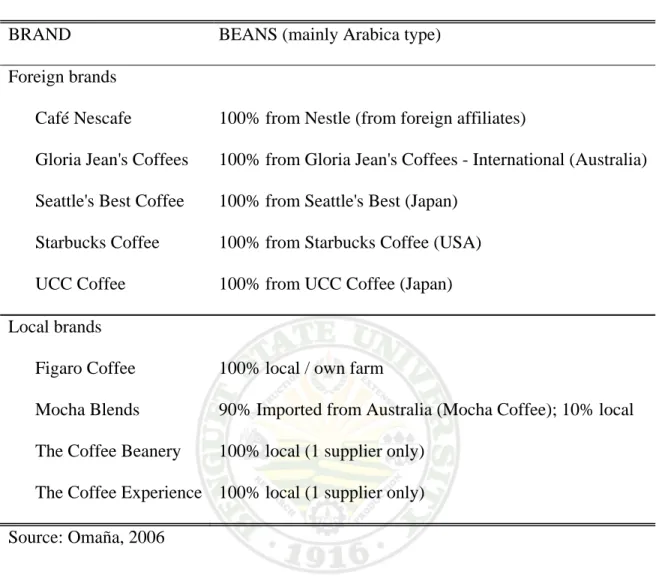
The main product of specialty coffee market is specialty coffee. Table 2 shows the main coffee bean supply. According to players foreign and local, it is easy to get suppliers for their major inputs. The prevalence of suppliers - which normally cater to restaurants, hotels and other institutional clients - has led to a situation wherein the suppliers themselves approach the companies to offer their products. Interestingly, Starbucks Coffee being the industry leader requires exclusivity from its suppliers. In other words, their suppliers are not allowed to cater to other specialty coffee shops. They can, however, still service hotels, restaurants and other food service outlets.
While the other players do not require their suppliers to be exclusive, they do not allow them to sell to other specialty coffee shops exactly the same products (e.g. breads, cakes, and pastries) as some of the recipes are proprietary (Omaña, 2006).
Table 1. List of key players in the Philippine specialty coffee shop industry, 2006 BRAND COMPANY YEAR
ESTABLISHED
NUMBER OF OUTLETS Foreign
The Coffe Bean and Tea Leaf
The Coffee Bean and Tea Leaf Philippines Inc.
2003 10 Gloria Jean’s
Coffees
Specialty Beans Philippines Inc. and various companies
2003 19 Segafredo Zanetti
Espresso
Liberty Ventures Inc. 2002 3
Café Nescafe La Barista Inc. 2001 5
San Francisco Coffee Co.
Coffee Partners Inc./ Hot Business Ventures Inc.
2001 6 Seattle’s Best
Coffee
Coffee Masters Inc. 2000 20
UCC Coffee Blue Mountain Coffee Ventures Coffee Brewmasters Inc.
2000 7
Dome Café Dome Café Franchise Corp. 1997 4
Starbucks Coffee Rustan Coffee Corporation 1997 93
McCafé Golden Arches Dev’t Corp. N/A 4
Local
Mocha Blends Mocha Blends Corporation and various companies
2002 39 Bo’s Coffee Club Coffee Centrale The bean Co.
Inc./Bo’s Coffee Franchise Corp.
1996 23
Figaro Coffee Company
Figaro Coffee Co. Inc.
and various companies
1993 49*
The Coffee Beanery
Cravings Food Svcs Inc. 1993 7
The Coffee Experience
CX Food Enterprises Inc. and various companies
1993 24 As of February 2006 NA = not available * = excluding three outlets overseas
Source: (Omaña, 2006)
Table 2. Sources of coffee bean of the major players or owners of specialty coffee shops in the Philippines
BRAND BEANS (mainly Arabica type)
Foreign brands
Café Nescafe 100% from Nestle (from foreign affiliates)
Gloria Jean's Coffees 100% from Gloria Jean's Coffees - International (Australia) Seattle's Best Coffee 100% from Seattle's Best (Japan)
Starbucks Coffee 100% from Starbucks Coffee (USA) UCC Coffee 100% from UCC Coffee (Japan) Local brands
Figaro Coffee 100% local / own farm
Mocha Blends 90% Imported from Australia (Mocha Coffee); 10% local The Coffee Beanery 100% local (1 supplier only)
The Coffee Experience 100% local (1 supplier only) Source: Omaña, 2006
Homegrown Coffee-Shop Brands
Instead of competing head-on with the giants, homegrown coffee-shop brands, like the Cordillera Coffee Company, an emerging local specialty coffee shop in the country, have concocted a different formula to withstand strong competition in the local market (Abaño, 2008). Abaño (2008) further wrote that Mary Grace Arboleda-Young, president and general manager of the company said that the company offers a connection to origin with each coffee experience. Cordillera Coffee Company’s main thrust is to
promote a native coffee culture and make Filipinos proud of the coffee grown in the Cordillera highlands.
Mary Grace Arboleda-Young’s business idea emerged in 2000, when she tasted different varieties of coffee here and abroad. She discovered that Arabica coffee, locally grown in Kalinga since age 10, was more flavorful than any she had tasted. The 37-year- old businessperson also said that there is always room for more coffee. What many Filipinos do not know is that Arabica coffee is one of the best coffee varieties in the world, and that it grows in the Cordillera highlands. Cordillera Coffee Company alone buys 10 to 12 tons of Arabica coffee per year from Benguet farmers (Abaño, 2008).
Overall, the continuing focus on addressing key success factors such as product development and innovation, brand and product promotion, and outlet expansion would allow the industry to continue and enjoy a brewing business and, help the development of the domestic coffee growing industry (Omaña, 2006).
Specialty Coffee
Specialty coffee is the result of global supply chains in which consumers are largely located in the US, Europe and Japan and producers in poor agriculturally based developing countries (Donnet, 2007). SCAA (2007) defines specialty coffee as, those
“made from exceptional beans grown only in ideal coffee-producing climates; they tend to feature distinctive flavors, which are shaped by the unique characteristics of the soil that produces them.” Specialty coffee is a growing market segment in an otherwise declining industry. The tremendous growth of this differentiated industry requires the full incorporation and improvement of producers in a highly demanding and coordinated supply chain. Coordination is crucial between coffee producers and roasters since
“specialty coffee distinguishes itself first and foremost by the quality of the raw material”
(Knox and Huffaker, 1997).
Requirements for a Specialty Coffee
Specialty coffees are usually obtained from several varieties of Coffea arabica:
the traditional cultivars of Typica and Bourbon, the more recent Catuai variety and the heirloom Pacamara are outstanding producers of specialty coffees. Growing methods also impact quality, fertilization, harvest and processing practices affect the characteristics in the coffee beans (Samper, 2003). Therefore, origin and the individual conditions of altitude, soils and climate, the variety of the coffee plant and the cultivation methods constitute potential reputation attributes (Donnet, 2007).
Arabica is the most widely used bean in the world. It contains half the caffeine of Robusta and is considered a superior bean in taste and quality. Arabica is grown at high altitudes (4,000 - 6,000 feet above sea level), needs some moderate to abundant rainfall, warm temperatures, fertile soil, and sometimes shade. The average tree or shrub yields from a meager 1/2 to 2 pounds of coffee beans per year (Anonymous, undated). The same source describes the processing of coffee in the following section.
The majority of specialty coffees are “washed” coffees. After being picked at the peak of ripeness, the coffee beans are squeezed out of the cherry skin by a pulper with the aid of water. The beans are then fermented for two to three days in order to remove the mucilage or fruity part. After the washing process is finished, the beans are dried in the sun for about three weeks, and they are turned several times each day to ensure that all of the beans dry evenly.
Specialty coffees that are not washed are called “naturals” or “sun-dried” coffees.
Instead of going through the washing process, the cherries are placed on concrete slabs or tarps and allowed to dry in the sun. After drying, the coffee is transported to mills, where it is milled to remove the dry hulls. At this point, all the coffees are carefully graded by size, density and, of course, taste (liquor). Specialty coffees should be larger and have few defects in the bean. Farmers send the green coffee to importers for sampling. Once the importer roasts, cups and approves the coffee, the importer will then either purchase the beans to sell or send more samples on to the individual roasters for additional cupping and subsequent approval. At this point, the coffee is shipped to the U.S. and sent out to the roasters. The roasters then sell their coffee to the retailers, who sell it to the consumer.
As an industry, there is an attempt to encode information about these subjective gestation experiences into ‘certified’ quality systems (Ponte and Gibbon, 2005), such as the coffee standards by the SCAA, the Cup of Excellence cupping form, and the quality rating in the Coffee Review. The prices paid according to this quality information by specialty coffee buyers to growers are the crucial element of supply chain coordination in these market based supply chains (Ponte, 2002).
The grading system for specialty coffee is based on the: a) growing region, b) conditions of the beans, c) bean size, d) taste, and d) number of defects. In the commodity coffee, the grading of coffee beans is the basic measure of value. The mainstream coffee trade is organized around a grading hierarchy according to type (Arabica or Robusta), primary processing (wet or dry), country of origin, and grade (Ponte, 2001). However, beans that are relatively uniform in appearance would be graded into the same category;
the problem is that the beans can vary significantly in the cup (Bates, 1997). Most defects
regarding appearance of the beans generally have little impact on cup quality (Barker, 2004).
Boccaletti (1999) observed and argued that specialty coffee prices are influenced by both sensory and reputation attributes since specialty coffee is a highly differentiated specialty food product. Quality ratings from the sensory evaluation of coffees in the cupping competitions have a significant impact on prices, particularly, since the specialty coffee market is in the early stage of its life cycle, in which the taste experts at the cupping competitions have a crucial role in defining sensory quality. Despite the exhaustive procedure for measuring quality developed by the specialty industry, prices are not a function of this measure alone but that preferences supported by reputations are likely to be observed in the bidding behavior. The possibility of growers capturing the price differentials depends on consumers recognizing the link between desired traits and their underlying determinants at the production level (IDS, 2001).
Quality Coffee
Murray-Prior and Batt (2007) also added that quality of coffee is essentially a subjective characteristic determined by the taste of the particular country and the segments within the market. Quality coffee can be categorized into three groups:
exemplary (limited availability and fine or unique cup); high quality or premium (either single origin or blends but of good cupping quality, may not be visually perfect); and mainstream (average quality). Coffees with good quality can attract considerable premiums at retain level, which can also result in worthwhile although still lower premiums to farmers. Nevertheless, it is important to recognize that specialty coffees account for less than 15 percent of the world market.
The consistent supply of premium quality coffee beans from its origin in coffee growing countries is crucial to sustaining the specialty coffee chains. Simultaneously, the impact of rural poverty in developing countries is not well understood. This represents a challenge to traditional producers who were used to selling to intermediaries in anonymous commodity supply chains. At the same time, this also represents a unique opportunity to show that the intrinsic quality and value of specialty coffees are created at the production level in the growing countries. Traditionally, expert tasters, usually the buyers and/or roast masters of coffee firms, define the quality that determines whether a coffee fits into the specialty category or not (Donnet, 2007).
Measuring quality of specialty food products is complex, as they need to be
‘looked and felt’ (de Figueiredo, 2000). Complexity arises from the variability of the sensory experience from person to person (quality is subjective) and from product to product (specialty products are different from one another).
The practice to assess coffee quality in the specialty industry is the cupping.
Analogous to wine tasting, cupping is the sensing of aromas, flavors and body through olfaction, gustation and mouthfeel, respectively (Lingle, 2001). The specialty coffee industry has operationalized quality assessment through the convention of a cupping form that rates coffees with a 100 point scale.
In contrast to the mainstream industry, the assessment of the quality attributes in the cup, acidity, body and flavor, is of foremost importance in the specialty industry.
Similar to the concept of terroir in wine production, high quality coffees can be produced only in certain places. There are origins that have proven their ability to grow great
coffees due to altitude, latitude, soil and other conditions while other origins have not demonstrated such ability (Holly, 2005).
Smallholder Coffee Growers
According to Murray-Prior and Batt (2007), coffee is the main source of cash income of smallholder coffee growers, which is used to pay school fees, purchase trade goods and meet traditional social obligations. Issues about smallholder coffee growers raised by several authors such as: Fitter and Kaplinsky (2001), Lewin et al. (2004), Oberhänsli (2001), Kaplinsky and Fitter (2004) include: a) To whom do the benefits of meeting the increasingly complex demands from consumers and buyers in coffee build up? b) How do the coffee producers take advantage of the specialty coffee markets? and c) How will the consumers recognize the valuable characteristics produced at the green coffee production level to capture price differentials?
Organizations of Specialty Coffee Shops
Some owners of the major specialty coffee shop chains meet and discuss as members of the private sector-led National Coffee Development Board (NCDB), which aims to promote and save the local coffee industry from declining production and area planted. The group started as the government's National Task Force on Coffee Rehabilitation organized in May 2002. One of NCDB's programs is the Kape Isla Cooperative Marketing whose objective is to develop loyalty to Philippine coffee, reduce imports, increase domestic production, and create new jobs. The Program's Kape Isla seal is intended for the use of the different players in the industry as a Philippine coffee quality seal. Another organization is the Specialty Coffee Association of the Philippines
(SCAP), which was established in 1998 to promote and support the specialty coffee trade in the country (Omaña, 2006).
Coffee Assistance for Indigenous Development
Coffee AID (Assistance for Indigenous Development) is an NGO that advocates fair trade, empowerment for indigenous peoples, and love for the place. Coffee AID buys the coffee from indigenous backyard growers from the Cordillera at above-market prices.
This group was organized to curb the practice of market intermediaries in some areas to take advantage and buy coffee at extremely low prices. This is because the AID believes that the farmers deserve the right price for their quality organically grown coffee.
Through this advocacy, the Coffee AID aims to eliminate the 'middleman' practice where coffee is bought from them at such a low price then sold at high margins to end- consumers. The native coffee growers care for the coffee they produce; coffee has been their way of life. Exploitation has been their pain and the Coffee AID hopes to completely reverse this by helping give what is due them (Anonymous, undated).
METHODOLOGY
Locale and Time of the Study
This research was conducted in Baguio City where the specialty coffee shops are located, and in Barangay Caliking, Atok, Benguet, one of the places where Arabica Coffee is produced in Benguet. The study was conducted in November 2008 to March 2009.
Research Instrument
An interview schedule was used in gathering information from the smallholder coffee growers. Information sought from the interview schedule include: socio- demographic profile of the respondents; membership in organizations; trainings attended in relation to coffee production and marketing; production practices; sources of coffee information; and problems encountered in coffee production and marketing.
Another set of interview schedule was prepared for the specialty coffee shop owners or managers. This contained questions on: the company coffee shop background;
sources, variety, form, and quantity of coffee bought; quality requirements; perceived characteristics of good coffee beans; and relationships with their coffee bean suppliers.
Respondents of the Study
The study got information from key informants taken from seven specialty coffee shops, which include the Cordillera Coffee Company, Fuzion Smoothie Café, Studio One Ballroom Dance Academe and Coffee Shop, Koffia, Café Picarre and, Mocha Blends.
The project-in-charge of the Benguet State University (BSU) Agro-forestry project, Professor Valentino Macanes, one of the sources of Figaro Company coffee was also
interviewed regarding the requirement of Figaro Company for Arabica coffee. Forty (40) farmers/respondents were chosen randomly from the 318 coffee growers in Caliking, Atok.
Data Analysis
Frequency counts and percentage were used in consolidating and presenting data from the smallholder coffee growers. Information from the coffee shops were presented and the key informants were presented as descriptive accounts. The gaps between the quality requirements of the coffee shops and the coffee growers were identified and discussed under the section on constraints and problems.
RESULTS AND DISCUSSION
The Specialty Coffee Market
Specialty coffee market consists of coffee chains, which offer a relaxed, social ambiance, trendy and visually appealing equipment, and well-mannered staff and crew that are as critical to their popularity as the coffee products they sell (Henson, 2006).
Filipino consumers are settling for a good coffee instead of alcohol on a night out.
Working people find these specialty coffee shops to be convenient places for business meetings (GAIN Report, 2007).
The outlets are located mainly in Metro Manila and in cities such as Baguio, Cebu, and Davao. As of February 2006, the Philippine specialty coffee shop industry has at least 15 major players. They are Café Nescafe, The Coffee Bean and Tea Leaf, Dome Café, Gloria Jean's Coffees, McCafe, San Francisco Coffee Co., Seattle's Best Coffee, Segafredo Zanetti Espresso, Starbuck's Coffee, UCC Coffee, Bo's Coffee Club, Figaro Coffee Company, Mocha Blends, and The Coffee Beanery, Baang Coffee, Libreria, and Coffee Republic (Omaña 2006).
The main product of specialty coffee market is specialty coffee. Starbucks Coffee requires their suppliers not to cater to other specialty coffee shops. While the others do not require their suppliers to be exclusive, they do not allow them to sell to other specialty coffee shops exactly the same products (Omaña, 2006).
The Cordillera Coffee Company has concocted a different formula to withstand strong competition in the local market (Abaño, 2008). The said company offers a connection to origin with each coffee experience. Cordillera Coffee Company promotes a native coffee culture and makes Filipinos proud of the coffee grown in the Cordillera.
The Specialty Coffee Market in Baguio City
All the seven coffee shops surveyed in Baguio City started their operations from 2001 to 2008. These coffee shops and their year of establishment in Baguio City are:
Mocha Blends (2003); Cordillera Coffee Company (2003); Café Picarre (2001); Koffia (2004); Studio One Ballroom Dance Academe and Coffee Shop (2006); Figaro Company and; Fuzion Smoothie Café (2008).
Coordination/Relationships of Coffee Shops with Suppliers
The Cordillera Coffee shared technologies on good coffee production practices with their suppliers by conducting seminars on coffee for the farmers. The company maintained good relationship by meeting with them regularly. The company also observed corporate social responsibility by organizing voluntary works like tree planting of coffee trees, alnus trees, and others, culture immersion, etc. The company supported farmers by providing financial sponsorship through the Coffee Assistance for the Indigenous Development (Coffee AID) and paid them at a fair price.
Figaro discussed the production and postharvest practices of coffee with Benguet State University (BSU) since BSU is supplying the Figaro Company. They maintained a good relationship by achieving the required standards set forth in the Memorandum of Agreement (MOA) signed by representatives of both parties.
Fuzion Smoothie Café, Studio One, Café Picarre, and the Koffia have no constant coordination with their specific suppliers; they just bought from the coffee retailers for their raw material - coffees. Mocha Blends also discussed with their suppliers about the quality and quantity of stocks supplied to them. They maintained good relationships with suppliers by paying them on time.
Sources of the Baguio City Specialty Coffee Shops for Arabica Coffee
The following paragraphs show the sources of coffee of the seven specialty coffee shops:
Cordillera Coffee bought Arabica coffee in bulk from the local coffee growers in Caliking, Atok because the company supports and helps in uplifting the livelihood source of the local coffee growers.
Fuzion Smoothie Café, Koffia, and Café Picarre bought Benguet, Barako, Arabica and Robusta coffee in ground form from coffee retailers. The Studio One Ballroom Dance Academe and Coffee Shop bought Benguet and Barako coffee bean in Baguio SM.
Café Picarre obtained Arabica coffee from its supplier in Manila twice a month. Mocha Blends was supplied with roasted Espresso imported from Australia by the main company and does not buy from local coffee growers.
Requirements of Baguio City Specialty Coffee Shops for Arabica Coffee
The subsequent paragraphs define the quality requirements for coffee beans of the specialty coffee shops:
Specialty coffees are usually obtained from varieties of Coffea arabica: the Typica, Bourbon, Catuai variety and, Pacamara are outstanding producers of specialty coffees (Samper, 2003). Specialty coffees should be larger and have few defects in the bean (Ponte and Gibbon, 2005). The grading system for specialty coffee is based on the:
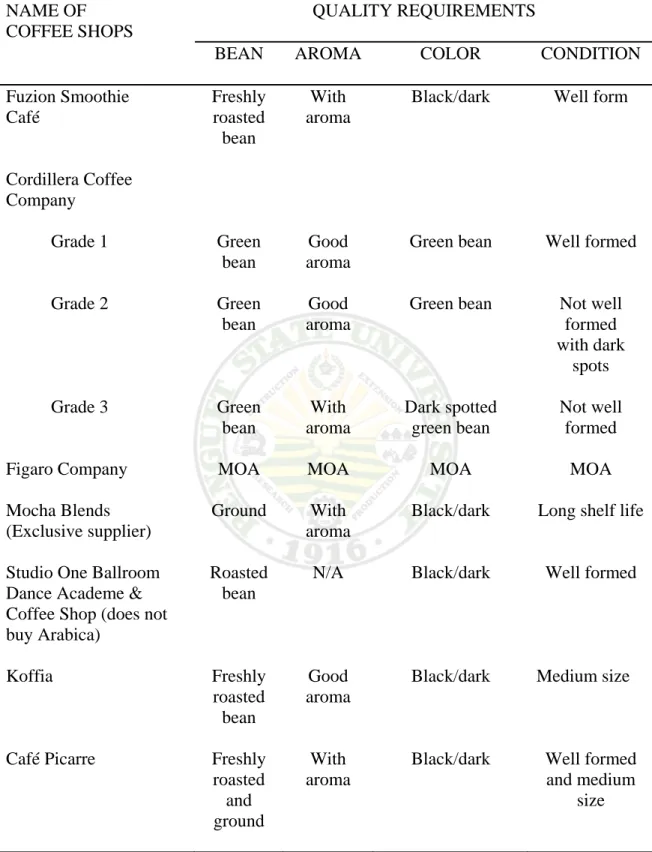
a) growing region, b) conditions of the beans, c) bean size, d) taste, and d) number of defects. The quality requirement for coffee beans of the specialty coffee shops is shown in Table 3.
Koffia identified good coffee with quality, appearance, and taste. Studio One bought only two kilograms of roasted Benguet and Barako. They do not buy from other coffee retailers since the coffee shop is already within Baguio SM supermarket where they buy their raw material. Mocha Blends’ requirement for coffee was good and quality beans. The quantity they bought depends on the season. It paid its supplier with cash upon purchase.
According to Prof. Valentino Macanes of BSU, Figaro Company followed the classification and sorting standards of the World Coffee Market (WCM) and of what is in their Memorandum of Agreement (MOA) in buying Arabica coffee bean.
The Cordillera Coffee Company selected coffee beans that are whole and only choose beans that are 100% Arabica. The coffee growers sold their Arabica coffee beans that were sorted according to the company’s standard. Fuzion Smoothie Café identified good coffee bean as dark roasted bean because they used espresso machine.
Generally, the quality requirements for coffee beans of the specialty coffee shops in a: a) Roasted and ground form: is freshly roasted, has good appearance, has good taste, has aroma and, has long shelf life; b) Roasted form: is dark, is freshly roasted, is medium in size, has aroma, has good appearance, has good taste and, has long shelf life and; c) Bean form: has aroma, has long shelf life, is medium in size, has good appearance, is well formed and whole. They all follow the classification and sorting standards of the world coffee market.
Table 3. Quality requirements for coffee beans of the specialty coffee shops NAME OF
COFFEE SHOPS
QUALITY REQUIREMENTS
BEAN AROMA COLOR CONDITION
Fuzion Smoothie Café
Freshly roasted bean
With aroma
Black/dark Well form
Cordillera Coffee Company
Grade 1 Green bean
Good aroma
Green bean Well formed Grade 2 Green
bean
Good aroma
Green bean Not well formed with dark
spots Grade 3 Green
bean
With aroma
Dark spotted green bean
Not well formed
Figaro Company MOA MOA MOA MOA
Mocha Blends (Exclusive supplier)
Ground With aroma
Black/dark Long shelf life Studio One Ballroom
Dance Academe &
Coffee Shop (does not buy Arabica)
Roasted bean
N/A Black/dark Well formed
Koffia Freshly
roasted bean
Good aroma
Black/dark Medium size
Café Picarre Freshly roasted
and ground
With aroma
Black/dark Well formed and medium
size
*MOA – According to the Memorandum Agreement of Figaro Co. and its suppliers.
*N/A- Not Applicable
Background Information of the Coffee Growers
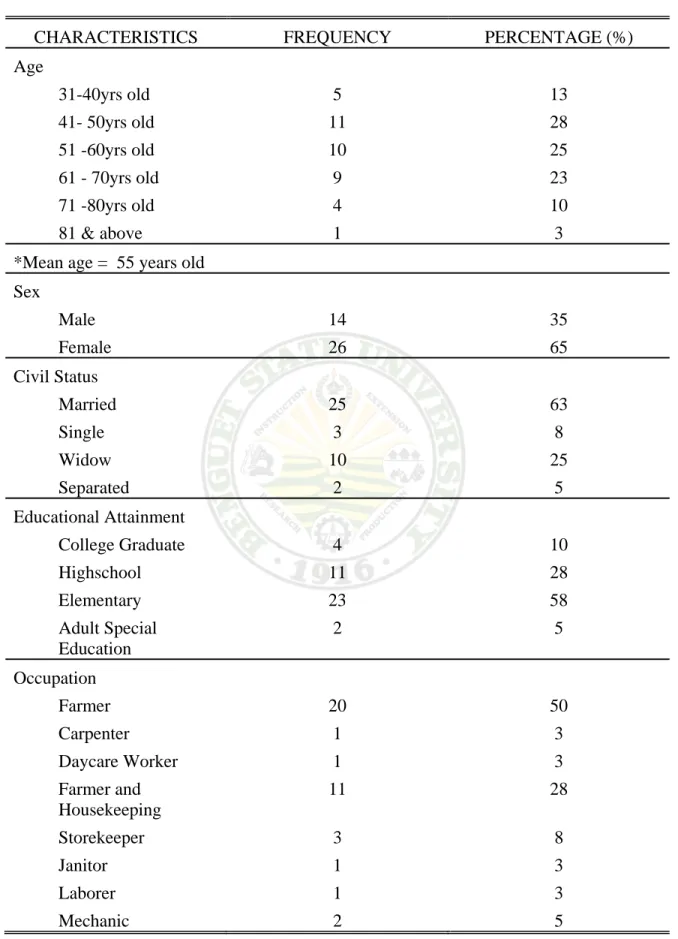
There were forty (40) respondents interviewed and majority of them were female (65%). As shown in Table 4, the average age of the farmers is 55 years old.
Most of the respondents were married. This is because traditionally, if the new married couples build their house at the place, they will also be planting coffee at their backyard.
As shown in Table 4, majority of the respondents attained elementary level of education. Half of the respondents are full-time farmers while 11 respondents are part- time farmers.
Trainings Attended Related to Coffee Production and Marketing
There were 50 percent of the respondents who attended trainings and seminars on coffee production and marketing conducted by Coffee AID and 35 percent of the respondents attended seminars conducted by BSU (Table 5).
Organizational Affiliations
Majority or 55 percent of the respondents are members of the Coffee AID (Table 6). This can be attributed to the assistance given by this organization. However, among the members, two growers did not attend any seminar conducted by the Coffee AID. The reason is that they are new members of the Coffee AID.
Table 4. Distribution of farmers according to profile
CHARACTERISTICS FREQUENCY PERCENTAGE (%)
Age
31-40yrs old 5 13
41- 50yrs old 11 28
51 -60yrs old 10 25
61 - 70yrs old 9 23
71 -80yrs old 4 10
81 & above 1 3
*Mean age = 55 years old
Sex
Male 14 35
Female 26 65
Civil Status
Married 25 63
Single 3 8
Widow 10 25
Separated 2 5
Educational Attainment
College Graduate 4 10
Highschool 11 28
Elementary 23 58
Adult Special Education
2 5 Occupation
Farmer 20 50
Carpenter 1 3
Daycare Worker 1 3
Farmer and Housekeeping
11 28
Storekeeper 3 8
Janitor 1 3
Laborer 1 3
Mechanic 2 5
Table 5. Distribution of farmers according to the trainings attended on coffee production and marketing
SEMINARS FREQUENCY PERCENTAGE (%)
Seminar conducted by:
Barangay Caliking 4 10
Municipal Agriculture Office
5 13
Coffee AID 20 50
Benguet State University
14 35
Table 6. Distribution of farmers according to memberships in associations
NAME OF ASSOCIATION FREQUENCY PERCENTAGE (%)
COFFEE AID 22 55
Senior Citizen Association 8 20
Atok Women’s Association 5 12
Km 30 Cooperative 8 20
Year Started with Arabica Coffee Production
Most of the respondents inherited their coffee farms. This means that most of the coffee trees planted are old. Coffee seedlings are usually sourced free from other coffee growers aside from sourcing their seedlings from their own seeds. The years in which the coffee farmers were established is shown in Table 7. The oldest coffee trees were planted
before 1945 as reported by one respondent while 11 (28%) respondents indicated having coffee trees planted within 1946 to 1960. Replanting were done in latter years.
Table 7. Distribution of farmers according to the year of establishments of coffee farms
YEAR STARTED FREQUENCY PERCENTAGE (%)
1931 – 1945 1 3
1946- 1960 11 28
1961-1975 6 15
1976-1990 8 20
1991- 2005 13 33
2006 – present 1 3
Number of Coffee Trees at Start of Operation and in 2008 According to Arabica Coffee Variety
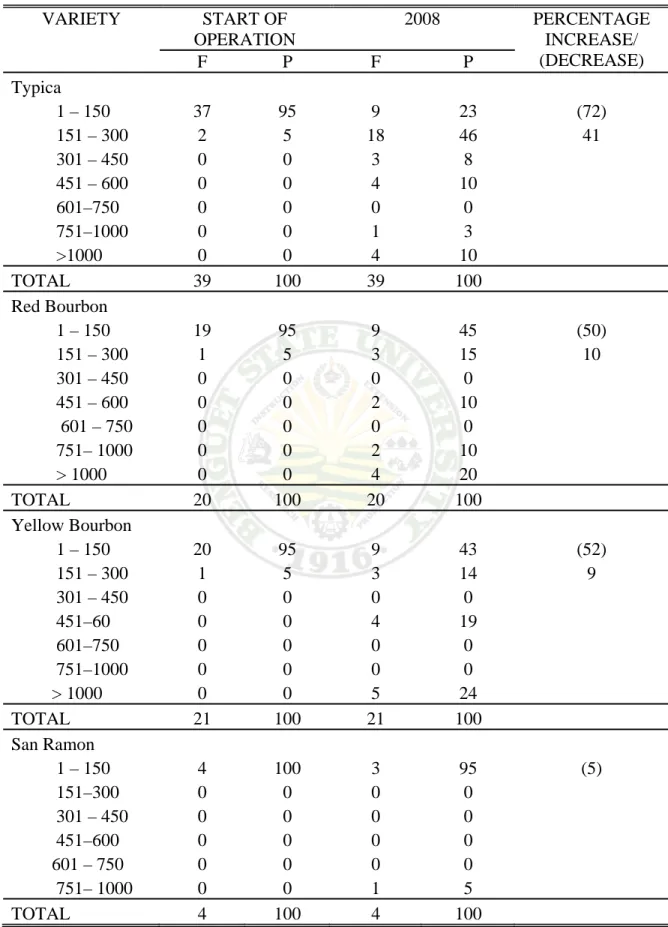
There are several coffee varieties in Caliking. The varieties shown in Table 8 together with the corresponding numbers of trees planted at start of operation and in 2008 includes: Arabica Typica, Red Bourbon, Yellow Bourbon and, San Ramon.
Arabica Typica. There were 37 respondents (95%) who reported having 1-150 trees at the start of operation, but the number of respondents within this category decline to 9 (23%) in 2008. This is translated to a 72 percent decline in the number of respondents who planted Arabica Typica in this category. The percentage decline in this level is explained by the percentage increase in the number of farmers reporting more number of trees in 2008 in the higher categories.
Red Bourbon. There were 19 respondents who planted 1-150 trees at start of operation, but the number of farmers who planted Red Bourbon trees in this category declined to 9 (45%) in 2008. This caused the 50 percent decrease in the number of trees in this level. The said percentage decline in this category is explained by the percentage increase in the number of farmers reporting more numbers of trees in 2008 in the higher categories.
Yellow Bourbon. There were 20 respondents who reported having 1-150 trees at start of operation, however the number of Yellow Bourbon trees in this category decreased to 9 (43%) in 2008. This is translated to a 52 percent decline in the number of respondents in this category. The percentage decrease in this level is explained by the increase in the number of farmers having more number of trees in the higher categories in 2008.
San Ramon. There were four respondents who planted 1-150 trees at start of operation. The number of farmers planting San Ramon trees in this category decreased to 3 (95%) in 2008. This is because one farmer added more coffee trees of this variety.
Sources of Seedlings
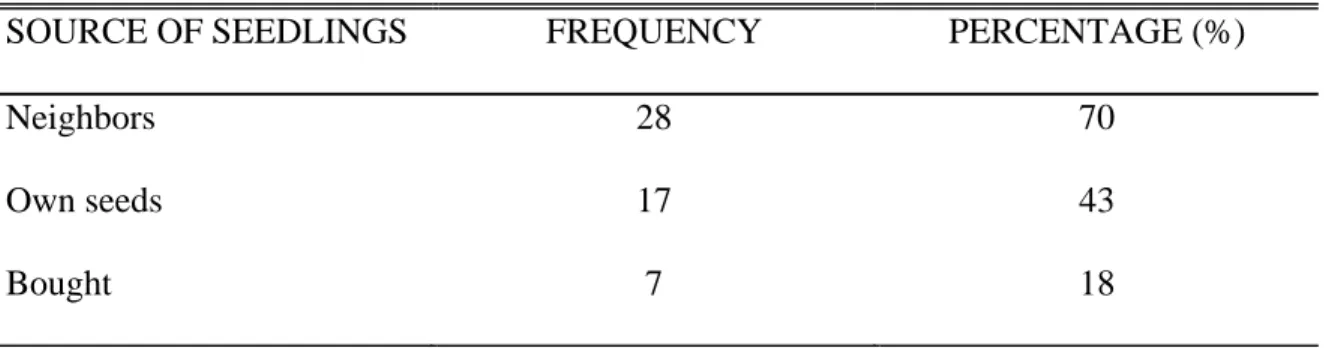
Majority (70%) of the farmers sourced out the coffee seedlings from their neighbors who are also planting coffee (Table 9). This is attributed to the proximity of the farmers to one another. Also, 17 farmers planted their own coffee seedlings.
Table 8. Number of Arabica coffee trees at start of operation and in 2008 by variety
VARIETY START OF
OPERATION
2008 PERCENTAGE INCREASE/
(DECREASE) F P F P
Typica
1 – 150 37 95 9 23 (72)
151 – 300 2 5 18 46 41
301 – 450 0 0 3 8
451 – 600 0 0 4 10
601–750 0 0 0 0
751–1000 0 0 1 3
>1000 0 0 4 10
TOTAL 39 100 39 100
Red Bourbon
1 – 150 19 95 9 45 (50)
151 – 300 1 5 3 15 10
301 – 450 0 0 0 0
451 – 600 0 0 2 10
601 – 750 0 0 0 0
751– 1000 0 0 2 10
> 1000 0 0 4 20
TOTAL 20 100 20 100
Yellow Bourbon
1 – 150 20 95 9 43 (52)
151 – 300 1 5 3 14 9
301 – 450 0 0 0 0
451–60 0 0 4 19
601–750 0 0 0 0
751–1000 0 0 0 0
> 1000 0 0 5 24
TOTAL 21 100 21 100
San Ramon
1 – 150 4 100 3 95 (5)
151–300 0 0 0 0
301 – 450 0 0 0 0
451–600 0 0 0 0
601 – 750 0 0 0 0
751– 1000 0 0 1 5
TOTAL 4 100 4 100
Table 9. Distribution of farmers according to the source of the Arabica coffee seedlings
SOURCE OF SEEDLINGS FREQUENCY PERCENTAGE (%)
Neighbors 28 70
Own seeds 17 43
Bought 7 18
Volume of Production
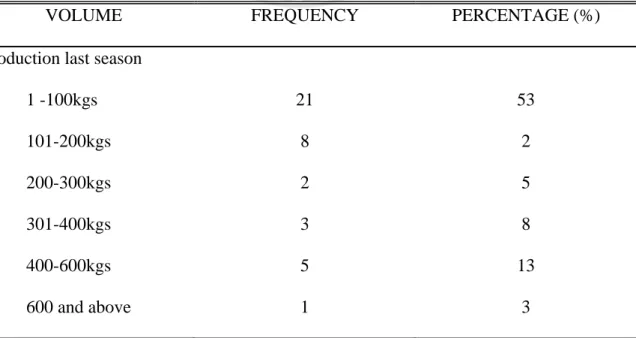
In terms of the quantity of production (Table 10), 53 percent of the respondents said that their volume of production last season (November 2007 – February 2008) was about 100 kilograms. For the farmers, their production last season was high compared to their production in November-December 2008. This can be attributed to the observation of some farmers that the coffee trees do not produce the same volume of berries every year. The average volume of production is 227.5 kilograms.
Table 10. Distribution of farmers according to volume of production
VOLUME FREQUENCY PERCENTAGE (%)
Production last season
1 -100kgs 21 53
101-200kgs 8 2
200-300kgs 2 5
301-400kgs 3 8
400-600kgs 5 13
600 and above 1 3
*227.5 kgs - average volume of production
Source of Capital
Almost all the respondents (95%) indicated that they used their own money as start-up capital (Table 11). However, 23 percent reported that they also borrowed for maintaining and replanting their coffee farms when they joined Coffee AID.
Sources of Information on Coffee
The most important source of information about coffee production and marketing identified by the respondents were the traders or buyers (Table 12). Other sources of information were other farmers, farmers organizations, radio and, Municipal agriculturists.
Coffee prices and new coffee varieties were information taken from traders while distance of planting, new coffee varieties and, coffee prices were information taken from other farmers.
Radio listeners identified radio station DZWT as the station where they tuned in.
Radio programs listened by the respondents were Boses ti Farmers, CHARM on the Air and BSU in the Air (Table 13).
Table 11. Distribution of farmers according to source of capital
SOURCE OF CAPITAL FREQUENCY PERCENTAGE (%)
Own 38 95
Borrowed capital 9 23
Table 12. Distribution of farmers according to sources of coffee information SOURCES OF
INFORMATION
FREQUENCY PERCENTAGE (%)
Trader/buyer 40 100
Other Farmers 30 75
Radio (DZWT) 23 58
Farmers’ Organization 23 58
Municipal Agriculturists 13 33
Table 13. Distribution of farmers according to the tuned-in radio programs
RADIO PROGRAMS FREQUENCY PERCENTAGE (%)
Boses ti Farmers 23 58
CHARM on the Air 21 53
BSU on the Air 17 43
Marketing of Arabica Coffee
There were 38 respondents who sold Arabica coffee in Baguio City. Only three respondents sold Arabica coffee in La Trinidad, Benguet since there were few coffee retailers in the area. As shown in Table 14, 63 percent sold the coffee produce to Cordillera Coffee Co. Farmers said that the company bought the Arabica coffee at higher than the market price especially if their products passed the standards of the company.
Only three respondents sold the coffee in ground form to the business establishments in
Saddle, Caliking, Atok, one sitio at the place where restaurants are located. Only two sold it to their friends, relatives or neighbors.
Form of coffee sold. There were 98 percent respondents who sold the Arabica coffee in green bean form (Table 15). These green beans were sold at the Baguio City market, La Trinidad market, Cordillera Coffee Co., and some of the friends or relatives of the coffee growers. One among the interviewed coffee farmers sold roasted Arabica coffee bean to friends, relatives or neighbors.
There were 8 percent of the coffee growers who sold coffee in roasted and ground form. The customers who bought this form of coffee were the business establishments in the area like the restaurants, and coffee shops including the friends or relatives of the farmers.
Table 14. Distribution of farmers according to market outlets of coffee
MARKET OUTLETS FREQUENCY PERCENTAGE (%)
Coffee Retailers
Baguio City market 38 95
La Trinidad market 3 8
Cordillera Coffee Company 25 63
Restaurants in Saddle 3 8
Friends/neighbors/relatives 2 5
Table 15. Distribution of farmers according to the form of coffee sold
FORM OF COFFEE SOLD FREQUENCY PERCENTAGE (%)
Green Beans 39 98
Roasted and Ground 3 8
Roasted Beans 1 3
Pricing. There were three modes of pricing used by the respondents in selling coffee. The first is price set by the buyers which they just take. The second is negotiated price or price agreed upon by the coffee farmers and buyers while the third is contract price or price agreed upon by the coffee farmers and buyers before harvest. Table 16 shows that 98 percent of the coffee growers sold at the price set by the buyers. Forty- three percent sold their produce at negotiated price while 40 percent sold at contract price. The latter refers to coffee sold to Cordillera Coffee Company.
Packaging. The farmers used sacks for packaging of the Arabica coffee when they sold to their customers. Coffee growers also used cellophanes for the Arabica coffee especially when they sold the coffee in a roasted or ground form. However, one of the respondents said they did not use cellophane for the Arabica coffee in a green bean form because the beans easily moist inside the cellophane
Table 16. Distribution of farmers according to the pricing modes
PRICING MODES FREQUENCY PERCENTAGE (%)
Buyer Price 39 98
Negotiate Price 17 43
Contract Price 16 40
Possibilities in Entering the Specialty Coffee Market
As to this writing, the Cordillera Coffee Co. is the only specialty coffee shop who bought Arabica coffee in green bean form and in bulk directly from the local coffee growers. The local coffee growers sold Arabica coffee beans sorted according to the company’s standard from grade 1 to 3.
Among the other specialty coffee shops, Café Picarre and Studio One indicated their willingness to buy Arabica coffee from the local farmers as long as the quality of the coffee meets their standards.
According to the manager of the Studio One, there is a possibility for them to buy Arabica coffee because of the aroma it produces but Arabica is very strong when blended with the other coffee varieties.
Willingness of the farmers. The farmers in Caliking, Atok, Benguet were willing to sell Arabica coffee bean to specialty coffee shops provided that the latter are willing to buy from them, price of their produce is higher than the prevailing market price because the standards of the specialty coffee shops for Arabica coffee bean is somewhat difficult for them to attain and, government agencies and institutions will support and initiate the selling of Arabica coffee to the coffee shops.
Constraints to Entering the Specialty Coffee Market
The primary constraint to entering the specialty coffee market is the difficulty in meeting the standards set by buyers. This was revealed by the respondents who sold to Cordillera Coffee Company.
Most of the problems encountered by the coffee growers were related to the coffee bean quality. For example, coffee beans were described as not uniform in size, deformed in structure, faded in color, has black spots, and has molds.
The respondents also reported having low production due to the coffee plants being attacked by stem borers.
SUMMARY, CONCLUSIONS AND RECOMMENDATIONS
Summary
This study was conducted to describe the specialty coffee market in Baguio City, identify the requirements of specialty coffee shops for Arabica coffee, determine the profile, emerging possibilities and, possible constraints of smallholder coffee producers of Caliking, Atok, Benguet in entering the specialty coffee market.
The study was conducted from November 2008-March 2009. There were 40 coffee growers from Caliking, Atok, Benguet who were randomly chosen to be the respondents of the study. An interview schedule was used to gather the necessary information needed. Personal interview with seven specialty coffee shop managers in Baguio City was also done. The data were tabulated, analyzed, discussed and interpreted using descriptive statistics such as percentages and frequency counts.
Local specialty coffee shops in Baguio City have standards in buying Arabica coffee bean while others have their own exclusive supplier. Also, their willingness to buy Arabica coffee bean from the farmers is viable as long as the farmers of Arabica coffee bean meet their standards.
The study revealed that the respondent’s average age is 55 years old. There were more female and most of them were married. Most of them worked as farmers.
Respondents sold the Arabica coffee in a green bean form. Almost all of the respondents sold the Arabica coffee with the buyer setting the price. The respondents used sacks to pack the Arabica coffee bean.
The primary constraint to entering the specialty coffee market is the difficulty in meeting the standards set by buyers. This was revealed by the respondents who sold to
Cordillera Coffee Company. Most of the problems encountered by the coffee growers were related to the coffee bean quality. For example, coffee beans were described as not uniform in size, deformed, faded in color, has black spots, and has molds. The respondents also reported having low production due to the coffee plants being attacked by stem borers.
Conclusions
Based on the findings, the following conclusions were drawn:
1. There is an opportunity for the farmers to target the specialty coffee shops as their direct customers.
2. The specialty coffee shops buy quality coffee beans.
3. Farmers in Caliking, Atok continued to increase the number of coffee trees that they maintain through new planting.
4. There is a good and harmonious supplier-buyer relationship developed by the Caliking, Atok growers and the Cordillera Coffee Company since the latter is so far the only direct customer of the farmers.
5. A new market is being created for the smallholder farmers wherein they will not be selling the Arabica coffee to the coffee retailers but directly to the specialty coffee shops as started by the Cordillera Coffee Company.
6. The quality of Arabica coffee bean in Benguet can qualify to the quality requirements of the coffee shops but not all Arabica coffee beans can meet standards when the beans are subjected to classifications.
Recommendations:
Based on the findings and conclusions of the study, the following are recommended:
1. Coffee growers should improve more and advance their knowledge in Arabica coffee production in order to attain the standards set by their target market, specifically participating in the local and international specialty coffee market.
2. The specialty coffee shops especially the local ones should reach out to the local farmers in buying Arabica coffee bean for the upliftment of the industry and maintaining product quality.
3. The coffee growers should increase their production but focusing on quality due to the growing demand of Arabica coffee.
4. Agencies, institutions, and public and private organizations to extend not just financial support to the coffee growers for the development of the industry but through technology and strategies that can improve the quality of Arabica coffee bean, which the local growers produce.