NADINES B. BULSO. MARCH 2006. Beekeeping Practices on European Bees for Honey Production by Beekeepers in Baguio and La Trinidad, Benguet. Benguet State University, La Trinidad, Benguet.
Adviser: Clifton D. Llanes, BS.
ABSTRACT
This case study was conducted to find out the practices of beekeepers in the care and management of their colonies as well as their practices in budgeting and record keeping. There were 34 beekeepers that were taken as respondents of this study. The study was conducted in July 2005.
All the respondents were male with an average age of 45 years old and engaged in the industry for 4 – 7 years. Majority were operating as single proprietorship with a few on partnership basis. Most of them were managing less than ten colonies.
As to care and management practices, they supplement the bees with 60% + 40% water solution in times of rainy days. They all use the Italian and Carniolan races of queen bees for colony multiplication. Some of the beekeepers migrate their colonies to other sites where the bees could find forage and away from pesticide spray. All of them had problems on predators, parasites and diseases but the most serious problem was the mites (Varroa Jacobsoni).
reunite the colony to a stronger colony. In some cases, they leave the colony to produce its own queen.
Honey produced is usually harvested once or twice a year between the months of November to January using either purely manual method or a combination of manual and mechanical method. Harvested honey are usually bottled at home.
The sources of funds for financing the operation was mostly from the beekeepers, personal savings. Very few were practicing budgeting of funds because not all of them were knowledgeable in preparing budget. The budget is usually based on their available working capital. Those who practiced budgeting were also keeping records while majority do not keep record because they just maintain a few colonies.
Bibliography . . . i
Abstract. . . i
Table of Contents . . . iii
INTRODUCTION . . . 1
Rationale of the Study . . . 3
Statement of the Problem . . . 4
Objectives of the Study . . . . . . 5
Significance of the Study…. . . … 5
Scope and Delimitation of the Study . . . 3
REVIEW OF LITERATURE Beekeeping as Modern Occupation...……… 6
Profile of Some Beekeepers in the Philippines……… 10
Starting a Good Apiary as Requirement………. 10
Care and Management of Colonies………. 11
Primary products in Beekeeping and Its’ Uses………... 11
Honey Harvesting and Processing………... 12
Traditional Practice of Bottling and Promotion of Honey……….. 13
Domestic Scenario on Honey………. 13
Bio-physical and Traditional Factors Affecting the success in Beekeeping………... 14
Definition of Terms………. 17
METHODOLOGY Locale and Time of the Study . . . .. . . 23
Respondents of the Study . . . 23
Research Instrument……… 23
Data Collection……… 24
Data Gathered . . . 24
Data Analysis . . . .. . . . 24
RESULTS AND DISCUSION Profile of the Respondents……… . . . 25
Form of Business Organization.. . . .. . . 27
Membership to Organization…. . . 27
Number of Years Experienced in Beekeeping………. . . 28
Number of Colonies Managed in the Apiary . . . 29
Practices in Giving Food Supplement……. . . 30
Feeding of Colonies with Artificial Pollen . . . ……... 31
Enhancement of Colony Growth and Development……… . . . 32
Practices in the Care and management of the Queen………... 32
Practices in the Re-queening queenless Colony……….. 34
Practices on Colony Migration……… 36
Plants Producing Nectar and Pollen………. 39
Practices in Management of Apiary………. 40
Bio-physical Factors Affecting Honey production……….. 47
Approaches in addressing of problems Encountered in the Operations.. 49
Practices in Harvesting Honey………. 50
Grading System Used to Classify Honey from other Product…………. 53
Marketing Practices of the Beekeepers……… 53
Practices in Disposing Honey Reject………... 56
Sources of Additional Fund………. 57
Reasons for not Borrowing of Additional Fund……….. 58
Budget Preparation……….. 58
Record Keeping Practices………...……. 60
Assistance of Baguio and La Trinidad Beekeepers………. 62
SUMMARY, CONCLUSIONS AND RECOMMENDATIONS . . . 63
Rationale of the study
In the past, our forefathers had been eating honey by collecting them in caves or on tree trunks produced by wild honey bees. Now a days people are producing honey just beside their homes. Honey production has become a popular past time and source of income by some people.
According to Joel Magsaysay (a bee culture grower from Silang Cavite since the late 1970’s), hundreds of Filipinos are now engaged in beekeeping activity for they found the endeavor fascinating and profitable, which is why some are raising bees on commercial scale.
At the initial stages in his beekeeping business, he discovered that the best specie to culture in the Philippines is the European honeybee (Apis Melifera). According to him, our country has a remunerative climate and lush vegetation, after only six to twelve months honey can be harvested, and when harvesting starts the maintenance cost would already be minimal. He said that harvesting must coincide with the pollen and honeyflow seasons. It was stressed that the foundation of successful beekeeping is the construction of a floral calendar particularly in the area in which bees will be kept. The floral calendar covers periods in the year when plants and trees bloom profusely and provide an over abundance of nectar and pollen as bees actively forage. He specified that a beginner could produce 20-25 kilos of honey per colony while experienced beekeepers can regularly harvest 30-40 kilograms. A family, working part-time as beekeeper, can raise an additional P4, 000 to P5,000 per colony per year.
Technology employed in beekeeping is fairly simple. It only requires a person to know the basic bee behavior and the flowering seasons in the area. Maslan (1988) mentioned that success in beekeeping depends on factors such as; knowledge and skills in beekeeping, knowledge on various honey plants and their blooming season, location of apiary, purchase of foundation stocks, colony and apiary expansion, and system of beekeeping. A similar statement was given by Sabas (2001), that success depends to beekeepers in carrying out the standards of managing the colonies of bees and maintaining favorable beekeeping environment as a whole.
The profitability of honeybee culture as a business depends partly on the behavior of the beekeeper and partly on nature. Inadequate skills and training techniques, ineffective methods employed on beekeeping, limited financing, in adequate knowledge on post harvest-handling and processing, and limited knowledge on proper marketing management of products are some factors that may affect the profitability of honey production.
Beekeeping is an important component of agriculture. Aside from its nutritional and economic contributions, it also contributes to ecological balance. This venture is viewed as a potential industry (small-scale industry) for development in the localities because it can provide employment to people in the rural communities. From a practical standpoint, beekeeping can be a dependable agricultural occupation only when the beekeeper has the technical know-how in beekeeping/honey production together with effective marketing and financial management, and farm-record keeping skill.
With the aforementioned rationale of the study, it is therefore relevant to study the beekeeping management practiced by beekeepers in Baguio city and La Trinidad, Benguet to document these practices so that concerned agencies could anticipate and assess the form of assistance needed by the local honey producers. A breakthrough in honey production in the locality would be possible through the effort of concerned government agencies who will provide the needed trainings and financial support for the local producers as pointed out by Wal (a local beekeeper from La Trinidad, Benguet).
Statement of the Problem
This study was conducted to answer the following questions related to the practices of beekeepers in Baguio City and La Trinidad:
1. What are the beekeeping practices on European bees (Apis melifera sp.) for honey production by beekeepers in Baguio City and La Trinidad, Benguet?
2. What form of honey do beekeepers produce and how do they promote and market it?
3. What are the standard practices applied in grading of the honey product for sale?
4. What kinds of pest, disease, predator, as well as biophysical factors affecting the growth and development of colonies of bees in the apiaries, and to whom the beekeepers approached to solve these problems?
5. What are the sources of additional funds used in the operation, and what system is applied in budget allocation and in farm-record keeping?
Objectives of the Study
The general objective of this study was to find out the beekeeping practices on European honey bees (Apis mellifera sp.) for honey production in Baguio city and La Trinidad, Benguet.
Specifically the study aimed to:
1. know the demographic profile of beekeepers in the Baguio City and La Trinidad
2. determine the production practices of beekeepers specifically on:
a. Care and management of colonies b. Queen rearing and colony production
c. Preparation and lay outing of apiaries or migration sites d. Harvesting of honey produce
3. Identify the form of honey produced and the system of promotion and marketing used by the beekeepers.
4. Identify the available technology used in bottling and find out the standard followed for grading processed honey products.
5. Identify the pest, disease, predator, as well as biophysical factors affecting the growth and development of colonies of bees in the apiaries, and to whom the beekeepers approached to solve these problems
6. Identify the sources of additional funds used in beekeeping operations, and budget allocation systems and farm-record keeping practices.
Significance of the study
The result of this study would provide information that are necessary and useful to assess the condition of the beekeeping industry to help the policy makers, project implementers, cooperatives and associations formulate plans for the development of the backyard honey production activities of the small producers into a commercial one.
Scope and Limitation
This study was confined to beekeepers in some parts of Baguio city and La Trinidad, Benguet. It was focused on the production, marketing, and financial management practiced of beekeepers specially on the European honey bees (Apis mellifera sp.)
It includes the demographic profile of beekeepers, form of honey produced for market (prime product), available technology used in grading and sorting of honey produced, common problems encountered on pest, disease, predator, and biophysical factors affecting their colonies and apiary. The sources of additional funds used in the operation, and the budgeting and farm-record keeping practices of beekeepers.
REVIEW OF LITERATURE
Beekeeping as a Modern Occupation
Beekeeping is the act of culturing bees for honey production. It is considered as one of the oldest form of insect culture. According to Wal (1996), the first known evidence that early man robbed money from bees was found in the cave wall. This practice of robbing honey from bee continued two thousand years until modern scientific methods, which led to the culture of bees.
All through out ancient endeavor until the middle of the last century, bees were kept only in a rudimentary fashion, there being little knowledge of its natural history and what went on in the bee hives’ interior. Straw skips, log gums, or crude box-hives used to house the bee colonies (Colting, 1998).
Recent developments such as creation of the movable-frame hive, bee comb foundation and the colony extractor, however, have placed beekeeping a modern occupation (Taco, 1998). The Introduction and modernization of beekeeping in tropical Asia are being made like in Bangladesh, Indonesia, Malaysia, Nepal, Philippines Sri- langka and some parts of Thailand (Matsuka et. al., 1998).
According to Wal (1996), there are three types of bees that are wide spread in Asia. They are: Apis florae as “dwarf bees”, Apis dorsata as “giant bees”, and Apis cerana. In the late 1900’s however, the European bees was introduced in the region.
Today, they are considered preferred stock due to their adaptability, gentleness, and great honey-gathering ability. This European honeybee, scientifically known as Apis mellifera, is considered the best honey producer because it thrives well in almost all countries of the
world. For this reason, it is now the major source of commercial honey in the world market.
The characteristics that make the European honey bee best suited for commercial propagation are: 1) It maintains a prolific queen, 2) it has a gentle temperament, 3) it swarm less frequently, and 4) it guards the hive vigilantly against enemies or pests.
In the study of Colting (1998), she stressed that one factor why research on indigenous specie was not seriously pursued is due to the behavioral limitations of other honey bee species particularly their practice of open air nesting which prevents their being kept in man made hives for reasonable long periods. While hiving colonies (Apis mellifera) in specially constructed containers (bee hive) is essential, this beehive type enables the colonies to be manipulated.
According to Ananayo (1989), the introduction of culturing the European honeybee in the Cordillera region is widely used to increase production specifically on honey. Today, this specie is commercialized and gaining popularity and support among local beekeepers of Baguio city and Benguet considering that it can adopt in our geographical locations and also suit on our environment conditions that favor nectar and pollen producing plants in our country sides which bloom almost year round.
There were certain plants producing nectar and pollen substance that bees forage.
These plants were found in the Cordillera region, which is considered the best and promising area for the culture of honeybees. On the report of the Ecosystem Research and Development Service (ERDS), these plants are: eucalyptus, calliandra, lithocarpus, weeping willow, kakawate, golden shower, anchoan dilao, duhat, molave, etc. In addition
to that, Ananayo (1989) has also identified other plants available in the area as: wild sunflower, acacia, narra, coffee, citrus, mango, coconut, corn, chayote, and other weeds.
Bees are insects of the order Hymenoptera, which are feed on pollen and nectar.
They constitute a group of about 20,000 species throughout the world, known taxonomically as the super family Apoidea. Honeybees of the genius Apis belong to the family Apidea, a sub-group of this super family. All honeybee species are eusocial insects, meaning they engage in favorable social activity like man.
Each member of the colony (Apis mellifera) like queen, thousands of workers, a few hundred of drones does a division of labor and specialization in the performance of biological functions. As an inherited behavior characteristic, all honeybee colonies tend to rear their brood and store a certain amount of honey and pollen as their food reserve by secreting the workers’ wax glands and store honey in the upper part of the comb. Beneath it are rows of pollen-storage cells, worker broad cells, and drones broad cells. In that order the groundnut-shaped queen cells are normally built at the lower edge of the comb.
The quantity of food stored depends upon several factors, including the seasonal availability of forage, the workers population, the colony’s’ rate of reproduction, the capacity of the nest, and other important inherited behavioral characteristics like the colony’s natural site of construction.
Personal Factors
Based on the findings of Cabilitazan (1994), age was significantly related to the development of improved farm practice implying that as age of people increase, the level of adoption practice increases too. He further discussed that change in civil status affects the perceptions of beekeepers / farmers because of additional responsibilities. We often
find that the greater the number of dependent children, the heavier usually the income burden because this means that the farmer has still to provide the economic securities to the children and provide them with basic needs such as clothing, food, medicine, shelter, and support them to school. These necessities affect the economic practice and eventually divide their minds on whom and what to prioritize either on any income–increasing program or sacrifice on some family necessities like health and education.
For Mahto (1989), farm practice is significantly related with farm size. He stated that farmers’ adoptions of new technologies were significantly influenced by their socio- economic background such sex, civil status, educational attainment, and membership in organization and size of farm. Government support programs like credit, needed tools, input materials and transportation were found readily available; however he said that majority of farmers believed that technicians were inadequate. He cited that most serious problems encountered by the farmers are: high interest rates of loans, lack of lending agency, lack of processing technologies, low prices, and lack of transportation facilities, lack of skills and lack of storage facilities. He also found out that problems encountered by the respondents differ significantly in degree according to sex, civil status, educational attainment and membership in organization. He further said that social factor, environmental factors, government policies and services, and farmers’ perception on technology affected positively certain production technologies.
In line with these findings, Mahto recommended that training on production specifically on storage, protection against pest and diseases, grading, packaging and marketing of cooperatives be undertaken.
In many parts of the world, including several countries in Asia, commercial beekeeping depends on moving the honeybee colonies to place where forage is abundant at certain periods of the year. Such migratory beekeeping often calls for the colonies to be moved several times a year. This approach is practicable only when the colonies are in movable- frame hives, which can be transported without danger to the hives or the colonies (Matsuka et. al, 1998).
Profile of Some Beekeepers in the Philippines that Culture a Commercial Bee
According to Joel Magsaysay, as reported by Henrylito Tacio (1991), hundreds of Filipinos are now engaged in beekeeping. Many of them found the endeavor fascinating and profitable, which is why some are raising bees on commercial scale. On the report of Ananayo (1989), there are 180 beekeepers in the Cordillera Region. They produce the cultured honey and each has an average of five to nine colonies. On the other hand Colting (1999), in an interview with PDI Northern Luzon Bureau, said that beekeeping is still a fledgling industry in the Cordillera. It was specified that most of the country’s beekeepers were from Mindanao.
Starting a Good Apiary as Requirements
Starting a colony needs an initial amount of 50,000.00 is required as working capital. The best time to start is during summer because flowers are in bloom for sufficient source of nectar and pollen. Bee colony should be procured from reliable source. And it should be free from mites and diseases (Wal, 1996).
Apiary or bee farms can bee placed anywhere, under of trees, in agricultural areas, or even in urban places provided they are located near an area with abundant nectar or pollen-producing plants apiary can be started provided that the following criteria are met:
1) The host plants should be located within three to eight kilometers radius of the apiary;
2) it should be near the source of clean water, to dilute honey and regulate the
temperature inside the beehive; 3) it should have enough wind breaks especially during typhoon seasons; and 4) it should bee far away from areas with high pesticide/ insecticide spray or usage. During the summer months, the colonies must be placed in shaded areas.
Likewise during cold months, it should be partially exposed to sunlight (ERDS, 1997).
Care and Management of Colonies
All management practices aimed at increasing honey yield, either directly through colony migration, adding honey suppers and harvesting, or directly by stimulating early colony growth, swarm control, feeding during off-season and pest and disease control.
Higher productivity, when compared to well manage topbar hives however, only results from the reusability of the combs and the possibility of migratory beekeeping due to better comb stability (Dangle et. al., 2000).
Primary Products in Beekeeping and Its Uses
Laguidan (2000) specified that honey is the primary product produced from beekeeping, comprised of substance collects by bees from nectars or honeydew from forage plants. Likewise, the types of honey are the creamed, crystallized, chunk or comb.
Beekeepers can also produce or extract such natural products as propolis, royal jelly, bee venum, bees’ wax and pollen, which serve as staple food for honeybee.
Sabas Gemma (2001) cited that in the Cordillera particularly in the Baguio City and Benguet Province, honey is consumed as fillings for bread, sweet potatoes, ube and other root crops and it is also as a mixture for wine. She further said that the production of honey nowadays doesn’t sustain the demand of honey on local market and this result to the availability of adulterated honey found on local market.
Honey Harvesting and Processing
Centrifugal extraction allows quick processing of the large quantities and produces honey with the least amount of contamination by the other hive materials. The handling of large quantities allows other processing technologies that foster the production of a uniform product with high control of quality standards. And usually, cleaver people tried to develop equipment to make the uncapping, extracting, pumping, filtering, and bottling procedure more convenient-even easy.
Mr. Tayaotao (an experienced beekeeper and president of Pines beekeepers cooperative from La Trinidad, Benguet) mentioned that old processing equipment was made from galvanized tin with lead solder joints, solid equipment that was built to stand years of heavy use. He added that early extractors were powered by low compression gasoline engines, extracting was done in a yard-an idea that should probably be revisited.
Now, commercial beekeepers use of stainless steel with welded joints big extractor.
According to Dangle (2000), many Harvesting methods are available to separate bees from their honey. Combs can be taken out at a time and shaking and brushing may
remove bees. The use of super instrument can clear off bees in the frames with strong air blower. An inner cover or special board with a one-way bee escape can be placed below the honey super. Up to one deep, two shallow supers can thus be cleared in 24 hours, if enough space is available below. This Method cannot be recommended if colonies are sitting unprotected in the sun, which might melt the combs in the low unventilated supers.
None of these methods can contaminate harvested honey.
Traditional Practice of bottling and Promotion of honey
Beekeeper respondents have mentioned that the early traditional practices of honey producers that they used of 4X4, round post, and catsup containers, in packaging honey products. But nowadays, beekeepers or processors became aware of product competition so they make use of more a practical and innovative way of packaging. Most beekeepers purchase bottle containers from a known seller in the locality, while others just simply promote their products by using wallpapers, sign boards. However, to others, they prefer to use high gloss label (paper label) on their products considering that a printing cost also requires also thousand of pesos that need to be set for budget for that producers who wants to establish and seeks a better market on their products.
Domestic Market Scenario on Honey
Honey and other honeybee products have always been in demand and such products command exorbitant prices. Juanengo (1994) as cited by Colting (1998) stated that honey or natural honey production in the Philippines is not enough to meet local demand that resorted to a significant importation. She further stated that the export was
more than 121 tons at a total cost of P328, 187,323. Magsaysay as reported by Mr. Tacio (2000) also said that although domestic market for bee products-which exceeds P1Million in sales everyday-is already being developed and expanded.
Bio-physical and Technical Factors: A Hindrance to Success in Beekeeping
According to Wal, (1996), in the Cordillera region, there were six selected problems that were encountered by beekeepers or the honey producers and these are caused by the seasonality of honey flow, (there are food shortage on nectar and pollen substance for honey); lack of coordination among cut flower and vegetable farmers resulting to poisoning of field bees; thieves on hives including bees and its’ products;
swarming of worker bees, drones, and queen that leaves the mother colony (a nature’s way of increasing the number of bee colonies); non availability of nucleus colonies; and pests and pest and diseases.
Aside from these Maslan (1997) identified certain factors affecting the beekeepers’ production and operations are: the lack of knowledge and skills in beekeeping. Other than these, Laquidan (1995) also mentioned the limited financing, scarcities of technical or poor knowledge for processing and marketing of bees’ products.
Knowledge on various honeys plants and their blooming season, location of apiary, purchased of foundation stocks, colony and apiary expansion, and system of beekeeping.
Again, Maslan (1997) specified that the Cordillera region lack roads, which mean that the marketing system and news is limited. Along with inadequate information as factors it led to low demand and supply of honey in the market.
It was reported in the Marid Bullitin (1992), a similar condition regarding the poor and inadequate road networks make farm inputs costly and produces price low. This is the reason on lack of vehicle, which also leads to high post harvest losses and limited access of technological information of local farmers.
Extension Services and Training Requirements of Beekeepers
There is a need for individual beekeepers to be technically knowledgeable on beekeeping, in a way of assisting the colony of honeybees in order to facilitate the rearing of broad needed in the production of honeybee products, queen and for colony multiplication. He added that beekeepers should be interested in intensive management of hive, capable of handling in a particular technology, and not avoiding spend money on inputs of any kind preferring to make their own apiary a better, (Sito 2000).
On the report of Mayer (1982), he discussed the major concerns of operations personnel or producer to maximize the probability that good or service will be produced at the lowest possible cost. He said that concerned personnel will have to carry the following series of steps on management: a) To produce goods or service in quantities and at times which will satisfy the demand for the item, b) to produce goods or services at a lowest possible cost, c) to produce a goods or services of satisfactory quality, d) ability to forecast future demand for a product, which may earlier or a good service e) procuring the required factors of production f) Translating the forecast into an equivalent demand for various factors of production g) utilizing those factors of production to produce the product.
In addition, Tagarino (1989) have enumerated specific concerns regarding production-based agribusiness opportunities that should provided to a farmers such as:
availability of financing schemes for prospect venture, provision of material inputs, availability of economic incentives and support, availability of technical support in terms of research and extension, and availability of market assistance are the specific priorities.
Beekeeping Operation: An assessment and policy
Matsuka et. al. (1998), says that about 75% of the evaluated projects on beekeeping have a little or no impact on the local beekeeping industry (355 filed totally).
According to them, most projects worked well as long as experts or volunteers were in place and in most cases this changed immediately after their departure or when the project was phased out. Among the many reasons identified for the failure of projects, the following are of special interest:
1) Sector policies at the national level: government shows a little interest in supporting the beekeeping industry.
2) Feasibility study: the value of traditional beekeeping system, their importance in the rural economy, and their social value were not profound analyzed.
3) Project planning: Bees and beekeeping techniques were the main focal points instead of the people and their potentials, capability, and interest for beekeeping.
4) Economic viability: The profit margins people might earn through beekeeping were highly over estimated. Natural resources and absorbing capacity of markets were not properly analyzed. A time horizon of the projects and backstopping time for the implementation was to short and monitoring and follow-up was not done properly.
5) Professionally of agencies: In most cases, extensionists were not practical beekeepers, but theoreticians and modernists. This resulted in low confidence among rural people and ineffective extension services. Technology and know how transfer: Most projects assumed that existing traditional system were not predisposed to developing, and concentrated mainly on changing them in a short time and with big steps. The level of applied appropriate technology was extremely low.
6) Factor costs: Inputs used to develop the industry were expensive, non- appropriate and not available at the village level.
Definition of Terms
Apiary is a beekeeping site where the colonies are being cultured.
Apiculture input refer to sugar, medicines, protective coating, hive tools, processing facilities, and colony stocks.
Apis mellifera is also called the European honeybees. It is considered the best honey producer.
Backyard beekeepers These are the respondents of the study that culture European (Apis mellifera sp), a commercialized honeybee raised purposely for honey production. This classification of beekeeper has a character to fulfill an interest by supplementing his /her main source income as sideline beekeeping.
Beehive box. It is commonly constructed using the wood material and flat sheet aluminum and forming it into a rectangular shape or box. These beehives are
classified as nuc-B framer (for confining small population of colony), 5-frames, and the 10-framer beehive or standard hive box.
Colony refers to a hundreds of bees’ workers and nurse bee, few drones and one queen bee that are confined into one beehive box.
Colony migration refers to moving or transferring colonies from one locality to another or by few kilometers away from the main apiary during a single season so that advantage can be taken of two or more nectar flows.
Comb honey. It is a honey that is produced in small wooden or plastic sections.
Concern agency refers to an Institution or organization, which is responsible in provisions of apiculture extension services, conducting activities that are carried out in the localities. Its task is providing apiculture training and demonstration to beekeepers.
Creditors or lending institution located at the locality that is responsible for providing loans to beekeepers through cooperatives.
Development assistance is a kind of activity designed to uplift the living conditions of the farmer. It usually considers the situation, objectives, problems, methodologies, resources, organization, projects, and the solutions of a given problems, as well as the strategies of implementation.
Extractor refers to a machine that rotates honeycomb at sufficient speed to remove honey from the cells by a centrifugal force.
Extracted honey refers to honey that has been separated from the comb by centrifugal force, gravity, straining, or by other means. It may be appear in the market in different form: a) liquid honey, a honey that is visible form crystals. B)
Crystallize honey, a honey completely granulated or solidified, including products known as “candied”, “fondant”, and “spreads” type of honey.
Field bees. Worker bees, which are usually 21 or more days old and work in the field to collect nectar, pollen, and propolis.
Financial practices an action undertaken by beekeeper to in sourcing of additional funds.
This includes the practice on budget allocation for the specific operations.
Form of business ownership refers to the register or non-registered form of business ownership. The respondents may operate solely or in partnership.
Grading system refers to method of grading or classifying the honey produced. It is the technologies apply during the bottling process of honey to classify it from other products. The respondents use an apparatus that indicates the moisture content of honey or by using assorted size of bottles to standardize their products.
Respondents used either manual type or combination of both manual and mechanize.
Honey refers to a sweet viscous liquid prepared by bees from nectar collected from plant nectarines and stored by them for food.
Honey flow refers to the fluvial season where abundance for the source of nectar and pollen by various plant species is sufficient that bees gather and store the nectar and convert it to honey.
Locality refers to division of zone in Baguio City and Benguet province. Each has a complete act of political, administrative and development units in it.
Management practices refer to skillful use of means to accomplish purposes. It is the utilization of human and material resources to accomplish assigned objectives.
Marketing practices refers to the kind of services rendered by the beekeepers particularly to direct-consumers or individual buyers of honey. These require usage of resources and effort such as creating marketing promotion and establishing effective marketing centers in the area. Others make use of help from other institution or cooperatives in the localities of Baguio-Benguet. It is an action employed before and after honey harvesting.
Mode of harvesting facility refers to equipment or materials used by the respondents in Harvesting.
Foraged substance. It is a foraged syrup (nectar) and solid (pollen) substance by visiting bees into a flower and carried it away to that stock into food frames which is usually harvest by beekeeper when the frames are filled or matured.
Pests, diseases, and predators refers to the encountered elements in the beekeeping operation that the respondents determined neither it is a serious no serious problem.
Pollen substitute as food supplement for colonies. It is consist of soybean flour, fortified with pollen. This food substitute is used entirely to replace natural pollen necessary in the development and growth of colonies in the spring, but also during other periods of the year.
Pricing system refers to set price by organization as a basis of respondents in imposing the monetary value of their honey.
Production practices refer to production method, technical skills employed by beekeeper on their beekeeping operations. This employed technology is either standard (recommended practice) or innovation by beekeeper.
Promotion is the way of respondents to in initiating the name of their products’ identity (physical appearance) to be known in the public to attract customers.
Protective coating refers to furnished paint in a commercial establishment. This is being applied in the outside covering of the beehive materials to serve as protection for insects’ attack and heavy exposure to sunlight and rains.
Queen bee refers to accepted mother of the colony. It is also the most important caste because she is responsible for the procreation of bees.
Queen rearing refers to applied method or technique to produce new queen bee use for colony production by a respondent into his/ her apiary.
Queen-lees colony refers to a colony without a queen.
Record keeping refers to act of recording the beekeeping operations using either single entry (logbook) or double entry (general journal). It is more systematic in a way by putting into a paper document, a better means of medium to monitor the operation than imagining how much or how many inputs were used and how much is the cost of operation etc.
Farm-record keeping. It is a systematic recording of operations, it is being written into book entry either by using logbook or formal recording (general ledger). The records present the visual performance of the beekeeping operations.
Schedule for inspection the apiary. It is set day intended for ocular inspection on apiaryto inspect the colonies’ growth and performance, status of queen and presence of pest, disease, and predators that will affect the colonies to determine the needed to bee kinds of assistance or maintenance to be extended for colonies.
Systematic budgeting. It refers to systematic allocation of funds on the specific necessities and obligations of business, which are being prioritized in the future actions. The estimated amount is therefore forecast by beekeepers; it is different to traditional because it requires keeping of past and present status of financial expenses of operations.
Wind breaks refer to a specially constructed fence or natural barriers to reduce the force of the wind in an apiary.
METHODOLOGY
Locale and Time of the Study
The research study was conducted in Baguio city and La Trinidad, Benguet.
These locations were centers of the apiculture industry for development in the region.
The study was conducted from July to December 2005.
Respondents of the Study
The respondents of this study were 34 beekeeper of European honeybees (Apis mellifera sp.) operating either as sole-proprietorship or partnership and producing honey on a commercial scale.
Research Instrument
A survey questionnaire was used by the researcher to gather empirical data and relevant information from prospected respondents. A combination of open and close- ended type and selection type of questions were used for the respondents to answer freely as possible. Then, a direct field observation on colonies and apiaries is also done to further compliment and clarify gathered data from the respondents.
Data Collection
The questionnaires were floated to prospected beekeepers, and then these were retrieved during the interview with these respondents.
Data Gathered
The data gathered were:
1. Demographic profile of beekeepers in the study area, 2. Production practices of beekeepers specifically on:
a. Care and management on colonies of bees b. Queen rearing and colony production
c. Preparations and lay outing of apiaries or migration sites d. Harvesting of honey that produced by bees,
3. Form of honey produced and the system of promotion and marketing employed by the respondents,
4. Available technology used in bottling and sorting of honey products,
5. Kinds of pest, disease, predator, as well as biophysical factors affecting the growth and development of colonies of bees in the apiaries, and to whom the beekeepers approached to solve these problems
6. Sources of additional funds used in beekeeping operations, and budget allocation systems and farm-record keeping practices.
Data Analysis
The data was tabulated and interpreted by the researcher according to the objectives of the study using frequency distribution, percentage, and mean.
25
RESULTS AND DISCUSSION
Profile of the Respondents
The profile of the respondents is presented in Table 1. There were 12 or 35.29%
with ages 40-50 years old, 11(32.35%) belonged to the 29-39 years old bracket, 8 (23.53%) belonged to the 18-28 years old, two (5.88%) belonged to the 51-61 years old, and only one belonged to the age bracket 62-72 years old.
Majority (76.47%) of the respondents were male and few are females (32.53%).
Most (73.53%) of them were married and nine (26.47%) were single. Majority (70.59%) had a household size of 4 –7 family members. Most (76.65%) of them have finished a college degree while 17.65% reached high school level, and two respondents finished elementary.
As to occupation of respondents, 14 or 35.29% were engaged in farming of cut flowers and vegetables. Eight (23.53%) respondents were employed in private establishments or institution and their jobs are: Cooperative heads, technicians of the same work related to beekeeping operation. Seven (20.29%) respondents were government employees working as: Teachers, Librarians, Engineers, and as Agriculture extension researchers. Four respondents were self-employed and ventured into upholstery shop, operator or driver of public utility vehicles (PUJ’s), and mangers of “sari-sari”
stores (retailers). Two (5.88%) of the respondents are still pursuing their college education but they finance their beekeeping operations through the financial assistance of their parents. This finding reveals that the beekeepers were not full time beekeepers but
have their main jobs and beekeeping is just their secondary source of income. This shows that honey production could be a source of additional income for the family.
Table 1. Profile of the respondents
PARTICULAR FREQUENCY PERCENTAGE
a. Age
18 – 28 8 23.53
29 – 39 11 32.29
40 – 50 12 35.29
51 – 61 2 5.88
62 – 72 1
Total 34 100
b. Sex
Male 26 76.47
Female 8 23.53
Total 34 100
c. Civil Status
Married 25 73.53
Single 9 26.47
Total 34 100
d. Educational Attainment
Elementary 2 5.88
High School 6 17.65
College 26 76.47
Total 34 100
Form of Business Organization
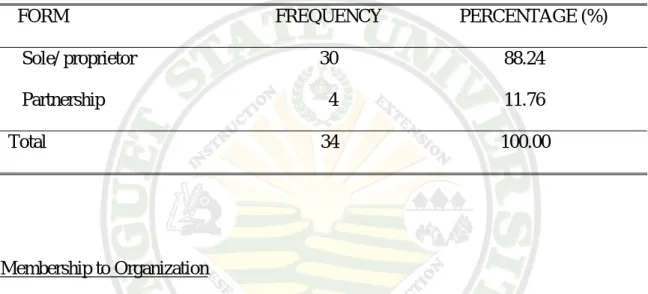
Table 2 shows that 30 or 88.24% of the beekeeper respondents operates as sole proprietorship, while 4 or 11.76% operates as partnership to sufficiently finance their operation and can provide more attention on beekeeping operations specifically on multiplication of colonies and production of honey.
Table 2. Form of business ownership
FORM FREQUENCY PERCENTAGE (%) Sole/ proprietor 30 88.24
Partnership 4 11.76 Total 34 100.00
Membership to Organization
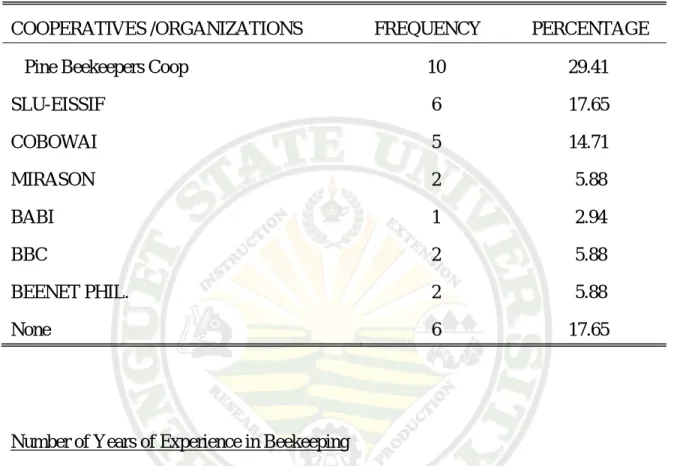
Table 3 presents that beekeepers were members of organizations or cooperatives.
These organizations provide financial assistance, technical training, as well as supplies needed by the beekeepers. Non-members do not enjoy these benefits; they rely on their own resources and knowledge.
The finding shows that 10 or 29.41% of the respondents were members of Pine Beekeepers Cooperative, while 6 or 17.65% were members of SLU-EISSIF, 5 (14.71%) were members of COBOWAI Cooperative, 2 (5.88%) each were members of Mirason Cooperative, Buguias Cooperative, and BEENET Philippines. Only one respondent was a member of BAPI Cooperative. There were six (17.65%) respondents who were not
This result indicates that some respondents were members of more than one organization.
Table 3. Membership of beekeepers to cooperatives or organizations
COOPERATIVES /ORGANIZATIONS FREQUENCY PERCENTAGE
Pine Beekeepers Coop 10 29.41
SLU-EISSIF 6 17.65
COBOWAI 5 14.71
MIRASON 2 5.88
BABI 1 2.94
BBC 2 5.88
BEENET PHIL. 2 5.88
None 6 17.65
Number of Years of Experience in Beekeeping
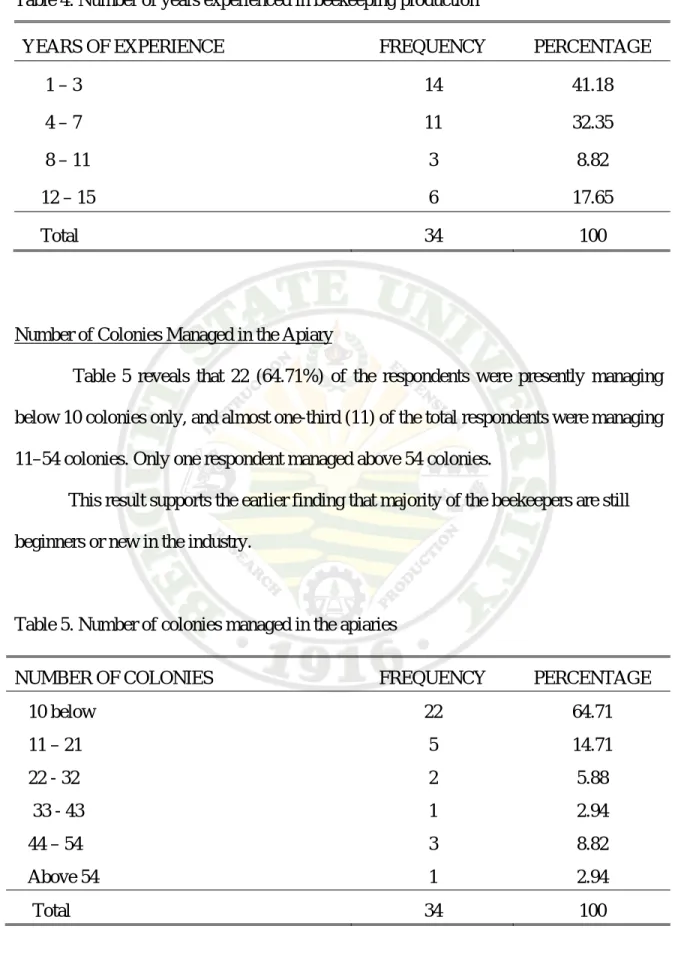
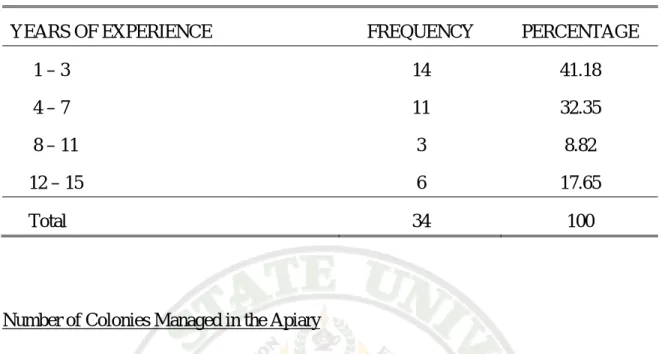
Table 4 shows that 14 or 41.18% of the beekeepers were engaged in the industry for the past 3 years which shows that they were just beginners. There were 11 or 32.35%
respondents who have been operating for 4 -7 years, while three or eight or 8.82% of the respondents have been operating for 8–11 years and six or 17.65% of the respondents have been operating for 12 –15 years. This finding implies that most of the respondents are just new in the industry.
Table 4. Number of years experienced in beekeeping production
YEARS OF EXPERIENCE FREQUENCY PERCENTAGE
1 – 3 14 41.18
4 – 7 11 32.35
8 – 11 3 8.82
12 – 15 6 17.65
Total 34 100
Number of Colonies Managed in the Apiary
Table 5 reveals that 22 (64.71%) of the respondents were presently managing below 10 colonies only, and almost one-third (11) of the total respondents were managing 11–54 colonies. Only one respondent managed above 54 colonies.
This result supports the earlier finding that majority of the beekeepers are still beginners or new in the industry.
Table 5. Number of colonies managed in the apiaries
NUMBER OF COLONIES FREQUENCY PERCENTAGE
10 below 22 64.71
11 – 21 5 14.71
22 - 32 2 5.88
33 - 43 1 2.94
44 – 54 3 8.82
Above 54 1 2.94
Total 34 100
Practices in Giving Food Supplement
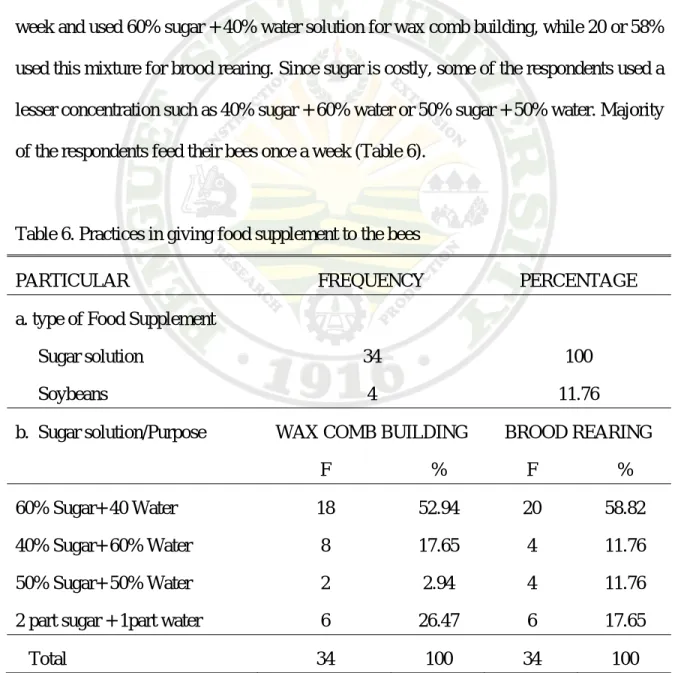
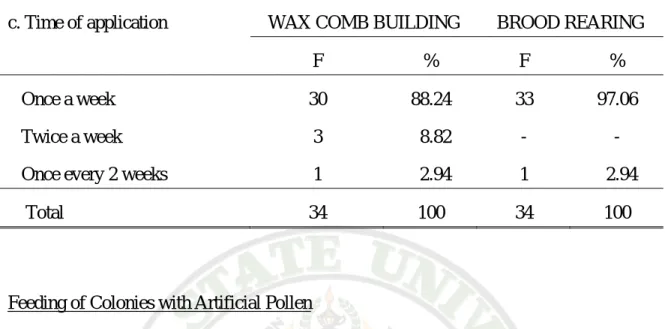
Since the stored honey in the food frames is not sufficient to sustain bees during rainy seasons the beekeepers have to supplement the bees with sugar-solution or soybeans, for wax comb building and brood rearing purposes. The finding shows that all the respondents used sugar solution as feed supplement but only 4 or 11.76% used soy beans. For economic or other reasons, some of the respondents used lesser concentration of sugar and feed the bees once every two weeks. However, majority feed the bees once a week and used 60% sugar + 40% water solution for wax comb building, while 20 or 58%
used this mixture for brood rearing. Since sugar is costly, some of the respondents used a lesser concentration such as 40% sugar + 60% water or 50% sugar + 50% water. Majority of the respondents feed their bees once a week (Table 6).
Table 6. Practices in giving food supplement to the bees
PARTICULAR FREQUENCY PERCENTAGE
a. type of Food Supplement
Sugar solution 34 100
Soybeans 4 11.76
b. Sugar solution/Purpose WAX COMB BUILDING BROOD REARING
F % F %
60% Sugar+ 40 Water 18 52.94 20 58.82
40% Sugar+ 60% Water 8 17.65 4 11.76
50% Sugar+ 50% Water 2 2.94 4 11.76
2 part sugar + 1part water 6 26.47 6 17.65
Table 6. Continued ….
c. Time of application WAX COMB BUILDING BROOD REARING
F % F %
Once a week 30 88.24 33 97.06
Twice a week 3 8.82 - -
Once every 2 weeks 1 2.94 1 2.94
Total 34 100 34 100
Feeding of Colonies with Artificial Pollen
The result shows that aside from the sugar solution used as food supplement to the bees, very few of the respondents feed artificial pollen. They used soybeans or other food substitutes to stimulate brood rearing of the bees. Table 7 show that 30 or 88.24% of the respondents do not use the soybeans or other food substitutes to stimulate brood rearing because it is not easy to prepare as compared to white sugar solution. Only few (11.76%) of the respondents claimed that they applied the soybean during the months of scarcity of pollen to avoid the grievances of bees on food, and to steadily maintain their population growth and development.
Table 7. Application of soybean syrup on colonies as pollen substitute
FOOD SUPPLEMENT FREQUENCY PERCENTAGE
Apply soybeans syrup 4 11.76
Not apply 30 88.24
TOTAL 34 100
Enhancement of Colony Growth And Development
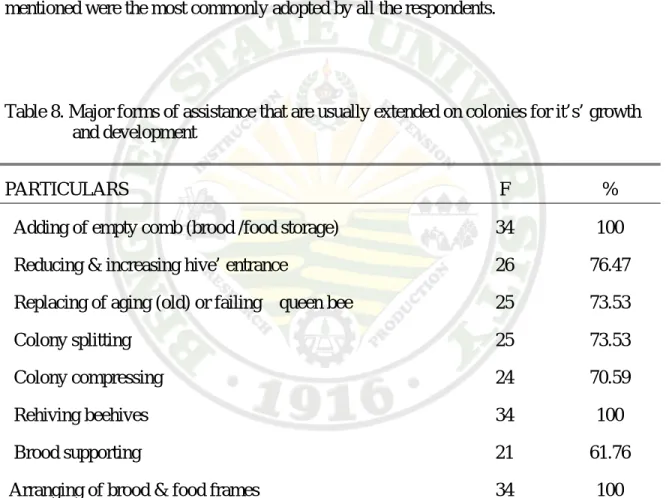
Inorder to facilitate the growth and development of colonies, the beekeepers have to introduce measures of hive assistance. The practices as presented in Table 8 were as follows: adding of empty combs (wax foundations), reducing or increasing hive entrance, replacing old queen bee, colony splitting, colony compressing, brood supporting rehiving of beehives, and arranging frames in hive boxes. The first and the last two practices mentioned were the most commonly adopted by all the respondents.
Table 8. Major forms of assistance that are usually extended on colonies for it’s’ growth and development
PARTICULARS F %
Adding of empty comb (brood /food storage) 34 100 Reducing & increasing hive’ entrance 26 76.47 Replacing of aging (old) or failing queen bee 25 73.53 Colony splitting 25 73.53 Colony compressing 24 70.59 Rehiving beehives 34 100 Brood supporting 21 61.76 Arranging of brood & food frames 34 100
Practices on the Care and Management of the Queen
This section consists of the acquisition of queen stock, strains of bees reared for
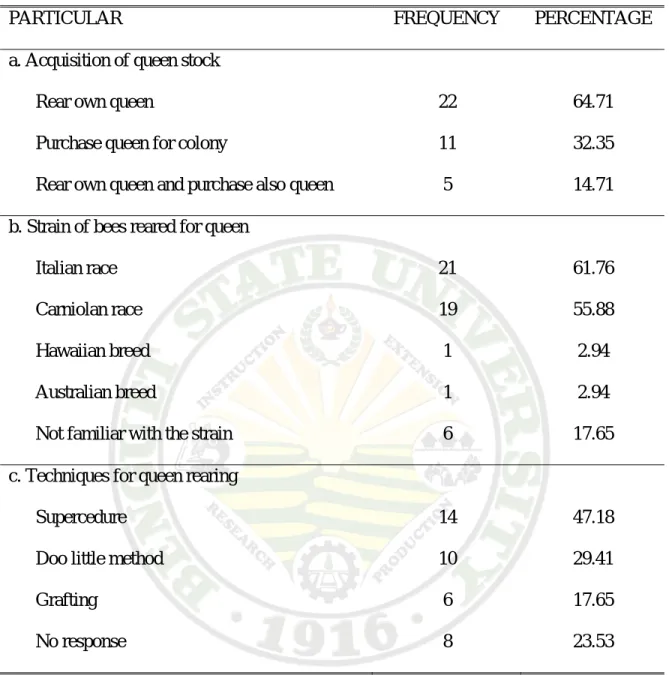
Acquisition of queen stock. Table 9 reveals that 22 or 64.71% of the respondents raised their own queen bee, while 11 or 32.35% said they purchased it from queen producers. These were the new beekeepers who still lack the skill or have limited skill in queen bee rearing. Five or 14.71% of the respondents said they rear their queen and they only purchase queen stocks from fellow beekeepers during emergency conditions (dead queen and unprolific queen condition) to maintain the growth and development of a queen-less colony.
Strain of bees reared for queen. The table shows that (61.76%) and (55.88%) of the beekeepers respectively rearing the Italian and Carniolan races of queen bees, respectively for colony production. Only one respondent says that he also reared or used the Hawaian and Australian hybrids, which were not common to many beekeepers. Six (17.65%) of these respondents could not determine the kind of queen stock they used because they were not familiar on available queens offered by fellow beekeepers.
Technique used for Queen Rearing. According to Sito (1995), bees will produce queen under the stimuli of: 1) supersedure, (2) swarming, and (3) emergency conditions.
Table 9 shows that many (47.18%) of the respondents commonly applied the supersede technique for colony production. On the other hand, 10 (23.53%) of the respondents practiced the “do little method”, there were six (17.65%) of the respondents who also applied “grafting method”. However, eight (14.71%) of the respondents did not respond on the question. These were the respondents that do not produce or rear their own queen bee.
The result shows that there is not one common technique applied among beekeeper for queen rearing.
Table 9. Practices of the respondents in care and management of the queen
PARTICULAR FREQUENCY PERCENTAGE
a. Acquisition of queen stock
Rear own queen 22 64.71
Purchase queen for colony 11 32.35
Rear own queen and purchase also queen 5 14.71 b. Strain of bees reared for queen
Italian race 21 61.76
Carniolan race 19 55.88
Hawaiian breed 1 2.94
Australian breed 1 2.94
Not familiar with the strain 6 17.65
c. Techniques for queen rearing
Supercedure 14 47.18
Doo little method 10 29.41
Grafting 6 17.65
No response 8 23.53
Practices on Re-Queening Queenless Colony
Table10 reveals that the common technique applied by most respondents (79.41%) is to introduce a new queen bee into a queenlees colony, and then observe if it is accepted within the beehive. Another practice was re-uniting or mounting of the said
colony into a well populated colony (stronger colony) that can maintain this queenless colony during the absence of the queen as pointed out by 64.71%. The third practice was to leave it and allow this queenless colony to produce its own queen as done by 35.29%.
This technique is applied only when the beekeepers have the knowledge on the conditions of the said queen-lees colony to prevent it from swarming.
Period of Re-queen. According to Baldo (1995), the queen bee can have a life span of up to 5 years. However her life span depends on her sperm counts and the kinds of assistance that beekeeper employ on her colony.
There were 15 or 44.11% of the beekeepers who usually re-queen every two years, and there were 22 (35.29%) who mentioned that they re-queen yearly. Only two (5.88%) have mentioned that they replaced their queens twice a year. The six (19.44%) beekeepers said that they re-queen anytime if they observe that the queen can no longer procreate bees in the colony. This finding shows that all the respondents re-queened in less than five years and they do not wait for the five years life span of the queen as mentioned by Baldo.
Reasons for Re-queen. The more popular reasons for re-queen are due to the aging condition of queens as indicated by 27 (79.41%) respondents, and also the low egg- laying capacity of queens as reasoned by 26 (76.47%) respondents. This partly explains why they do not wait for the queen to age up to 5 years as this would mean a decline in her productivity. Half of these respondents have claimed they accidentally killed their queens during manipulation or treating and feeding application on colonies (Table 10).
Table 10. Practices on re-queening queenless colonies
PARTICULAR FREQUENCY PERCENTAGE
a. How a queenless colony is re-queened
Introduce new queen if there’s available 27 79.41
Unite it to stronger colony 22 64.71
Allow to produce its own queen bee 12 35.29
b. Interval of re-queening
Yearly 12 32.29
Twice a year 2 5.88
Every two years 15 44.11
As the need arises 7 20.59
c. Reasons for re-queening
Old or aging condition 27 79.41
Have low egg laying capability 26 76.47
Accidental death during colony 17 50.59
Practices in Colony Migration
Practices in colony migration as presented in Table 11 includes the number of respondents that migrated their colony and those that did not, their reasons for migrating and not migrating, the best time for migrating the colonies, and the distance of migration site.
Practicing and not practicing migration of colonies. Table 11 reveals that majority (20 or 58.82%) of the respondents do not practice colony migration while only 14 or 41.18% practiced colony migration.
Reasons for migrating. The respondents who migrate their colonies moved them to a nearby locality or to the low lands where abundance of plants producing pollen and nectar is believed to be sufficient for bees to have better forage to increase honey yield.
The other reason for moving their colonies were as follows: to avoid exposure of colonies to pesticides by 42.86%, for pollen production by 28.57%, to avoid food competition on colonies by35.71%, for expansion of colonies by 14.29%, and for crop pollination by only 7.14%. This finding shows that aside from honey production, the beekeepers have varied reasons in migrating their colonies.
Reasons for not migrating. As for the 20 respondents that did not practice colony migration, they had varied reasons for not doing it. The most prevalent reason is the high cost of migration of colonies to other place (38.23%). Next is the un-availability of land as an alternative site to culture the colonies (32.35%). Third is the abundance of food sources (plants producing substance like nectar and pollen, and propolis) in the present apiary (23.53%). And the last is the lack of knowledge on migrating or moving of bees as well as its being time consuming as reasoned by one respondent.
Best time for migrating the colonies. There were eight or 57.14% of the respondents who preferred transporting of colonies as early as 6:00 to 9:00 o’clock in the early morning, while four (28.57%) preferred in the late afternoon (3:00 to 6:00 O’clock P.M.), and two (14.29%) respondents preferred past 6:00 O’clock in the evening.
Finding shows that all respondents who migrated their colonies avoid transporting from 9:00 to 12:00 O’clock in the late morning and 12:00 to 3:00 O’clock in the early afternoon because they wanted to prevent the colonies from heat exposure that could cause stress among the bees.
Distance of migration site . Six (42.85%) of the respondents said that they migrated their colonies about 8 to 13 Kilometers away from the main apiary. Three (21.42%) respondents claimed that they moved their colonies just less than 1 kilometer, and another 21.41% of the respondents say that the colonies were moved from 2 to 7 kilometers away from the original location of apiary. Only 14.23% of the respondents have mentioned that they migrate their colonies more than 13 kilometers away.
This implies that majority of the respondent have practice migration only to a place where they find available land to culture their colonies.
Table 11. Practice and reasons for migrating and not migrating colonies
MIGRATION OF COLONIES FREQUENCY PERCENTAGE
Practiced migration 14 41.18
Do not practice migration 20 58.82
REASONS FOR MIGRATING
For crop pollination 1 7.14
For honey production 14 100
For pollen production 4 28.57
To avoid food competition on colonies 5 35.71 Avoid exposure of colonies to pesticide 6 42.86
Table 11. Continued…
REASONS FOR NOT MIGRATING FREQUENCY PERCENTAGE
No available site for colony migration 11 32.35
High cost for migration 13 38.23
Lack of knowledge 1 2.94
Abundance of food source in the present apiary 8 23.53
It is time consuming 1 2.94
BEST TIME FOR MIGRATING
6 to 9 O’clock A.M. 8 57.14 3 to 6 O’clock P.M. 4 28.57 Past 6 O’ clock P.M. 2 14.29 DISTANCE OF MIGRATION SITE
Below 1 kilometer away 3 21.42 2 to 7 Kms. Away 3 21.42 8 to 13 Kms. Away 6 42.85 Above 13 Kms. Away 2 14.23
Plants Producing Nectar and Pollen Substance Foraged by the Field bees
The locations where the honeybees go and collect food (nectar, pollen, and propolis) should contain diverse species of plant vegetation such as fruit trees, shrubs, weeds, herbs and other agricultural crops.
In Baguio City and La Trinidad, Benguet, there are also various plants producing
respondents have mentioned that the main foraged plant where bees go to collect food substances is from the wild sunflower. The second common source of bees’ food is from chayote (88.24%). Aside from these, other plants like weeds (64.71%), gummamella flower (47.06%), Citrus tree (35.29%), and calliandra tree (26.47%) are other sources of foraged substance that collects by field bees. Only one respondent claimed that his bees collects also from the yacon and lantana plants (Table 12).
Table 12. Kinds of plants producing nectar and pollen substance foraged by bees
KINDS OF PLANTS FREQUENCY PERCENTAGE
Sunflower 34 100
Chayote 30 88.24
Gummamela 16 47.06
Citrus 12 8.89
Corn 10 29.41
Weeds 22 64.71
Calliandra 9 26.47
Yacon 1 2.94
Lantana 1 2.94
Practices in the Management of the Apiary
Location of the apiary. Table 13 presents that most (29 or 85.29%) beekeepers’
apiary is located at their backyard for ease of monitoring the colonies condition. Six or 17.65% of the respondents placed some of their beehives on their rooftop. This is to accommodate the growing number of their conies. Four (11.76%) respondents settled
their apiaries in the mountain areas, and three (8.82%) respondents settle their apiary within the vicinity of their garden. This finding shows that majority of the beekeepers locate their apiaries in their backyard.
Schedule for inspecting the apiary. A regular inspection of the colonies in the apiary should be done inorder to see the status and arrangement of food and brood frames, to check the queen condition and observe if the there are predators or intruders that are present in the beehives or apiary. Majority of the respondents (67.65%) inspected their colonies weekly (Table 13). This is consistent with the standard schedule of inspection mentioned by Sito (2000). There were seven (20.59%) respondents that do the inspection once in every two weeks, and very few (8.82%) inspect their colonies twice a week. One respondent said that he does the inspection himself once in a month because he hired care takers to do the regular inspections (weekly schedule) of cultured colonies.
It reveals that most of the beekeepers were following the standard schedule in apiary inspection and there were few of them that based the schedule for inspection in their most convenient time, which they regularly follow.
Types of hive box used in confining colony. Table 22 shows that the small population of colony is usually confined into small beehives (nuc-Box) or 5 framer boxes. As the colony increase its population, introducing additional frames (both food and brood frames) must be done to facilitate the activities of bees in the colony, and eventually this hive material will be replaced into standard beehive as the population of said colony has increased
The result shows that all respondents have used the standard beehive (10-framer beehive box). Aside from these, majority (82.35%) of these respondents have also used
the 5-framer beehive, but only few of these respondents have uses the nuc-B framer beehive box in confining colonies (47.06%). And this indicates that most of the respondents were managing colonies that are well populated.
Applied protective coating on bee hives. All beehives that are fabricated with the use of wood materials can be prevented against damages (depreciation cause) due to weathering conditions by applications of protective coatings in the outside covering of said hive boxes. On findings, most (52.94%) of the respondents applied the oil-based paint, while 10 or 29.41% have preferred to use the rubber-based latex so that hives may last longer even if it is exposed to sunlight and rains. According to beekeepers the rubber–based latex paint will flex and resist chalking much more than oil–based paints but both will finally succumb to mildew and peeling. In the part of other (17.65%) respondents, they do not apply any protective coatings in their beehives because they were not aware on the advantages brought about by coating.
Distances in-between hives. The practice on setting of beehives in the apiary is also necessary for ease of management on beehives. But because of the geographical locations in our localities the following practices are revealed.
Majority (67.65%) of the respondents claimed they maintain 1 meter and less in distance in-between beehives. There were 41.17% of respondents who set the beehives 1 meter apart and only two (5.88%) of the respondents said that they maintain 2 meters and above distance in-between beehives.
Beekeepers vary in setting up of beehives in the apiary. It meant that some of the respondents have problem on physical location of apiary, considering that the locality are mountainous, that prevents them from following the recommended standard in setting up
of beehives as compared to lowland areas wherein the hives or colonies are uniformly settled down in the apiaries.
Point of directions of hives’ entrance. According to Sito, (2000), the entrance of beehives should be positioned east to west direction for the entrance of colonies to be easily stricken by sunrise.
The table shows that most (70.59%) of the respondents followed the east to west direction of hives’ entrance. But there were some apiaries that were situated under the tall trees or infrastructures, which prevented the reach of sunrise on the colonies and usually it is not positioned according to recommended standard.
Leveling of hives’ entrance. The Hives’ entrance should be observed flat during summer but it must be positioned lower than its’ opposite side during rainy days to prevent entrance of water (Sito, 2000). The findings presents that most (73.528%) of the respondents have practiced lowering of hive entrance even during typhoon or summer time, while nine (26.47%) respondents says that they steadily level it either during typhoon or summer time. In connection to this finding, Wal (1996) mentioned that during typhoon the beekeepers usually cover each beehives with plastic cellophane, the hives’
entrance are reduced, and they nail the beehives and tied it up in strong foundation (wooden or steel made wreck) to prevent it from collapse.
Table 13. Practices in the care and management of apiaries
PRACTICES FREQUENCY PRECENTAGE
a. Location of Apiary*
At the rooftop 6 17.65 Within the backyard 29 85.29 Near or within the garden /field 3 8.82 In the mountain 4 11.76 b. Inspection of the Apiary *
Twice a week 3 8.82 Weekly 23 67.65 Once in two weeks 7 20.59 Monthly 1 2.94
Total 34 100
c. Types of Hive used*
Nuc-B framer hive box 16 47.06
5 framer hive box 28 82.35
10 framer box 34 100
d. Protective Coating Used
Rubber-based latex 10 29.41 Oil-based paint 18 52.94
Not Applied 6 17.65
Total 34 100
*Multiple response
Table 13. Continued…
e. Distance in Between Hives* FREQUENCY PRECENTAGE
1 meter and below 23 67.65
1 meter 14 41.18
2 meters and above 2 5.88
f. Direction of Entrance*
North to South 6 17.65 East to West 24 70.59 West to East 2 5.88 South to North 3 8.82 g. Leveling of Hive’s Entrance
Entrance is lower than its opposite side 25 73.52
Flat or leveled 9 26.47
TOTAL 34 100
* Multiple Response
Perceptions About Pest, Predators, and Diseases
The respondents differ in their perceptions as to whether the parasites, the predators and the diseases they encountered in their apiaries is a serious problem or not a problem. Table 14 presents the opinion of the respondents.
Parasites. The parasites of bees are mites which are of two kinds: Varroa jacobsoni and Tropilaelaps clarae. It seems that the former is a more serious problem to the beekeepers than the latter. Majority of the respondents (65%) perceived that Varroa jacobsoni is a serious problem while 35% said that it is not a problem. Perhaps their apiary was never attacked by this parasite that is why they say it is not a problem.
Predator. The predators identified by the respondents were also of two kinds: the swift bird and the wasp. There were 53% of the respondents who said that the swift bird is a problem while 47% said that it is not a problem. There were also 21% who said that the wasp is a serious problem while 79% said the wasp is not a problem. It is apparent that there were more respondents who encountered the swift bird as their serious problem.
Diseases. There were 4 categories of diseases revealed by the respondents. The first one was the fungal disease (chalk brood). Majority of the respondents (85%) however said that this was not a problem. Only 15% encountered it as a serious problem.
The second category was the Protozoan (nosema apis). However, all the respondents mentioned that it is not a problem. The third category was the Viral disease (Sac brood) but majority (94%) also said that it is not a problem. The fourth category was the bacterial diseases. There were two strains of bacteria causing diseases, the European foul brood and the American foul brood. Both of them were not a problem as pointed out by majority of the respondents.
This finding reveals that the beekeepers were not so concerned about the diseases.
Their concerns were the Varroa Jacobosoni and the swift bird. These were the major enemies of the honeybees. According to Baldo (2000), the mites can cause shriveled and deformed wings and bodies of young bees which eventually lead to death of the bees.
Tayaotao also mentioned that the swift bird can consume approximately 400 to 500 bees a day.
Table 14. Pests, predators and diseases that attacked the bee colonies
PARTICULAR NOT A PROBLEM A SERIOUS PROBLEM
F % F %
a. Parasites (mites)
Varroa jacobsoni 12 35.29 22 64.71
Tropilaelaps clarae 27 79.41 7 20.59
b. Predators
Swift bird 16 47.06 18 52.94
Wasp 26 76.06 8 23.53
c. Diseases
(Fungal) Chalk brood 29 85.29 6 14.70
(Protozoan) Nosema apis 34 100 - -
(Viral) Sac brood 32 94.12 2 5.88
(Bacterial) European foul brood 31 91.18 3 8.82
American foul brood 31 91.18 3 8.82
Bio-physical Factors Affecting Honey Production
As recommended by ERDS, the ideal bee farm should be located within 3-8 kilometers radius from the host plants depending on the slope in the area where the apiary is situated. It should also be located near the source of clean water for bees to dilute honey and regulate the temperature inside the beehive, it should have enough windbreaks against typhoon season, and it should be far from pesticide spray.