ABELLERA, RONNIE C. APRIL 2012. Growth and Yield of Pole Snap Bean Mixed with Pine Wood Strips During Seed Storage.Benguet State University, La Trinidad, Benguet.
Adviser: Leoncia L. Tandang, Ph. D.
ABSTRACT
This study was conducted to evaluate the growth and yield of pole snap bean varieties mixed with pine wood strips during seed storage; determine the best amount of pine wood strips on germination, growth and yield of snap beans; determine the interaction effect of variety and pine wood strips on germination, growth and yield of pole snap bean; and determine the ROCE of growing pole snap bean mixed with pine wood strips during seed storage.
Mixing pine wood strips in a kilogram of pole snap bean seeds did not affect all the parameters measured in this study except the percent emergence of pole snap bean. Mixing the seeds with 12.5g of pine wood strips resulted in highest percent emergence and ROCE but comparable to those unmixed seeds and those with 50g of pine wood strips. All varieties evaluated did not differ in their growth and yield except for percent emergence, number of seeds per pod and pod length and width. Maroon had the highest percent emergence together with Stone Hill black and Black Valentine. Black Valentine and Stone Hill black had longer and wider pods than Burik and Maroon. Growing all the varieties resulted in positive ROCE but growing Stone Hill black mixed with 50 g of PWS per kg of seeds at storage recorded the highest ROCE (34.77%).
Page
Bibliography……….. i
Abstract……… i
Table of Contents………. ii
INTRODUCTION……….. 1
REVIEW OF LITERATURE………... 4
Importance of Seed Storage and Quality of Seeds………. 4
Snap Bean Seed Storage Problem………. 5
Varietal Evaluation………... 7
Importance of Pine Wood Strip ………... 8
MATERIALS AND METHODS………. 9
Laboratory Experiment ……… 9
Field Experiment……….. 9
Data Gathered………... 10
At Storage………. 10
Experimental Field……… 11
Analysis of Data……… 14
RESULTS AND DISCUSSION….………. 15
At Storage……….. 15
Weevil Infestation……….. 15
Final weight and weight lost of seeds……….……...……… 15
Percent emergence ………..……… 15
Number of days from sowing to emergence, to flowering, from emergence to pod setting, and from flowering to pod setting………...……… 17
Days from emergence to first harvest and to last harvest………...………. 18
Number of flower per cluster, pods per cluster, and percent pod set... 18
Number of seed per pod…….………..……… 20
Length and width of marketable fresh pods ………..………...……… 21
Weight of marketable and non- marketable fresh pods and total yield per plot ……… 21
Reaction to pod borer infestation and bean rust infection…....……… 22
Return on Cash Expense………. 24
SUMMARY, CONCLUSION AND RECOMMENDATION……… 28
Summary………... 28
Conclusion... 29
Recommendation……….... 30
LITERATURE CITED………...….... 31
APPENDICES... 33
INTRODUCTION
Snap bean (Phaseolus vulgaris L.) is a tender annual, grown for its edible immature pods. It grows either as bush or vine. The size and color of pod and seeds vary.
Pods can be 3or 4inches to 6-8 inches or more long. The colors are green, yellow, purple, and speckled. Pods can be round or flat. Bush bean varieties are ready to harvest 45 to 60 day while pole beans are harvested 60 to 85 days. Bush beans grow to 2 to 3 feet tall and mature earlier than pole bean that grows to 8 feet and requires support. Pole beans produce more pods per plant than bush bean.
Pole snap bean is important food worldwide and a significant source of nutrients because of its fiber, protein and vitamin contents. It is traditionally a basic food in many developing countries and it serves as a major plant for rural and urban areas(Dursun,2007).
Bean seeds easily loose their germination ability if stored under ordinary conditions. In order to keep seeds for the next season, they must be stored properly. Close and cold storage are commonly used in storing bean seed (FAO, 2007). However, apparently, seeds at storage are easily infested with weevil. Bean weevil is a major stored product pest because of the damage it causes to bean seeds. It becomes a pest in heated granaries where it can breed continuously on dried seeds. They may consume nearly the entire bean nutrient contents (Beyond Pest Control Inc., 2009).
Seed is the most important and basic input in agriculture. It protects and sustains life. We must also consider the seed quality, which ensures desirable crop production.
Maintaining seed quality is maintaining the moisture content and temperature of stored
seed.In addition, seeds play a very important role in determining the fruit yield. It requires the purity, percentage mixture and no weed seeds (Acad, 2009).
For generation, farmers struggled to improve the performance of their seeds, and protect from pest and diseases. Apparently, bean seeds are easily infested by weevil even after seed extraction. Benguet farmers use pine wood chips as seed treatment during seed storage with the belief that it controls weevil infestation (Tandang, 2011).
High seed production depends upon the viability of high quality seeds. The quality of seeds obtained from reliable sources could be beneficial by reducing seedling rate and risk of pest and disease problems(Simsim and Balaoing, 2007).
Sowing healthy seeds of high quality is a major concern to improve crop yield thus increasing food production. It has a great concern to farmers and seed producing agencies where the diseases is high and the average yields are low and where more food is needed to feed the ever-increasing population. So, it is important to test the seeds for disease causing organism before they are sown in the field and to avoid harmful organisms traveling from infected to non-infected areas within a country or across internationalboundaries.
The study was undertakento:
1. evaluate the growth and yield of pole snap bean varieties mixedwith pine wood stripsduring seed storage;
2. determine the best amount of pine wood strips on germination, growth and yield of snap bean;
3. determine the interaction effect of variety and pine wood strips on germination, growth and yield of pole snap bean; and
4. determine the return on cash expense (ROCE) of pole snap beanmixedwith pine wood strips.
The storage study wasdone from June 2011 to November 2011 andthe field experiment was on November 2011 to February 2012at IPB-BSU Highland Crops Research Station in Benguet State University, La Trinidad, Benguet.
REVIEW OF LITERATURE
Importance of Seed Storage and Quality of Seeds
Seed treatment is the oldest practice in plant protection. In 1992, the modern introduce organo-mercury fungicide for seed treatments are widely used for several decades(Nergaad, 1997). Today, the most widely used application of seed treatment is a traditional way of protecting the germinating seedling against pest and disease (Catnas, 2009).
Seed vigor is a measure of the quality of seed. It involves seed viability, the germination percentage, germination rate and the strength of seedlings produced (Wikipedia). Good quality bean seed should be pure and clean, that is, all seed should be of the same variety and then same size. It should not include any dirt, stones, broken seed, shriveled seed, moldy seed, rotten seed, andinsect damaged seed (David, 2007).
Barton (1996) found that the seeds of high initial viability are more resistant to unfavorable storage environment condition than low viable seed. Once seed start to deteriorate it proceeds rapidly. Seeds which were injured mechanically suffered a lot and lose its viability and vigor very quickly.
Storing seeds in a cool dry environment keeps them viable for longer period.
Seeds have a tendency to absorb moisture during storage. To maintain dryness, the storage containers could be filled to a quarter capacities with dry wood, ash or dry charcoal. Viability and quality of seeds will be protected from insects and pests (FAO, 2007).
Cooler temperature will extend seed life, as long as the seeds are protected from all moisture, seeds to be saved for many years should be sealed from any air circulation, because of the moisture it carries (Farmerik, 2007).
Using salt water treatment is found to be effective in separating healthy seeds from unhealthy ones. This is effective in paddy seeds (Kaufman, 2000).
Snap Bean Seed Storage Problem
Snap bean is one of the most important vegetable. Since it is an important vegetable crop, production should be amplified using good quality seeds for planting.
Proper storage of seed are sometimes also neglected that result to poor growth and low yield. In this regards, it is important to know the nature of the seeds before planting (Simsim and Balaoing, 2007).
In 2004, the number of farmer engaged in growing snap bean decreased from 9,903 to 5,088 in 2009. These farmers were observed to mainly defend on traditional cultivars due to lack of improved varieties of snap bean. Alno and Burik, are commonly grown traditional varieties, which are susceptible to pest and diseases. They were also low yielding varieties (Tandang, 2007).
Acad (2009) stated many problems were encountered in bean production. Insect pests and diseaseoccur in seed storage and bean growing areas.Bruchids, or bean weevil are major pest of dry bean around the world. Two bruchids species (Zobrotessubfasciatus and Acanthoscelidesobtectus) are found in East. Z. subfesciatus prefer lower elevations and warmer temperatures, while A.obtectus is found in higher latitude environments with cooler temperature (Ampofo, 1992).
The female bean weevil deposits her eggs on bean pods in the field or on whole beans in storage. Each female lays up to 60 eggs in her lifetime and numerous whitish eggs can be seen on a single bean. Bean weevils are internal feeders so the tiny, grub-like larvae bore their way into the bean. Several larvae may feed inside each bean and a considerable portion of the bean’s interior is consumed. It is the larvae that do the damage. Adults do not feed. Upon maturity, the larvae pupate near the surface of the bean and then emerge from the bean, leaving numerous holes in the bean. The entire life cycle can last from 21 days or as long as 80 days. Populations of bean weevils develop quickly in stored beans where suddenly hundreds or thousands of weevils are seen crawling or flying in infested rooms. The first indication of an infestation is often the presence of numerous flying weevils. A bag, box or storage bin of beans may be so infested that weevils are forced to leave the container in search of fresh beans on which to lay their eggs. Bean weevils “play dead” when disturbed and may take up to five minutes to resume movement (Beyond Pest Control Inc., 2009).
Beans are normally harvested when the pods are black and stems have shriveled.
Because water loss is slow forming the thick fleshy pods and large seeds, a prolonged period of ripening and drying may be required before combining, particularly in cool climates. If the crop is harvested too soon, the beans in the topmost pods will be immatured. They will also be higher in moisture content than in those lower pods.
Because of problems associated with prolonged ripening, late harvesting, frost damage, and prolonged drying, fababeans are frequently binned in a nonuniform state and consequently they need to be carefully monitored during storage(Demand Media, Inc., 2011).
Mechanical handling damage is a problem which becomes more severe at low temperature and moisture levels. To reduce damage, use belt conveyors or front- end loaders rather than augers to handle beans wherever possible. Avoid roping beans from excessive heights, particularly onto concrete floors (Canadian Grain Commission, 2001).
Varietal Evaluation
In 2007, Mulchino found that the six varieties of pole snap bean grown underKabayan, Benguet condition differed in their yielding potential. Violeta and Blue Lake performed significantly better than other varieties in pod cluster/plant, pod/plant and number and weight of marketable pods.
12 varieties of pole snap bean was evaluated by Tandang and her team under highlands condition in 2007. Violeta significantly recorded highest computed yield/ha followed by Burik and N2643 (Tandanget al, 2007).
In 2005, Cayso stated that among the varieties she evaluated, they did not show differences on percent survival, days to flowering, number of flower per cluster and percent pod set. B-21, Stonehill, Taichung, and Violeta were observed to have mild resistance to pod and bean rust. Bluelake, Maccarao and B-21, exhibited higher yield potential.
Calya-en (2009),stated that among the ten varieties of pole snap bean she evaluated in Mankayan, Benguet in 2009, CPV 69 was the earliest to flower in 40 DAS;
While BVC-8521 recorded the shortest flowering duration in 21 days. B-21, CPV 60, CPV 69 and Bluelake were the earliest varieties to be harvested in 75 DAS. Pole snap bean produced four to five flowers per cluster. Magbunga, Bluelake, and Taichung had
highest pod cluster par plant while Hav 71 had the highest percentage of pod setting.
Magbunga had the longest pod and Bluelake had the narrowest pod.
Importance of Pine Wood Chip
Pinewood is an excellent construction material. In the mining areas of Benguet, pine is used as mine shafts and tunnels. It is also used as piles, posts, Christmas trees, and as raw material for pulp and paper manufacturing. Wood from pine trees is a good fuel source both for cooking and heating purposes. Pine bark is a potential source of tannin for the country’s leather industry, and sawmills wastes like Pine sawdust are source of tan and pitch. Oleoresin from pine trees generates income for many inhabitants in the pine region. Upon distillation, oleoresin yields turpentine and residue called resin. Resin is a hydrocarbonsecretion. Turpentine is used as a solvent and thinner in paints (Balague, 1990).
The properties of pine are antimicrobial, antineuralgic, antirheumatic, antiseptic, antiviral, bactericidal, balsamic, cholagogue, deodorant, diuretic, expectorant, hypertensive, insecticidal, restorative, rubefacient, adrenal cortex stimulant as well as stimulant to the circulation and nervous system(Esoteric Oils CC and Sallamander Concepts (Pty) Ltd, 2011).
Pine woodstrips locally known as “Saleng” is traditionally used as a seed treatment in many provinces of Cordillera for next season planting materials.
Pinuskesiya, is one of the most distributed pines in Asia. Its range extends south and east
from the Khasi hills in the Northeast Indian state of Meghalaya from where it got its name to northern Thailand, Burma, Laos, Southern China, Vietnam and the Philippines (Wikipedia, 2008).
MATERIALS AND METHODS
A. Laboratory Experiment
Seeds of four varieties of pole snap bean harvested last April 2011, weighing 1500 grams each and a trunk of more than 50 years old pine treeobtained from Wangal, La Trinidad, Benguet was chopped into small pieces were used in the storage study. The seedswere divided into twelve sets weighing 125 grams each. The seedswere mixed with different amounts of pine wood strips(PWS) during storagesuch as 12.5g/kg of seeds, 25g/kg of seeds, 50g/kg of seeds and without any treatment. The experiment was set-up following the 4 x 4 factor factorial in Randomized Complete Block Design (RCBD) with three replications. This was done at IPB-BSU Highland Crop Research Station, for a period of six months from May 2011 to October 2011.
B. Field Experiment
A total area of 240m2was prepared for the experiment. This was divided into three blocks, consisting of 16 plots each with a dimension of 1m x 5m. Two seeds were sown per hill at a distance of 25cm between hills and between rows. The experiment was laid out using 4 x 4 factor factorial in Randomized Complete Block Design (RCBD) with three replications. The seed mixed with different amounts of pine wood strips during storage wasconsidered as factor A and the four varieties of pole snap bean were considered as factor Bas follows:
FACTOR A –AMOUNT OF PINE WOOD STRIPS
Code Amount of PWS (g/kg of seeds)
S1 O (Control)
S2 12.5
S3 25.0
S4 50.0
FACTOR B – VARIETY
Code Variety
V1 Black Valentine V2 Stone Hill Block
V3 Burik
V4 Maroon
Data Gathered A. At Storage
1. Weevil infestation during storage. This was observed every two weeksafter storing the seeds using the following scale:
Scale PercentInfestation Description
1 No infestation Highly resistant
2 1-25% infestation/plot Moderately resistant 3 26-50% infestation/plot Resistant
4 51 - 75% infestation/plot Susceptible 5 76-100% infestation/plot Very susceptible
2. Final weight of stored seeds. This was monitored using the digital weighing scale every two weeks after seed storage.
3. Weight loss. This was monitored by weighing the seeds using the digital weighing scale every two weeks throughout the duration of seed storage under ordinary room condition.
Experimental Field
1. Percent of emergence. This was obtained by using the following formula:
Number of Seeds Germinated
%emergence = × 100%
Number of Seeds Sown
2. Days from sowing to emergence. This was recorded by counting the days fromsowing to the time when at least 50% of the plant emerged.
3. Days from emergence to flowering. This was recorded by counting the
number of days from emergence to the day whenat least 50% of the plants have fully opened flowers.
4. Days from flowering to pod setting. This was recorded by counting the number of days starting from flowering to the day when pod set.
5. Days from emergence to pod setting.This was recorded by counting the number of days starting from emergence to the day when pod set.
6. Days from emergence to first harvesting. This was recorded by counting the number of days from emergence to first harvesting
7. Days from emergence to last harvesting. This was recorded by counting the number of days from emergence to last harvesting.
8. Number of flowers per cluster. The number of flowers per cluster was counted from ten samples per plot during peak of flowering stage.
9. Number of pods per cluster. The number of pod per cluster was counted from ten random sample plants per plot.
10. Percentage pod set per cluster. This was computed using the data gathered in Nos.8 and 9 using the following formula:
Total No. of Pods per Cluster
% Pod Setting per cluster = × 100 % Total No. of Flower per Cluster
11. Number of seeds per pod. The number of seeds per pod was countedfrom ten sample pods per plot.
12. Length of marketable pods (cm). Ten samplepods werepicked at random from each plot and their lengthwere measured from pedicel end to blossom end using the foot rule.
13. Width of marketable pods (cm). This was measured from ten random sample pods per plot using the vernier caliper.
14. Weight of marketable pods (kg). The marketable pods were harvested and weight every harvesting period. Marketable pods were pods that are free from damage caused by insect pest and diseases and not deformed.
15. Weight of non-marketable pods (kg). The non-marketable pods werethose affected by insect pest and diseases, and deformed pods. They were weight every harvesting period.
16. Total yield per plot (kg). This was the total weight of all harvested fresh pods per plot.
17. Reaction to pod borer. This was taken by assessing the degree of infestation by pod borer using the following scale used at BSU-IPB Highland Crop Research Station, by Tandang, et al. in 2008:
Scale PercentInfestation Description
1 No infestation Highly resistant
2 1-25% infestation/plot Moderately resistant 3 26-50% infestation/plot Resistant
4 51 - 75% infestation/plot Susceptible 5 76-100% infestation/plot Very susceptible
18. Reaction to bean rust. This was taken by assessing the degree of infection causedby bean rust that infested the crop using the following scale used at BSU-IPB, Highland Crop Research Station by Tandang, et al. in 2008.
Scale Percent Infection Description
1 No infection High resistance
2 1-25% infection/plot Moderate resistance 3 26-50% infection/plot Mild resistance 4 51 - 75% infection/plot Susceptible 5 76-100% infection/plot Very susceptible 19. Return on Cash Expenses. This was computed using the following formula:
Gross sales- Total Expenses ROCE= × 100%
Total Expenses
Analysis of Data
All quantitative datawerestatistically analyzed using analysis of variance (ANOVA) for 4 x4 factor factorial inRandomized Complete Block Design (RCBD) with three replications. The significance of differences among the treatment means were tested using F test and the Duncan’s Multiple Range Test (DMRT).
RESULTSAND DISCUSSION
A. At Storage Weevil Infestation
All seeds of four varieties of pole snap bean mixed with different amountsof pine wood strips during seed storage were highly resistant to weevil infestation throughout five months of storage after harvest in a biscuit tin can at ordinary room condition(Appendix Table 1).
Final Weight and Weight Lossof Seeds
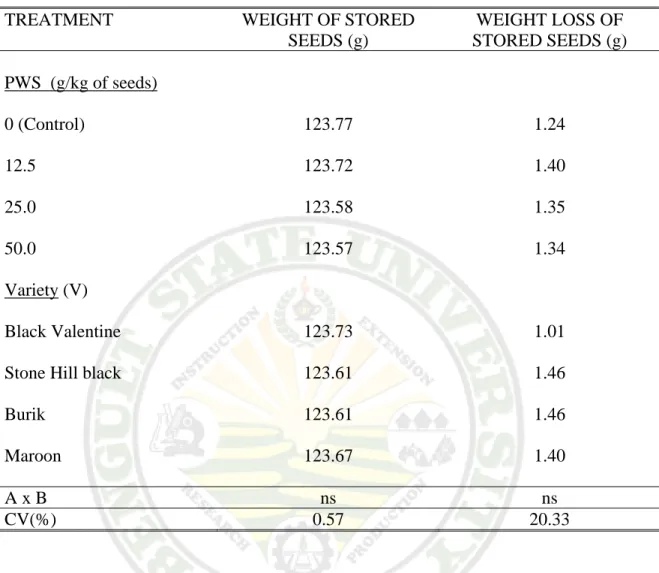
No significant differences were noted in the final weight and weight lossof stored seeds of different varieties of pole snap bean mixed with different amounts ofpine wood strips (PWS)after five months of storage in a biscuit tin can under ordinary room condition (Table 1). All four varieties of pole snap beans mixed with different amounts of PWShad statistically similarfinal weight and weight lossafter five months of storage.
Probably seeds were properly dried that after five months of storage, they were not yet infested with weevil.
No significant interaction effect of variety and PWS on the weight and weight loss of stored seeds of pole snap beans were observed (Table 1).
B. Experimental Field Percent Emergence
Significant differences were noted on the percent emergence of pole snap bean mixed with different amounts of pine wood strips during seeds storage. Pole snap beans
Table 1. Final weight and weight loss of seeds of four varieties of pole snap bean mixed with differentamountsof pine wood strips (PWS) after five months of storage TREATMENT WEIGHT OF STORED
SEEDS (g)
WEIGHT LOSS OF STORED SEEDS (g) PWS (g/kg of seeds)
0 (Control) 123.77 1.24
12.5 123.72 1.40
25.0 123.58 1.35
50.0 123.57 1.34
Variety (V)
Black Valentine 123.73 1.01 Stone Hill black 123.61 1.46
Burik 123.61 1.46
Maroon 123.67 1.40
A x B ns ns
CV(%) 0.57 20.33
mixedwith 12.5g of pine wood strips had the highest percent emergence but comparable to those of 50g of pine wood strips and no pine wood strips (Table 2). Seed mixed with 25g of pine wood strips had the lowest percent of emergence.
Maroon had the highest percent emergence but comparable to those of Stone Hill black and Black Valentine which had statistically similar percent emergence with Burik.
The differences observed could be due to varietal characteristics.
Table 2. Percent emergence of four varieties of pole snap beans mixed with different amounts of pine wood strips (PWS) during storage
TREATMENT EMERGENCE (%)
PWS (g/kg of seeds)
0 (Control) 93.25a
12.5 94.08a
25.0 89.41b
50.0 93.16a
Variety (V)
Black Valentine 92.08ab Stone Hill black 93.66a
Burik 89.66b
Maroon 94.58a
A x B ns
CV % 4.04
*Means of the same letter not significantlydifferent from each other at 5% level of significance using DMRT.
No significant interaction effect of variety and the pine wood strips were noted on the percent emergence of pole snap beans (Table 2).
Number of Days from Sowing to Emergence, to Flowering, from Emergence to Pod Setting, and from Flowering to Pod Setting
The seeds of four pole snap bean varieties that were mixed with different amounts of PWS emerged within six days after sowing. They all took 42-43 days from emergence
to flowering, 48 days to set pod and five to six days from flowering to set pod (Appendix Table 5-7).
The number of days from sowing to emergence, from emergence to flowering, from emergence to pod setting, and from flowering to pod setting were similar in different varieties (Appendix Table 5-7). All the varieties emerged within six days after sowing. Stone Hill black, Burik and Maroon flowered 42 days after emergence while Black Valentine flowered one day later. Similar observation was noted on the days from emergence to pod setting. Stone Hill black, Burik and Maroon produced pods within 47 days after sowing while Black Valentine produced pods two days later. The same result was observed on the flowering to pod setting. Stone Hill black, Burik and Maroon produced pods 5 days after flowering while Black valentine produced pods one day later.
Differences might be due to varietal characteristics of the pole snap bean varieties.
Days from Emergence to FirstHarvest andfrom Emergence to LastHarvest
All the varieties of pole snap bean and the seeds treated with different amount of BPWC during storage were first harvested at 56 DAE and last harvesting of pole snap bean was done at 78 DAE.
Number of Flower per Cluster, Pods per Cluster, and Percent Pod Set
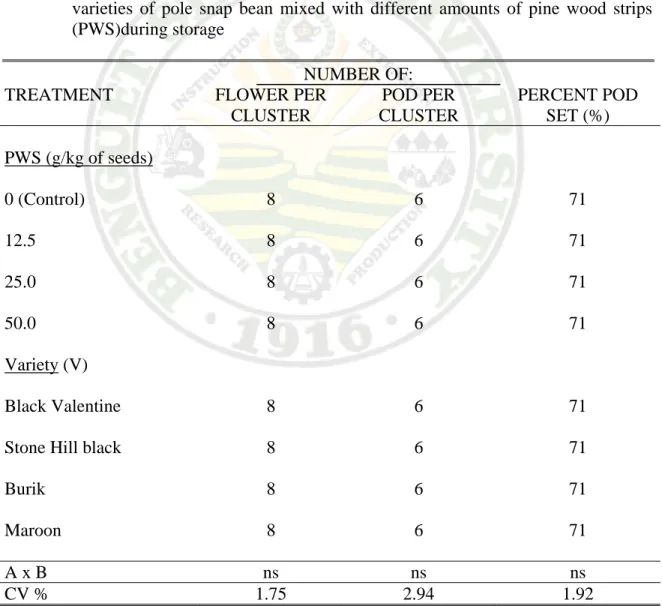
No significant differences were noted on the number of flowers, pods per cluster and percent pod set of the different varieties of pole snap bean mixed with pine wood strips during seed storage. There were eight flowers per cluster, six pods per cluster and 71% pod setting (Table 3).
The number of flower per cluster, pod per cluster, and percent pod set of different varieties of pole snap beans testedwere not significantly different (Table 3). There were eight flowers per cluster, six pods per cluster and 71% pod setting in the four varieties of pole snap bean.
There was no interaction effect of variety and pine wood strips observed on the number of flower per cluster, pod per cluster and percent pod set of pole snap bean (Table 3).
Table 3.Number of flower per cluster, pods per cluster, and percent pod set of four varieties of pole snap bean mixed with different amounts of pine wood strips (PWS)during storage
NUMBER OF:
TREATMENT FLOWER PER CLUSTER
POD PER CLUSTER
PERCENT POD SET (%) PWS (g/kg of seeds)
0 (Control) 8 6 71
12.5 8 6 71
25.0 8 6 71
50.0 8 6 71
Variety (V)
Black Valentine 8 6 71
Stone Hill black 8 6 71
Burik 8 6 71
Maroon 8 6 71
A x B ns ns ns
CV % 1.75 2.94 1.92
Number of Seeds per Pod
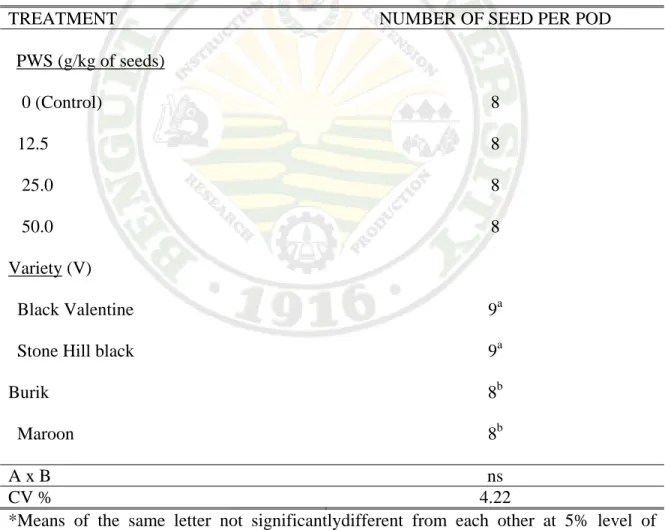
No significant differences were noted on the number of seeds per pod of the four varieties of pole snap bean seeds mixed with different amounts of pine wood strips (Table 4). There were eight seeds per pod that developed regardless of the amount of pine wood strips.
Stone Hill black and Black Valentine had statistically high number of seeds per pod (9) than Burik and Maroon. The differences might due to varietal characteristics.
Table 4.Number of seeds per podof four varieties of pole snap bean mixed withdifferentamountsof pine wood strips (PWS) during storage
TREATMENT NUMBER OF SEED PER POD PWS (g/kg of seeds)
0 (Control) 8
12.5 8
25.0 8
50.0 8
Variety (V)
Black Valentine 9a
Stone Hill black 9a
Burik 8b
Maroon 8b
A x B ns
CV % 4.22
*Means of the same letter not significantlydifferent from each other at 5% level of significance using DMRT.
No significant interaction between the variety and pine wood strips was noted on the number of seeds per pod of pole snap bean (Table 4).
Length and Width of Marketable Fresh Pods
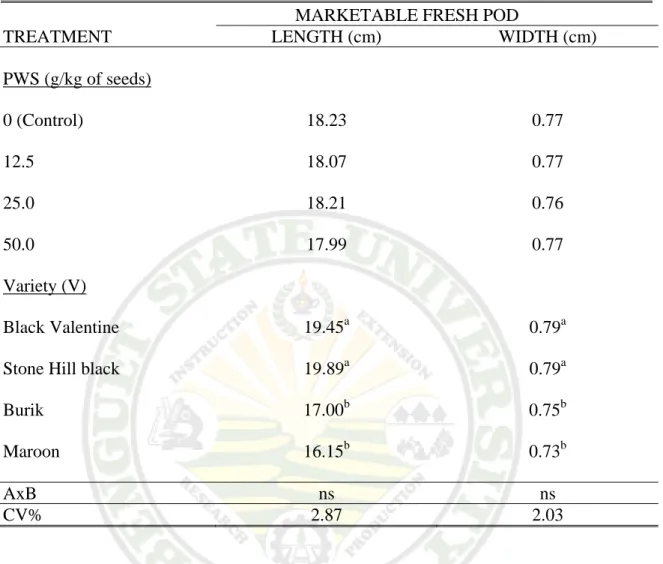
No significant differences on the pod length and width of four varieties of pole snap bean produced from seeds mixed with different amounts ofpine wood strips. The length ranged from 17.99 to 18.23cm and the width ranged from 0.76 to 0.77cm (Table 5).
Stone Hill black and Black Valentine significantly had the longer pod than those of Burik and Maroon (Table 5). Similar observation was noted in pod width. Stone Hill black and Black Valentine had significantly wider pod than those of Burik and Maroon
(Table 5). The difference observed could be due to varietal characteristic.
No significant interaction effect of variety and pine wood strips on pod length and width of marketable fresh pods of pole snap bean was noted (Table 5).
Weight of Marketable and Non-marketable Fresh Pods and Total Yield per Plot
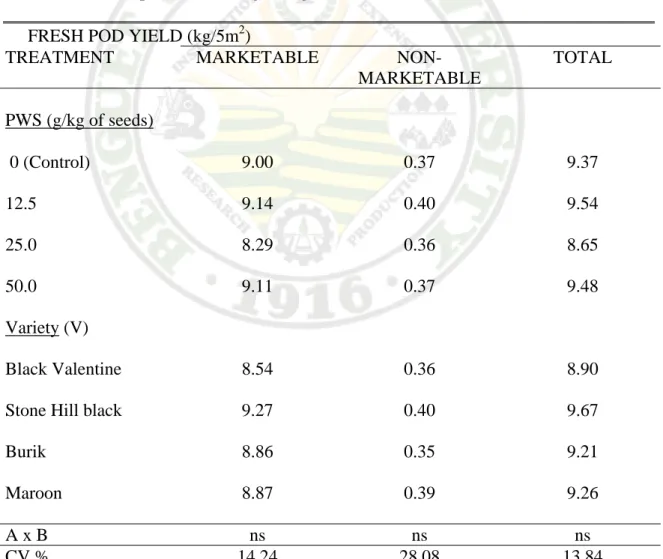
No significant differences were noted on the weight of marketable, non- marketable and total yield of fresh pod per plot of the different varieties of pole snap beans mixed with different amounts of pine wood strips during seeds storage. Treatment of PWS did not significantly increase the yield of pole snap bean varieties.
No significant differences were also noted on the weight of the marketable, non- marketable and the total yield of fresh pods per plot among different varieties of pole snap beans evaluated (Table 6). All snap bean varieties studied produced around 9 kg fresh pods/5m2 plots.
Table 5.Length and width of marketable fresh podsof four varieties of pole snap bean mixed with different amountsof pine wood strips (PWS) during storage
MARKETABLE FRESH POD
TREATMENT LENGTH (cm) WIDTH (cm) PWS (g/kg of seeds)
0 (Control) 18.23 0.77
12.5 18.07 0.77
25.0 18.21 0.76
50.0 17.99 0.77
Variety (V)
Black Valentine 19.45a 0.79a Stone Hill black 19.89a 0.79a
Burik 17.00b 0.75b
Maroon 16.15b 0.73b
AxB ns ns
CV% 2.87 2.03
No significant interaction effect of variety and pine wood strips was noted on the weight of marketable, non-marketable and the total yield per plot of pole snap beans (Table 6).
Reaction to Pod BorerInfestation and Bean Rust Infection
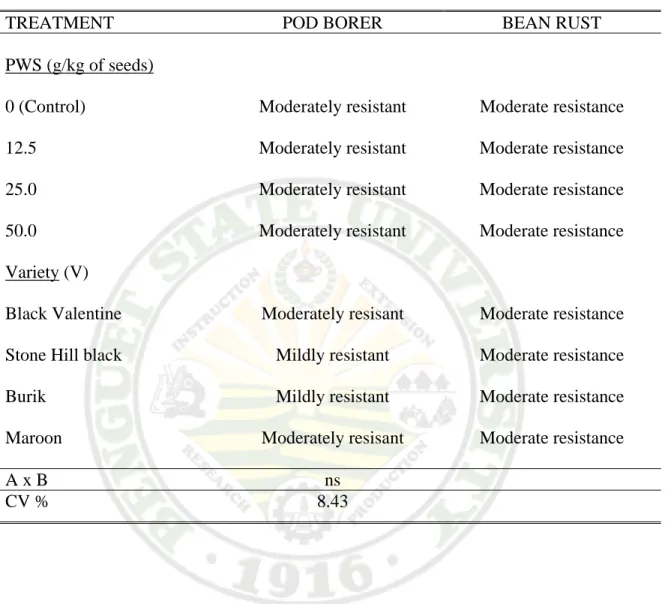
No significant differences were noted on the reaction to pod borer and bean rust of pole snap bean mixed with different amounts of pine wood strips (Table 7).
Similarly,all PWS treatments resulted in moderate resistance to pod borer and bean rust in pole snap bean (Table 7).
Highly significant differences on the reaction to pod borer were noted among the four varieties of pole snap bean (Table 7). Stone Hill and Maroonwere observed to be moderately resistant to pod borer while Black Valentine and Burik were mildly resistant.
All the varieties of pole snap bean evaluated exhibited was moderate resistance to bean rust.
Table 6.Weight of marketable and non-marketable fresh pods and total yield per plot (kg/m2) of four varieties of pole snap bean mixed with different amounts of pine wood strips (PWS) during storage
FRESH POD YIELD (kg/5m2)
TREATMENT MARKETABLE NON- MARKETABLE
TOTAL
PWS (g/kg of seeds)
0 (Control) 9.00 0.37 9.37
12.5 9.14 0.40 9.54
25.0 8.29 0.36 8.65
50.0 9.11 0.37 9.48
Variety (V)
Black Valentine 8.54 0.36 8.90 Stone Hill black 9.27 0.40 9.67
Burik 8.86 0.35 9.21
Maroon 8.87 0.39 9.26
A x B ns ns ns
CV % 14.24 28.08 13.84
No significant interaction effect of the variety and pine wood strips was noted on the reaction of pole snap bean to pod borer and bean rust (Table 7).
Return on Cash Expense
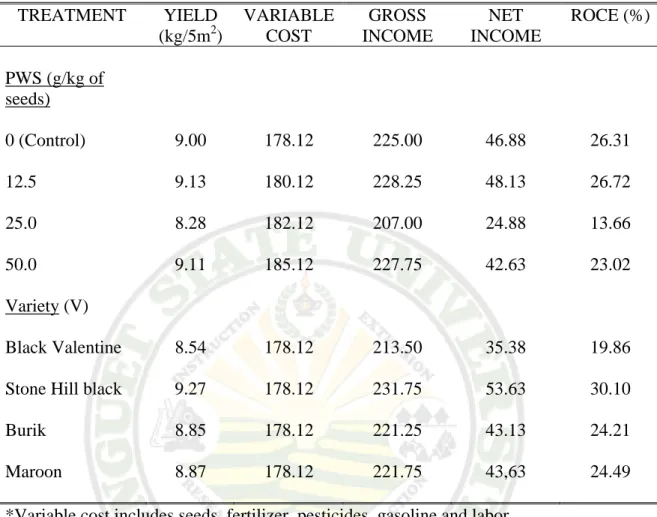
Seeds mixed with 12.5g pine wood strips and withoutPWS recorded the highest ROCE. It was followed by those mixed with 50g of PWS. Seeds mixed with 3.12g of PWS had the lowest ROCE (Table 8).
The return on cash expenses of four pole snap bean varieties is also shown in Table 8. Stone Hill black registered the highest ROCE (30.10%) followed by Maroon (24.49%) and Burik (24.21%). The lowest ROCE was obtained in producing Black Valentine (19.86%). These results indicated the feasibility of growing four varieties of pole snap bean mixed with different amounts of PWS during seed storage. All treatment combination appeared to be profitable but mixing 12.5g of pine wood strips per kg of pole snap bean resulted in highest ROCE because it produced high marketable fresh pods.
Table 7.Reaction to pod borer infestation and bean rust infectionof four varieties of pole snap bean mixed with different amountsof pine wood strips (PWS) during storage
TREATMENT POD BORER BEAN RUST
PWS (g/kg of seeds)
0 (Control) Moderately resistant Moderate resistance
12.5 Moderately resistant Moderate resistance 25.0 Moderately resistant Moderate resistance 50.0 Moderately resistant Moderate resistance Variety (V)
Black Valentine Moderately resisant Moderate resistance Stone Hill black Mildly resistant Moderate resistance
Burik Mildly resistant Moderate resistance Maroon Moderately resisant Moderate resistance
A x B ns
CV % 8.43
Table 8.Return on Cash Expenses (ROCE) of pole snap bean varieties mixed with different amount of pine wood strips (PWS)during storage
TREATMENT YIELD (kg/5m2)
VARIABLE COST
GROSS INCOME
NET INCOME
ROCE (%)
PWS (g/kg of seeds)
0 (Control) 9.00 178.12 225.00 46.88 26.31
12.5 9.13 180.12 228.25 48.13 26.72 25.0 8.28 182.12 207.00 24.88 13.66 50.0 9.11 185.12 227.75 42.63 23.02 Variety (V)
Black Valentine 8.54 178.12 213.50 35.38 19.86 Stone Hill black 9.27 178.12 231.75 53.63 30.10
Burik 8.85 178.12 221.25 43.13 24.21 Maroon 8.87 178.12 221.75 43,63 24.49
*Variable cost includes seeds, fertilizer, pesticides, gasoline and labor
*Sales was based on average of 25 pesos per kilo
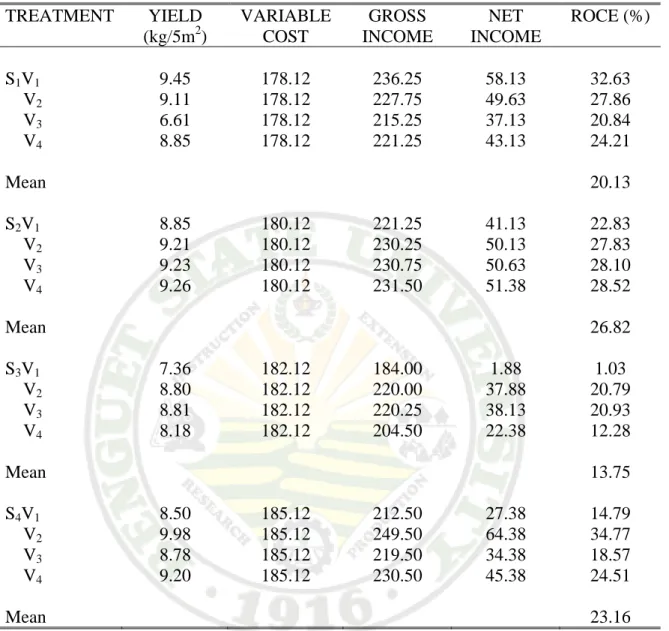
Table 9. Return on Cash Expenses(ROCE) of pole snap bean varieties mixed with different amountsofpine wood strips(PWS) of during storage
TREATMENT YIELD (kg/5m2)
VARIABLE COST
GROSS INCOME
NET INCOME
ROCE (%)
S1V1 9.45 178.12 236.25 58.13 32.63
V2 9.11 178.12 227.75 49.63 27.86 V3 6.61 178.12 215.25 37.13 20.84 V4
Mean
8.85 178.12 221.25 43.13 24.21 20.13
S2V1 8.85 180.12 221.25 41.13 22.83 V2 9.21 180.12 230.25 50.13 27.83 V3 9.23 180.12 230.75 50.63 28.10 V4
Mean
9.26 180.12 231.50 51.38 28.52 26.82
S3V1 7.36 182.12 184.00 1.88 1.03 V2 8.80 182.12 220.00 37.88 20.79 V3 8.81 182.12 220.25 38.13 20.93 V4
Mean
8.18 182.12 204.50 22.38 12.28 13.75
S4V1 8.50 185.12 212.50 27.38 14.79 V2 9.98 185.12 249.50 64.38 34.77 V3 8.78 185.12 219.50 34.38 18.57 V4
Mean
9.20 185.12 230.50 45.38 24.51 23.16
*Variable cost includes seeds, fertilizer, pesticides, gasoline and labor
*Sales was based on average of 25 pesos per kilo Legend:
V1- Black valentine V3- BurikS1- 0 (Control) S3–25g V2- Stone hill black V4- Maroon S2 – 12.5gS4 – 50g
SUMMARY, CONCLUSION AND RECOMMENDATION
Summary
The pole snap bean seedsmixed with different amounts of pine wood strips were apparentlyrated highly resistant to weevil infestation throughout five months of storage after harvest. No significant differences were noted in the final weight and weight loss of stored seeds of pole snap bean.
Mixing pine wood strips in a kg of pole snap bean seeds did not significantly affectall the parameters measured except on the percent emergence. Pole snap beans mixed with 12.5g of pine wood strips per kg of seeds had the highest percent emergence but comparable to those of the control and 50gpine wood strips. Seed mixed with 25g of pine wood strips had the lowest percent of emergence.The seeds of four pole snap bean varieties that were mixed with different amounts of pine wood strips emerged within six days after sowing. They all took 42 days to flower after emergence, 48 days to set pod and five days from flowering to set pod. First harvesting of all the varieties studied was done at 56 DAE and the last harvesting was also done on the same day, at 78 DAE.
The four varieties emerged at 6 DAE. Maroon andStone Hill black had significantly higher percentemergence than Burik which was comparable with those of Black Valentine. Stone Hill black, Burik and Maroon flowered in 42 DAE and set pods at 47 DAE. First harvesting of the four varieties of pole snap bean was done at 56 DAE while last harvesting was done at the same time, at 78 DAE.The four varieties of pole snap beans studied did not significantly differ in other characters measured except on the number of seeds per pod and pod length and width. Black Valentine and Stone Hill black had significantly higher seeds per pod (9) than Burik and Maroon which had eight seeds
per pod. They also had longer and wider pods than Burik and Maroon. Stone Hill black and Maroon showed moderate resistance to pod borer whileBlack Valentine and Burik exhibited mild resistance to pod borer. All varieties showed moderate resistance to bean rust. Stone Hill black recorded the highest return in cash expenses (ROCE).
No significant interaction effect of varieties of pole snap bean and the different amounts of pine wood strips used during seeds storagewas observed in all the parameters measured. However, mixingStone Hill black with 50g pine wood stripsper kg of pole snap bean resultedin highest ROCE (34.74%) although all treatment combinations resulted in positive ROCE.
Conclusion
In this study, mixing pine wood strips to a kg of pole snap beandidnot affect the growth and yield of pole snap bean except its percent emergence. Even without mixing PWS on the pole snap bean seeds at five months of storage, comparable emergence of seeds with 12.5g and 50g of PWS per kg of seeds resulted. Using 12.5g of PWS per kg of pole snap bean seeds gave higher ROCE than other treatments.
The four varieties of pole snap beans evaluated differed in terms of percent emergence, number of seeds per pod and pod length and width. Maroon and Stone Hill black had significantly higher emergence than Burik and was comparable to Black Valentine. Black Valentine and Stone Hill black had significantly higher number of seeds per pod and longer and wider pods than Burik and Maroon. All the varieties gave positive returns. Stone Hill black production resulted in highest ROCE (30.10%)
The PWS and variety of pole snap bean did not have a significant interaction effect on germination, growth and yield of pole snap bean. However, positive ROCE
were recorded in all treatment combinations. Among them, Stone Hill black seeds stored with 50g of PWS per kg of pole snap bean seed resulted in the highest ROCE (34.77%).
Recommendation
Based on the result of the study, it is recommended that a similar study with longer duration of seed storage in more than five months be conducted in the future to observe the effect of PWS in controlling weevil infestation in pole snap bean seeds considering the amount of moisture loss in the seeds during storage. Although no significant effect of PWS were observed in this study, mixing of 12.5g of PWS/kg of pole snap bean seed would give higher ROCE. Any of the four varieties of pole snap bean tested could be planted by the farmers in La Trinidad, Benguet but growing Stone Hill black mixed with 50g of PWS per kg of seed would give the highest ROCE.
LITERATURE CITED
ACAD, J. 2009. Moisture Content and Germination of Bean (Phaseolus vulgaris l.UnderDifferent Storage Condition.Retrieved June 30, 2011 from http://www.idosi.org/ajps/2%284%2909%/4.pdf.
AMPOFO, J.K. 1992. Insect Pests of Bean.Retrieved June 30, 2011 from http://www.annualreviews.org/doi/abs/10.1146/annurev.en.41.010196.000401?j ournalCode=ento.
BALAGUE, T. B. 1990. Philippine Forest Resources.Retrieved July 4, 2011 from http://www.nscb.gov.ph/peenra/Publications/Asset/forest.pdf.
BARTON, R. 1996. Initial Seeds Quality.Retrieved July 4, 2011 from http://www.Agritech.tnau.ac.in/seed_certification/seed%20storage_storage%20f actors.html.
BEYOND PEST CONTROL INC. 2009.Bean weevil.Retrieved July 4, 2011 from http://www.nypestpro.com/bean weevul.html.
CALYA-EN, S. M. 2009. On-farm trial of promising varieties of pole snap bean varieties in Balili, Mankayan, Benguet. BS Thesis. Benguet State University. La Trinidad, Benguet.
CATNAS, E. 2009. Influence of animal urine and salt water seed treatment on the Growth and yield of organically grown pole snap bean (Phaseolus vulgaris) in La Trinidad, Benguet. BS Thesis. BSU, La Trinidad, Benguet.
CANADIAN GRAIN COMMISSION. 2001.Crop Post Harvest. July 4, 2011 fromhttp;//www.ph/books?id=QYz9oajaat0C&pg=PA177&lpg=PA177&dq=ca nadian+grain+commission+2001&sou
DAVID, S. 2007. Producing Seed Bean.Retrieved July 4, 2011 from http://www.fao.org/sd/erp/toolkit/books/handbook_1_english.pdf.
DEMAND MEDIA, INC., 2011. How to Harvest Pole Snap Bean. Retrieved July 4, 2011 from http://www.ehow.com/how_5569028_harvest-snap-beans.html.
DURSUN, A. 2007.Variability, Heritability and Correlation Studies in Bean Genotype.Retrieved June 30, 2011 from http://www.idosi.org/wjas/wjas 3/13.pdf.
FOODAND AGRICULTURALORGANIZATION. 2007. Green Bean Ecological Guide.
Retrieved June 20, 2011 from http://www.vegetableipmasia.org/docs/Ecological%20Guide/Green%20Bean%2
0Integrated%20Pest%20Management.pdf.
FARMERIK. 2007. LONG TERM SEED STORAGE. Retrieved July 4, 2011 from http://seedforsecurity.com/article.php?articleid=27.
JEFFERSON, T. 2005. Dry Edible Beans. A High Value Alternative Legume.Retrieved July 4, 2011 from http://www.Jeffersoninstitute.Org/ pubs/dry beans.shtml.
KAUFMAN, E.R. 2000.Organic Seed Treatment Notes.Retrieved June 30, 2011 from http://www.grow seed.org/seed treatment notes.hmtl.
NERGAAD, P. 1997.Seed Phathology, vols.I, II.Jonh and Sons, New York.
SIMSIM, P. A. and J.G. BALAOING. 2007. Organic Fertilization on the Seed Quality of Pole Snap Bean Phaseolus vulgaris (Var. Maccarao). BSU Research Journal.P.
56.
TANDANG, L. L. 2011. Personal Communication. September 14, 2011.
TANDANG, LL. 2007. New NSIC-approved variety of pole snap bean (Phaseolus vulgaris) in Benguet, Philippines. Philippines Journal of Crop Science (PJCS) December 2010. Pp. 57-63.
APPENDICES
Appendix Table 1. Weevil infestation during seed storageof four varieties of pole snap bean mixed with different amounts of pine wood strips (PWS)
REPLICATION
TREATMENT I II III TOTAL MEAN S1V1
S1V2
1 1 1 3 1 1 1 1 3 1
S1V3 1 1 1 3 1
S1V4 1 1 1 3 1
S2V1 1 1 1 3 1
S2V2 1 1 1 3 1
S2V3 1 1 1 3 1
S2V4 1 1 1 3 1
S3V1 1 1 1 3 1
S3V2 1 1 1 3 1
S3V3 1 1 1 3 1
S3V4 1 1 1 3 1
S4V1 1 1 1 3 1
S4V2 1 1 1 3 1
S4V3 1 1 1 3 1
S4V4 1 1 1 3 1
TOTAL 16 16 16 48 16
MEAN 1 1 1 3 1
Appendix Table 2.Final weight (g) of the stored seedof four varieties of pole snap bean after 5 monthsmixed with different amounts of pine wood strips (PWS) during storage
REPLICATION
TREATMENT I II III TOTAL MEAN S1V1 123.75 123.87 124.75 372.37 124.12
S1V2 122.87 122.75 123.81 369.43 123.14 S1V3 122.75 124.75 124.75 372.25 124.08 S1V4 123.50 123.75 123.75 371.00 123.66
S2V1 123.75 124.75 123.25 371.75 123.91 S2V2 124.25 124.75 122.81 371.81 123.93 S2V3 123.87 122.81 122.93 369.61 123.20
2V4 123.87 122.81 123.87 371.55 123.85 S3V1 124.87 122.81 123.75 369.31 123.10 S3V2 122.75 122.75 123.75 370.25 123.41 S3V3 123.75 123.75 122.75 371.25 123.75 S3V4 124.75 123.75 123.75 372.25 124.08 S4V1 124.75 123.75 123.75 371.37 123.79 S4V2 123.87 123.75 124.37 371.87 123.95 S4V3 123.75 123.75 122.81 370.31 123.43 S4V4 123.75 122.81 122.75 369.31 123.10 TOTAL 1980.85 1977.36 1977.60 5935.81 1978.60 MEAN 123.80 123.48 123.60 370.98 123.66
TWO WAY TABLE
VARIETY PWS
TOTAL MEAN S1 S2 S3 S4
V1 124.12 123.91 123.1 123.79 494.92 123.73 V2 123.14 123.93 123.41 123.95 494.43 123.61 V3 124.08 123.2 123.75 123.43 494.46 123.62 V4 123.66 123.85 124.08 123.1 494.69 123.67 TOTAL 495 494.89 494.34 494.27 1978.5
MEAN 123.75 123.723 123.585 123.568 123.66
ANALYSIS OF VARIANCE TABLE SOURCE
OF VARIANCE
DEEGREES OF FREEDOM
SUM OF SQUARE
MEAN SQUARE
F VALUE
TABULAR F 0.05 0.01 Replication 2 0.442 0.221
FACTOR A 3 0.315 O.105 0.21ns 3.04 4.06 FACTOR B 3 0.115 0.038 0.07ns 3.04 4.06 AB 9 5.778 0.642 1.28ns 3.35 4.45 ERROR 30 14.975 O.99
TOTAL 47 21.624
ns = not significant CV = 0.57%
Appendix Table 3. Final weight (g) lost of stored seed of four varieties of pole snap beanmixed with different amounts of pine wood strips (PWS) during storage
REPLICATION
TREATMENT I II III TOTAL MEAN
S1V1 1.25 1.13 0.25 2.63 0.87 S1V2 2.13 2.25 1.19 5.57 1.85 S1V3 2.25 0.25 0.25 2.75 0.91 S1V4 1.50 1.25 1.25 4.00 1.33
S2V1 1.25 0.25 1.75 3.25 1.08 S2V2 0.75 0.25 2.19 3.10 1.06 S2V3 1.13 2.19 2.07 5.39 1.79 S2V4 1.13 2.19 1.13 4.45 1.48 S3V1 0.13 2.19 1.25 3.57 1.19 S3V2 2.25 2.25 1.25 5.75 1.91 S3V3 1.25 1.25 2.25 4.75 1.58 S3V4 0.25 1.25 1.25 2.75 0.91 S4V1 0.25 1.25 1.25 2.75 0.91 S4V2 1.13 1.25 0.63 3.01 1.00 S4V3 1.25 1.25 2.19 4.69 1.56 S4V4 1.25 2.19 2.25 5.69 1.89 TOTAL 19.15 22.64 22.40 64.19 21.39 MEAN 1.21 1.41 1.40 4.02 1.33
TWO WAY TABLE
VARIETY PWS
TOTAL MEAN S1 S2 S3 S4
V1 0.87 1.08 1.19 0.91 4.05 1.01 V2 1.85 1.06 1.91 1 5.82 1.46 V3 0.91 1.79 1.58 1.56 5.84 1.46 V4 1.33 1.48 0.91 1.89 5.61 1.40 TOTAL 4.96 5.41 5.59 5.36 21.32 MEAN 1.24 1.35 1.40 1.34 1.33
ANALYSIS OF VARIANCE TABLE SOURCE
OF VARIANCE
DEEGREES OF FREEDOM
SUM OF SQUARE
MEAN SQUARE
F VALUE
TABULAR F 0.05 0.01 Replication 2 0.475
FACTOR A 3 0.155 0.052 0.11ns 3.04 4.06 FACTOR B 3 1.669 0.556 1.16ns 3.04 4.06 AB 9 5.010 0.557 1.16ns 3.35 4.45 ERROR 30 14.350 0.478
TOTAL 47 21.660
ns = not significant CV = 20%
Appendix Table 4. Percent of emergence of four varieties of pole snap beanmixed with different amounts of pine wood strips (PWS) during storage
REPLICATION
TREATMENT I II III TOTAL MEAN
S1V1 93 91 98 282.00 94.00
S1V2 90 96 96 282.00 94.00
S1V3 88 86 98 272.00 90.66
S1V4 96 93 96 285.00 95.00
S2V1 90 94 94 278.00 92.66
S2V2 98 89 99 286.00 95.33
S2V3 97 89 97 283.00 94.33
S2V4 95 93 94 282.00 94.00
S3V1 80 93 97 270.00 90.0
S3V2 94 91 86 271.00 90.33
S3V3 85 80 85 250.00 83.33
S3V4 90 95 98 283.00 94.33
S4V1 90 88 97 275.00 91.66
S4V2 95 92 98 285.00 95.00
S4V3 92 87 92 271.00 90.33
S4V4 98 94 96 288.00 96.00
TOTAL 1471 1451 1521 4443 1481 MEAN 91.93 90.68 95.06 277.67 92.56
TWO WAY TABLE
VARIETY PWS
TOTAL MEAN S1 S2 S3 S4
V1 94 92.66 90 91.66 368.32 92.08 V2 94 95.33 90.33 95 374.66 93.67 V3 90.66 94.33 83.33 90.33 358.65 89.66 V4 95 94 94.33 96 379.33 94.83 TOTAL 373.66 376.32 357.99 372.99 1480.96
MEAN 93.415 94.08 89.4975 93.2475 92.56
ANALYSIS OF VARIANCE TABLE SOURCE
OF VARIANCE
DEEGREES OF FREEDOM
SUM OF SQUARE
MEAN SQUARE
F VALUE
TABULAR F 0.05 0.01 Replication 2 162.500 81.250
FACTOR A 3 154.729 81.576 3.68* 3.04 4.06 FACTOR B 3 179.896 59.965 4.28** 3.04 4.06 AB 9 115.188 12.799 0.91ns 3.04 4.06 ERROR 30 419.500 13.983
TOTAL 47 1031.813
* = significant CV = 4.04%
** = highly significant ns = significant
Appendix Table 5.Days from sowing to emergence of pole snap bean mixed with different amounts of pine wood strips (PWS) during storage
REPLICATION
TREATMENT I II III TOTAL MEAN
S1V1 6 6 6 18 6.00
S1V2 6 6 6 18 6.00
S1V3 6 6 6 18 6.00
S1V4 6 6 6 18 6.00
S2V1 6 6 6 18 6.00
S2V2 6 6 6 18 6.00
S2V3 6 6 6 18 6.00
S2V4 6 6 6 18 6.00
S3V1 7 6 6 19 6.33
S3V2 6 7 6 19 6.33
S3V3 6 7 6 20 6.33
S3V4 6 6 6 18 6.00
S4V1 6 6 6 18 6.00
S4V2 6 6 6 18 6.00
S4V3 6 6 6 18 6.00
S4V4 6 6 6 18 6.00
TOTAL 98 98 96 292 97.33
MEAN 6.12 6.12 6.00 18.25 6.08
Appendix Table 6.Days from emergence to floweringof pole snap bean mixed with different amounts of pine wood strips (PWS) during storage
REPLICATION
TREATMENT I II III TOTAL MEAN
S1V1 43 43 43 129 43
S1V2 42 42 42 126 42
S1V3 42 42 42 126 42
S1V4 42 42 42 126 42
S2V1 43 43 43 129 43
S2V2 42 42 42 126 42
S2V3 42 42 42 126 42
S2V4 42 42 42 126 42
S3V1 43 43 43 129 43
S3V2 42 42 42 126 42
S3V3 42 42 42 126 42
S3V4 42 42 42 126 42
S4V1 43 43 43 129 43
S4V2 42 42 42 126 42
S4V3 42 42 42 126 42
S4V4 42 42 42 126 42
TOTAL 676 676 676 2028 676
MEAN 42.25 42.25 42.25 126.75 42.25
Appendix Table 7.Days from flowering to pod settingof pole snap bean mixed with different amounts of pine wood strips (PWS) during storage
REPLICATION
TREATMENT I II III TOTAL MEAN
S1V1 6 6 6 18 6
S1V2 5 5 5 15 5
S1V3 5 5 5 15 5
S1V4 5 5 5 15 5
S2V1 6 6 6 18 6
S2V2 5 5 5 15 5
S2V3 5 5 5 15 5
S2V4 5 5 5 15 5
S3V1 6 6 6 18 6
S3V2 5 5 5 15 5
S3V3 5 5 5 15 5
S3V4 5 5 5 15 5
S4V1 6 6 6 18 6
S4V2 5 5 5 15 5
S4V3 5 5 5 15 5
S4V4 5 5 5 15 5
TOTAL 83 83 83 249 83
MEAN 5.18 5.18 5.18 15.54 5.18
Appendix Table 8. Days from emergence to pod settingof pole snap bean mixed with different amounts of pine wood strips (PWS) during storage
REPLICATION
TREATMENT I II III TOTAL MEAN
S1V1 49 49 49 147 49
S1V2 47 47 47 141 47
S1V3 47 47 47 141 47
S1V4 47 47 47 141 47
S2V1 49 49 49 147 49
S2V2 47 47 47 141 47
S2V3 47 47 47 141 47
S2V4 47 47 47 141 47
S3V1 49 49 49 147 49
S3V2 47 47 47 141 47
S3V3 47 47 47 141 47
S3V4 47 47 47 141 47
S4V1 49 49 49 147 49
S4V2 47 47 47 141 47
S4V3 47 47 47 141 47
S4V4 47 47 47 141 47
TOTAL 757 757 757 2271 757
MEAN 47.31 47.31 47.31 141.93 757
Appendix Table 9.Days from emergence to first harvestingof pole snap bean mixed with different amounts of pine wood strips (PWS) during storage
REPLICATION
TREATMENT I II III TOTAL MEAN
S1V1 56 56 56 168 56
S1V2 56 56 56 168 56
S1V3 56 56 56 168 56
S1V4 56 56 56 168 56
S2V1 56 56 56 168 56
S2V2 56 56 56 168 56
S2V3 56 56 56 168 56
S2V4 56 56 56 168 56
S3V1 56 56 56 168 56
S3V2 56 56 56 168 56
S3V3 56 56 56 168 56
S3V4 56 56 56 168 56
S4V1 56 56 56 168 56
S4V2 56 56 56 168 56
S4V3 56 56 56 168 56
S4V4 56 56 56 168 56
TOTAL 896 896 896 2688 896
MEAN 56 56 56 158 56
Appendix Table 10.Days from emergence to last harvestingof pole snap bean mixed with different amounts of pine wood strips (PWS) during storage
REPLICATION
TREATMENT I II III TOTAL MEAN
S1V1 78 78 78 234 78
S1V2 78 78 78 234 78
S1V3 78 78 78 234 78
S1V4 78 78 78 234 78
S2V1 78 78 78 234 78
S2V2 78 78 78 234 78
S2V3 78 78 78 234 78
S2V4 78 78 78 234 78
S3V1 78 78 78 234 78
S3V2 78 78 78 234 78
S3V3 78 78 78 234 78
S3V4 78 78 78 234 78
S4V1 78 78 78 234 78
S4V2 78 78 78 234 78
S4V3 78 78 78 234 78
S4V4 78 78 78 234 78
TOTAL 1248 1248 1248 3744 1248
MEAN 78 78 78 234 78
Appendix Table 11.Number of flower per cluster of pole snap bean mixed with different amounts of pine wood strips (PWS) during storage
REPLICATION
TREATMENT I II III TOTAL MEAN
S1V1 7.9 8.4 8.3 24.60 8.2 S1V2 8.0 8.2 8.1 24.30 8.1 S1V3 8.0 8.3 8.5 24.80 8.2 S1V4 8.3 8.2 8.1 24.60 8.2
S2V1 8.3 8.3 8.3 24.90 8.3 S2V2 7.9 8.1 8.1 24.10 8.0 S2V3 8.4 8.1 8.2 24.70 8.2 S2V4 8.3 8.5 8.2 25.00 8.3 S3V1 8.0 8.5 8.3 24.80 8.2 S3V2 8.4 8.2 8.0 24.60 8.2 S3V3 8.3 8.3 8.3 24.90 8.3 S3V4 8.1 8.4 8.3 24.80 8.2 S4V1 8.3 8.3 8.3 24.90 8.3 S4V2 8.2 8.2 8.3 24.70 8.2 S4V3 8.3 8.2 8.3 24.80 8.2 S4V4 8.2 8.4 8.4 25.00 8.3 TOTAL 139.1 132.6 132.0 403.7 134.5
MEAN 8.6 8.2 8.2 25.0 8.20
TWO WAY TABLE
VARIETY PWS
TOTAL MEAN S1 S2 S3 S4
V1 8.20 8.30 8.20 8.30 33.00 8.25 V2 8.10 8.00 8.20 8.20 32.50 8.13 V3 8.20 8.20 8.30 8.20 32.90 8.23 V4 8.20 8.30 8.20 8.30 33.00 8.25 TOTAL 32.70 32.80 32.90 33.00 131.40 MEAN 8.18 8.20 8.22 8.25 8.20
ANALYSIS OF VARIANCE TABLE SOURCE
OF VARIANCE
DEEGREES OF FREEDOM
SUM OF SQUARE
MEAN SQUARE
F VALUE
TABULAR F 0.05 0.01 Replication 2 0.093 0.046
FACTOR A 3 0.057 0.019 0.91ns 3.04 4.06 FACTOR B 3 0.156 0.052 2.48ns 3.04 4.06 AB 9 0.082 0.009 0.43ns 3.35 4.45 ERROR 30 0.627 0.021
TOTAL 47 1.015
ns = not significant CV = 1.75%
Appendix Table 12.Number of pods per clusterof pole snap bean mixed with different amounts of pine wood strips (PWS) during storage
REPLICATION
TREATMENT I II III TOTAL MEAN
S1V1 5.5 6.1 5.9 17.50 5.83 S1V2 5.9 6.0 5.9 17.80 5.93 S1V3 5.5 6.0 6.1 17.60 5.86 S1V4 5.9 5.6 5.8 17.30 5.76
S2V1 6.0 5.8 5.9 17.70 5.90 S2V2 5.8 5.8 5.7 17.30 5.76 S2V3 5.9 5.8 5.8 17.50 5.83 S2V4 6.1 6.1 5.9 18.10 6.03 S3V1 5.8 6.0 6.0 17.80 5.93 S3V2 6.1 5.7 5.6 17.40 5.80 S3V3 5.9 5.9 5.8 17.60 5.86 S3V4 6.0 6.2 5.9 18.10 6.03 S4V1 6.0 5.8 6.1 17.90 5.96 S4V2 6.0 5.7 6.0 17.70 5.90 S4V3 6.1 5.8 5.8 17.70 5.90 S4V4 5.8 5.9 5.9 17.60 5.86 TOTAL 94.3 94.2 941 282.6 94.2
MEAN 5.8 5.8 5.8 17.5 5.88
TWO WAY TABLE
VARIETY PWS
TOTAL MEAN S1 S2 S3 S4
V1 5.83 5.90 5.93 5.96 23.62 5.91 V2 5.93 5.76 5.80 5.90 23.39 5.85 V3 5.86 5.83 5.86 5.90 23.45 5.86 V4 5.76 6.03 6.03 5.86 23.68 5.92 TOTAL 23.38 23.52 23.62 23.62 94.14
MEAN 5.85 5.88 5.91 5.91 5.88
ANALYSIS OF VARIANCE TABLE SOURCE
OF VARIANCE
DEEGREES OF FREEDOM
SUM OF SQUARE
MEAN SQUARE
F VALUE
TABULAR F 0.05 0.01 Replication 2 0.001 0.001
FACTOR A 3 0.027 0.009 0.30ns 3.04 4.06 FACTOR B 3 0.044 0.015 0.49ns 3.04 4.06 AB 9 0.221 0.025 0.82ns 3.35 4.45 ERROR 30 0.899 0.030
TOTAL 47 1.192
ns = not significant CV = 2.94%
Appendix Table 13.Percentage pod set per clusterof pole snap beanmixed with different amounts of pine wood strips (PWS) during storage
REPLICATION
TREATMENT I II III TOTAL MEAN
S1V1 69.62 72.61 71.08 213.31 71.10 S1V2 73.75 73.17 72.83 219.75 73.25 S1V3 68.75 72.28 71.76 212.79 70.93 S1V4 71.08 68.29 71.60 210.97 70.32
S2V1 72.28 69.87 71.08 213.23 71.07 S2V2 73.41 71.60 70.37 215.38 71.79 S2V3 70.23 71.60 70.73 212.56 70.85 S2V4 73.49 71.76 71.95 217.20 72.40 S3V1 72.50 70.58 72.28 215.36 71.78 S3V2 72.61 69.51 70.00 212.12 70.70 S3V3 71.08 71.08 72.28 214.44 71.48 S3V4 74.07 73.80 71.08 218.95 72.98 S4V1 72.28 69.87 73.49 215.64 71.88 S4V2 73.17 69.51 72.28 214.96 71.65 S4V3 73.49 70.23 69.87 213.59 71.19 S4V4 70.73 70.23 70.23 211.19 70.39 TOTAL 1152.54 1135.99 1142.41 3431.44 1143.81 MEAN 72.03 70.99 71.43 214.45 71.49
TWO WAY TABLE
VARIETY PWS
TOTAL MEAN S1 S2 S3 S4
V1 71.1 71.07 71.78 71.88 285.83 71.46 V2 73.25 71.79 70.7 71.65 287.39 71.85 V3 70.93 70.85 71.48 71.19 284.45 71.11 V4 70.32 72.4 72.98 70.39 286.09 71.52 TOTAL 285.60 286.11 286.94 285.11 1143.76
MEAN 71.40 71.53 71.74 71.28 71.49
ANALYSIS OF VARIANCE TABLE SOURCE
OF VARIANCE
DEEGREES OF FREEDOM
SUM OF SQUARE
MEAN SQUARE
F VALUE
TABULAR F 0.05 0.01 Replication 2 8.636 4.318
FACTOR A 3 1.379 0.460 0.24 3.04 4.06 FACTOR B 3 3.275 1.092 0.57 3.04 4.06 AB 9 27.776 3.086 1.63 3.35 4.45 ERROR 30 56.603 1.888
TOTAL 47 97.669
ns = not significant CV = 1.92%
Appendix Table 14. Total number of seeds per podof pole snap bean mixed with different amounts of pine wood strips (PWS) during storage
REPLICATION
TREATMENT I II III TOTAL MEAN
S1V1 8.7 8.6 8.5 25.80 8.60 S1V2 9.2 9.3 8.5 27.00 9.00 S1V3 8.6 7.7 8.2 24.50 8.16 S1V4 7.7 8.3 7.9 23.90 7.96
S2V1 8.9 8.8 9.2 26.90 8.96 S2V2 9.4 8.7 8.4 26.50 8.33 S2V3 8.5 8.3 8.1 24.90 8.30 S2V4 8.4 7.9 7.7 24.00 8.00 S3V1 8.8 9.1 8.5 26.40 8.80 S3V2 8.9 9.5 8.5 26.90 8.96 S3V3 7.9 7.7 8.3 23.90 7.96 S3V4 7.8 7.7 8.1 23.60 7.86 S4V1 9.2 8.7 8.4 26.30 8.76 S4V2 8.9 9.3 8.2 26.40 8.80 S4V3 7.6 7.7 8.2 23.50 7.83 S4V4 7.7 8.3 7.6 23.60 7.86 TOTAL 136.2 135.6 132.3 404.1 134.7
MEAN 8.5 8.4 8.2 25.1 8.38