The Philippine Review of Economics
Editor-in-Chief EMMANUEL F. ESGUERRA
Editorial Advisory Board EMMANUEL DE DIOS
RAUL V. FABELLA HAL CHRISTOPHER HILL
CHARLES Y. HORIOKA KIAN GUAN LIM ROBERTO S. MARIANO JOHN VINCENT C. NYE GERARDO P. SICAT JEFFREY G. WILLIAMSON
Associate Editors LAWRENCE B. DACUYCUY FRANCISCO G. DAKILA JR.
JONNA P. ESTUDILLO MARIA S. FLORO GILBERTO M. LLANTO
Managing Editor HONLANI RUTH R. RUFO
A joint publication of the University of the Philippines
School of Economics and the Philippine Economic Society
ARTICLES IN THIS ISSUE Unemployment and monetary policy:
a revisit and new job strategies Dante B. Canlas
A SYMPOSIUM ON THE CARE ECONOMY Introduction to the symposium on
the care economy Maria S. Floro
Elizabeth M. King Child and elderly care in South Korea:
policy analysis with a gendered, care-focused computable general equilibrium model
Martín Cicowiez Hans Lofgren
Women’s market work and childcare policies in Colombia: policy simulations using a computable general equilibrium model
Martín Cicowiez Hans Lofgren Ana Tribin Tatiana Mojica The enduring impact of the
pandemic on gender patterns of paid and unpaid work: evidence from time-use data in Turkey
Ipek Ilkkaracan Emel Memiş
Unpaid eldercare and its impact on
the US labor supply Tanima Ahmed
Maria S. Floro Care work and the demographic
composition of households: two Asian cases
Elizabeth M. King Hannah L. Randolph Jooyeoun Suh Care workers’ sense of responsibility,
working conditions, and the quality of care in South Korea
Shirin Arslan Arnob Alam Maria S. Floro Seung-Eun Cha Eunhye Kang
Aims and Scope: The Philippine Review of Economics (pre) invites theoretical and empirical articles on economics and economic development. Papers on the Philippines, Asian and other developing economies are especially welcome. Book reviews will also be considered.
The pre is published jointly by the up School of Economics and the Philippine Economic Society. Its contents are indexed in the Journal of Economic Literature, EconLit, and RePEc.
pre’s readership includes economists and other social scientists in academe, business, government, and development research institutions.
Publication Information: The pre (issn 1655-1516) is a peer-reviewed journal published every June and December of each year. A searchable database of published articles and their abstracts is available at the pre website (http://pre.econ.upd.edu.
ph).
Subscription Information:
Subscription correspondence may be sent to the following addresses:
• pssc Central Subscription Service,
psscenter, Commonwealth Avenue, 1101, Diliman, Quezon City, Philippines.
P.O. Box 205, up Post Office, Diliman, Quezon City, Philippines 1101
PHONE: 922-9627, FAX: 924-4178/926-5179
Submissions: Authors may submit their manuscripts to addresses below:
• [email protected] or [email protected]
• The Editor, The Philippine Review of Economics, Rm 237, School of Economics, University of the Philippines, Diliman, Quezon City, 1101.
Manuscripts must be written in English and in ms Word format.
All graphs and tables must be in Excel format. Submission of a manuscript shall be understood by the pre as indicating that the manuscript is not under consideration for publication in other journals. All submissions must include the title of the paper, author information, an abstract of no more than 150 words, and a list of 3–4 keywords. Complete guidelines can be viewed in pre’s website.
Copyright: The Philippine Review of Economics is protected by Philippine copyright laws. Articles appearing herein may be reproduced for personal use but not for mass circulation. To reprint an article from pre, permission from the editor must be sought.
EDITOR-IN-CHIEF Emmanuel S. de Dios UP SCHOOL OF ECONOMICS EDITORIAL ADVISORY BOARD Raul V. Fabella
UP SCHOOL OF ECONOMICS Hal C. Hill
AUSTRALIAN NATIONAL UNIVERSITY Charles Y. Horioka
ASIAN GROWTH RESEARCH INSTITUTE (KITAKYUSHU)
Kian Guan Lim
SINGAPORE MANAGEMENT UNIVERSITY Roberto S. Mariano UNIVERSITY OF PENNSYLVANIA John Vincent C. Nye GEORGE MASON UNIVERSITY Gerardo P. Sicat UP SCHOOL OF ECONOMICS Jeffrey G. Williamson HARVARD UNIVERSITY ASSOCIATE EDITORS Dante B. Canlas UP SCHOOL OF ECONOMICS Ramon L. Clarete UP SCHOOL OF ECONOMICS Lawrence B. Dacuycuy DE LA SALLE UNIVERSITY Francisco G. Dakila Jr.
BANGKO SENTRAL NG PILIPINAS Cristina C. David PHILIPPINE INSTITUTE
FOR DEVELOPMENT STUDIES Jonna P. Estudillo NATIONAL GRADUATE INSTITUTE
FOR POLICY STUDIES (TOKYO) Maria S. Floro
AMERICAN UNIVERSITY (WASHINGTON D.C.) Gilberto M. Llanto
PHILIPPINE INSTITUTE FOR DEVELOPMENT STUDIES Aniceto C. Orbeta PHILIPPINE INSTITUTE
FOR DEVELOPMENT STUDIES Ernesto M. Pernia UP SCHOOL OF ECONOMICS Stella Luz A. Quimbo UP SCHOOL OF ECONOMICS MANAGING EDITOR Honlani Ruth J. Rabe UP SCHOOL OF ECONOMICS COPY EDITOR Dinna Dayao
and the Philippine Economic Society (PES)
EDITOR IN CHIEF Emmanuel F. Esguerra UP SCHOOL OF ECONOMICS EDITORIAL ADVISORY BOARD Emmanuel de Dios
UP SCHOOL OF ECONOMICS Raul V. Fabella UP SCHOOL OF ECONOMICS Hal Christopher Hill AUSTRALIAN NATIONAL UNIVERSITY Charles Y. Horioka KOBE UNIVERSITY Kian Guan Lim
SINGAPORE MANAGEMENT UNIVERSITY Roberto S. Mariano UNIVERSITY OF PENNSYLVANIA John Vincent C. Nye GEORGE MASON UNIVERSITY Gerardo P. Sicat UP SCHOOL OF ECONOMICS Jeffrey G. Williamson HARVARD UNIVERSITY ASSOCIATE EDITORS Lawrence B. Dacuycuy DE LA SALLE UNIVERSITY Francisco G. Dakila Jr.
BANGKO SENTRAL NG PILIPINAS Jonna P. Estudillo UNIVERSITY OF THE PHILIPPINES Maria S. Floro
AMERICAN UNIVERSITY (WASHINGTON D.C.) Gilberto M. Llanto
PHILIPPINE INSTITUTE FOR DEVELOPMENT STUDIES
MANAGING EDITOR Honlani Ruth R. Rufo UP SCHOOL OF ECONOMICS
Aims and Scope: The Philippine Review of Economics (PRE) invites theoretical and empirical articles on economics and economic development. Papers on the Philippines, Asian and other developing economies are especially welcome. Book reviews will also be considered.
The PRE is published jointly by the UP School of Economics and the Philippine Economic Society. Its contents are indexed in the Journal of Economic Literature, EconLit, and RePec. PRE’s readership includes economists and other social scientists in academe, business, government, and development research institutions.
Publication Information: The PRE (ISSN 1655-1516) is a peer- reviewed journal published every June and December of each year.
A searchable database of published articles and their abstracts is available at the PRE website (http://pre.econ.upd.edu.ph).
Subscription Information:
Subscription correspondence may be sent to the following addresses:
• PSSC Central Subscription Service,
PSSCenter, Commonwealth Avenue, 1101, Diliman, Quezon City, Philippines.
P.O. Box 205, UP Post Office, Diliman, Quezon City, Philippines 1101
PHONE: 922-9627, FAX: 924-4178/926-5179
Submissions: Authors may submit their manuscripts to the addresses below:
• The Editor, The Philippine Review of Economics, Rm 237, School of Economics, University of the Philippines, Diliman, Quezon City, 1101.
Manuscripts must be written in English and in MS Word format.
All graphs and tables must be in Excel format. Submission of a manuscript shall be understood by the PRE as indicating that the manuscript is not under consideration for publication in other journals. All submissions must include the title of the paper, author information, an abstract of no more than 150 words, and a list of 3–4 keywords. Complete guidelines can be viewed in the PRE’s website.
Copyright: The Philippine Review of Economics is protected by Philippine copyright laws. Articles appearing herein may be reproduced for personal use but not for mass circulation. To reprint an article from PRE, permission from the editor must be sought.
Acknowledgements: The PRE gratefully acknowledges the financial support towards its publication provided by the Philippine Center for Economic Development (PCED). The Review nonetheless follows an independent editorial policy. The articles published reflect solely the editorial judgement of the editors and the views of their respective authors.
2017 OFFICERS AND BOARD OF DIRECTORS
PRESIDENT Jose Camacho Jr.
UNIVERSITY OF THE PHILIPPINES LOS BAÑOS VICE PRESIDENT
Majah-Leah Ravago
UNIVERSITY OF THE PHILIPPINES DILIMAN SECRETARY
Ronald Mendoza ATENEO SCHOOL OF GOVERNMENT TREASURER
Emilio Neri Jr.
BANK OF THE PHILIPPINE ISLANDS MEMBERS
Victor Abola
UNIVERSITY OF ASIA AND THE PACIFIC Cristina Bautista
ATENEO DE MANILA UNIVERSITY Kevin Chua
WORLD BANK
Lawrence Dacuycuy DE LA SALLE UNIVERSITY Lawrence Fernandez MERALCO
George Manzano
UNIVERSITY OF ASIA AND THE PACIFIC Stella Quimbo
PHILIPPINE COMPETITION COMMISSION IMMEDIATE PAST PRESIDENT Rosemarie Edillon
NATIONAL ECONOMIC AND DEVELOPMENT AUTHORITY
PHILIPPINE REVIEW OF ECONOMICS Emmanuel de Dios
EDITOR
COUNCIL OF ADVISERS Romeo Bernardo
LAZARO, BERNARDO, TIU AND ASSOCIATES Raul Fabella
UNIVERSITY OF THE PHILIPPINES DILIMAN Cielito Habito
ATENEO DE MANILA UNIVERSITY Ernest Leung
Solita Collas-Monsod
UNIVERSITY OF THE PHILIPPINES DILIMAN Cesar Virata
C. VIRATA AND ASSOCIATES
Founded 1961
The Philippine Economic Society (PES) was established in August 1962 as a nonstock, nonprofit professional organization of economists.
Over the years, the PES has served as one of the strongest networks of economists in the academe, government, and business sector.
Recognized in the international community of professional economic associations and a founding member of the Federation of ASEAN Economic Associations (FAEA), the PES continuously provides a venue for open and free discussions of a wide range of policy issues through its conferences and symposia.
Through its journal, the Philippine Review of Economics (PRE), which is jointly published with the UP School of Economics, the Society performs a major role in improving the standard of economic research in the country and in disseminating new research findings.
At present the society enjoys the membership of some 800 economists and professionals from the academe, government, and private sector.
• Lifetime Membership – Any regular member who pays the lifetime membership dues shall be granted lifetime membership and shall have the rights, privileges, and responsibilities of a regular member, except for the payment of the annual dues.
• Regular Membership – Limited to individuals 21 years of age or older who have obtained at least a bachelor’s degree in economics, or who, in the opinion of the Board of Directors, have shown sufficient familiarity and understanding of the science of economics to warrant admission to the Society. Candidates who have been accepted shall become members of the Society only upon payment of annual dues for the current year.
• Junior Membership – This is reserved for full- time college or graduate students majoring in economics. Affiliation for junior membership is coursed through the Junior Philippine Economic Society (JPES).
For more information, visit: www.phileconsociety.org.
BOARD OF TRUSTEES 2023 PRESIDENT
Philip Arnold P. Tuaño ATENEO DE MANILA UNIVERSITY
VICE PRESIDENT Agham C. Cuevas
UNIVERSITY OF THE PHILIPPINES-LOS BAÑOS
SECRETARY Alice Joan G. Ferrer
UNIVERSITY OF THE PHILIPPINES-VISAYAS
TREASURER Marites M. Tiongco DE LA SALLE UNIVERSITY
BOARD MEMBERS Faith Christian Q. Cacnio BANGKO SENTRAL NG PILIPINAS Jovi C. Dacanay
UNIVERSITY OF ASIA AND THE PACIFIC Sarah Lynne S. Daway-Ducanes NATIONAL ECONOMIC AND DEVELOPMENT
AUTHORITY Ricardo L. Dizon
POLYTECHNIC UNIVERSITY OF THE PHILIPPINES Adoracion M. Navarro
PHILIPPINE INSTITUTE FOR DEVELOPMENT STUDIES
Emilio S. Neri, Jr.
BANK OF THE PHILIPPINE ISLANDS Ser Percival K. Peña-Reyes ATENEO DE MANILA UNIVERSITY
EX-OFFICIO BOARD MEMBERS Charlotte Justine Diokno-Sicat ASIAN DEVELOPMENT BANK
IMMEDIATE PAST PRESIDENT Emmanuel F. Esguerra UNIVERSITY OF THE PHILIPPINES DILIMAN
EDITOR-IN-CHIEF, THE PHILIPPINE REVIEW OF ECONOMICS
The Philippine Review of Economics
Vol. LX No. 1 June 2023
ISSN 1655-1516
DOI: 10.37907/ERP3202J
1 Unemployment and monetary policy: a revisit and new job strategies
Dante B. Canlas
A Symposium on the Care Economy 10 Introduction to the symposium on the care economy
Maria S. Floro Elizabeth M. King
19 Child and elderly care in South Korea: policy analysis with a gendered, care-focused computable general equilibrium model Martín Cicowiez
Hans Lofgren
65 Women’s market work and childcare policies in Colombia:
policy simulations using a computable general equilibrium model Martín Cicowiez
Hans Lofgren Ana Tribin Tatiana Mojica
99 The enduring impact of the pandemic on gender patterns of paid and unpaid work: evidence from time-use data in Turkey Ipek Ilkkaracan
Emel MemiŞ
Maria S. Floro
158 Care work and the demographic composition of households:
two Asian cases Elizabeth M. King Hannah L. Randolph Jooyeoun Suh
191 Care workers’ sense of responsibility, working conditions, and the quality of care in South Korea
Shirin Arslan
Arnob Alam
Maria S. Floro
Seung-Eun Cha
Eunhye Kang
Care workers’ sense of responsibility, working conditions, and the quality of care in South Korea
Shirin Arslan*
Radio Free Asia
Arnob Alam
American University
Maria S. Floro
American University
Seung-Eun Cha
University of Suwon
Eunhye Kang
Seoul National University
As countries like South Korea expand their paid care services, ensuring quality care has become critical. Since care work involves significant emotional labor, a worker’s sense of responsibility for the care recipient's well-being affects the quality of care delivered. In this study, we explore this particular determinant of quality care that has been underexplored to better understand its nature. However, a worker's sense of responsibility or commitment level is not static and varies depending on various factors including working conditions. Using 2018 Korean childcare and eldercare survey data, we empirically examine the relationship between a worker's commitment levels and working conditions by conducting Tobit and generalized maximum entropy (GME) analyses. Results indicate that training, shorter commutes, predictable schedules, and easy interactions with the care recipient’s family are associated with higher levels of commitment. Our findings highlight the importance of supportive working conditions in promoting quality care.
JEL classification: J13, J14, J81, D91, J28, J490
Keywords: quality of care, childcare, eldercare, paid caregivers, working conditions, South Korea
* Address all correspondence to [email protected].
1. Introduction
As populations have grown, the demand for care services has also increased.
Governments in middle- and high-income countries have responded by expanding paid care services, including childcare, early childhood education, and long- term care for older adults in need of care. A significant portion of unpaid care work, however, still falls on family members, with women shouldering much of the workload. In Korea, for example, the average weekly time spent caring for children and older adults in need of care exceeds 50 hours (Kang et al. [2021];
Cha et al. [2022]; Suh [2021]). One reason for the continuing heavy reliance on unpaid care is the concern about the quality of paid care services, making families less willing to substitute paid services for family caregiving. Studies on childcare in Korea show that the lack of affordable care of adequate quality has compelled even dual-earning households to rely heavily on women's unpaid care labor (Kim and Jeong [2006]; Sung [2018]). Adult children, particularly daughters and daughters-in-law, are opting to provide eldercare themselves, citing severe concerns regarding the quality of paid care as the main reason for this choice (Choi and Kim [2013]; Lee [2018]; Song [2014]).
This persistent reliance on women’s unpaid labor worldwide to meet care needs has serious economic, social, and welfare consequences. Women face long working hours and stress as they try to balance paid work and caregiving, particularly among low-income workers (Himmelweit [1995]; England [2005];
Folbre [2011]). This reliance reinforces gender gaps in the labor market by decreasing women’s labor force participation and earnings. In Korea, women’s unpaid workload has kept its female labor force participation rate below those of other OECD countries (OECD [2021]; Statistics Korea [2023a]). Moreover, the reliance on women’s unpaid care labor has contributed to the ultralow fertility rate in Korea, which has an adverse long-term impact on economic growth, social security systems, and reproduction.1 For these reasons, governments must address not only the need for accessible care services but also for good quality care.
There is good reason for the concern about the quality of paid care. Caregiving is distinct from other types of paid care services in that it requires personal attention, is typically provided on a face-to-face basis, and is often for persons needing assistance in performing daily activities and bodily functions [Waerness 1984]. These features make the paid care sector particularly susceptible to quality problems [Folbre 2006]. While some argue that paid care workers may be unlikely to provide the same quality of care and emotional support that a loving family member or kin can offer [Moon and Cha 2020], others point to a contrasting view—due to their specialized training, paid care workers can be equally, or more, effective in providing quality care [Banuri et al. 2019].
1 In 2021, it dropped to 0.81 births per woman, which is way below the 2.1 births per woman replacement rate and is now the lowest in the world.
If appropriately trained, such workers may be better able to provide the type of care that, say, an older adult with worsening dementia needs.
In this paper, we explore factors that may influence the quality of paid care services. In particular, we focus on a less studied factor, namely, the worker’s sense of responsibility for the well-being of the care recipient. This sense of responsibility felt by the caregiver is, in our view, the key to providing good quality care. Commitment or a strong sense of responsibility in the delivery of care services plays a critical role in determining the quality of care work, whether paid or unpaid.
Moreover, a care worker’s sense of responsibility for the recipient may increase as more time is spent together, but it can also decline over time as stressful working conditions take their toll on the caregiver. Long working hours, long commute times, inadequate training, job insecurity, and difficulty in dealing with the recipient’s family members can all adversely affect a worker’s level of commitment.
To better understand care workers’ commitment, we estimate the relationship between care workers' expressed level of responsibility towards the care recipient’s well-being and their working conditions in South Korea. We examine the extent to which this sense of responsibility is associated with the working conditions of the caregiver, such as job security, work schedule predictability, and adequacy of training, as well as with care work intensity and the nature of the relationship with the recipient and the recipient’s family. In focusing on this critical factor that affects the quality of care, we fill a gap in the literature. Using the population- weighted 2018 Care Work and the Economy Project survey data collected by Gallup Korea among 600 childcare and eldercare workers, we undertake Tobit and general maximum entropy (GME) analyses.
This paper proceeds as follows: Section 2 examines the role of worker's sense of responsibility in quality care provisioning, while Section 3 discusses the relationship between care workers’ sense of responsibility and their working conditions. Section 4 presents our case study set in Korea, including the data collection and analytical methods used. Finally, Section 5 concludes with policy implications based on the findings of this study.
2. Context: the role of worker's commitment in quality care delivery Caregiving, whether for young children or older or disabled adults, is a fundamental aspect of human life that facilitates the development of individuals, the continuity of social relations, and the reproduction of the labor force [Folbre 2011]. In the context of providing quality care, care workers must offer not only sufficient practical care but also enriching emotional support to recipients.
Care work involves the utilization of communication skills, emotional exertion, and a strong sense of commitment or responsibility for the well-being of those receiving care (Tronto [1998]; Steinberg [1999]). For these reasons, the caregiver's own well-being is inseparable from the quality of care provided (Folbre [2006];
Nelson [2010]; Himmelweit [1995]). This factor, however, is often overlooked in assessing the quality of care [Steinberg 1999].
Measuring the quality of care is challenging, owing in part to the subjective and context-dependent nature of care provision [Nelson 2011].2 Nevertheless, one consistent ingredient of quality care across diverse contexts and subjective opinions is the presence of a strong sense of responsibility in the care worker.
Whether it is in the context of childcare or eldercare, a care worker's sense of responsibility influences the level of effort that care workers provide and their interactions with the care recipients (Tronto [1987]; Folbre and Weisskopf [1998];
Nelson [1999]; England [2005]; Meagher [2007]; Himmelweit and Land [2010]).
This relationship between worker’s commitment and job performance has been explored in various settings, including healthcare (Somers and Birnbaum [1998];
Brooke et al. [1988]; Teng et al. [2009]; Ruano et al. [2012]), but it has received less attention in the context of eldercare and childcare.
3. Understanding a care worker’s sense of responsibility
One’s sense of responsibility determines a care worker’s approach and attitude in performing fundamental tasks such as dressing, feeding, bathing, administering medication to the care recipient, and addressing their emotional and developmental needs. In addition, it shapes the kind of relationship the care worker develops with recipients, and it ensures that care work is performed at a high level and with the recipient's best interest in mind [Nelson 1999]. Childcare workers committed to the well-being and development of the children in their care are likely to approach their duties with enthusiasm, motivation, and a positive attitude. Similarly, eldercare workers with a strong sense of responsibility are more likely to take time to listen to the older adult’s stories and provide comfort when the care recipient is distressed [Eaton 2005].
A care worker’s sense of responsibility itself reflects several factors or characteristics of the individual, such as the capacity for empathy, patience, and conscience. These intrinsic factors help care workers develop a positive relationship with the families of care recipients. Getting along with parents is crucial for high-quality childcare services (Garrity and Canavan [2017]; Zulauf- McCurdy and Zinsser [2022]). Similarly, a positive relationship between eldercare workers and older adults who receive care enables emotional and social support in addition to practical care (Walsh and Shutes [2013]; Teshuva et al. [2019];
Timonen and Doyle [2010]).
Working conditions can strengthen or erode a worker’s sense of responsibility in affecting the quality of care. For example, studies have shown that adequate
2 Quality care service provisioning depends on a variety of factors, as noted in the literature (O’Kane [2005]; Hotz and Xiao [2011]; Bowblis and Ghattas [2017]). These include: a) a robust care infrastructure, b) professional development and training, c) stringent standards, and d) effective regulations.
staffing (in the case of nursing homes and daycare centers), lower care recipient- worker ratios, job security, and supportive management are associated with higher quality care in both childcare and eldercare settings (Blau [2000]; de Schipper et al. [2006]; Bjørnestad and Os [2018]; Totenhagen et al. [2016]; Shin and Hyun [2015]; Cho et al. [2020]; Kwon and Hong [2017]; Holden et al. [2011];
Harrington et al. [2012]; Perruchoud et al. [2021]). Conversely, unpredictable work hours, job insecurity, long commute times to one’s place of work (as in Korea), and the absence of benefits can worsen a worker’s healthy work-life balance and adversely affect his or her commitment level [Folbre and Weisskopf 1998], and therefore, the quality of care delivered. Intensely demanding care work can lead to worker burnout and negatively impact a care worker’s mental health (Linnan et al. [2017]; Kumagai [2017]), resulting in higher absenteeism and turnover [Barford and Whelton 2010].
Ongoing professional development and training programs for care workers are also essential in equipping workers with the knowledge and skills necessary to deliver quality care services (Burchinal et al. [2002]; de Schipper et al. [2007];
Bjørnestad and Os [2018]; Nolan et al. [2008]; Fernández-Puebla et al. [2022];
Sanjuán et al. [2023]). In contrast, inadequate or lack of training can lower a worker's confidence in performing their job, thereby negatively affecting their commitment level and, consequently, the quality of care delivered.
In Figure 1, we hypothesize that the care worker's level of responsibility towards the recipient's well-being is closely related to the realities of the work environment, including the working conditions, work intensity, and ease in dealing with the recipient’s family. Concerning the latter, the direction of the relationship can be mixed: while higher intensity of care work is likely to be more stressful
FIGURE 1. Understanding the factors influencing care worker’s sense of responsibility
and therefore can lead to burnout, possibly eroding a worker’s commitment level, it can also strengthen the emotional bond between the care worker and recipient and thus heighten the care worker's sense of commitment (Kim et al. [2018]; Kim and Yeom [2016]). Care workers with a strong sense of responsibility may also be willing to take on intense care jobs, such as caring for persons with severe dementia or immobility.
4. The case of childcare and long-term care workers in Korea
4.1. Background
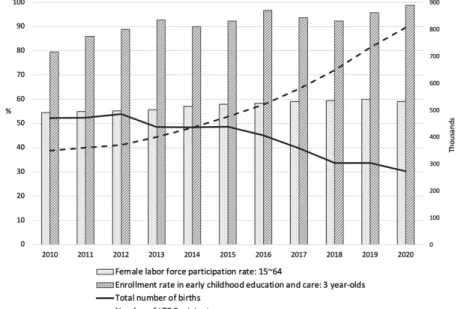
By 2060, Korea's population aged 65 and over is predicted to exceed 80 percent of the working-age population [OECD 2020]. Over the last decade, its population of older adults aged 80 and over has more than doubled. Alongside Korea’s rapid population aging, the total fertility rate (TFR), i.e., the number of children born to a typical woman over her lifetime, has consistently declined since 1960, reaching a record low of 0.84 births per woman in 2020,3 with the total number of 272,337 births compared to 444,849 in 2010 (Figure 2). These demographic shifts have raised significant economic and social concerns about the country’s future labor supply, pensions, economic growth, and social reproduction. There has also been a steady increase in women's labor force participation, and rising living standards over the last few decades have increased demand for quality care services, such as enriched and educationally focused childcare and quality eldercare services.
Now, the government is expected to provide affordable and quality eldercare.
According to the 2002-2018 national social statistics survey, only 27 percent of Koreans agreed that the family should be solely responsible for caring for older adult family members in need of assistance [Kim 2019].
In recent years, the Korean government has made significant investments in improving care provisioning for children and older adults who need assistance with daily living. The universal childcare system, which includes daycare, nursery schools, and after-school programs, was further expanded in 2018 with the establishment of a cooperative childcare program rooted in the traditional Korean concept of poom-asi—taking care of children in neighborhoods in Korean society [Ministry of Gender Equality and Family 2012]. The long-term care insurance (LTCI) system has also been improved, with an increase in the number of in- home care services and a reduction in waiting times. In 2018, Korea's Ministry of Health and Welfare released a community care plan, focusing on customized care services in local communities [Ministry of Health and Welfare 2020a].
3 In 2020, South Korea’s population declined for the first time, with the number of births down 10 percent from 2019 [Lee 2021]. In 2021, Korea's TFR dropped even further to 0.81; the global average fertility rate is 2.4, while the OECD average is 1.61 [OECD 2023a].
The plan is being piloted in 16 local governments from 2019 to 2022 [Ministry of Health and Welfare 2020b].
The Korean government’s effort to expand and improve the country’s care infrastructure is apparent in the steady increase of the country’s Early Childhood Education enrollment rate and the rising number of long-term care (LTC) recipients (See Figure 2). This is also reflected in the growth of the LTC workforce, serving individuals that need assistance with daily living activities due to physical, cognitive, or functional impairments. The number of formal LTC workers doubled between 2010 to 2020, from 178,223 to 366,261.4
However, the working conditions for care workers in South Korea remain challenging and stressful. Care workers often have to manage complex tasks and relationships with care recipients, while facing low pay and job insecurity, long hours, and other challenges such as long commutes (Peng et al. [2020]; Suh [2020]; Kim et al. [2022]). As for family members who provide care, despite the expansion of government support and the rapid growth of the private care sector, their workload continues to be heavy [Cha et al. 2022].
Recent studies indicate that family caregivers view caregiving as a burden and experience with significant opportunity costs [Moon and Cha 2020]. As in other countries, the primary family caregivers in Korea are typically women who continue to bear a large share of the total care work, even with the utilization of paid care services (Choi et al. [2014]; Lee et al. [2015]; Song [2016]; Chung [2018]; Cha et al. [2022]). Before the COVID-19 pandemic, family members provided 48.3 percent of total childcare in South Korea [KICCE 2018]; more than a third of women in their 30s and 40s reported having to carry a double burden of care, that is, taking care of both their children and their older parent(s) in need [Song 2014]. Cultural practices, a work culture that involves long hours spent in jobs, and socially ascribed gender norms that expect mothers, daughters, and daughters-in-law to provide care for their children, older parents, and parents-in- law continue to persist.
The most cited reason, however, for the continued heavy reliance on family caregiving relates to the affordability and quality of paid care services (Kim and Jeong [2006]; Sung [2018]; Choi and Kim [2013]; Lee [2018]; Song [2014]).
Persistent concerns about neglect and abuse by care workers, including daycare teachers and yoyangbohosas,5 led to the implementation of monitoring protocols using surveillance cameras. However, it is still being determined if such protocols have led to higher usage rates of paid care services.
The heavy unpaid care workload on women has hindered Korea’s progress toward achieving gender equality. Women returning from career breaks from
4 Long-Term Care Resources and Utilization, Formal LTC workers (Headcounts), Health theme data, from OECD [2023b].
5 The term yoyangbohosa is a newly defined job category in South Korea that refers to certified care workers in both homes and institutions.
childbirth or childcare often re-enter the labor market as non-regular workers with low-paying jobs. The gender wage gap continues to be one of the largest among OECD countries, at 31.5 percent in 2020 compared to the OECD average of 12.5 percent (in 2019) [OECD 2023c]. Additionally, women’s labor force participation rate has also stagnated, hovering between 55 percent to 59 percent over the last decade (2010–2020).
These trends are puzzling in a country where paid care services have been made widely available in recent years through government policies. That, in theory, should have reduced the unpaid care workload of women. This expectation has yet to materialize, however, due to serious concerns regarding the quality of paid care services available, which make families reluctant to substitute unpaid care with those purchased in the care market (Kim and Jeong [2006]; Sung [2018];
Choi and Kim [2013]; Lee [2018]; Song [2014]).
As the review of the literature in the previous section shows, existing studies on the quality of paid care services have examined several measurable factors, such as standards and regulations, care workers’ training and education, and working conditions, while focusing on their potential impact on the quality of care delivered. The care worker’s sense of responsibility for the recipient in their care, a pertinent ingredient in quality care provisioning, has received little attention in empirical studies involving childcare and eldercare.
FIGURE 2. Demographic and workforce trends in the context of Korea’s Early Childhood Education (ECE) and Long-Term Care Insurance (LTCI) systems
Sources: Statistics Korea [2023a]; OECD [2023]; Statistics Korea [2023b]; National Health Insurance Corporation [2023]
Our case study focuses on this less-studied aspect of quality care. We examine the extent to which this is associated with their working conditions, such as job security, work schedule predictability, and adequacy of training, while taking into account the care worker’s demographic characteristics, geographical context, the intensity of care work, and ease in dealing with the recipient’s family.
4.2. Empirical analysis 4.2.1. Data description
Our analysis uses the 2018 Care Work and the Economy survey data collected by Gallup Korea. The sample consists of 300 eldercare workers and 300 childcare workers in public and private care institutions across South Korea, including Seoul/Metropolitan Area (Seoul, Incheon, Gyeonggi-do, and Gangwon-do), Chungcheong Area (Daejeon, Sejong, Chungbuk, and Chungnam), Honam Area (Gwangju, Jeonbuk, and Jeonnam), Gyeongbuk Area (Daegu and Gyeongbuk), and Gyeongnam Area (Busan, Ulsan, and Gyeongnam). The sampling design of childcare and eldercare workers took into account the stratification by geographical region and occupational categories (institutional worker, home-based worker, or informal worker) [Jun et al. 2021].6 To make the samples representative of the childcare and long-term care workers population in South Korea, we constructed inverse sampling probability weights using care workers' data by geographical region and type of care arrangement using information from the 2017 Day Care Centre Statistics Yearbook [National Statistics Office 2017] and the 2017 Long- Term Care Insurance Statistical Yearbook [National Health Insurance Corporation 2017].7 Annex 1 describes the methodology for constructing the sampling weights.
Responses to the survey question “How much responsibility do you feel for the health and safety of your care recipient(s)?” is used as our measure of expressed commitment or sense of responsibility by the care worker. There are some caveats about the survey data that are worth mentioning. First, the primary variable of interest is based on the respondent’s self-report response, bounded between zero percent (not my responsibility at all) and 100 percent (entirely my responsibility).
Moreover, the data is cross-sectional; hence, we cannot evaluate the direction of change over time.
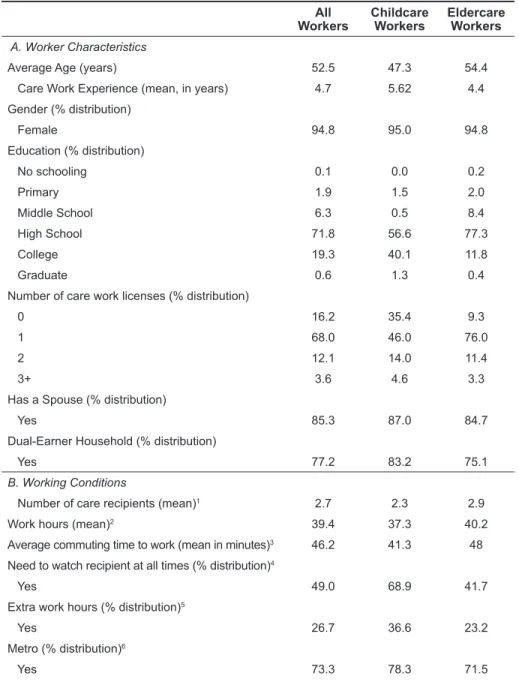
Table 1 provides the characteristics and working conditions of the care workers in our sample. Reflecting the dominance of women in Korea’s paid care sector, a vast majority (95 percent) of the respondents are women, with eldercare
6 Eldercare workers in institutional facilities work in nursing homes and daycare centers, excluding hospitals. Home-based eldercare workers work in the older person’s home and are funded by National LTCI. In contrast, informal eldercare workers are hired by families or older people without written or formal contracts, e.g., live-in carers. Institutional childcare workers are employed in public, private, or corporate daycare centers. Home-based childcare workers are hired through agencies, while families hire informal childcare workers without formal contracts, e.g., informal babysitters.
7 For informal workers, the regional informal worker population was estimated using the informal sector share of GDP. See Annex 1 for details.
workers being older on average (54.4 years) compared to childcare workers (47.3 years). Most of the care workers completed at least high school education (71.8 percent), live with a spouse (85.3 percent), and are in dual-earning households (77.2 percent). The majority work in a metropolitan area (73.3 percent), and about half (50.4 percent) are regular or contract employees with a signed contract.
TABLE 1. Characteristics and working conditions of care workers, by type of worker
WorkersAll Childcare
Workers Eldercare Workers A. Worker Characteristics
Average Age (years) 52.5 47.3 54.4
Care Work Experience (mean, in years) 4.7 5.62 4.4
Gender (% distribution)
Female 94.8 95.0 94.8
Education (% distribution)
No schooling 0.1 0.0 0.2
Primary 1.9 1.5 2.0
Middle School 6.3 0.5 8.4
High School 71.8 56.6 77.3
College 19.3 40.1 11.8
Graduate 0.6 1.3 0.4
Number of care work licenses (% distribution)
0 16.2 35.4 9.3
1 68.0 46.0 76.0
2 12.1 14.0 11.4
3+ 3.6 4.6 3.3
Has a Spouse (% distribution)
Yes 85.3 87.0 84.7
Dual-Earner Household (% distribution)
Yes 77.2 83.2 75.1
B. Working Conditions
Number of care recipients (mean)1 2.7 2.3 2.9
Work hours (mean)2 39.4 37.3 40.2
Average commuting time to work (mean in minutes)3 46.2 41.3 48 Need to watch recipient at all times (% distribution)4
Yes 49.0 68.9 41.7
Extra work hours (% distribution)5
Yes 26.7 36.6 23.2
Metro (% distribution)6
Yes 73.3 78.3 71.5
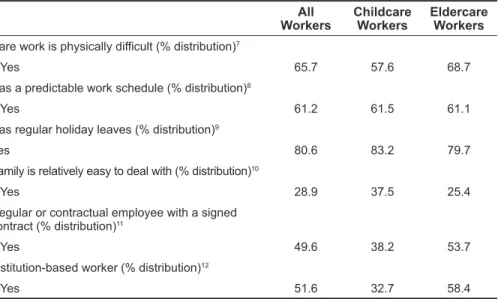
TABLE 1. Characteristics and working conditions of care workers (continued) WorkersAll Childcare
Workers Eldercare Workers Care work is physically difficult (% distribution)7
Yes 65.7 57.6 68.7
Has a predictable work schedule (% distribution)8
Yes 61.2 61.5 61.1
Has regular holiday leaves (% distribution)9
Yes 80.6 83.2 79.7
Family is relatively easy to deal with (% distribution)10
Yes 28.9 37.5 25.4
Regular or contractual employee with a signed contract (% distribution)11
Yes 49.6 38.2 53.7
Institution-based worker (% distribution)12
Yes 51.6 32.7 58.4
Note: Calculated using the 2018 CWE-GAM Korean Childcare and Eldercare Workers Survey data based on respondent’s answer to the following survey questions:
1. How many care recipients have you taken care of over the past week?
2. Over the past month, how many hours per day did you do care work on average? (Sum of weekday and weekend hours)
3. How much time does it take to commute to work from your home on average?
4. I need to watch my care recipient at all times (agree/strongly agree =1, yes) 5. I work more hours than the standard number of hours (agree/strongly agree=1, yes)
6. Opening survey question completed by survey investigator on the location of care work provided.
7. In general, how much physical difficulty do you have taking care of the child or elderly person?
(Slightly/very difficult=1, yes)
8. There are times when my work schedule gets cancelled without notice (strongly /somewhat disagree=1, yes)
9. I can apply for holidays when I want to (strongly/somewhat agree=1, yes)
10. It is very difficult to deal with the care recipient’s family members (strongly/somewhat disagree=1, yes)
11. What type of employment do you have at your current workplace (regular employee or contract up to 2 years), and have you signed an official written labor contract related to your current care work (yes or don’t know)?
12. Main workplace (Work at an institution or care center)
Childcare workers, on average, have a higher percentage of college degree holders (40.1 percent) compared to eldercare workers (11.8 percent). About 65 percent of childcare workers and 91 percent of eldercare workers work with at least one professional license in terms of work experience; childcare workers have more years of care work experience on average (5.6 years) compared to eldercare workers (4.4 years). Most eldercare workers (58.4 percent) are institution-based and spend more time commuting to work, whereas childcare workers are more likely to work in the care recipient’s home.
On average, the care worker respondents in our sample care for two to three recipients, work about 40 hours a week, and spend roughly 46 minutes commuting daily. Compared to childcare workers, eldercare workers tend to care for more recipients and work more hours per week. About a quarter (26 percent) of the
sample reported working more hours than the original employment agreement stated. Nearly 40 percent reported having an unpredictable work schedule. More than half of the paid care workers face job insecurity (i.e., they don’t have a signed labor contract or regular employment) and lack work schedule predictability.
Less than one-third of respondents agreed that it is relatively easy to deal with the recipient’s family, which we use as a proxy for the relationship with the recipient’s family.
In terms of care work intensity, about half (49 percent) of the paid care workers reported that their care recipient requires constant supervision (i.e., the recipient needs to be “watched at all times”) during working hours. This is more pronounced among childcare workers (68.9 percent) than among eldercare workers (41.7 percent). More than a quarter of care workers responded that they worked more than the standard 40 hours; nearly two in three responded that care work is physically difficult. These findings suggest that care work is intense and challenging for a significant portion of the workforce, with some notable differences between eldercare and childcare.
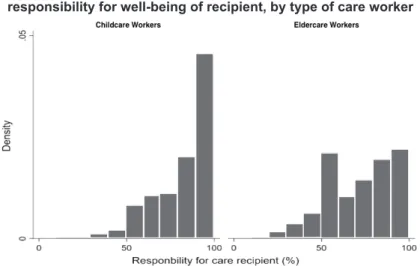
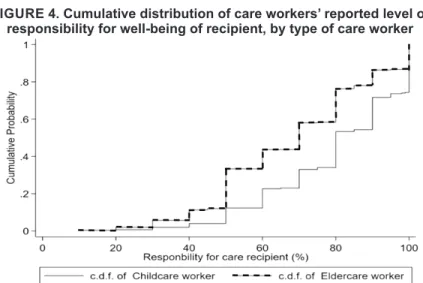
The frequency and cumulative distributions of our main variable of interest, i.e., level of expressed commitment or sense of responsibility of the care workers, are given in Figures 3 and 4, respectively, and ranges in value from zero percent (not my responsibility at all) to 100 percent (entirely my responsibility). Overall, the mean percentage level of responsibility reported by the respondents is 71.6 percent. Childcare workers tend to report a higher level of responsibility (79.5 percent on average), compared to eldercare workers (68.7 percent on average), as shown in Table 2.
FIGURE 3. Frequency distribution of care worker’s reported level of responsibility for well-being of recipient, by type of care worker
Sources: Care Work and the Economy Project Field Work Data [2021a]; Care Work and the Economy Project Field Work Data [2021b].
TABLE 2. Average care workers’ reported level of responsibility for care recipient, by type of worker (in percent)
Responsibility for Care Recipient Mean Std. Dev
All Workers 71.60 20.60
Childcare Workers 79.50 17.30
Eldercare Workers 68.70 21.00
Note: Statistics are based on 2018 CWE-GAM Korean Childcare and Eldercare Worker Survey respondent’s answer to the following question: “How much responsibility do you feel for the health and safety of your care recipient(s)?” The responses ranged between zero percent (not my responsibility at all) and 100 percent (entirely my responsibility).
4.2.2. Methodology
An underlying argument of this paper is that the commitment or sense of responsibility exhibited by a care worker constitutes a crucial element in providing quality care services. This commitment is influenced by the realities of the care worker's working conditions, as well as by intrinsic characteristics of the care worker, such as patience and consciousness, for which we do not have direct measures. In this section, we test the hypothesis that better working conditions are associated with a higher level of expressed commitment toward the recipient's well-being. We use the following indicators for working conditions, including work schedule stability, job security, which is proxied by a dummy variable indicating regular employment status or having either a labor contract for up to two years or a signed written agreement, and adequacy of training, proxied by a
FIGURE 4. Cumulative distribution of care workers’ reported level of responsibility for well-being of recipient, by type of care worker
Sources: Care Work and the Economy Project Field Work Data [2021a]; Care Work and the Economy Project Field Work Data [2021b].
dummy indicating if a worker lacks adequate training. We also consider the care worker’s commute time based on care workers’ concern regarding long commutes to and from their place of work.8
Since our dependent variable, a care worker’s sense of responsibility, is bounded between zero percent and 100 percent, we use two estimation methods that can accommodate this censoring of the data. We use Tobit regression and the censored Generalized Maximum Entropy proposed by Golan et al. [1997].9 For the Tobit model, we assume that the observed dependent variable,
That is, our observed values yi are bounded between zero and one for the underlying latent variable yi* where yi* which is the level of responsibility the care recipient would theoretically “choose” if the response was not bounded between zero percent and 100 percent). We then estimate the model using a maximum likelihood (ML) approach.
Given the small sample size, we also conduct an entropy-based econometric analysis. This method is deemed appropriate because it does not require restrictive assumptions on the distribution of the error terms, unlike conventional linear regression models, and is a more efficient estimator than the ML estimator.
Specifically, it draws inferences from limited or small data using the available observed information to yield a non-uniform distribution with minimal assumptions that is consistent with the observed sample moments [Golan 2007].
In this study, we follow the generalized maximum entropy (GME) approach by Golan et al. [1997]. The entropy of a probability distribution p̃ is given by:
H(p̃) = −∑(pi logpi ) (2) where 0⋅log 0≝0. We seek to maximize this objective function (the entropy) subject to constraints including the constraint (∑i pi = 1). The probability distribution is over the vector of parameter estimates β. For each parameter estimate βk, we propose a support [–βk ,βnk] centered on zero. We then maximize the entropy subject to the data and the added constraint that
8 Based on one of the authors’ field interviews with and roundtable presentations by representatives from Seoul Supporting Center for Eldercare Workers, Childcare Workers Chapter of the Korean Confederation of Trade Unions, Seoul LTC Care Workers Association, and Korean Domestic Workers’ Association, at the International Conference on Empowerment of Care Workers: Issues and Challenges, Seoul National University, Seoul, February 25, 2019. See Moon et al. [2021] for qualitative methodology and survey instruments used in the Care Work and the Economy project’s fieldwork in South Korea.
9 See Annex 2 for further discussion of Generalized Maximum Entropy.
0 if yi* < 0 yi* if 0 < y t* ≤ 1 1 if yi* > 1
{
yi = (1)
0 if yi* ≤ 0 1 if yi* ≥ 1
{
yi = (3)
In addition to the proxy variables and indicators for working conditions, we include the following variables of interest, namely, commute time and care work intensity as proxied by a) whether the recipient requires constant supervision, b) the number of recipients currently being cared for, and c) regular occurrence of working extra hours. Controls for selected worker i characteristics, such as life cycle (age and age-squared), experience proxied by the number of years since the start of care service employment, years of education, whether the worker resides in a metro area, and if the worker has a spouse, are included along with job characteristics such as whether performing eldercare or childcare and the ease in dealing with care recipient’s family.
The basic model is expressed as:
Yi = β0 + β1 Agei + β2 Agei2 + β3 Educi + β4 Experiencei + β5 Spousei + β6 Metroi + β8 Eldercarei + β9 ExtraHoursi + β10 NumRecipientsi + β11 NeedsConstantWatchi + β12 CommuteTimei + β13 StableSchedi +
β14 FamilyRelationi + β15 SecureJobi + β16 InadequateTrainingi + ϵi (4) where Yi is the observed (reported) level of responsibility, Agei is the care worker’s age, Educi is the worker’s years of education, Experiencei is the worker’s years of experience in providing care work (calculated from the survey question: “years since care work first started”), Spousei is a dummy variable for whether the care worker has a spouse, Metroi is a dummy variable for whether care work is performed in a metro area, Eldercarei dummy indicates whether the worker is providing eldercare (as opposed to childcare), ExtraHoursi dummy indicates whether or not the care worker regularly works extra hours more than was originally agreed to (self-reported), NumRecipientsi refers to the number of care recipients being cared for, NeedsConstantWatchi dummy indicates whether the recipient needs to be watched at all times (i.e., care worker response's is
“agree” or “strongly agree”), CommuteTimei refers to weekly average commute time, StableSchedi dummy indicates whether the care worker has a predictable (or stable) work schedule (self-reported), FamilyRelationi is a dummy variable on whether the care worker reports that it is easy to deal with recipient’s family members, InadequateTrainingi dummy indicates if the worker lacks adequate training, SecureJobi dummy indicates whether the worker is a regular (full-time) employee, a contract worker with up to two-year labor contract or a dispatched employee with a signed written agreement, and ϵi is the random error term.
4.2.3. Results and discussion
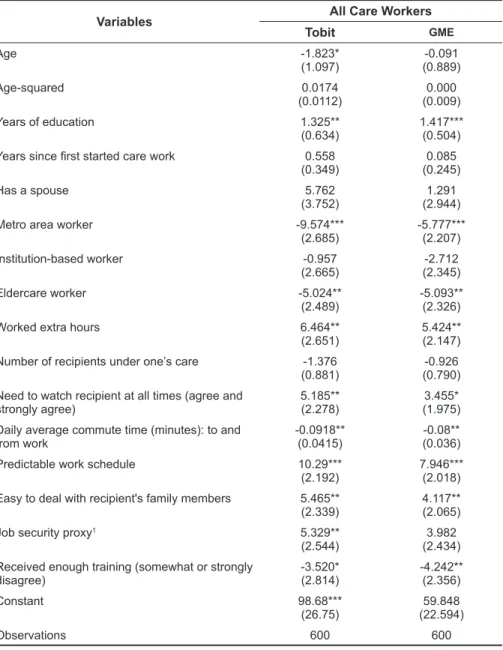
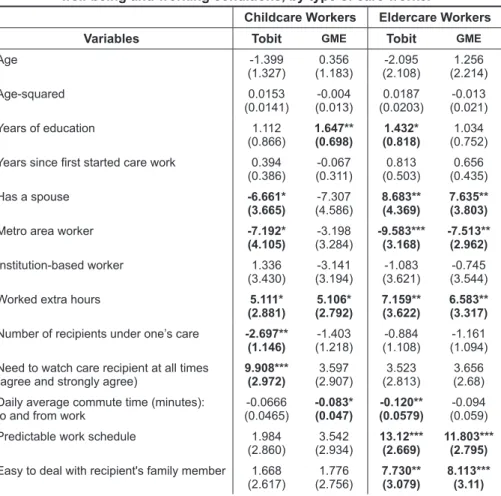
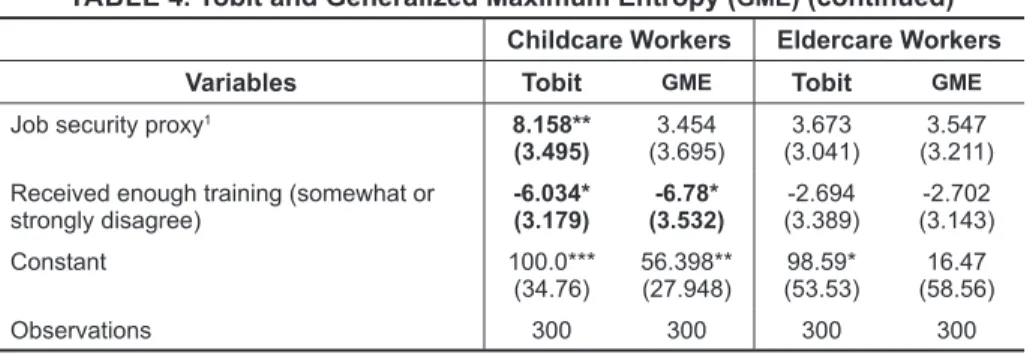
The results of both Tobit and GME models using the entire sample (both eldercare and childcare workers) are reported in Table 3. The standard errors of the estimates of the latter are smaller since the GME estimators are more efficient.
Our results are consistent for both regression analyses; however, we focus our discussion on the GME results.
TABLE 3. Tobit and Generalized Maximum Entropy (GME) regression estimates: association between care worker’s level of responsibility for
recipient’s well-being and working conditions, by type of worker
Variables All Care Workers
Tobit GME
Age -1.823*
(1.097) -0.091
(0.889)
Age-squared 0.0174
(0.0112) 0.000
(0.009)
Years of education 1.325**
(0.634) 1.417***
(0.504)
Years since first started care work 0.558
(0.349) 0.085
(0.245)
Has a spouse 5.762
(3.752) 1.291
(2.944)
Metro area worker -9.574***
(2.685) -5.777***
(2.207)
Institution-based worker -0.957
(2.665) -2.712
(2.345)
Eldercare worker -5.024**
(2.489) -5.093**
(2.326)
Worked extra hours 6.464**
(2.651) 5.424**
(2.147) Number of recipients under one’s care -1.376
(0.881) -0.926
(0.790) Need to watch recipient at all times (agree and
strongly agree) 5.185**
(2.278) 3.455*
(1.975) Daily average commute time (minutes): to and
from work -0.0918**
(0.0415) -0.08**
(0.036)
Predictable work schedule 10.29***
(2.192) 7.946***
(2.018) Easy to deal with recipient's family members 5.465**
(2.339) 4.117**
(2.065)
Job security proxy1 5.329**
(2.544) 3.982
(2.434) Received enough training (somewhat or strongly
disagree) -3.520*
(2.814) -4.242**
(2.356)
Constant 98.68***
(26.75) 59.848
(22.594)
Observations 600 600
1 Dummy variable for worker who is a regular employee, with a signed contract up to two years or a dispatched employee with a signed labor contract.
Robust standard errors in parentheses.
*** p<0.01, ** p<0.05, * p<0.1
Several of the working conditions variables examined are statistically significant. A predictable work schedule is associated with a 7.9 percentage point increase at one percent level of statistical significance in the reported level of commitment towards the safety and well-being of the care recipient, while a lack of adequate training leads to a 4.24 percentage point decline at five percent level of statistical significance. The ease in dealing with the recipients’ family is associated with a 4.1 percentage point increase at a five percent level. This indicates the importance of maintaining a predictable work schedule that helps avoid sudden and unanticipated changes in the care worker’s schedule. Adequate training is also paramount in reducing accidents and building the worker’s confidence in dealing with emergencies. The results also imply that relationships with the recipient’s guardians (parents or children) can affect the care worker’s level of commitment.
Table 3 results also show that longer commute times are associated with lower reported levels of commitment; that is, an increase in commute time is associated with an 0.08 percentage point decrease in the respondent’s sense of responsibility.
These results give support to the Korean care workers’ associations’ concern about the lack of travel allowance that compels workers to use the cheapest, albeit longer, means of travel to their workplace and about their need for adequate training.
Interestingly, working more than the standardized 40 hours a week is associated with a 5.4 percentage point increase in the worker’s sense of responsibility, while constant supervision (i.e., the need to watch the care recipient at all times) is associated with a 3.4 percentage point increase. We acknowledge that the relationship between the worker’s sense of responsibility (the dependent variable) and these care work intensity indicators may be bi-directional. On the one hand, as workers attempt to meet the intense caregiving needed by the recipient, their sense of commitment also increases. At the same time, workers who feel a strong sense of responsibility for recipients may self-select into or stay in positions where the recipient requires constant supervision.
Table 3 results suggest that higher education may positively influence workers' sense of responsibility, with an additional year of schooling correlating with a 1.4 percentage point increase (significant at the one percent level). Conversely, living in a metropolitan area is associated with a 5.8 percentage point decrease (significant at the one percent level). This may, in part, reflect the regional differences in educational attainment, professional training, and working conditions and confirm the findings of other studies. For instance, Kim and Kim [2017] found that care workers in urban areas face poorer work conditions than rural areas in Korea, especially those caring for older adults.
Another possible explanation is the market density effect, i.e., there are more job opportunities and competition among care workers in urban areas compared to rural areas, where opportunities tend to depend on kinship and community networks.
Overall, performing eldercare is associated with a lower sense of responsibility