BIBLIOGRAPHY
ESCO, HEIDI T. April 2009. Production and Marketing Practices of Organic Lettuce Producers in Tublay, Benguet.
Adviser: Jovita M. Sim, MSc
Benguet State University, La Trinidad, Benguet.
ABSTRACT
This study was conducted to find out the organic production and marketing practices on organic lettuce in Tublay, Benguet.
The respondents were nine organic practitioners who were members of the La Trinidad Organic Practitioners Multipurpose Cooperative (LaTOP-MPC) and the Association of Tublay Organic Practitioners (ATOP). This study was conducted in December 2008. Data/information were gathered through personal interview guided with the questionnaire.
Organic farming is the major source of income of the respondent, other sources of income include employment and weaving. All the respondents have attended formal education. Reasons for going into organic farming include, health conscious both for the farmer and consumers, awareness on the negative effects of chemical farming to the environment and the high price of inorganic fertilizers. All the farmers do not utilize all the farms for organic production because of the limited market for organic products.
The market outlet of the respondents is the association where its main stall is located in La Trinidad Public Market which has 2 outlets in Baguio City. The ATOP sell their product in an open market in the University of Cordillera in Baguio City. Each
member had a schedule of delivery and are assigned a quota on volume to be delivered to the association. The products were packed in plastic and labeled with the name of association, name of farmer and farm, address of the farm and the star label.
All the respondents used compost as fertilizer, practice intercropping of repellant plants and crop rotation to control pest and diseases. All employ manual picking of insects instead of chemical control. Source of irrigation is from spring.
Production and marketing problems include: high cost pf certification for organic products, lack of capital for greenhouse production, pest and diseases, limited market outlet and lack of awareness of consumers about value and benefits from organic products.
It is therefore recommended that technical researchers should look into the organic control of pest and diseases, and the government support in technical and financial, and promotion of organic products to increase or create market for organic products.
TABLE OF CONTENTS
Page
Bibliography . . . ….. . . i
Abstract . . . ……… . . . i
Table of Contents . . . . . . iii
INTRODUCTION . . . 1
Background of the Study . . . 1
Statement of the Problem . . . 2
Objectives of the Study . . . 2
Importance of the Study . . . 2
Scope and Delimitation of the Study . . . 3
REVIEW OF LITERATURE . . . 4
Description of Lettuces . . . 4
Climatic and soil Adaptation of Lettuce . . . 5
Importance of Lettuce . . . 5
Benefits of Growing Organic Products . . . 6
Source of Organic Materials for Organic Farming . . . 6
Effects of Organic Fertilizers . . . 7
METHODOLOGY . . . 9
Locale and Time of the Study . . . 9
Respondents of the Study . . . 9
Research Methods and Instrument . . . 9
Data Analysis . . . 9
RESULTS AND DISCUSSION . . . 10
Distribution of Respondents as to Study Area . . . 10
Profile of the Respondents . . . 10
Reasons for Practicing Organic Farming . . . 14
Trainings Attended Related to Organic . . . 15
Demographic Profile of the Farm Area . . . 15
Size of Farm Devoted to Organic Production . . . 18
Source of Planting Materials . . . 19
Other Crops Planted . . . 19
Fertilization Practices . . . 20
Pest and Disease Control Measures . . . . . . 21
Problems Encountered in Organic Production . . . 21
Marketing Practices . . . 24
Marketing Problems . . . 25
SUMMARY, CONCLUSION AND RECOMMENDATION . . . 27
Summary . . . 27
Conclusion . . . 28
Recommendation . . . 29
LITERATURE CITED . . . . . . 30
INTRODUCTION
Background of the Study
Lettuce belong to the Compositae (sunflower or daisy family), Lactuca sativa. It is an annual plant native to the Mediterranean area. Cultivation may have started as early as 4500 BC, perhaps initially for the edible oil extracted from the seed. Salad was popular with Ancient Greeks and Romans. Cultivated lettuce was probably derived from the so called wild or prickly, lettuce serriola. The primitive forms of lettuce were loose and leafy. Firm heading forms become well developed in Europe by the 16th century.
Oak leaves and curled-leaf types of various colors were described in the 16th and 17th centuries in Europe.
Lettuce is considered as one of the important salad crops in the Philippines. It grows in places like that of Benguet where temperature is generally low and climate is distinctly cool. It is easily affected by high temperature, so carefully managed with respect to the vegetative growth is essential for the attainment of satisfactory growth, development and head-yield. Besides temperature, this crop is much affected by the cultural practices, affecting growth and yield with the application of organic vegetable (Jerry, 2002).
Lettuce is one of the most common salad vegetable crop being produced in the highlands of the Cordillera Administrative Region (CAR), which command high price not only in the local but also in the national markets (Estero, 2007). As reported by Kudan (1999), 293 hectares was planted to lettuce in 1994 producing 2,995.50 metric tons (BAS, 1999).
2
Currently, lettuce is one the most important crop grown organically, not only in the Cordillera but also in other areas where temperature is cooler. This crop is usually eaten raw as fresh salad and garnishing, thus is advised and very important to be grown organically. Thus, this study will document the practices of growing lettuce organically.
1. What are the production and marketing of organic lettuce?
Statement of the Problem
The study aimed to answer the following questions:
2. What are the reasons of farmers in producing organic lettuce?
3. What are the production and marketing problem of farmers?
1. Find out the production and marketing practices of organic lettuce production in Benguet;
Objectives of the Study
The study was conducted to:
2. Find out the reasons of planting organic lettuce;
3. Determine the marketing and production problems in organic lettuce production;
4. Determine the perceived solution of the production and marketing problems in organic lettuce production.
Information gathered in this study can be used as basis for planners in developing program related to organic lettuce and other organic vegetable production. This will also serve as a guide/basis for technical researchers in developing technologies for organic Importance of the Study
3
Scope and Delimitation of the Study
This study is limited with the documentation on organic lettuce production and marketing in Benguet.
REVIEW OF LITERATURE
Description of Lettuce
Tredjen (1964), as cited by Estero (2007) stated that lettuce, Lactuca sativa L., is a smooth annual plant of the family compositae, and is extensively cultivated for the tender leaves used as salads. Lettuce is grown on well lime soil of sandy textures that permits access to oxygen.
Historically, Watts (1922) presents the following classification and description of the various types of lettuce recognized by most seedmen and horticultural writers namely the romaine, distinguished by their hard crisp textures, while the crisp varieties are coarser veined and bigger ribbed than the butter sorts but more so than the romaine varieties. Their boarders are also developed than the other parts of the leaf and the cotyledons of the butter sorts. On account of their much developed borders they are sometimes called dried lettuce.
On the other hand, Knott (1970) enumerated four types of cultivated lettuce;
asparagus lettuce with narrow leaves and a thick, succulent edible stem, head or curled lettuce, with the leaves foiled into compact head, leaf or curled lettuce, with a rosette of leaves that are curled, finely cut, smooth edged or oak leaves in shape, and cas or romaine with smooth leaves that form a full oblong, loose head. Horticultural varieties differ in seasonal adaptability and disease resistance. Average monthly temperature from 14oC to 16oC promote good quality, firmness. In heading varieties, stocky growth in the loose leaved types. For successful cultivation, lettuce requires ample water especially during warmer weather.
5
Climatic and Soil Adaptation of Lettuce
Kudan (1999), reported that lettuce prefer a mist moist well-drained soil type, rich in organic matter, sandy loam or loam with pH ranging from 6.5 to 7.5.
Erickson (1996), reported that most kind of lettuce grows well in temperature between 70oF (21oC) and 75oF (29oC). Some varieties that were developed for gardeners thrive just below 80oF (27oC). In the Northern United States, commercial growers plant lettuce in spring for harvest during summer. Growers in South Western States plant in fall or winter for harvest during the spring. Moreover, Kudan (1999), mentioned that the optimum high temperature for lettuce is 10oC to 15oC . With a temperature of 15 to 20oC lettuce is classified as cool seasonal crop. If the temperature is higher than 20oC, head lettuce will not form firm head.
Importance of Lettuce
Lettuce is consumed as a salad due to its nutritive value, it contributes to the dietary needs of man. It is an excellent source of vitamin A and C and helps in neutralizing body acidity and in promoting good blood circulation (Buhay and Lizardo, 1979). It was pointed by Purseglove (1982) that lettuce leaves contain about 94.3%
water, 1.2% protein, 0.2% fat, 2.8% carbohydrates, and 0.7% fiber. Anon (1980), added that as its nutritional value per 100g lettuce, contains 9.5% water. 13 calories for energy, 0.9g protein, 0.1g fat, 2.9g total carbohydrates, 0.5mg iron, 9 mg sodium, 175mg potassium, 320 IU vitamin A, 0.06 mg thiamin and riboflavin, 0.3mg niacin and 6mg ascorbic acid.
6
Benefits of Growing Organic Products
Organically produced crops and other products have been proven to contain higher percentage of nutrients have no pesticide residue, generally taste better and have positive benefits on the environment (Frank, 2006). Benefits of eating organically grown vegetables are evident. Their greatest strength lies in minerals and vitamin content. The nutritional values of organic vegetables are also good source of protein and minerals. It contain most of the elements needed for human diet in small and large quantities are vitamin C, K, P (Pro vitamin A) and as well as B vitamin. In the case of organic vegetables grown in the Cordillera Region, it was found out that the produce are not only tastier but have nutritional value higher than conventionally grown vegetables (Almante, 2006).
Source of Organic Materials for Organic Farming
Bucu (1991) as cited by Caaya (2007) stated that in general the kinds of organic material according to source are crop residues, green manure, swine manure, cattle manure, chicken manure, common compost, used mushroom compost, municipal refuse residues after oil extraction and residues from processing animal products.
Sacla (2002) reported that organic fertilizer include guano, are substance that is found in some coast or island frequented by sea fowl. Guano contain about 12%
nitrogen, and 12% phosphorous pentoxide (P2O5), dried blood and bone meals (contain from 12 to 14%), animal tankage (slaughter house refuge); and meat and bone meals (contain from 6 to 10% nitrogen and from 10-18% of P2O5) and bone meals and flouks (contain from 1 to 4% nitrogen and from 22 to 28% P2O5)
7
The organic manures are bulkier than the organic fertilizers and contain relatively lower amount of plant nutrients. The best known of organic manure is farm manure, the excrement of livestock together with the straw or another bedding material. The composition of farm manure depends on the type of animals that produced it and how they were kept and fed.. Usually, a ton of manure from cattle, horses or hogs is need to supply about 4.5 kg N, 2.2 kg P2O5 and 4.4 kg K2O. Chicken manure which are dried and richer, supply about three times as much nitrogen and P2O5 per ton as other manure but only about the same amount of K2O. Organic manures also contain micronutrients, and an application of 10 tons/0.4 may supply enough boron, copper, iron, molybdenum, manganese and zinc for several crops planted in successions where organic manure are used regularly, micronutrients deficiencies are rare and the organic matter of the soil increases.
Sewage sludge and other urban wastes are often proposed as organic manure, usually to aid in their disposal. Sludge generally contain from 12 to 20% nitrogen and P2O5 and even less K2O7, but especially treated sludge are richer and more useful to crops. The dust and pulverized refuge from cities are poorer in nitrogen and phosphorous and are little values as manures (Dremann, 1987).
Increase the vigor and insect resistance of the plant. The sap of the plant fertilized with organic matter is also more bactericidal than plants not fertilized with organic matter Effects of Organic Fertilizers
Crop fertilized with organic matter have greater resistance to pest and diseases.
The humus acid and growth substances are absorbs into plant tissue through the roots and that they favor the formation of proteins by influencing the synthesis of enzymes that will
8
(Abadilla, 1982). In addition, organic manure contains essential plant nutrients especially nitrogen, phosphorous and potassium as well as trace elements not generally found in chemical fertilizer (Jones, 1982).
Kinoshita (1972) as cited by Sacla (2007) stated reported that organic fertilizers such as plant compost, stable manure, fermented night soil, chicken dropping and green manure containing mainly nitrogen tend to improve the physical and chemical properties of the soil. Organic residues also make the soil more porous by enhancing soil granulated that binds or tightens and expand soil aggregates.
Similarly, PCARRD (1979) as cited by Calpo (2000) pointed out that organic matter improves soil structure, thus increasing the capacity of the soil to hold water and provide aeration. They stimulate the microorganisms decomposing residues and aid in the extraction of plant nutrients from minerals in the soil.
Bautista (1983) cited several functions of organic matter in the soil by forming complexes with the nutrient elements, organic matter prevents loss of nutrients , it facilitates entrance and percolation of water into and through the soil, it improves the penetration of roots through the soil, good structure brought about by its decomposition, organic matter also contributes nutrient elements, thus favoring the high yield and growth of plants.
METHODOLGY
Locale and Time of the Study
The study was conducted in Barangay Ambassador and Caponga in Tublay, Benguet, from October to December, 2008.
Respondents of the Study
The respondents of the study were purposively selected from the list members of the La Trinidad Organic Practitioners (LaTOP), other organic producers organization and individual farmers who are engaged in organic lettuce production.
Research Methods and Instrument
The study made use of secondary and primary data. Respondents were interviewed by the researcher. A questionnaire was used as a guide in interviewing the respondents. Secondary data such the list of organic producers and area cultivated were gathered from the Department of Agriculture (provincial and municipal offices) and records of organic producer organization.
Data Analysis
The data was analyzed and presented using descriptive analysis such as frequency counts, percentages and appropriate statistical tools.
RESULTS AND DISCUSSION
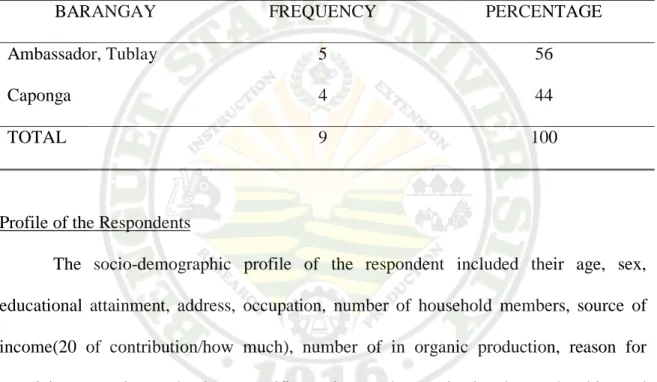
BARANGAY
Distribution of Respondents as to Study Area
There were nine organic lettuce producers in Tublay, Benguet and they served as respondents of the study. Five of these respondents were from barangay Ambassador and 4 were from Caponga.
Table 1. Distribution of respondents as to study area
FREQUENCY PERCENTAGE
Ambassador, Tublay 5 56
Caponga 4 44
TOTAL 9 100
Profile of the Respondents
The socio-demographic profile of the respondent included their age, sex, educational attainment, address, occupation, number of household members, source of income(20 of contribution/how much), number of in organic production, reason for practicing organic production, specific topics, and organizational membership and position (rank). These are presented in table two.
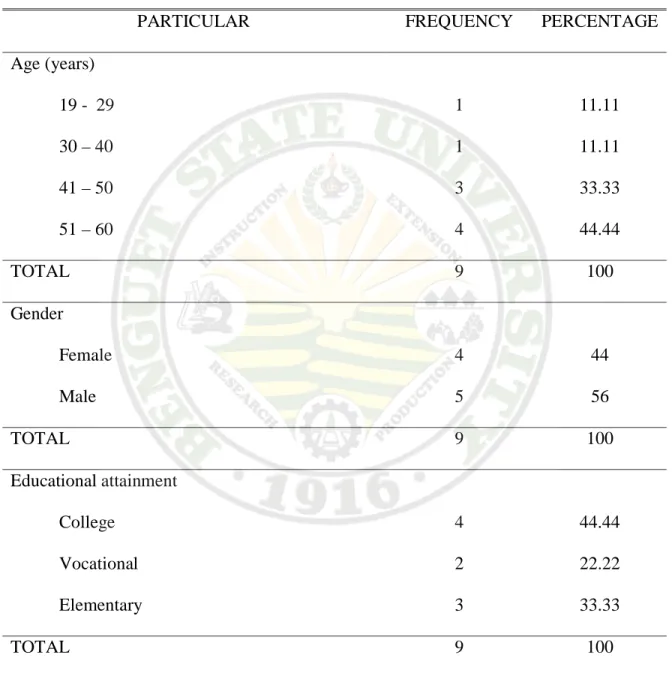
Age. Four (44.44%) of the respondents belonged to the age of the range 52-62 years followed by three (33.33%) with in the range of 43-51, one (11.11%) belong to the age range of 19-29 and another 11.11% belongs to the range 30-40 years old
Gender. Most of the respondents were male (55.55%) while 44.44% of the
11
Educational attainment. Forty-four percent of the respondents attend collage level while 22.22% are vocational and 33.33% for elementary.
Source of income. All of the respondents are farmers (100%) but some of them has several occupation like government employee, laborer, weaving.
Average monthly income. Two respondents (22.22%) belongs to the average monthly income of PhP10,000-12,000 coming from organic production and from being a government employee. 22.22% belongs to PhP 7,000-8,000 comes from organic production and wages from laboring and weaving while 3 respondents belongs to the average monthly income of PhP 3,000-4,000. Two (11.11%) respondents belong to average monthly income of PhP 4,000 to 6,000.
Number of years in organic production.. There were two (22.22%) respondents who have been into organic vegetables production for eight years. Two (22.22%) of the respondents were engaged in organic for five years. Two (22.22%) respondents practice organic farming in three years and two (22.22%) respondent practice organic vegetable production in two years and one respondents practice organic in less than a year. The result implies that the respondents did not go into organic production t into organic production all at the same time. It may also imply that the others were motivated by the first person who practiced organic.
Membership in organization. Five (56%) respondents are members of the Acop Tublay Organic Practitioners (ATOP) and four (44%) are members of La Trinidad Organic Practitioners (LaTOP). This findings implies all the organic lettuce growers are members of the organic organization.
12
Year started in organic farming
PARTICULAR
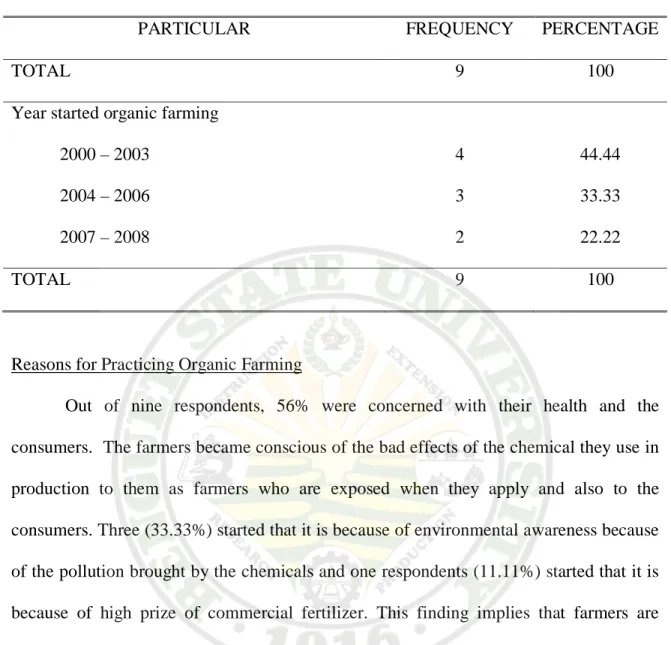
. Most of the organic practitioners started from the bracket 2000-2003 where there are 44.44% followed by bracket 2004-2006 (33.33%) and two respondents started from 2007-2008.
Table 2. Profile of the respondents
FREQUENCY PERCENTAGE
Age (years)
19 - 29 1 11.11
30 – 40 1 11.11
41 – 50 3 33.33
51 – 60 4 44.44
TOTAL 9 100
Gender
Female 4 44
Male 5 56
TOTAL 9 100
Educational attainment
College 4 44.44
Vocational 2 22.22
Elementary 3 33.33
TOTAL 9 100
13
Table 2. Continued
PARTICULAR FREQUENCY PERCENTAGE
Source of income
Farming 9 100
Government employee 3 33.33
Weaving 1 11.11
Monthly average income (pesos)
4,000 – and below 3 33.33
4,001 – 6,000 2 22.22
6,001 – 8,000 2 22.22
8,001 – 10,000 0 0
10,001 – 12,000 2 22.22
TOTAL 9 100
Number of years in organic production
Less than one year 1 11.11
2 – 3 4 44.44
4 – 5 2 22.22
6 – 7 0 0
8 – 9 2 22.22
TOTAL 9 100
Membership in organization
La Trinidad Organic Practitioners (LaTOP) 5 56
Acop Tublay Organic Practitioners 4 44
14
Table 2. Continued
PARTICULAR FREQUENCY PERCENTAGE
TOTAL 9 100
Year started organic farming
2000 – 2003 4 44.44
2004 – 2006 3 33.33
2007 – 2008 2 22.22
TOTAL 9 100
Reasons for Practicing Organic Farming
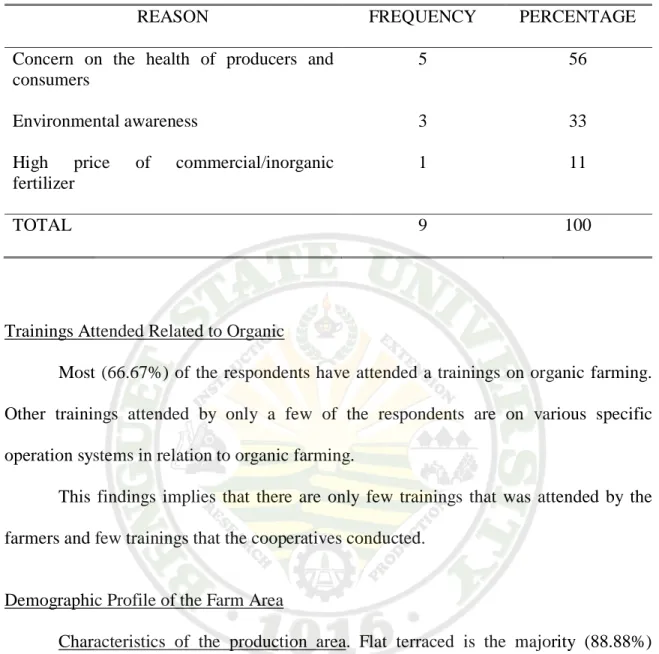
Out of nine respondents, 56% were concerned with their health and the consumers. The farmers became conscious of the bad effects of the chemical they use in production to them as farmers who are exposed when they apply and also to the consumers. Three (33.33%) started that it is because of environmental awareness because of the pollution brought by the chemicals and one respondents (11.11%) started that it is because of high prize of commercial fertilizer. This finding implies that farmers are becoming aware of the bad effects of organic to the health of both producers and consumers and its effect to the environment and to the soil they cultivate. The tremendous increase on the price of inorganic farm inputs had also contributed to the shifting of farmers from conventional to organic.
15
Table 3. Reasons for practicing organic farming
REASON FREQUENCY PERCENTAGE
Concern on the health of producers and consumers
5 56
Environmental awareness 3 33
High price of commercial/inorganic fertilizer
1 11
TOTAL 9 100
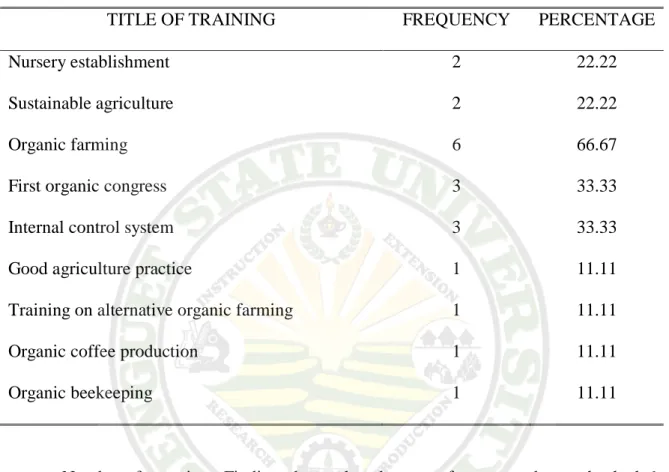
Trainings Attended Related to Organic
Most (66.67%) of the respondents have attended a trainings on organic farming.
Other trainings attended by only a few of the respondents are on various specific operation systems in relation to organic farming.
This findings implies that there are only few trainings that was attended by the farmers and few trainings that the cooperatives conducted.
Demographic Profile of the Farm Area
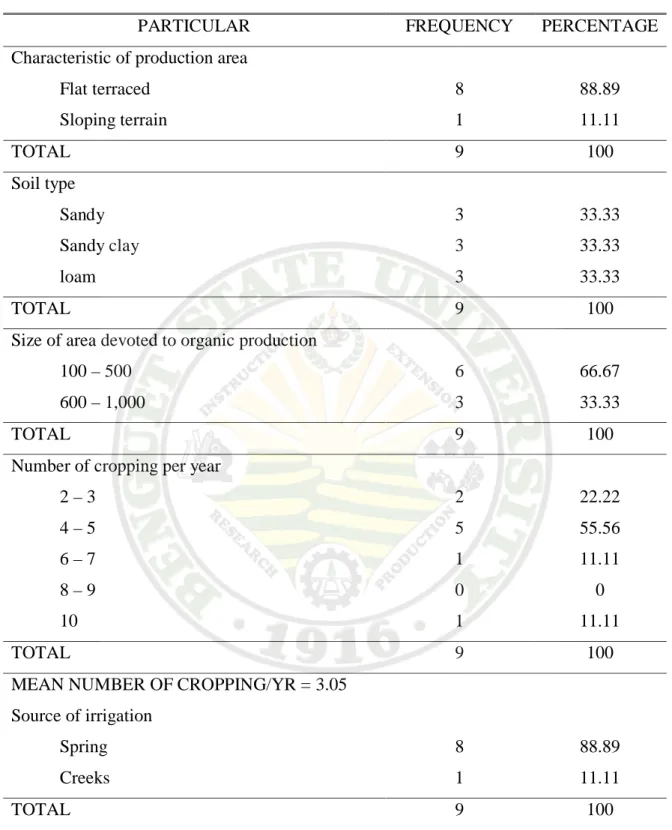
Characteristics of the production area. Flat terraced is the majority (88.88%) characteristics of the farm production while 11.11% had sloping terrain.
Varieties grown and source. All the respondents grow the five varieties of lettuce namely: Red Romaine, Red Web, Oak Leaf, Green Ice and NLBR. All the respondents buy the seeds from farm supply stores and they wash the seed before sowing to remove the chemical used in treating the seed.
16
Type of soil.
TITLE OF TRAINING
There were three (33.33%) respondents who farm has a sandy soil, 33.33% have sandy clay soil type and 33.33% have clay soil type.
Table 4. Trainings attended by respondents
FREQUENCY PERCENTAGE
Nursery establishment 2 22.22
Sustainable agriculture 2 22.22
Organic farming 6 66.67
First organic congress 3 33.33
Internal control system 3 33.33
Good agriculture practice 1 11.11
Training on alternative organic farming 1 11.11
Organic coffee production 1 11.11
Organic beekeeping 1 11.11
Number of cropping. Finding shows that there are few respondents who had 6 cropping per year and another one who had ten (11.11%) cropping per year. There were (22.22%) respondents who had 2-3 cropping per year. Most of them (55.55%) had a maximum of five cropping per year. The respondents said that their production was continuous because they had crop programming and that they replace the crop at once upon harvest.
Source of irrigation. Most of the respondent (88.88%) get their irrigation water from the spring while 11.11 percent get (their) her irrigation water from creek
17
Table 5. Demographic profile of the farm area
PARTICULAR FREQUENCY PERCENTAGE
Characteristic of production area
Flat terraced 8 88.89
Sloping terrain 1 11.11
TOTAL 9 100
Soil type
Sandy 3 33.33
Sandy clay 3 33.33
loam 3 33.33
TOTAL 9 100
Size of area devoted to organic production
100 – 500 6 66.67
600 – 1,000 3 33.33
TOTAL 9 100
Number of cropping per year
2 – 3 2 22.22
4 – 5 5 55.56
6 – 7 1 11.11
8 – 9 0 0
10 1 11.11
TOTAL 9 100
MEAN NUMBER OF CROPPING/YR = 3.05 Source of irrigation
Spring 8 88.89
Creeks 1 11.11
TOTAL 9 100
18
Size of Farm Devoted to Organic Production
FARMER
.
Six (66.66%) respondents devoted 100-500 square meter and thirty-three point thirty-three percent filled 600-1000 square meter. This results shows that most of the organic practitioners devoted a limited area. The average area cultivated by the respondents is only 366.66 sq m. The respondents only use a certain portion of their farm for organic production. As shown in table 6, the wider the area the lesser percentage is devoted for organic production.
Table 6. Size and percentage of farm area devoted for organic production TOTAL FARM
AREA (SQ.M)
AREA DEVOTED TO ORGANIC
(SQ.M)
PERCENTAGE AREA DEVOTED TO ORGANIC (%)
1 - 300 -
2 5,000 350 7
3 1,500 350 23
4 1,000 160 16
5 - 500 -
6 10,000 1,000 10
7 1,000 300 30
8 400 400 100
9 1,000 400 40
19
SOURCE Source of Planting Materials
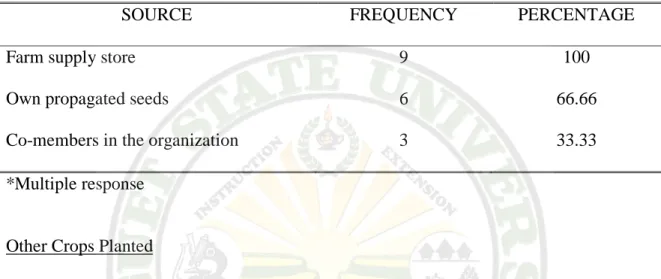
Majority (100%) of the respondents buy their planting materials from farm supply stores, some (66.66%) were able to propagate their own seeds/seedlings and other 33.33% buy it from co-members of the cooperative.
Table 7. Source of planting materials
FREQUENCY PERCENTAGE
Farm supply store 9 100
Own propagated seeds 6 66.66
Co-members in the organization 3 33.33
*Multiple response
Other Crops Planted
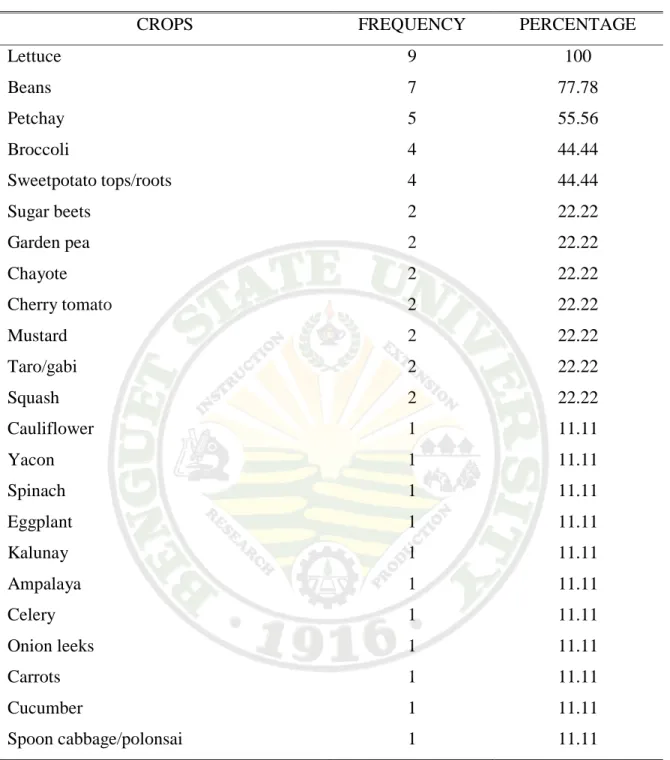
Most of the respondents grow beans, (77.77%). Petchay are planted by 55.55% of the respondents, 44.44% percent grow lettuce, broccoli ,camote tops/fruits. There are 22.22% each of the respondents who produced sugar beats, garden pea, cayote, cherry tomato, mustard, gabi and squash. Another 11.11% each of the respondents grow cauliflower, polonsai, yacon, spinach, eggplant, kalunay, ampalaya, squash, celery, union leeks, carrots and cucumber. This implies that the respondents are productive given a limited crop to be grown. The respondents are under going crop programming. One crops is limited to be grown which one crop is grown by ten persons only.
20
Table 8. Organic crops planted
CROPS FREQUENCY PERCENTAGE
Lettuce 9 100
Beans 7 77.78
Petchay 5 55.56
Broccoli 4 44.44
Sweetpotato tops/roots 4 44.44
Sugar beets 2 22.22
Garden pea 2 22.22
Chayote 2 22.22
Cherry tomato 2 22.22
Mustard 2 22.22
Taro/gabi 2 22.22
Squash 2 22.22
Cauliflower 1 11.11
Yacon 1 11.11
Spinach 1 11.11
Eggplant 1 11.11
Kalunay 1 11.11
Ampalaya 1 11.11
Celery 1 11.11
Onion leeks 1 11.11
Carrots 1 11.11
Cucumber 1 11.11
Spoon cabbage/polonsai 1 11.11
*Multiple response
All the respondents used compost as fertilizer. However, there were other Fertilization Practices
21
using this kind of organic fertilizer. Some (33.33%) used sunflower solution as fertilizer and others (22.22%) used animal manure (Table 9). This implies that compost is still the most common organic fertilizer used by organic producers.
All the respondents apply fertilizer/compost before planting and more than one half (55.55%) apply after planting, usually side dressed during hilling-up.
Pest and Disease Control Measures
One hundred percent of the respondents manually control pest by hand picking insects and clean farm surroundings to remove the breeding places of pests. There were 7 respondents among 9 practitioners who practice crop rotation to break the life cycle of pest and prevent pests from multiplying on their last crop at the same time eliminating soil borne diseases. One practitioner use mechanical traps such as spider web, they place sticks in between the plants so that the web will attached to the sticks, to prevent the aphids beetles from eating the leaves of the crop (Table 10).
This finding implies that the organic farm practitioners only have few control measure practices for the pest and disease.
Problems Encountered in Production
Table 11 presents the different problems encountered by the respondents. There were 3 respondents whose problem was lack of educational training. According to Municipal Agricultural Office of Tublay, since the plan international was not able to pursue on their program, practitioners don’t have any more trainings about organic farming. Because of this some members go back to conventional farming. They still have to acquire the necessary technical skills through trainings and seminar. Without this, the
.
22
farmers would not be able to implement the prescribed practices of organic farming so sometimes the farmers are suspended from supplying organic products to LaTOP.
One respondent (11.11%) said that his problem is the high cost of certification.
The product cannot be considered as organic if the requirements were not meet by the farmer.
Table 9. Type of organic fertilizer
PARTICULAR FREQUENCY PERCENTAGE
Type of organic fertilizer used
Compost 9 100
Compost tea 5 55.55
Animal manure 2 22.22
Sunflower solution 3 33.33
Time of application
Before planting 9 100
After planting 5 55.55
*Multiple responses
Table 10. Pest and disease control measures
CONTROL MEASURE FREQUENCY PERCENTAGE
Manual picking of worms/insects 9 100
Clean farm surroundings 9 100
Crop rotation 7 77.78
23
Lack of machineries was a problem mentioned by 33.33% of the respondents because of high price of machine like for example of weeds shredder. It is hard to decompose the weeds and crop residues if not shredded.
There were 2 (22.22%) respondents who mentioned that they need green house, but they cannot afford to construct one because it is costly and they don’t have enough money to invest on it. the greenhouse is needed according to them so that they will have continuous production even in rainy seasons. When rainy days, the crops are easily attacks with diseases and organic fertilizers are easily washed out.
Three respondents (33.33%) said that there problems are the insect pest and diseases. It takes time to pick the insects eating the leaves of the crops. But some respondents said that insect pest is not really a major problem.
One respondents (11.11%) said that his problem was the acidity of the soil, thus he need to put lime and more compost on it.
Table 11. Production problems incurred by the farmer respondents
PRODUCTION PROBLEM FREQUENCY PERCENTAGE
Lack of technical training to strictly implement
proper method 3 33.33
High cost of certification as organic farmers 1 11.11
Lack of farm machineries 3 33.33
High cost of greenhouse which is needed for
continuous production 2 22.22
Pest and diseases 3 33.33
Acidic soil 1 11.11
*Multiple response
24
Marketing Practices
Market outlet. The respondents who are members of the LaTOP have a schedule of product delivery. The LaTOP members deliver every Wednesday and Saturday. They also deliver at Café by Ruins in Baguio city and in Mario’s Restaurant also in Baguio City. On the other hand, farmers who are members of the Acop Tublay Organic Practitioners deliver their produce every Thursday to the University of the Cordillera in Baguio City. If there are excess supply these are sold to their neighbors and friends.
Pricing system. Both association (LaTOP and ATOP) members decides on the price of the products. The respondents together with the other members and the officers determined their price by knowing the cost of production, and what price the farmer will accept and the market was willing to pay. The members decide on the price of the products and agreed by the Board of Director and the Chairperson. The prices that were agreed are effective only for one year. Every they changed the prices of the products.
Packaging materials. All the respondents use crates, plastic bags and cartons. In retailing, the packaging is done by the farmer with the plastic bags provided by the associations with the label of their associations, either LaTOP or ATOP, name of the farmer, farm location and the star label as a guarantee of being organic.
Volume produced. All the respondents are able to produce the required volume of crops and some members consume if there are excess.
Methods of promoting organic produce. All the respondents through the association participate in local trade fairs/festivals to promote the product, to let the public know that organic products are available. All the respondents also promote their
25
eating organic vegetables and why their products are expensive as compared to the conventionally produced vegetables.
According to the respondents, other means of promoting their product were through advertisement in the information program DZWT, a local station in Baguio City.
The print media such as the Baguio Midland Courier, Sunstar Baguio, Zigzag Weekly also supported the respondents by publishing important updates and accomplishment about organic farming.
The Municipal Agriculture Office (MAO) support them too in promoting their products. They use flyers and streamers which are placed in the vicinity of the market outlet and let the public know their locations.
Marketing Problem
Table 12 reveals that 7 (77.77%) of the respondents said that limited market outlet for organic produce is a problem because even if they produce more they there is no market outlet. The current outlet can only accommodate a few quantities of the different vegetables. Besides, not all the delivered products were sold, so they need to pull-out the organic product and bring it to the Trading Post getting a lower price instead of a premium price.
Another is lack of awareness of consumers on the value of organic produce. The 4 (44.44%) respondents said that the costumers tend to compare the appearance of the vegetables organically and conventionally. There were consumers who were not aware of the nutritive value of organic crops so they prefer to buy the cheap conventionally produced products over the expensive organic products.
26
Table 12. Marketing problem
PROBLEM FREQUENCY PERCENTAGE
Limited market outlet for organic produce 7 77.77 Lack of awareness of consumers on the
value of organic products
4 44.44
* Multiple response
SUMMARY, CONCLUSION AND RECOMMENDATION
All the respondents do not devote all their areas for organic production. Income from organic production ranged fro 4,000 to 12,000 pesos per months depending on the size of the farm and production. Other sources of income aside from organic farming include employment and weaving. The respondents mentioned that the major reason for going into organic lettuce production were due to health consciousness and producing chemical free vegetables especially for lettuce because lettuce are eaten raw as vegetable Summary
The study is focused on the organic production and marketing practices of lettuce growers in Tublay, Benguet. The study was conducted in the different barangays of Tublay. Specifically the study aimed to find out the production and marketing practices of farmers in the production of organic lettuce; to find out the reasons of farmers going into organic production and determine the problems encountered by the farmers in the production of organic lettuce and their perceived solutions.
The data needed were gathered through a personal interview with the respondents.
Respondents of the study were the organic lettuce producers who were members of the La Trinidad Organic Practitioners (LaTOP) and the Acop Tublay Organic Practitioners (ATOP). There were nine organic producers in the area and these served as respondents of the study. Majority of the respondents were middle aged with an average age of 47 years. Some (44.44%) of the respondents had reached or finished a college degree, however, all of them had formal education. All have also attended trainings related to organic farming.
28
salad. Other reason is due to environmental awareness and the high price of inorganic fertilizer.
In marketing, the major outlet the farmers is the LaTOP and ATOP market outlet.
The farmers have a scheduled delivery dates and volume quota to supply these markets.
The associations in consultation with the members decide on the price of the vegetables and price set is only good for one year, thus every year the price is changed.
The major problems encountered in lettuce production are lack of trainings to strictly implement proper method, lack of farm machineries, pest and diseases, high cost of greenhouse, high cost of certification and acidic soil.
The major problem in marketing encountered by organic lettuce producers include limited or lack of market outlet and lack of awareness of consumers on the value fo organic products.
1. There are two organic producers association where the organic lettuce growers of Tublay were members.
Conclusion
The following conclusion were drawn based on the findings of the study
2. Growers produce organic in a limited area because of the limited market outlet or limited market.
3. The organic farmers received a premium price of their produce and the price set is fixed for one year and set by the association in consultation with the members.
29
1. The Municipal Agriculture Office should conduct trainings and seminar for the farmers regarding organic farming or organic production.
Recommendation
Based on the findings, the following are recommended.
2. The government should build a trading center for organically grown products.
3. Concern citizens. Government, non-government sector, and organic farmers should set a campaign regarding the benefits of organic production and consumption of organically produced vegetables.
LITERATURE CITED
ABADILLA, A.A. 1982. Temperature and Nitrogen and Nutrition Relation to Flowering and Fruiting of Tomatoes. Netherlands Journal Agric. Sci. 18: Pp. 111-115.
ANON. 1980. Seed for Today: A Description Catalog of Vegetable Varieties. No. 23.
Asgrow Seed Co. Kalamazoo, Michigan. Pp. 10-75.
BAUTISTA, O.K.. 1983. Introduction to tropical Horticulture University of the Philippines, Loa Banos, Laguna P. 97.
BUCU, G.S. 1991. Kinds and Source of Organic Materials. Golden Roots Newsletter.
3(2): 1,2,9.
DREMANN, C.C. 1987. Organic Fertilizer: The Truth and the B.S. Redwood City seed Co. P.75.
ERICKSON, H..T. 1996. The World Book Multimedia Encyclopedia, The Authoritative CD-Rom Encyclopedia, World Book Inc. Chicago Il.
ESTERO, O.P. 2007. Variety Evaluation of Romain Type Lettuce under La Trinidad, Benguet Condition. BS Thesis, Benguet State University, La Trinidad, Benguet.
Pp. 1-5.
KNOTT, J.E. 1967. Vegetable Production in Southeast Asia. UPCA, Los Baňos, Laguna. P. 83.
KINOSHITA, K. 1972. Vegetable Production in the Sub-Tropics Overseas Technical Cooperation Agency, Tokyo. P. 375.
KUDAN, S.L. 1999. Lettuce Production. Office of the director of Extension. Benguet State University, La Trinidad, Benguet. Pp. 1-6.
PCARRD, 1979. The Philippine Recommends for Fertilizer Usage. PCARRD Technical Bulletin Series. No. 52. Los Baňos, Laguna. Pp. 23-29.
SACLA, F.G. 2002. Growth and Yield Response of Cabbage (Scorpio) to various Rates of 6-8-8. Tomy Green Organic Liquid Fertilizer. P. 3.
TIEDJEN, V.A. 1964. Colliers Encyclopedia. The Crowell-Collier Publ. Co. 14:523.
WATTS, R.L. 1922. Vegetable Gardening. New York: Orange Judd. Pp. 351-358.