R E T O R T P O U C H S E A F O O D
Marine Fisheries Research Department Southeast Asian Fisheries Development Center
Southeast Asian F isheries D evelopment Center
The Southeast Asian Fisheries Development Center (SEAFDEC) is a technical organization devoted to the accelerated development of fisheries in the region. The member countries of SEAFDEC are Japan, Brunei Darussalam, Malaysia, Philippines, Singapore, Thailand and Vietnam. SEAFDEC has four departments, viz., Marine Fisheries Research Department in Singapore, Training Department in Thailand, Aquaculture Department in the Philippines and Marine Fishery Resources Development and Management Department in Malaysia.
Marine Fisheries Research Department
Southeast Asian Fisheries Development Center Postal address: Changi Fisheries Complex
300 Nicoll Drive Singapore 498989
Secretariat: SEAFDEC Secretariat Suraswadi Building
c/o Department o f Fisheries Kasetsart University Campus Bangkhen, Bangkok 10900 THAILAND
Retort Pouch Seafood
Copyright 1996. Marine Fisheries Research Department
Southeast Asian Fisheries Development Center, Singapore
All rights reserved. No part o f this publication may be reproduced, stored in a retrieval system or transmitted in any form or by any means, electronic, mechanical, photocopying, recording or otherwise without prior permission o f the publisher.
ISBN : 981-00-8920-1 S$ 10.00
R E T O R T P O U C H S E A F O O D
Authors
MFRD:
Ng Mui-Chng Lee How Kwang
Evelyn Chia Geok Hoon
Special Fellows, Thailand:
Varatip Somboonyarithi Chakree Thongraung
Marine Fisheries Research Department Southeast Asian Fisheries Development Center
Singapore 1996
ACKNOWLEDGMENT
The authors would like to thank the Government o f Japan for the sponsorship o f this program through MFRD, SEAFDEC.
We are grateful to Mr. Tan Sen Min and Dr. Shiro Konagaya, Chief and Deputy Chief o f MFRD for their useful advice and guidance extended to us in conducting this study and preparation.
Very special thanks to Mr. Masumi Dan, JICA expert in fish processing and Mr. Hiroshi Ohsuga, short-term JICA expert on packaging films for their valuable technical advice.
We would also like to thank the MFRD staff for taking part in this program as sensory panelists and their feedback. Finally, our appreciation to all the MFRD staff for helping us in one way or another.
Note: The mention o f trade names in this publication does not imply endorsement o f the product.
FOREWORD
R
etort pouch foods have enjoyed rapid growth in demand since its introduction in the late 1960s. Although the main market is in Japan where annual consumption is more than 200,000 tons, there has been increasing interest by food manufacturers outside Japan to produce retort pouch foods, not only for export to Japan but also for local consumption. Recently, consumer preference for genuine and gourmet foods has created a trend towards higher class retort foods.In the beginning, retort food was marketed for its convenience and economy which appealed to consumer preferences for practicality. Recently, manufacturers have targeted their products at a wider range o f consumers, from children to adults. The products therefore have expanded in range from curries and stews to “finished cooked foods”, cooking sauces and cooking ingredients and are now readily available in most supermarkets in the ASEAN region.
Based on this trend to provide greater diversity o f retort pouch foods, the MFRD embarked on a study on retort pouch seafood to provide examples and information on the variety o f retort pouch seafood products available in Japan and in the ASEAN region. In addition, the study also gives examples o f several seafood products popular in the region and are suitable for processing as retort pouch seafood.
This manual on retort pouch seafood is the result o f the study done by MFRD research officers in collaboration with a Japanese short-term expert on retort pouch foods and two Special Fellows from Thailand. I would like to congratulate them for their combined effort in coming up with this manual which I am sure will be extremely useful to the seafood manufacturers not only in the ASEAN but also to the fish processing industry in other developing countries as well.
DR NGIAM TONG TAU
SEAFDEC Council Director for Singapore
and Director, Primary Production Department, Singapore
CONTENTS
Acknowledgment
Foreword
Introduction... 1
Retort pouch seafood products...5
Processing of retort pouch seafood... 11
Sweet and sour prawn... 12
Prawn in tamarind sauce... 15
Prawn with garlic and pepper... 18
Tuna mayonnaise...20
Tuna vegetable... ...22
Tuna vegetable with mayonnaise...24
Discussion...28
Retort pouch packaging materials...29
Retort pouch thermal sterilization...32
References...37
Appendices: (I) Product Information... 39
(II) Heat penetration curves...42
INTRODUCTION
T
he retort pouch is a relatively new type of container for packaging food and it is lighter in weight than metal cans or glass jars. It allows the contents to be warmed up quickly in about 3 minutes by placing the entire pouch in boiling water or heating in a microwave oven before serving. The pouch has been catching up in popularity with the glass jars, metal cans and other plastic materials as a new technique and material for preserving food.It was the advent of heat-resistant, plastic film, along with non-toxic adhesive compounds, that accelerated the development of what we call today, “retort pouch”. The United States Army, noting the great potential of food packaging with plastic bags for battle rations, launched a program to exploit this new method through the Army’s Natic Development Center. A number of notable achievements were made by the Center in the 1960s. In 1968, the Center conducted reliability tests for determining the integrity of retort pouch seals, the sterilization characteristics and percent defects in pouch food production, and came out with results which put the retort pouch on par with the metal cans to demonstrate that it is a safe and suitable device for food preservation.
Though its future appeared to be rosy, the retort pouch had to overcome one more hurdle in the United States, that of obtaining an approval from the Food and Drug Administration (FDA). The FDA approval was long overdue because of a lingering doubt about the adhesive compound used for lamination:
will it not disperse into the food? In 1977, the pouch was finally cleared by the FDA and this paved the way for commercial production of retort pouch in the United States.
While its commercial production in the United States was held up on account of the question of dietary hygiene, the retort pouch won sanctions in other countries. The Italian and Japanese retort pouch licensees had gone ahead and were already producing the pouch in the late 1960s; the British and West German licensees soon follow suit. Today, retort pouch food is produced not only in these countries but also in many other countries. In Europe and US, retort foods are filled in trays and cups, replacing the pouch. In Asian countries such as Korea and Taiwan, retort pouch food is gaining popularity in the market. In 1968, one Japanese company became the first in the world to produce curry in
"T h e p ouch h a s been catching up in p op u l a r i t y w ith m e t a l c a n s a n d g l a ss j a rs w hich
was common ly used in the ea rly 1950s."’
aluminum foil pouch for large scale marketing.
Currently, Japan is the biggest producer of retort pouch food where its annual consumption volume in 1995 is about 204,899 tons in which curry accounts for about 43%; sauce for soybean curd
(mapo tofu
ingredients) 6.9%; rice, meat sauces and soups c o n s titu te 4 .7 5 , 2.79 and 6.07%respectively. Fisheries accounts for 3.39%
in 1995. The main product is tuna which constituted 88.1% in fisheries. Initially, curry was marketed with an appeal to the consumers’ preferences for practicality, convenience and cost consideration.
Recently, m anufacturers have been aiming at a wider range of consumers from children to adults. The products have expanded to curries, stews, meat sauces, and other “finished cooked foods” to cooking sauces such as Chinese seasonings and “cooking ingredients” so as to meet consumer preference for hom e-prepared m eals. These have become popular among housewives as time-saving dishes. More consumers especially the working women and young singles are beginning to appreciate the
“convenience and appealing” retort food and considerable market growth can be expected.
The characteristics of the retort pouch is its ability to preserve food contents comparable to that of the metal cans. For sterilization, the retort pouch enables its contents to be heated quickly and this property has made it possible to apply heat at a higher temperature in a shorter heating time, thus minimizing its deteriorating effect on the taste, flavour, colour and nutritional value in the preserved food contents.
S t e r i l i z a t i o n o f r e t o r t p o u c h f o o d
As in canning, retort pouch food is s te riliz e d a fte r p a ck in g , but the sterilizing procedure differs as the flexible retort pouch is susceptible to rupture owing to changes in the pressure between the pouch and the retort during heating and cooling. When the heating medium is steamed, the hot water or shower which is subsequently cooled under atmospheric pressure is bound to cause the pouch to inflate and burst. To avoid this, compressed air is used to create a pressurized atmosphere in which the pouch is cooled. Thus, the sterilizing and cooling must be carried out under controlled pressure.
F o o d s u i t a b l e f o r r e t o r t p o u c h
A wide range of food is now available in retort pouch and they are represented by the following entrees such as meat balls in tomato sauce, curry sauce and other thick sauces; chicken stew, beef stew;
ravioli, spaghetti with meat; barbecued c h ic k e n , b e e f s tro g a n o ff; fru its , vegetables, potato salad; cooked cereals (rice), porridge; cooked meats, seafood;
sauces, soups, pastries and pet foods.
Although retort pouch seafood constitutes 4% of the total consumption of retort pouch foods in Japan, there is a potential to develop a greater variety of such products due to the increasing consumer perception on seafood as a healthy food. Within the ASEAN region, there has been considerable interest in developing its popular seafood dishes in retort pouch. Dishes like shark fin soup, spicy seafood gravy and tuna flakes are gaining popularity in this region.
A d v a n t a g e s o f r e t o r t p o u c h
1. Shelf life of retort pouch products is at least equal to that of foods in metal cans; refrigeration or freezing is not required.
2. There is no hassle in cleaning up utensils when consuming the product.
3. Pouch can be opened up by tearing the notch at the top of the side seam or by using scissors.
4. Storage and disposal space for pouch is lesser than that of metal cans.
5. There is significant reduction in processing time (30-40%) as well as energy due to the rapid heat transfer of the pouch.
6. Lesser heating time will lessen the deterioration of the taste, colour and nutritional value of the food contents.
7. The empty retort pouches will take up less storage spaces and lighter weight. Compared with metal cans, pouches use up 85 spaces lesser: one thousand 4.5 x 7 inches pouches weigh 9.4 lb. as compared to an equal number of cans with an area of 211 x 304 inches weighing 112.5 lb.. A 45- ft trailer holds 200,000 eight-ounce empty metal cans whereas over 2.3 million empty pre-formed pouches can be shipped on the same trailer.
8. Retort pouch labels have more space as compared to metal cans labels.
9. Retort pouch will not be dented as it
is a soft package.
10. Retort pouch is safer as consumer would not be cut as in the case of metal cans or broken glass jars.
D i s a d v a n t a g e s o f r e t o r t p o u c h
1. Major investments expected on the retort and filling equipment, different containers and m odifications for different thermal processes.
2. F illin g o f contents is slow and com plex. The fillin g lines are currently run from 30 to 60 pouches per minute compared to 400 per minute for canned and frozen foods and up to 1,200 per minute for glass jars.
3. For different types of products and container sizes, thermal processing conditions will have to be modified.
4. Detection of leakage on the pouch is more difficult due to its flexible nature. The pouch is also easily punctured.
5. C o n s i d e r a b l e m a r k e t i n g or advertising expenditures may be required to educate the consumers, although the institutional market may allow easier entry into the retail market.
6. Educating traders and consumers on the handling of retort food is difficult.
Tests have shown that some retailers handle retort pouches as if they were frozen foods.
RETORT POUCH SEAFOOD PRODUCTS
J apan is the biggest producer for retort pouch products. It is therefore useful for us to take a closer look at the retort pouch market in the country. This section provides examples and market information on retort pouch seafood products available in the supermarkets in Japan and in the ASEAN region. The annual production of retort pouches in Japan increased from 91,292 tons in 1985 to 204,899 tons in 1995.
These quantities constitute 13 main product categories namely, curry, stew, hayashi, sauce of mapotofu, boiled mixture of meat and vegetables, sauce of kamamesi, cooked meat, seafood, soups, farm products, rice, meat sauce and other sauces. The curry product makes up the largest portion of the total annual production of retort pouch products in 1995 as shown in Fig. l. For seafood products, although it constituted only 3.39%
of the total production in 1995, there is a notable increase between 1985 to 1995 as shown in Fig.2.
For the ASEAN market, most of the retort pouch products are imported from Japan even though there are such factories in these countries which are equipped to undertake retort pouch processing. Recently high- value seafood products eg. abalone and sharkfin have been marketed in retort vacuum pouch and are gaining popularity with consumers in Southeast Asia.
R e c e n tly high-value sea fo o d produ cts eg.
abalone and sharkfin have been marketed in retort vacuum pouch and are gaining popularity with consumers in Southeast A sia
Fig. 1 Percentage of retort pouch foods in Japan, 1995 (Total production volume : 204,899MT)
Fig. 2 Annual production volume of retort pouch seafood in Japan
Table 1. Product Information of Retort Pouch Seafood in Japan
Packing Style Product N et-w eight (g) Size o f container (cm)
Casings Fish burger 220 -
Trays Flat fish, cuttlefish, mackerel
220 2 .3 x 17.1
Standing Pouch (with Al-foil)
Tomato sauce, fish and vegetable porridge with crab
270 11.8 x 17.7
Bags
(with Al-foil)
Tuna mayonnaise 50 9.0 x 14.0
Tuna chunk 1000 30.0 x 22.8
Tuna flake 1000 30.0 x 22.8
Clam 1000 13.3 x 19.5
Short neck clam 100 12.2 x 19.6
Crab meat and egg sauce 15.3 x 20.2
Crab meat with vegetables 15.3 x 20.2
Spicy tamarind sauce 13.0 x 17.0
Bags
(without Al-foil)
Oden
2 x 520 -Vacuum pack (transparent)
Freshwater clam
100 13.0 x 19.5Hamaguri clam Asari clam
Bags in carton (with Al-foil)
Salmon with seaweed 130 12.5 x 16.8
Shrimp with chili sauce 110 11.8 x 15.7
Seafood curry 200 12.8 x 17.2
Spicy seafood sauce from Malaysia
Japanese seafood gravy Assorted fish products (Oden)
Tuna and tuna mayonnaise Tuna in oil in institutional pack.
Seafood porridge in standing pouch
Squid in retortable trays
Flat fish in retortable trays
Abalone in retortable vacuum pouch
Fish sausages in retortable casings
Retort pouch seafood packed in carton box
Retort vacuum packed clams
PROCESSING OF RETORT POUCH SEAFOOD
Experim ents on several retort pouch seafood products were conducted to determine the processing conditions and to provide examples of such products. They are based on popular recipes in the Southeast Asian region.
Prawn products : Sweet and sour prawn Prawn in garlic and pepper Prawn in tamarind sauce
Tuna products : Tuna mayonnaise Tuna vegetables
Tuna vegetables in mayonnaise
Most o f the products e.g. sweet and sour prawn, prawn in garlic and pepper are mild in taste except for prawn in tamarind sauce which is spicy and hot. The prawn in tamarind sauce has a strong flavour and is popular with Southeast Asian consumers.
The processing of these products are stated in the following pages and the heat penetration study has been conducted by using the thermocouples and the reading o f Fo obtained from a time/
temperature recorder connected to the retort. The low acidity (pH
> 4.5) had been maintained before and after retort sterilization.
Moreover, the products went through the incubation test at 55°C for 10 days.
S w e e t a n d s o u r p r a w n
T h i s p r o d u c t h a s a c o m b i n a t i o n o f s w e e t , s o u r a n d s a l t y t a s t e . T h e s a u c e
c o n ta in s v e g e t a b l e s s u c h a s t o m a t o , o n i o n a n d s w e e t p e p p e r ( c a p s i c u m ) . G e n e r a lly ,
t h i s s a u c e c a n b e u s e d f o r m a n y k in d s o f m e a t , n o t o n l y p r a w n b u t a ls o f i s h m e a t
c h u n k s o r f r ie d f is h . I t h a s a m il d t a s t e s u it a b l e f o r p e o p l e w h o d o n o t li k e h o t a n d
s p i c y f o o d .
F o r m u l a t i o n
S a u c e
C o m s t a r c h 4 .8 6 %
T o m a to s a u c e 3 .8 9 %
T o m a to p a s te 1 . 6 2 %
V i n e g a r 1 . 5 0 %
S u g a r 4 .7 0 %
S a l t 0 .2 6 %
O n i o n 1 4 .5 9 %
S w e e t p e p p e r 1 4 .5 9 %
T o m a t o 1 9 .4 5 %
W a te r 3 3 .0 8 %
Prawn
T h e r a ti o o f p r a w n : s a u c e 2 :3
Preparation o f sw eet a n d sou r sau ce
• Dissolve com flour into half of the water used.
• Boil the rest of the water together with the seasonings (sugar, salt, vinegar, tomato paste and tomato sauce).
• Pour the well stirred corn flour suspensions into the seasonings mixture.
• Reduce heat, add vegetables and stir until cooked.
Sweet peppers, tomatoes and onions are washed and cut.
Black tiger prawns (45 pcs/kg) are washed, headed, peeled and blanched for 3 mins.
Ready for packing
Retorting at 115°C for 20 mins.
Finished product
Sweet and sour prawn
Vegetables
Fresh/frozen prawn Corn starch
sweet peppers tomatoes onions
water sugar salt vinegar tomato paste
& sauce
Peeling Cutting Simmering
Blanching 3 mins
Cooked prawn Sauce
Filling of retort pouch (250 g)
Sealing
Sterilization 115°C/20 mins
P r a w n i n t a m a r i n d s a u c e
T h is p r o d u c t is s u it a b l e f o r S o u t h e a s t A s i a n c o n s u m e r s a s it is h o t , s p ic y a n d
ta s ty . T h e s a u c e c a n b e c o o k e d w i t h m a n y k i n d s o f m e a t s u c h a s f i s h , c r a b a n d
s h e l l f i s h . V e g e t a b le s c a n b e a l s o a d d e d b e f o r e s e r v i n g w i t h r i c e o r b r e a d .
F o r m u l a t i o n
S a u c e
O n i o n 1 2 .7 0 %
G a r li c 4 .2 5 %
L a k s a l e a f 3 . 4 0 %
L e m o n g r a s s 1 .6 0 %
Y e l lo w g in g e r 0 .4 5 %
B l u e g i n g e r 0 .7 4 %
C h i li 1 7 .9 5 %
T a m a r i n d p a s t e 2 1 .0 0 %
S h r i m p p a s t e 3 . 1 0 %
M o n o s o d iu m g l u t a m a t e 0 .0 9 %
S u g a r 2 .7 8 %
S a lt 0 .9 3 %
W a te r 3 1 . 0 0 %
P r a w n
T h e r a t io o f p r a w n : s a u c e 2 :3
Preparation o f praw n in tam arin d sauce
Ingredients are washed and cut into small pieces.
Black tiger prawns are washed, headed, peeled and blanched for 3 minutes.
Mince all ingredients in the mincer.*
Retort at 115°C for 20 minutes
Finished product.
* Add water into the ingredients and cook with the seasonings.
Fill the tamarind paste with or without shrimp into the pouch.
Prawn in tamarind sauce
Fresh/frozen prawn Tamarind sauce
Peeling
Blanching 3 mins
garlic onion laksa leaf lemon grass yellow ginger blue ginger red chilli shrimp paste tamarind sugar MSG water
Cooked prawn Mixing
Filling of retort pouch
Sealing
Sterilization 115°C/20 mins
P r a w n w i t h g a r l i c a n d p e p p e r
Fried prawn with garlic and pepper is one of popular home-cooked dish as well as a restaurant delicacy in Thailand. It is usually consumed with rice or noodles.
F o r m u l a t i o n
Pepper and garlic paste
P e p p e r 9 .5 0 %
G a r li c 6 6 .1 8 %
C o r ia n d e r r o o t 2 .3 6 %
S a lt 2 1 .9 6 %
Prawn
T h e r a t i o o f p r a w n : p a s t e 7 :3
Prawn in garlic and pepper
Fresh/frozen prawn
Fried
Peeling
Blanching 3 mins
Ground garlic Pepper
Salt
Seasoning sauce
Cooked prawn Mixing
Filling of retort pouch (250 g)
Sealing
Sterilization 115°C/20 mins
T u n a m a y o n n a i s e
T h i s i s a p o p u l a r d i s h w h i c h c a n b e c o n s u m e d w i t h b r e a d . A s p e c i a l m a y o n n a i s e
s t a b l e u n d e r r e t o r t c o n d i t i o n s w a s u s e d . T h i s m a y o n n a i s e i s n o w c o m m e r c i a l l y
a v a i l a b l e . T h i s p r o d u c t i s v e r y t a s t y a n d d i f f e r e n t s p e c i e s o f t u n a c o u l d b e u s e d .
F o r m u l a t i o n
T u n a m e a t 8 2 . 3 0 %
S a l t 1 . 0 0 %
M o n o s o d i u m g l u t a m a t e 0 . 1 6 %
W h i t e p e p p e r 0 . 1 6 %
C o r n o i l 1 6 . 3 4 %
M a y o n n a i s e 8 1 . 7 0 %
Tuna M ayonnaise
Tuna meat Fresh/frozen
Steaming (65 - 95°C/22 mins) Centre temp. 75°C
Cooling Cooked tuna
1 kg
Seasoned meat I Seasoned meat II
salt (1.5%) MSG (0.2%)
white pepper (0.2%) vegetable oil (20%)
salt (2%) MSG (0.2%) Cooking
Mixing
(Seasoned meat: Mayonnaise) 60:40
Filling into pouch (120 g) Vacuum packaging
Sealing
Sterilization 115°C/18 mins
T u n a w i t h v e g e t a b l e s
C a r r o t s , o n i o n s a n d c a b b a g e s a r e v e g e t a b l e s w h i c h c a n e n h a n c e f l a v o u r o f
t u n a m e a t . T h e s e v e g e t a b l e s a r e m in c e d a n d b o i l e d w i t h s e a s o n i n g u n t i l s o f t a n d
th e n f o l l o w e d b y m i x i n g w i t h t u n a m e a t . T h e f in is h e d p r o d u c t c a n b e s e r v e d w it h
r i c e o r b r e a d .
F o r m u l a t i o n
T u n a m e a t 4 2 .9 7 %
O n io n s 2 1 .4 8 %
C a r r o t s 8 .6 0 %
C a b b a g e s 4 .3 0 %
C e l e r y 8 .6 0 %
S a l t 0 .8 6 %
M o n o s o d iu m g l u ta m a te 0 .2 1 %
W h it e p e p p e r 0 .0 9 %
C o r n o il 1 2 .8 9 %
Tuna with vegetables
Tuna meat Fresh/frozen
Vegetables
Steaming (65 - 95°C/22 mins) Centre temp. 75°C
Cooling
onions (500g) carrots (200 g) cabbages (200 g) celery ( 100 g)
Cooked tuna 1 kg
Mincing
Mixing with ingredients salt (20 g) MSG (5 g)
white pepper (2 g) vegetable oil (300 g) Cooling for 1 hour
Draining excess oil and water
Cooked vegetables
Seasoned meat
Filling into pouch (120 g)
Sealing
Sterilization 115°C/18 mins
T u n a w i t h v e g e t a b l e s a n d m a y o n n a i s e
T h is p r o d u c t i s t h e c o m b i n a t i o n o f t u n a m a y o n n a i s e a n d t u n a v e g e t a b l e . T h e
c o n s u m e r w i l l l ik e it b e c a u s e it c o n t a i n s n o t o n l y t u n a a n d m a y o n n a i s e b u t a l s o
v e g e t a b le s w h i c h w i ll e n h a n c e it s a p p e a r a n c e a n d f la v o u r .
F o r m u l a t i o n
T u n a m e a t 3 3 .7 3 %
O n i o n s 1 6 .7 0 %
C a r r o t s 6 .6 8 %
C a b b a g e s 3 .3 4 %
C e l e r y 0 .6 7 %
S a lt 0 .1 7 %
M o n o s o d i u m g l u t a m a t e 0 .1 7 %
W h i te p e p p e r 0 .0 6 %
C o r n o il 1 0 .0 2 %
M a y o n n a i s e 2 2 .2 7 %
Tuna with vegetables and mayonnaise
Tuna meat
Fresh/frozen Vegetables Mayonnaise
Steaming (65 - 95°C/22 mins) Centre temp. 75°C
Cooling
onions (500g) carrots (200 g) cabbages (200 g) celery (100 g)
Cooked tuna 1 kg
Mincing
Mixing with ingredients salt (20 g) MSG (5 g)
white pepper (2 g) vegetable oil (300 g) Cooking for 1 hour
Draining excess oil and water
Cooked vegetables
Seasoned meat
mixing
seasoned meat:mayonnaise 60:40
Filling into pouch (120 g)
Sealing Sterilization 115°C/18 mins
Preparation o f tuna p ro d u cts
Raw materials:
Cutting and steaming the semi-thawed frozen tuna meat.
Cooked tuna meat
Celery, carrots, onions and cabbages are washed and cut into small pieces.
(For tuna with vegetables)
Mincing vegetables
Mixing shredded tuna meat with other ingredients
Filling mixture into pouch
Sealing
Retorting at 115°C for 18 mins
Discussion
T
he processing trials indicated that the p raw n and tuna products such as sw eet and sour praw n, p raw n w ith garlic and pepper, praw n in tam arind sauce, tuna m ayonnaise, tu n a vegetable and tuna vegetables w ith m ayonnaise are suitable as retort pouch seafood. The h eat p en etratio n study w as carried out in all p ro d u cts as show n in A p p e n d ix II. T h e F o v a lu e s fo r all p ro d u c ts w e re g rea ter th an 3 m inutes.A s these p ro d u cts are low acid fo o d w ith p H g reater th an 4.0 (A p p e n d ix I), h en ce ste riliz a tio n p ro c e ss m u st b e ap p lied . A fter sterilization all products w ere incubated at 55°C for about 10 days fo r ste rility test. It w as fo u n d th a t all p ro d u cts w ere still in good condition and there w as no sw elling in the pouch. T his im plies that there w as no therm ophilic b acteria in th em as 55°C is the optim um tem p e ra tu re fo r its g ro w th . T h ere fo re su ch p ro d u c ts are safe fo r consum ption. In addition, sensory evaluation w as also conducted to determ ine the overall acceptability o f these products, particularly on th e ir a p p e a ra n c e an d taste. T he p ra w n p ro d u c ts w e re q u ite w e ll accepted, except fo r slight ad justm ents in its salty and sour tastes.
M ost o f the panelists preferred the hot and spicy taste o f the praw n in ta m a rin d sa u c e . T h e tu n a p ro d u c ts w e re a lso p o p u la r as th e ir appearance, flavour, and taste w ere readily accepted by the panelists.
RETORT POUCH PACKAGING MATERIALS
T
he production o f retort pouch food begins with the making o f pouches from multi-layer sheets or laminations by using plastic films and aluminum foil. Prepared food is packed into the pouch and the top o f the pouch is heat-sealed. The filled pouch is then sterilized by heating under pressure. The basic materials o f the lamination are 12-micron-thick polyester film, 9-micron-thick Al foil and 70-micron-thick polypropylene film. These films are laminated together by using an adhesive compound.The outermost layer is polyester which is tough and gives strength to the pouch. The aluminum foil layer serves as a barrier against ultraviolet rays and food-spoiling gases and oxygen. The innermost polypropylene layer has good heat sealing properties and is also non- toxic while retaining the taste and flavour of foods. It also provides flexibility and strength over a wide range of temperatures.
Recently, the lamination of other materials for pouch are widely used, for example:
ON/CPP, PET/ON/A1/CPP, and PET/A1/ON/CPP
Cups and trays are also used as retort containers. In the case o f cups, PP is usually used.
When oxygen barrier property is required, materials such as PP/Ad resin/EVOH/Ad resin/PP is used. For trays, PP, PP/A1/PP and PP/PET/PP are used.
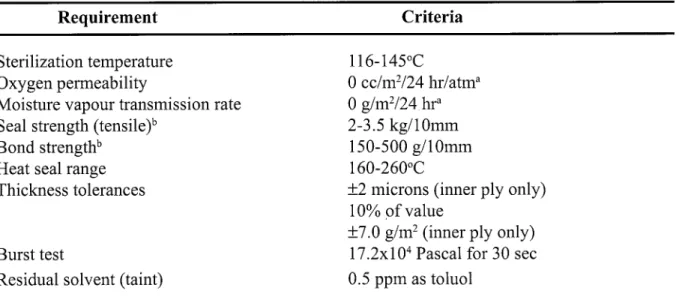
A number o f parameters is routinely measured in determining the barrier ability of packaging materials. Table 2 below shows some o f properties requirements.
Table 2 Range o f performance requirements for retort pouch materials
R eq u irem en t C riteria
Sterilization temperature 116-145°C
Oxygen permeability 0 cc/m2/24 hr/atma
Moisture vapour transmission rate 0 g/m2/24 hra
Seal strength (tensile)b 2-3.5 kg /10mm
Bond strengthb 150-500 g /10mm
Heat seal range 160-260°C
Thickness tolerances ±2 microns (inner ply only)
10% o f value
±7.0 g/m2 (inner ply only)
Burst test 17.2 x l0 4 Pascal for 30 sec
Residual solvent (taint) 0.5 ppm as toluol
a Assuming shelf-life o f 6 months or more is desired; zero based on sensitivity o f prevailing procedures.
b Covers both machine and transverse directions.
(Source: Lampi, R.A., 1977, Adv. Food Res. 23, 306.)
Materials and laminates for retort pouch
Many kinds of materials for retort pouch are readily available today. Below are examples of materials commonly used for 2 different types of pouches.
a) Flat pouch
PET(12)/A1(9)/CPP(70) Curry, sauce
PET(12)/ON(15)/CPP(75) Boiled rice
PET(12)/ON(15)/CPP(85) Assorted fish jelly product
ON(25)/CPP(80) Assorted fish jelly product
ON(25)/CPP(60) Cooked meat
ON(15)/CPP(50) Seasoning bamboo
b) S ta n d in g p ou ch
PET(12)/A1(7) /ON(15)/CPP(70) Japanese tea gruel, corned beef, entrails porridge
PET(12)/ON(15) /A1(7)/CPP(80) Porridge, entrails porridge, fried soy bean cake (seasoning) noodle soup, meat sauce
PET(12)/ON(15)/Al(9)/CPP(60) Cream stew, sauce for mapo tofu
ON(15)/CPP(100) Sweet bean
ON(15)/CPP(80) Sweet bean
c) Trays and cups
Trays and cups can also be used for retorting food. Examples o f such food in the market are shown in Table 3.
The transparent type is made from polypropylene by thermo-forming method and in some case, by injection molding. This type is not suitable for oily food because it does not have oxygen barrier properties, thus, it is used for cooked white rice, red rice and others.
The transparent, high barrier type is made by co-extruded sheet o f polypropylene (PP) and ethylene vinyl alcohol copolymer (EVOH). M odified polypropylene with maleic anhydride (Adm er resin) is used to increase adhesion betw een these two polym ers. One example o f lamination of the co-extruded sheet is as follows:
PP/Regrind/Ad resin/Regrind/PP
Examples of lamination of light shaded type are as follows:
- Outer protect coat/Al foil (120~130pm)/PP (50μm)
- PP(40μm)/Adhesive material resin/Fe foil (75μm)/Adhesive material resin/PP(75μm) In the case of trays and cups, easy peelable lid is generally applied. As the lid is perfectly sealed to the container, it becomes very difficult to open. Easy peelable sealant is generally PP polymer blended with LDPE, LLDPE and/or other polymers (PP blend).
Transparent trays shrink when sterilized, and in some case, ON laminated film is used for the lid. Examples are as follows:
Transparent type:
- PP
- PP/PET/PP Blend - ON/PP Blend - PP/EVOH/PP Blend - PET/PVDC/ON/PP Blend Light shaded type:
- Coat Layer/Al foil/PP Blend - PET/A1 foil/PP Blend - PET/ON/Al foil/PP Blend Table 3 Usage of retort trays and cups
Types Heat resistance Contents
Transparent 120°C Rice, macaroni au gratis, spaghetti, cooked
vegetables (carrots, bamboo shoots, beans, potatoes), cold desserts (puddings and sweet bean cakes)
Light shaded 135°C Beef curry, beef stew, potato salad, gratin PET Polyethylene terephthalate
Al Aluminum
ON Biaxially oriented nylon
PP Polypropylene
CPP Coated polypropylene
EVOH Ethylene vinyl alcohol copolymer
RETORT POUCH THERMAL STERILIZATION
S
terilization by means of heat is one of the methods available to preserve food products and give them a longer shelf life. This process is designed to prevent micro-organisms from utilizing the medium present in the food. It will stop the organisms from growing or destroy them completely.Thermal food processing requires some knowledge of how micro-organisms enter and multiply in food and of the consequences. The micro-organisms involved are those which cause food spoilage and those which are harmful to man. The micro-organisms commonly found in food are mould, yeast and bacteria. Of these, bacteria present the greatest hazard.
Since bacteria are living organisms, they need food for this subsistence and reproduc
tion. Aerobic bacteria can only grow in the presence of oxygen and anaerobic bacteria will only multiply in the absence of oxygen. In addition, temperature and pH are factors for growth. Different species of micro-organisms are characterized by a specific pH value for optimum growth. Particularly Clostridium botulinum, an anaerobic and thermophilic bacte
ria which is a harmful microorganism. It can multiply and produce its deadly toxin if the pH of the product is higher than 4.6. Therefore canned foods may be classified into three cat
egories based on their acidity (Lopez, 1981):
a) low-acid pH above 4.6
b) acid pH 4.0 to 4.6
c) high acid pH below 4.0
At high acid pH values below 4.0 bacterial growth is hardly possible and although pasteurization will not destroy any bacterial spores, this process can be applied successfully in the preservation of acid foods such as fruit and sauerkraut. Foods in the low acid range must be fully retorted to assume safety. Sterilization has the purpose of eliminating all microbiological activity in a given product, whilst minimizing impairment of the product's quality. The process is carried out at temperatures ranging from 110°C to as high as 140°C.
It can be used on most meat products, vegetables, baby foods, pet food and liquid dairy products, and will give them a commercial shelf life up to one year.
The heat treatment applied to a product is determined by the slowest heating point in the container, because by working from this point we can ensure complete exposure to the treatment. For each individual product, it is necessary to establish whether the product has effectively undergone sterilization, based on the requirement that the slowest heating point should reach a given value. The Fo value is a standard unit of lethality which is the value resulting from a constant temperature of 121.1 °C applied for a certain number of minutes. It is based on a decimal reduction time (D value) of 1 min at 121.1°C and a Z value of 10°C (Willenborg, 1981).