Her most ardent disciples came from the ranks of the "young officers" in the Japanese army. At the time of Franklin Roosevelt, American opinion had always been against colonialism, especially French colonialism. Robert Butow, Tojo and the Coming of War, Princeton: Princeton University Press, 1961, and S.M.
Even the American consuls appointed to Canton were not consuls in the diplomatic sense of the word. President McKinley believed that the occupation of the Philippines would be a great help to the growing US. With the arrival of the Wilson administration in 1913, American lending policies in China were reversed.
This does not seem correct in light of the situation discussed.
CHANG HSUEH-LIANG ON THE SIAN INCIDENT*
The passage of time and other circumstances have removed some of the main characters from the living. Chou, who represented the Chinese Communist Party in the Sian negotiations, never gave his version of the proceedings. Chiang Kai-shek and Madame Chiang published their official accounts of the events almost immediately afterwards.
He also spoke about some of the complex personal relationships that prevailed at the time - his seemingly childish re-. My initial task on arrival in Shanghai was to be appointed the head of the Generalissimo's aide-de-camp corps. Chiang Kung gave me two choices: to direct a campaign against the bandit forces of Liu Kuei-tang or to fight the Communists along the border areas of the three provinces.2 I wanted neither.
I returned to Shensi immediately after hearing of the failure of our campaign in the northern part of that province. Their propaganda became more and more attractive to me and to most of the North Eastern Army, at least to the younger elements in it. Since at that time I did not know the real motives of the Communists, it was necessary to establish contact with them to find out their intentions.
I advocated the acceptance of the Communist Party [by the Kuomintang] as in the days... under the Tsunli [Sun Yat-sen]. Later, after the defeat of the 109th Division, I also expressed my desire to overcome my fatigue with the extermination business. Ultimately, these flaws in my personality are the root causes of the Sian Incident.
THE RELATIONSHIP BETWEEN THE ARMY AND THE PARTY IN CHINA DURING THE TRANSITIONAL PERIOD
FROM 1967-1976
As already mentioned, the military intervention between the Czech Republic was ordered by the Central Committee of the Party and its commission for military affairs. 25 Moreover, even during the intervention, the army was constantly under the control of the party. Local party committees were asked to follow the lead of the central party authority, the Central Committee.
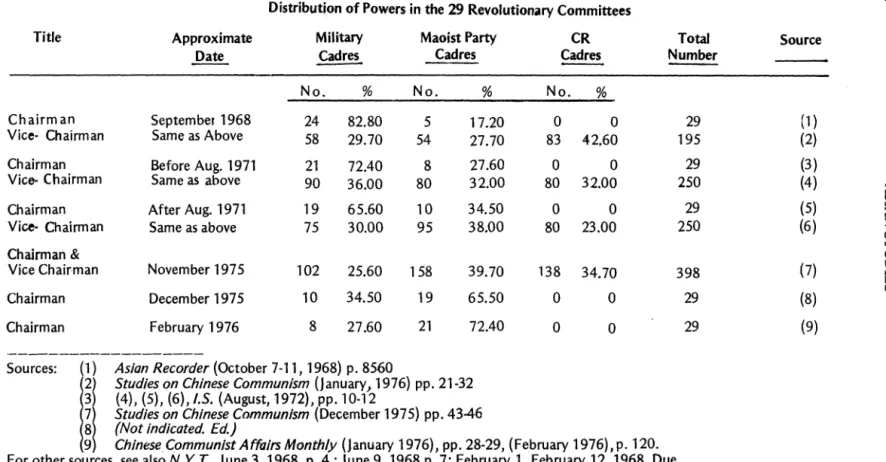
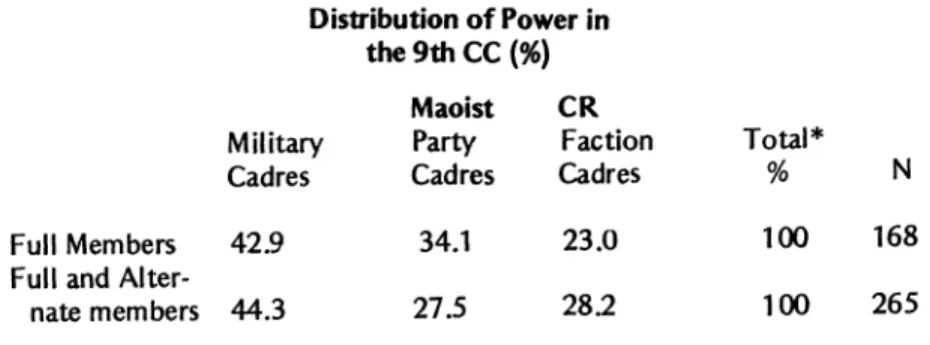
The launch of the CR and the subsequent military intervention was to eliminate the Lin/Teng faction in the party apparatus. These steps were clearly taken by the Maoist faction to reduce the power of the army. The reduction of the power of the army in the central government organization: the council of state.
The new State Constitution adopted at the 4th People's Congress contains new provisions to ensure the power of the party. The reduction of the power of the army in the regional and district military apparatus. The reduction of the power of the military in the civil and party apparatus: the removal of civil and party forces from the regional and.
The reduction of the power of the military in the civil and party apparatus: the reorganization of. But the purge of the Lin faction and the re-emphasis of the party's centralized leadership reversed the trend. Power distribution in each of the 29th Revolutionary Committees (Chairman and Vice-Chairmen) (Approximate date: December 1975).
70 ASIAN STUDIES
72 ASIAN STUDIES
In fact, eight of the eleven current military regional commanders are either directly or indirectly related to the former Second Field Army.6 3Therefore, Teng's reinstatement could win the sympathy and support of the military cadres of the Maoist faction to ensure the successful purge of the Lin faction. In summary, therefore, the essential role played by arrny has long been emphasized and appreciated by the Chinese leaders. Thus, the military intervention under the CR was initiated by the party chairman and ordered by the party's central committee.
Immediately after the CR, when military representation became too overwhelming and Lin Piao reportedly became too ambitious, Mao decided to purge Lin and his faction. To ensure effective neutralization of the Lin faction and smooth transition of power, Teng and his supporters were reinstated. The attacks on Teng began almost immediately after the transfer; of all regional military commanders and the purge of the Lin faction were completed.
In 1971, the fall of Lin also coincided with the completion of the purge of the Liu/Teng faction. In April, less than two months after Hua Kuo-feng, a member of the CR faction, was appointed Acting Premier after Chou's death, the Beijing riots occurred. On April 5, a crowd estimated at 30,000 to 100,000 people gathered in Tiananmen Square in Beijing, protesting against Teng's transition as acting Prime Minister.
Immediately after the riot, Teng was dismissed from all his party and government positions, including Politburo member, Vice Chairman of the Party, First Vice Prime Minister and Chief of Staff of the Army. Attacks on Teng intensified and Teng's name was mentioned for the first time.65. Currently, the question to be answered is whether the Maoist faction can once again rely on the military to ensure their leadership over the Teng faction.
74 ASIAN STUDIES
But it is doubtful whether the CR faction alone can maintain the party's centralized leadership. They are members of the PLA, but at the same time they are in charge of the party apparatus in the PLA. For example, on April 6, 1967, an order from the Commission on Military Affairs severely limited the army's power.
However, by early September of that year, the army had regained most of its powers; see People's Daily, September 17, 1967. 1005; For a complete list of members and deputies, see "Analysis of the Newly Elected 9th Central Committee of the CCP" Ibid. For the 10th Party Congress, see Fang Chun-kuei, "An Analysis of the Chicom Tenth Central Committee," Studies on Chinese Communism (September, p.
Lung Fei, "An Analysis of the Personnel of the CCP's Tith National Congress," Ibid., p. Although attempts were immediately made to formalize the council's operations, military representation remained strong. See also Chou Tzu-ch-tang, "An Analysis of the Chinese Communist Military Area System" I.S.
56 Apparently the Maoist faction is still concerned about the remaining members of the Lin faction. Therefore, as of April 1976, there is no evidence that any of the eleven commanders had refused to participate in the criticism of Teng. Whether his death is related to any attempts by the Maoist faction to eliminate possible military dissidents remains a mystery.
CUMULATIVE SUBJECT INDEX
Document of Understanding between the National Museum's Division of Anthropology and the University of the Philippines' Department of Anthropology. China's diplomacy through art: a discussion of some of the archaeological and art findings in the People's Republic of China. A bibliography of material available in the Institute of Asian Studies library on South and East Asia (as of June 1964).
Theoretical aspects of the history of Southeast Asia; John Bastin and the study of Southeast Asian history. The conversion of the Alani by the Franciscan missionaries in China in the fourteenth century.
LLO MOVEMENT
Reflections on the migration theory towards the arrival of Indian influences in the Philippines. Some Recent Investigations into the Structure-Function of Conflict Gangs in the Manila City Jail. Southeast Asia and the scramble of the great powers for influence in the Indian Ocean.
The destruction of the Indonesian political party system - the PNI during the early years of Guided Democracy. Sair nona fientje de feniks; an example of popular Indonesian fiction in the first quarter of the century. The problem of personal pronouns in Bahasa Indonesia and the presentation of the words: nia, and ia.
INTERNATIONAL RELATIONS The Erosion of the Bipolar Power Structure in the 1960s: Its Impact on East Asian International Politics. Japanese Colonialism and Korean Economic Development Japan and the Indian National Army during World War II.
LA-MADRAS TRADE
Sair nona fientje the phoenix; an example of popular Indonesian fiction in the first quarter of the century.
NYAYA
SECRET SOCIETIES - LEGISLATION Government legislation for Chinese secret societies in the Straits Settlements in the late 19th century. A bibliography of materials available in the University of the Philippines library system on the modern history of Southeast Asia. The Erosion of the Bi-Polar Power Structure in the 1960s: Its Impact on East Asian International Politics.
The Contributors
ARTICLE CONTRIBUTIONS ARE ACCEPTED FROM READERS. ) SUBSCRIPTION RATES
TO CHANGE WITHOUT PRIOR NOTICE) Domestic Foreign
PAPERBOUND
ARTICLE CONTR VI
Dealer: U. P. Press/Please address all communications to: c/o Univ.. of the Philippines Press, Basement, Gonzalez Hall, U. P. DilLman, Quezon City). The PCAS publishes a quarterly journal, Asian Studies, an annual journal, Lipunan, a monograph series, occasional papers, as well as a separate book program. Upon submission of their manuscripts to PCAS and upon decision by the PCAS to publish, authors are presumed to have agreed to their manuscripts, layout designs, etc.
For uniformity of style, manuscripts should conform to the style of footnotes and bibliographic forms outlined in Kate Turabian's Manual for Writers. The PCAS accepts no responsibility for the loss of, or damage to, unsolicited manuscripts, photographs, illustrations and other material. Authors whose articles have been published in Asian Studies are entitled to a fee of five hundred pesos ('P'SOO.OO) for each article.
Authors of approved and published books and monographs are entitled to royalties determined by the Editorial Board. Authors of book reviews are entitled to a maximum compensation of P'l 00.00, the exact amount to be determined by the Editor-in-Chief.