A MODEL OF LANNA BOUTIQUE SMALL HOTEL'S SERVICE QUALITY, CUSTOMER SATISFACTION AND PERCIEVED VALUE INFLUENCING BEHAVIORAL INTENTION, A CASE
STUDY OF CHIANG-MAI, THAILAND
Nutthaporn Wongprateep
A Dissertation Submitted in Partial
Fulfillment of the Requirements for the Degree of Doctor of Philosophy (Integrated Tourism and Hospitality
Management)
The Graduate School of Tourism Management National Institute of Development Administration
2021
A MODEL OF LANNA BOUTIQUE SMALL HOTEL'S SERVICE QUALITY, CUSTOMER SATISFACTION AND PERCIEVED VALUE INFLUENCING BEHAVIORAL INTENTION, A CASE
STUDY OF CHIANG-MAI, THAILAND Nutthaporn Wongprateep
The Graduate School of Tourism Management
Major Advisor (Assistant Professor Watsida Boonyanmethaporn, D.HTM)
The Examining Committee Approved This Dissertation Submitted in Partial Fulfillment of Requirements for the Degree of Doctor of Philosophy (Integrated Tourism and Hospitality Management).
Committee Chairperson (Assistant Professor Siyathorn Nakphin, D.HTM)
Committee (Professor Therdchai Choibamroong, Ph.D.)
Committee (Associate Professor Suwaree Namwong, Ph.D.)
Committee (Assistant Professor Sangkae Punyasiri, D.B.A.)
Committee (Assistant Professor Watsida Boonyanmethaporn, D.HTM)
Dean (Assistant Professor Paithoon Monpanthong, Ph.D.)
_____/_____/_____
ABST RACT
ABSTRACT
Title of Dissertation A MODEL OF LANNA BOUTIQUE SMALL HOTEL'S SERVICE QUALITY, CUSTOMER SATISFACTION AND PERCIEVED VALUE INFLUENCING BEHAVIORAL INTENTION, A CASE STUDY OF CHIANG-MAI, THAILAND Author Miss Nutthaporn Wongprateep
Degree Doctor of Philosophy (Integrated Tourism and Hospitality Management)
Year 2021
The service quality model of a small boutique hotel in Lanna style: a case study of Chiang Mai province. The purpose of the dissertation is to study and analyze the confirmatory factor analysis components of service quality that affect the perceived value, customer satisfaction, and behavioral intent. To test the structural equation model of the service quality factor of a small boutique hotel in Lanna style affects behavioral intentions. To suggest the service quality model of a small boutique hotel in Lanna style.
The quantitative method was used in this research. The data was collected using questionnaires, and the sample group consisted of 400 customers who used the service at the Lanna boutique hotel. The data was analyzed by percentage, mean, and standard deviation using the table to present, describe and analyze the data collected from the sample group. For example, the collected data included a personal profile, customer service information, and levels of opinion on service quality, perceived value, customer satisfaction, and behavioral intention. Inferential statistics and Structural Equation Modeling (SEM) were used to analyze the structural equation model for service quality factors of a small boutique hotel in Lanna affecting the behavioral intention.
The results of the service quality model of small boutique hotels in Lanna are as follows: 1. service quality consists of courtesy with a weight of factor loading 0.97, communication with a value of 0.97. Credibility has a weight of 0.97 and access has a value of 0.96. Understanding has a weight of 0.94, and reliability has a weight of 0.93. The perceived value consists of service quality value with a weight of 0.98,
reputation value with a weight of 0.97, and emotional value with a weight of 0.97.
The conditional value has a weight of 0.96, and the functional value has a weight of 0.94. Customer Satisfaction consists of the place of service weighing 0.98, and service quality of expected (SQE) weighing 0.97. Communication and coordination of the service provider were weighted at 0.97, and physical evidence was weighted at 0.97.
The process was weighted at 0.97, and promotion was weighted at 0.97. Behavioral Intention consisted of a period of usage with a weight of 0.97, first-in-mind with a weight of 0.96, and price tolerance with a weight of 0.95.
The implication of this study includes that service quality should be developed with service personnel skills and service mind in the Lanna boutique style, based on 3 main factors, namely hospitability, communication, and understanding. Moreover, the service designs are based on 3 main factors: credibility, accessibility, and reliability to raise the standard of professionalism in the Lanna service style.
The perceived value aspect should be flexible hotel policies established. The hotel can be amended according to the uncertain situation and managed to design a customer experience that aligns with customer expectations and satisfaction to create a unique experience. It enhances a feeling of simplicity, which is the charm of the unique Lanna service style.
Customer satisfaction consists of two elements. First, the management of the front of the house should focus on 3 factors, namely the location of the service, the service environment, and the promotion of service recommendations. In addition to outstanding design and decoration that is unique to Lanna. The hotel needs to pay attention to standards of cleanliness, hygiene, and marketing promotion. Second, the management of back-of-house should focus on 3 factors: service process communication and coordination of service providers; the quality of service expected by customers; and applying the appropriate service innovations to the small hotel business, in boutique Lanna style.
Behavioral intention: when creating a customer experience management strategy, hotels should take the opportunity of using the services of their customers to make an impression. The hotel employs personal marketing tools to support the process and combines systematic analytics technology to be able to offer services and
v products that meet the customer’s needs. The important things are honesty, sincerity, and unethical business opportunities to provide customers with fair prices. The quality of products and services is appropriate to maintain standardized services to manage customer expectations.
ACKNOWLEDGEMENT S
ACKNOWLEDGEMENTS
This dissertation will not be completed without many important people around me. Firstly, I would like to thank my advisor Assistant Professor Wasida Boonyanmethaporn, D.HTM, who gave me advice and many meaningful guidances.
Secondly, thank you to my PH.d. 8 classmates, who have been very supportive and helpful during this journey.
Thanks to my family who is always there for me. My family gives me loves and supports that I need in both good and difficult times. Finally, special thanks to my husband who has been through this dissertation journey. All the help and support he gave me was very meaningful and it got me to where I am today.
Nutthaporn Wongprateep August 2022
TABLE OF CONTENTS
Page
ABSTRACT ... iii
ACKNOWLEDGEMENTS ... vi
TABLE OF CONTENTS ... vii
LIST OF TABLES ... xi
LIST OF FIGURES ... xiv
INTRODUCTION ... 1
1.1Background and Significance of the Research ... 1
1.2Problem Statement of the Research ... 7
1.3Gap of the Research ... 10
1.4Research Questions ... 11
1.5Research Objectives ... 11
1.6Scope of the Research ... 12
1.6.1Scope of Content ... 12
1.6.2Scope of Area ... 12
1.6.3Scope of Population ... 12
1.6.4Scope of Time ... 12
1.7Expected Benefits ... 12
RELATED CONCEPTS THEORIES AND RESEARCH RESULTS . 14 2.1Concepts and Theories about Service Quality ... 15
2.1.1Background of Service Quality ... 15
2.1.2Definition of Service Quality ... 16
2.1.3SERVQUAL ... 18
2.1.4Service Quality and Customer Satisfaction ... 21
2.2Concepts and Theories about Customer Perception Value ... 39
2.2.1Definition of Customer Perception Value ... 39
2.2.2Perception theory ... 41
2.2.3The Perception Process Consisted of the Following Steps ... 42
2.2.4Haracteristics and Factors of Perception ... 43
2.2.5Measure of Perception Value ... 44
2.3Concepts and Theories about Customer Satisfaction ... 65
2.3.1Satisfaction Meaning ... 65
2.3.2Related to Satisfaction Theories ... 70
2.3.3Affecting Satisfaction Factors ... 71
2.4Concepts and Theories about Behavioral Intention ... 91
2.4.1Definition of Consumer Behavior ... 91
2.4.2Planned Behavior Theory and Rational Action Theory ... 94
2.4.3Elements of Customer Behavior ... 101
2.5Information about a Small Boutique Hotel in Lanna, a Case Study of Chiang Mai………. ... 102
2.5.1The Meaning of a Small Boutique Hotel ... 102
2.5.2Components of a small hotel business ... 104
2.5.3Meaning and Characteristics of a Boutique Hotel ... 110
2.5.4Information about a Small Boutique Hotel in Lanna, Chiang Mai ... 113
2.6Related Documents and Literatures ... 119
2.6.1Service Quality Factor Affects the Perceived Value Factor ... 119
2.6.2Service Quality Factors Affecting Customer Satisfaction ... 121
2.6.3Service Quality Factors Affect Behavioral Intention ... 130
2.6.4Perceived Value and Customer Satisfaction Factors ... 134
2.6.5Perceived Value Factors Affect Behavioral Intention ... 137
2.6.6Customer Satisfaction Affects Behavioral Intention ... 141
2.7Final Conclusion ... 144
CONCEPTUAL FRAMEWORK AND RESEARCH METHODS .... 147
3.1Research Conceptual Framework ... 148
3.2Research Hypothesis ... 148
3.3Operational Definition ... 149
3.4Population and Sample ... 150
3.5Research Instruments ... 151
3.6Testing of Research Instruments ... 153
3.7Data Collection ... 154
3.8Data Analysis ... 155
DATA ANALYSIS RESULTS ... 163
4.1Resultofthe Study and Analysis of Service Quality Influencing Perceived Value Customer Satisfaction and Behavioral Intention of a Small Lanna Boutique Hotel,Case Study Chiang Mai ... 164
4.1.1Results of the Analysis of Demographic and Behavioral Characteristics of the Respondents ... 164
4.1.2Results of the Analysis of Mean and Standard Deviation of the Respondents……….. ... 172
4.1.3Analysis Results Confirmatory Factor Analysis of Service Quality Influencing Perceived Value Customer Satisfaction and Behavioral Intention……… ... 207
4.2The Results of the Structural Equation Model of Service Quality of a Lanna Small Boutique Hotel, Case Study Chiang Mai Province Influencing Behavioral Intention ... 216
4.3Results of a Structural Equation Model of Service Quality of a Small Lanna Boutique Hotel, a Case Study of Chiang Mai Province ... 228
SUMMARY OF FINDINGS, CONCLUSION AND RECOMMENDATIONS ... 230
5.1Summary of Research Results ... 232
5.2Discussion the Research Results ... 237
5.3Suggestions for Applying the Research Results ... 274
5.3.1Research Findings and Recommendations for Utility ... 274
5.3.2Service Quality ... 275
5.3.3Perceived Value ... 276
5.3.4Customer Satisfaction ... 277
5.3.5Behavioral Intention ... 279
5.3.6Strategic Suggestions ... 280
5.4Suggestions for the Next Research ... 283
BIBLIOGRAPHY ... 284
BIOGRAPHY ... 302
Page
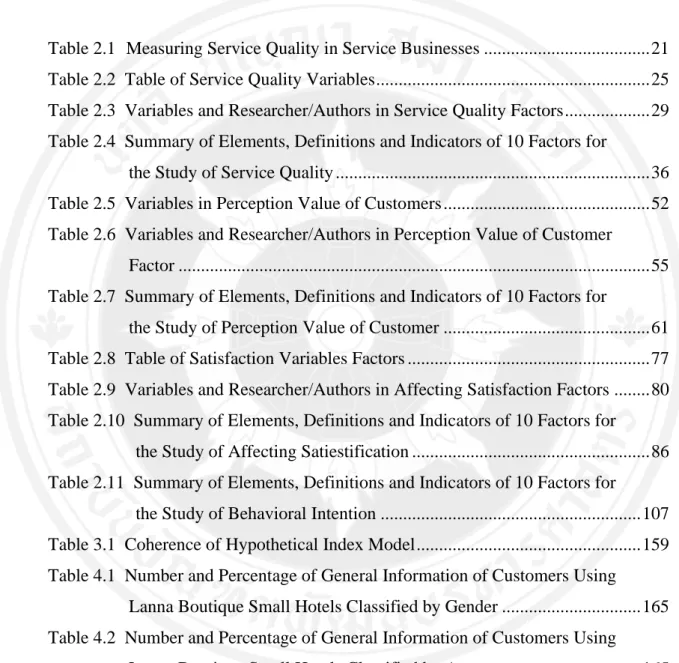
Table 2.1
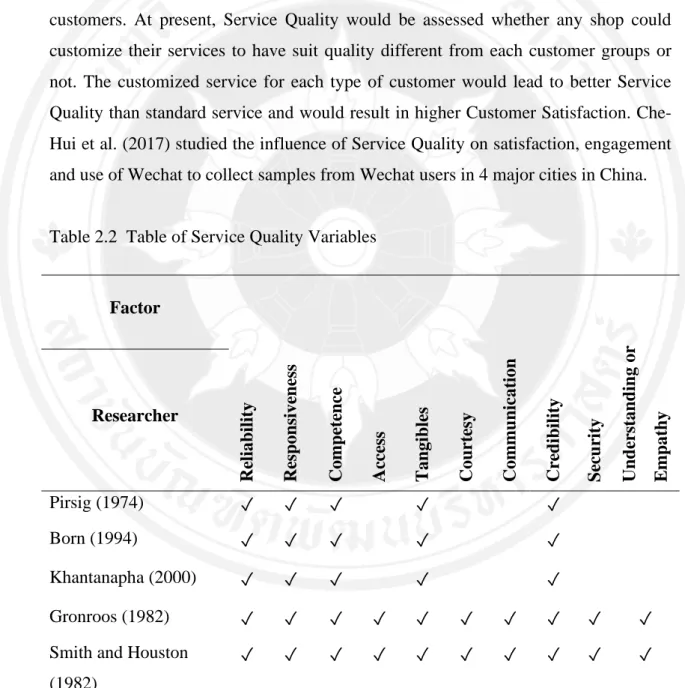
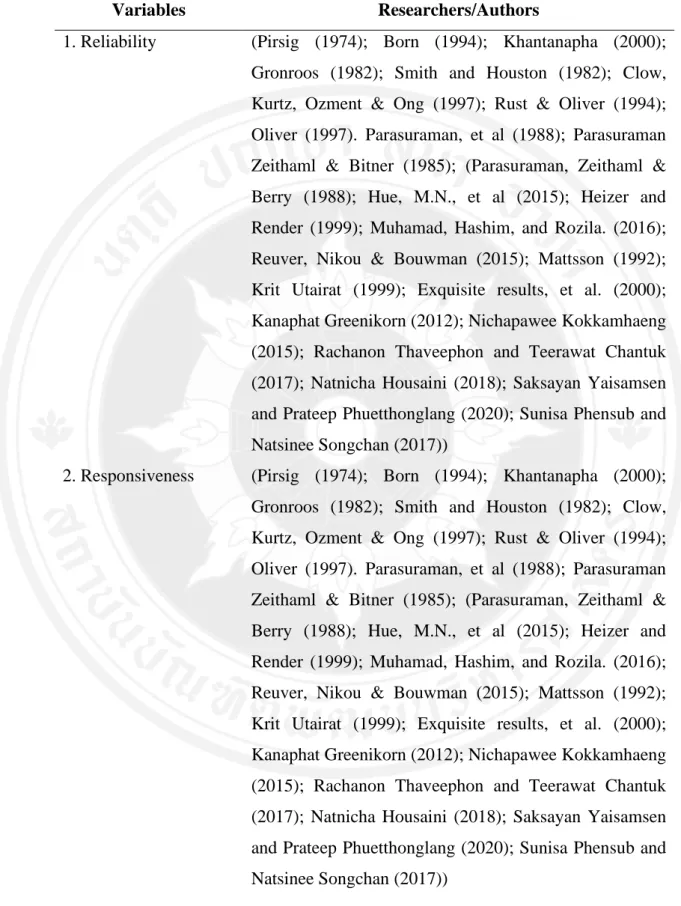
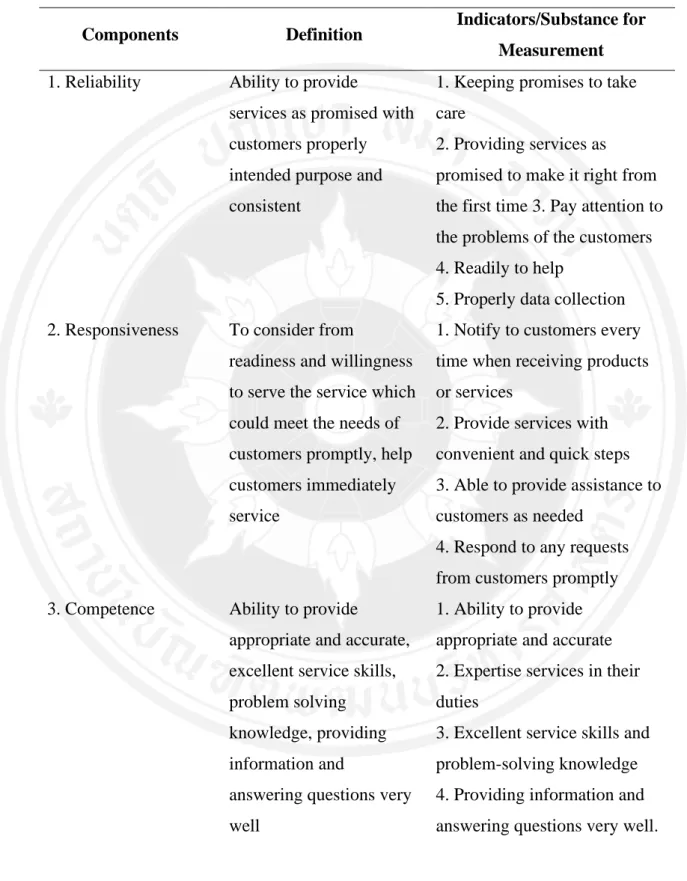
Measuring Service Quality in Service Businesses ... 21 Table 2.2 Table of Service Quality Variables ... 25 Table 2.3 Variables and Researcher/Authors in Service Quality Factors ... 29 Table 2.4 Summary of Elements, Definitions and Indicators of 10 Factors for
the Study of Service Quality ... 36 Table 2.5 Variables in Perception Value of Customers ... 52 Table 2.6 Variables and Researcher/Authors in Perception Value of Customer
Factor ... 55 Table 2.7 Summary of Elements, Definitions and Indicators of 10 Factors for
the Study of Perception Value of Customer ... 61 Table 2.8 Table of Satisfaction Variables Factors ... 77 Table 2.9 Variables and Researcher/Authors in Affecting Satisfaction Factors ... 80 Table 2.10 Summary of Elements, Definitions and Indicators of 10 Factors for
the Study of Affecting Satiestification ... 86 Table 2.11 Summary of Elements, Definitions and Indicators of 10 Factors for
the Study of Behavioral Intention ... 107 Table 3.1 Coherence of Hypothetical Index Model ... 159 Table 4.1 Number and Percentage of General Information of Customers Using
Lanna Boutique Small Hotels Classified by Gender ... 165 Table 4.2 Number and Percentage of General Information of Customers Using
Lanna Boutique Small Hotels Classified by Age ... 165 Table 4.3 Number and Percentage of General Information of Customers who
use the Service at Small Lanna Boutique Hotel, Chiang Mai Province Classified by Status ... 166
Table 4.4 Number and Percentage of General Information of Customers who use the Service at Lanna Boutique Small Hotels Classified by
Educational Level ... 166
Table 4.5 Number and Percentage of General Information of Customers who use the Service at Small Lanna Boutique Hotel, Chiang Mai Province Classified by Occupation ... 167
Table 4.6 Number and Percentage of General Information of Customers who use the Service at Small Lanna Boutique Hotel, Chiang Mai Province Classified by Monthly Income ... 168
Table 4.7 Number and Percentage of Length of Stay Data ... 169
Table 4.8 Number and Percentage of Hotel Stay Data ... 169
Table 4.9 Number and Percentage of Room Rate Data ... 170
Table 4.10 Number and Percentage of Information for the Purpose of this Stay ... 171
Table 4.11 Number and Percentage of Booking Methods Information ... 171
Table 4.12 Number and Percentage of Data on Frequency of Use of Small Boutique Hotels in Lanna, Chiang Mai Province ... 172
Table 4.13 Results of the Analysis of the Mean and Standard Deviation of the Respondents in Terms of Service Quality ... 173
Table 4.14 Results of the Mean and Standard Deviation of Perceived Value Respondents ... 181
Table 4.15 Results of the Analysis of the Mean and Standard Deviation of the Customer Satisfaction Survey Respondents (Customer Satisfaction) .... 189
Table 4.16 Results of the Mean and Standard Deviation of Behavioral Intention Respondents ... 200
Table 4.17 Abbreviated Descriptions of the Results of the Corroborated Conformity Test of the Service Quality Model of Small Boutique Hotels in Lanna, a Case Study of Chiang Mai Province ... 207
Table 4.18
Sample Correlation value, Structural Model of Service Quality of a Small Lanna boutique hotel case study of Chiang Mai Province ... 218
Table 4.19
Standardized Residual Covariances Structural Model of Service Quality of Lanna Boutique Small Hotels Case Study ofChiang Mai Province ... 220
Table 4.20
Results of Regression Weights and Significant Values Structural Model of Service Quality of Lanna Boutique Small Hotels
Case Study of Chiang Mai Province ... 222 Table 4.21 Results of Standardized Regression Weights Structural Model
of Service Quality of Small Lanna Boutique Hotels Case Study of
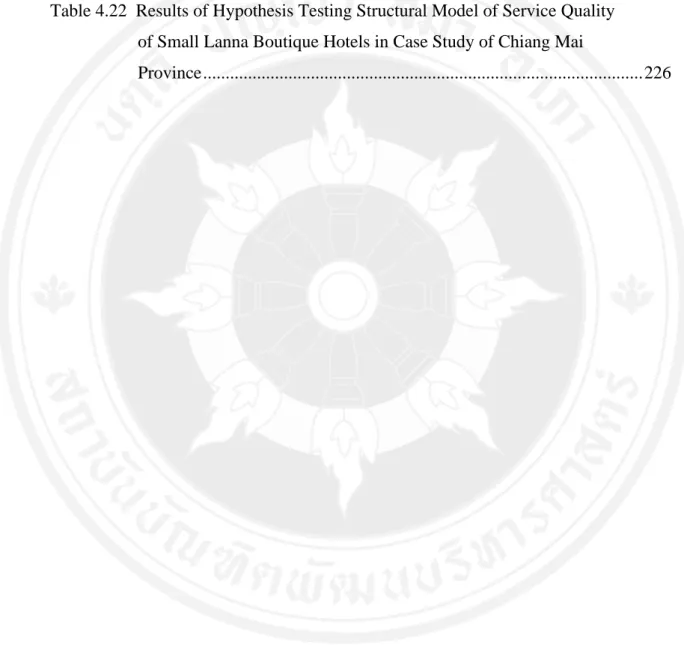
Chiang Mai Province. ... 224 Table 4.22 Results of Hypothesis Testing Structural Model of Service Quality
of Small Lanna Boutique Hotels in Case Study of Chiang Mai
Province ... 226
Page
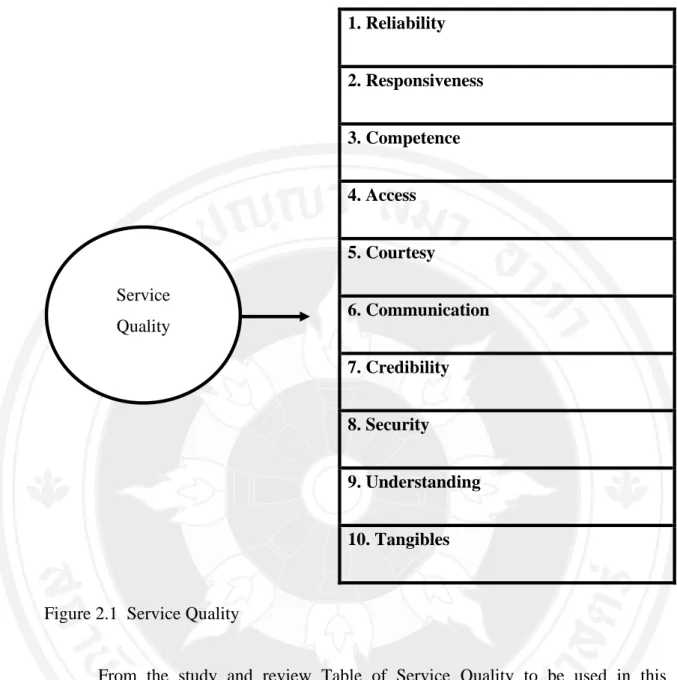
Figure 2.1 Service Quality ... 28
Figure 2.2 Showed the Perspective of the Consumption Value Measurement ... 50
Figure 2.3 Variable and Researcher/Authors in Perception Value of Customer ... 54
Figure 2.4 Affecting Satisfaction Factors ... 80
Figure 2.5 Theory of Planned Behavior ... 95
Figure 2.6 Research Conceptual Framework ... 146
Figure 3.1 Research Hypothesis ... 148
Figure 4.1 The Results of the Corroborative Factor Analysis (Confirmatory Factor Analysis, CFA) Service Quality (Not Fit) ... 209
Figure 4.2 Confirmation Factor Analysis Results (Confirmatory Factor Analysis, CFA) in Terms of Service Quality (Fit) ... 210
Figure 4.3 Confirmation Factor Analysis Results (Confirmatory Factor Analysis, CFA), Perceived Value, Not Fit ... 211
Figure 4.4 The Results of the Corroborative Factor Analysis (Confirmatory Factor Analysis, CFA) Perceived Value (Fit) ... 212
Figure 4.5 Confirmation Factor Analysis Results (Confirmatory Factor Analysis, CFA) Customer Satisfaction Satisfaction) that is Not Fully Formed (Not Fit) ... 213
Figure 4.6 The Results of the Corroborative Factor Analysis (Confirmatory Factor Analysis, CFA) Customer satisfaction Satisfaction (Fit) ... 214
Figure 4.7 The Results of the Corroborative Factor Analysis (Confirmatory Factor Analysis, CFA), Behavioral Intention, Not Fit ... 215
Figure 4.8 Confirmation Factor Analysis Results (Confirmatory Factor Analysis (CFA) on Behavioral Intention (Fit) ... 216
Figure 4.9 Structural Model Analysis of Service Quality of Small Boutique Lanna Hotels case study of Chiang Mai Province that has not been Fully Formed (Not Fit) ... 217 Figure 4.10 Structural Model of the Service Quality of a Small Lanna
Boutique Hotel in Case Study of Chiang Mai Province ... 225 Figure 4.11 Results of Hypothesis Testing, Structural Model of Service
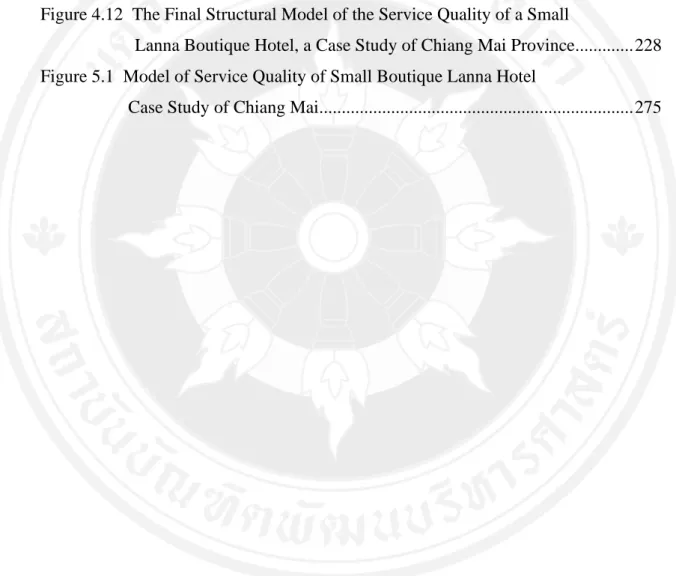
Quality of Small Boutique Hotels in Lanna Case Study of Chiang Mai Province ... 227 Figure 4.12 The Final Structural Model of the Service Quality of a Small
Lanna Boutique Hotel, a Case Study of Chiang Mai Province... 228 Figure 5.1 Model of Service Quality of Small Boutique Lanna Hotel
Case Study of Chiang Mai ... 275
INTRODUCTION
1.1 Background and Significance of the Research
The hotel and accommodation industry are very important to Thai economy.
They are a part of the service and tourism industry. Thai tourism industry can divide into 3 groups of service providers, the first group is hotels and accommodations, the second group is airlines and transportation and the third group is tour company. All three groups had a high correlation. (Puey Ungphakorn Economic Research Institute, 2020) Hotel business (hotels, resorts and guesthouses) was the business related to tourism sector which was Gross Domestic Product (GDP) in accommodation and food services activities. In 2019, its valued of 1.03 trillion-baht, 6.1% of the country's GDP. In the hotel and accommodation industry, there were more than 1.6 to 1.7 million rooms nationwide, caused employment more than 1.5 million job positions. In 2019, under normal circumstances, there were more than 40 million tourists visiting in Thailand per year before the corona virus epidemic. Total tourist income was 2.8 trillion baht, of which 61% came from foreign tourists and 39% came from Thai tourists. The tourism sector generated a lot of income for the country from foreign tourists each year, accounting for 65% of total income (data in 2019). Because of foreign tourists had higher expense per capita and longer stays compared to Thai tourists. Thai tourists’ revenues approximately accounted for 35% of total tourism revenue. Apart from the main tourist provinces such as Bangkok, Chonburi (Pattaya) and Phuket, Thai tourists were interested in the tourism business and hotels moreover, in other tourist provinces such as Chiang Mai, Prachuap Khiri Khan (Hua Hin), Rayong, Kanchanaburi, as well as the central provinces of the region such as Nakhon Ratchasima, Phitsanulok, and Khon Kaen including other secondary cities such as Buriram, Chiang Rai, Tak, Phetchabun, Nakhon Sawan, Sukhothai, Lampang, Mae Hong Son, and Nan. Due to the government has pushed more plans to promote
tourism in various areas, such as in secondary cities consist of transportation routes development and airports in many regions. So, this has led more investment in hotel to expanse business in the provincial centers and in the tourist cities such as Chiang Mai, Krabi, and Koh Samui (Suratthani Province), resulting in an increase number of rooms nationwide from 540,088 rooms in 2013 to 784,118 rooms in 2019. There was an average growth of 6.5% per year with both Thai and international hotel chain.
Then when considering the number of hotels and rooms found that it continued to grow in accordance with the tourism sector. During 2015 to 2019, number of foreign and Thai tourists had continued to expand, resulting in an increase average occupancy rate nationwide respectively was average at 68.8%. Supporting factors were 1) Increase number of direct and charter flights including the growth of low-cost airlines 2) Tourism promotion measures, such as the exemption of VOA fees for tourists from 21 countries. Thai tourists traveled within country in 2019 with 166 million trips, equal to 2018. Causing of the domestic tourist market was not expand and mainly due to Thai outbound tourists (Krungsri Research Center, 2019)
In 2020, tourism and hotel businesses around the world faced Covid-19 epidemic crisis which caused governments in many countries around the world to impose lockdown measures to control international flight. As a result, number of tourists around the world shrink severely unprecedented especially in the Asia-Pacific region such as Singapore (-85.1%), Thailand (-83.2%), South Korea (-85.6%) and Japan (shrinkage almost 90%). From the study of this conditions and trends of the hotel and accommodation industry, it was found that before the COVID-19 crisis Thailand's hotel and accommodation industry is already experiencing oversupply. In order to, a crisis occurs, this problem is exacerbated. Entrepreneurs have to close their businesses and slow down investment in tourism business especially highly popular provinces of foreign tourists such as Chiang Mai, Phuket, Phang Nga, Krabi and Surat Thani (Thai Hotels Association, 2020). Hotels and accommodations industry must adapt and take opportunities during the Covid-19 crisis to penetrate the market mainly in domestic tourists, especially Thai tourists with high purchasing power who normally preferred to travel abroad (Thai outbound tourists) but they unable to travel abroad. In addition, the government has a policy to promote domestic tourism for reducing measures, preventing the spread and issuing measures to stimulate tourism,
such as “We Travel Together” including government measures to support the seminars in hotels. Entrepreneurs were accelerating for continuing their business (TMB Economic Analysis Center, 2020).
Thai tourism and hotel businesses still rely on Thai tourists to drive their business due to the fact that many countries still have strict measures, travel abroad is still limited. As a result, Thai tourists tend to travel more in the country. In addition, the tourism behaviors have changed according to the COVID-19 epidemic situation which affects the travel of Thai tourists. The Thai tourist’s proportion who has traveled domestically since the epidemic in early 2020 is 43.7 percent. From Thai tourist’s behavior found that travel style, there is a greater proportion of car use especially traveling as a family. A closer destination is selected by choosing a destination within the province, travel duration, the number of days per trip, changed to travel only one day trip (not stay overnight). The frequency of travel decreased to travel within the country 1 to 2 times per year. Budget used is an overall proportion of spending which has decreased but there are additional expenses in the category of travel or the costs associated with being more careful such as choosing restaurants which have better quality and more standard. Interest in the form of tourism products has changed, is namely natural tourism. Tourism products are likely gain more popularity during the Covid-19 period because there is low risk, provide peace, relaxation, health tourism focuses on therapeutic activities which avoid exposure.
Sustainable tourism got more attention during the Covid-19 situation, travel by faith and believe helps in matters of mental dependency. In conclusion, Thai tourists have overall tourism behaviors was “Traveling in Thailand, traveling near and safe travels.” 1) Choose to travel in the country first even if able to travel abroad and the risk of infection from aboard is higher than Thailand. 2) Short trips, drive away, as driving is a safer way to travel and safety from infection. 3) Unseen travel had less crowded due to popular travel source. People in the country may have been there and is less crowded making it safer from infection.
For behaviors related to accommodation choice during COVID-19, travelers are paying more attention to the service quality and the accommodation environment which includes a selling point corner of the accommodation. The selling point will impress, affects the experience of the guests and also has an indirect effect to promote
the hotel from the image being shared via social media, divided into 4 areas as follows: 1) Types of accommodation are popular which are: Beautifully decorated in small hotel and famous on social media, famous hotel chain and accommodation in the tourist community 2) The important factor choice is to be decorated beautifully, clean according to standards and being a new hotel 3) Media or sources affect the decision to stay are social media which presents various tourist attractions with articles and pictures. 4) Interested tourist’s provinces is Chiang Mai, Prachuap Khiri Khan (Hua Hin) and Chonburi Province 5) Online channels have a huge role in the tourist experience by starting from searching for tourist attractions and accommodation information via social media then booking accommodation through online channels both directly the operator's website or booking through various accommodation booking platforms online or online travel agencies such as Agoda, Booking, Traveloka, etc. then including rating and reviewing accommodation after the stay (Kasikorn Research Center, 2021).
Chiang Mai is a famous province for tourism and is a popular tourist destination for both Thai and foreign tourists. Chiang Mai is a province with potential in tourism both nationally and globally. There is uniqueness of the Lanna people with a variety of tourism forms, styles and convenience such as restaurants and hotels.
Chiang Mai Province has been recognized as an important tourist destination by tourists around the world. The tourism awards are: 1) in 2017, the “World’s Best Cities” award, the 3rd most attractive city of the world by Travel and Leisure magazine, and Asia's number one "Asia Best Cities" award from the rankings of Travel and Leisure magazine 2) in 2018 "The world's Best cities 2016" award, the 2nd best city of the world from Travel and Leisure magazine 3) the number one tourist- friendly city in 2020 (Chiang Mai) from Condé Nast Traveler Magazine which is a travel magazine of the United States. Moreover, in 2019, there were 11,165,860 tourists coming to Chiang Mai, 7,691,453 Thais and 3,474,407 foreigners with the number of incomes from tourism about 110,670 million baht, separated into Thais of 67,321.49 million baht and foreigners of 43,438.84 million baht. From the tourism overview report of the Ministry of Tourism and Sports in 2019, there are 39.7 million tourists traveling in Thailand, generating tourism income approximately 1.93 trillion baht. While 166 million Thai tourists travel within the country, worth 1.08 trillion
baht which Chiang Mai got top 3 of the highest tourism revenue along with Bangkok Chiang Mai and Phuket. Based on the proportion of tourist numbers and tourism revenue, Chiang Mai is one of the most popular destinations among Thai tourists with a proportion of more than 65% and is an important area which generates income from Thai tourists. If counting in 2019 before the outbreak of COVID-19, Chiang Mai received tourism revenue from Thai tourists in one hundred billion baht. (Chiang Mai Provincial Development Plan, 2021)
For the hotel and accommodation business in 2020, Chiang Mai had total number of 545 guesthouses, resorts and hotels decreased in 2019 from 1,498 hotels and accommodation 36,819 rooms with a period of stay 2.19 days with an occupancy rate of 70.56% (Chiang Mai Tourism and Sports Office, 2021). Chiang Mai is a famous for its boutique hotels which is unique and has many medium and small hotel businesses. At present, the hotel business in Chiang Mai has a wide variety, including one to five stars hotels, interbrand hotels, boutique hotels, and hostels. Small hotels are located in the Old City and Nimmanhaemin Road. which is growing fast resulting in higher competition (Upper Northern Hotel Association, 2019). The competition in the hotel business tends to more intense from competitors in the same business group.
As hoteliers continue expand their investments in the main tourist areas and regional center cities both the investment itself and the management (Most of them are big ones with hotel chains). Competition from goods and substitute services such as apartments, serviced apartments and condominiums both from the large number of surplus rooms and the increasing number of replacement rooms as well as being occupied platforms by rental sharing customer, so entrepreneurs need to work hard to sustain their businesses through strategies such as optimal cost management, increase revenue from other channels, paying more attention to safety and sanitation. Then the most important is preparing and changing the service model to associate with Thai tourists who become the main customers for hotel business in Chiang Mai especially Thai tourists in the age range of 23-40 years or Generation Y, who are expected to be the first group to travel after the COVID-19 situation is better. Most of tourist’s behavior prefer to stay in medium-small hotels which are near adjacent to tourist attractions and the price is not too high (The Government Savings Bank Research Center, 2020).
In additional, from the forecast of tourism and hotel businesses recovering due to as a result of vaccines development and many countries around the world already vaccinated to their population, caused the number of infected people to decrease accordingly. As a result, the Thai government began to decrease preventive measure and measures on opening the country to support partial and full tourists in the future.
It is expected that many foreign tourists will choose Thailand as the first country in traveling by the Krungsri Research Center has analyzed the factors affecting the hotel business in the future with mainly in 4 areas consist of 1) Demographic and social change 2) tourism adaptation to meet individual needs. (Individualization) 3) the adoption of technology to change the business model and the automatic control system (Digital transformation and automation) and 4) Health and hygiene at first.
The number of Thai tourists is likely to recover because of the factors supported by the government's measures stimulate domestic tourism while the number of foreign tourists gradually recovered as countries Like Thailand, it tends to promote tourism in the country first. (Krungsri Research Center, 2021)
From the above information, it was discovered that Chiang Mai is an important in the dimension of being a tourism destination for both foreign tourists and Thai tourists then in the dimension of being an important area to generate tourism revenue from both Thai and foreign tourists. Tourism has always affected to hotel and accommodation businesses due to the declining number of hotels and the fierce competition in the hotel business, coupled with the changing behavior of tourists in accordance with the situation of the COVID-19 epidemic, resulting in the traditional business operation may not be sufficient to meet the changing needs of tourists.
Therefore, the hotel business should speed up the adjustment to be able to continue the business and the most important to drive hotel business in ever-changing era. It is inevitable that there is a matter of maintaining service quality standards to generate income and create competitiveness in the business. How to fully meet the needs of accommodation customers? How to make users feel and aware the real quality of service? Then what will affect to the satisfaction, the perception of the values and intent behavioral that customers have for hotels which will support the hotel business to develop sustainably. Therefore, entrepreneurs should adapt their business strategy adjustments, service quality improvement and must be maintained excellent service
standards as well as building connections with other sectors in the tourism and hospitality industry or even the local community because of hotel business success had not come not only from location, rooms, price and amenities. If it still comes from cooperation with other communities and businesses, ability to adapt and risk management and a change in business practices emphasize the adoption of modern technology including attention to health and hygiene, finding the uniqueness of the business. For this reason, the researcher realizes the importance of studying a model of service quality of a small boutique hotel in Lanna, a case study in Chiang Mai.
1.2 Problem Statement of the Research
Improving the quality of service is the heart of the drive hotel and accommodation business especially small hotel businesses need to pay more attention.
Service quality is a key factor to differentiate the competition because good service quality will be able to create satisfaction for customers. Due to the increasingly intense competition in the business, hotel businesses in all areas still compete intensely from oversupply both from the same business as hoteliers continue to expand their investments in the main tourist areas and the regional center cities. Both the investment itself and the management, most of them are large companies with network or hotel chains) Competition from substitute products, services and other types of accommodation services such as apartments and condominiums are still available for daily rentals and most of them have lower average rental prices or it is an Airbnb startup that has a high growth rate and is a real threat to the hotel business.
Due to the lower price and a variety of accommodation styles to choose from intense competitive situation made service quality and service standards, are to increase competitiveness and it's a way to get your business out of the price competition. It is an important thing to develop a different service model and a standardized quality of service that can create a different experience. This makes entrepreneurs face to challenges in the design of service processes with uniqueness, be more unique and more importantly able to fully meet the needs of customers in terms of quality of service which can create satisfaction and create a customer experience with the interaction with the business at the same time.
In the present, customer behavior is complex and constantly changing both from the spread of COVID-19, trend of globalization, technological advances and current market competition have resulted in many businesses focusing on the development of new products and services to keep up with the needs of consumers.
This situation has resulted in many hotel businesses undergoing changes in many dimensions. Today, tourists' behaviors regarding accommodation selection are different from the past, Kasikorn Research Center (2018), which states that from the tourism promotion of the Tourism Authority trend in Thailand made tourists like to seek accommodation in an informal way but it is comfortable, clean and a unique experience both the appearance of the architecture, service model, atmosphere inside and accommodation outside is different from the big hotels or other accommodation.
From the travel expectations of the new generation tourists have changed, a hotel is not just a place to sleep but it is another travel experience and conducting surveys about the tourist’s behavior in COVID era, the data from global booking accommodation Tripadvisor.com platform which states that the tendency for tourists to travel after COVID-19 at first is the closest place near home to eat local food, local camp or traveling within the country. International tourism came in second associated with one of UNESCAP's economic analysis teams analyzing the future of tourism after COVID-19 that more people will turn to domestic tourism because of concerns about the spread of the virus while cannot be expected from the large group because after this, travel will change to small group more or travel by yourself (Tripadvisor, 2021) The most important factor is the quality of service and the environment of the accommodation which includes the corner of the accommodations with a selling point which will make an impression, can be shared via social media and influences the guest experience (Kasikorn Research Center, 2021).
By Lewis & Bloom (1983), defined service quality states that service quality is the heart of any service business. It is also a direct experience about the brand which consumers receive. Improving the service quality in any field will help customers feel more satisfied. Then service quality is also an indicator to the level of service which is delivered from service provider to service recipient which how well of the service relates to the needs of the service provider (Kanapat Greenikorn, 2012).
The delivery of quality service means responding to service recipients based on their
expectations by Gronroos (1982), has classified the definition of service quality into two aspects: 1. Technical quality relating to results or what the recipient receives from that service. It can be measured as an assessment from product quality and 2.
Functional quality is about assessment process related to Crosby (1988) which a service quality is a concept based on the service operation principle without defect, respond to the needs of service providers and able to know the needs of customers or service recipients as well. Parasuraman, Zeithaml, and Berry (1988) conceptualized criteria for assessing service quality which consist of 5 aspects. There are Tangibles Service, Reliability Service, the aspect of ensuring the Assurance Service, the perception Empathy perception of customers and the responsiveness to the customer's needs. This service quality assessment has also developed a tool to measure the service business of restaurants, gas stations, service businesses and hotel service quality. However, there are some researchers who have developed research and created tools from service quality which consists of 3 dimensions: 1) Employee behavior 2) Tangible and 3) Information technology. Kaura, Durga Prasad, and Sharma (2015) and Krit Utairat (1999) has defined 10 dimensions which are (1) Reliability (2) Responsibilities (3) Ability (4) Accessibility to services (5) Politeness and hospitality (6) Communication (7) credibility (8) safety (9) understanding and know customers in real and (10) tangible or concrete service.
From the study above, the trend of competition in the hotel business is intense due to the increasing of hotel numbers leading to oversupply. In addition, the behavior of consumers has changed and become more complex. The development of a new service quality model is a great importance in terms of building competitiveness. The development of this research result also increases the research findings on the model of service quality about small boutique hotels in Thailand research case. This research focuses on the quality of service in small boutique hotels in Lanna. A case study of Chiang Mai is an important tourism destination of Thailand generating income from tourists. Service quality also created a valuable, differentiated, and satisfied experience for the customer which is an interesting finding. The researcher therefore recognizes the importance of this research.
1.3 Gap of the Research
Considering the importance of service quality to increase the competitiveness of the small hotel business from service quality issues, literature reviews, research and related document, are a study of the service quality in a small hotel is about service quality of hotel businesses in various studies. But it is found that most of the research is the study of service quality in large hotels and affects to satisfaction by using a study of service quality in the 5 main dimensions of Parasuraman, Zeithaml, and Berry (1988), it was found that 1) Reliability 2) Assurance 3) Tangibles 4) Empathy 5) Responsiveness. Moreover, it is a study of service quality as a guideline for hotel service development. (Thanasit Suksuth, 2012; Naret Hanpitakkul, 2009; Atthiya Tangkosakul, 2011; Nat Nicha Housaini, 2018; Rachanon Thaveephol, 2017;
Rachanon Thaveephol & Teerawat Chantuk, 2017; Saksayan Yaisamsen & Prateep Phuetthonglang, 2020).
In addition to, most of the research has not focused on finding structural correlations or structural equations. It is a study to see which factors of service quality affect to satisfaction only. Some studies will expand on the issue of bringing the service quality discovered to further study on affecting brand loyalty issue and reuse is mostly found that there was still a lack of overview education. Moreover, there is no study of aimed at developing a service quality model in the hotel business both in a small hotel and the type of hotel in a boutique style has not yet been discovered.
Especially in the Lanna, there are no such research findings including there is a lack of studies on other value perception factors. From the study found only product value and monetary value which does not cover Behavioral Intention and not yet at the stage of developing model of small hotel service quality specifically to the small boutique hotel business in Lanna Such studies have not yet been found.
It can be seen that in this study which the integration of concepts, theories, and knowledge in order to discover the phenomena that occur. The aim of this research was to explore the relationship of the structural equation of service quality affecting the Perceived Value, Customer Satisfaction, and Behavioral Intention which are to test the structural equation in service quality factors model and to suggest a service quality model of a small boutique hotel in Lanna. A case study of Chiang Mai is from
the literature review, articles, research and books about the service quality in a variety of educational issues. Therefore, this is the origin of a study about service quality of a small boutique hotel in Lanna which is a case study of Chiang Mai to meet the needs of service recipients. Then the number of tourists both Thais and foreigners tend to continue increase including a guideline for improving service quality for small hotel boutique Lanna entrepreneurs in Chiang Mai by focusing on research according to the following research questions.
1.4 Research Questions
This research has the research questions as follow;
1) Structural equation relationship of service quality how affecting Perceived Value, Customer Satisfaction, and Behavioral Intention.
2) Structural equation model for service quality what factors of small boutique hotels in Lanna, case study of Chiang Mai consists of.
3) Model of service quality of small boutique hotels in Lanna, how case study of Chiang Mai should be and what is the reason.
1.5 Research Objectives
1) To study and analyze the corroborating elements of service quality which affect the Perceived Value, Customer Satisfaction, and Behavioral Intention of a small boutique hotel in Lanna, a case study of Chiang Mai.
2) To test the structural equation model for service quality factors of a small boutique hotel in Lanna, a case study of Chiang Mai affecting Behavioral Intention.
3) To suggest a model of service quality of a small boutique hotel in Lanna, a case study of Chiang Mai.
1.6 Scope of the Research
In this research, the researcher has defined the research scope as follow;
1.6.1 Scope of Content
The scope of content in this research aims to study the causal model of service quality that affects the perception of value, customer satisfaction and Behavioral Intention of a small boutique hotel in Lanna, is the case study of Chiang Mai. From a literature review on the concept, theories and research include Service Quality, Perceived Value, Customer Satisfaction, and Behavioral Intention.
1.6.2 Scope of Area
Scope of Area for causal models on service quality affects the Perceived Value, Customer Satisfaction, and Behavioral Intention of a small boutique hotel in Lanna, in the area of Chiang Mai.
1.6.3 Scope of Population
The Scope of Population in this research is customers who use the service at Lanna Boutique Hotel in Chiang Mai. The sample group used in this research consisted of 400 people.
1.6.4 Scope of Time
Scope of Time of this research study is planned to take one year to complete.
1.7 Expected Benefits
1) Small Lanna Boutique Hotel’s Entrepreneurs
(1) Small Lanna boutique hotel entrepreneurs can apply the results of their studies to apply in their business to improve service quality and increase their competitiveness in the business.
(2) Results of a model recommendation in service quality of a small boutique hotel in Lanna, a case study of Chiang Mai. It is beneficial to entrepreneurs as a guideline for planning a business strategy.
(3) Small Lanna Boutique Hotel Entrepreneurs get a service quality model to make them aware of customer satisfaction factor which this is a good result for entrepreneurs to apply the results and develop in direct way.
(4) Research results, Lanna Boutique Hotel entrepreneurs can be used as a model for business management in succeed.
2) Private and Government Agencies
(1) Northern Thai Hotels Association able to apply knowledge of service quality model and disseminate as knowledge to entrepreneurs in other provinces.
(2) The government sectors can be a guideline in formulating policies to support the development of service quality in small hotel businesses correctly and appropriately.
(3) Government and private sectors can create indicators to develop service standards for small hotels in Lanna provinces.
(4) Educational agencies can use the research results to be further developed in the next research.
(5) Educational agencies have more knowledge of the quality of service in the hotel business which can increase the ability to compete in the business.
(6) This research able to help to fill the gap in the research on service quality of small boutique Lanna hotel businesses and to enhance competitiveness.
RELATED CONCEPTS THEORIES AND RESEARCH RESULTS
This research focused on studies research to propose a service quality model of a small boutique hotel in Lanna, a case study of Chiang Mai which able to help industrial, government and private sectors involved in the tourism and hospitality industry, to develop a service quality model of a small boutique hotel in Lanna, was a case study of Chiang Mai and to apply in the properly and appropriate service quality management to the area Therefore, the researcher has compiled the concepts, theories and related research to present as follows 2.1 Concepts and related to Service Quality theories. 2.2 Concepts and related to Perception of Customer Value theories. 2.3 Concepts and theories related to Customer Satisfaction to explain and support concepts and theories of affecting customer satisfaction factor including the concepts and theories of Behavioral Intention. 2.4 Concepts and theories of Behavioral Intention to explain the factors and behavioral indicators which factors and indicators should be. 2.5 Information about a small boutique hotel in Lanna, was a case study of Chiang Mai. and Related Documents and Literatures. Thus, in this chapter 2 concepts, theories and research results were presented in details were as follows:
2.1 Concepts and theories about Service Quality
2.2 Concepts and theories about Customer Perception Value 2.3 Concepts and theories about Customer Satisfaction 2.4 Concepts and theories about Behavioral Intention
2.5 Information about a small boutique hotel in Lanna, a case study of Chiang Mai
2.6 Related documents and literatures
2.1 Concepts and Theories about Service Quality
2.1.1 Background of Service Quality
Quality abled to consider from many perspectives, field of knowledge and various characteristics of economic, social, marketing, psychology and management research. Quality was a technical which was recently very important to senior management, was a fundamental of creating competence management and competitiveness for the organization which had been attracted over the past few decades. Then quality was the attribute of thoughts and statements which were believed to produce the expected results. The abstraction of this quality made it difficult to define what quality mean. This is because quality was often a word to consider in relation to itself (Pirsig, 1974; Born, 1994; Khantanapha, 2000).
A well-known academician defined quality definition was widely recognized such as Joseph Juran was the Master of Quality Management who suggested concept of quality management systems throughout the organization. A former professor at the Massachusetts Institute of Technology (MIT) had argued that quality was the practicability and extension of a product's succeed (goods or services). In respondent to purposes and goals of usage throughout period of product or service usage mean easy to understand which was a Conformance to requirement and quality was the expectation of customers or service recipients with that service. In conclusion, quality was the best product and service which were valuable and appropriate to meet the needs of customers and was due to the comparison between expectations and perceptions of the service and product, if the customer used the service as expected (Crosby, 1982; Ziethaml, Parasuraman, & Berry, 1990).
In terms of Service Quality was a comparison between Customer Expectations in products or services with their actual perception. If customers or service recipients saw that those products or services were the best and meet their expectations, it could be considered that products or services had quality. The Service Quality was classified as a point of view on quality along with explaining that Service Quality was control to ensure the Service Quality which was different from quality in the production of goods or products. However, the method of quality control of the service was so difficult because the service was be less regulated or managed but at
the same time it was very important. In a certain way, the quality level obtained from the service, prediction was often impossible because it depended on many factors including behavior of the delivery person, image of the organization by the customer would be inspector since the starting service process until the end of the service. The service would be better, if the customers evaluated to the service at that time. From academician mentioned about their views, the study of Service Quality was an important issue and it is an important qualitative perspective which deserved attention (Ross, Goetsch, & Davis, 1997; Juran & Gryna, 1998; Hutchins, 1985; Zeithaml, Parasuraman, & Berry, 1990).
2.1.2 Definition of Service Quality
Service Quality was customer comparison between Customer Expectations and what customers got from the product or service. Service Quality was the customer's decision about the overall excellence and beyond expectations including effective management. Service quality required a clear understanding of what customer service was. Providing good Service Quality to customers affected to reliability which allowed for word-of-mouth advertising of customers to attract new customers to get the service. However, Service Quality was developed from trust and responding to the needs of customers which could affect to use service again and again by consumer. In conclusion, Service Quality was expectation-WHAT THEY WANT and perception-WHAT THEY GET.
Lovelock (2001) defined Service Quality as a level of service which created Customer Satisfaction. That service must be able to adequately meet the needs, wants and expectations of the customers. According to the service was Intangibility, Service Quality was caused by the comparison between Service Expectations and Service Perceptions. If the customers received the service as their expected, it showed that the service had quality (Juran & Gryna, 1988). Service Quality happened in the point of view from customer perception and was a personal opinion in the Subjective. So it was different in each individual (Parasuraman, Zeithaml, & Berry, 1988). In addition, Lewis and Bloom (1983) told that the Service Quality was a measure in service level with how well delivered from service providers to meet needs of service recipients.
Service quality was the heart of service business and also a direct experience about
the received brand which consumers received. Improving the Service Quality in any aspect would help customers to feel more satisfied (Kanapat Greenikorn, 2012).
Lewis, and Bloom (1983) defined Service Quality as an indicator of how well the service level delivered by service providers to customers or service recipients to meets their needs. The delivery of Quality Service mean, responding to customers based on their expectations by (Gronroos, 1982, 1990, p. 17). We could classify Service Quality into 2 types: 1) Technical Quality was about results or what the customer received from that service. It could be measured as product quality assessment, and 2) Functional Quality was related to evaluation process, consistent with (Crosby, 1988) told that “Service Quality” was a concept based on the principle of defect-free service operation. and respond to the needs of service providers and be able to know the needs of customers or service recipients as well.
Parasuraman et al. (1993) suggested that Service Quality was what customers abled to judge the trust to product or service. Hirschman (1970) told that the Service Quality of the product would be assessed by customers as good or not good in comparison with product or other services. Parasuraman, Zeithaml, and Berry (1985) suggested that Service Quality often occurred during service delivery with interactions between customers and contact persons from the company. There were ten dimensions in following 1) Reliability 2) Responsibilities 3) Competence 4) Accessibility 5) Politeness and Courtesy 6) Communication 7) Creditability 8) Safety 9) Understanding customers and 10) Tangible or Tangible Service (Gronroos, 1982;
Smith & Houston, 1982; Clow, Kurtz, Ozment, & Ong, 1997; Rust & Oliver, 1994;
Oliver, 1997; Parasuraman, et al., 1988; Parasuraman, Zeithaml, & Bitner, 1985). In a study from Thai academics by Weerapong Chalermjirarat (2000), Service Quality was consistency of customers or service recipients needs or the service ability level to meet the needs of customers or service recipients which made customers or service recipients satisfied from the received service. Somwong Pongsataporn (2007) suggested that Service Quality was the attitude which the service recipient collected expected information which they would receive from the service. If it was at an acceptable level, service recipients would satisfy with the service which there were different levels to individual expectations and satisfaction, as evaluation results of received service at that time. Therefore, the Service Quality was necessary to satisfy
the customer in repeat service according to if customers received good service, consumers would satisfy with the service and affect to customer use the service again in the next time.
2.1.3 SERVQUAL
Wisher and Corney (2001) said that Service Quality. There was an important study direction which was the analysis called SERVQUAL. In order to, the two academicians suggested that Service Quality was a diagnostic decision on superiority of the service and SERVQUAL. In the process of providing services, a business expectation was Customer Satisfaction to the received service. Therefore, in order to making customers aware to the Service Quality, Parasuraman, Zeithaml and Berry (1988) developed the basic factors which customers used in determining Service Quality, resulting in only 5 factors of service quality as follows: 1) Tangible 2) Reliability 3) Responsiveness 4) Assurance 5) Empathy.
Hue et al. (2015) studied the Service Quality (SERVQUAL 5 Dimensions) affecting the Customer Satisfaction of the hotel service customers in Vietnam which collected data from 33 3-star hotels. From the study results found that Service Quality was correlated with High Customer Satisfaction and Service Quality which had an important role to ensure that customers had high satisfaction in the business service.
In addition, there was a study of Krit Utairat (1999) that further described about Service Quality as 10 indicators as follows: 1) Competence to provide appropriate services and had expertise in duties 2) Courtesy, politeness, humble, honorable and maintain manners with customers 3) Communication abled to convey messages related with what customers want to know and answer all questions 4) Creditability of customers (personality, posture and fluency) 5) Customer Understanding in compassion, pay attention to customers or the public 6) Reliability in management standards 7) Responsiveness to respond with feelings and needs 8) Access Easily 9) Security had tools or control methods in incidents which may occur.
10) Tangibles could tactile and perceptible because service was different from product. Customers could assess the product value before making a purchasing decision by their senses but customers could not assess a service. Because of the service was intangible. To build confidence to customers by offering Service Quality
was therefore important. Different characteristics of products and services made creation Service Quality was different from general product quality. There was someone suggest about Service Quality theory in many theories such as Service Triangle (ST) Theory which was fundamentals to success of Service Quality in Mckensy's 7S Theory and overall Service Quality Management Theory.
Moreover, there was an extended study of 10 indicators of Service Quality as follows: 1) Reliability included stability of the characteristics and ability to dependency. This mean that the organization had to do the right customer service the first time, as well as to honor its commitments. 2) Responsiveness about the willingness or readiness of employees to provide timely customer service. 3) Competence referred to skills and knowledge needed for employees to use in the service 4) Access included the ability to access the service and easy to communication 5) Courtesy included health, respect, considerate and friendliness to contact with people 6) Communication listened to information and opinions from customers and willing to be friendliness with polite words and easy language to understand considering the difference of customer level 7) Credibility included trust, reliability and honesty 8) Security mean safety from harm, all risks and concerns 9) Understanding or knowing the customer included trying to understand the customer's truly needs. 10) Tangibles referred to all manners, gestures, and postures in service.
For providing services to meet succeed of the service must be able to offer high Service Quality to be consistent and uninterrupted. That was, it must be able to respond to Customer expectation at the same or higher-level which customer.
Expected (Gronroos, 1990; Heizer & Render, 1999; Pranatphonkrung et al., 2000;
Krit Utairat, 1999).
For measuring Service Quality in service businesses had developed a instrument to assess Customer Perceptions of Service Quality in service and retail business to be used as a guideline to improve the Service Quality, called SERVQUAL. SERVQUAL was one of the famous measures. Later, it was found that the Degree of Correlation between such variables was quite high, so the assessment criteria of Service Quality were adjusted with a total of 5criteria. In each of criteria was defined instrument to measure Service Quality levels consisting of 22 items, distributed according to the following criteria: (Gronroos, 1990; Heizer & Render,
1999; Zuithaml, Bitner, & Gremler, 2006; Parasuraman, Zeithaml, & Berry, 1985;
Muhamad, Hashim, & Rozila, 2016; Kanaphat Greenikorn, 2012; Nichapawee Kok Kamhaeng, 2015; Praewphon Krang et al., 2000; Krit Utairat, 1999).
1) Tangibles were physical characteristics which abled to see and customers could perceive it from the five senses which made convenient to customers such as tools, equipment, service personnel and environment including tools used for communication. There were four related questions such as modern equipment and tools which had convenient facilities inside the shop, staffs dressed properly and shop has a beautiful decoration.
2) Reliability means the ability to provide services as promised properly and consistently to the customers and intended purpose. It consisted of 5 related questions which were keep the promises, pay attention to the customer's problems, ready to help and provide service as promised from proper data collection.
3) Responsiveness mean service providers have readiness and willingness to serve which able to meet the needs and help customers promptly, Immediate and fast service. There were 4 related questions which were notify to the customers when received products or services, when service was provided convenient and fast, it would able to provide assistance as needed and responding to requests from customers promptly.
4) Assurance refers to able to create confidence to customers and service providers which must demonstrate skills and knowledge with polite, gentle, serve with integrity. This leaded to build the customer got trust. There were 4 related questions such as having trust employees, customers got safe, employees were polite and employees were committed to their work.
5) Empathy means caring and giving interested to the customers according to different needs of the individual customers. It consisted of 5 related questions such as providing intimate and friendly services, employees take care the customers, know their needs well and always think about the benefits of the customers. The dividing factors theory which influenced the perception of Service Quality consisted of 5 dimensions (Mattsson, 1992) as follows: (1) Reliability (2) Timeliness (3) Accessible (4) Humane: Pleasant to Use (5) Choice, Cost.
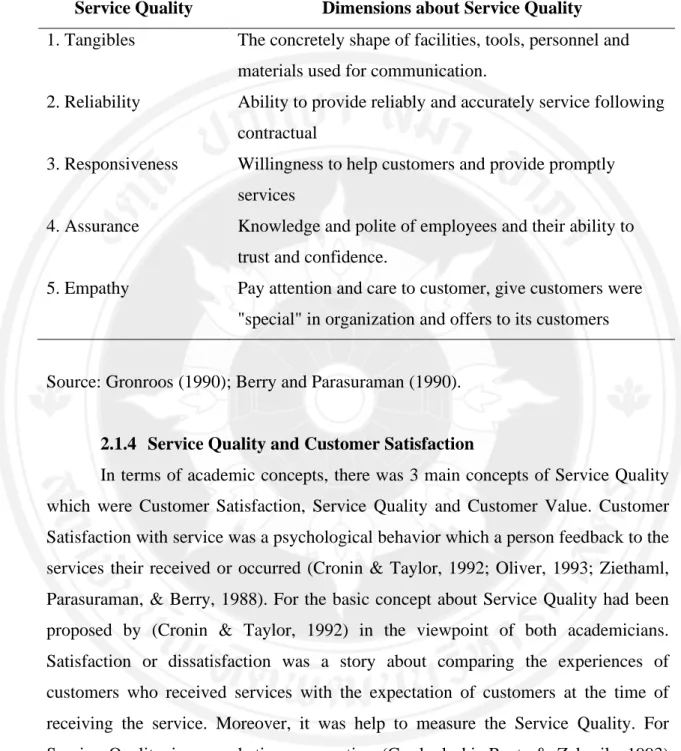
Table 2.1
Measuring Service Quality in Service Businesses
Service Quality Dimensions about Service Quality 1. Tangibles The concretely shape of facilities, tools, personnel and
materials used for communication.
2. Reliability Ability to provide reliably and accurately service following contractual
3. Responsiveness Willingness to help customers and provide promptly services
4. Assurance Knowledge and polite of employees and their ability to trust and confidence.
5. Empathy Pay attention and care to customer, give customers were
"special" in organization and offers to its customers Source: Gronroos (1990); Berry and Parasuraman (1990).
2.1.4 Service Quality and Customer Satisfaction
In terms of academic concepts, there was 3 main concepts of Service Quality which were Customer Satisfaction, Service Quality and Customer Value. Customer Satisfaction with service was a psychological behavior which a person feedback to the services their received or occurred (Cronin & Taylor, 1992; Oliver, 1993; Ziethaml, Parasuraman, & Berry, 1988). For the basic concept about Service Quality had been proposed by (Cronin & Taylor, 1992) in the viewpoint of both academicians.
Satisfaction or dissatisfaction was a story about comparing the experiences of customers who received services with the expectation of customers at the time of receiving the service. Moreover, it was help to measure the Service Quality. For Service Quality in a marketing perspective (Cordupleski, Rust, & Zahorik, 1993) defined that Service Quality was an extension of the service, service process and service organizations which able to meet theory need or satisfy the expectations of each person. The fundamental concept at Service Quality was be viewed through this service satisfaction. It was supported by another academician (Bitner, 1992) who
described the research which had been studied. Service Quality could be measured through Customer Satisfaction.
Kitapci, Akdogan, and Dortyol (2014) studied on the impact of Service Quality which affected to satisfaction. Intention to return using the service again and word of mouth in the public healthcare industry found that Service Quality influenced to Customer Satisfaction (Reuver, Nikou, & Bouwman, 2015). Study about the relationship of cost, Service Quality, trust and loyalty in the smartphone industry research result found that Service Quality influenced with trust (Patterson, Doucette, Urmie, & McDonough, 2013). Study in the relationship between Pharmacy services effected on incentives and patient satisfaction research result showed that Service Quality influenced to Service Quality satisfaction. It was a conceptual and practical of assessing of customers by comparing expectation service and perception service from the service provider. If the service provider could provide services to meet the needs of customers or create a higher level of service than the customers expected. This would result in Service Quality which made the Customer Satisfaction greatly (Zeithaml, Parasuraman, & Berry, 1988; Fitzsimmons & Fitzsimmons, 2004;
Napaporn Khantanapha, 2000; Kotler & Anderson, 1987; Parasuraman, Ziethaml, &
Berry, 1985). It pointed out that Service Quality was service exceeds their need or meets the expectations of customers. It is a matter of evaluating or expressing opinions about service excellence as a whole. In dimension of perception, research results of this academician group saw that assessing the Service Quality as perceived of consumers related in form of attitude comparison to expected service and perceived service. In conclusion is providing Service Quality mean providing services were consistent with the expectations of service recipients or consumers on a regular basis.
Therefore, service satisfaction was direct related to meet expectations or not meeting expectations of the consumer itself.
As a concept (Buzzell & Gale, 1987) the Service Quality was a great interest and importance. There was research which investigated consumer behavior and consumer expectation, found that Service Quality was a complex depended on the point of view of the consumer refer to as “Customers”. Customer Expectations (Ziethaml, Parasuraman, & Berry, 1990) following this academician group Service Quality was a consumer assessment of the excellence or superiority of a service.