The Effects of Thailand Country Images on Chinese Tourist Behavioral Intention in Thailand
Yao Youyin
A Thesis Submitted in Partial Fulfillment of Requirements for degree of Master of Business Administration in Marketing Management
June 2020
Copyright of Mahasarakham University
ผลกระทบของภาพลักษณ์ประเทศไทยที่มีต่อเจตนาเชิงพฤติกรรมของนักท่องเที่ยวชาวจีนใน ประเทศไทย
วิทยานิพนธ์
ของ
Yao Youyin
เสนอต่อมหาวิทยาลัยมหาสารคาม เพื่อเป็นส่วนหนึ่งของการศึกษาตามหลักสูตร ปริญญาบริหารธุรกิจมหาบัณฑิต สาขาวิชาการจัดการการตลาด
มิถุนายน
2563ลิขสิทธิ์เป็นของมหาวิทยาลัยมหาสารคาม
The Effects of Thailand Country Images on Chinese Tourist Behavioral Intention in Thailand
Yao Youyin
A Thesis Submitted in Partial Fulfillment of Requirements for Master of Business Administration (Marketing Management)
June 2020
Copyright of Mahasarakham University
The examining committee has unanimously approved this Thesis, submitted by Miss Yao Youyin , as a partial fulfillment of the requirements for the Master of Business Administration Marketing Management at Mahasarakham University
Examining Committee
(Dr. Prathanporn Jhundra-indra ,
D.B.A.)
Chairman
(Assoc. Prof. Pornlapas Suwannarat , Ph.D.)
Advisor
(Dr. Rattanawadee Sonthiprasat , Ph.D.)
Co-advisor
(Dr. Narissara Sujchaphong , Ph.D.)
Committee
(Asst. Prof. Nikorn Yasamorn , Ph.D.)
External Committee
Mahasarakham University has granted approval to accept this Thesis as a partial fulfillment of the requirements for the Master of Business Administration Marketing Management
(Asst. Prof. Nitipong Songsrirode ,
Ph.D.)
Dean of Mahasarakham Business School
(Assoc. Prof. Krit Chaimoon , Ph.D.) Dean of Graduate School
D
ABST RACT
TITLE The Effects of Thailand Country Images on Chinese Tourist Behavioral Intention in Thailand
AUTHOR Yao Youyin
ADVISORS Associate Professor Pornlapas Suwannarat , Ph.D.
Rattanawadee Sonthiprasat , Ph.D.
DEGREE Master of Business Administration
MAJOR Marketing Management UNIVERSITY Mahasarakham
University
YEAR 2020
ABSTRACT
The context of a slowdown in global economic growth, many countries have taken up the development of tourism, especially inbound tourism. This represents an important engine to stimulate their economic growth and many countries even pursue this as a nation-building strategy. Tourism plays a supporting role in the Thai economy, and Chinese tourists are the main customers of Thai inbound tourists. The purpose of this study is to ascertain the Thailand Country Images and to study Behavioral Intention of Chinese tourists in Thailand. As well, this study finds the relationship between Country Images and Behavioral Intention of Chinese tourists in Thailand and discovers the influence of Country Images on Behavioral Intention. The variations of the perception of Country Images and Behavioral Intention according to different demographic background have also been studied.
After obtaining 400 valid questionnaires of Chinese tourists in Thailand and analyzing data with SPSS17.00, via descriptive statistical analysis and inferential statistical analysis: t-test, ANOVA, MANOVA, correlation and regression analysis.
The factor loading indicates twelve dimensions (National System, National Capacity, National Characteristic, National Relationship, Environment Conditions, Landscape and Environment Attractions, Atmosphere Attractions, Activity Attractions, Services Facilities Attractions, Commodity, Price and Value, Perceived Image and Satisfaction) of Thailand Country Images, which are important to Behavioral Intention with three dimensions (Consumption Intention, Recommendation Intention and Revisit Intention).
This study concludes: 1) Thailand Country Images significantly correlate with Behavioral Intention of Chinese Tourists. 2) Thailand Country Images significantly influence on Behavioral Intention of Chinese tourists. 3) The variations of perception of Thailand Country Images of Chinese tourists can be found according to gender, ages, marital status, monthly income, level of education, style of travel and experience about traveling in Thailand of Chinese tourists; 4) The variations of Behavioral Intention of Chinese Tourists can be seen according to gender, ages,
E
marital status, monthly income, level of education, style of travel and experience about traveling in Thailand of Chinese tourists.
This study results provide applicable suggestions for policy maker as well as tourism managers both in national or regional levels to develop better country images and marketing programs for sustainably attract and retain Chinese tourists into the ASEAN country of Thailand.
Keyword : Country Images, Behavioral Intention, Thailand Tourism
F
ACKNOWLEDGEMENT S
ACKNOWLEDGEMENTS
The four years during university life as a MBS student majors in Marketing Management of Mahasarakham Business School, is of great importance and deep influence on my academic career.
From the preparation of the thesis to finish it, I have received the assistance and encouragement from a great number of people. Primarily, I would like to express my thankful to my supervisor, Associate Professor Dr. Pornlapas Suwannarat for his patient guidance, useful advice as well as spiritual encouragement in the process of my writing.
Moreover, I would like to express my sincere thanks to my vice supervisor Dr.
Rattanawadee Sonthiprasat, her attitude to academic researches left me a deep impression which is beneficial to my following academic career. Besides, my thanks wants to extend to all professors in MBS who influence me deeply during the study of post-graduation. In addition, to all classmates and friends who provide me many relevant materials and advice of the thesis for me.
Lastly, I would like to thank the director and friends of Watsratong Municipal School who always give me both spiritual and physical support.
Yao Youyin
TABLE OF CONTENTS
Page ABSTRACT ... D ACKNOWLEDGEMENTS ... F TABLE OF CONTENTS ... G LIST OF TABLES ... I LIST OF FIGURES ... R
CHAPTER I INTRODUCTION ... 1
Background ... 1
Purpose of the Study ... 3
Importance of the Study ... 4
Framework of the Study ... 5
Scope of the Study ... 6
Hypotheses of the Study ... 7
Terminology ... 7
CHAPTER II RELEVANT LITERATURE ... 12
General Situation of Thailand Tourism Industry ... 12
Overview of Chinese Tourists in Thailand ... 16
Overview of Country Images ... 20
Overview of Behavioral Intention ... 37
Related Research ... 47
CHAPTER III STUDY METHOD ... 51
Population and Sample ... 51
Tools Used in Study ... 52
Creating and Developing Tools ... 53
Data Collection ... 54
Data Analysis ... 54
H
Statistics Used in Study ... 56
CHAPTER IV THE ANALYSIS OF DATA ... 57
Symbols Used in Presenting Data Analysis Results ... 57
Agenda in Presenting the Data Analysis Results ... 58
Analysis of the Data ... 59
CHAPTER V THE PURPOSE OF STUDY, SUMMARY, DISCUSSION AND SUGGESTIONS ... 120
The Purpose of the Study ... 120
Summary of Results ... 121
Discussions ... 127
Research Suggestion ... 138
REFERENCES ... 140
APPENDIX ... 151
APPENDIX A Questionnaire ... 152
APPENDIX B Quality of Tool ... 159
APPENDIX C Comparison of Pair Averages ... 164
APPENDIX D Regression Analysis Test ... 205
BIOGRAPHY ... 209
I
LIST OF TABLES
Table 1 Concept of Country Images ... 23
Table 2 Concept of the Destination Images ... 25
Table 3 Measurement of the destination image on a national scale ... 31
Table 4 The Impact of Destination Image on Tourists Consumption Behavior ... 43
Table 5 General Information of Chinese Tourists in Thailand ... 59
Table 6 Thailand Country Images... 62
Table 7 Thailand Country Image of National System ... 63
Table 8 Thailand Country Images of National Capacity ... 63
Table 9 Thailand Country Images of National Characteristics ... 64
Table 10 Thailand Country Images of National Relationship ... 64
Table 11 Thailand Country Images of Environmental Conditions ... 65
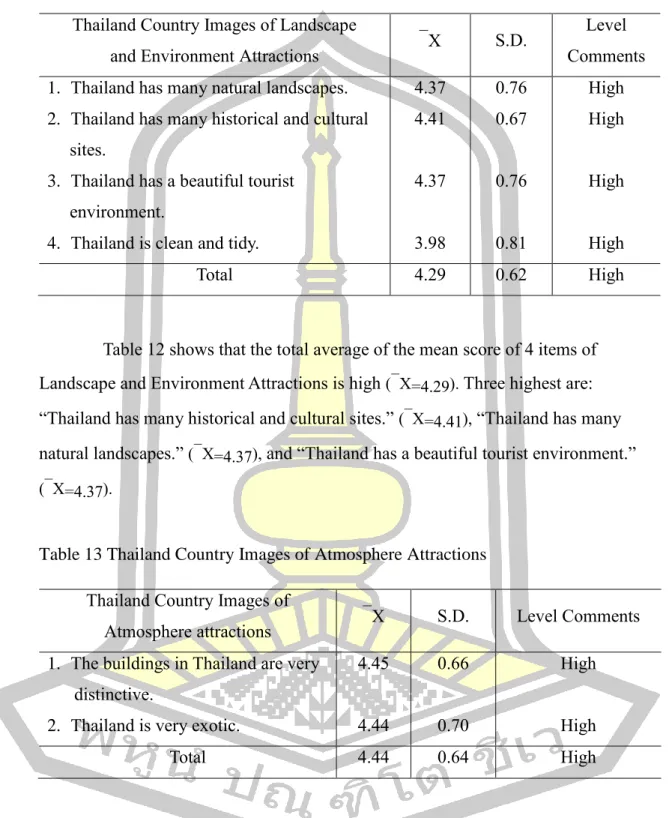
Table 12 Thailand Country Images of Landscape and Environment Attractions ... 66
Table 13 Thailand Country Images of Atmosphere Attractions ... 66
Table 14 Thailand Country Images of Activity Attractions ... 67
Table 15 Thailand Country Images of Services Facilities Attractions ... 67
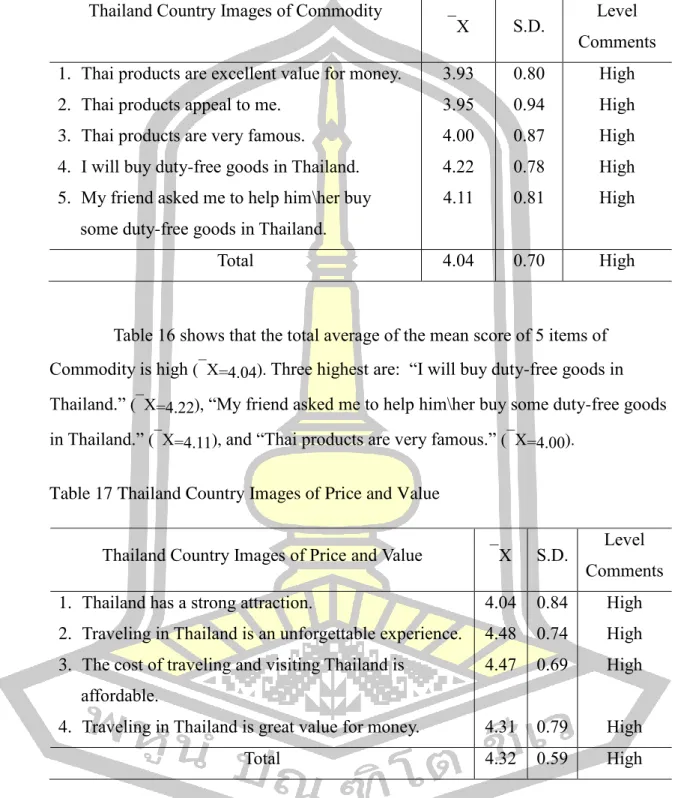
Table 16 Comments about the Thailand Country Images of Commodity ... 68
Table 17 Thailand Country Images of Price and Value ... 68
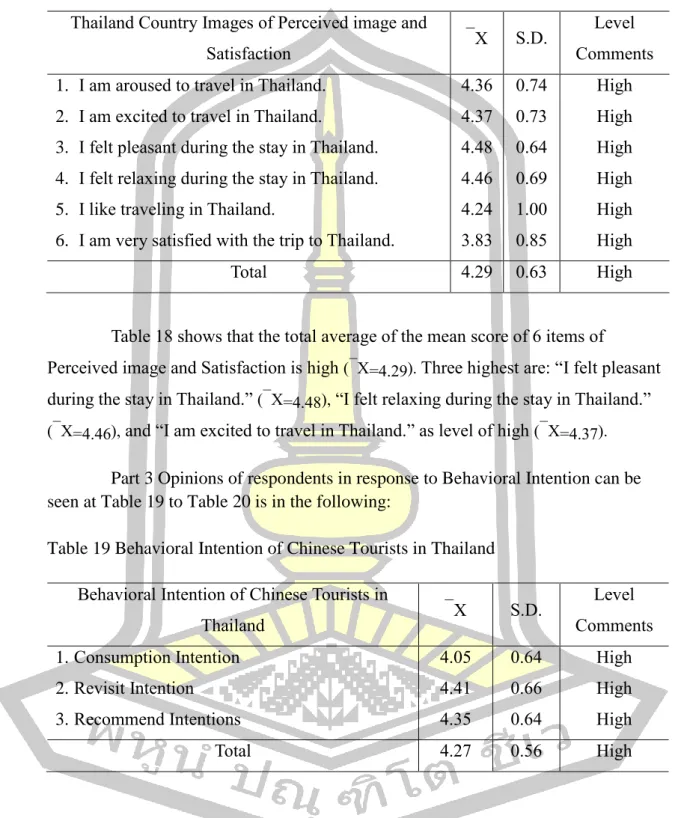
Table 18 Thailand Country Images of Perceived Image and Satisfaction ... 69
Table 19 Behavioral Intention of Chinese Tourists in Thailand ... 69
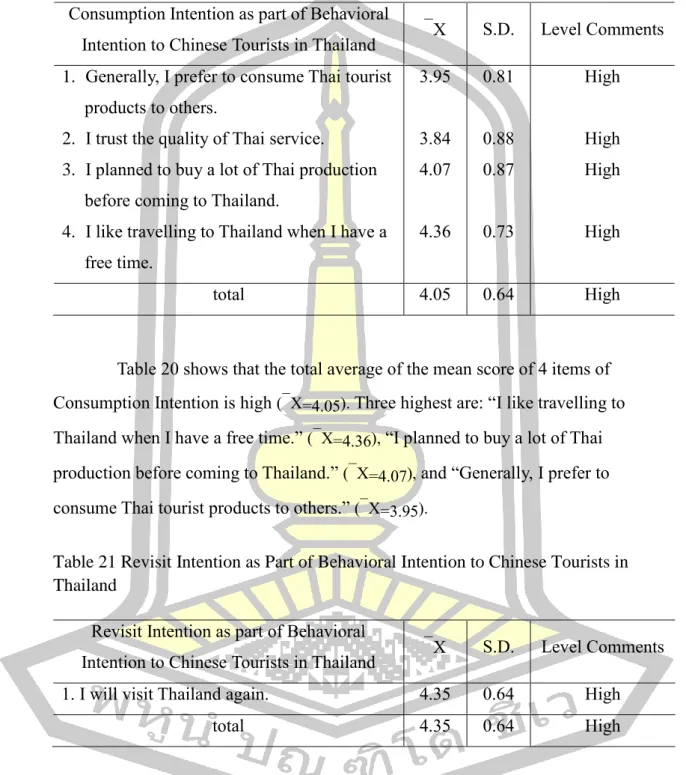
Table 20 Consumption Intention as Part of Behavioral Intention to Chinese Tourists in Thailand ... 70
Table 21 Revisit Intention as Part of Behavioral Intention to Chinese Tourists in Thailand ... 70
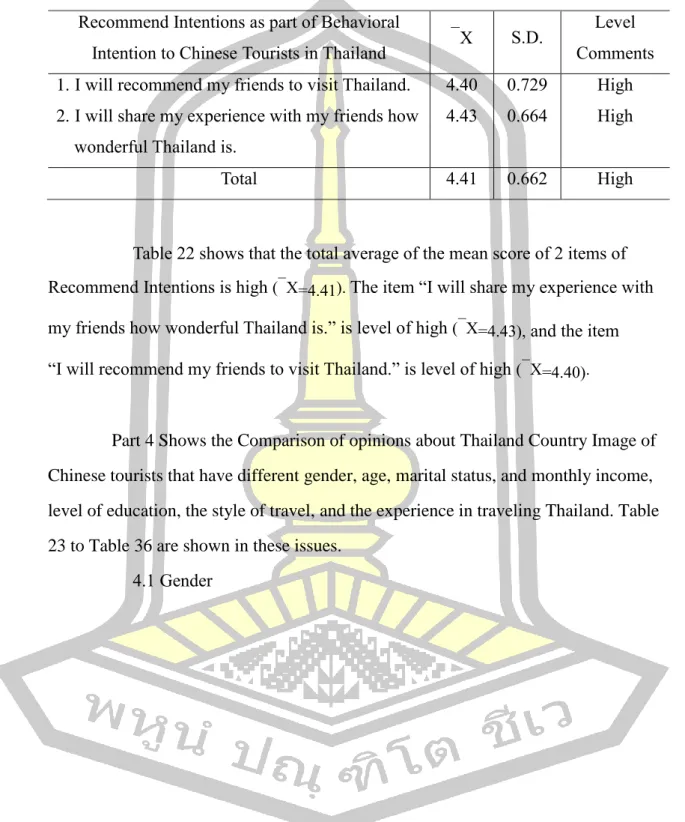
Table 22 Recommend Intentions as Part of Behavioral Intention to Chinese Tourists in Thailand ... 71
J
Table 23 The Difference of Thailand Country Image according to Gender of
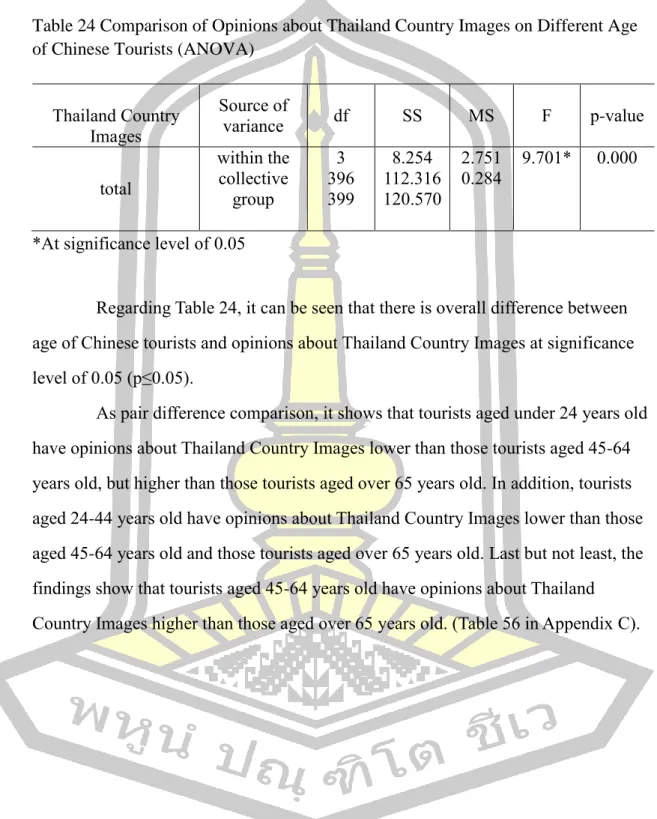
Respondents ... 72 Table 24 Comparison of Opinions about Thailand Country Images on Different Age of Chinese Tourists (ANOVA) ... 73 Table 25 Comparison of Opinions about Thailand Country Images on Different Age of Chinese Tourists (MANOVA)... 74 Table 26 Comparison of Opinions about Thailand Country Images on Different Marital Status of Chinese Tourists (ANOVA)... 77 Table 27 Comparison of Opinions about Thailand Country Images of Different Marital Status of Chinese Tourists (MANOVA) ... 78 Table 28 Comparison of Opinions about Thailand Country Images on Different Income of Chinese Tourists (ANOVA) ... 81 Table 29 Comparison of Opinions about Thailand Country Images of Different Income of Chinese Tourists (MANOVA)... 82 Table 30 Comparison of Opinions about Thailand Country Images on Different Level of Education of Chinese Tourists (ANOVA)... 83 Table 31 Comparison of Opinions about Thailand Country Images of Different Level of Education of Chinese Tourists (MANOVA) ... 83 Table 32 Comparison of Opinions about Thailand Country Images on Different Style of Travel for Chinese Tourists (ANOVA) ... 85 Table 33 Comparison of Opinions about Thailand Country Images of Different Style of Travel for Chinese Tourists (MANOVA) ... 86 Table 34 the Difference of Thailand Country Image According to Experience about Traveling in Thailand of Respondents ... 91 Table 35 The Difference of Behavioral Intention of Chinese Tourists According to Gender of Respondents ... 92 Table 36 Comparison of Opinions about Behavioral Intention of Chinese Tourists on Different Age (ANOVA) ... 93 Table 37 Comparison of Opinions about Behavioral Intention of Chinese Tourists on Different Age (MANOVA)... 93
K
Table 38 Comparison of Opinions about Behavioral Intention of Chinese Tourists on Different Marital Status (ANOVA) ... 95 Table 39 Comparison of Opinions about Behavioral Intention of Chinese Tourists of Different Marital Status (MANOVA) ... 95 Table 40 Comparison of Opinions about Behavioral Intention of Chinese Tourists on Different Income (ANOVA) ... 96 Table 41 Comparison of Opinions about Behavioral Intention of Chinese Tourists of Different Income of Chinese Tourists (MANOVA) ... 97 Table 42 Comparison of Opinions about Behavioral Intention of Chinese Tourists on Different Level of Education of Chinese Tourists (ANOVA) ... 97 Table 43 Comparison of Opinions about Behavioral Intention of Chinese Tourists in Different Level of Education (MANOVA) ... 98 Table 44 Comparison of Opinions about Behavioral Intention of Chinese Tourists on Different Style of Travel (ANOVA) ... 99 Table 45 Comparison of Opinions about Behavioral Intention of Chinese Tourists of Different Style of Travel for Chinese Tourist (MANOVA) ... 100 Table 46 The Difference of Behavioral Intention of Chinese Tourists According to Experience about Traveling in Thailand of Respondents ... 102 Table 47 Correlation Analysis of Thailand Country Images and overall Behavioral Intention of Chinese tourists in Thailand ... 104 Table 48 Regression Analysis Test between Thailand Country Images and Overall Behavioral Intention of Chines Tourists in Thailand ... 106 Table 49 Correlation Analysis of Thailand Country Images and Behavioral Intention in the Dimension of Consumption Intention of Chinese tourist in Thailand ... 108 Table 50 Regression Analysis Test between Thailand Country Images and
Consumption Intention of Chinese Tourists in Thailand ... 110 Table 51 Correlation Analysis of Thailand Country Images and Behavioral Intention in the Dimension of Chinese Tourist Recommend Intention in Thailand ... 112 Table 52 Regression Analysis Test between Thailand Country Images and Chinese tourist Behavioral Intention in the Dimension of Recommend Intention in
Thailand ... 114
L
Table 53 Correlation Analysis of Thailand Country Images and Behavioral Intention of Revisit Intention of Chinese Tourists in Thailand ... 116 Table 54 Regression Analysis Test between Thailand Country Images and Behavioral Intention in the Dimension of Revisit Intention of Chinese Tourists in Thailand ... 118 Table 55 Classification Values and Reliability Values of Questionnaires ... 160 Table 56 Tthe Comparison of Opinions about Thailand Country Images According to Age Difference ... 165 Table 57 The Comparison of Opinions about Thailand Country Images in Each Dimension According to Age Difference ... 166 Table 58 The Comparison of Opinions about National System According to Age Difference ... 167 Table 59 The Comparison of Opinions about National Capacity According to Age Difference ... 167 Table 60 The Comparison of Opinions about National Characteristics According to Age Difference ... 168 Table 61 The Comparison of Opinions about Environmental Conditions According to Age Difference ... 168 Table 62 The Comparison of Opinions about Landscape and Environment Attractions According to Age Difference ... 169 Table 63 The Comparison of Opinions about Atmosphere Attractions According to Age Difference ... 169 Table 64 The Comparison of Opinions about Activity Attractions According to Age Difference ... 170 Table 65 The Comparison of Opinions about Services Facilities Attractions
According to Age Difference ... 170 Table 66 The Comparison of Opinions about Commodity According to Age
Difference ... 171 Table 67 The Comparison of Opinions about Perceived image and Satisfaction
According to Age Difference ... 171
M
Table 68 The Comparison of Opinions about Thailand Country Images According to Marital Status Difference ... 172 Table 69 The Comparison of Opinions about Thailand Country Images in each Dimension According to Marital Status Difference ... 173 Table 70 The Comparison of Opinions about National System According to Marital Status Difference ... 174 Table 71 The Comparison of Opinions about National Capacity According to Marital Status Difference ... 174 Table 72 The Comparison of Opinions about National Characteristics According to Marital Status Difference ... 175 Table 73 The Comparison of Opinions about National Relationship According to Marital Status Difference ... 175 Table 74 The Comparison of Opinions about Environmental Conditions According to Marital Status Difference ... 176 Table 75 The Comparison of Opinions about Landscape and Environment Attractions According to Marital Status Difference ... 176 Table 76 The Comparison of Opinions about Atmosphere Attractions According to Marital Status Difference ... 177 Table 77 The Comparison of Opinions about Activity Attractions According to Marital Status Difference ... 177 Table 78 The Comparison of Opinions about Services Facilities Attractions
According to Marital Status Difference ... 178 Table 79 The Comparison of Opinions about Commodity According to Marital Status Difference ... 178 Table 80 The Comparison of Opinions about Price and Value According to Marital Status Difference ... 179 Table 81 The Comparison of Opinions about Perceived image and Satisfaction
According to Marital Status Difference ... 179 Table 82 The Comparison of Opinions about Thailand Country Images in each Dimension According to Monthly Income Difference ... 180
N
Table 83 The Comparison of Opinions about National System According to Monthly Income Difference ... 181 Table 84 The Comparison of Opinions about Commodity According to Monthly Income Difference ... 181 Table 85 The Comparison of Opinions about Thailand Country Images According to Level of Education Difference ... 182 Table 86 The Comparison of Opinions about Thailand Country Images in Each Dimension According to Level of Education Difference ... 183 Table 87 The Comparison of Opinions about National System According to Level of Education Difference ... 184 Table 88 The Comparison of Opinions about National Capacity According to Level of Education Difference ... 184 Table 89 The Comparison of Opinion about Environmental Conditions According to Level of Education Difference ... 185 Table 90 The Comparison of Opinions about Atmosphere Attractions According to Level of Education Difference ... 185 Table 91 The Comparison of Opinions about Commodity according to Level of Education Difference ... 186 Table 92 The Comparison of Opinions about Perceived image and Satisfaction
According to Level of Education Difference ... 186 Table 93 The Comparison of Opinions about Thailand Country Images According to Travel Style Difference ... 187 Table 94 The Comparison of Opinions about Thailand Country Images in each Dimension According to Travel Style Difference ... 188 Table 95 The Comparison of Opinions about National System According to Travel Style Difference ... 189 Table 96 The Comparison of Opinions about National Capacity According to Travel Style Difference ... 189 Table 97 The Comparison of Opinions about National Characteristics According to Travel Style Difference ... 190
O
Table 98 The Comparison of Opinions about National relationship According to Style of Travel Difference ... 190 Table 99 The Comparison of Opinions about Environmental Conditions According To Style of Travel Difference ... 191 Table 100 The Comparison of Opinions about Landscape and Environment
Attractions According to Style of Travel Difference ... 191 Table 101 The Comparison of Opinions about Atmosphere Attractions According to Style of Travel Difference ... 192 Table 102 The Comparison of Opinions about Activity Attraction According to Style of Travel Difference ... 192 Table 103 The Comparison of Opinions about Services Facilities Attractions
According to Style of Travel Difference ... 193 Table 104 The Comparison of Opinions about Commodity According to Style of Travel Difference ... 193 Table 105 The Comparison of Opinions about Price and Value According to Style of Travel Difference ... 194 Table 106 The Comparison of Opinions about Perceived image and Satisfaction According to Style of Travel Difference ... 194 Table 107 The Comparison of Opinions about Tourism Behavioral Intention
According to Age Difference ... 195 Table 108 The Comparison of Opinions about Tourism Behavioral Intention in each Dimension According to Age Difference ... 195 Table 109 The Comparison of Opinions about Consumption Intention According to Age Difference ... 196 Table 110 The Comparison of Opinions about Recommend Intention According to Age Difference ... 196 Table 111 The Comparison of Opinions about Revisit Intention According to Age Difference ... 197 Table 112 The Comparison of Opinions about Tourism Behavioral Intention
According to Marital Status Difference ... 197
P
Table 113 The Comparison of Opinions about Tourism Behavioral Intention in each Dimension According to Marital Status Difference ... 198 Table 114 The Comparison of Opinions about Consumption Intention according to Marital Status Difference ... 198 Table 115 The Comparison of Opinions about Recommend Intention According to Marital Status Difference ... 199 Table 116 The Comparison of Opinions about Revisit Intention According to Marital Status Difference ... 199 Table 117 The Comparison of Opinions about Tourism Behavioral Intention
According to Level of Education Difference ... 200 Table 118 The Comparison of Opinions about Tourism Behavioral Intention in each Dimension according to Level of Education Difference ... 200 Table 119 The Comparison of Opinions about Consumption Intention According to Level of Education Difference ... 201 Table 120 The Comparison of Opinions about Recommend Intention According to Level of Education Difference ... 201 Table 121 The Comparison of Opinions about Revisit Intention according to Level of Education Difference ... 202 Table 122 The Comparison of Opinions about Tourism Behavioral Intention
According to Style of Travel Difference ... 202 Table 123 The Comparison of Opinions about Tourism Behavioral Intention in each Dimension of Tourism Behavioral Intention According to Style of Travel
Difference ... 203 Table 124 The Comparison of Opinion about Consumption Intention according to Style of Travel Difference ... 203 Table 125 The Comparison about Recommend Intention according to Style of Travel Difference ... 204 Table 126 The Comparison of Opinions about Revisit Intention According to Style of Travel Difference ... 204 Table 127 Testing the Correlation of Regression between Thailand Country Image and Chinese Tourist Behavioral Intention in Thailand ... 206
Q
Table 128 Testing the Correlation of Regression between Thailand Country Images and Chinese Tourist Consumption Intention in Thailand ... 206 Table 129 Testing the Correlation of Regression between Thailand Country Images and Chinese Tourist Consumption Intention in Thailand ... 207 Table 130 Testing the Correlation of Regression between Thailand Country Images and Chinese Tourist Recommend Intention in Thailand ... 207 Table 131 Testing the Correlation of Regression between Thailand Country Images and Chinese Tourist Revisit Intention in Thailand ... 208
R
LIST OF FIGURES
Figure 1 Model of the Study ... 11 Figure 2 Tourists Arrivals and International Tourism Receipts (2015-2022) ... 13 Figure 3 Top 10 Arrivals by Nationality... 17
1
CHAPTER I
INTRODUCTION
Background
In the context of a slowdown in global economic growth, many countries have taken up the development of tourism, especially inbound tourism (Wa, Hu and Zhang, 2020). This represents an important engine to stimulate their economic growth and many countries even pursue this as a nation-building strategy. When one talks about tourism, Thailand tourism is of utmost importance. Thailand tourism revenue has become one of the main sources of national income. Regional giant China is its position as the largest source of arrivals to Thailand, with almost 11.0 million visitors (Ministry of Tourism & Sports, 2020). One area of concern is the recent economic slowdown in China, which may deter travel outside of the country in the future. A devaluation of the yuan would also make international travel more expensive.
However, Thailand is still keen to attract more visitors from this massive potential market and continues to reduce entry barriers for Chinese passport holders, which most recently practice is removing visa fees for Chinese visitors (BMI, 2018).
In addition, according to Outbound Tourism Big Data Report for the Half year of 2018, researched by China Tourism Research Institute and CTrip Travel Big Data Joint Lab, which is a large web-based tourism company with accounts for more than half of the Chinese tourism market. It indicates that in the first half of the year, the top 20 destination countries most popular among Chinese tourists were:
Thailand, Japan, Vietnam, South Korea, Singapore, Indonesia, Malaysia, Russia, USA, Cambodia, Philippines, Australia, France, United Arab Emirates, Turkey, Italy, Maldives. Germany, Sri Lanka, the United Kingdom (China Travele News, 2018).
Compared to others, from 2012 to 2016, the proportion of Chinese tourists to
2
Thailand increased dramatically. During 2012 to 2015, the growth rate of Chinese tourists to Thailand was over 61%, and the growth rate of tourism revenue exceeded 75%. Despite the slight decline in the number of Chinese tourists due to political turmoil in 2014, tourism revenues have steadily increased (Zhao, 2018).
The importance of tourism destination image in consumer choice decision and loyalty has been recognized by many scholars (Zhang and Cai, 2011). (Hunt, 1975) points out that the positive impact of destination image on consumer behavior has confirmed by many studies since 1975. Country Images comes from the origin of the country studying in the marketing field, and outbound tourism is a kind of
invisible product that needs to bring across the border. It is a product image, which is the image of tourism destination influenced by the Country Images. The image of the country is an important concept in international business and international marketing.
In the increasingly competitive global market, the image of the country has important strategic value for the product and for the tourist destination to gain the competitive advantage. At present, Country Images especially image of Thailand has not been studied widely. Therefore, this study fills in the knowledge gap into the literature.
According to the studies of tourism behaviors, person's behavioral intentions derived from attitudes, feelings, and attitudes; the relationship between behavior and
behavioral intention directly relates each other. It predicts one's behavior, which is often a more accurate measure of intent (Bai, Chen and Zhao, 2012).
Based on the above reasons, this study explores the relationship between Country Images and Tourism Behavioral Intention from the perspective of the tourism and marketing fields. The researcher applies the basic “Model of Tourism Intention for International Tourists” which was researched by Zhang and Cai (2011) who studied the effect of Country Images on Behavioral Intention of Chinese tourists. This study also intends to ascertain whether the variables of the Country Images of
Thailand are the key factors influencing Behavioral Intention of Chinese tourists or not. Hence, the results of the study can provide the new insights of Country Images
3
and Behavioral Intention in the context of Thailand. Last but not least, this study also focus on the variations of Country Images and Behavioral Intention of Chinese tourists according to their gender, ages, tourism experience, income, and education level. This can enhance the understanding about Country Images and Behavioral Intention of Chinese tourists. At the same time, this study also provides some suggestions for the development of Thailand tourism industry.
Purpose of the Study
The key purpose of this study is to explore the influence of Country Images of Thailand on Behavioral Intention of Chinese tourists. The specific objectives are as follows:
1. To ascertain the Country Images of Thailand.
2. To discover Behavioral Intention of Chinese tourists in Thailand.
3. To study the relationship between Country Images and Chinese Tourist Behavioral Intention in Thailand.
4. To find the influence of Country Images on Chinese Tourist Behavioral Intention in Thailand.
5. To study the variations of the perception of Country Images according to gender, ages, marital status, monthly income, level of education, style of travel, experience of traveling in Thailand of Chinese tourists.
6. To ascertain the variations of Behavioral Intention of Chinese tourists because of difference in terms of gender, ages, marital status, monthly income, level of education, style of travel, experience of traveling in Thailand of Chinese tourists.
4
Importance of the Study
1.The context of a slowdown in global economic growth, many countries have taken up the development of tourism, especially inbound tourism. This represents an important engine to stimulate their economic growth and many
countries even pursue this as a nation-building strategy. Tourism plays a critical role in the Thai economy, and Chinese tourists are the main customers of Thai inbound tourists. Treating Chinese tourists in Thailand as study objects is appropriately necessary for the development of inbound tourism in Thailand.
2. Making a thorough inquiry on the Thailand Country Images and
Behavioral Intention of Chinese tourists is of administrative significance to national or regional policy makers and tourism managers. They need to develop better country images and marketing programs for sustainably attract and retain Chinese tourists into the ASEAN country of Thailand.
3. The study on Behavioral Intention has always been a hotspot in academic circles. This study is also involved in the study of Behavioral Intention of Chinese tourist may provide some practical examples for the rich theory and model.
4. This study has attempted to integrate the two concepts of country image and destination image and hopes that more tourism researchers will pay attention to the role of tourism research in the development of management theory and put tourism research in a larger framework and to find the location and contribution of tourism research.
5
Framework of the Study
The Effects of Thailand Country Images on Chinese Tourist Behavioral Intention in Thailand, which is the framework as follows:
1. Country Images is defined as, “an evaluation of all aspects of a country”
(Zhang and Xu, 2015). which contains the “Macro-Country Images” and “Micro- Country Images”. Also, Country Images is defined as “The sum of descriptive, inferential, and informational attitudes that an individual has in a country.” (Martin and Eroglu, 1993).
1.1 The “Macro-Country Images” measured by five dimensions as follows:
1.1.1 National System 1.1.2 National Capacity 1.1.3 National Characteristics 1.1.4 Environmental Conditions 1.1.5 National Relationship
1.2 The “Micro-Country Images” measured by three dimensions as follows:
1.2.1 Local Attractions
1.2.1.1 Landscape and Environment Attractions 1.2.1.2 Atmosphere Attractions
1.2.1.3 Activity Attractions
1.2.1.4 Services and Facilities Attractions 1.2.1.5 Commodity
1.2.2 Price and Value
1.2.3 Perceived Image and Satisfaction
6
2. Behavioral Intention is defined as tourist willingness to consume, repeat, and provide feedback in response to their consumption in tourism activities.
In the study of tourism, the re-parade is the tourist willingness to visit the tourist destination again in a satisfactory state (Kozak, 2001). Some tourists expressed their willingness to pay as a higher price with loyalty (Baker and Crompton, 2000). Hence, in this study Tourism Behavioral Intention is measured by three dimensions as follows (Bai, Chen and Zhao, 2012).
2.1 Consumption Intention 2.2 Revisit Intention
2.3 Recommendation Intention
Scope of the Study
1. Population and Sample group
1.1 Population and samples in this study are the Chinese tourists. In 2019, regional giant China maintained its position as the largest source of arrivals to
Thailand, with almost 11.0 million visitors (Ministry of Tourism & Sports, 2020).
1.2 Sample of this study randomly selected from 400 Chinese tourists in the airports, shopping malls, and other tourist attractions of Thailand.
2. Geographical scope of the research is Thailand where Chinese tourists visiting to.
3. Period of data collection is about 30 days during 1 to 30 April 2019.
4. The variables used in research
4.1 Group 1: Testing of the relationship between Thailand Country Images and Chinese Tourist Behavioral Intention.
4.1.1 The independent variable is Thailand Country Images.
4.1.2 The dependent variable is Chinese Tourist Behavioral Intention.
7
4.2 Group 2: Comparing the variations of Thailand Country Images and Chinese Tourist Behavioral Intention.
4.2.1 The independent variables are gender, ages, marital status, monthly income, level of education, style of travel, and experience of traveling in Thailand of Chinese tourists.
4.2.2 The dependent variables are Thailand Country Images and Chinese Tourist Behavior Intention.
Hypotheses of the Study
1. There will be relationship between Thailand Country Images and Chinese Tourist Behavioral Intention.
2. There will be the influence of Thailand Country Images on Chinese Tourist Behavioral Intention.
3. There will be the variations of perception of Thailand Country Images according to gender, ages, marital status, monthly income, level of education, style of travel, and experience of traveling in Thailand of Chinese tourists.
4. There will be the variations of Chinese Tourist Behavioral Intention according to gender, ages, marital status, monthly income, level of education, style of travel, and experience of traveling in Thailand of Chinese tourists.
Terminology
1. Thailand Country Images
Thailand Country Images is an evaluation of all aspects of Thailand.
According to Scott (1966: 394), “when we think of the country, the overall image of the country emerged in our minds.” In this study, researcher wants to study the overall image of Thailand, which emerged in Chinese tourists’ minds. In order to describe
8
Thailand Country Image systematically, researcher uses both “Macro” and “Micro”
aspects in studying Country Image.
“Macro Country Image” is the perception of tourists about political, economic, technological, environmental, national and other tourism environmental factors of destination country as well as “National System”, “National Capacity”,
“National Characteristics”, “Environmental Conditions” and “National Relationship”
(Lei, et,al, 2015).
“Micro Country Image” is the perception and evaluation of tourists when a particular-region, city or country used as a tourist destination (Mossberg and Klappe, 2005). The researcher defines the dimensions of “Micro Country Image” as “Local Attractions” (Zhang, 2002) “Price and Value” (Le, 2018). (Lei, et,al, 2015) and
“Perceived Image and Satisfaction” (Lou, 2002).
1.1 National System
National System is the political system and management system of a country (Nadeau, et.al., 2008). The measurement of the National System depends on political stability, democracy and security.
1.2 National Capacity
National Capacity is the ability to develop and implement policies to stimulate economic growth, and to provide good governance and effective and
reliable institutions (Englebert, 2000). According to Knight, Spreng and Yaprak (2003), dimension of National Capacity can be level of economic and technological development, which reflects to “Thailand's economic development”, “Thailand's level of modernization” and “Thailand's level of advanced technology”. From the content analysis in this study, these items mainly use to measure the level of overall capacity of development in Thailand. The higher the scores of tourists’ choices, the more positive they perceive for the capacity of development of Thailand.
9
1.3 National Characteristics
National Characteristics is the total impression of foreigners over a country; this includes ethnicity and nationality. Characteristics about a nation could help to represent a national identity, such as being honest, friendly, hardworking, and enthusiastic and so forth (Wang, et al., 2012).
1.4 National Relationship
National Relationship is the situation about national diplomatic relations, especially in countries with different political systems (Wang, 2010).
1.5 Environmental Conditions
Environmental Conditions are the country's management,
governance, and effectiveness of environment management, which have measured in various dimensions such as national ecological environment, living environment, and the sum of the working environment (Lei, et al., 2015).
1.6 Local Attractions
Local Attractions refer to the sum of those natural and social things and phenomena that are attractive to tourists and have business value to tourism operators (Zhang, 2002). In this study, local attraction includes Landscape and Environment Attractions, Atmosphere Attractions, Activity Attractions, Services Facilities Attractions and Commodity.
1.6.1 Landscape and Environment Attractions can be dramatic natural wonders, quaint or bustling cities, pristine beaches, historic landmarks or vibrant community festivals (Chaulagain, Wiitala and Fu, 2019).
1.6.2 Atmosphere Attractions are non-material atmosphere, such as modern urban atmosphere and quiet country atmosphere (Beerli and Martin, 2004).
1.6.3 Activity Attractions are both the attraction of tourism and the composition or necessary supplement of tourism activities (Lou, 2018).
1.6.4 Services and Facilities Attractions mean the evaluation of tourists in facilities and other infrastructure, which refers to equipment and service
10
provided by the country as the tourist destination to tourists, such as a variety of outdoor activity equipment and facilities, good shopping environment, adequate and good quality of accommodation facilities, convenient transportation facilities, and so forth (Chen and Kerstetter, 1999).
1.6.5 Commodity is a product or service to meet the obvious needs of tourists (Bao, Jia and Hu, 2008).
1.7 Price and Value
Price and Value is the evaluation of payment and value of using services in tourism destination, which means the cost and benefit of travelling in Thailand perceived by tourists (Gallarza, et al., 2002).
1.8 Perceived Image and Satisfaction
Perceived Image and Satisfaction is the abstract and generalized understanding and evaluation of tourists' overall characteristics of tourism
destinations (Lou, 2002). The destination environment provides a wide range of hints for tourists, which used to create typical impression of tourist destination. These hints include product and price (Lou, 2001). While satisfaction is the result of comparing the feelings and expectations of the tourists (Gao, 2011).
2. Tourist Behavioral Intention
Tourist Behavioral Intention is the willingness of tourists to participate in a certain kind of tourism activity (Bai, Chen and Zhao, 2012).
2.1 Consumption Intention is the purpose of consumers who carry out the specific and intended activity to consume specific products (Zeithaml and Berry, 1996).
2.2 Recommend Intention is the tourist satisfaction based on high willingness to recommend tourist destinations or travelling products or souvenirs to friends and families (Baker and Crompton, 2000).
2.3 Revisit Intention is the willingness to re-visit the same destination in a satisfactory mode (Alenmoud and Armstrong, 1996).
11
Figure 1 Model of the Study
12
CHAPTER II
RELEVANT LITERATURE
The Effects of Thailand Country Images on Chinese Tourist Behavioral Intention in Thailand with the relevant literature are as follows:
1. Generals Situation of Thailand Tourism Industry 2. Overview of Chinese Tourists in Thailand 3. Overview of Country Images
3.1 Concept of Country Images 3.2 Elements of Country Images 3.3 Importance of Country Images 4. Overview of Behavioral Intention
4.1 Definition of Behavioral Intention 4.2 Elements of Behavioral Intention 4.3 Significance of Behavioral Intention 5. Related Research
General Situation of Thailand Tourism Industry
The history of Thai tourism can trace back to 1924, when the Royal Thai Railway Authority established the Ministry of Public Relations to promote tourism in Thailand and provided the necessary assistance to foreign tourists. In 1959, Thailand established the Thai Tourism Organization through joint ventures. The Thai economy slowed down in 1979 and tourism became the main source of foreign exchange earnings. In 1979, the Thai Tourism Organization upgraded to the National Tourism Administration of Thailand, and in 1990, Thailand's tourism industry became the main source of foreign exchange. Tourists from Southeast Asia are becoming more
13
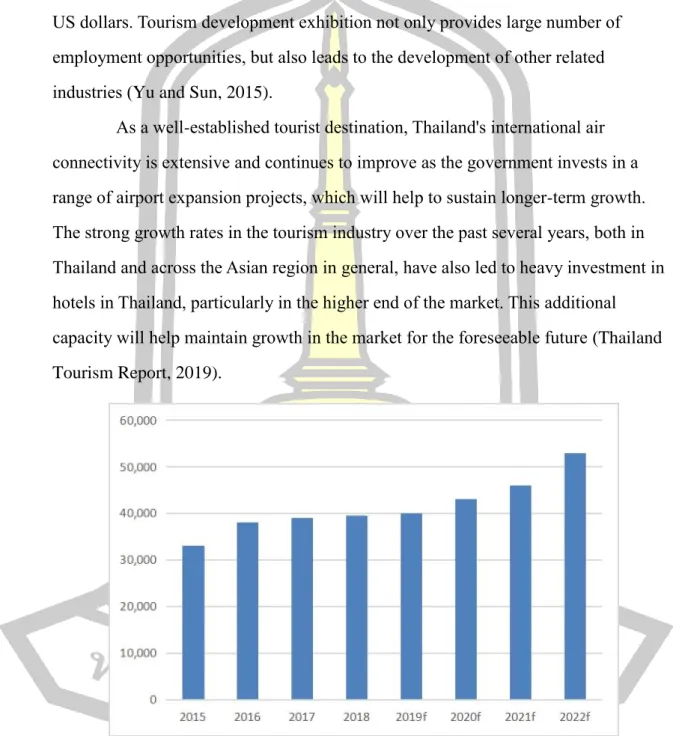
important to Thailand. By the year 2000, Thailand had received nearly 10 million tourists from other countries. As a result, the number of foreign tourists in Thailand has been growing rapidly, triggering foreign exchange earnings of more than 7 billion US dollars. Tourism development exhibition not only provides large number of employment opportunities, but also leads to the development of other related industries (Yu and Sun, 2015).
As a well-established tourist destination, Thailand's international air connectivity is extensive and continues to improve as the government invests in a range of airport expansion projects, which will help to sustain longer-term growth.
The strong growth rates in the tourism industry over the past several years, both in Thailand and across the Asian region in general, have also led to heavy investment in hotels in Thailand, particularly in the higher end of the market. This additional capacity will help maintain growth in the market for the foreseeable future (Thailand Tourism Report, 2019).
Figure 2 Tourists Arrivals and International Tourism Receipts (2015-2022) Source: Thailand Tourism Report (2019).
14
Shi and Wang (2018) studied on the international competitiveness of tourism service trade in 21 countries around the world. Their study was based on data from 2004 to 2015, using export market share, export rise advantage index, trade
competitiveness, advantage index, revealed comparative advantage index and revealed competitive advantage index. The results showed that the export market shares of Asian countries were relatively low. European and American countries were comparatively high, and China was ranked fourth. Export rise advantage index showed that China had a significant disadvantage, and Asian countries were in the growing trend of overall volatility. Chinese tourism service trade has a greater competitive disadvantage, but trade competitive advantage of Thailand and Malaysia were prominent. They pointed out that the main reason is the rapid development of the international tourism industry in the Asia-Pacific region. The number of inbound tourists had increased year-by-year, breaking the original market structure of the international tourism industry that was highly monopolized by Europe and the United States. The center of development of the world tourism industry has gradually moved eastward. Moreover, Shi and Wang (2018) emphasized that Thailand has a strong competitive advantage, which related to Thailand's abundant natural resources and the government's strong support for tourism.
The development of tourism has considerably created a large amount of foreign exchange income for Thailand. Thai tourism started in the early 1960s, in 1982, the foreign exchange income of the tourism industry reached 23.78 billion baht.
In the same year, the foreign exchange income of the tourism industry became the largest source of foreign exchange earnings for Thailand. Since the 1990s, Tourism revenue accounts for 7.1% of Thai GDP. According to the World Bank’s Global Economic Outlook Report, Thailand's tourism industry from 2009 to 2011 was 19.4 billion, 23.4 billion and 25.1 billion US dollars respectively and the annual rate increased by about 14% much higher than other ASEAN member countries. It can be seen that the development of tourism in Thailand has greatly made the improvement
15
of trade surplus of Thailand (Ai. 2013).
The development of tourism has directly contributed to the country's large amount of foreign exchange and improved economic efficiency. Since the mid-1980s, tourism has become the industry with the largest foreign exchange earning in
Thailand, surpassing the traditional rice and rubber export industry. By 2000,
Thailand had received nearly 10 million foreign tourists and foreign exchange income exceeded US$7 billion. In addition, this development promoted the development of industry, especially crafts and the food industry. For example, tourists have favored teak carvings, Buddha statues, paper umbrellas, Thai silks and crocodile skin products in Thailand. Moreover, foreign investment has been promoted as well. The tourism industry provides the good platforms for foreign investors to inspect, exchange and negotiate, thus attracting many foreign investors to Thailand for holiday tourism, investigating the market and investing. Also, this situation provides a large number of employment opportunities. At present, in Thailand, more than 2 million people are engaged in tourism-related occupations. Tourism has become the third largest employment area after agriculture and industry. Further, tourism has promoted Thailand’s interaction with the world. It has advanced massively science and
technology from developed countries, and it has promoted political system reform and democratic legal system construction. In particular, Thai people have undergone great changes in ideology, living habits, and values. Nowadays, in the process of the
development of the national economy, Thailand combines modernization with traditional culture, world and nationality, and attracts foreign tourists with “Thai’s unique” tourism resources, which not only highlights Thai characteristics, but also brings new vitality to the national tourism industry (Qi, 2018).
The development of tourism not only promotes the improvement of the overall level of Thailand's service industry, but also greatly promotes the development of various social and cultural undertakings and solves the employment problems of many Thais. However, the development of Thailand's tourism industry is not without
16
obstacles. Since the 21st century, tourism industry of Thailand has experienced the 911 terrorist incident in 2001. In 2003, due to the US-Iraq war and the impact of SARS in Asia, the southern riots and bird flu epidemic in 2004 and the tsunami disaster at the end of 2004. This series of difficulties has brought immeasurable losses and negative effects to the Thai tourism industry, but the Thai tourism industry has overcome many difficulties under the guidance of the positive policy measures of the Thai government. Through short-term adjustments, it has re-entered the stage of stable development (Li, Xue and Zgeng, 2010).
Again, the healthy and sustainable development of Thailand's tourism industry has also provided more employment opportunities for the Thai people while improving the living standards of the Thai people.
Overview of Chinese Tourists in Thailand
From 2006 to 2016, the number of Chinese tourists travelling 34 countries along the Belt and Road is increasing year by year. Among them, Thailand, Singapore and Vietnam are the three countries with the highest tourist volume (Jia, 2018)
Accourding to Qi (2010), as a result of China's development, capacity and conditions to increase the number of tourists, has become important potential source of tourists to Thailand. Chinese tourists have always favored Thailand beautiful scenery and folk customs. Together with the close relationship between Thailand and China, the opening of direct flights, as well as affordable prices and high quality of service, a number of people traveling to Thailand in various provinces from China have substantially increased.
Each year, a huge number of Chinese tourists come to Thailand and
Thailand's official tourism statistics show that China is now Thailand's main source of foreign tourists. At the same time, Yu and Sun (2015) argue that Thailand has become one of the most important international tourist destinations for Chinese tourists.
17
As well, Chinese tourists contribute the most to Thailand's tourism and tourism revenue growth (Zhao, 2018).
In 2019, regional giant China has maintained its position as the largest source of arrivals to Thailand, with almost 11.0 million visitors. Thailand is keen to attract more visitors from this massive potential market and continues to reduce entry barriers for Chinese passport holders, with most recently removing visa fees for Chinese visitors (Ministry of Tourusm & Sports, 2020).
Source: “Tourism Statistics 2019". Ministry of Tourism & Sports (2020).
Chinese tourists to Thailand have a wide range of tourism reasons, including sightseeing, leisure and vacation, visiting relatives and friends, religious pilgrimage, technology exchange, medical care, business travel, conference tours, cultural tours, sports tours, shopping tours and so forth. A survey of 2005 revealed that the main destinations chosen by Chinese tourists to Thailand are Bangkok, Pattaya and Phuket.
However, a survey of 2014 revealed that Chiang Mai became the first destination for Figure 3 Top 10 Arrivals by Nationality
18
Chinese tourists to Thailand, followed by Bangkok, Pattaya, Ayutthaya, Prachuap, Surat Thani, Chiang Rai, Lamphun, Lampang, Sukhothai, Ubon Ratchathani, Udon Thani and Phuket. It can be seen that the tourist destinations of Chinese tourists are more diversified and have penetrated into different cultural regions of Thailand. Some places underdeveloped areas in Thailand that have cultural or natural environmental characteristics have also received considerable attention (Gong, 2019).
The main expenses of Chinese tourists is accommodation, transportation and shopping. Chinese tourists have strong spending power. They averagely spend 5,000 baht per day and stay in Thailand about seven days. It has brought huge foreign exchange income to the tourism industry and related industries in Thailand, and promoted the development of transportation, energy, food, hotels and other related industries, as well as created a huge employment market.Chinese tourists in Thailand spend more on catering, shopping, tourism, and accommodation. The consumption has increased so fast, but the consumption benefits has still been questionable. The consumption benefits in entertainment and transportation are better but the growth rate is lower than the average level of the Thai tourism industry (Pang and Liu, 2018).
(Pang and Liu, 2018).
Xiao (2018) found that Chinese tourists mainly come to Thailand from October to March, which accounts for 67% of the total number. Through the analysis of the products purchased by Chinese tourists in Thailand, she found that Chinese tourists favor Thai specialty foods, souvenirs and handicrafts. Chinese tourists visit Thailand for sightseeing and experiencing exotic customs, which shows that China's outbound tourism is still in the early stage of outbound tourism development. The traditional tourism is still the main purpose of Chinese tourists in Thailand, but Chinese outbound tourism has great market potential.
The opening of relations between Thailand and China continue to closely tie and have direct routes each other, as well as access to reasonable price and high quality services from Thailand, making Chinese tourists traveled to Thailand
19
massively and it is greatly promoted Thailand industry. As well Chinese tourists choose Thailand because of its low prices, proximity to China, easy visa procedure, and more airline choices. The Thai inbound travel is one of the lowest cost travel destinations. For example, Air Asia airline from China to Bangkok Thailand, round trip transportation is around RMB 2000; this let many people feel value for money both in traveling and in shopping. Although many brand names in Thailand is not cheap, but a lot of mid-range brand in Thailand is much cheaper than China, for example cosmetics, cloths and so forth (Zhong, 2014).
Due to personal characteristics such as age, gender, education level, income, occupation and so forth, Chinese Tourists to Thailand have the impact on tourism consumption decision-making behaviors, which leads to obvious differences in tourism consumption levels. According to data, most Chinese tourists choose Thailand as the destination for their first overseas trip. Education has no effect on tourism consumption in Thailand, and gender has little effect on tourism consumption in Thailand (Li, 2019).
The majority of outbound travel of Chinese tourists to Thailand is family trip. Tourists are more personalized in their choices of travel routes and travel items.
Therefore, tourism products and service have to be more diversified. Chinese tourists would prefer to have experiential tourism products. They are no longer just
sightseeing, but also pay more attention to participation and experience in the travel process. They favor experience marine tourism projects, snorkeling, and scuba diving.
More tourists are been to experience the local people's lifestyle and understand the customs (Zhang, 2019).
All above, Thailand's tourist companies should grasp the characteristics of Chinese tourists, make a clear market positioning, focus on specific tourist markets, and develop tourism products of interest to Chinese tourists, in order to increase their consumption in Thailand.
20
Overview of Country Images
1. Concept of Country Images
Originally, Martineau (1958). explained that the image of Country Images concept successfully applied to the field of business research and pointed out that the image of the subjective attitude of the consumers as to a subject, emotion, and image of good or bad, is one of the important factors affecting consumer behaviors.
Correspondingly, since the 1960s, foreign research on Country Images has been widely carried out, but at the beginning, it was in the field of marketing. Previous research confirmed that consumers' evaluation of products is significantly different because of the origin, which is the “country of origin effect”. In the field of
international business and marketing, Country Images (CI) research is closely related to the study of the country- of-origin (COO) (Zhang and Cai, 2011).
The earliest proposed country-of-origin effect is Schooler (1965). He used Guatemalan students as a sample to study the evaluation of Guatemalan consumers' products in the four Central American countries. It found that consumers' evaluation of El Salvador and Costa Rican products was lower than that of Mexican and domestic products, thus demonstrating the existence of the country-of-origin effect.
Since then, research on the country-of-origin has sprung up. Early studies of country- of-origin effects focused on differences in evaluations and preferences for products from different countries, and respondents were only provided to national names such as China and the United States (Zhang and Cai, 2011).
As the research progressed, Roth and Diamantopoulos (2009) proposed the concept of the country-of-origin image (COI). They believe that traditional research only analyzes whether consumers have different evaluations and preferences for products and brands in different countries, and the study of the image of the country-of-origin can analyze why consumers have such different evaluations and preferences. Roth and Diamantopoulos studied on the basis of comprehensive review
21
of relevant research and divided the concept of the image of the country-of -origin into three categories according to the different image objects of interest: (1) Country Images is concerned with the overall image of the country. For example, Martin and Eroglu (1993) define the Country Images as “the sum of descriptive, inferential and informational beliefs that an individual has in a country” (2) Product Country Images (PCI), this type of definition focuses on the image of the country and its products. For example, Li, Sun and Murray (1997) defined the image of the country-of-origin as
“the image of consumers in different countries and products made in these countries”
(1997:115). (3) Product image (PI), this definition focuses on the image of a country's products. “Country Images” refers to the overall perception of consumers from the country based on their perception of a country's products and marketing strengths and weaknesses.” (Roth and Romeo, 1992).
In 1965, Reynolds introduced the "Image" to the study of tourism and pointed out human beings in the environment is a whole message of certain
impressions based on the construction of sustainable development (Reynolds, 1965).
One of its manifestations is the individual in tourism activities in the formation of the image.
From the perspective of business trade, Country Images is a concept about the image, reputation, and stereotype of a merchant or consumer's product for a particular country (Nagashima, 1970). Martin and Eroglu (1993) argues that the national image is the sum of descriptive, inferential, and informative beliefs about a particular country. Roth and Romeo (1992) defined Country Images as a general perception of a particular product in a particular country based on previous knowledge of the strengths and weaknesses of a country's production and marketing. This means that when consumers make purchasing decisions, they will consider the impression of the product category and the country as a whole object.
22
In China, Li (2007) stated that “the image is a kind of picture that contains cognitive and emotional elements.” Further, Qiu (2003) rationalized that “Image is the overall impression or stereotype of perception, cognition and evaluation produced by subjective judgments on related attributes after an individual is stimulated by outside information. This impression changes with value judgment, sensory experience and cultural knowledge.” Fang (2015) explained that, “the initial transmission of the Country Images took place during World War II, when the most advanced means of communication such as broadcasting propagated the war. From the perspective of international communication, the definition of Country Images is an impression that a country has made in international news (Xu, 2000). The Country Images shaping is a transnational political communication with the promotion of international image as the main body, following the basic norms of communication, and serving the international political interests and social purposes (Tian, 2012).
As for the real Country Images as a research object and topic, it is in the field of international relations and communication.” In many papers in China,
Country-of-origin image, Country Images, product-country images is usually used to express the same meaning (Li, et al., 2018).
However, the study of the image of the country of origin is mainly
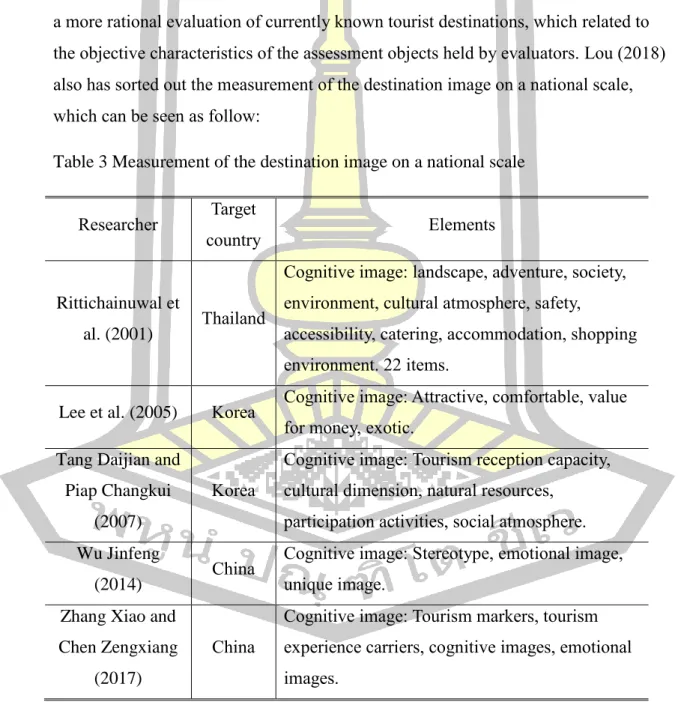
directed at tangible products, while the products of tourist destinations are invisible as an experience product. When the country is a tourist destination, there is a certain overlap between the destination image and the Country Images. Lou (2018) sorted out the conception of the Country Images with a table as follow:
23
Table 1 Concept of Country Images
Researcher Conception
Bannister and Saunders (1978)
A comprehensive image of representative products, economics, political maturity, historical events and relationships, traditions, industrialization, and technology.
Thoreli (1985)
A stereotype and prejudice that a person or a certain part of a country has about a person or product in another country.
Erleksonetal.(1984) Parmeswaran and
Yaprak (1987)
A general perception of a consumer's product in a
particular country or a perception of the characteristics of a particular country's people.
Desborde (1990)
The origin-Country Images is the overall impression of the culture, the political system, the level of economic development and the level of science and technology in the minds of consumers.
Martin and Eroglu (1993)
The Country Images is a person's descriptive, inferred, and informative overall belief in a particular country.
Kotler (1993)
The sum of people's beliefs and impressions about a place. Image is a simplification of mass associations associated with a place and countless information. It is also the product of the brain which tries to process large amounts of data from a certain place and extract useful information from it.
Lantz and Loeb (1996) Consumers' overall assessment of a country's perceptions.
Askegaard and Ger (1998)
A tomb model or network structure that can define the relevant factors of a country. Our knowledge of a country and the emotional structure of its triggers constitute a comprehensive knowledge structure.
24
Table 1 Concept of Country Images (Continued)
Researcher Conception
Allred (1999)
The impression or perception of a country from
consumer. This national impression or cognition based on the country's economic conditions, political structure, culture, labor conditions, conflicts with other countries, and environmental affairs.
Verlegh andSteenkamp (1999)
The psychological performance of a country's people, products, culture and national symbols. The product Country Images includes a widely recognized cultural stereotype.
Verlegh (2001) The psychological structure of emotional and cognitive associations associated with a country
Hooley (1988) Stereotypes of individual countries and their products, and their impact on consumer behavior.
Li (1997) Consumers' impressions of producing products in different countries and in these countries.
Knight and Calantone (2000)
The origin-Country Images (COI) reflects the consumer's perception of the quality of the products produced in a particular country and the qualities of the people of the country.
Jaffe and Nebenzahl (2001)
The brand image and Country Images are the
psychological portrayal of the brand and the country.
Nebenazhl (2003)
Consumer perception of the characteristics of a product produced in a particular country and the sentiment towards a country and the resulting desire to own the country's products.
Papadopoulos and Heslop (2003)
The product-Country Images (PCI) is the image of a place where the buyer or seller is associated with a product.
Source: Lou, 2018.
25
When examining Country Images, no one could ignore Destination Image.
Destination image is researched in the early 1970s. Hunt (1975), who studied the destination image earlier, believes that the destination image is “the impression people hold about their non-resident country (state). Gartner (1992) believes that the image of the destination is formed by the interrelationship between the three components of hierarchy (cognition, emotion and intention). Crompton (1979) defines the destination image as the sum of the beliefs or thoughts and impressions held by the individual against the destination.
Echtner and Ritchie (1991) believes that the destination image is the
perception of the individual attributes of the destination and the overall impression of the destination. Chen and Chu (2007) has sorted out the concept of Destination Image like the form as follow:
Table 2 Concept of the Destination Images
Researcher Concept
Hunt (1971) The impression that an individual has on his non- residence.
Markin (1974) Individual, internalized, conceptual understanding of an individual's formation.
Phelps (1986) Regional perception or impression.
Moutinh (1987) Establish an individual attitude based on the perception and perception of destination attributes.
Calantone (1989) Perception of potential tourist destinations.
Embacher and Buttle (1989)
The opinion or concept held by an individual or group after a survey of the destination.
Chon (1990) The result of the individual's beliefs, opinions, feelings, expectations, and impressions of the destination.
26 Table 2 Concept of the Destination Images (Continued)
Researcher Concept
Echtner and Ritchie (1991)
Single destination attribute and perception of overall impression.
Dadgostar and Isotalo (1992)
The overall impression and attitude of the individual to the place.
Milman and Pizam (1995)
The visual or spiritual impression that the public has on the place, product, or experience.
Macka and Fesenmaier (1997)
A total impression of a variety of products or a combination of attractions and attributes.
Pritchard (1998) The spiritual and visual impression of a destination place.
Baloglu and McCleary (1999)
The individual's perception of the destination, the feeling, and the spiritual representation of the overall impression.
Coshall (2000) Personal perception of destination Characteristics.
Murphy (2000)
A combination of pieces of information associated with a destination, including multiple constituents of the destination and personal perception.
Tapachai and Waryszak (2000)
The perception and impression of the tourist's
expected interest or consumption value on the tourist destination.
Bigne and Sanchez (2001)
Tourists' subjective interpretation of the reality of tourism.
Kim and Richardson (2003)
The accumulation of impressions, beliefs, opinions, expectations and feelings formed in a place formed over time.
Lawson, Bond-Bovy (1977)
An impression of an individual's impressions, prejudices, imaginations, and emotional thoughts about a particular object or place.
Crompton (1979) The sum of the beliefs, opinions and impressions of the tourists on the destination.
Assael (1984) The overall perception of the destination formed by the processing of multiple sources of information.
Source: Chen and Chu (2007).
27
There is also a difference between the Country Image and the destination image. The most basic difference is that the Country Images is an evaluation of all aspects of a country, and the destination image refers to the perception of a particular region, city or country as a tourist destination (Mossberg, 2005).
In this study, Thailand Country Images is an evaluation of all aspects of Thailand. According to Scott (1966 : 394), “when we think of the country, the overall image of the country emerged in our minds.” Researcher wants to study the overall image of Thailand, which emerged in Chinese tourists’ minds. Researcher wants to study the overall image of Thailand which emerged in Chinese tourist’s mind.
2. Element of Country Images
In the field of international trade and marketing, some scholars divide the Country Images into two dimensions: Macro-Country Images and Micro-Country Images. They believed that the two components are related.
Pappu and Quester (2007) believed that the Country Images is a construct that includes the national level (macro) and the product level (micro). They measured the macro-Country Images from the three dimensions of economy, politics and technology, and measured the Micro-Country Images from three dimensions:
innovation, prestige and design. The Macro-Country Images refers to the sum of consumers' descriptive, inferential and informative beliefs held by a country (Martin and Eroglu, 1993). The Micro-Country Images refers to the reputation and impression that consumers have about a country's products (Nagashima, 1970). Puppu and
Quester (2010) measured the Macro-Country Images with five dimensions:
industrialization, economic development, culture, free market system, and democracy.
They measured the Micro-Country Images in four dimensions: trust, quality of work, innovation, and independence.
Li, et al., (2018) constructed the Country Images scale with both tests of reliability and validity based on Chinese national conditions through exploratory factor analysis and confirmatory factor analysis by six aspects: evaluation of relations