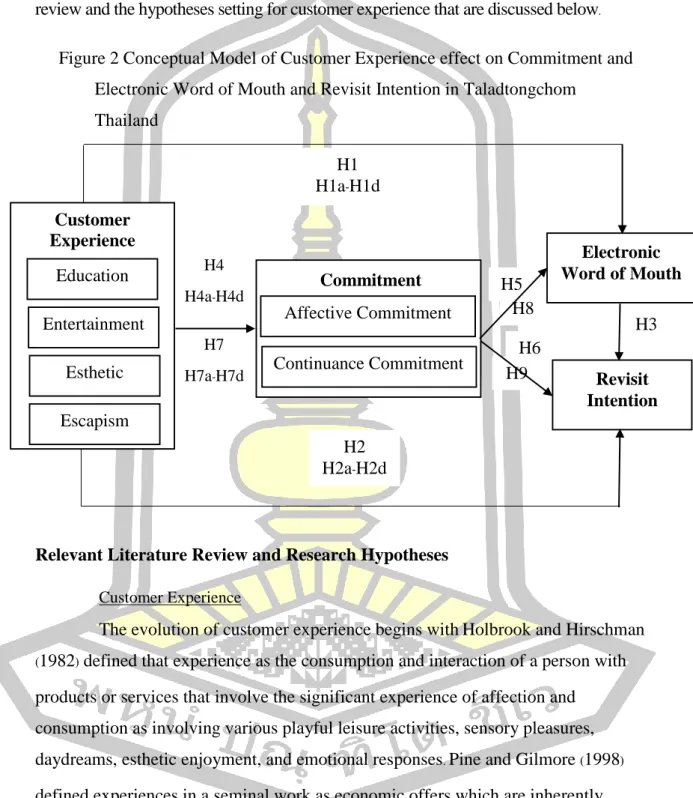
The purpose of this research is to examine the effects of customer experience on electronic word of mouth (eWOM) and revisit intention and the influence of engagement mediates the relationship between customer experience, electronic word of mouth (eWOM) and revisit intention. Thus, the researcher sees a gap in the study of the relationship of customer experience and engagement. How customer experience and the dimension of customer experience affect engagement type, electronic word of mouth, and review intent.
How commitment type, which intermediary, influences the relationship between customer experience and electronic word-of-mouth (eWOM) and revisit intention. To examine the impact of user experience and dimensions of user experience on type of commitment, electronic word-of-mouth (eWOM) and revisit intention. In addition, word of mouth is associated with cognitive evaluation of the user experience (Ha and Jang, 2010).
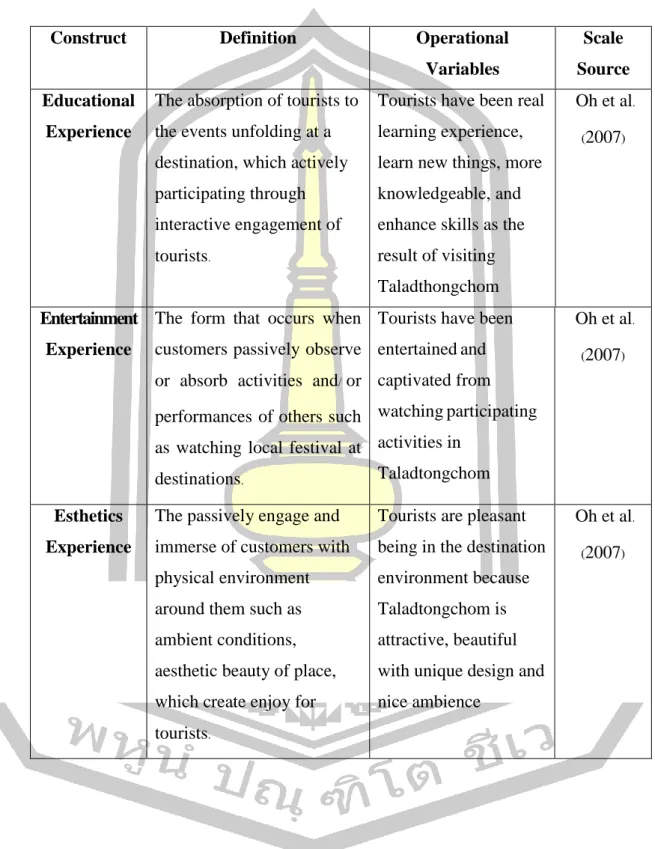
Radder and Han (2015) have shown that educational experience has the greatest effect on behavioral expectations such as word of mouth and revisit intention. Entertainment experience is an important experience in determining visitors' revisit intention (Radder and Han, 2015). Aesthetic experience had a strong effect in predicting loyalty intention, such as revisit intention (Quadri-Felitti and Fiore, 2013).
The following hypotheses are proposed for the relationship between electronic word of mouth and revisit intention:.
Affective commitment has a long tradition in the relationship marketing literature (Gundlach et al., 1995; Kumar et al., 1995; Morgan and Hunt, 1994). Affective commitment in marketing relationships has been described as a complex mix of loyalty, involvement and attachment (Gundlach et al., 1995). Affective commitment reflects the desire to continue a relationship because of a psychological attachment, kinship, or bond (Richard et al., 2007).
A general positive feeling towards the exchange partner is based on an affective commitment (De Ruyter et al., 2001). Affective commitment is considered essential in the development and maintenance of mutually beneficial relationships between partners (Kumar et al., 1995). Continuance commitment refers to an awareness of the costs associated with leaving the service provider (Geyskens et al., 1996; Verhoef et al., 2002).
In addition, continuance commitment is described as a perceived cost associated with leaving the organization (Meyer et al., 1993). Continued commitment is crucial because it is based on more rational and economic aspects of the relationship (Johnson et al., 2001). Continuance commitment or awareness of costs of leaving the service provider (Geyskens et al., 1996; Verhoef et al., 2002).
Both affective and continuance commitment have been found to mediate the effect of customer satisfaction on customer loyalty (Johnson et al., 2001). Furthermore, customer experience in the tourism industry is important to have a positive impact on consumers' emotions (Slåtten et al., 2011).
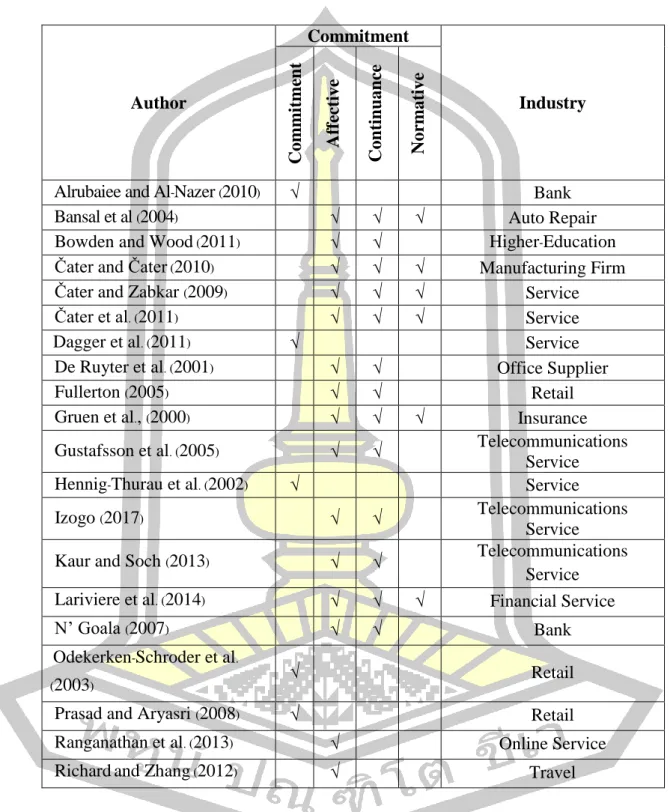
The above relationship implied that customer experience is likely to be related to affective commitment because affective or emotional commitment is the extent to which a customer wants to maintain a relationship with a service provider based on their emotional attachment, positive feeling and identification with the service provider. service provider. 2011) and (Jung and Soo, 2012) found that brand experience is a positive factor in customer affective commitment. Which customer satisfaction has been strongly related to the development of affective commitment (Hennig-Thurau et al., 2002; Johnson et al., 2001; Wetzels et al., 1998). In addition, the experience of entertainment has a positive and significant impact on emotions (Ali et al., 2016; Manthiou et al., 2011).
In other words, emotion-related feelings may be associated with affective commitment because affective commitment. Agree with Manthiou et al. 2011) suggested that experiencing escapism in an event has a positive effect on emotion. Similar to Zhang et al. 2016) showed that escape experience has a significant positive effect on satisfaction.
Previous studies have shown that the escapist experience is related to emotion, satisfaction, and memory, which is related to affective commitment. In addition, relatively other studies have also found positive effects of affective commitment on positive word of mouth (e.g., Morgan and Hunt (1994) and Price and Arnould (1999) found that customer advocacy is seen as an important consequence of affective commitment).
Additionally, affective commitment was related to a desire to continue the relationship with service providers, a willingness to invest in the relationship, and a greater propensity to engage in positive word-of-mouth recommendations (Harrison-Walker , 2001; Wetzels et al., 1998). ), consumer referrals (Verhoef et al., 2002), activism and company shares (Fullerton, 2003 and Fullerton, 2005). Similarly, Morgan and Hunt (1994) and Garbarino and Johnson (1999) mentioned that affective commitment positively affects the general intentions of the customers to maintain the business relationship and to recommend the products and services of the service provider.
Affective commitment is positively related to electronic word of mouth
Rauyruen and Miller (2007) argue that customers who are affectively committed to an organization intend to purchase from that organization. Fullerton (2005) suggested that affective commitment has a direct positive relationship with behavioral intentions such as repurchase intention. The chance that a customer will switch to another provider also decreases if customers have experienced a positive increase (Klaus et al., 2013).
The overall customer experience is an attitude influenced by exposure to stimuli over time that allows consumers to consider alternative perspectives (Palmer, 2008). Tourism experiences are fundamental determinants of post-consumption behavior such as decision-making and choice (Gnoth, 1997; Hosany and Gilbert, 2009). Customer experience will yield both utilitarian and hedonic perceptions (Jain and Bagdare, 2009; Meyer and Schwager, 2007).
In the context of continuity, commitment can be called either calculative or utilitarian commitment (Bowden and Wood, 2011). According to continuance commitment is the extent to which customers perceive the need to maintain one. Online shopping experience is associated with yield benefits and includes convenience, price comparison, time saving and improved customer-retailer relationship (Rose et al. 2012).
It does not only consider costs because perceived costs can be either monetary or non-monetary (time, effort, risk-taking, etc.).
Customer experience is positively related to continuance commitment
For the above reasons, it appears that the customer. experience may be related to the continuation obligation. Thus, this study proposes the following hypothesis for the relationships between educational experience and continuation commitment: Based on previous research reviews, it can be concluded that little research has been conducted on the relationship between entertainment experience and continuation commitment, but still shows that the entertainment experience is related to financial considerations or utilitarian benefits and costs.
Thus, the researcher assumed that customer experience is presumably related to the continuance commitment because the continuance. This research therefore proposes the following hypothesis for the relationship between aesthetic experience and continued commitment:. The relationship between escape experience and sustained commitment Song et al. 2018) suggested that escape experience is significant.
Similarity: The context of continuous commitment means the benefits and costs that the researcher assumes the escapist experience may be associated with continuous commitment. Based on previous research reviews and the reasons stated above, the researcher predicted that the escapist experience was likely related to continued commitment by considering the relationship between financial or utilitarian benefits and costs. Thus, this research is interested in studying relationships between escapist experiences and continued commitment to affirming relationships.
Some studies report that continuance commitment is positively related to attitudinal and behavioral loyalty (Evanschitzky et al., 2006). Correspondence with Sharma et al. 2006) suggested that continuance commitment can be positive (value-based commitment).
Continuance commitment is positively related to electronic word of mouth
Customers with strong values-based commitment continue their relationship because they benefit from remaining in the relationship (Sharma et al., 2006).
Continuance commitment is positively related to revisit intention
It feels like and worthwhile for tourists who watch the show and participate in activities, can motivate tourists to pass information orally and stimulate tourists' desire to travel. This means that customer experience can create electronic word of mouth and revisit intent through commitment.
Affective commitment mediates the relationship between customer experience and word of mouth and revisit intention
Continuance commitment mediates the relationship between customer experience and word of mouth and revisit intention
H10 Emotional commitment mediates the relationship between customer experience and word of mouth and revisit intention. H11 Continuance commitment mediates the relationship between customer experience and word of mouth and revisit intention. 134 Table 32 Descriptive Statistics of User Experience, Commitment, Electronic Word of Mouth and Revisit Intention (Continue).
Thus, data on customer experience, engagement, electronic word of mouth, and revisit intent frameworks can. In this study, it tests the reliability and validity of a measurement model of customer experience, engagement, electronic word of mouth, and revisit intention. The hypotheses of the proposed frameworks for customer experience, engagement, electronic word of mouth and revisit intention are tested.
To consider the effects of customer experience, engagement, electronic word of mouth and review intent. The results of hypothesis testing of customer experience, engagement, electronic word of mouth and revisit intention reveal findings are as follows. This study presents the conceptual framework of customer experience, engagement, electronic word of mouth and revisit intention.
Results from hypothesis testing reveal that electronic word of mouth is significantly and positively related to revisit intention. The empirical results of this study increase understanding of the relationships between customer experience, engagement, electronic word of mouth (eWOM) and revisit intention. First, the results show that educational and aesthetic experiences are positively related to e-word of mouth and revisit intention.
Third, this research is merely an examination of the relationship between customer experience and electronic word-of-mouth engagement and revisit intention.
REFENCES
Determinants of customer experience and consequent satisfaction and revisit intentions: PLS-SEM approach for Malaysian resort hotels. Event Experience: A case study of differences between the way organizers plan an event experience and the way guests receive the experience. The Effects of Aesthetic Experience Qualities on Tourist Positive Emotions and Loyalty: A Case of a Nature-Based Context in Norway.
The impact of user experience and perceived value on sustainable social relationships in blogs: An empirical study. Examining the structural relationships of destination image, tourist satisfaction and destination loyalty: An integrated approach.