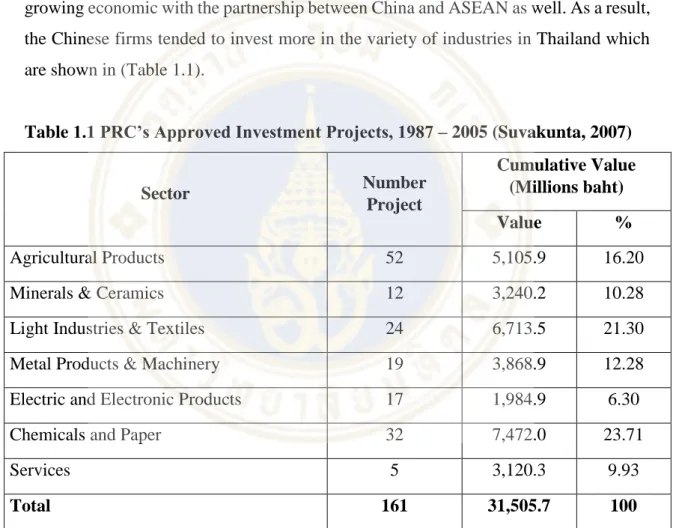
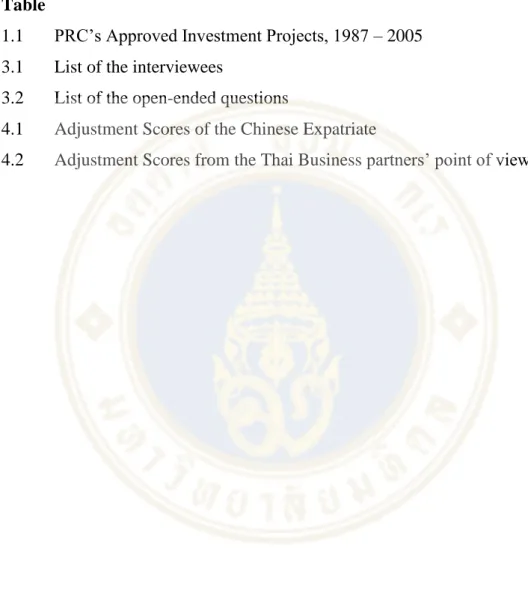
This study also identifies the motivation of Chinese firms to invest in Thailand, their preparation, their challenges during the development of the Thai market and their adaptation to the Thai market. The study concluded that there are 3 challenges for Chinese firms which are political stability, trust and. As a result, Chinese firms tend to invest more in a variety of industries in Thailand, which are shown in (Table 1.1).
Therefore, this paper aims to identify the major challenges that the Chinese firms face during their Thai market development. Thus, this study will only focus on some Chinese firms that have done business in Thailand from the Chinese and Thai employees' point of view. What are the challenges and problems that the Chinese firms usually face in the Thai market.
LITERATURE REVIEW
- Chinese Firm Internationalization Difficulties and Challenges
- Thai Business Culture
- Chinese Business Culture
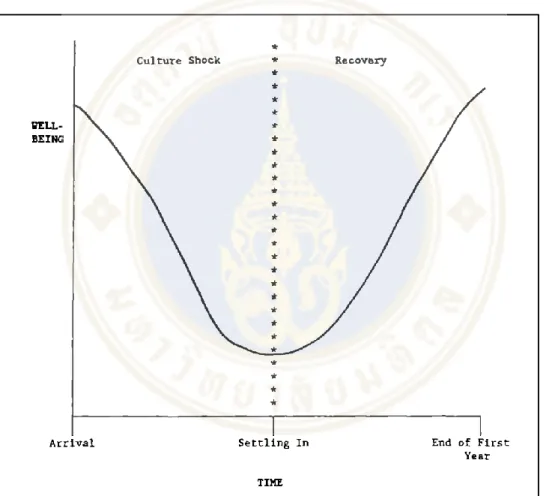
- Chinese Expatriates Culture Shock
- Strategies and Recovery
Another challenge mentioned by Suvakunta (2007) is that after the opening of the Chinese economy, although Thailand signed an agreement to establish Sino-Thai joint economic cooperation committee with China in 1985, not all Chinese firms can come to Thailand. The competition is categorized as selective, which also requires Chinese government approval first. Ghauri and Fang (2001) investigated the characteristics of the Chinese business culture using the way of 4 Ps, which are Priority, Patience, Price and People.
Priority: In their study, they explained that the Chinese government is the biggest boss that all Chinese state-owned enterprises do business according to the government's priorities, policies and plans. Chinese firms are likely to become suspicious that the risk is high and the firm will lose its credibility in the eyes of the Chinese firms. In the same way, if a foreign firm rejects any Chinese firm's request for a price discount, the Chinese will most likely feel insulted.
On the other hand, if the Chinese firms find that the foreign side is giving them a face, they will adapt accordingly and be more helpful and friendly mannered. Their survey showed that the Chinese companies believe more in the people than in the contracts. Not only in terms of business, but also the individual, which affects the Chinese companies to face some difficulties.
The result of their research showed that most Chinese immigrants were affected by racism and time orientation at work and had a feeling of being deeply uncomfortable. Their research concludes that the main factors that make Chinese expatriates face difficulties are poor business communication adaptability, language barriers and high pressure from work tasks.
RESEARCH METHODOLOGY
Primary Data Collection Method
Interview Method
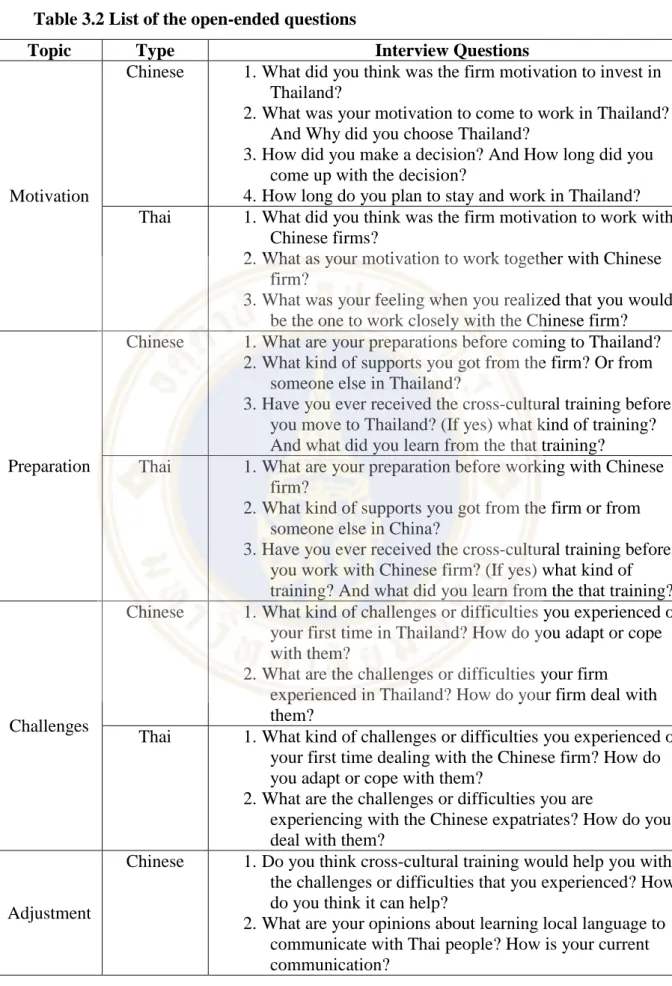
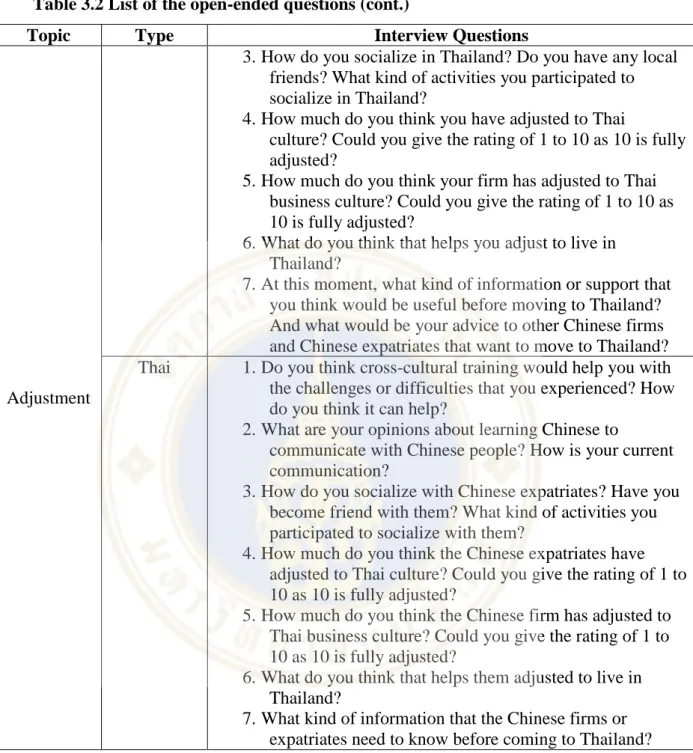
To understand the challenges and how the Chinese companies and Chinese expats face through their practical experiences, the open-ended questions are developed and presented to the interviewees, giving them the flexibility and freedom to answer all questions as in (Table 3.2). What was your feeling when you realized that you would be the one working closely with the Chinese company. What support you received from the company or anyone else in China.
What challenges or difficulties you encountered when you first started working with the Chinese company. Do you think intercultural training could help you with the challenges or difficulties you have experienced? What kind of information or support do you think you would find useful at this point before moving to Thailand?
And what would be your advice to other Chinese firms and Chinese expatriates looking to relocate to Thailand. What kind of information should the Chinese firms or expatriates know before coming to Thailand. Furthermore, the interviewees' body language, gestures and facial expression would be observed and additionally recorded with the recorder.
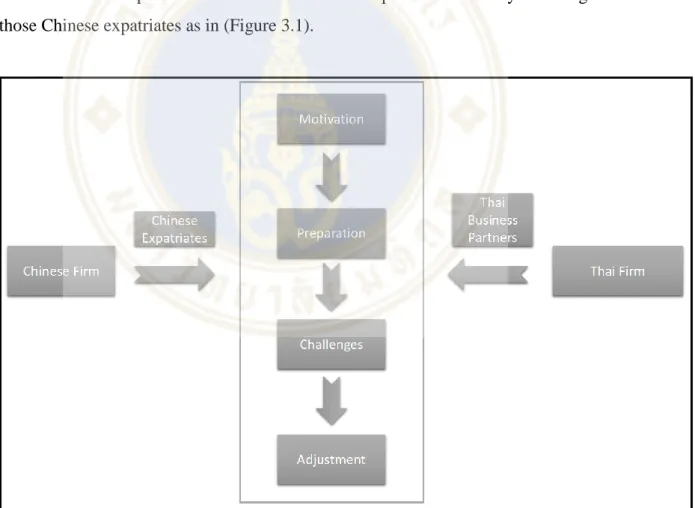
Research Framework: The research framework will cover the objective of this article to find out the motivation, challenges and adjustment of Chinese company and Chinese expatriates during the development of Thai market. By sending the assigned Chinese expats to Thailand to develop the market, both the company and the expats will enter the four main phases: motivation, preparation, challenges and adaptation.
RESEARCH FINDINGS
- Interviewees’ Background Information
- Motivation
- Chinese Firms’ Motivation
- Chinese Expatriates’ Motivation
- Preparation
- Firms’ Preparation
- Personal Preparation
- Challenges
- Personal Challenges
- Firm Challenges
- Adjustment
- Firm Adjustment
- Personal Adjustment
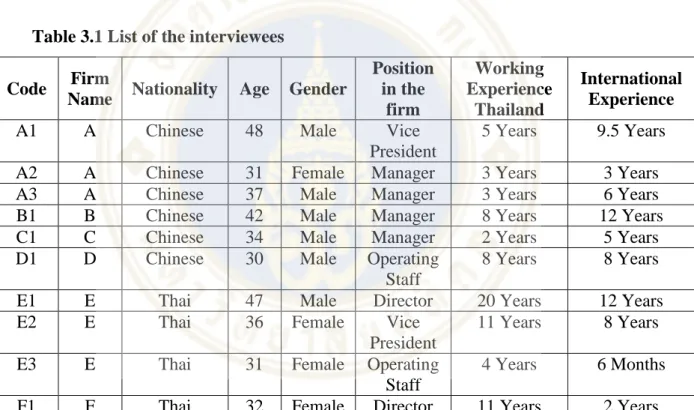
- Adjustment Level
- The Useful Support or Information
On the other hand, only Mr D1 was a Thai university graduate and had worked in Thailand since his Thai bachelor's degree. As a result, it motivated them to come to work in Thailand as the overseas Chinese. In addition, the author also asked the same question to the Thai business partners to learn from their point of view how they had prepared before working with the Chinese expatriates.
Like the Chinese interviewees, none of the Thai interviewees knew what intercultural training was. According to the interview with the Chinese interviewees, all of them said that their firms had not prepared much for them to live in Thailand for several years. It enhanced her impression of Chinese expatriates by how well they had prepared themselves before coming to Thailand compared to Thai business partners like herself who did not have to prepare much.
In order to understand what kind of challenges or difficulties Chinese firms faced during the development of the Thai market, those Chinese interviewees were asked some questions. One of the challenges during the development of the Thai market was the political stability in Thailand. On the contrary, it was completely different from the expectations of Thai firms for the higher profit margin of Chinese products.
On the other hand, Mr. B1 said the same with Mr. E1 about how Chinese products were perceived by the Thai customers in the past. In addition, the author also asked the Thai interviewees for their opinions on the Chinese companies and Chinese expats who are also currently working with them. One of the reasons could be that the Chinese expats had to live in the Thai environment.
E3 as she feels that the Chinese firm's adaptation to Thai business culture has been a good fit.

CONCLUSION AND RECOMMENDATIONS
Conclusion
Before the deployment, the Chinese firms only set the KPI and shared their targets for the development of the Thai market to their expatriates. The Chinese expatriates themselves had to prepare other necessities such as VISA and work permit. Unlike the Chinese firms, most of the Thai firms only prepared the profile of the Chinese firms, their main products and services, the name and position of the expatriates, and their website.
On the other hand, Thai business partners were not at all interested in cross-cultural training when dealing with Chinese companies because they believed that Chinese culture was similar to Thai culture. Another challenge related to the differences in business culture between Chinese expatriates and Thai business partners. However, Thai business partners' opinion of Chinese expatriates was not as good as expected.
On the other hand, the Chinese expatriates also had headaches because of the Thai business culture which was very slow in every process. Even though the Chinese firms trusted them and invested as they asked, the number did not even come close to the previous commitment. However, the Thai firms thought that the Chinese products would be cheaper, but instead the cost was quite high with less margin for their firm unless they could sell in a very large volume.
The Thai firms therefore had to come up with the strategy that combines the slightly higher forecast to negotiate the costs with the Chinese firms. On the other hand, the Chinese expatriates adapted themselves by attending the social activities to build the relationship with the Thai business partners.
Recommendations
Therefore, it was difficult to change their mentality, even though Chinese products had improved a lot in terms of quality recently. They adapted by strengthening trust and relationships with Thai companies. Although they used to claim that Thai partners could not be trusted, they still insisted on maintaining trust while controlling the information they received from the Thai partners.
They decided to change their current procedures, operations and financial terms to suit the Thai business culture. In addition, sports that involve many people at the same time were also the best choice for Thai business partners, such as badminton. Some procedures or policies may need to be adapted to suit Thai business culture.
In order to build a relationship, Chinese expatriates can join social activities together with Thai business partners, such as having dinner together, going to karaoke, or playing some sports that involve a lot of people, such as badminton. To adapt to Thai culture faster, we recommend a local friend to help Chinese expats learn more about Thai culture. Cross-cultural training is also recommended for Chinese expatriates prior to their emigration to Thailand.
Change management is also recommended to change the Thai consumer's bias towards Chinese products, otherwise it will consume more time to develop the Thai market.
Scope and Limitations
However, the author still hopes that this article would somehow be useful to the other Chinese companies and the Chinese expats who are planning to invest or stay in Thailand. Therefore, they could adapt their strategies to Thai business culture and develop the market with fewer problems in the future as well.