The purpose of this paper is to find out the key success factors that helped the family business to overcome the flood disaster in 2011. The qualitative research method was used to collect data by interviewing the CEO and the related person who were decision makers and managers in the bus service business to explore the relationship between family business management style and crisis management. The results revealed that family business model is considered as an organization with a unique management style that worked effectively to help the company overcome the crisis.
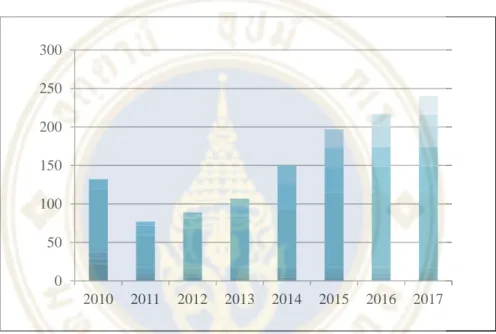
However, the paper contains some limitations because it is only based on one firm in the field of bus service business, so further research and studies are suggested to study to explore more details in the factors of crisis management of family businesses in Thailand. Chalermpat Transport is one of the bus service providers that has been supporting the transferring employee system to the factories since 1992, and has also faced the consequences of this disaster. All income from Chalermpat Transport came from long-term contracts with the facilities located in the flood zone, so at the time when the facilities stopped their operations, it was massively affected by the company's income.
This thematic article aims to discover and analyze the key success factors that contributed to the company's survival and development into one of the competitive companies in the market.
LITERATURE REVIEW
- Family Business and Decision Making
- Leadership Management
- Factors that Support Each Leadership Style
- Crisis Management
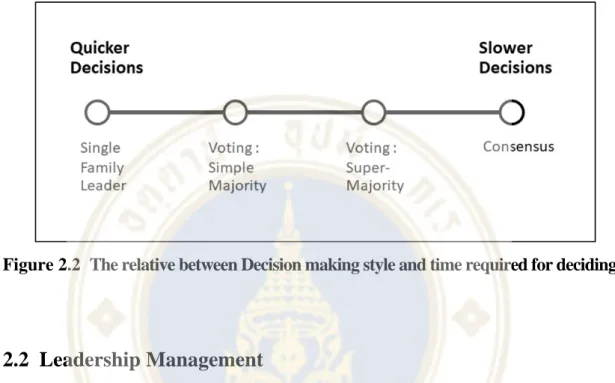
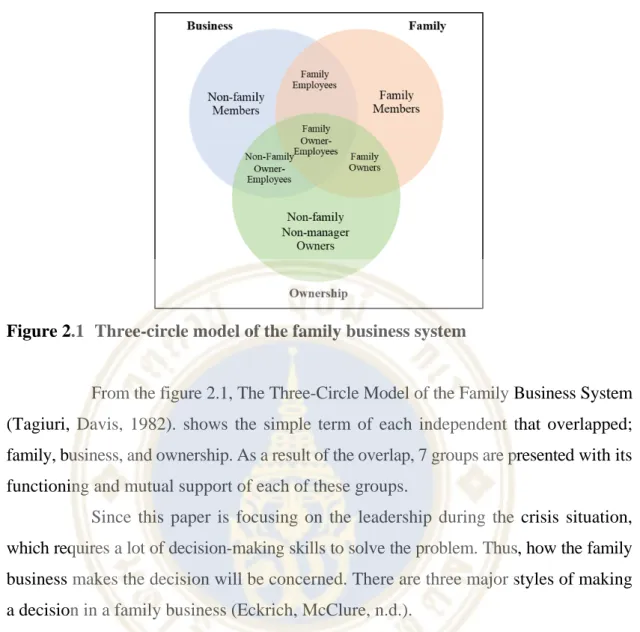
As a result of the overlap, 7 groups are presented with the operation and mutual support of each of these groups. Normally you will find this style of decision-making in a small family business, because the owner of the company is responsible for the results of the company. This decision-making style allows the follower to get the quickest answer to any problem.
Voting requires an understanding of the rules before voting to avoid a conflict after voting because some of those who are chosen to vote must be defined and also the result of the voting must be clear. Contingency Theory or Situation Theory: This theory focuses on the environment that influences leadership style. Behavioral Theory: This theory is based on the different behavior of the leader and the non-leader.
The power of the leader can be described as four management styles according to Rensis Likert's Theory (Dininni, 2017) to understand how each leadership style affects the structure of the organization and the direction of the company. This leadership style helps each member in the team see the importance of group members in influencing the company's performance. Decision making level: Different decision making style leads to different leadership style.
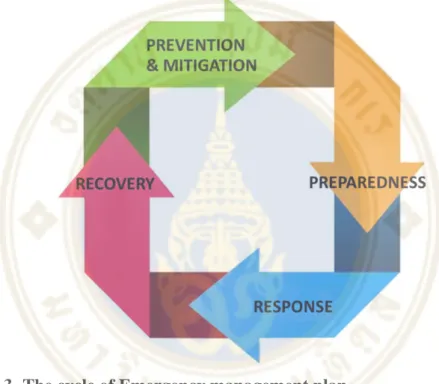
For example, in a centralized organization such as a single family business, there will be little or no decision input from the lower level of the business allowed. The four phases of the emergency plan work in cycle to make the plan work effectively. This phase includes training and education of the related person to ensure that those who dealt with the consequence of the crisis understand and are ready to use the plan well.
This phase is the important one and leads to a result of the negative consequences of the crisis. From the four phases of the contingency plan, after passing the fourth phase, the recovery phase, the company will see room for improvement to develop and prepare in the mitigation and prevention phase to make this preventive plan work more effectively in the future crisis.
RESEARCH METHODOLOGY
The interview includes two key people who were decision makers or leaders of the flood in 2011. The background of the selected company for this paper and each interviewee will be presented as follows. It was established in 1992 with expertise and experience in providing transportation services for factory workers in Pathum Thani, Ayutthaya and Nakhon Ratchasima.
With over 20 years of experience in providing transportation services, the company has been trusted by the world's leading companies with manufacturing bases in Thailand to be their personnel transportation supplier, with contracts that are continuously renewed for a long period. Chalermpat Transport has the professional and experienced drivers with a driver's license as well as the good quality coaches with full facilities provided to the customers, for example the air conditioner, the GPS, the identifying driver system and the entertainment service. After overcoming a difficult economic and social situation, Chalermpat took a few years to recover from the crisis and turn to be one of the well-known bus service providers that have factories located in Thailand.
He started this company himself when he graduated from his bachelor's degree in education program. He had no background in business, but he had the opportunity to start the first bus service contract for the factory in Pathum Thani. Terdsak started the company with just one bus with a reliable service that met factory standards, so the good service reputation was spread to other factories in the area.
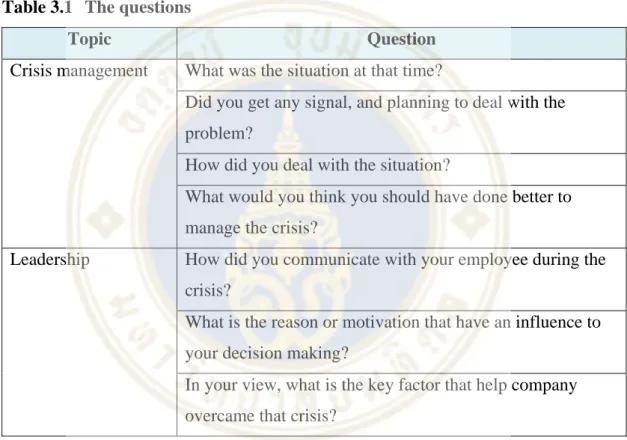
During the 2011 flood, Aphiwit was the manager and not the main leader. Aphiwit grew with the age of technology, so he was the one who encouraged and wanted to use technology to support the system after a crisis and help the company get back to normal faster. Developed questions will be prepared before the interview to help the researcher control the direction of the questions to get the most effective results from the interviewees.
FINDINGS
Crisis Management
Their strategy to deal with the suspension of the customers was to try to save the equipment, especially the buses. The buses drove through the flood zone because it was the only way to go to the highway entrance. And the company still has to take care of the volunteer who helped look after all the buses on the highway by paying them extra wages.
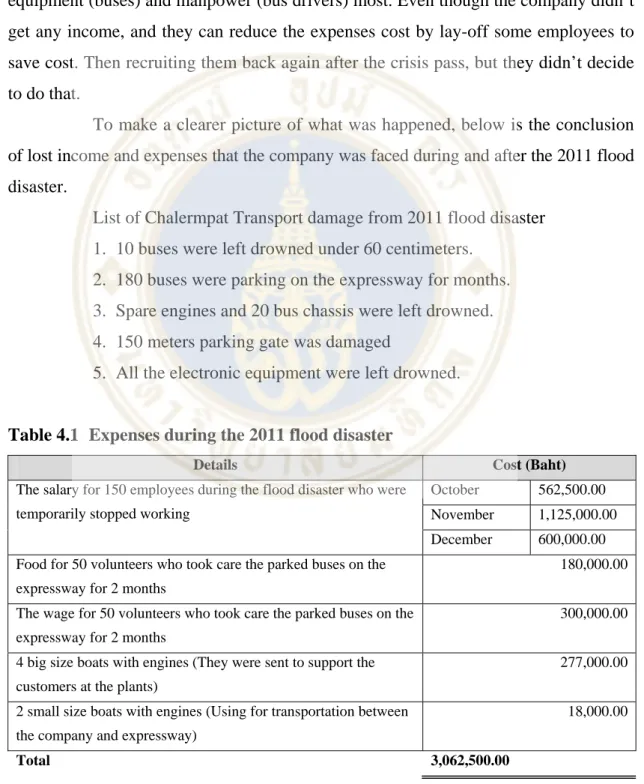
During the time when the buses had to stop working and park on the expressway, the company did not get any income from the customers for a long time because the customers were in the same situation, they were also unable to run the business. So the company's expenses were still running with a large amount for the salary of the employee and corrections for the costs of the parked buses. Although the company did not get any income, it can reduce the cost of expenses by laying off some employees to save costs.
To create a clearer picture of what happened, below is the conclusion of lost revenue and expenses that the company faced during and after the flood disaster of 2011. It is clearly seen here that two main assets that drive the company are buses and drivers, so Terdsak and Aphiwit made every effort to ensure that they can keep these assets in a safe place by not laying off any employees, and the buses parked in a safe place as much as possible. From obtaining information about how the CEO and manager of Chalermpat Transport reacts to the situation, it can be connected to the emergency plan to find the strategy that the manager of the company uses to overcome the crisis.
Mitigation and Prevention: Because the company has been operating for almost two decades without having to deal with this type of crisis before, they had no system or barrier in place to help prevent the crisis. They also negotiated quickly with the bank and suppliers to understand the situation the company was facing. During this recovery phase, external factors, such as good support from the bank and the supplier from the Response case, also support the company in this phase.
Factors That Support Each Leadership Style
From the information about the situation, researcher not only found the leaders' actions that can be linked to the emergency management plan, but also found some leadership management style in this family business model. In the urgent situation that needs a quick response, a single leader, in this case, Terdsak, is more effective in supporting a quick action to deal with an uncertainty situation. This can be related to the research framework on the factors that support each leadership management style.
Goal Congruence: According to Maslow's Hierarchy of Needs, basic needs for Chalermpat workers are Physiological Needs and Safety and Security Needs. As well as Chalermpat Transport, the company's goal is to work with the customers directly after the crisis recovery to generate income. Terdsak and Aphiwit said that more than 150 workers in their company are skilled in working with professionals in bus management.
These people are a key factor in helping the business recover by providing the service immediately after the customer. Different leadership styles can be used depending on the degree of current common purpose in an organization. Transformational leadership enabled leaders to engage everyone in the company by functioning as a team, recognizing the importance of group members influencing the company's performance.
With only 4 members of the family influencing the decision making of the company, it can be said that Centralized Leader is a leadership style used for the company. Because the owner of the company is responsible for the company's result as the ownership, they have the most powerful decision-making regarding anything that affects the company or caused a problem.
CONCLUSIONS
Conclusion
Recommendations
Limitations