Furthermore, I would like to thank all the employees of Phoomthai Garden Hotel, Phrae for their help in distributing questionnaires to hotel guests and collecting data. DETERMINING THE INFLUENCE OF SERVICE QUALITY ON CUSTOMER SATISFACTION: A CASE STUDY OF PHOOMTHAI GARDEN HOTEL, PHRAE. This study aims to investigate the influence of service quality on hotel guest satisfaction by focusing on the case of Phoomthai Garden Hotel, Phrae.
The questionnaires were physically distributed to hotel guests staying at the hotel during the long weekend, 22nd to 25th October 2015, and were also made available on the hotel's facebook fan page to allow guests who used to stay at the hotel to complete the questionnaires online. According to the analysis result, all five dimensions have a positive relationship with customer satisfaction as expected. The research result is expected to facilitate the hotel, including other hotel owners, to improve their service and create sustainable benefits.
The tourism industry in Thailand is an industry that generates huge income for the country every year. Many researchers identify that service quality is a key element that influences customer satisfaction and repeat visits in the hotel business. Mosin and Lockyer (2010) also point out that service quality not only helps the hotel to create positive products and services, but also represents the standard of the hotel.
Therefore, it is crucial to examine factors affecting service performance and dimensions of service quality.
LITERATURE REVIEW
Theoretical
- Service Quality
- Consumer Satisfaction
Thus, if the service provider can facilitate its customer to perceive a unique positive and memorable first-hand impression, it is likely that the customer will return in the future. It refers to how service providers perform and complete their promised services with quality and accuracy in accordance with mutually agreed upon requirements with the customer. Delgado and Ballester and Reliability (2004) define reliability as an important dimension for service delivery as every customer wants to know if the service providers are reliable and are able to meet the set of service requirements.
Responsiveness of service providers can influence customers to feel more valued with service quality if they receive the best possible service quality (Delgado and Ballester, 2004). Therefore, if the staff could not promote this dimension to the customers, there will be a fairly high chance that the customers will not return to the service (Delgado and Ballester, 2004). In other words, it refers to how the service providers show the customer their care and provide individualized attention to the customers to make the customers feel more valued and special. that once customers recognize that they are receiving individualized and quality attention, there will be a high potential that they will return to purchase the service again.
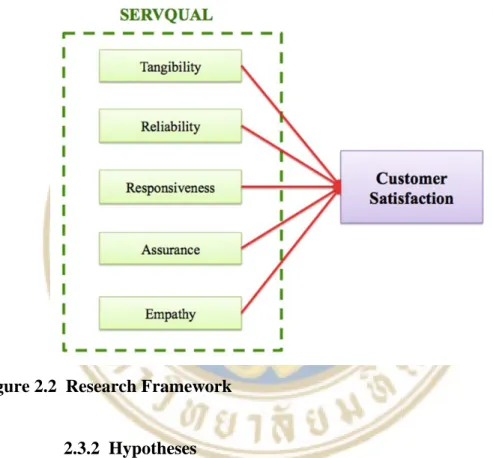
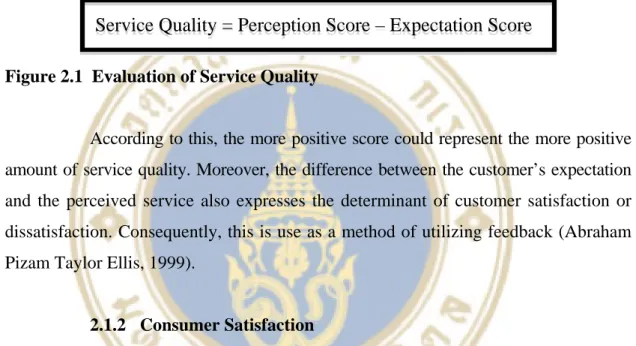
With the SERVQUAL measurement scale, service quality is considered as the gap between the customer's expectations and the perception of the performance of the service provided. In terms of service business, customer satisfaction refers to the result of the customer's perception of the value they received in the service, equal to the value expected from the service performed by the service providers (Blanchard & Galloway, 1994).
Empirical
- Relationship between Service Quality and Customer Satisfaction Pursuant to the study of Yılmaz (2007), there is a strong relationship of
- Service Quality, Customer Satisfaction, and Key Success Factors of Business
Research Framework and Hypotheses
- Research Framework
- Hypotheses
METHODOLOGY
- Research Design
- Population and Sample Group
- Research Instrument
- Constructs Measurements
- Questionnaire Design and Question
- Data Collection
For the questions aimed at grouping the response data and general information of the respondents, the nominal scale was applied. Whereas, the interval scale is adapted to the questions, the objective of which is to evaluate the level of agreement of the respondents in the service attributes of each hotel through 6 levels of the evaluation scale from very agree (6) to completely disagree (1) . This section aims to examine data from respondents who have never experienced a hotel stay to continue answering questions especially in the case of online questionnaires.
The section intends to evaluate customer perceived value on each service quality factor provided by the hotel. The paper questionnaires were circulated to the hotel's guests who visited the hotels in the period 22 - 25 October 2015. In addition, the online survey was prepared by the Google program and posted on the hotel's Facebook fan page to be answered from 22 - 31 October 2015.
DATA ANALYSIS AND RESEARCH FINDINGS
- Research Finding
- Respondents
- Demographic Information of Respondents
- General Information of Respondents
- Specific Information
- Correlation Analysis
- Multiple Regressive Analysis
- Model Summary
- ANOVA
- Regression Analysis
- Hypotheses Summary
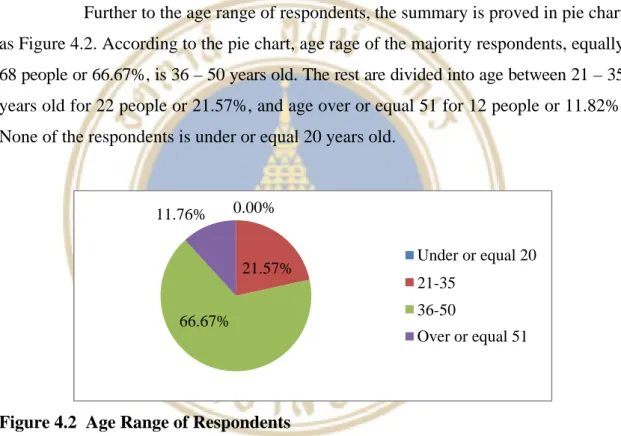
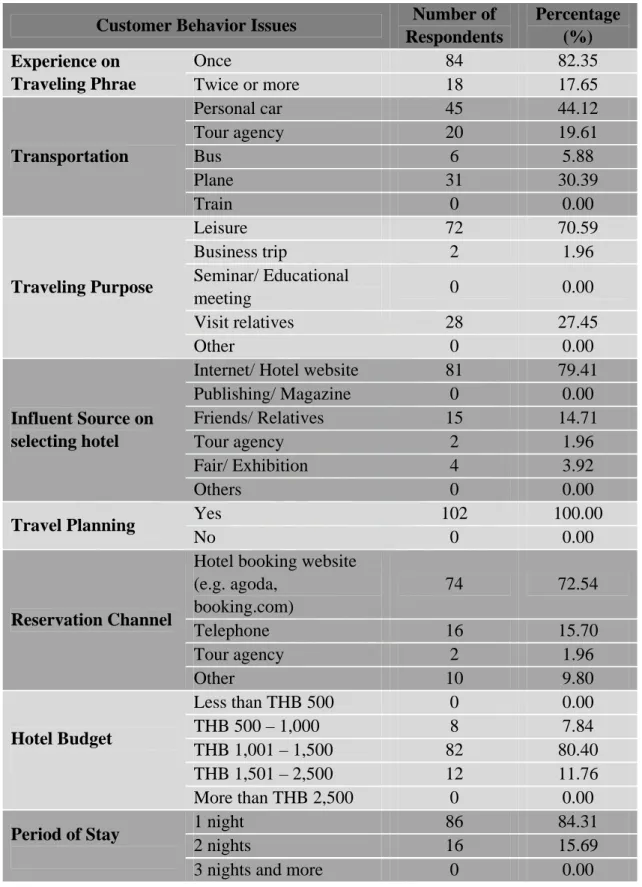
Further to the age group of respondents, the summary is proved in pie chart as Figure 4.2. The first two occupations of the respondents are government official and office worker, for 54 people or 52.94% respectively, and 35 people or 34.31%. Personal car is the most popular vehicle used by the respondents, 45 people or 41.12%, followed by plane and travel agency whose numbers are 31 and 20 people respectively.
The source that most influences the decision to choose a hotel is the Internet and the hotel's website; a total of 81 people or 79.41% of them rely on the Internet and the hotel's website. Meanwhile, 15 people or 14.71% stay in a hotel recommended by their friends and relatives, while the rest believe the information obtained from the exhibition and travel agency for 4 and 2 people, respectively. All respondents usually plan and book their trip in advance.
15.70% or 16 people called the hotel directly to book a room while 10 people walked in. Most of the respondents, 86 persons or 84.31%, spent the night in Phrae, and the other 16 persons stayed 2 nights. Specific questions were used to gather information regarding the customer's attitude toward each dimension of the quality of service provided by the hotel and overall satisfaction with the hotel.
With the average score of 4.55, which is the highest score among the SERVQUAL dimensions, it could be determined that the customer most perceived the value of the hotel's responsiveness. While the average score of overall satisfaction with the hotel's services is around 4.53. According to the correlation coefficients between five SERVQUAL dimensions and customer satisfaction, as shown in Table 4.2, in the last row it can be seen that customer satisfaction is moderately correlated with tangible, reliability, assurance and empathy (r is between, although it has a low correlation with responsiveness (r = .206).
According to the ANOVA result given in Table 4.4, it can be concluded that at least one of the service quality dimensions is statistically significant (F = 11.915, p-value = .000). The results from multiple regression analysis show that responsiveness (t = 4.122, p-value = 0.000) and sensitivity (t = 2.225, p-value = 0.028) are significant explanatory variables in predicting customer satisfaction (Y). It can be considered that responsiveness has the greatest impact on customer satisfaction (Beta = .250), followed by sensitivity (Beta = .119).
According to the hypothesis summary table, it could be seen that all five dimensions of SERVQUAL have a positive relationship with the customer satisfaction of the hotel guest. However, only responsiveness and empathy have a significant impact on customer satisfaction, while the other three dimensions such as tangibility, reliability and security have a moderate effect on customer satisfaction.

CONCLUSION AND LIMITATIONS
Recommendations and Implementations
Based on the result of the study, all dimensions of service quality have a positive correlation with customer satisfaction. However, only responsiveness and sensitivity have a high and direct impact on the evaluation of hotel guest service. Promote Service Mindset: The training program should begin with creating a willingness and begging to provide service mindset to the staff.
With this attitude, it believes that the staff will promptly perform service with quality and promote exclusivity towards the customer. Provide service guidelines: In some cases where the guest needs assistance, the staff may not recognize how to meet the guest's demand or the extent of the service they could perform, the hotel can provide the guild with the possible solutions for certain circumstances that may happen or often happen to them. For example, when the customer could not find their way to the hotel, on to guild guidance to them by phone, the hotel can arrange for the staff, if possible, to go out to see them and lead them to the hotel.
Monitoring and giving: After the first two steps are ensured, the hotel should monitor the performance of the staff along with placing more focus on the complaint from the guest to improve the service. Conversely, once there is a surcharge from the guest, the hotel must reward the staff. However, although the other dimensions will have less impact on customer satisfaction, it is recommended that the hotel does not ignore maintaining service quality in other dimensions as all five dimensions have a positive relationship with customer satisfaction.
Limitations
Based on the research analysis that provides that the model to evaluate customer satisfaction through the five dimensions of service quality does not have high predictive power to analyze the customer satisfaction. Therefore, other factors such as hotel reputation and value for money can be used to consider as substance for customer satisfaction analysis for further research. Furthermore, in order to generate effective results, a study will be carried out to other hotels located in the same area to influence the perspective of tourists visiting the city, or to focus on certain segments to gain the opinion of the target customer reflect.
Mohsin, Asad., and Lockyer, Tim. 2010), Customer Perceptions of Service Quality in Luxury Hotels in New Delhi, India: An Exploratory Study, International Journal of Contemporary Hospitality Management. A conceptual model of service quality and its implications for service quality research, Journal of Marketing, 49, p. International Journal of Contemporary Hospitality Management, Volume 11, Number 7, 1999, pp. An empirical test of a model for service quality, satisfaction, and relationship-oriented outcomes, International Journal of Service Industry Management Measurement of Service Quality in the Hotel Industry.
APPENDICES
Appendix A: Questionnaire
Screening questions
Specific questions
- Tangible
- Responsiveness
- Assurance
- Empathy
Appendix B: Descriptive Data Summary