Based on research data dating back to 2013, it is estimated that the total market value of family businesses in Thailand is 28 trillion Baht, accounting for 70 percent of Thailand's total market value (Srihong, 2013 and cited in Apisakkul, 2015 ). In most family-owned businesses, conflicts usually occur when it involves changing authority and power within the business. However, due to the uniqueness of each family-owned enterprise, be it company size, number of employees or type of business, there is no absolute method or approach to deal with every variation of family business (Janjuha -Jivraj, 2014).
A common problem in family businesses has to do with the 'human' factor within the organization (Parker, 2007). According to Mary Hladio, president of Ember Carriers Leadership Group, she emphasized the importance of non-family talents and how their contributions would benefit family businesses (Myers, 2013). This study is based on a family business in Kanchanaburi province in Thailand.
Currently, the researcher holds the position of General Manager in this family-owned business, and there are five other office workers. This paper aims to diagnose and explore different situational management styles to manage non-family members based on their personality, learning styles and readiness level.
Scope of the Study
Contribution of the Study
LITERATURE REVIEW
- Definitions
- The Definition of Medium Enterprises
- The Definition of Family Business
- Situational Leadership Style
- Personality Type
- Myers-Briggs Types Indicator (MBTI)
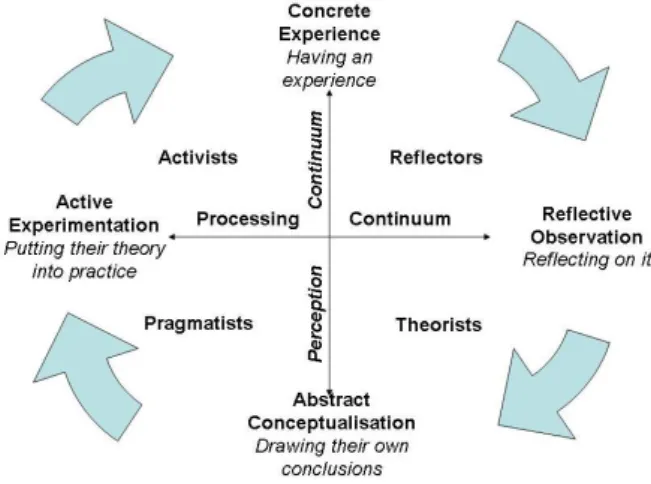
- Learning Styles
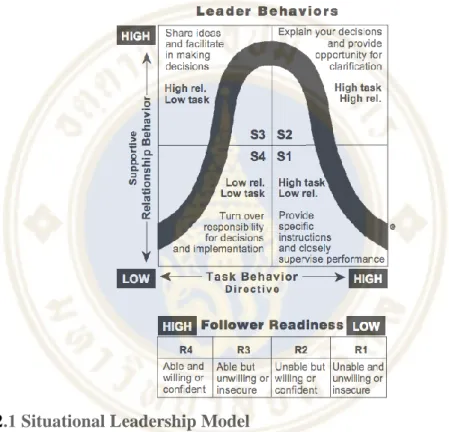
Situational leadership theory, first introduced in the 1970s, is part of the contingency theories of leadership. In the lower right quadrant of the graph, high-task/low-ratio leadership behavior (S1) is referred to as the telling or directing style of leadership. In the upper right quadrant of the chart, high-task/high-relationship leadership behavior (S2) is referred to as the selling or coaching style of leadership.
In the lower left quadrant of the graph, high relationship/low task leadership behavior (S3) is referred to as the participative leadership style. In the upper left quadrant of the graph, low relationship/low task leadership behavior (S4) is referred to as the delegating leadership style. Finally, the team's competency and commitment levels should be used as an indicator that determines the management style to be used (Webster, 2017).
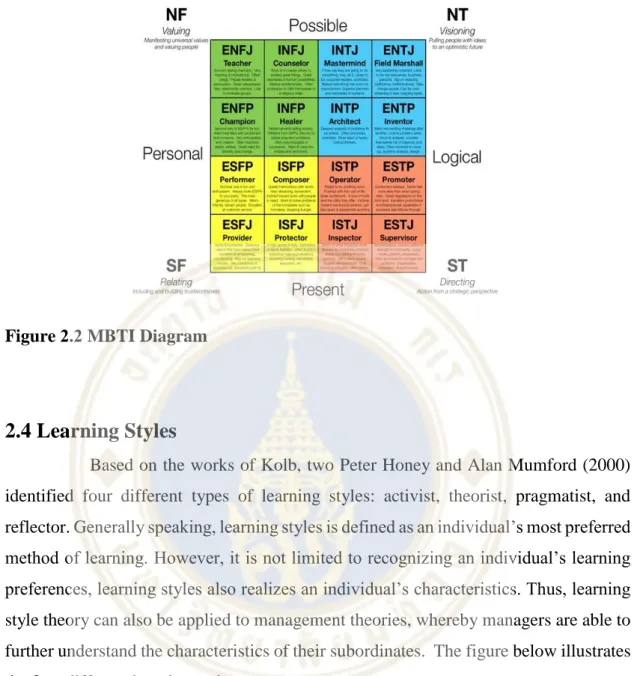
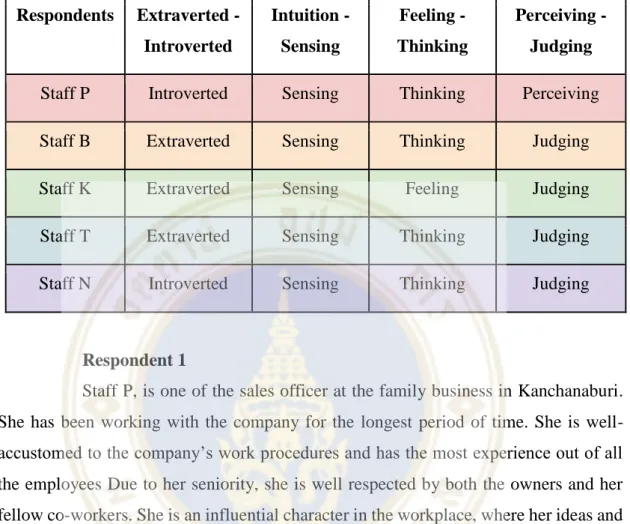
Since the Myers-Briggs types indicator is based on the works of Jung, each letter of the result will correlate with the definition from the paragraph above. The first letter of the result determines one's general attitude towards the world, whether the individual is introverted or extroverted.
RESEARCH METHODOLOGY
Data Collection
Data Source
Questionnaire
DATA ANALYSIS
Quantitative Part
- Analysis of Personality Type
- Analysis of Learning Styles
She is an influential character in the workplace, where her ideas and attitude are of great importance. Based on the personality questionnaire, the researcher has concluded that the personality type of staff P is ISTP. Based on the personality questionnaire, the researcher has concluded that the personality type of staff B is ESTJ.
In the Appraisal Where dimension, staff B is shown to have the personality type of an appraiser. From the personality type questionnaire, it is said that staff K tends to be a censor. This applies to staff K as she gets along well with other employees in the company.
Staff T, one of the three sales officers, is responsible for sales in the northern and northeastern regions of Thailand. In the questionnaire he gave a high score of 5 for the statement "discuss a new, unconsidered issue in a group". Staff N, a sales officer responsible for sales in the central regions of Thailand and the factory workers' wages, is a fairly new employee at the company.
The results of the questionnaire show that staff P is inclined towards the learning preference of a theorist. From this example, you can clearly see that Staff P is a theorist because she gets irritated when the instructor fails to explain each procedure clearly. Personnel B is responsible for weighing the trucks before and after loading the fertilizers onto the trucks.
Another behavior that implies that staff K is a reflector is that she will examine how other employees issue invoices, file billing statements and commissions and adopt it in her work. Then, when the seller receives the trash, the T staff is responsible for issuing invoices and sending them to the sellers. When the check is cashed and recorded in the accounting system, the T staff will then print and send the receipt to the vendors.
Quantitative Part
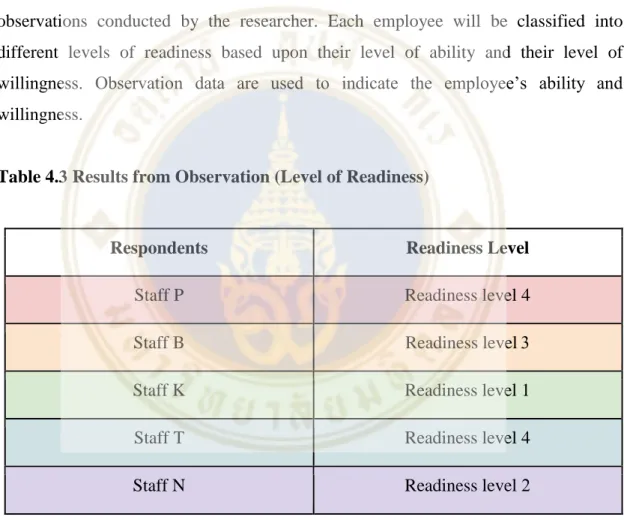
- Analysis of Situational Leadership (Level of Readiness)
According to observations, he is able to fulfill his obligations without the help of other employees. He has the ability to excel at his work, but he is not a detailed person. In addition to being responsible for checks, he is also responsible for employee payroll.
Overall, the above paragraphs have provided evidence supporting the fact that Personnel B is considered an R3. As the newest member of the company, personnel K is considered to have both low ability and low willingness. Moreover, she is only responsible for the work assigned to her by Staff P, her mentor.
With his many years of experience working in the company, he is able to perform many tasks on his own. Staff T is responsible for all sales of the northern and northeastern regions of Thailand. This is because he feels more confident in his work when he works alone, and because he would not want other employees to create mistakes in the work he is responsible for.
Employee T is considered a high willingness employee because of his commitment to the company. For example, he can come up with a solution himself to make his job easier for him and the sales person. All in all, he is considered an R4, due to his high ability and high willingness shown in the workplace.
Staff N is a fairly new addition to the company, therefore she is considered to have low ability and high willingness. Therefore, due to her little work experience and her carelessness, she is considered a low-ability employee. Overall, staff N is an employee with few skills, but she has a high willingness and determination to work at the company.
CONCLUSION AND RECOMMENDATIONS
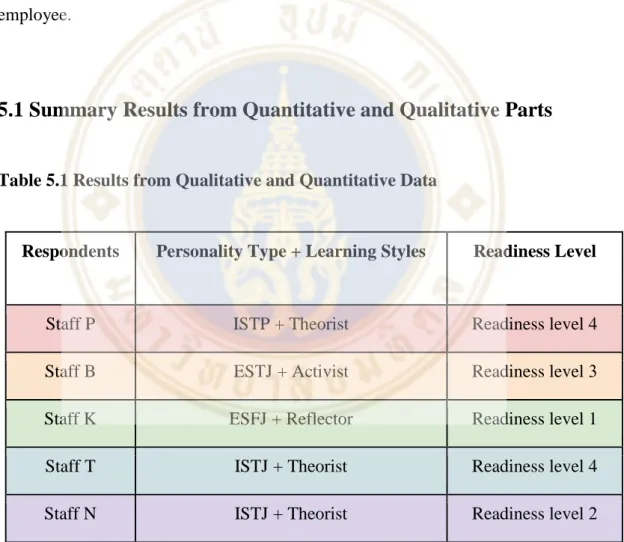
Summary Results from Quantitative and Qualitative Parts
Recommendation
Therefore, it is important for managers to give this type of employee, in this case staff P, the freedom to make decisions and to create the most appropriate work procedures that they see fit. In the first part, the personality questionnaire concluded that the personality type of staff B is an ESTJ. In the second part, the learning styles questionnaire suggests that staff B is an activist learner.
Therefore, managers should be aware that employees with this type of personality will talk too much and not do their work. This type of learner would need time to review what they have been instructed before proceeding with the work. This type of employee is insecure about their work and how to do their job properly.
Managers will therefore need to use coaching style of leadership to guide this type of employee. According to 16personalities, people with the personality type of an ENTJ are natural born leaders and also productive workers. This type of learner prefers to follow a step-by-step logical way of thinking and also working process.
Managers managing this type of learner should be careful with their work process and not disrupt their well-planned work procedures. Because this type of follower is able to make their own decisions, leaders could easily delegate tasks and complete them without managerial assistance. Leaders should lead this type of people by encouraging them to speak up for themselves.
Therefore, managers are recommended to use a low-task, high-relationship, or so-called collaborative, type of leadership. In this type of leadership, managers should provide facilitative behaviors such as assigning a professional employee to coach and guide them in their work. Since such employees have a willingness to contribute to the company, it will be wise for managers to take advantage of their suggestions and ideas in order to increase the efficiency of work in the company.
Conclusion
Pridobljeno iz https://thoughtcatalog.com/heidi-priebe/2015/06/if-youre-confused-about- your-myers-briggs-personality-type-read-this-an-intro-to-cognitive- functions/ .
APPENDICES
APPENDIX A: Personality Types Questionnaire
ส่วนที่ 2: แบบทดสอบบุคลิกภาพ (Personality Types)
คนท างานนั้น
ถ้วน
APPENDIX B: Learning Styles Questionnaire
ดูอาจารย์ทอลองใช้ให้ดู
ทอลองใช้คอมพิวเตอร์ด้วยตนเอง
วางแผนคร่าว ๆ และแผนสามารถเปลี่ยนได้เสมอ ตามสถานการณ์
สามารถน ามาใช้ได้ในชีวิตประจ าวัน
เริ่มเลย