One of the ways managers can influence perceived business performance is through profit management. 2003) suggest that earnings no longer truly reflect firm fundamentals and that earnings management is obscuring financial reports. Companies with larger board sizes and a higher share of non-executive directors have a higher level of profit management.
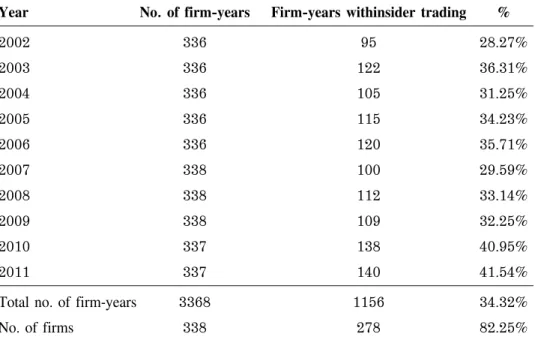
Our study contributes to the debate on corporate governance in emerging markets by showing that higher overall governance quality does not necessarily mean that earnings management will be lower. Upward earnings management tends to be a sign of good news to the market when it is in conjunction with insider buying activity. Nevertheless, a positive relationship between earnings management and the proportion of non-executive directors is found in net insider selling companies.
A number of studies have been conducted on earnings management in the context of developed economies. Bergstresser and Philippon (2006) show that there is a positive relationship between performance-related compensation and earnings management. Family involvement in a company's board can thus lead to higher earnings (Uzun, Szewczyk and Varma, 2004).
The other reason is that managers use earnings management to increase the quality of information about the firm's operations.
Data and Research Methodology
Based on signaling theory, managers send a signal of business value in the form of earnings forecasts and insider trading. Empirical evidence also shows that firms are more likely to manage discretionary accrual than total accrual (Guay et al., 1996; Kothari, Leone, and Wasley, 2005; Jaggi, and Tsui, 2007). In the main section of the paper, we use the Dechow et al. 1995) model and present the results for the other models in our robustness tests.
Non-discretionary accruals are the fitted values from respective regressions of the Jones (1991), Dechow et al. 1995), and Kasznik (1999) models, and discretionary accruals are the residuals from these regressions. The four portfolios are: (1) firms involved in high discretionary accruals and net purchase insider trading;. (3) firms engaged in low discretionary accruals and net purchase insider trading; and (4) firms engaged in low discretionary accruals and net sales insider trading.
To estimate Equation (6), we classify the firms in our sample into 10 groups based on discretionary accruals. The bottom three deciles are defined as the most negative group of discretionary accruals, and the top three deciles are defined as the most positive group of discretionary accruals.
Empirical Results
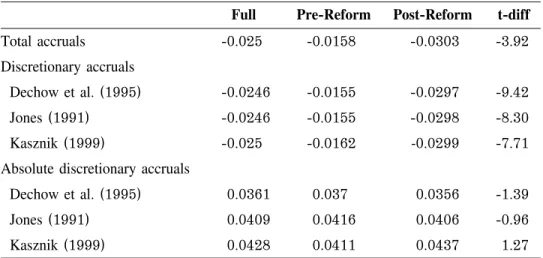
The post-reform sub-period covers the sample between 2002 and 2005 and represents the post-implementation of corporate governance principles. Total accruals and discretionary accruals are all negative and there is a significant difference between the pre- and post-reform periods. Overall, absolute discretionary provisions amounted to between 3 and 4 percent of total assets over the entire sample period.
This table shows statistics on total accruals, discretionary accruals and absolute values of discretionary accruals. The pre-reform sub-period covers the sample between 2002 and 2005 and represents the pre-implementation of the corporate governance principles. The post-reform sub-period covers the sample between 2002 and 2005 and represents the post-implementation of the corporate governance principles.
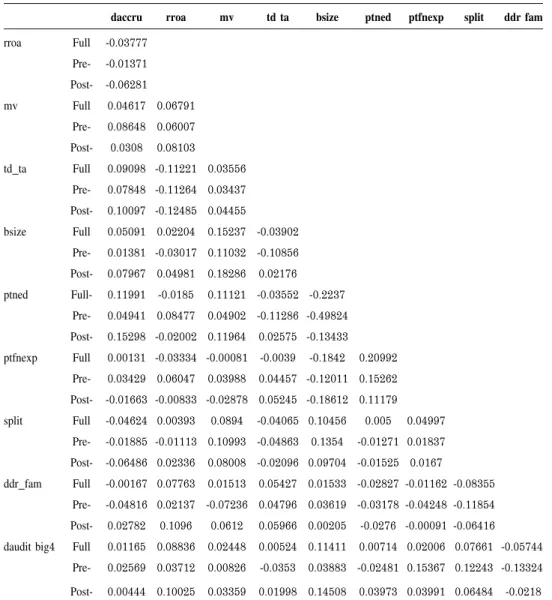
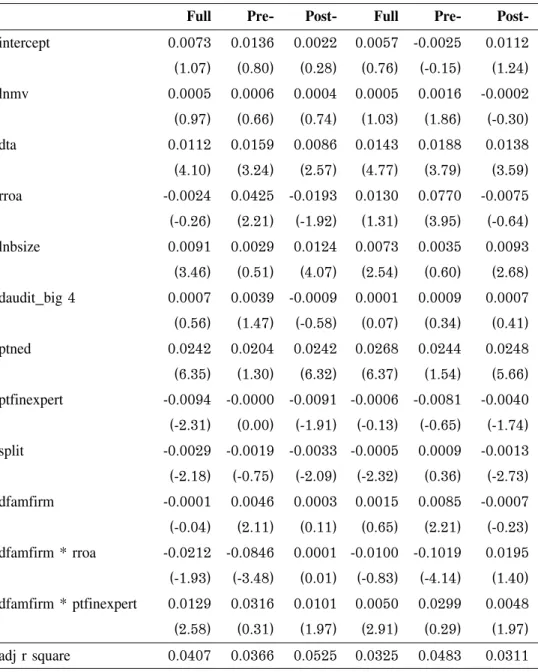
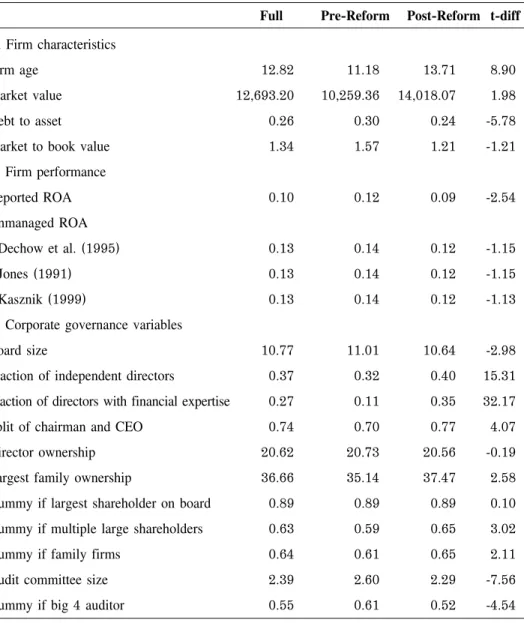
Earnings management is measured as the absolute value of discretionary accruals (Leuz et al., 2003; Nabar and Boonlert-U-Thai 2007;. From Table 5, variables that have a significant correlation with total discretionary accruals are firm performance (reported ROA) ., firm size (market value of equity), firm leverage (total debt to total assets) and some corporate governance variables, including board size, proportion of independent directors on the board, and the split role of the chairman/CEO. Pre-reform sub-period covers the sample between 2002 and 2005 and represents the pre-implementation of principles of good corporate governance.
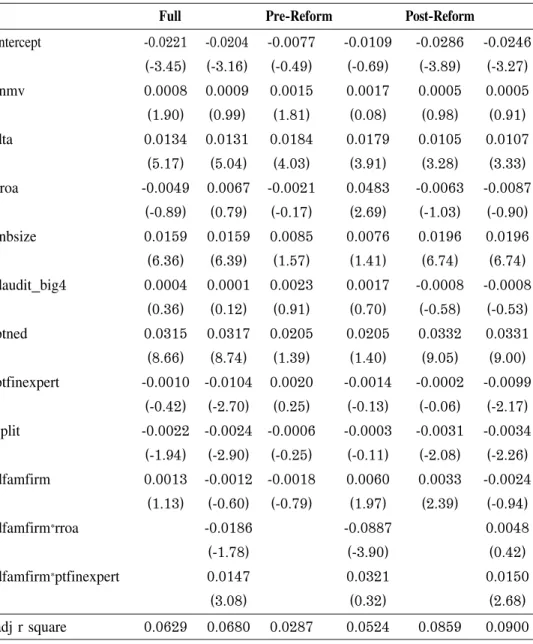
If corporate governance induces managers to improve the quality of earnings figures through income smoothing, one would expect those governance variables to be positively related to absolute discretionary accruals. While board size and the percentage of non-executive directors on the board are positively related to absolute discretionary accruals, the separation of the chairman/chief executive role and having financially sophisticated directors are negatively related to absolute discretionary accruals. Regarding the control variables, leverage and return on assets are positively related to absolute discretionary accruals.
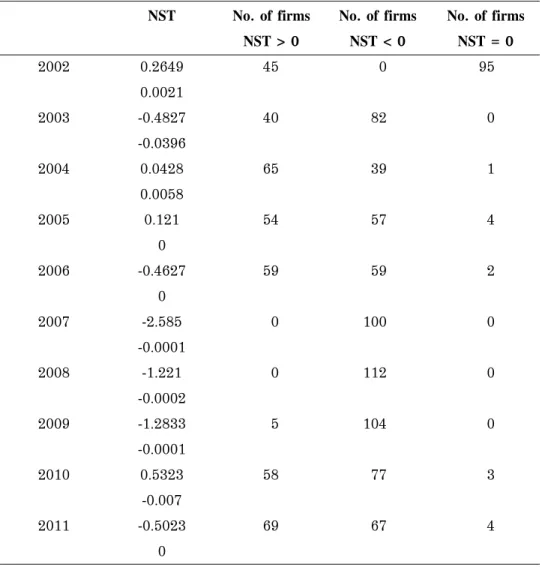
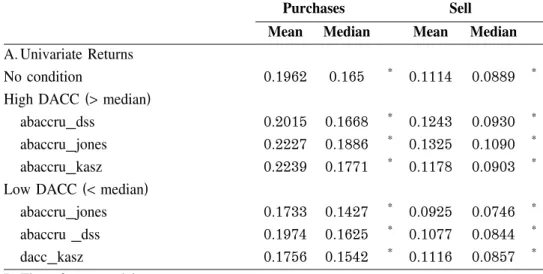
To identify potential gains from insider trading and profit management, we perform regressions on portfolios constructed using the criteria of abnormal trading and discretionary construction. Discretionary build is abaccru_jones by Jones (1991), abaccru_dss by Dechow et al. 1995) and abaccru_kasz by Kasznik (1999) Abnormal buy is a firm whose NST is greater than the median of all buying firms. Companies that sell long net with inside information with high discretionary income and companies that sell short net with inside information with low discretionary income (for the longer term) and 3.
Long net buy insider firms with low discretionary accruals and short net sell insider firms with high discretionary accruals (short-term perspective). The table reports the results of the alternative measurement regression of discretionary accruals and explanatory variables.
Conclusions
Profit management in Belgium: an overview of the empirical evidence., Tijdschrift voor Economie en Management, Vol. Corporate Governance, Earnings Management and the Information Content of Accounting Income: Theoretical Model and Empirical Tests. Earnings Management and Corporate Governance of the Stock Exchange of Thailand, Master's Thesis in Accounting, Graduate School, Kasetsart University.
An investigation of the relationship between corporate governance, earnings management and the effect of governance reforms. A Study of Earnings Management Motives in Anglo-American and Euro-Continental Accounting Models: The Canadian and French Cases. Type of earnings management and the effect of ownership structure, firm size and corporate governance practices: Evidence from Indonesia.