WOMEN’S EDUCATIONAL ACHIEVEMENT AND THEIR PARTICIPATION IN THE THAI CENTRAL REGION LOCAL POLITICAL DECISION-MAKING PROCESS
Ratchaneepan Sodsangchan
A Dissertation Submitted in Partial
Fulfillment of the Requirements for the Degree of Doctor of Philosophy (Population and Development)
School of Applied Statistics
National Institute of Development Administration 2008
ABSTRACT
Title of Dissertation Women's Educational Achievement and Their Participation in the Thai Central Region Local Political Decision-Making Process
Author Mrs. Ratchaneepan Sodsangchan
Degree Doctor of Philosophy (Population and Development)
Year 2008
The purpose of the study is to understand the relationships between women's educational achievement and their participation in the Thai central region local political decision-making process. The objectives of this study are: first, to study women’s personal characteristics and their participation in the local political decision- making process; second, to study the relationships among educational achievement, demographic status, civic attitudes and obstacles to women’s political participation;
and third, to study women’s engagement in the local political decision-making process.
The concept model was developed to be testes through statistical analysis. The research is a quantitative survey of 395 women in Chantaburi and Samutprakarn Provinces. Various analytical techniques were employed including ANOVA analysis, Hierarchical regression analysis, Path analysis and qualitative data analysis, using in-depth interview from women who have elected to position in local political offices, and as local community leader.
This study found that qualities like age, occupation and political background are statistically significance as are variables of political background, and participation at the political supporter level.
The relation of educational achievement found that success in reaching news information has a direct and indirect influence. Obstacles that hinder participation had a direct positive affect as well as success from learning, social networks, occupation and the number of years in formal learning. Age, income, political background and being a member of an institution had negative affects.
The comparison between women’s educational success and participation showed the opinions of women who live inside the municipal area matched those of women who live outside the municipal area. Success in accessing news, success in the study about social networks, and involvement in institutions had indirect positive effects. Women who lived in municipal areas had different opinions from those living out of municipal areas regarding the success of education, ability in learning and number of years learning which had indirect positive effects, while age, and political background had indirect negative effects.
Outer factors that hinder participation were culture, tradition, customs Thai social values, support from political parties and support from the government and private sectors. Inner factors were; the readiness of the family, the political confidence and physical condition of women.
This research suggested that the educational achievement of women has a significant relation to the participation of women in local political decision-making procedures. In order to promote this aspect, the participation of women in political decision-making procedures has to be encouraged. The educational achievement of the women will decrease the problems and obstacles towards political participation by women according to the nature of the population, economy and society.
iv
ACKNOWLEDGEMENTS
The author would like to express sincere to my major advisor, Associate Professor Dr. Kanikar Sookasame, for her valuable advice, encouragement and guidance in making the dissertation a successful one. I also wish to extend thanks and appreciation to all of the committee members, Associate Professor Dr. Suwanlee Piampiti, Associate Professor Pisit Sukreeyapongse, Assistant Professor Dr.Preecha Vijittamaros for their thoughtful comments and suggestions.
My appreciation to those who responded to my questionnaires, and contributed valuable information to complete this study.
I would like to express my graduate to all my teachers, professors, academics and all those who have endowed me with knowledge.
Finally, my family has been real source of strength and support throughout my study period. I am very grateful to my parent and my children for their unending patience and understanding. Without their constant love and encouragement, I never could have accomplished such a task. This dissertation is dedicate to them.
Ratchaneepan Sodsangchan
November 2008
TABLE OF CONTENTS
Page
ABSTRACT iii
ACKNOWLEDGEMENTS v
TABLE OF CONTENTS vi
LIST OF TABLES ix
LIST OF FIGURES xii
CHAPTER 1 INTRODUCTION 1
1.1 Statement of the Problem 1
1.2 The Purposes of the Study 11
1.3 Scope of the Study 12
1.4 Expected Benefits 12
1.5 Structure of Presentation 13
CHAPTER 2 LITERATURE REVIEW 14
2.1 Women and Politics 14 2.2 Theories and Concepts Related to Women and Their 17
Participation in the Thai Central Region Local Political Decision-Making Process
2.3 Women and Local Politics and Administration 18 2.4 Women’s Participation in Local Political 22 Decision-Making Process
2.5 Women’s Educational Attainment 28
2.6 Demographic and Socio-Economic Factors Affecting 32 Women’s Participation in Local Political
Decision-Making Process
2.7 Civic Attitudes 37
2.8 Barriers to Women’s Participation in Politics 39
2.9 Definitions of Research’s Key Words 41
2.10 Conceptual Framework 44
2.11 Research Hypotheses 46
CHAPTER 3 RESEARCH METHODOLOGY 47
3.1 Target Population and Samples 47
3.2 Data Collection 52
3.3 Operational Definitions and Instrumentation 53
3.4 Variable and Measurement Criteria 59
3.5 Testing Reliability of the Measurement 61 3.6 Primary Characteristics of the Sample 62
3.7 Methods of Data Analysis 80
CHAPTER 4 THE RELATIONSHIP BETWEEN WOMEN’S PERSONAL 81 CHARACTERISTICS AND THEIR PARTICIPATION IN
LOCAL POLITICAL DECISION-MAKING PROCESS
4.1 The Relationship between Women’s Personal 81 Characteristics and Political Participation at the Political
Observer Level
4.2 The Relationship between Women’s Personal 84 Characteristics and Political Participation at the Political
Supporter Level
4.3 The Relationship between Women’s Personal 86 Characteristics and Political Participation at the Political
Competitor Level
4.4 Conclusion 89
CHAPTER 5 THE RELATION OF WOMEN’S EDUCATIONAL 90 CHIEVEMENT AND THEIR PARTICIPATION IN
LOCAL POLITICAL DECISION-MAKING PROCESS
5.1 The Relation of Women's Educational Achievement and 91 Their Participation in Local Political Decision-Making
Process
vii
5.2 Direct and Indirect Effects Towards Women's 110 Participation in Local Political Decision-Making Process
in the Municipality
5.3 Direct and Indirect Effect Towards the Women's 118 Participation in Local Political Decision-Making Process
Outside the Municipality
5.4 Conclusion 127
CHAPTER 6 OBSTACLES HINDERING WOMEN FROM 128
PARTICIPATION IN THE POLITICAL DECISION-MAKING PROSSESS
6.1 Obstacles that Hinder Women from Participating in the 129 Political Decision-Making Process
6.2 Conclusion 151
CHAPTER 7 CONCLUSION, CONTRIBUTIONS AND 152
RECOMMENDATIONS
7.1 Conclusion 152
7.2 Contributions 155
7.3 Limitations of the Study 160
7.4 Recommendations 161
7.5 Implications for Future Research 165
BIBBLOGRAPHY 166
APPENDICES
Appendix A Questionnaire 176
Appendix B In-Depth Interview 186
BIOGRAPHY 188
viii
LIST OF TABLES
Tables Page
1.1 Number of Pupils and Students in Thailand’s Formal Educational 3 System in the Academic Year 2007
1.2 Number of National Representatives Elected in 1996-2007 5 1.3 Percentage of Women’s Engagement in National Level Politics 6 among ASEAN Nations
1.4 Number of Elected Representatives in Local Administrative 7 Organizations
3.1 Population and Sample Categorized by District and Subdistrict 51
3.2 Sample Summary of this Research 51
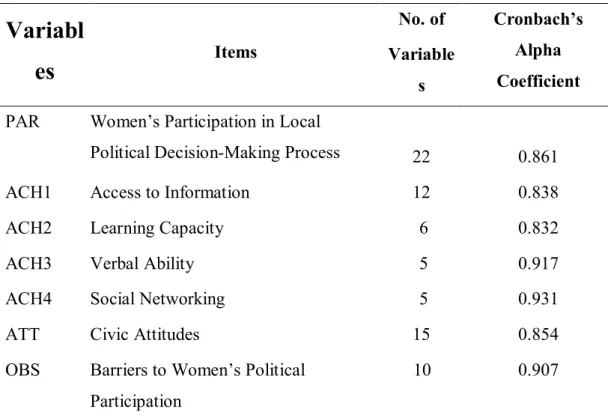
3.3 Construction of Variable Scoring for Data Analysis 60 3.4 Reliability Coefficient of Women's Educational Achievement 61 and Their Participation in the Thai Central Region Local Political
Decision-Making Process
3.5 Descriptive Statistics of the Sample Group 64 3.6 Means, Standard Deviations, Maximum, and Minimum Variables 67
for Analyzing Access to Information
3.7 Means, Standard Deviations, Maximum, and Minimum Variables 69
for Analyzing Learning Capacity
3.8 Means, Standard Deviations, Maximum, and Minimum Variables 70
for Analyzing Verbal Ability
3.9 Means, Standard Deviations, Maximum, and Minimum Variables 72
for Analyzing Social Networking
3.10 Means, Standard Deviations, Maximum, and Minimum Variables 74 for Analyzing
Civic Attitudes
3.11 Means, Standard Deviations, Maximum, and Minimum Variables 76 for Analyzing Barriers to Women’s Political Participation
3.12 Means, Standard Deviations, Maximum, and Minimum of 78 Variables for Analyzing Women’s Participation in Local Political Decision-Making Process
4.1 The Relationship between Women’s Personal Characteristics and 82 Political Participation at the Political Observer Level
4.2 The Relationship between Women’s Personal Characteristics and 85 Political Participation at the Political Supporter Level
4.3 The Relationship between Women’s Personal Characteristics and 87 Political Participation at the Political Competitor Level
5.1 Bivariate Correlation Matrix between Various Variables Used 95 in the Analysis
5.2 Hierarchical Regression Analysis of Women's Educational 98 Achievement and Their Participation in the Thai Local Political
Decision-Making Process
5.3 Regression Results from Path Analysis of Women's Educational 103 Achievement and Their Participation in Local Political
Decision-Making Process
5.4 Relationship between Independent Variables and 109 Women's Participation in Local Political Decision-Making
Process, Total Sample
5.5 Regression Results from Path analysis of Women's Educational 112 Achievement and Their Participation in the Thai Central Region
Local Political Decision-Making Process in the Municipality
5.6 Relationship between Independent Variables and 118 Women's Participation in Local Political Decision-Making Process in the Municipality
5.7 Regression Results from Path analysis of Women's Educational 120 Achievement and Their Participation in Local Political
Decision-Making Process Outside the Municipality x
5.8 Relationship between Independent Variables and the Women's 124 Participation in the Local Political Decision-Making Process
Outside the Municipality
5.9 Comparison of Relationship of Women's Educational Achievement 126 and Their Participation in the Local Political Decision-Making
Process Inside and Outside the Municipality xi
LIST OF FIGURES
Figures Page
2.1 Conceptual Framework of Women's Educational Achievement 45 and Their Participation in the Thai Central Region Local Political
Decision-Making Process
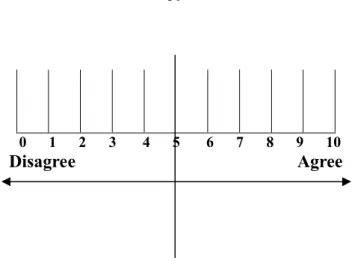
3.1 Score to Reflect the Opinion of the Respondent 59 5.1 Conceptual Framework of Women's Educational Achievement 101
and Their Participation in the Thai Central Region Local Political Decision-Making Process
5.2 Model of the Result of the Analysis of Women's Educational 104 Achievement and Their Participation in the Thai Central Region
Local Political Decision-Making Process
5.3 Final Model of Women's Educational Achievement and 107 Their Participation in the Thai Central Region Local Political
Decision-Making Process
5.4 Model of the Results of Analysis of Women's Educational 113 Achievement and Their Participation in the Thai Central Region
Local Political Decision-Making Process in the Municipality
5.5 Final Model of Women's Educational Achievement and 116 Their Participation in the Thai Central Region Local Political
Decision-Making Process in the Municipality
5.6 Model of the Result of the Analysis of Women's Educational 121 Achievement and Their Participation in the Thai Central Region
Local Political Decision-Making Process Outside the Municipality
5.7 Final Model of Women's Educational Achievement and 123 Their Participation in the Thai Central Region Local Political
Decision-Making Process Outside the Municipality
CHAPTER 1
INTRODUCTION
1.1 Statement of the Problem
One of the goals in human resource development is to develop leadership characteristics in humans, so that they can function as capable leaders with integrity and initiative minds, leaders who make sound decisions. Any human being, regardless of gender, value, custom, or any belief, should have an equal chance to develop his or her potential. In order to achieve the aim of human resource development in the political realm, the responsibilities of both men and women are required, and opportunities must be given to women to participate in politics. Women, as intellectuals, should share an equal part in policy planning, making decisions, and, together with men, taking charge of social responsibilities (Kusol Soonthorntada and others, 1995: 3).
Thailand has seriously begun taking steps towards women’s development since 1972 by including several issues related to women’s development in the Third National Development Plan, 1972–1976. Subsequently, the first women’s development plan, that is, the long-term development plan for women, was created 1982-2001. This plan formed the basis for the women’s development plan for a period of five years;
and included in the Fifth National Social and Development Plan, 1982-1986 as well as the Sixth National Social and Development Plan, 1987-1991. Later on, when the National Committee for Women’s Promotion and Coordination was set up as an entity under the Office of the Permanent Secretary in 1999, the National Committee for Women’s Promotion and Coordination had the view that the first long-term women development plan should be revised, which would update the plan in terms of content and direction, keeping in line with rapid social change. A subcommittee was set up to
create a long-term women’s development plan, 2002-2011. The work of the subcommittee was used as the basis for the five-year plan and other long-term plans.
At present, the women’s development plan is included in the Tenth National Economic and Social Development Plan, 2007-2011. Its main strategy is to promote positive and reduce negative Thai attitudes towards women, aiming to enhance women’s opportunities to engage in political and administrative decisions, to promote their health and rights to have healthy reproduction, to strengthen their life security, and to promote their participation in economic activities.
The consistent development of women in many aspects since the year 1972 has resulted in a higher number of women participating in social and national development affairs, positively changing, the overall attitudes of the Thai public towards women. Past attitudes, based on anatomical differences between the two genders, that men are physically stronger than women, validated that the brute force of men was the factor determining the power relationship of the two genders.
Especially, in the past, men were leaders and rulers; they protected their subordinates such as warriors. Men were well-established in the higher class, the administrative class. Most scholars and thinkers, creative artists were men. Therefore, all of the rights in society such as education, opportunities to work as government officers, and other social privileges were granted only to men. At the same time, women recognized and accepted men as the governing class; they had the obligation to do household chores and provide services for their husbands. Women accepted their limited role as a tool to support and honor the prestigious status of their husbands, or a behind the scenes supportive role in making men attain their fame, recognition, honor, and all sorts of successes. Many men, nowadays, still hold the attitude that women are simply objects, and not equal partners in society.
Nowadays more women have greater opportunities to access education, formally and informally. In addition, women have more opportunities to access career training. The more education they have, the greater their awareness of self-reliance and the fewer the limitations on gender equality, resulting from the national education system and the implementation of National Education Act, 1999. Both movements have provided greater educational opportunities, equally, for both genders: formal education, informal education, continuing education, and education for life.
According to Article 10 of the National Education Act, 1999, the state must provide compulsory education for Thai citizens, both genders, for at least 12 years.
The state must make education available and accessible for all on an equal basis, free of charge. In addition, the Compulsory Education Act, 2002, requires that parent or guardians of children age approaching six years have their children undergo nine years of compulsory education, resulting in the fact that male and female children, on an equal basis, have the opportunity to access primary and secondary education; thus fulfilling the agreement and the goal of the millennium set by Thailand in 2004.
Apart from compulsory education, more women have accessed tertiary education. In 2007, more women than men attended the tertiary educational level, 54.55 percent and 45.45 percent, respectively. Apart from compulsory education, more women also continue their tertiary education. In 2007, more female than male students attended the tertiary educational level, 54.55 percent and 45.45 percent, respectively. The same trend is also found at the postgraduate level; more female than male students, 54.37 percent and 45.63 percent, respectively. (Table 1.1)
Table 1.1 Number of Pupils and Students in Thailand’s Formal Educational System in the Academic Year 2007
No. of Students Percentage
Male Female Total Male Female
Preschool 903,729 854,844 1,758,573 51.39 48.61
Preprimary 2,873,668 2,690,956 5,564,624 51.64 48.36
Secondary 2,317,833 2,410,930 4,728,763 49.02 50.98
Lower Secondary 1,411,488 1,371,346 2,782,834 50.72 49.28 Upper Secondary 906,345 1,039,584 1,945,929 46.58 53.42
Tertiary 1,104,634 1,325,600 2,430,234 45.45 54.55
Postgraduate 99,297 118,318 217,615 45.63 54.37
Source: Ministry of Education, 2007a.
Academics differ in their opinions of education and its provision. For example, anthropologists view education as an acculturation process; sociologists regard
Educational Level
education as a socialization process; economists hold the view that education is a part of the social development process, the process of building human social capital, while political scientists maintain that education is but a political process (Chaiyos Imsuwan, 2000: 52). It can be seen that education pervades all dimensions of society.
Nowadays, education has undergone reformation; it has been modernized, aiming to promote creativity in learners, develop their quality of life, build up the learning society, and create democratic values. New education also aims to develop autonomous learners who are capable of making their own decisions, functioning as knowledge creators and doers. All of the knowledge must be update; ethics, morality, values and culture must be emphasized. Kovit Prawalpruek. (2002: 11) has proposed that education should empower learners, arguing that education is an analytical process for people to analyze themselves and social changes; it is a learner-centered process, aiming to develop people’s power relationships and develop human resources. These aims can be achieved by cultivating learners’ skills and knowledge, shaping their desirable learning behaviors, and promoting their critical thinking in the realms of society, power, inequality, and changes.
Therefore, education is a human cultivation process, from children to adults. It helps make humans aware of choices in life and the prudence to make good choices;
education is thus a strong factor determining the development of citizens of any civilized society, and the quality of its citizens. The development of a country needs to focus on improving the quality of its people or developing human resources, which can be done, essentially, by providing sound education (Wittamon Niwattichai, 2000: 1)
Given the widespread range of educational opportunities, more and more women have been educated; new and broader perspectives enable them to take new roles in society, apart from their traditional ones at home. They have started to recognize and become aware of their rights and responsibilities in society; many of them have engaged in political activities, especially as political representatives, making it more convenient to address women’s problems and their issues have been better addressed, under the assumption that nobody can understand women better than women themselves.
Since the change of Thailand’s political system from absolute monarchy to democracy in 1932, women and men have been granted equal rights. Over the past
decades, more women entered the political arena by running for house representatives; yet, the number is still low compared with men. The first Thai woman to be elected as a representative occurred in the year 1949. More women nowadays have been elected to sit in the house of representatives and as senators, but the number still low compared with male members of parliament.
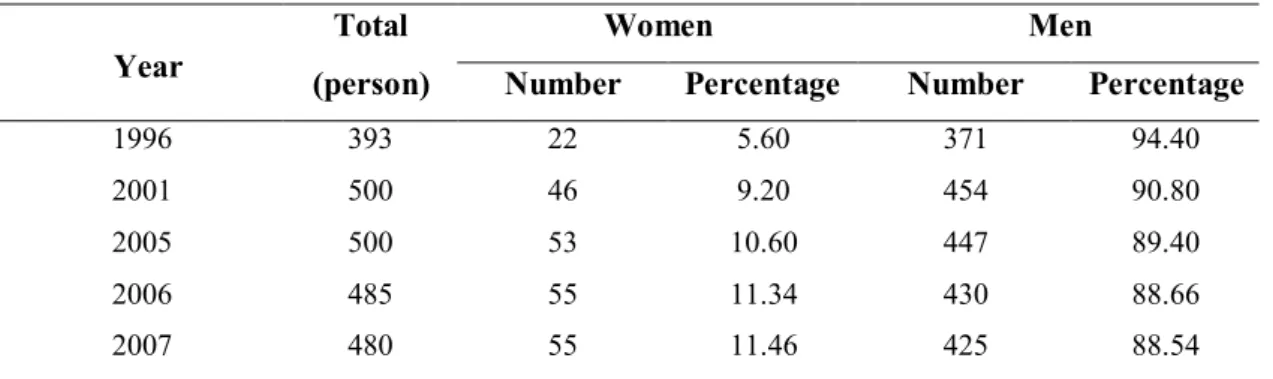
In the general election of 2001, women were elected, both as conventional candidates and party-list members, as many as 46 of them or 9.20 percent of the total representatives. The figure was higher than that in the year 1996 where only 22 female representatives or 5.60 percent were elected.
The 2005 general election saw the number of female representatives as high as 53 or 10.60 percent. In the election of 2006, the number stood at 55 or 11.34 percent;
and in the latest election in 2007, the number of female representatives was 55 (11.46 percent), out of a total number of national representatives of 480. Out of a total of 80 party-list MPs, 74 of them or 92.50 percent were men; only 6 (7.51 percent) were female.
The total number of constituency MPs was 400; 351 or 87.50 percent of them were male; 49 or 12.25 percent were female. This shows that the proportion of women at the national level of politics has increased, but at a slow pace, lower than the target set by the international body as well as the target set by the national committee for economic and social development, which would like to see the number of female politicians increase to 30 percent or higher (Bureau of Gender Equality Promotion, 2008). (Table 1.2)
Table 1.2 Number of National Representatives Elected in 1996-2007
Total Women Men
(person) Number Percentage Number Percentage
1996 393 22 5.60 371 94.40
2001 500 46 9.20 454 90.80
2005 500 53 10.60 447 89.40
2006 485 55 11.34 430 88.66
2007 480 55 11.46 425 88.54
Source: Bureau of Gender Equality Promotion, 2008.
Year
Thai women’s political engagement was lower than those in developed countries. For example, female representatives in Sweden have been as high as 45.3 percent, 38 percent in Denmark, and 37.5 percent in Finland. The number of Thai female representatives was also lower than those of many ASEAN nations. In Vietnam, for example, it was as high as 27.31 percent, 25.22 percent in the People’s Democratic Republic of Laos, 24.47 percent in Singapore, and 15.25 percent in Philippines. The number of Thai female representatives was only 11.34 percent.
(Table 1.3)
The number of women engaging in the local political decision-making process was lower than their participation at the national level. In the year 2007, the number of female members of the Subdistrict Administration Organizations was as low as 6.73 percent; 4.61 percent of women were members of Provincial Councils. The female chairs of the Provincial Administration Organizations comprised only 12 percent (Department of Provincial Administration, 2007: 13). (Table 1.4)
Table 1.3 Percentage of Women’s Engagement in National Level Politics among ASEAN Nations
Country Female Representative (%)
Vietnam Lao PDR Singapore The Philippines Thailand Indonesia Cambodia Malaysia
27.31 25.22 24.47 15.25 11.34 11.27 9.76 9.13
Source: Office of Women’s Affairs and Family Development, 2008.
Table 1.4 Number of Elected Representatives in Local Administrative Organizations
Number Percentage
Female Male Total Female Male
Member of Provincial Council
Chair of Provincial Admin Organization Member of Municipal Council
Major
Members of SAO Chair of SAO
Head of village group (Kamnan) Village head (Phoo Yai Ban)
Member of Bangkok Municipal Council Member of Bangkok District Council
107 9 720 76 8,591 301 205 3,069 11 54
2,215 66 10,167 1,068 119,003 6,335 6,760 64,240 59 305
2,322 75 10,887 1,144 127,594 6,636 6,965 67,309 70 359
4.61 12.00 6.61 6.64 6.73 4.54 2.94 4.56 15.41 15.04
95.39 88.00 93.39 93.36 93.27 95.46 97.06 65.44 84.29 84.96 Total 13,143 210,218 223,361 5.88 94.12
Source: Department of Provincial Administration, 2007: 13.
.
It can be seen that it is extremely challenging for women to enter the realm of political decision-making process, compared with men. Several obstacles block their path. This makes most women feel insecure and uneasy to get involved in politics, even at the local level. One important obstacle is the traditional role prescribed to them by society, handed down from generation to generation. The society has traditionally assigned certain roles for women to look after many family matters, look after the wellbeing of family members, which is different from the men’s roles outside the house. This radically different role expectation by society has created a certain image for women as well as a certain attitudes the society has adopted towards women, which is almost the opposite of men’s. For generations, women have been cultivated to accept conditions that are inferior to those of men. This has resulted in the fact that most women and men believe that men are leaders and women followers.
Given the perception that politics is the male’s domain, women cannot easy enter that arena, especially when women have to perform their roles as wives and daughters, looking after household chores and other family matters. This has made it
Position
difficult for them as they have little time left, and if they wished to pursue a political career, without help from men to lessen their burdens, it would be difficult indeed for women to be successful (Surasawadee Hunpayon and Chanatip Boonyaket, 2002: 51).
Another view holds that not allowing women the opportunity to participate in political decision-making mechanisms deprives them of their political rights and responsibilities as citizens; it excludes them from voicing their opinions concerning law and policy making processes; it excludes them from having their say in the allocation of budget and resources. This is also viewed as an act depriving society from accessing the expertise and perspectives of women (Wirada Somsawas, 2003: 33).
Even though women’s participation in social development has been recognized, most people in society either overlook or discriminate against women, providing them limited opportunities to exhibit their potentiality. All of them are the result of biases based on a set of values, norms, and laws that discriminate against women. As the new wave of attempt to improve gender relations has begun to take shape, there are now many practices that aim at empowering women, resulting in their greater roles in decision-making processes, responding to women’s needs much better than the past situation. Several approaches to improve women’s conditions exist such as educational support, and occupational skill development for the enhancement of economic opportunities. At the same time, efforts have been made to abandon all forms of discrimination against women, including an attempt to promote men to look after women’s education and share more responsibilities in other areas (Passorn Limanon, 2001: 172).
It is worth noting that attempts to improve the above-mentioned women’s conditions do not entail their role as communicators that would empower women, especially, their roles in the political arena of the decision-making process, which is a significant mechanism for the development of society. As women are now entering the territory traditionally occupied by men, their readiness is crucial; they need to prepare themselves. If they are well-prepared and accumulate all the necessary experience, to a certain level, they will, surely, utilize their potential for the development of society; this would be beneficial for all members of society, both male and female alike. With regard to their preparation and accumulation of
experience, attaining education is a means to enhance their communication effectiveness, a set of tools to gain knowledge and acquire other skills.
It can be said that, under the rapid changing environment, nowadays, women should assume more roles in the decision-making process; they should be able to determine directions of societal development. This would appropriately address their needs; and better manage the human resources of society. This requires that men and women must proportionately share their roles and responsibilities in society. This would improve the quality of any decision, as more perspectives would be sought and duly considered. It is, therefore, imperative that women attain more and better education, which would improve the quality of politics, from local to national levels, making it more transparent, just, and under good governance.
In the past, Thailand divided its governing structure and administrative power into two spheres; the administration at the regional level was under the administration of regional bodies. However, when King Rama V reformed the kingdom’s administration, the administrative power was centralized, and the administration was revamped into many ministries; regional administrative bodies were abandoned (Orapin Sopchoakchai, 1997: 9-10). This reformation has resulted in the Thai Centralization of Thailand’s administrative power, including political power, and Bangkok has become the center of national administrative and political power. Even though the main aim of the reformation was to unify and consolidate the nation, several consequences result, the marginalization of local politics and the weakness of local administrative power and politics. The reformation resulted in the domination and greater political power of national level politics, as evidenced today.
However, later on, changes were made in people’s perspectives and understanding of politics, resulting in a new wave of provincial administrative reform.
In the past, under Thailand’s parliamentary democratic system, many municipalities were under provincial administration. However, after the political upheaval in 1932, a new law was passed. The Provincial Administration Act became effective, and the Municipal Administration Act 1933 was enacted. Since the year 1956, Thailand has separated its political administration into two levels: national and provincial.
Thailand’s provincial administration allows Thai citizens in their own locality to participate in different political activities. The law requires that people be elected to
represent their political areas; and, a variety of elections, based on its organization’s history have evolved. It is, therefore, useful and essential to classify women’s participation in the political decision-making process into three groups as follow:
Group 1: Women’s political engagement in large cities, i.e., Bangkok Municipality and Pattaya Municipality
Group 2: Women’s political engagement at the provincial level, that is, the Provincial Administrative Organization (PAO)
Group 3: Women’s political engagement at the community level, that is, Subdistrict or Tambon Council (TC) and The Subdistrict Administrative
Organization (SAO)
Even though provincial-level politics have been viewed as being less important than national-level politics in terms of impacts and the scope of political power, it is a ‘political space’ for Thai people to take part in monitoring and managing resources and benefits directly related to their lives.
Therefore, women’s political participation at the local level is very significant;
women, regardless of political level, should have the opportunity to take part in politics, and their roles in provincial politics will be significant, as they can help men in monitoring and managing the resources and benefits of various political groups.
Moreover, women’s political participation at the local level establishes their presence at the fundamental political level. If more women have the opportunity to take part in the local political decision-making process, it will be beneficial for women in three aspects: (1) it can guarantee fairness and equality of people in society, (2) women can protect their rights by monitoring and managing the resources of their own community, and (3) their engagement allows them to accumulate experience and prove themselves in the political sphere, opening up their opportunities to enter national politics (Ormthip Mekraksawanich Camp. 2003: 44).
It can be seen from the above discussion that in order to promote greater women’s participation in the local political decision-making process it is important to empower them, especially the decision-making process. This requires that women attain high education levels, resulting in their development in all aspects.
When the potential of women and their opportunities are enhanced, they have better access to political information, and develop their knowledge and skills,
especially those related to politics. Education develops their rhetorical and writing skills, and equips them to deal successfully with political activities, including wider and greater social networking. All of these developmental aspects result in the improvement of women’s potential, and their engagement in politics would be effective and successful, as, via better education, they will become more autonomous.
Given the significance of education for women and their roles in local politics, the researcher is interested in investigating women’s educational achievement and their participation in the local level political decision-making process. The researcher would like to explore the nature of the relationship between these two factors, their characteristics and patterns, including the levels of their political engagement. Factors that enhance or promote women’s participation in the local political decision-making process will also be investigated. The results of the research would contribute to the advancement of existing body of knowledge regarding women and politics. It is thus hoped that this investigation would contribute to the advancement of academic study;
the results of which could be applied to solve practical problems.
1.2 The Purposes of the Study
The three stated aims of the study are:
1.2.1 To study women’s personal characteristics that contribute to their participation in the local political decision-making process.
1.2.2 To study the relationships between women’s educational achievement,, demographic status, civic attitudes, and other obstacles to their participation in the local political decision-making process.
1.2.3 To study the problems and obstacles preventing women from taking part in the local political decision-making process.
1.3 Scope of the Study
The scope of the study include:
1.3.1 This study only addresses the relationship between women’s educational attainment and their participation in the political decision-making process at local levels, namely, the provincial district, municipal, and subdistrict administration levels.
1.3.2 This study will only investigate areas in the Thai Central region of Thailand based on the categorization by the Department of Local Administration, Ministry of Interior. Two provinces were chosen: Chantaburi Province and Samutprakan Province. As far as local Thai politics is concerned, Chantaburi Province is the province with the highest political voting record (71.47 percent);
Samutprakan Province represents the opposite, that is, the province with the lowest political voting record (47.16 percent). The data were based on the local political voting record of 14 March 2004 (Office of Election Commission of Thailand, 2004a).
1.4 Expected Benefits
This study is expected to provide a body of knowledge that would benefit the following:
1.4.1 The results of this study would be useful in providing information for the promotion and support of women’s education attainment and their greater roles in the decision-making process in local politics.
1.4.2 The results of the study would provide basic information for the development of women’s educational achievement so as to enable more women to effectively participate in the decision-making process at the local political.
1.4.3 The results of this study would provide a set of suggestions to reduce women’s obstacles in the local political decision-making process.
1.5 Structure of Presentation
This research is divided into seven chapters. Chapter 1 is the introduction, and Chapter 2 reviews the literature on women and politics, theories and concepts of political decision-making process and participation, women and local political administration, women’s engagement in the political decision-making process, women’s educational attainment, demographic and socio-political factors affecting women’s political decision-making process, civic attitudes, and obstacles to women’s political engagement in the decision-making process. This second chapter also includes terminology, the research conceptual framework, and the set hypotheses.
Chapter 3 presents the research methodology, detailing the description of the population and the samples, how the data were collected, operational definitions, and assessment criteria, the variables and the measures to assess them, and the quality of the developed research measure or instruments. This chapter also describes the essential characteristics of the samples and data categorization and data analyses.
Chapter 4 presents the demographic and personal data of women that influence their political engagement in the local decision-making process, including the characteristics of women’s participation in the political decision-making process.
Women’s educational attainment and their civic attitudes, and the factors that deter or prevent their political participation are also discussed in this chapter.
Chapter 5 presents the relationship between women’s educational attainment, their demographic data, and their levels and characteristics of engagement in the local political decision-making process. Chapter 6 presents the qualitative analysis of the problems and issues that obstruct women’s political decision-making involvement.
Finally, Chapter 7 summarizes the research, including research implications, suggestions, and recommendations for further research.
CHAPTER 2
LITERATURE REVIEW
This research on women's educational achievement and their participation in the Thai central region local political decision-making process covers the following main topics: 1) Women and politics, 2) Theories and concepts related to women and their participation in decision-making in local politics, 3) Women and local politics and administration, 4) Women’s participation in political decision-making process, 5) Women’s educational achievement, 6) Demographic, Socio-Economic factors affecting women’s participation in the political decision-making process, 7) Civic attitudes, 8) Barriers to women’s political participation, 9) Definitions of key terms, 10) Research framework and 11) Research hypotheses.
2.1 Women and Politics
Research has been conducted on women and politics; one issue being women’s participation in the political decision-making process. The issue on political decision-making participation has been widely investigated. The role of women in politics has been mentioned by Plato, who stated that women, like men, should take part in important matters such as military affairs and administration of states. Giving women domestic roles such as raising children, household chores, responsibilities detached from citizenship roles, is to waste valuable resources. Plato, obviously, did not view this as a violation of women’s rights, but as a waste of human resources (Tinnapan Nakata, 2002: 1-3).
Thai society in recent times has given opportunities for women to take greater part in politics and administrative matters. Thai women have run for local administrative offices such as members of subdistrict administrative organizations, village heads, heads of village groups, or council members, and members or chairs of
provincial administrative organizations. Women have also been chosen as assistant district officers, governors, etc.
It is not fair to conclude that women and politics do not mix; that politics is unclean for women or too tough for women. The evidence from women’s participation in politics reveals that the quality and efficiency of political work depends on individual abilities and skills, rather than on their genders. Kanchana Kaewthep (1995: 12 and Suthira Thompson (1998: 32) conducted a study on the roles of female politicians and summarized that the reason women decided to become candidates for Bangkok representatives was that they wanted to take a greater part in politics; they felt that Thailand had many problems that needed to be solved. Another reason was that they, as women, wanted to participate in politics to help solve Thailand’s problems, caused by both genders. In reality, they said, very few women participate in politics and administration; women could contribute their abilities and skills and solve those problems. Men and women, therefore, should play an equal part in developing society, and together they can better deal with the problems.
Problems concerning women, in particular, would be better addressed if women were put in charge, as women can better understand women’s problems.
Thailand’s 2007 Constitution addresses the equality of men and women in Article 30, stating that all citizens are equal under the law, and they shall be equally protected by the law. Men and women have the same rights. Any act of discrimination or any unfair treatment based on a person’s race, hometown, language, gender, age, disability, health, personal status, socio-economic status, belief or religion, education background, or political orientation, is not allowed and violates the constitution of Thailand. Any state-sanctioned measure aiming to lessen or eradicate biases and to promote more equality in rights and freedom is not, in principle, considered an unfair or biased practice and act. Article 87 states that the state needs to take into consideration the equal proportion of male and female citizens, requiring that any plan, policy, and implementation of the policy needs to have people’s participation, and the proportion of both genders needs to be appropriate.
Moreover, Article 97 states that political parties need to take into consideration an equal proportion of male and female members or candidates, providing both genders equal political opportunities (The Secretariat of the House of
Representatives, 2007). Besides, the Tenth National Economic and Social Development Plan, 2007-2011 clearly states that any strategy for the development of human resources and Thai society as a knowledge-based society requires that men and women have equal opportunities. It specifically recommends that women be promoted to take greater roles in politics and administration at all levels. The plan also calls for Thai society to adjust its attitudes towards women, providing more opportunities for women to participate in the political decision-making process at all levels.
It is therefore important to include women’s knowledge and perspectives, which are different from men’s. Such a body of knowledge and contributions would provide different approaches to project planning, problem identification, and problem solving in society. Today, Thailand is facing many problems. The society urgent needs to look after children, teenagers, women and families as basic social institutions. At present, social problems, trends of violence against women and children; cases of child and sexual abuse, within families and in public are on the rise.
Cases of international human trafficking are increasing. All of the problems mentioned reflect the inequality in Thai society from the past, the ignorance of the importance of women’s roles in social and economic development, an inadequate emphasis regarding quality of life and environment issues, and less emphasis on virtue and morality.
The United States has stated that, since women and men show different values, the fact that more women are now taking part in politics allows women to share their side of knowledge and values. This shows that traditional values restricting women’s roles creates a loss for society as a whole. When more women take part in the political decision-making process, it is posited that these political matters would affect human private spheres. This would mean different approaches towards natural conservation, environmental development, and cultural preservation, resulting from differences in worldviews between men and women (United Nations, 2000: 135-146).
In sum, women need to have greater roles in politics and the country’s administration. Thailand’s Constitution 2007 emphasizes gender equality, stating that all people are equal before the law. They shall be equally protected by the law.
Moreover, the Tenth National Economic and Social Development Plan, 2007-2011 has set up the strategy to develop human resources and Thai society towards a
knowledge-based society. It also promotes gender equality, promoting more women’s participation in political decision-making process, women’s roles in planning socio- economic development, including the role in monitoring the exercise of state power in all political levels. The plan also promotes equal rights for men and women in politics and administration.
2.2 Theories and Concepts Related to Women and Their Participation in the Thai Central Region Local Political Decision-Making Process
Two theories and one concept are related to this research: Women’s Inequality Theory, System Theory, and Concept of Feminism.
2.2.1 Women’s Inequality Theory
The theory explains the inequalities being faced by women as members of society. Such gender inequalities make it difficult for women to take part in politics and hinder social development. Four subtheories to this theory are namely: 1) Culture dualism theory, 2) Social evolutionary theory, 3) Developmentalism theory and 4) Dependency theory. These theories address issues related to gender inequalities in terms of cultures determined by men to control women’s behavior and limit their social roles and responsibilities, resulting in women’s disadvantages (Elliot, 1977: 1-8).
2.2.2 System Theory
The theory classifies political systems and explains interactions in political systems, revealing political dynamic interactions at all levels and systems. It posits that any political system, in any given time, needs factors or inputs from the environment of that system, i.e., demands and support; then the political system processes the inputs and produces outputs. The outputs are political decisions, which will interact with the environment. This theory on political systems explains overall human interactions for appropriate allocation and management for the good of the society via rules and laws for the people to follow (Easton, 1985: 112). It is a theory that explains factors related to political decision-making participation, including the relationship between the factors or variables.
2.2.3 Concept of Feminism
Feminism explains women’s movements calling for their rights and protecting their interests. Feminists argue that since many women have been oppressed; it is high time for the society to treat women better. This movement reveals how women view the world and their thoughts; it can explain present-day situations and why calls for women’s rights are increasing.
Indeed, feminist movements began in many countries in the West. Several sub-groups exist, namely, radical feminism, Marxist feminism, and socialist feminism (McQuire, 1984: 26-31). All of these movements view that many problems and issues in society involving women are inter-related to one another, ranging from sexual issues to political ones. They also focus on the oppression of women in their own families as well as women’s and men’s roles in the workplace and at home. They argue that society often views women’s problems as their personal ones, so the limited opportunities given to women coupled with certain traditional practices cannot effectively solve the long-existing problems. It is important for the global society to stand up for and support the rights and social roles of women. By building up networks of women’s development with other systems, such networks would result in the progress of feminist movements and women’s development (Thitirat Vichaidit, 2006: 10).
It is useful, therefore, to explain women’s conditions and problems via these theories and concepts. Such theories and concepts can serve as the basis for understanding what the effects of women’s educational attainment have on women’s political participation, especially their participation in the decision-making process.
They would illuminate the complex dynamics of the political decision-making process, and analyze different political systems at all levels; they would be able to explain how gender inequality has been conditioned by culture, resulting in limited opportunities imposed on women, including other issues such as women’s rights.
2.3 Women and Local Politics and Administration
The Thai government has a clear policy on decentralization in line with the principles of democracy; it has formulated policies on natural resource allocation and
distribution, promoted local administrations as legal bodies for a more effective administration of the problems for rural people in provincial areas. However, an important aspect for women involved in local politics is the need for more women in local politics. Many problems are related to the well-being of women in the community: food shortage, malnutrition, AIDS, and other community’s problems - all have an impact on women’s quality of life. It is logical, therefore, to involve women in solving those problems. As there are still more men than women in local politics, the empowerment of women in Thai society is needed for more effective decentralization (Wirada Somsawas, 2003: 32).
Provincial administration is a part of the country’s administrative machines, allowing local communities a certain level of autonomy. Local power is under state power, and local administrations are not independent bodies; they are organizations bound under the law, set up to benefit the well-being of the people in the community.
Currently, four kinds of provincial administration are operating in Thailand (Office of Election Commission of Thailand, 2004c: 3-10).
1) Provincial Administration Organization
The Provincial Administration Organization is the largest body of Thailand’s provincial administration; each province has one, except Bangkok. The PAO covers the whole area of the province, and is set up with the aim to manage and provide public services within its province, helping the works of municipalities and the subdistrict administrations. It does so by collaborating with other administrations within the same province to avoid power redundancy and utilize appropriate budget allocation.
The Provincial Administrative Organization (PAO) consists of two administrative bodies. The first is the administrative body led by the chair of the Provincial Administrative Organization; he or she is responsible for all the administrative affairs of the province. The second is a legislative body where members of the Provincial Administrative Organization issue rules and regulations as well as monitor the management of the provincial organization.
There is only one chair of each Provincial Administration Organization; he or she is elected by the people in the province. The main duty is to monitor and manage the Provincial Administration Organization led by the permanent secretary of the
organization, who functions as the top executive of the organization. The chair appoints his or her assistants, who are not members of the provincial administration council, to help him or her run the administrative affairs of the organization. The assistantship serves four years. Duties include managing and monitoring provincial administrative affairs, making sure that the administration is done in accordance with provincial acts and regulations and the provincial development plan. Other duties include planning the development of the province, setting up annual budgets to be submitted to the provincial administrative council, and reporting performance indicators and expenditures to the Provincial Administrative Council.
Members of the PAO are directly elected by the people; they are elected to a four-year term. Their duties and responsibilities include enacting rules and regulations to be used within a particular province or district such as regulations on petrol and tobacco taxes, monitoring of the administration of the PAO, and monitoring and evaluation of project expenditures. Their roles and responsibilities also include approving the provincial development plan, a collection of plans and projects submitted from municipalities and subdistrict administrative organizations. Plans may entail road construction or other infrastructure. They also take part in approving the province’s annual budget, which is the management of the public money, managing the collected taxes levied from the public, including property tax and indirect taxes such as trade and business taxes. These collected taxes, in principle, would be returned for the development of the province or municipality (Office of Election Commission of Thailand, 2004b: 3 - 8).
2) Municipalities
Municipalities refer to provincial political units, such as a city or town and is classified in three categories: 1) subdistrict (Tambon) municipality, 2) district (Muang) municipality and 3) city (Nakorn) municipality, depending on population size and the civility and development of that particular area.
Municipalities are set up to manage and provide basic infrastructure for people in local areas; they permeate the daily life of people from birth to death. In theory, a municipality’s administration is autonomous. Municipal staff and the permanent secretary function as local government servants, carrying out their duties under the supervision of the municipal council directly elected by the people.
A municipality entails two bodies: legislative and administrative. The legislative body’s main duty is to enact local regulations and monitor the administration of the municipal council while the administrative body manages the affairs of the municipality via the executive power of the mayor and the members of the municipal council.
The mayor is directly elected from the eligible people with a particular constituent, serving a term of 4 years; each municipality entails 2 council members from each subdistrict (Tambon), 3 council members from each district, and 4 council members from the province.
Members of the municipal council are directly elected from the eligible voters, serving a term of 4 years. The number of council members depends on the type of municipality: 12 for the subdistrict municipal council, 18 for the district municipal council and 24 for the city municipal council (Office of Election Commission of Thailand, 2004b: 3-10).
3) Special Provincial Administration
The Special Provincial Administration refers to the administration of Bangkok.
The Bangkok Metropolitan Administration divides its administration into districts and subdistricts. The Bangkok Administration Council functions as a legislative body, and the governor of Bangkok is the head of the administrative body. The governor and members of the Bangkok Administrative Council are elected by direct vote. The term for the members of the council is 4 years. The other special provincial administration is the administration of the city of Pattaya; it entails a city council as the legislative branch with 24 elected members. The mayor of Pattaya is elected by the people, serving as the head of the executive branch.
4) Sub-District Administration Organization
The Sub-District Administration Organization is a provincial administrative organization under the Councils and Subdistrict Administration Organization Act 1994, functioning as a local administrative organization at the subdistrict (Tambon) level, and thus, very close to the people of the community. A Subdistrict Administration Organization develops from a Tambon Council with income up to a certain level. It is established to manage public services at local levels, village and
subdistricts, as it is impractical for the government to administer all of the villages in the country, numbering over 70,000.
A sub-district administration organization entails two branches: the legislative and executive branches. The legislative branch comprises members of the organization. Their main duties are to pass local laws and monitor the administrative affairs of the subdistrict. The executive branch is led by the president of the organization who chairs the subdistrict administration organization. The chair of a subdistrict administration organization is elected by the people functioning as the head of the administrative branch for a term of 4 years.
Members of the subdistrict administration organization are directly elected by the people of the community; their administrative term lasts four years. The number of the members for each subdistrict varies, depending on the number of villages within a particular subdistrict. The subdistrict organization of only one village can only have 5 members. If the number of villages is two, each village is allowed to vote for three representatives. The organization with more than two villages is allowed to have two representatives for each village (Office of Election Commission of Thailand, 2004d: 3-8).
In summary, this study investigates women’s political participation at three local levels: the provincial administrative organization level, the municipality level, and the subdistrict administrative organization level. They are closely aligned with the local people’s daily lives, as they provide basic services to the people, taking care of the well-being of the people in the community. They represent the power of the central government. Therefore, people’s political participation at these local levels is very important, and the law requires that every eligible citizen cast his or her vote in the local level election. Anyone who fails to vote in an election will lose some rights as specified by laws.
2.4 Women’s Participation in Local Political Decision-Making Process
People’s participation in local political decision-making process refers to their behavior in various forms, on a voluntary basis; and in order to be successful, such participation needs to be systematically managed, be it a single decision-making event
or a continuous one. The result would influence the selection and policy of the government and have an impact on the election of political representatives and leaders, locally and nationally (Weiner, 1971: 123). The people’s political participation, therefore, men and women, is a significant variable for the development of democratic processes of a country. The more a society promotes and develops its people to participate in political activities, the more it can develop democracy. Thus, it can be said that people’s participation in political decision-making process is both a political goal and process. To develop its politics and become more democratic, a society needs to set goals in promoting and providing opportunities for people to participate, as much as possible, in political decision-making activities, both male and female citizens. This can be done by increasing the percentage of women’s participation in the political decision-making process to as high as 30 to 50 percent (Bello, 2003: 1).
The political participation of people moves from having no interest at all to those who have some interest in political activities. For those who are interested in politics, their interest level moves from low to high. People’s political interest depends on time, the situation, and society, but their interest in politics does not differ much from each other, maybe one or two level differences.
In addition, political participation is an accumulative process, that is, if a person participated in one political activity, he or she is likely to engage in other political activities. This shows that a person’s participation in apolitical decision- making process has its hierarchy, that is, from a lesser to a greater extent. They, first, engage in political activities as spectators; they then become politician supporters. In other words, they participate in transitional activities; they, gradually, become people who engage in gladiatorial activities (Milbrath and Goel, 1977: 126; Rush, 1992: 114).
2.4.1 Spectator Activities
2.4.1.1 Interest in Political Activities
The fact that more women are interested in politics reveals that political factors influence them to become more interested in politics and to be keener to engage in the political making process. They follow news and political updates from TV, newspapers, radio, and other new media, including small talks with co-workers