The purpose of the current study was to further investigate teacher burnout in a Thai EFL context and to identify factors that contribute to English teacher burnout in Thai elementary education. I would like to express my sincere gratitude to all participants in this study for their time and their willingness to share their insightful experiences about teacher burnout, which allowed me to better understand teacher burnout.
INTRODUCTION
- Background of the study
- Purposes of the study
- Scope of the study
- Significance of the study
- Definitions of terms
- Organization of the thesis
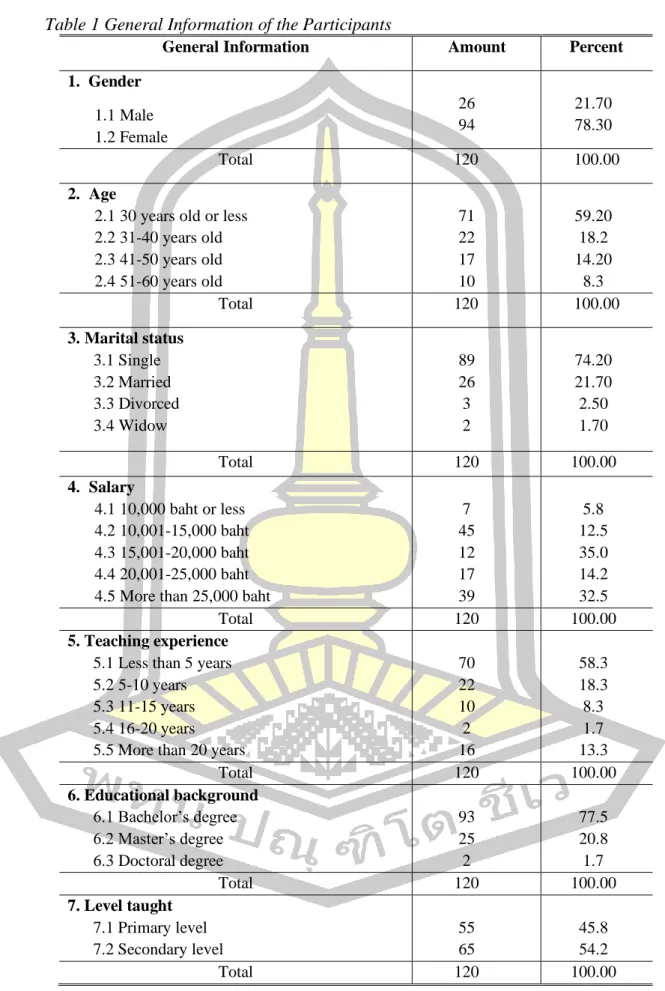
This research focused on English teacher burnout in the Thai EFL context at primary and secondary education levels. This research was intended to shed light on what factors influence English teacher burnout in a Thai EFL context.
LITERATURE REVIEW
Definitions of teacher burnout and its characteristics
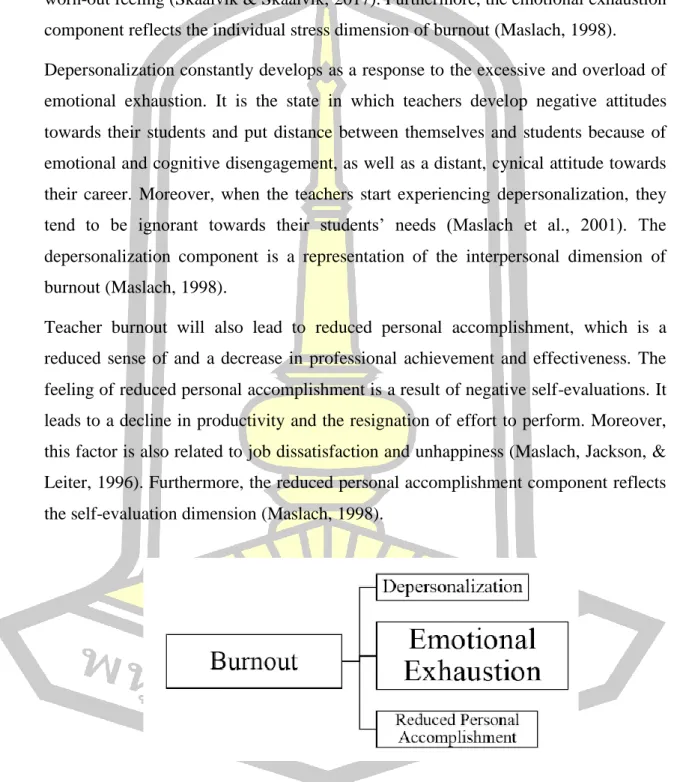
The characteristic of depersonalization in EFL teacher burnout includes negative and impersonal perceptions towards their colleagues and students (Sadeghi. Furthermore, teacher burnout is shown to be negatively related to teacher self-efficacy, leading to a reduction in teaching effectiveness (Skaalvik & Skaavik, 2017) .
Theoretical framework
- Maslach’s Multidimensional Theory of Burnout
- Job-Fit Person Theory of Maslach and Leiter
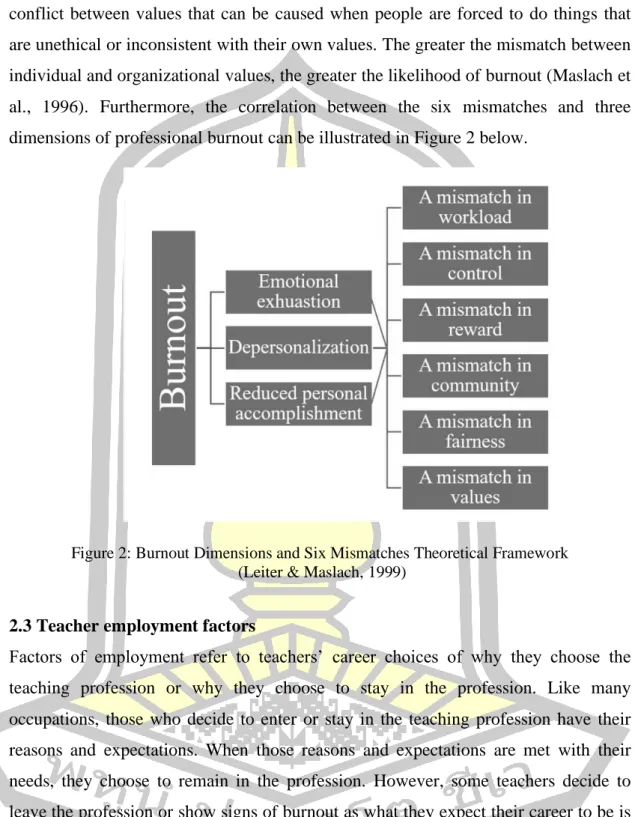
For community dissonance, it occurs when people lose a sense of community or positive connectedness in an organization, which is associated with emotional exhaustion (Maslach et al., 1996). In terms of justice mismatch, it is found to be most related to emotional exhaustion and depersonalization (Maslach & Leiter, 2001) due to unfairness between people and the job.
Teacher employment factors
These factors have been found to be related to teachers' career decisions in many studies (Areekkuzhiyil, 2014; Kevessiga, 2013; Rintaugu, 2013; Sulaiman & Akinsanya; 2014). Working conditions and job rewards are strongly associated with teachers' career decisions because they directly affect the job satisfaction of the teachers (Akbar, Ramzan, 2013).

Related studies
- Factors contributing to teacher burnout
- Demographic factors
- Job-related stressors
- Self-Efficacy
- Job satisfaction
- Effects of teacher burnout
- Effects of burnout on teachers
- Effects of burnout on learners
- Impact of burnout on education regarding teacher attrition
Ozkara (2019) investigated the relationship between Turkish EFL teachers' self-efficacy and burnout level through the analysis of data collected by Maslach. Teacher burnout can negatively affect teacher behavior, student achievement, and as a result, the school system.
Studies related to burnout intervention/ coping strategies
- Individual interventions and coping strategies
- Organizational interventions and coping strategies
Studies have supported that proactive strategies can effectively reduce teacher burnout (Klassen & Durksen, 2014; Pietarinen et al., 2013). Social support interventions have significant effects on increasing personal performance, which helps reduce teacher burnout (Iancu et al., 2018).
Related studies on teacher burnout in the Thai context
Another study on Thai teacher burnout in the context of special education was outlined by Yotanyamaneewong (2012). According to the aforementioned studies, many factors play an important role in teacher burnout in the Thai context, as the teaching profession in Thailand is a stressful occupation. However, social support and the learning environment are probably the most influential factors contributing to teacher burnout in the Thai context, as studies have examined the learning environment and relationships with colleagues.
Therefore, it is worth investigating teacher burnout in the Thai EFL context to gain more understanding of this issue.
Organizational context of Thai basic education
This issue is far from being overlooked by the Office of the Basic Education Commission, which has the central authority involving supervision, supervision, control and management of affiliated organizations and all primary schools at both regional and local levels (Wiyaporn & . Raksapolmuang, 2017). According to a study on Beliefs and Classroom Assessment Practices of English Teachers in Primary Schools in Thailand by Narathakoon, Sapsirin & Subphadoongchone (2020), the results of the study show that the English teachers in a primary school in Thailand taught more than one class and more than one subject , as one of the teachers taught up to nine subjects. Narathakoon, Sapsirin & Subphadoongchone (2020) revealed that some of the primary school teachers taught more than five subjects per term. term.
Workload stress from teaching extracurricular subjects has been considered as one of the negative influences on teaching efficiency and unsatisfactory results for teachers (Collie et al., 2012) Therefore, this issue of teacher shortage is one of the main organizational factors that cause emotional exhaustion, stress and heavy workload in primary school teachers.
Summary of Chapter II
RESEARCH METHODS
- Participants and setting
- Research instruments/techniques
- Demographic Survey
- Maslach Burnout Inventory-Educators Survey (MBI-ES)
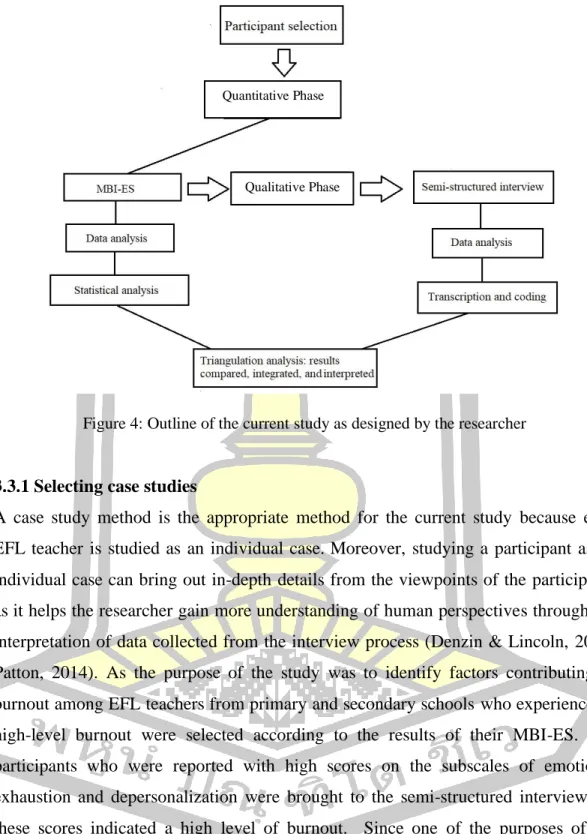
- Semi-structured interviews
- Data collection procedure
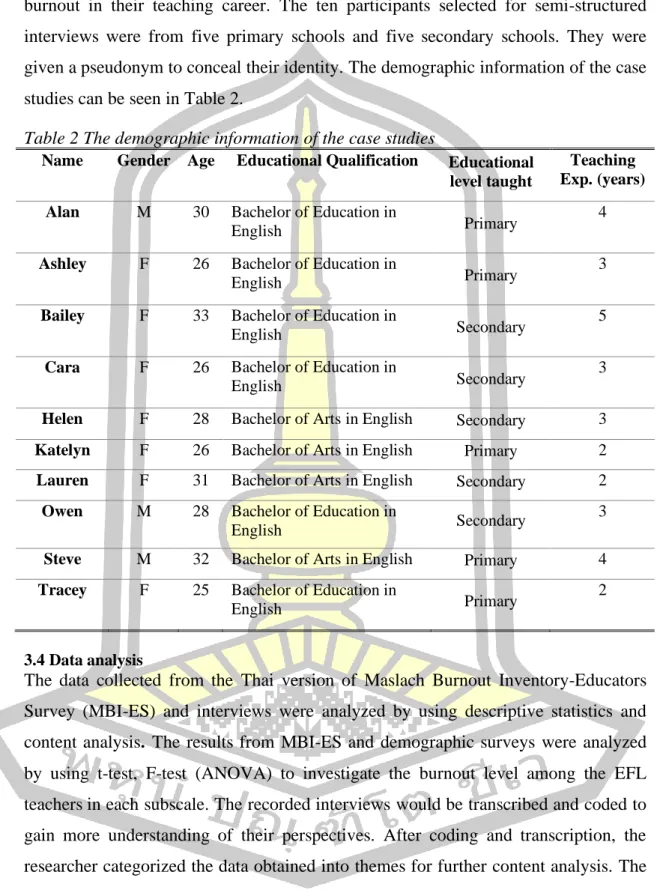
- Selecting case studies
- Ethical considerations
- Summary of Chapter III
The participants expressed that they needed support from the administration to help them deal with work-related stressors and reduce the excessive workload, but "the administrators don't really care about the burden of teaching." They also noted that their administrators did not prioritize teaching or students, but instead focused on other projects unrelated to teaching. It makes things even more difficult to work at a school... It makes me exhausted and burnt out... The administrators don't really care about the burden of teaching. Khanarat, S., & Nomura, T, 2008, 'The analysis of English as a second language teaching methods in Thailand and Japan', Saitama Univ.Fac.Educ., 57(2).
Well… (long pause) the administrator should be more understanding and prioritize teachers and students, not the crappy prizes and projects.
RESULTS
Overall findings
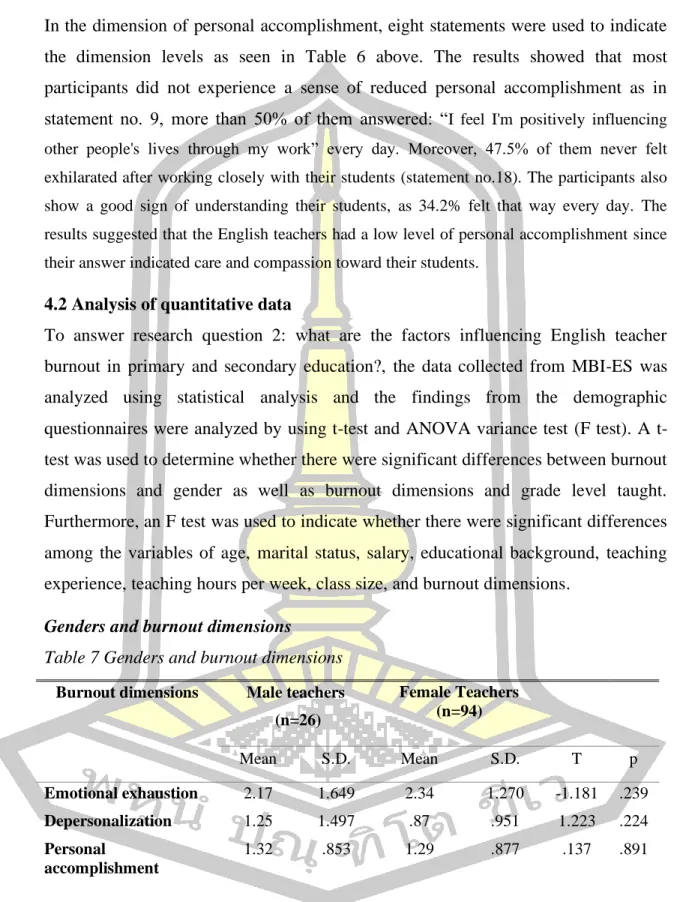
It was found that 27.5% of the participants suffered a high level of emotional exhaustion while another 27.50% suffered moderate emotional exhaustion. It showed that more than half of the participants suffered from high-moderate emotional exhaustion (55%) while another 45% had a low level of emotional exhaustion. The results indicated that 7.50% of the participants had a high level of burnout in the depersonalization dimension.
The results showed that most of the participants suffered from emotional exhaustion at a moderate-high level.

Analysis of quantitative data
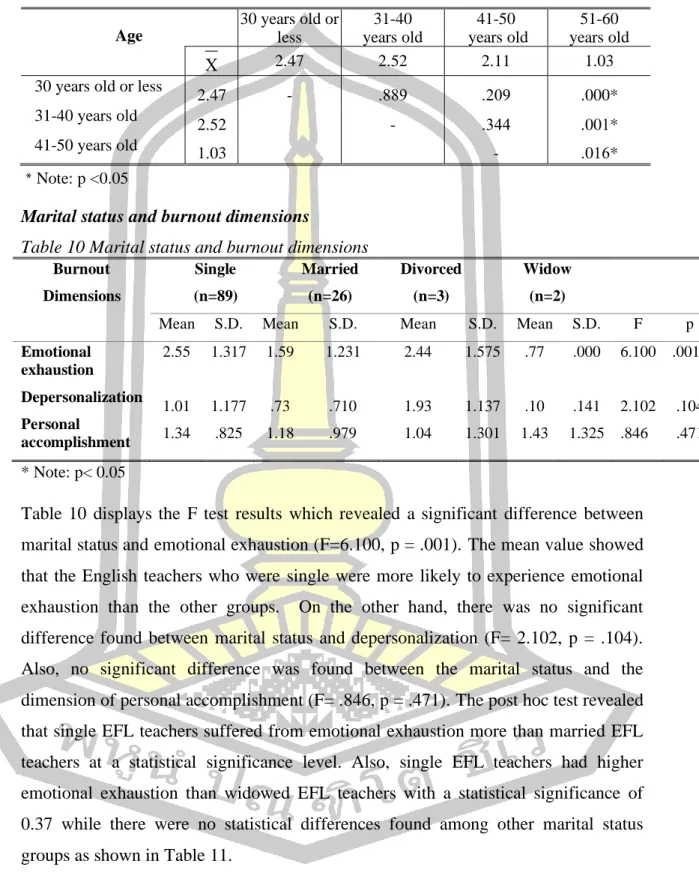
A post hoc test showed that single EFL teachers suffered more from emotional exhaustion than married EFL teachers at the level of statistical significance. Mean values indicated that English teachers with PhDs suffered higher levels of emotional exhaustion compared to other groups. In addition, post hoc analysis showed that PhDs suffered more from emotional exhaustion than those with master's degrees at the level of statistical significance.
The post hoc test also revealed a significant difference in emotional exhaustion between the Thai EFL teachers with a bachelor's degree than those with a master's degree, as shown in Table 14.
Results of qualitative data
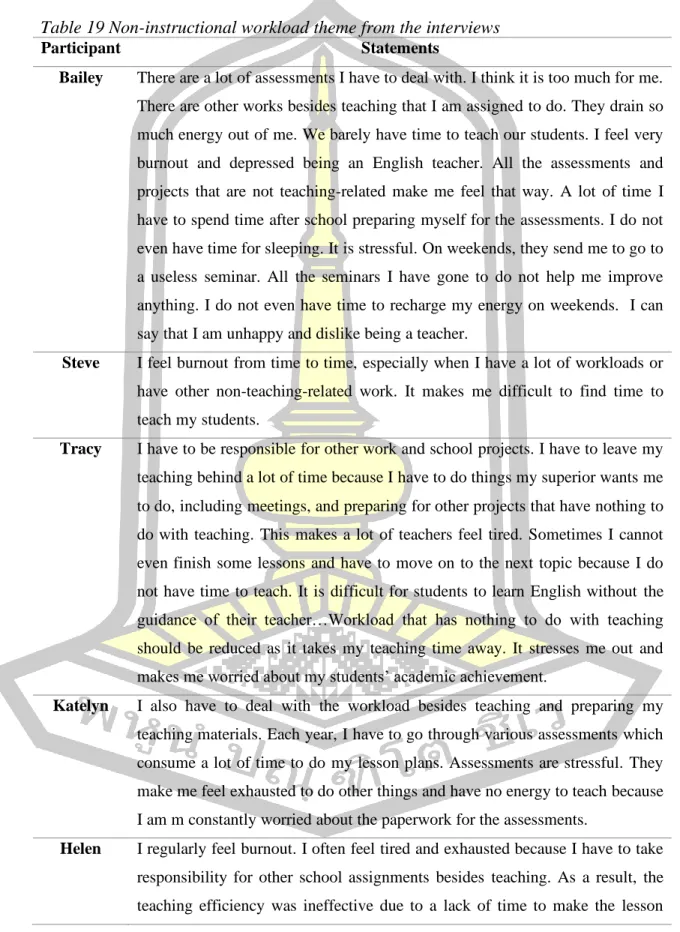
Katelyn Most of my students don't like English and they don't pay attention to my teaching. I often review my teaching and try to change my instruction to make it more suitable for my students, but it doesn't work well because my students aren't participating. Administrators do not see the real problems and do not support us to devote time to teaching.
I have to devote a lot of time to instruction and I don't have enough time to teach.
Grade level taught and burnout dimensions
Conclusion
However, age, marital status, educational background, and teaching experience were found to be related to Thai EFL teachers' burnout. This current study provided insight into Thai EFL teacher burnout through the voices of the Thai EFL teachers in Northeast Thailand. The effect of gender, education level and marital status on Iranian EFL teachers' burnout level.
The effect of social comparison tendencies on EFL teachers' burnout experience and teaching self-efficacy.
DISCUSSION AND CONCULSION
Burnout in Thai English teachers
These findings are consistent with a previous study showing that Canadian teachers also show a moderate to high level of emotional exhaustion (Koenig, 2014) as well as a previous report that almost all teachers involved in English as a foreign language (EFL) ) teaching experienced a high level of emotional exhaustion (Byram, 2013). The results of the semi-structured interviews suggested that this high level of emotional exhaustion among Thai EFL teachers was caused by work-related stressors that caused them to experience a loss of energy. For example, Akbari et al (2020) found that Iranian EFL teachers with high emotional exhaustion also showed high depersonalization.
Overall, this study clearly showed that Thai EFL teachers suffering from burnout are most likely to experience emotional exhaustion followed by depersonalization and personal accomplishment.
Factors influencing Thai English teachers’ burnout in primary and secondary
- Demographic factors
- Factors emerging from semi-structured interviews
In the current study, it was found that Thai EFL teachers who were single experienced a higher level of emotional exhaustion than those in the other groups (i.e., married, divorced, widowed). Poor peer relationships may cause Thai EFL teachers to feel undervalued and develop low self-efficacy. In the present study, semi-structured interviews revealed that student misbehavior had an effect on emotional exhaustion and depersonalization.
This may make Thai EFL teachers feel stressed and unsupported as their administrators do not support them to devote their time to teaching.
Burnout in primary and secondary school teachers of English
The older teachers always use the younger ones to do things for themselves and the younger ones are afraid to say no.” (Owen, 28 years old). Furthermore, the semi-structured interviews revealed that factors influencing burnout, including a lack of administrative support, a negative work environment, disruptive student behavior and excessive workload, were found in both primary and secondary schools. Therefore, according to the findings of the current study, teacher burnout does not differ between primary and secondary English teachers because both primary and secondary teachers are likely exposed to a similar work environment and organizational culture.
Limitations of the study
Implications
In order to reduce or minimize teacher burnout at an organizational level, the administration or the Office of the Basic Education Commission must actively help the teachers themselves. Since the administration and the Office of the Basic Education Commission have central authority in supervision, supervision, control and management of affiliated organizations, they need to support teachers by creating a positive working environment for their teachers. The administrative support can be provided to the teachers by reducing the non-instructional workload and assessments as well as by promoting a collaborative environment to make the workplace a more enjoyable experience.
It is important for the administration to develop a supportive school culture, which can be done by developing and promoting shared values and goals and reducing the pressure on teachers.
Conclusion
The understanding of Thai EFL teachers' burnout obtained through the current study can be used as a guide to prevent and reduce the effects of burnout. The effect of burnout level of English teachers on the overall English achievement of EFL students in senior secondary school. Levels of teacher burnout in an Iranian EFL context: The case of junior high school, high school, university and private English EFL institute teachers.
Kitjaroonchai, N., 2013, 'Primary and Lower Secondary School Teachers' Attitudes towards English language learning: A case study of Teachers in Muak Lek and Wang Muang Districts, Saraburi Province', Catalyst. Exploring the demographic and contextual factors influencing English language teacher burnout: Implications for teacher education programs. A mixed methods study on the relationship between EFL teachers' job satisfaction and job performance in Iran. 2017).