FACTORS AFFECTING INTENTION TO PURCHASE AND SHOPPING BEHAVIOR ON THAI FASHION
APPAREL BRANDS IN BANGKOK
PASSAPORN LIMNITHDA
A THEMATIC PAPER SUBMITTED IN PARTIAL FULFILLMENT OF THE REQUIREMENTS FOR THE DEGREE OF MASTER OF MANAGEMENT
COLLEGE OF MANAGEMENT MAHIDOL UNIVERSITY
2018
COPYRIGHT OF MAHIDOL UNIVERSITY
Thematic paper entitled
FACTORS AFFECTING INTENTION TO PURCHASE AND SHOPPING BEHAVIOR ON THAI FASHION
APPAREL BRANDS IN BANGKOK
was submitted to the College of Management, Mahidol University for the degree of Master of Management
on April 22, 2018
……….….…..………
Asst. Prof. Chanin Yoopetch, Ph.D.
Advisor
……….….…..………
Duangporn Arbhasil, Ph.D.
Dean
College of Management Mahidol University
……….………….…..………
Miss Passaporn Limnithda Candidate
……….
Asst. Prof. Winai Wongsurawat, Ph.D.
Chairperson
……….….…..………
Prof. Barbara Igel, Ph.D.
Committee member
ii
ACKNOWLEDGEMENTS
This thematic paper would have not been completed without the guidance from my advisor, Assistant Professor Chanin Yoopetch. I would like to express my deepest gratitude for your patience. Your advice and support were invaluable. I am honored to have you as my advisor.
I would like to thank you all the respondents for their time and willingness to complete the questionnaires. Without their valuable inputs, I could not make this thematic paper possible.
Finally, I would like to thank you my family and friends who always support and encourage me through the years. I am so grateful to have all of you beside me.
Passaporn Limnithda
iii
FACTORS AFFECTING INTENTION TO PURCHASE AND SHOPPING BEHAVIOR ON THAI FASHION APPAREL BRANDS IN BANGKOK PASSAPORN LIMNITHDA 5949060
M.M. (ENTREPRENEURSHIP MANAGEMENT)
THEMATIC PAPER ADVISORY COMMITTEE: ASST. PROF. CHANIN YOOPETCH, Ph.D. ASST. PROF. WINAI WONGSURAWAT, Ph.D. PROF.
BARBARA IGEL, Ph.D.
ABSTRACT
The objectives of this research are to gain better insights on consumer behaviors and seek for guidance on effective marketing strategies toward Thai fashion apparel brands in Bangkok by identifying the factors that affect intention to purchase and shopping behavior.
The quantitative research was conducted through online questionnaire using convenience sampling method. The data was collected from people who live in Bangkok Metropolitan and have experience in purchasing Thai fashion apparel brands. The sample size is 187 respondents. The statistics used for data analysis are Descriptive Statistics including frequency, percentage, mean, and standard deviation. Inferential Statistics which is multiple regression.
The research result shown that most of the respondents were female at 77.5% and were aged between 21 to 30 with Master degree. They work for private companies with the average monthly income of 30,001-45,000 Baht and more than 60,000 Baht. 39% of the respondents purchased Thai fashion apparel brands once a month with the average spending amount per time of 1,000-2,500 Baht. Purchase decision was made by the respondents themselves followed by influence from friends. The most favorite fashion apparel style is Minimal style.
In addition, Place and Price were the most important marketing mix that the respondents concerned for. The important decision-making styles were Perfectionist and Recreational or Hedonistic styles. From data analysis, it revealed that Place is the most influencing factor on shopping behavior followed by Promotion. For the decision-making styles that were the most influencing factors were Perfectionist followed by Price conscious style. Moreover, Product, Place, and Price have the most impact on intention to purchase respectively. The decision- making style that has the most impact on intention to purchase was Impulsive style followed by Novelty-fashion conscious and Recreational style.
KEY WORDS: Fashion / Marketing Mix / Decision-making Style / Purchase Decision / Shopping Behavior
80 pages
iv
CONTENTS
ACKNOWLEDGEMENTS ii
ABSTRACT iii
LIST OF TABLES iv
LIST OF FIGURES vii
CHAPTER I INTRODUCTION 1
1.1 Research Questions 3
1.2 Research Objectives 3
1.3 Research Scope 3
1.4 Expected Benefits 4
CHAPTER II LITERATURE REVIEW 5
2.1 Fashion Apparel Industry 5
2.1.1 Fashion 5
2.1.2 Levels or types of Fashion 6
2.2 Product 7
2.3 Price 9
2.4 Place or Distribution Channel 10
2.5 Promotion 13
2.6 Shopping Behavior 15
2.7 Purchasing Decision Process of Fashion Products 16
2.8 Research Framework 18
2.9 Related researches 19
CHAPTER III RESEARCH METHODOLOGY 24
3.1 Research Design 24
3.2 Population and Data collection 24
v
3.3 Research Instrument 24
3.4 Data Analysis 27
3.4.1 Descriptive Statistics 27
3.4.2 Inferential Statistic 27
CHAPTER IV RESEARCH FINDINGS AND ANALYSIS 28
4.1 Demographic Results 28
4.2 Descriptive Statistics 31
4.3 Model Testing 39
4.3.1 Model I 39
4.3.2 Model II 41
4.3.3 Model III 44
4.3.4 Model IV 47
4.4 Discussion 49
4.4.1 Demographic Characteristics 49
4.4.2 General information and Behavior 49 4.4.3 Descriptive Statistic (Mean) 50
4.4.4 Influential Factors 51
CHAPTER V CONCLUSIONS AND RECOMMENDATIONS 52
5.1 Background and Importance of the Research 52
5.2 Summary of the Findings 52
5.3 Recommendations 53
5.4 Limitations and Future Research 56
REFERENCES 57
APPENDICES 61
Appendix A: Questionnaire (English) 62
Appendix B: Questionnaire (Thai) 69
BIOGRAPHY 80
vi
LIST OF TABLES
Table Page
Table 4.1.1 Gender 28
Table 4.1.2 Age 29
Table 4.1.3 Education Level 29
Table 4.1.4 Occupation 30
Table 4.1.5 Average Monthly income 30
4.1.1 Gender 28
4.1.2 Age 29
4.1.3 Education Level 29
4.1.4 Occupation 30
4.1.5 Average Monthly income 30
4.2.1 Frequency of Purchase 31
4.2.2 Average spending amount per time 32
4.2.3 Influencers 32
4.2.4 Fashion apparel Styles 33
4.2.5 Mean scores and standard deviation of the independent variables 34
vii
LIST OF FIGURES
Figure Page
1.1 Revenue of Fashion segment 1
1.2 Thailand Creative Industry Trade Performance 2003-2012 2 1.3 Market demand of clothing in Thailand from 2011 to 2018 2
2. 1 Five Product Levels 8
2.2 Four generic pricing strategies 10
2.3 Major types of Store Retailers 11
2.4 Top Social Media for Thai 13
2.5 Four types of buyer behavior 15
2.6 Traditional vs Fashion Products Purchase Decision Process 16 2.7 The factors affecting Intention to Purchase and Shopping Behavior 18 4.1 Thai Fashion apparel brand that was recently purchased 34
4.3.1 Model I framework 41
4.3.2 Model II framework 44
4.3.3 Model III framework 46
4.3.4 Model IV framework 48
5.1 The most popular product for Thai online shoppers 55
1
CHAPTER I INTRODUCTION
Overview of Thailand’s fashion industry:
Thai fashion industry is a part of the creative industry introduced by the United Nation Conference on Trade and Development (UNCTAD). It represents a large contribution to the national economic growth with the value of approximately 700 billion Thai baht in 2018 which the majority come from the fashion apparels. Thai fashion industry has high growth potential with the Compound Annual Growth Rate (CAGR) around 21% over the next 5 years (2018-2022) according to the statistics report.
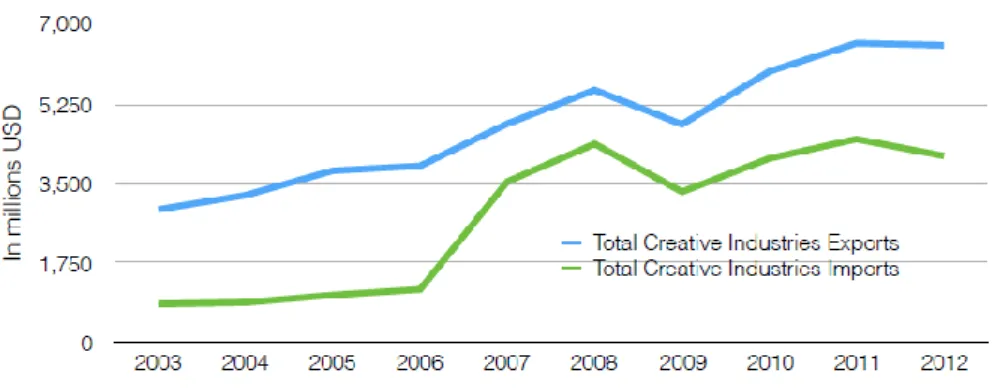
The fashion industry involves local labor force over 700,000 people in total. According to UNCTAD’s report, Thailand’s creative industry export grew significantly with the total value of 200 million baht in 2012 which the majority comes from design section.
The value of the design alone, including jewelry, interior design, and fashion, is approximately 167 billion baht. There was also a campaign organized by Thailand Creative & Design Centre (TCDC) to promote creative industry as a key for national economic development.
Figure 1. 1 Revenue of Fashion segment
Sources: https://www.statista.com/outlook/244/126/fashion/thailand#market-revenue
2
Figure 1.2 Thailand Creative Industry Trade Performance 2003-2012 Source: UNCTAD. (2015). Creative economy outlook and Country profiles.
Figure 1.3 Market demand of clothing in Thailand from 2011 to 2018 (in billion US dollars)
Source: https://www.statista.com/statistics/616404/thailand-clothing-market-demand/
Due to the upward trends of clothing demand in Thailand, Thailand Develoment Research Institute (TDRI) claimed that Thai fashion products are expected to reach 1 trillion baht a year in 2021. Thai fashion industry is supported by many public organizations in developing new SMEs. Department of Industrial Promotion (DIP) plays an important role in promoting creativity and competitiveness of Thai fashion and providing the opportunity for new Thai designers to display their work to the market.
3
DIP launches a variety of activities and campaigns to develop skills and creativities of Thai designers. For instance, DIP together with the Institute for Small and Medium Enterprise Development (ISMED) has recently launched the competition called “Fashion Designer Creation 2017” in order to develop Thai fashion brand to international market.
With the support from government and public organizations and high potential growth of the industry, there is a continuous increasing in numbers of Thai fashion apparel brands in the market. Since the pioneer of fashion industry to the development of Bangkok Fashion Society which including Premium designer brands.
And nowadays, there are over 100 online Thai fashion apparel brands with the integration of digital platforms.
Therefore, it is a good worthwhile for new fashion entrepreneurs to study the target consumer behaviors and the factors that can influence their purchase decision before launching the new fashion products to the market.
1.1 Research Questions
What is the factor that influence intention to purchase Thai fashion apparel brands?
What is the factor that influence shopping behaviors on Thai fashion apparel brands?
1.2 Research Objectives
To gain better insights on consumer behaviors towards Thai fashion apparel brands.
To seek for guidance on effective marketing strategies for fashion retailers.
1.3 Research Scope
This research mainly focuses on only Thai ready-to-wear fashion apparel brands. The aim is to study the factors that influence intention to purchase and shopping behaviors on Thai fashion apparel brands which the two main factors that taking into
4
account are Marketing Mix and 8 decision-making styles. The Quantitative method was conducted through online questionnaire with the sample size of 187 respondents.
1.4 Expected Benefits
New fashion entrepreneurs will gain the insights from the research result on the consumer behaviors and influential factors affecting the purchase decision. These will be beneficial for them in establishing their own fashion brands since they can better understanding the customers so they can design the right design collection and select the right marketing strategies for the brands.
5
CHAPTER II
LITERATURE REVIEW
The literature review will cover the overview of Fashion Apparel Industry.
The relevant theories about fashion adoption process. The categories of fashion apparels.
In this research will focus on the two main factors affecting intention to purchase and shopping behavior of Thai fashion apparel brands. The first factor is Marketing Mix which composes of four elements; Product, Price, Place, and Promotion. The second factor is Decision-making styles which compose of; Perfectionism, Brand consciousness, Novelty-fashion consciousness, Recreational or Hedonistic, Price consciousness, Impulsiveness, Confused by overchoice, and Habitual or Brand-loyal.
2.1 Fashion Apparel Industry
2.1.1 Fashion
Fashion is the style most popular at a given time. The style in this sense refers to any particular characteristic or look of apparel or accessories that is accepted or purchased by a large group of consumers (Frings, 2008). Style is defined as a particular combination of attributes that differentiates from other categories (Solomon and Rabolt, 2004) Fashion is always changing in response to the change in people’s lifestyles and needs and current events. Hence, the key factor success factor in fashion industry is to have the ability to understand the speed of acceptance and change (Frings, 2008). Most of the times, fashion is identified with clothing. It is a process of social diffusion that a new fashion or style is adopted by consumers. Thus, fashion is a specific combination of attributes (Solomon, Bamossy, Askegaard, and Hogg, 2006).
6
The fashion adoption process can be explained by three theories as the following;
Traditional Fashion Adoption (Trickle-Down Theory) is the process of copying and adapting trendsetting fashion from European such as Paris, Milan, London, and New York designers. Since the couture or signature line is expensive, it can reach to a limited group of consumers. So, producers decide to use less expensive material and design for the adaptation
Reverse Adoption (Trickle-Up or Bottom-Up Theory) focuses on consumer preference rather than copying and adapting. Designers get the inspiration of their new collection from what people are wearing.
Mass Dissemination (Trickle-Across Theory) states that fashion trends and collection are spreading rapidly due to internet. Sometimes the original versions get copied before launching at stores (Frings, 2008).
2.1.2 Levels or types of Fashion
High fashion or Haute couture literally mean fine sewing which refers to high-quality custom-made clothing. It refers the new style that is very expensive and exaggerated in style. These fashion items are accepted by limited number of fashion leaders who can afford them. The example of design houses for Haute couture are Dolce
& Gabbana, Dior, and Alexander McQueen.
Ready-to-wear lines or prêt-à-porter is much more affordable and casual style. It is also influential to American fashion. The example of designers are Calvin Klein, Ralph Lauren, and Anna Sui. This fashion line is shown on the runway shows twice a year.
Mass fashion refers the majority of fashion sales in United States. These fashion styles are produced in large quantities and normally sold in department or discount stores throughout the world (Solomon and Rabolt, 2004).
7
There are two types of fashion apparels. The first type is Haute couture which is a high-end fashion which is tailored made and used high quality and expensive material for the detail of sewing. It is meant to sell as a piece of art rather than an everyday wear. The second type ready-to-wear which refers to a factory-made clothing or the one that sold in standardized sizes. It can be further separated into two types which are Designer fashion and Mass fashion or Street fashion. Designer fashion refers to Designer-branded Merchandise which the design derives from Haute couture with an adjustment on design and production process. Mass fashion refers to large production product with low costs. It copies the design of high fashion but at lower quality (Duangmanee, 2014).
This research focuses on ready-to-wear line of apparels which can be either designer fashion brands or mass fashion brands both online and offline channels. The example of Thai designer brands are Sretsis, Greyhound, or Asava etc. The well-known online fashion brands are such as Lookbooklookbook, Everydayapparel, and Basicbysita. The examples of Mass fashion brands are Jaspal, Lyn around, and AIIZ.
2.2 Product
Product is anything that offer to consumers in the market that might satisfy their wants or needs. (Armstrong and Kotler, 2006) It can be both tangible and intangible such as physical product or service (Singh, 2012) As mentioned by (Kotler, 2012) that the Product Concept is to offer consumers a valuable product in terms of both functions and features which there are many sub-elements under product ranging from ideas and designs to people and experiences. Thus, it is very important in designing the new products.
One of the key aspects to be concerned about product is product attribute.
Products are group of attributes that are used to describe themselves. There are three main types of attributes. Features which are the components of the product such as
8
dimension, structure, or appearance, Functions which are the how the product works, Benefits which can be identified to many things like product usage or enjoyment. The three types of product attributes sequentially occur in which the feature will limit to a certain function that can lead to specific benefit (Crawford and Benedetto, 2015).
Some scholars say that product development involves defining the benefits that the product offers by communicating and delivering them through product attributes; quality, features, and design. Product quality is the ability that a product to perform its functions including durability, reliability, and precision. Quality can be measured by both level and consistency which means no defect or variation. Product features are the elements that a product offer. They are very important for product differentiation. Product design is what make product unique. It concerns more than style or appearance of the product. It takes into account the usefulness as well as the economical production and distribution (Kotler, Armstrong, Wong, and Saunders, 1999).
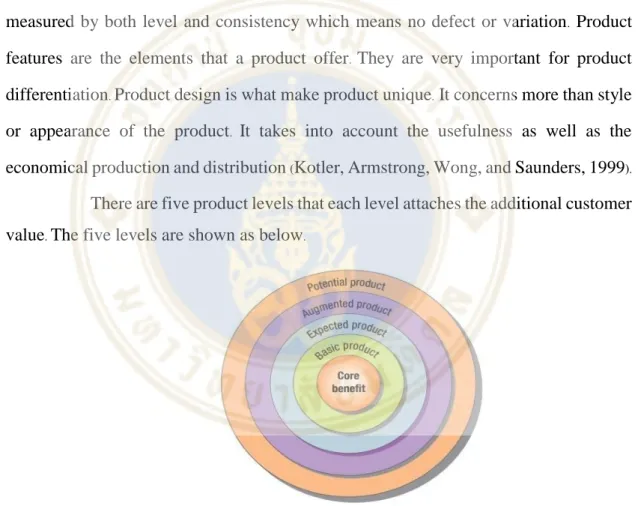
There are five product levels that each level attaches the additional customer value. The five levels are shown as below.
Figure 2. 1 Five Product Levels
Source: Kotler and Keller (2012). Marketing Management, p.348
The core benefit is the actual benefit that customers buy which later turn into a basic product which include something that is needed for its function. The expected product are the conditions that consumers expect to get from the product
9
including the aesthetic, feeling, and accuracy. The next level is the augmented product, which is something that product offer exceeding the consumer expectation like additional features. This is the level that involve product competition and brand positioning. The fifth level is the potential product which represents the way to differentiate the product and increase customer satisfaction and loyalty.
Another essential part of a product is brand as it adds value to a product. A Brand is a name, sign, or design that differentiate one producer’s product from competitors (Granger and Sterling, 2012).
The fashion product in this research refers to only fashion apparel. This research will focus more on women’s wear and does not include shoes and other accessories. The product attributes are the key concern in designing new apparels to consumer. The function of apparel is wearing but it can be defined the different purpose of apparel on different occasions. The features of the apparel are size, design, color, print which are the attractive aspect of apparel to draw to consumers’ attention and influence their purchase decision. For the benefits, they involve with emotion and satisfaction.
Nowadays, fashion products try to provide value to customers through five levels. The core benefit and basic product levels are common basic for all fashion producers. Fashion products start to compete heavily from expected product and augmented product level which link with the product attributes and brandings for brand identity and image.
2.3 Price
Price is how much the product or service is charged for (Ehmke, Fulton, and Lusk, n.d.). Price has many forms such as rate, rent, and commission (Kotler and Keller, 2012). Price is not only about the numbers, it also sends the message of product or service value to potential customers (Granger and Sterling, 2012). Price is the only component in marketing mix that generates revenue (Kotler, Armstrong, Wong, and
10
Saunders, 1999). This is in line with the goal of every retailer of Sustainable Profit Maximization.
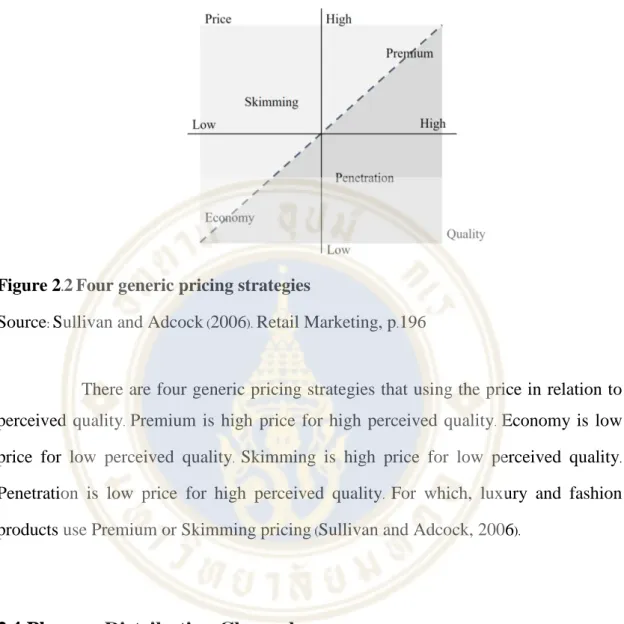
Figure 2.2 Four generic pricing strategies
Source: Sullivan and Adcock (2006). Retail Marketing, p.196
There are four generic pricing strategies that using the price in relation to perceived quality. Premium is high price for high perceived quality. Economy is low price for low perceived quality. Skimming is high price for low perceived quality.
Penetration is low price for high perceived quality. For which, luxury and fashion products use Premium or Skimming pricing (Sullivan and Adcock, 2006).
2.4 Place or Distribution Channel
Distribution Channel is any interdependent organization that involves in making a product or service available to consumers. It moves goods from producers to consumers (Kotler, Armstrong, Wong, and Saunders, 1999). As a part of distribution channel, Retailing involves the activities to sell product or service directly to final consumers. Retailers can be divided into three major types; Store Retailers, Nonstore Retailers, and Retail Organizations.
11
Store Retailers refers to physical store. The well-known type of store retailer is the department store. Each format of store retailers will have different competitive and price dynamics.
Figure 2.3 Major types of Store Retailers
Source: Kotler and Keller (2012). Marketing Management, p.471
Retailing is the heart of fashion industry. Fashion stores have been developed from traditional type like department store to other types nowadays. The fashion retailing market trend introduced a new distribution channel called multi-brand fashion retail store. Multi-brand fashion retail store is an assembly of fashion apparel brands which provide consumers various choices which they can compare the products from different brands (Ho and Li, 2010).
Nonstore Retailers fall into four major categories: direct selling, direct marketing including telemarketing and internet selling, automatic vending, and buying services.
Direct selling or network marketing refers to companies that selling door-to-door. It can be either one-to-one selling like Avon or one-to-many like Tupperware.
Direct Marketing includes telemarketing, television direct-response marketing, and electronic shopping which people shop for a variety of products and services as they get used to shopping on the Internet.
12
Automatic vending is a self-service 24-hour selling which offer a variety of products including impulse goods. It is located in communities’ areas such as offices or large retail stores.
Buying service is a storeless retailer for specific customers. Normally it is an agreement between large organizations and retailers who allow employees to buy at discount.
Online stores refer to retail stores that do not have physical storefront. They use internet to facilitate sales transactions and deliver the product to consumers mainly by post service. The communication between buyer and seller can be either instant message or phone call (Chaisuwankeeree, 2016).
E-commerce uses website as a platform to sell products and services to customers online.
It has advantages in terms of cost saving (Kotler and Keller, 2012).
There are several tools for entrepreneurs which they will have to choose the right tool to implement first by analyzing the product and target consumer behavior in order to get the most effective result (SMEs go Online, 2017). The followings are the example of Digital marketing tools for Thai consumer behavior.
Website is a basic tool for entrepreneurs to do digital marketing. It serves as a front store to introduce and buy and sell the products. If they have websites, target consumers will aware of their brands and quality of products.
Online PR refers to publication through online channels such as website or social media to build awareness and positive attitude towards product and brand. It is also an important tool enhance image of the business.
Content Marketing includes content, picture, and video clip, is released through all channels. The good content must give knowledge to audiences and interesting enough for them to share. This is a marketing tool that can communicate with the target group.
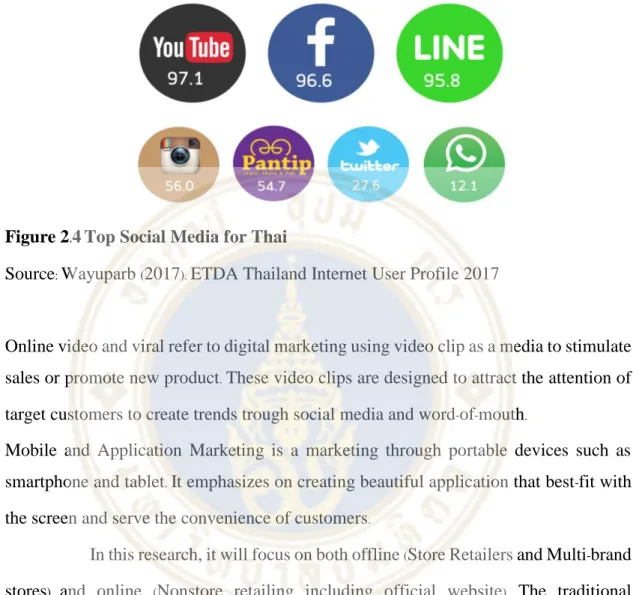
Social Media Marketing such as through Facebook, Twitter, Instagram, Pinterest, Google+. Entrepreneurs need to select the channel according to their purposes. For example, Pinterest is suitable for distinctive product image, Instagram is suitable for photo-based. According to the 2017 survey by Electronic Transactions Development
13
Agency (Public Organization), or ETDA found that top three Social Media that popular amongst Thai users were YouTube, Facebook, and Line.
Figure 2.4 Top Social Media for Thai
Source: Wayuparb (2017). ETDA Thailand Internet User Profile 2017
Online video and viral refer to digital marketing using video clip as a media to stimulate sales or promote new product. These video clips are designed to attract the attention of target customers to create trends trough social media and word-of-mouth.
Mobile and Application Marketing is a marketing through portable devices such as smartphone and tablet. It emphasizes on creating beautiful application that best-fit with the screen and serve the convenience of customers.
In this research, it will focus on both offline (Store Retailers and Multi-brand stores) and online (Nonstore retailing including official website). The traditional distribution channel of fashion apparel is the store retailer which allow consumer to see and touch the products before purchasing.
2.5 Promotion
Promotion refers to as tool that sellers use to communicate product’s value to consumers to impress and influence their purchase decisions (Prongpromarat, 2016).
14
It consists of various communications activities as the followings (Cravens and Piercy, 2003);
The components of Promotion Strategy
Advertising is nonpersonal communication through a variety of media such as magazines, television, internet, or outdoor advertising. Advertising has advantages of controls in terms of budget and exposure as well as the consistency of the message.
However, it lacks interaction with the consumers and limited to duration of exposure.
Personal Selling is a communication between sales representative and consumer in influencing or making sales. It is an expensive method though it has its own advantages that sales representative can interact with consumers right away by answering the questions and providing feedbacks.
Sales Promotion includes a variety of promotional activities like trade shows, point-of- purchase displays, and trade incentives. This strategy can be used to target consumers and providing incentive to purchase especially during special occasions.
Direct Marketing consists of channels that give the opportunity to seller to communicate with individual consumers directly. The example of the channels are direct mail, electronic shopping, and kiosk shopping.
Interactive/ Internet Marketing is another channel to communicate promotions to consumers. Using the internet as a mean of communication enable the interaction between sellers and consumers. Moreover, it can be used to provide information, conduct online survey, or even make direct sales. The components of this strategy are internet, CD-ROMs, and interactive television.
Khan (2014) states that communication activities are necessary for marketing strategies since they play important roles in providing information, persuading and encouraging target consumers to make the sales. The companies can use a combination of activities to stimulate the sales through consumers’ emotion and feeling. The level of
15
marketing expenditure allocating to each promotional activity will depend on marketing manager’s decision (Prongpromarat, 2016).
2.6 Shopping Behavior
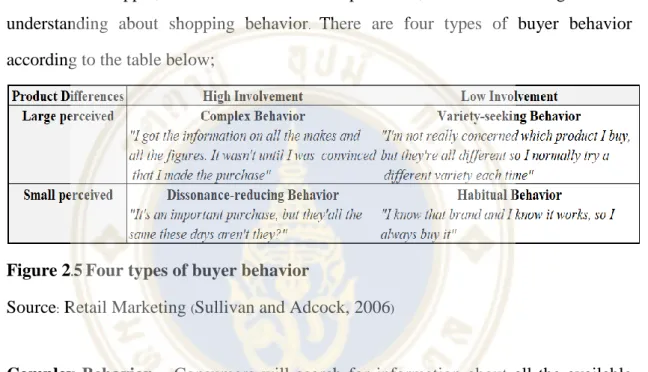
Sullivan and Adcock (2006) stated that examining the factors that directly affect on the shopper, both internal and external processes, enables retailer to gain better understanding about shopping behavior. There are four types of buyer behavior according to the table below;
Figure 2.5 Four types of buyer behavior
Source: Retail Marketing (Sullivan and Adcock, 2006)
Complex Behavior – Consumers will search for information about all the available options and they will extensively evaluate their purchase and post-purchase decision.
Dissonance-reducing Behavior – Similar to Complex Behavior, consumers will start with the searching information process but may lessen once they realized that the options are very similar. On the other hand, they will go through considerable post- purchase evaluation in compensation with the limited information search.
Variety-seeking Behavior – Consumers have limited information search process as the product involvement is low. However, they will need to consider different options before making purchase decision.
16
Habitual Behavior – Consumers have the lowest engagement with information search and evaluation as they think that the costs of searching and evaluating are greater than the benefits.
2.7 Purchasing Decision Process of Fashion Products
Figure 2.6 Traditional vs Fashion Products Purchase Decision Process Source: Solomon and Rabolt (2004). Consumer Behavior in Fashion, p.353
The Purchasing Decision Process is a psychological process that is important to consumers in making purchase decision. Consumers do not have to go through all five stages, they may skip or jump from one stage to another depending on the nature and the level of the involvement of the product.
Problem Recognition is the first stage in the process when consumers recognize a problem or need which was driven by internal or external stimuli. Thus, marketers try to ignite consumer interest and motivate them to consider a purchase
17
decision. Information Search explains about the level of searching engagement. Most consumers search for limited amount of information. However, some consumers engage in active information search which includes reading material, asking friend, or searching online to learn more about the product.
After searching for product information, consumers will evaluate their choices of product prior to making final judgement. In this stage, consumers will concern about the product attributes that will deliver certain benefits which their beliefs and attitudes can influence their purchasing behavior. As they formed purchase intention from their preference, consumers will enter purchase decision stage. It includes brand, quantity, channel, and payment method. The final stage in the process is Post Purchase Behavior which explains about satisfaction deriving from the gap between performance and expectation. If the consumers satisfied with the product, they will spread positive word-of-mouth to others (Kotler and Keller, 2012). Unlike the traditional purchasing decision that start with problem recognition, the purchase decision of fashion products start with the existence of that products since they are not necessity goods (Duangmanee, 2014).
Another interesting aspect in purchasing decision process is a consumer decision-making style. It is a mental-oriented approach that characterizing consumers when making decisions. It uses the concept of personality in psychology which involves cognitive and affective traits. Some researchers developed Consumer Styles Inventory (CSI) to collect the traits list in related to purchasing decision to serve consumer-interest professionals and systematically test the styles of consumers’ making decisions. There are eight profiles of consumer styles (Sproles and Kendall, 1986)
Perfectionism is a consumer who seek for the best quality in products. These consumers tend to shop systematically and comparatively.
Brand consciousness refers to consumers that prefer to buy expensive products because they believe that the higher the price the better the quality. Thus, they would select well- known and best-selling national brands over other brands in the market.
18
Novelty-fashion conscious consumers are the type who enjoy seeking out for new as well as a variety of products. They are fashion and novelty conscious which they are likely to keep up-to-date with the trends and styles.
Recreational or Hedonistic consumers view shopping as an entertaining activity.
Price consciousness refers to consumers who are looking for the product that value for their money, lower prices in general. Thus, they tend to be comparison shoppers.
Impulsiveness or carelessness refers to consumers who do not plan for their shopping and feel indifferent about the price and the quality of the products.
Confused by overchoice consumers are overwhelmed by a vast information and choice available which make it difficult for them in making choices.
Habitual or Brand-loyal is a well-known behavior of consumer decision-making. These consumers are likely to repetitively select the products from their favorite brands or stores.
2.8 Research Framework
Figure 2.7 The factors affecting Intention to Purchase and Shopping Behavior
19
2.9 Related researches
Hunjra, Niazi, and Khan (2012) studied the relationship between decision- making styles and consumer behavior in general by identifying the factors that influence consumer behavior based on a decision-making style. Five decision-making styles, Brand consciousness, Perfectionism, Product quality, Variety seeking, and Novelty fashion, are concerned in the research. The research was conducted in Pakistan Islamabad and Rawalpindi. Out of 250 respondents, 56.4% are male and 40.4% are female which most of them are 25 to 30 years old. From independent sample T-test, it shown that there is a significant relationship between male and female consumer behavior regarding the decision-making style with higher mean score for female. This means that decision- making style can influence consumer behavior of female more than male. The result of multiple regression analysis stated that there is a significant relationship between decision-making style and consumer behavior from all the decision-making styles. Of which Novelty fashion and Product quality have the highest impact on consumer behavior.
Paisanwongdee and Kumdetch (2012) studied the factors influencing decision-making of female in purchasing women’s wear on internet in Bangkok area.
They used quantitative method with the sample size of 400 for data collection and analyzing data by using frequency, percentage, mean, and standard deviation. They use One-way ANOVA and Multiple regression to test hypothesis. The majority of the respondents are aged 26 to 35 years old who have Bachelor’s degree. They work for private companies with the average monthly income more than 30,001 Baht. According to the mean scores, the most influencing factors to purchase women’s wear on the internet were the convenience from 24 hours operation (Mean=7.86) followed by the easiness to compare the prices from different shops (Mean= 7.42). The three main factors they tested were demographic information, consumer satisfaction, and marketing mix.
The result from multiple regression analysis shown that education level, marital status,
20
consumer satisfaction, price, and promotion were significantly influence the purchase decision.
Watcharapotikhun (2014) studied the factors affecting consumer behavior on online purchasing of fashion clothes in Bangkok. The researcher used Questionnaire to collect the data from sample size of 400. The statistics used for data analysis were One- way ANOVA and Chi-square. The respondents are mostly age between 21 to 30 and single. They have bachelor degree and work for private companies with average monthly income of 15,001 to 35,000 baht. The most popular fashion clothe was dress which they focused on the design followed by the reasonable price. The average spending for shopping per time is less than 1,500 baht and the average spending per item is between 500 to 1,500 baht. The reasons for online purchasing of fashion clothes in Bangkok were in trend products, cheap, and well-known brand respectively. The frequency of purchase is 2 to 3 times a month. According to the mean scores, Price
(Mean=4.26) and Product (Mean=4.17) are amongst the highest followed by Place
(Mean=4.01) and Promotion (Mean= 3.79). The first hypothesis found that different in
demographic elements has no impact on online purchasing of fashion clothes. The second hypothesis found that different in marketing mix has no impact on online purchasing of fashion clothes. The third hypothesis shown that there is no relationship between demographic and marketing but if consider by each element found that education level has a relationship with price in marketing mix.
Jaito (2016) studies factors influencing the decision to buy branded garments from Thailand domestic production of consumer in Bangkok. The researcher used questionnaire to collect the data from 384 respondents. The statistics used for data analysis were T-test independent, One-way ANOVA, and Pearson Product-Moment Correlation coefficient. The majority of the respondents were female at 71.88% age between 20 to 34. They have bachelor degree and average monthly income of 15,000 to 35,000 baht. The first hypothesis found that there is a difference in purchase decision in related to marketing factor amongst different genders which promotion has the highest
21
impact on purchase decision. It is also found that consumers with different gender, age occupation, and income consider different psychological factors like belief, motivation, and awareness. Moreover, the research result found that marketing factors and psychological factors are positively correlated with purchase decision of Thai clothing.
Kongsanit and Orapan (2017) studied the factors affecting consumer’s buying behavior of costume SOS (Sense of Style) in Instagram. They collected data from 300 questionnaires of 18 years old up population. The statistics used for data analysis were Independent T-Test, One-way ANOVA, and Multiple regression. Most of the respondents were female at 91%, aged between 26 to 33. Their shopping frequency is 1 to 2 times a month with the average spending of 1,001 to 2,000 baht. The respondents claimed that they turn on post notification feature on Instagram for apparel’s accounts
(83.7%) with the reason that they mostly want to know price information (21.7%).
According to the mean scores, the highest mean score under product was beautiful and modern design (Mean= 3.29). The important aspect of Price is clearly stated price tag
(Mean=3.40). For Place, the location has the highest mean score of 3.40. The first
hypothesis found that there is no difference between different gender and age on the frequency to turn on post notification. The second hypothesis stated that there is a relationship between turning on post notification and buying behavior of clothing at SOS (Sense of Style) in the Instagram. The third hypothesis found that three elements of marketing mix, Product, Price, and Promotion, have relationship with buying behavior of clothing at SOS (Sense of Style) in the Instagram.
Lokniyom, Onsomkrit and Somboontawee (2015) researched about the behavior and factor that has influence for making the decision to purchase clothing design by Thai designer of teenagers in Bangkok. The data collection was conducted by collecting 400 questionnaires from teenagers age between 18 to 28. The researchers used Pearson Chi-square for data analysis. Most of the respondents are female at 62.3% age between 21 to 25. They work for private companies with the average monthly income more than 15,001 baht. This research mainly focused on 8 product quality attributes
22
which are durability, feature, performance, aesthetic, perceived quality or reputation, conformance, reliability, and serviceability. The reputation is the most influencing factor on purchase decision of Thai designer clothing.
Prongpromarat (2016) studied factors affecting the purchase of premium brand clothing in Bangkok Metropolitan area. The researcher used questionnaire to collect the data. The result from the sample of 398 respondents shows that 64.07% were female and 35.93% were male respondents. The average age of the respondents is between 20 to 35. They have bachelor degree or equal. They work for private companies with average monthly income of 20,001 to 30,000 baht. Most of the respondents purchase premium brand apparel less than once every 3 months with the average spending per time of 1,000 to 5,000 baht from department stores followed by internet.
The popular style among the respondents are Minimal style. According to multiple regression analysis, Product and Price, Location, and Promotion are the top 3 factors that have impact on purchase decision. On the contrary, Online channel and Product image do not influence the purchase decision of premium brand clothing.
Pongputtipoon (2010) studied customer Decision making Styles on online and offline shoppers. The researcher collected 400 questionnaires. The research mainly focused on fashion products such as fashion apparels and accessories. Paired-sample t- test was used to compare whether there is a difference between online and offline shoppers for each decision-making style. Most of the respondents were female at 84.8%
age between 23 to 30. 69.2% of the respondents have bachelor degree. The majority were students with average monthly income of 10,001 to 20,000 baht. Of which they purchase fashion apparels at most followed by fashion bags. The research result show that there is no difference between shopping through online and offline channels for only Novelty- fashion consciousness and Habitual decision-making styles. The rest of the decision- making styles shown the difference between shopping through online and offline channels due to pros and cons of each channel. For example, the price conscious decision-making style is different because consumers can compare the price more easily
23
for online channel. Another example is that brand conscious decision-making style is different since consumers will choose the product from brand reputation as they cannot see the actual product online. For High quality consciousness, Impulsiveness, and Hedonistic decision-making styles, the mean score of offline channel higher than online channel. For Brand consciousness, Price consciousness, and Confused by overchoice decision-making styles, the mean score of online channel higher than offline channel.
24
CHAPTER III
RESEARCH METHODOLOGY
This chapter discusses on the research design and methodology. The objective of this research is to examine the factors affecting the intention to buy and shopping behavior of Thai fashion apparel brand in Bangkok.
3.1 Research Design
This study uses Quantitative method in collecting data through online questionnaire. The quantitative method is conducted to find the pattern and significant factors that affect intention to buy and shopping behavior of Thai fashion apparel brands.
The online questionnaire retrieved on 14 April 2018 from https://goo.gl/forms/leJZOhxK1HUGYu0D2.
3.2 Population and Data collection
The populations of this study are people who live in Bangkok Metropolitan.
The online questionnaire was randomly distributed to the sample size of 212 respondents during March 2018.
3.3 Research Instrument
The research instrument of this study is online questionnaire. The questionnaire consists of four main parts; Screening questions, General questions, Specific questions, and Demographic questions.
25
The First part is screening question which is used to screen out the respondents who does not have the direct experience in purchasing Thai fashion apparel brands. The screening question serves as a tool to help improve the accuracy in collecting the data from the target consumers. If the respondents answer Yes, they will continue with the next parts of the questionnaire. Answering otherwise will end the questionnaire.
The Second part is general questions which will ask the respondent about general idea of purchasing Thai fashion apparel brands. For example, the frequency of purchase, the expenses per time, and the purchasing influencers. This part will help the respondents to think about their past experience with Thai fashion apparel brand which lead them to the specific questions.
Example of questions;
1. How often do you purchase Thai Fashion apparel brand?
2. How much do you spend on Thai Fashion apparel brand per time?
(Can be more than 1 piece)
3. Who has the most influence when you purchase Thai Fashion apparel brand?
4. What is your most favorite Fashion apparel Style (Select 1 answer) 5. What Thai Fashion apparel brand that you recently purchased
The Third part is specific questions which is considered to be the most important part since it will focus on the specific factors that affect the purchase decision of Thai fashion apparel brands. A Likert scale is used for the specific questions.
The Independent variables used in the questionnaire are;
1. Marketing Mix 1.1 Product 1.2 Price 1.3 Place 1.4 Promotion
26
2. Decision-making Styles 2.1 Perfectionism
2.2 Brand Consciousness 2.3 Novelty-fashion conscious
2.4 Recreational or Hedonistic consumer 2.5 Price Consciousness
2.6 Impulsive or Carelessness 2.7 Confused by overchoice 2.8 Habitual or Brand-loyal
The Dependent variables used in the questionnaire are;
1. Shopping Behaviors 2. Intention to Purchase Example of statements;
1. Thai fashion apparel brands have high quality 2. Price is reasonable for the given quality
3. There is discount offer during special occasions 4. I shop when I find the product that I like
5. I wait to shop during the sale even though I like the product 6. I think purchasing best overall quality product is important 7. Shopping is pleasant activity for me
8. I will purchase Thai fashion apparel brand again in the future
In the scale of 5, mean score is divided into intervals to interpret the degree of agreement.
Interval = (Upper-Lower)/ No. of scales = (5-1)/5
= 0.8
27
The interpretation of mean scores
Mean Scores Level of Agreement 4.21 – 5.00 Strongly Agree
3.41 – 4.20 Agree
2.61 – 3.40 Neutral
1.81 – 2.60 Disagree
1.00 – 1.80 Strongly Disagree
The Fourth part is demographic questions that will ask the respondents about their personal information. The questions include gender, age, education level, occupation, and average monthly income.
Some of the survey questions are adapted from Sproles and Kendall (1986),
“A Methodology for Profiling Consumers’ Decision-Making Styles” and Pongputtipoon (2010), “The study of Customer Decision Making Style on Online and Offline Shopping”.
3.4 Data Analysis
The data analysis of this research is divided into 3 sections as the followings;
3.4.1 Descriptive Statistics to explain the demographic information of the respondents. It will show the frequency or the number of respondents the percentage together with the mean score and standard deviation of independent variables.
3.4.2 Inferential Statistic which uses IBM SPSS Statistics software for data analysis. The models from the research framework of factors affecting the intention to buy and shopping behavior of Thai fashion apparel brand in Bangkok will be tested by Multiple regression.
28
CHAPTER IV
RESEARCH FINDINGS AND ANALYSIS
This chapter will show the detail findings and analysis of the online questionnaire conduct. It begins with the demographic information of the respondents following by the descriptive statistics of general and specific questions. The last part will cover the measurement model testing.
4.1 Demographic Results
Of the valid 187 questionnaires, the demographic information of the 187 respondents are shown in Table 4.1.1 to Table 4.1.5.
Table 4.1.1 Gender
Gender No. of respondents Percent
Male 42 22.5
Female 145 77.5
Total 187 100.0
77.5% of the respondents were female and 22.5% were male.
29
Table 4.1.2 Age
Age Frequency Percent
20 or below 5 2.7
21-30 94 50.3
31-40 67 35.8
41-50 17 9.1
Above 50 4 2.1
Total 187 100.0
For the age groups, most of the respondents were between 21 to 30 at 50.3%
followed by the group of 31 to 40 at 35.8%. The respondents with age 20 or below, 41 to 50, and above 50 represented 2.7%, 9.1%, and 2.1% of the total respondents respectively.
Table 4.1.3 Education Level
Education Level No. of respondents Percent
Below Bachelor Degree 9 4.8
Bachelor Degree 82 43.9
Master Degree 95 50.8
Doctoral Degree 1 .5
Total 187 100.0
For the education level, more than half of the respondents hold master degree at 50.8% followed by bachelor degree at 43.9%. The respondents who graduated below bachelor degree represent 4.8% of the total respondents and the one with doctoral degree represent only 0.5% of the total respondents.
30
Table 4.1.4 Occupation
Occupation No. of respondents Percent
Student 20 10.7
Government Officer 10 5.3
State Enterprise Company 8 4.3
Private Company 113 60.4
Business Owner 31 16.6
Others 5 2.7
Total 187 100.0
For the occupation, 60.4% of the respondents worked for private company.
Student, government office, state enterprise company, and business owner accounted for 10.7%, 5.3%, 4.3%, and 16.6% respectively. 2.7% of the respondents were others which included doctor, dentist, and housewife.
Table 4.1.5 Average Monthly income
Average Monthly income Frequency Percent
Less than 15,000 Baht 14 7.5
15,000-30,000 Baht 39 20.9
30,001-45,000 Baht 51 27.3
45,001-60,000 Baht 32 17.1
More than 60,000 Baht 51 27.3
Total 187 100.0
31
The highest average monthly income fell into two ranges of 30,001-45,000 Baht and more than 60,000 Baht which represented 27.3% of the respondents each. 20.9%
earned the average monthly income of 15,000 to 30,000 Baht. The respondents who earned average monthly income of less than 15,00 Baht and in the range of 45,000 to 60,000 accounted for 7.5% and 17.1% respectively.
4.2 Descriptive Statistics
The general information towards consumer behavior on Thai fashion apparel brands are shown in Table 4.2.1 to Table 4.2.4 and Figure 4.1.
Table 4.2.1 Frequency of Purchase
Frequency of purchase No. of respondents Percent
Once a week 11 5.9
Once a month 73 39.0
Once every 3 months 47 25.1
Once every 6 months 24 12.8
More than 6 months 32 17.1
Total 187 100.0
39% of the respondents purchased Thai fashion apparel brands once a month followed by once every 3 months at 25.1%. The frequency of once a week, once every 6 months, and more than 6 months represented 5.9%, 12.8%, and 17.1% respectively.
32
Table 4.2.2 Average spending amount per time
Average spending amount No. of respondents Percent
Less than 1,000 Baht 47 25.1
1,000-2,500 Baht 111 59.4
2,501-3,500 Baht 18 9.6
3,501-4,500 Baht 6 3.2
More than 4,500 Baht 5 2.7
Total 187 100.0
The average spending amount per time in this research included more than one item purchases per time. The highest average spending was 1,000-2,500 Baht which is approximately 59.4% followed by less than 1,000 Baht at 25.1%. The average spending amount in the range of 2,501 to 3,500 Baht, 3,501 to 4,500 Baht, and more than 4,500 Baht accounted for 9.6%, 3.2% and 2.7% respectively.
Table 4.2.3 Influencers
Influencer No. of respondents Percent
Self 144 77.0
Seller 2 1.1
Friends 21 11.2
Family 8 4.3
Celebrities 12 6.4
Total 187 100.0
33
From the results, the respondents decided to purchase Thai fashion apparel brands by themselves by approximately 77% and followed by friends’ influence of 11.2%.
6.4% of the respondents were influenced by celebrities and 4.3% of the respondents were influenced by family. The least important influencer on Thai fashion apparel brands purchase decision was seller which represented 1.1%.
Table 4.2.4 Fashion apparel Styles
Style No. of respondents Percent
Vintage 17 9.1
Sporty 17 9.1
Minimal 97 51.9
Maximal 16 8.6
Lolita Cosplay 1 .5
Follow current fashion trends 30 16.0
Others 9 4.8
Total 187 100.0
The most favorite fashion apparel style is Minimal style at 51.9% followed by following the current fashion trends at 16%. Vintage style and sporty style represented 9.1% each. 8.6% of the respondents like maximal style and 0.5% like Lolita cosplay. Other styles, which included bohemian, casual, or depending on the preference during the time, represented 4.8% of the total respondents.
34
Figure 4.1 Thai Fashion apparel brand that was recently purchased
In related to Thai fashion apparel brands that the respondents recently purchased, most of the respondents purchased undefined brands at 65%. Moreover, there are top 3 Thai fashion apparels brands that the respondents recently purchase which are JASPAL at 9%, CC-OO at 6%, and Lyn around at 5%.
Table 4.2.5 Mean scores and standard deviation of the independent variables
Constructs Mean
Std.
Deviation
Marketing Mix
Product 3.668 0.5851
1. Thai fashion apparel brands have high quality 3.995 0.676 2. Thai fashion apparel brands have a good pattern design 3.941 0.7345 3. Thai fashion apparel brands have a unique pattern design 3.567 0.8548 4. Thai fashion apparel brands have interesting print 3.69 0.8738 5. Thai fashion apparel brands have embellishment
(embroidery, sequin, lace) 3.439 1.0161
6. Thai fashion apparel brands have their own identities 3.695 0.9379
35
Table 4.2.5 Mean scores and standard deviation of the independent variables (cont.)
Constructs Mean
Std.
Deviation 7. Thai fashion apparel brands have a variety of designs 3.738 0.8742 8. Thai fashion apparel brands have detailed label 3.417 0.9932 9. Thai fashion apparel brands are famous 3.535 0.8504
Price 3.7607 0.68629
10. Price is reasonable for the given quality 3.765 0.8087 11. Price is reasonable compared to other brands 3.759 0.8301
12. Price reflects the good image 3.524 0.9522
13. Price is clearly stated 3.995 0.9069
Place 3.7834 0.64489
14. Retail Shops (Department stores or Multi-brand stores) 3.952 0.8378
15. Online Shops (Official website) 3.914 0.9235
16. Other online channels (Lazada or Shopee) 3.465 1.1372 17. Retail Shops clearly organize the product into sections 3.802 0.822
Promotion 3.733 0.7323
18. There are interesting picture for promotion 3.775 0.9116 19. There are discount offer during special occasions 3.872 0.9126 20. There are special privileges for the members 3.684 0.9627 21. There are advertisement through various media
channels (Magazine, Instagram, Facebook) 3.952 0.9798 22. There are good after-sales services 3.38 0.9784
Shopping Behaviors 3.721 0.5206
23. I will search for product information before shopping 3.594 1.0083 24. I shop when I find the product that I like 4.433 0.7255
36
Table 4.2.5 Mean scores and standard deviation of the independent variables (cont.)
Constructs Mean
Std.
Deviation 25. I will look at all the available options before shopping 3.957 0.9494
26. I shop by special occasions 3.775 1.0175
27. I do not pay attention to the brand when shopping 3.455 1.0533 28. I always seek for a variety of products 3.733 0.9522 29. I wait to shop during the sale even though I like the
product
3.337 1.067
30. I shop from the familiar brand 3.786 0.8342
31. I always follow the new collection of my favorite brands
3.422 1.0667 Purchase Decision (Decision-making Styles)
Perfectionism 4.144 0.6512
32. I think purchasing best overall quality product is important
4.31 0.664 33. I make special effort to choose the very best quality
products
4.037 0.8057 34. I have high standards and expectations for the products
I buy
4.086 0.7572
Brand consciousness 3.253 0.8994
35. I will choose well-known brands 3.524 0.9465
36. I believe the most advertised brands are usually very good choices
2.984 1.1143 37. I prefer buying the best-selling brands 3.251 1.0905
37
Table 4.2.5 Mean scores and standard deviation of the independent variables (cont.)
Constructs Mean
Std.
Deviation
Novelty-fashion consciousness 3.561 0.8404
38. Fashionable and attractive styling is very important to me
3.722 0.9715 39. I usually have one or more outfits of the very newest
style
3.091 1.1155 40. I feel excited when buying new products 3.872 0.9698
Recreational or Hedonistic 4.102 0.8377
41. I enjoy shopping 4.123 0.8804
42. Shopping is pleasant activity for me 4.107 0.8671 43. I like to spend my time on shopping 3.807 1.0602
Price consciousness 3.795 0.766
44. I buy as much as possible at sale prices 3.658 1.1025 45. I spend time comparing the prices to get the lower price
products
3.695 0.9827 46. I look carefully to find the best value for the money 4.032 0.8854
Impulsive or Carelessness 3.409 0.7999
47. I do not plan for my purchase 3.647 0.9747
48. I make careless purchase which make me regret later 3.278 1.0815 49. I spend a little time on shopping 3.305 1.1303
Confused by overchoice 2.893 0.9418
50. All the information about different products confuses me
2.85 0.9941 51. I cannot make purchase decision as I learn more about
the products
2.925 1.1095
38
Table 4.2.5 Mean scores and standard deviation of the independent variables (cont.)
Constructs Mean
Std.
Deviation 52. I am confused by many brands in the market 2.904 1.1646
Habitual or Brand-loyal 3.613 0.8597
53. I will always buy from my favorite brands 3.642 0.889 54. I have brands that I regularly buy 3.668 0.9931 55. I tend to buy from the same brand over and over 3.529 1.0123
Intention to Purchase 3.62 0.7461
56. I will purchase Thai fashion apparel brand again in the future
4.037 0.8189 57. I will purchase the new product within 3 months 3.203 1.0883
From table 4.2.5, there are 14 independent variables with 57 sub-variables.
The top 5 highest mean score of independent variables are;
1. I shop when I find the product that I like (Mean = 4.433) under Shopping Behaviors
2. I think purchasing best overall quality product is important (Mean = 4.31) under Perfectionism
3. I enjoy shopping (Mean = 4.123) under Recreational
4. Shopping is pleasant activity for me (Mean = 4.107) under Recreational
5. I have high standards and expectations for the products I buy (Mean = 4.086) under Perfectionism
Product
The factor that has highest mean score is the high quality of Thai fashion apparel brands (Mean = 3.995) followed by the good pattern designs (Mean =3.941)
39
Price
The factor that has highest mean score is price that is clearly stated (Mean = 3.995) followed by the reasonable price with the given quality (Mean =3.765)
Place
The factor that has highest mean score is the Retail shops (Mean = 3.952) followed by the online shops (Mean =3.914).
Promotion
The factor that has highest mean score is the advertisement through various media channels (Mean = 3.952) followed by the discount during special occasions (Mean
=3.872).
Shopping Behaviors
The factor that has highest mean score is shopping when they find the products they like (Mean = 4.433) followed by look at all available options before shopping (Mean =3.957).
Decision-making styles
The factor that has highest mean score is Perfectionism (Mean = 4.144) followed by Recreational (Mean = 4.102).
4.3 Model Testing
4.3.1 Model I
Shopping Behavior = 0.039 (Product) + (-0.085) (Price) + 0.343 (Place) + 0.244 (Promotion)
40
Model Summary
Model R R Square
Adjusted R Square
Std. Error of the Estimate
1 .497a .247 .230 .456764034830714
a. Predictors: (Constant), Promotion, Price, Product, Place
ANOVAa
Model
Sum of
Squares df
Mean
Square F Sig.
1 Regression 12.433 4 3.108 14.898 .000b
Residual 37.971 182 .209
Total 50.404 186
a. Dependent Variable: Shopping Behaviors
b. Predictors: (Constant), Promotion, Price, Product, Place
a. Dependent Variable: Shopping Behaviors Coefficientsa
Model
Unstandardized Coefficients
Standardized Coefficients
t Sig.
B Std. Error Beta
1 (Constant) 2.142 .259 8.265 .000
Product .035 .070 .039 .493 .622
Price -.064 .060 -.085 -1.068 .287
Place .277 .065 .343 4.278 .000
Promotion .174 .062 .244 2.809 .006
41
According to Global test based on ANOVA table, the model is usable with F= 14.898 and P-value = 0.000. R2 = 24.7%, means that shopping behaviors of Thai fashion apparel brands can be explained by marketing mix of 24.7%.
There are two factors under Marketing Mix that P-value < 0.05 which are Place and Promotion. It means that both Place and Promotion have significantly affect Shopping Behaviors on Thai fashion apparel brands. From the analysis, Place has higher impact on shopping behaviors than Promotion since the standardized coefficient is higher.
Figure 4.3.1 Model I framework - Marketing mix on Shopping Behaviors
4.3.2 Model II
Shopping Behavior = 0.324 (Perfect) + 0.066 (Brand) + 0.061 (Novelty)
+ 0.122 (Recreational) + 0.273 (Price) + 0.077 (Impulsive)
+ 0.085 (Overchoice) + (-0.102) (Habitual)
42
Model Summary
Model R R Square
Adjusted R Square
Std. Error of the Estimate
1 .615a .379 .351 .419466781057249
a. Predictors: (Constant), Habitual or Brand-loyal, Confused by overchoice, Price Consciuosness, Perfectionism, Recreational or Hedonistic consumer, Impulsive or Carelessness, Brand Consciousness, Novelty-fashion conscious
ANOVAa
Model
Sum of
Squares df
Mean
Square F Sig.
1 Regression 19.085 8 2.386 13.558 .000b
Residual 31.320 178 .176
Total 50.404 186
a. Dependent Variable: Shopping Behaviors
b. Predictors: (Constant), Habitual or Brand-loyal, Confused by overchoice, Price Consciuosness, Perfectionism, Recreational or Hedonistic consumer, Impulsive or Carelessness, Brand Consciousness, Novelty-fashion conscious