This chapter presents the importance of the problem of turnover intention for temporary employees of the major national airline in Thailand. According to the intense competition among airlines, this study will focus on one of the top ranked national airlines in Thailand.
Research Objectives
Many studies show that employees' job satisfaction and organizational commitment gradually decline before actual employee turnover occurs (Joo & Park, 2010). Thus, it has been suggested that managers should simultaneously increase career commitment and organizational commitment.
Scope of Study
Expected Benefits
Operational Definition
Job feedback: the extent to which the employee receives clear information about his or her performance. Coworker satisfaction: satisfaction comes from the degree of professional collaboration as well as from the sense of social belonging.
LITERATURE REVIEW
Literature Review and Hypothesis
- Employee Turnover Intention
- Job Characteristic
- Job satisfaction
- Organizational Commitment
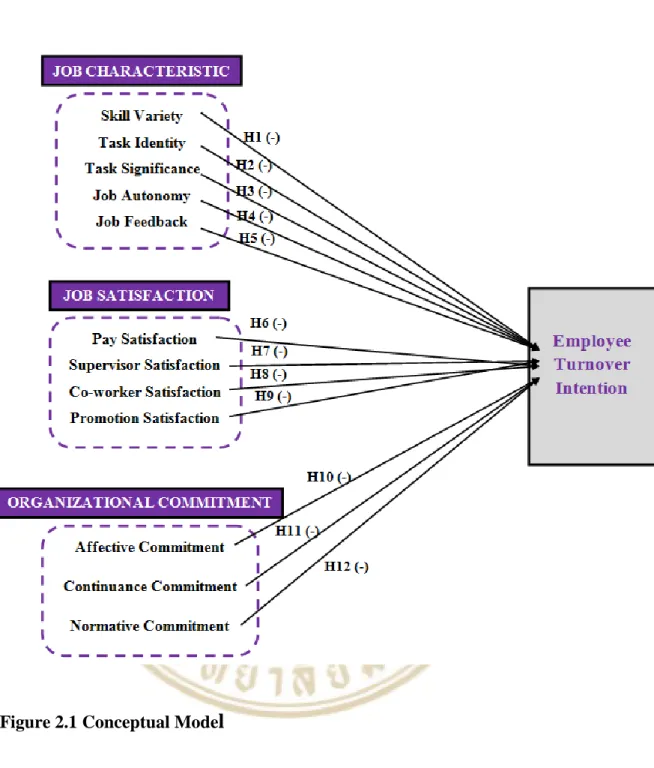
The relationship between five components of job characteristics was analyzed, as well as the influence on employee turnover intention. Sager and Johnston (1989) suggested that skill variation has a negative significant effect on turnover intentions. However, some researchers found that task meaning was negatively related to turnover intentions (Shawnta & Earnest, 2003).
Hence, job feedback is positively related to commitment and is negatively related to turnover intention, the higher level of job feedback from supervisor can enhance the higher level of organizational commitment and lower level of employee turnover intention. Similar to Susskind et al (2000) and Blau (1987), researchers have proven that job satisfaction has a significantly negative association with turnover intention on a consistent basis. McCalister (2003) suggested that coworker support and supervisor support significantly influence job stress, job satisfaction, and turnover intention in a negative direction.
Therefore, a close coworker relationship can improve job satisfaction and reduce employees' turnover intention to a certain extent. A study by Janet and Christopher (2008) showed that organizational commitment has a negative linear relationship with employee turnover intention by analyzing 124 published studies, shortly after they suggested that the employee who has a higher level of organizational commitment, more tend to stay at work compared to the employee who has a lower level of organizational commitment. When employees feel that the organization gives them the fair spiritual and material reward, they will receive organizational care and support, follow the organization's goals and roles, thus reducing employees' turnover intention (Matthew et al., 2012).
Conceptual Framework Model
It is also seen as a siren call to let employees realize that their resignation is a high cost and then abandon their intention to leave. However, Pastorino et al., (2010) suggest that commitment to continue may also arise because employees do not want to lose the company's social ties or friendships. On the other hand, continuance commitment reflects the level of employee's intention to stay with the organization and the willingness not to leave (Lee & KamarulZaman, 2009).
Normative commitment refers to an employee's perceived obligation to remain with the organization (Sajjad et al., 2011). It shows that employees stay with the organization only because it is the right thing to do based on their personal norms such as moral and then realized organizational goals. Therefore, the normative commitment defined that the employee remains in the organization due to moral obligation; he/she does not want to lose coworkers as a lesson in resignation (Pennsylvania State University Report, 2011; Pastorino et al., 2010).
RESEARCH METHODOLOGY
- Research Design
- Population and Sample
- Data Collection
- Personal Information
- Job Characteristic
- Job Satisfaction
- Organizational Commitment
- Employee Turnover Intention
- Data Analysis
From the calculation, the result of the sample size is 384.16, based on the confidence level at 95%. The questions extracted from the related literature and they are in accordance with this research, after testing it turned into formal questionnaire. There are 7 questions about the personal information of respondents in this part, including 2 types of scale: the nominal scale which is gender; the ordinal scale which is age, education level, marital status, monthly income, job categories, years of work.
They identify five core job characteristics to be the dimensions, namely: skill variety, task identity, task meaning, autonomy and feedback. In this study, it is necessary to use four dimensions to measure it which included pay satisfaction, supervisor satisfaction, co-worker satisfaction, promotion satisfaction. Organizational commitment is as a psychological attachment of an employee to an organization, It makes employee more loyal to organization, take the organization's goal as their goal to struggle, they are more willing to put up their own emotion for the organization sacrifice and have a stronger desire to make an effort for the organization.
In this work, these three dimensions will be measured with 11 questions adapted from Albrecht & Andreetta (2011), Gunlu et al. (2010). The questions in this section euphemistically inquire about the respondent's intent, each answer having an impact or relationship. One variable is considered the dependent variable and the others are considered the independent variables.
RESEARCH FINDINGS
Demographic Characteristic
In contrast, male respondents are only 166 with 47.4% of the total number of respondents, which is slightly lower than the percentage of females. In age groups, most of the respondents are in the range of 26 to 30 years old being 36%, while the rage from 31 to 35 years old with little difference in the second. The range from 36 to 40 years is 14 respondents which is 4%, and there is no range of respondents older than 41 years.
In addition, 97.4% of respondents with a bachelor's degree participated, followed by 1.7% above a bachelor's degree, 0.9% of the professional diploma level. In terms of marital status, there are 339 respondents in the survey who are single, namely 96.9%, the second is married respondents, including 11 people with a rate of 3.1%. The next category is the monthly income of the respondents. Most respondents with monthly income in Thai baht participated with 54.9%, a total of 192 respondents.
There are 214 general staffs, which make up the majority of the total number of Table 4.1 Characteristics of respondents (continued).
Data Analysis and Findings
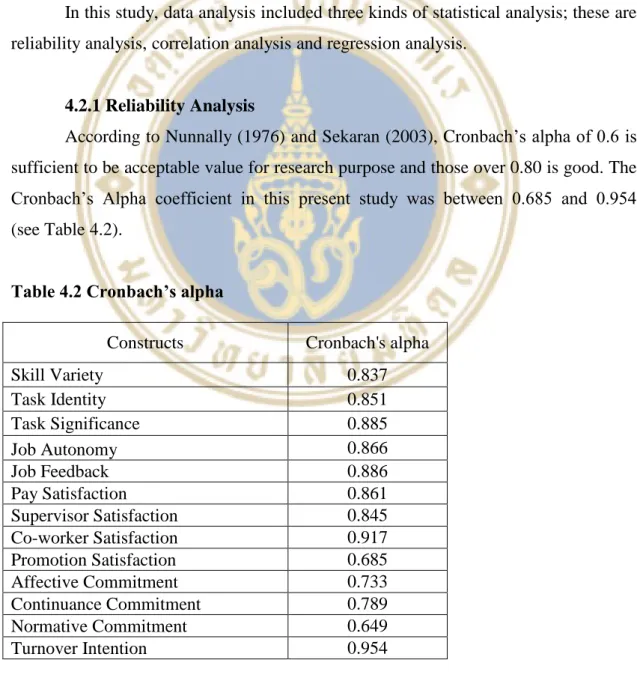
- Reliability Analysis
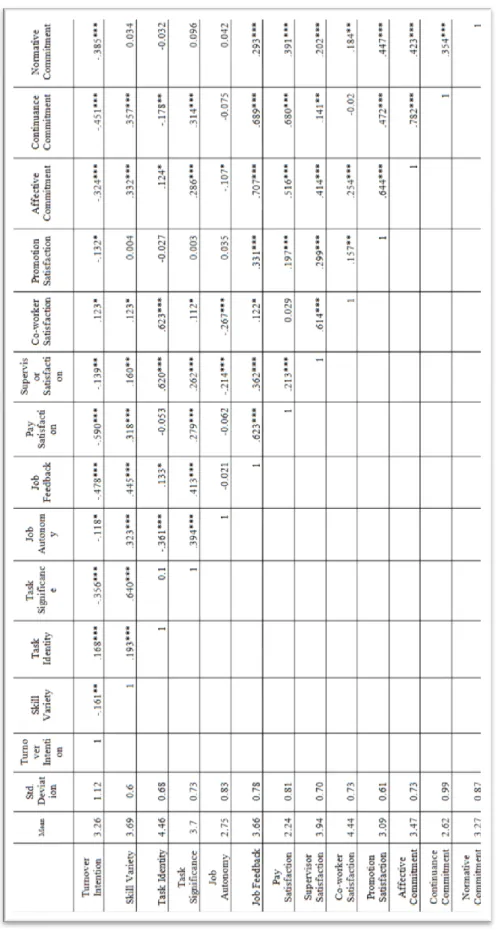
- Correlation Analysis
- Multiple Linear Regression Analysis
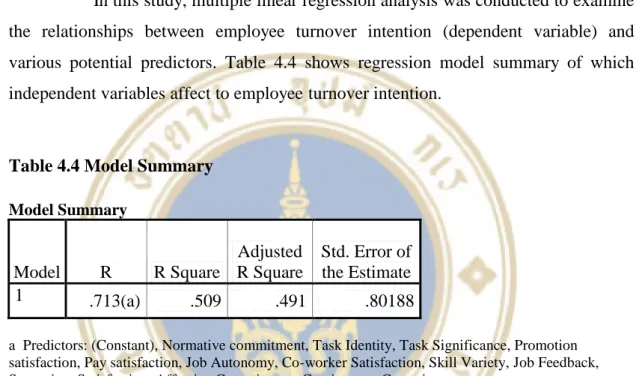
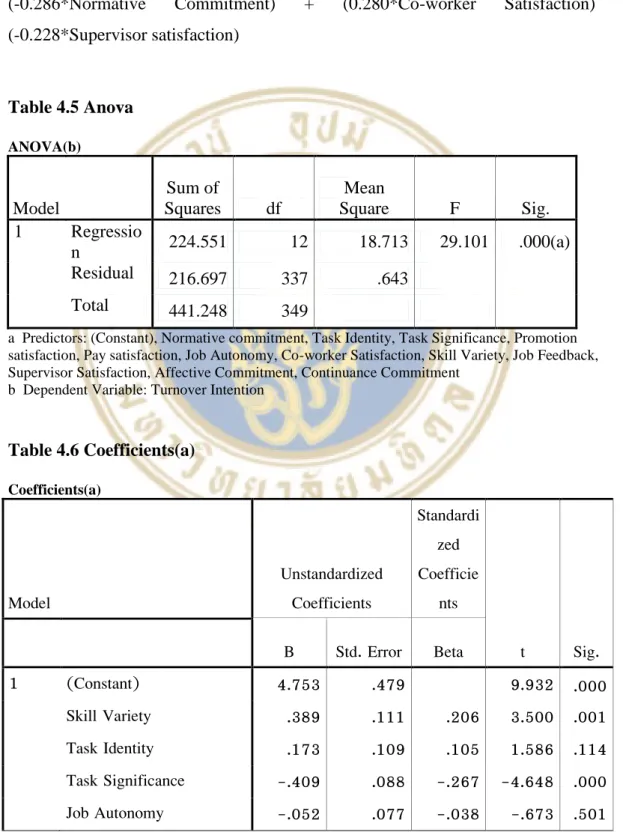
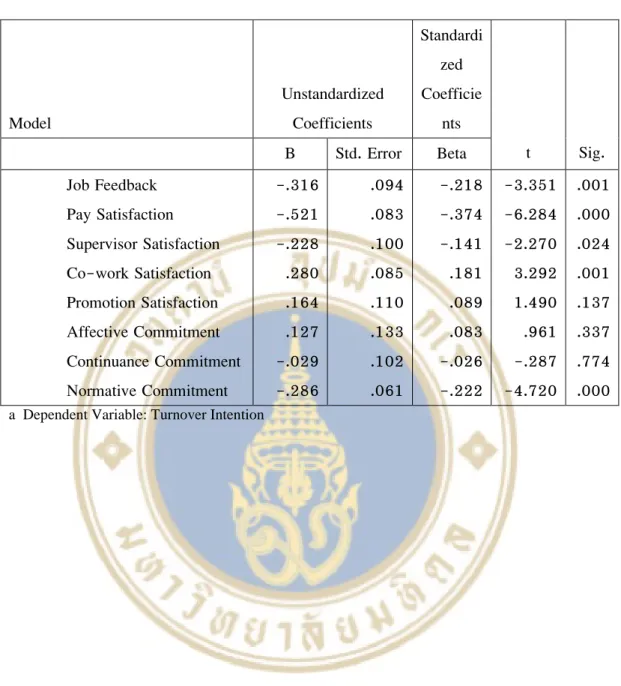
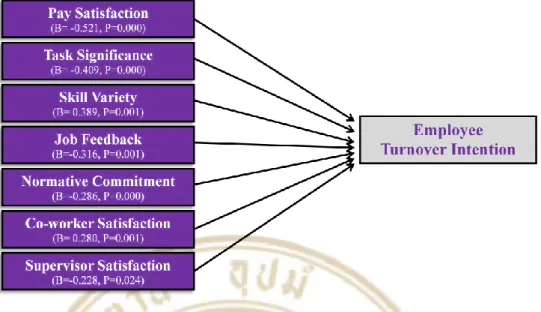
In this study, multiple linear regression analysis was conducted to examine the relationships between employee turnover intention (dependent variable) and various potential predictors. From Table 4.4, it shows that R-squared value is 0.509, which means that 50.9% of variance in the employee turnover intention is influenced by independent variables such as Normative commitment, Task identity, Task meaning, Promotion satisfaction, Pay satisfaction, Job autonomy, Employee satisfaction, Skill variety, Job feedback. , Supervisor Satisfaction, Affective Commitment and Continuance Commitment. Furthermore, from Table 4.5, it also shows P = 0.000 and F = 29.101, which means that at least one of the independent variables has a significant predictive relationship with the dependent variable (employee turnover intention).
In addition, Table 4.6 illustrates the predictive independent variables that significantly influence employee turnover intention. Job feedback Satisfaction with pay Supervisor satisfaction Co-worker satisfaction Promotion satisfaction Emotional satisfaction Commitment Continuance commitment Normative commitment.
DISCUSSION, PRATICAL IMPLICATIONS AND LIMITATIONS OF THE STUDY
Discussion
This factor shows that employees who are aware of the importance of the task will feel that they are part of this company and want to work and stay in the company as long as possible. Thus, managers should make staff aware of its importance and illustrate the significant effects of this task, which can reduce the rate of turnover intention. From the literature review, the result of this study is significant with the result of previous studies of Sajjad et al. 2010) showed that employees perceived that they should stay with an organization because it is the right thing to do based on their personal norms and moral obligation.
Moreover, coworkers' satisfaction is also another factor that influences the turnover intention of temporary workers working in this airline. The result of this study differs from the previous study, which showed that if employees have good relationships with their colleagues, turnover intention will decrease. Contrary to the outcome of this study, employees who have a good relationship with colleagues generally have the intention to leave the company.
Moreover, another factor that may influence the turnover intention of temporary workers working at this airline is 'Supervisor Satisfaction'. Ng and Sorensen (2008) indicated that high levels of managerial support lead to high emotional interaction between employees. Research showed that employees find support from managers strongly related to job satisfaction, affective commitment and turnover intentions. For the remaining factors, including Task Identity, Job Autonomy, Promotion Satisfaction, Affective Commitment and Continuity Commitment, it is clear that these five factors do not have a significant influence on the turnover intention of temporary workers working at this airline.
Practical Implications
Gagnon and Michael (2004) described supervisor support as the degree to which an employee feels supported by their supervisor. For example, some employees feel that they are not suited to this field of work because it is too difficult or does not directly match the degree they graduated from. Job rotation will be another opportunity to make employees discover their true skills and can reduce the turnover of temporary employees as well.
The company must ensure that the employees feel warm and instill in them a sense of commitment to the organization, even if they are dissatisfied in their role or even if they want to look for better opportunities. Employees believe that they should stay in the organization because it is the right thing to do. Employees may feel that they should stay with the organization because it has invested money or time in employee training.
Alternatively, the organization may have provided an upfront reward, such as paying for the employee's college tuition. For example, the employee's family may have emphasized that they must remain loyal to the organization, this may be the reason why they feel obligated to stay with this company. Based on the results of turnover intentions of temporary employees working in this airline, there are some recommendations that the researcher would like to make.
Limitations and Suggestions for Future Research
Comparing motivational job characteristics, job satisfaction and turnover intention of knowledge workers and blue-collar workers, and testing a structural model of the variables' relationships in China and Japan. Career satisfaction, organizational commitment, and turnover intention: The effects of goal orientation, organizational learning culture, and developmental feedback. Turnover of information technology professionals: A narrative review, meta-analytic structural equation modeling, and model development.
The work design questionnaire (WDQ): Developing and validating a comprehensive measure for assessing work design and the nature of work. Impact of time demands of work on job satisfaction and turnover intention: Software developers in offshore outsourced software development firms in Sri Lanka.
APPENDICES
APPENDICES 1
แบบสอบถาม
อายุ
5.รายได้ของท่านต่อเดือน
ส่วนที่ 2 ลักษณะงาน (ความเข้าใจกับงาน)
ส่วนที่ 3 ความพึงพอใจ