KEY FACTORS AFFECTING HYBRID VEHICLE PURCHASE CONSIDERATIONS IN THAILAND (BANGKOK AND BORDER AREA). The purpose of this thematic paper study was to understand the relationship between the five factors and purchase intention for hybrid cars (Bangkok and border area). Through this study, the result showed that only three factors, which are environmental concern, self-image and price perception, have a positive relationship with the purchase intention of hybrid car (Bangkok and border area).
A hybrid vehicle is the type of vehicle that uses more than one means of propulsion, such as a combination between a regular petrol or diesel engine and an electric motor. However, hybrid vehicles only became widely available in the late 1990s, after the first mass-produced hybrid vehicle Toyota Prius, which was introduced in Japan in 1997, and followed by the Honda Insight, which was introduced in 1999 in the United States and Japan. Even there are many models of hybrid vehicles from Japanese and European car manufacturers that are introduced in the Thailand market.
However, the ratio of sales volume of hybrid vehicles to conventional vehicles is still considered low. To determine the factors that influence the purchase intention of hybrid vehicles in Thailand (Bangkok and border area). To identify which factors have a greater influence on their decisions to purchase hybrid vehicles (Bangkok and Border Region).
LITERATURE REVIEW
- Self-image and purchasing intention for hybrid vehicle
- Social norm and purchasing intention for hybrid vehicle
- Price perception and purchasing intention for hybrid vehicle Price is one of the main factor that impact to consumer decision when they
- Government incentive and purchasing intention for hybrid vehicle Government incentive is possible to be one of the factor that impact on
- Hypotheses to be tested
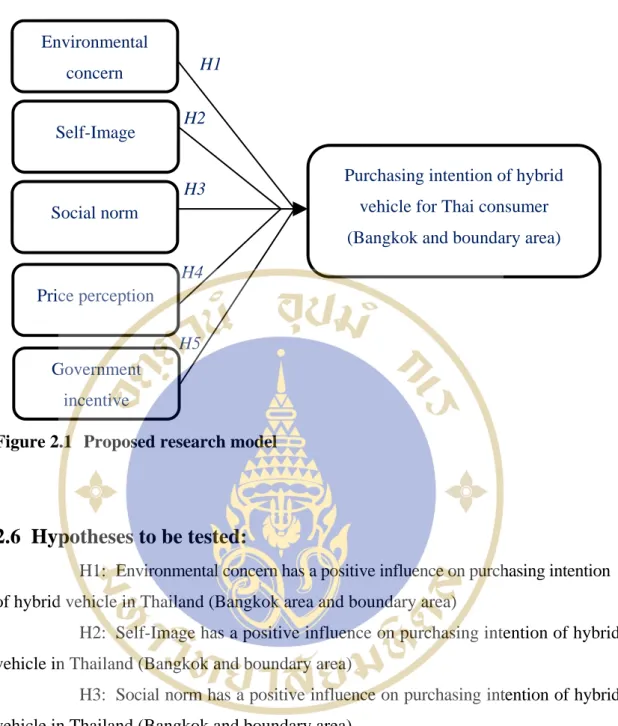
Their study also found that there was a positive relationship between self-image and purchase intention in Korea and the US. This study will investigate the relationship between self-image and hybrid vehicle purchase intention for Thai consumers, whether it is similar to that of consumers in Korea and the US or not. H2: Self-image has a positive influence on the purchase intention of hybrid vehicles in Thailand (Bangkok and border area).
Moreover, peer group and family are the people with the most influence to purchase hybrid vehicles in Sri Lanka as founded by Karunanayake and Wanninayake. Therefore, this study will explore the relationship between social norm and hybrid vehicle purchase intention for Thai consumers (Bangkok and border area). H3: Social norm has a positive influence on the purchase intention of hybrid vehicles in Thailand (Bangkok and border area).
Based on study by Karunanayake and Wanninayake on the impact of key purchase determinants on purchase Intention of hybrid vehicle brands in Sri Lanka, it showed that price perception has a strong impact on adoption of hybrid vehicles in Sri Lanka. This situation is also similar to the market in Thailand, usually the second-hand price of hybrid vehicle tends to be lower than conventional vehicles that produce in the same year, even the first-hand price is higher. Therefore, this research will investigate whether the relationship between this factor and the purchase intention of the Thai consumer exists or not.
H4: Price perception has a positive influence on the purchase intention of hybrid vehicle in Thailand (Bangkok and bound area). According to Karunanayake and Wanninayake, government incentives are one of the factors influencing the adoption of hybrid vehicles in Sri Lanka and the government should continue to provide incentives for hybrid vehicle buyers. Therefore, this factor should be considered whether it has a relationship with the purchase intention of hybrid vehicle or not.
H5: Government incentive has a positive influence on the purchase intention of hybrid vehicle in Thailand (Bangkok and border area). H1: Environmental concern has a positive influence on hybrid vehicle purchase intention in Thailand (Bangkok area and border area). H2: Self-esteem has a positive influence on the purchase intention of hybrid vehicle in Thailand (Bangkok and border area).
RESEARCH METHODOLOGY
Instrument development
Data collection method
Data analysis
DATA COLLECTION AND ANALYSIS
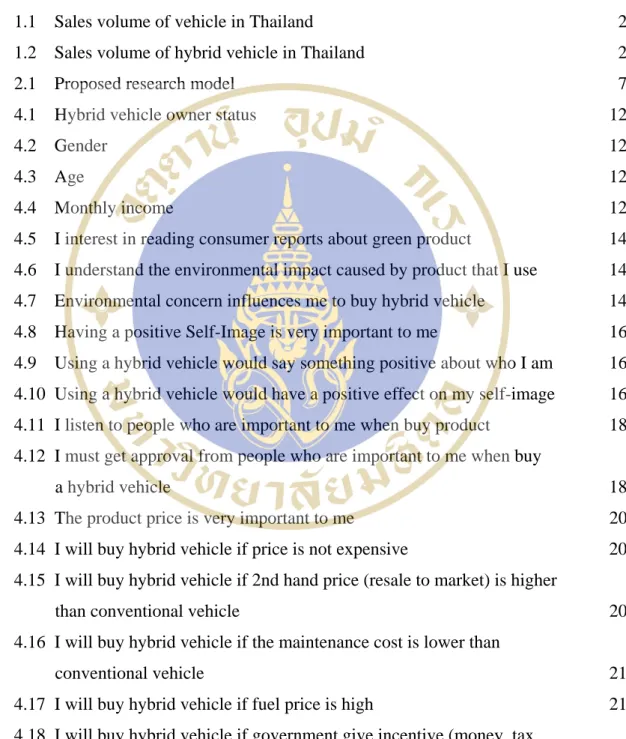
Another sentence reads: 'Using a hybrid vehicle would have a positive effect on my self-image' (Figure 4.10). Then the second sentence reads: 'I need to get approval from people who are important to me if I buy a hybrid vehicle' (Figure 4.12). The third sentence reads: “I will buy a hybrid vehicle if its second-hand resale price on the market is higher than that of a conventional vehicle” (Figure 4.15).
Fourth sentence is “I will buy hybrid car if the maintenance cost is lower than conventional vehicles” (Figure 4.16). The last sentence under this factor is 'I will buy hybrid car if the fuel price is high' (Figure 4.17). First sentence is "I will buy hybrid car if the government gives incentive (money, tax cut) to support me" (Figure 4.18).
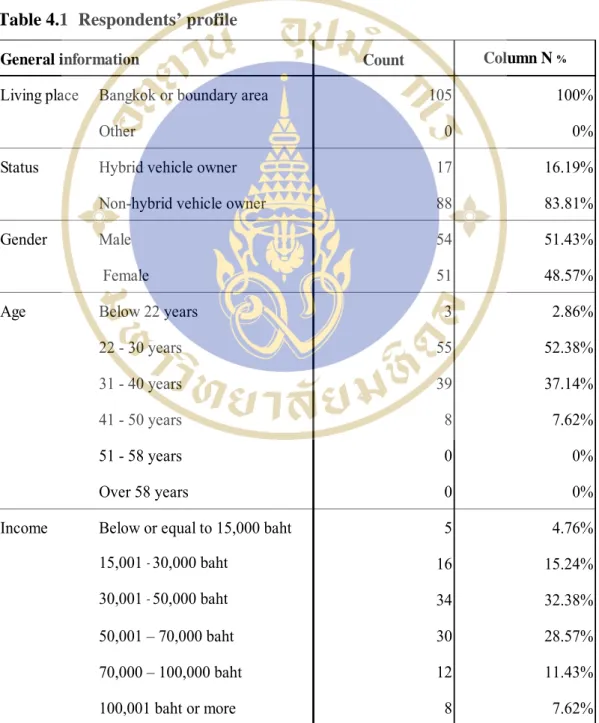
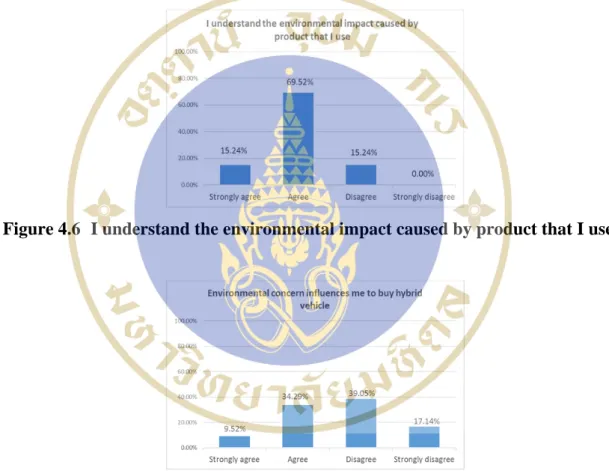
The second sentence reads: 'I will not buy a hybrid car if the government provides an incentive to support the oil price' (Figure 4.19). Half of them agree/strongly agree (51%, 54 people), while the other half disagree/strongly disagree (49%, 51 people). 1) I would like to buy a hybrid vehicle for my next car. Therefore, respondents were asked with the sentence 'I would like to buy a hybrid car for my next car'.
For the result in the model summary table, the researcher found that the adjusted R-square is 0.459, which means that these variables can explain the relationship between hybrid vehicle purchase intention (45.9%). For the result in the summary table of the model, the researcher found that the adjusted R-square is 0.449, which means that these 3 variables can explain the relationship between hybrid vehicle purchase intention (44.9%). For the value of 'standard coefficients (beta)', it was found that environmental concern has the strongest correlation with purchase intention for hybrid vehicles (0.389).
SUMMARY AND CONCLUSION
Research Questions and Findings
In addition, the study result also showed that environmental concern has the strongest relationship in hybrid vehicle purchase intention (Bangkok and border areas).
Recommendation
Limitation and future research