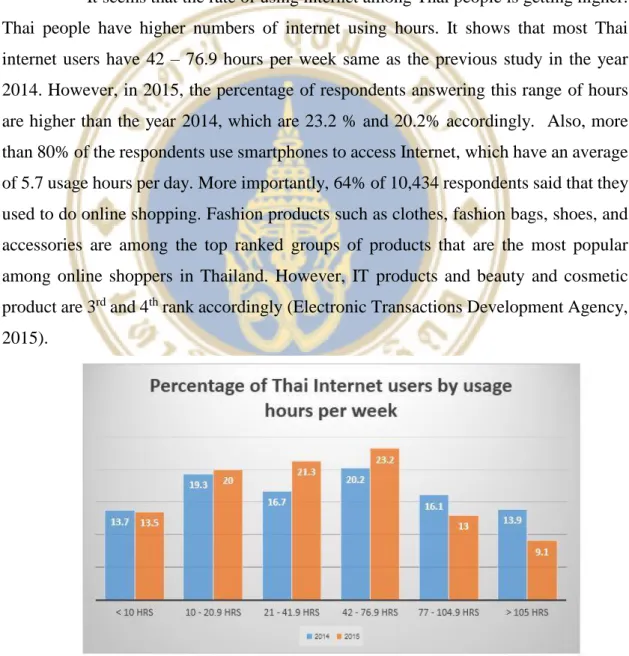
The purpose of this research is to find factors that influence Thai consumers to shop on online retail websites in Thailand. Moreover, the above information about the percentage of online shoppers in Thailand shows that there are still a large number of online shoppers in Thailand. Thailand's Internet retail market is expected to have a potential growth of US$12 to US$15 billion from US$1 billion at its current size (Sullivan, 2015).
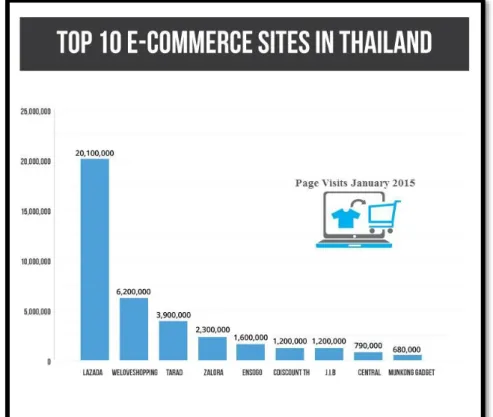
Furthermore, the e-commerce situation in Thailand is expected to grow as high as US$6 billion during the year 2020 to 2025 ("9 Fundamentals for Ecommerce in Thailand", 2014). Therefore, the Thai e-commerce market is expected to have a bright future, and more internet availability and LTE coverage can also support the growth of e-commerce in Thailand. However, major online retailers such as Lazada, Zalora, Ensogo, JIB and Central Online still play an important role in Thailand's e-retail market according to Figure 1.2 ("The 10 E-Commerce Sites", 2015).
Problem Statement
The potential growth of an online retail business in Thai is expected to be higher and higher. The major major retail companies in Thailand such as Tesco Lotus, 7 – 11 and Central already have their online shopping channels to reach their customers. Moreover, some online retail websites such as Lazada, Zalora and Central Online generate millions of visits per month, referring to Figure 1.2.
Therefore, this study would like to find out what are the influencing factors that affect Thai consumers' intention to buy online, and a result of this will provide some knowledge and key success factors to improve Thai online retail websites.
Research Objectives
Scope of Study
Definition of Terms
LITERATURE REVIEW
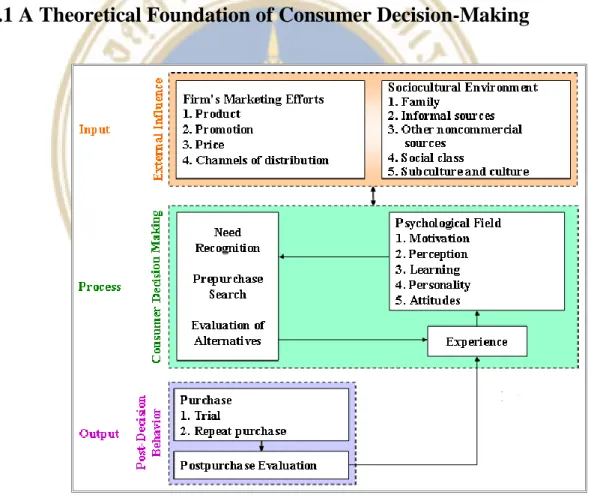
- A Theoretical Foundation of Consumer Decision-Making
- Online Consumer Behavioral & Influencing Factors
- Thai Consumer Behaviors towards Ecommerce
- Conceptual Framework
In addition, the majority of online shoppers are women and prefer to shop to pass the time and relax (Lai et al., 2014). Also, online shoppers do not have to deal with inconsistent service provided by store employees (Eastman et al., 2009). Therefore, based on these findings about online shoppers' ability to compare products before purchasing, the following hypothesis is proposed.
According to Shobeiri et al., (2015), online shoppers prefer an e-retailer website to be easy to use and well organized. Online shoppers still have some concerns about some after-sales services, such as returning items and accessing online transactions (Lai et al., 2014). However, Thai online shoppers still had some concerns and issues about their online shopping experiences.
RESEARCH METHODOLOGY
- Research Design
- Population and Sampling
- Data Collection
- Data Analysis
For the size of the population, it was still unable to identify the exact number of people who have used the service from Thai online retail websites. Therefore, a calculation formula for the infinite population was used to calculate a sample size for this research as follows (Sinjaru, 2013). An online survey service from Typeform.com was used to conduct an online questionnaire survey and it was convenient to collect data and export all data to SPSS.
For the screening part, some questions were asked whether the respondents have purchased anything online in the past six months, and some questions also asked whether they have purchased anything from the major online retailer websites in Thailand. If a respondent clicked 'No' on the two screening questions, the online survey system would automatically take them to the demographic question section. For the specific part, the questions in this part were based on each construct of consumer behavior and factors influencing online shopping in relation to online shopping such as quality of products convenience, shopping attitudes, product comparison, website design and interactive features, value for money, sales promotion, ease of use, safety and after-sales service.
Another kind of seven Likert scales is also used to measure consumers' intentional likelihood of shopping online, which is also adopted from Vijayasarathy (2003), and those seven likely scales are 1: very unlikely, 2: unlikely, 3: somewhat unlikely, 4: neutral, 5: somewhat likely, 6: likely, and 7: very likely. That's why we have. Firstly, the researcher used the frequency table to analyze backgrounds and profiles of the respondents such as percentages of gender, income, frequency of online purchase of products, etc. Moreover, the researcher used the factor analysis technique to come up with the most reliable sets of constructs that can are used to test the relationships with the dependent variable.
This method allows the researcher to eliminate elements that are not important enough until pure groups of constructs are obtained. After obtaining pure sets of constructs from factor analysis, the researcher then used Cronbach's Alpha technique to test the reliability of the question items of each construct. In addition, correlation analysis was then used to see the interrelationships of all constructs.
Finally, Multiple Regression analysis was used to test the hypotheses to see relationships between independent variables and the dependent variable.
RESEARCH FINDINGS
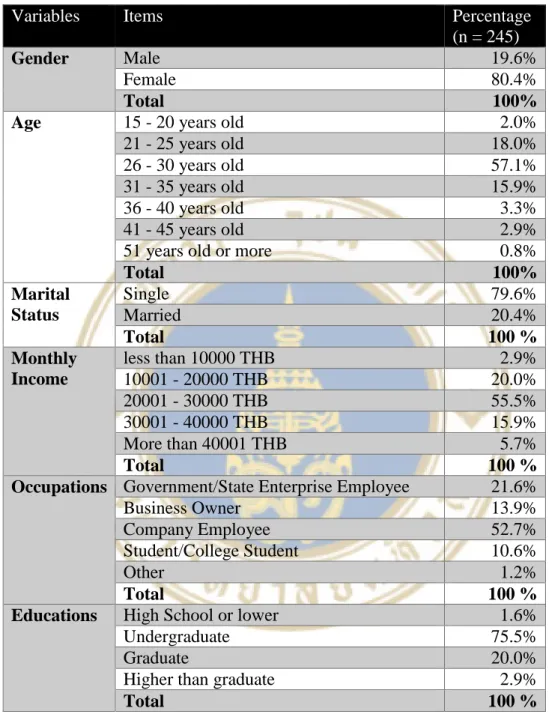
Demographic Backgrounds
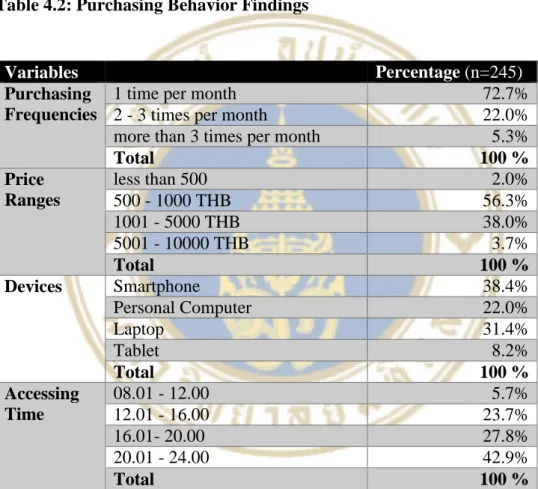
Purchasing Behaviors
Factor Analysis
- Total Variance Explained
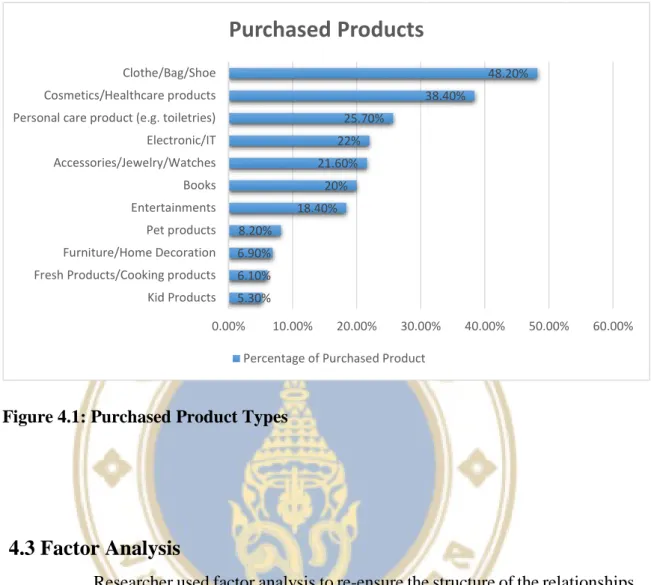
Purchased Products
- Scree Plot
- Rotated Component Matrix
- Data Validation
- Correlational Analysis
- Multiple Regression Analysis
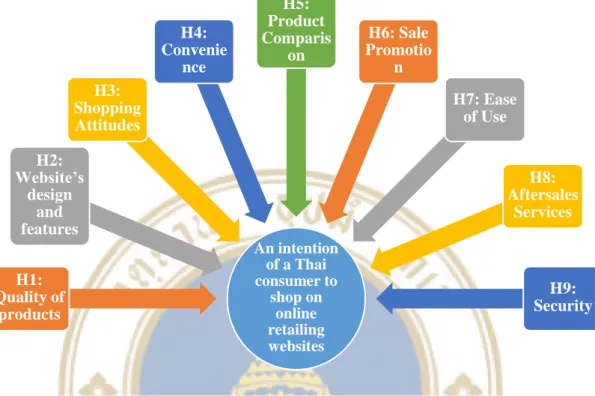
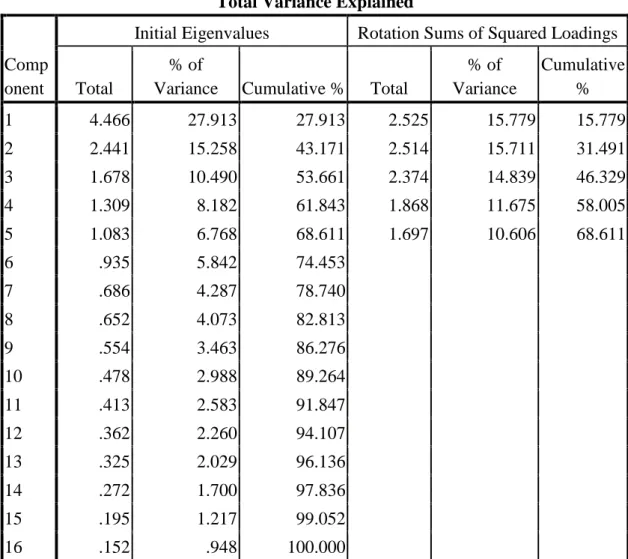
Therefore, Table 4.4 provides the results of 16 important questions that can be grouped together into five factors, which are intention to buy online (dependent variable), Safety and after-sales service, product quality and design and features. web, product comparison, and shopping attitudes. The factor with the highest Alpha value is Safety and After Sales Services, which has an Alpha value of 0.852, and the factor with the lowest Alpha value is Product Comparison, which has an Alpha value of 0.644. Therefore, all the five factors, which are Intention to buy online (dependent variable), Safety and After-sales Service, Product Quality and Web Design and Features, Product Comparison and Buying Attitudes, can be used for analysis. further. H1: There is a positive relationship between product quality and web design and features and a consumer's intention to purchase on online retail websites.
H2: There is a positive relationship between consumer attitude toward online shopping and consumer intention to shop on online retail sites. H3: There is a positive relationship between consumer's perception of convenience and consumer's intention to shop online. H4: There is a positive relationship between consumer product comparison behavior and consumer intention to shop online.
H5: There is a positive relationship between sales promotion and a consumer's intention to shop online. H6: There is a positive relationship between ease of use and a consumer's intention to shop online. H7: There is a positive relationship between a consumer's perception of safety and after-sales service and a consumer's intention to shop online.
For the intention to shop online, the result implies that most of the respondents 'agreed' with their intentions to shop online in the near future (m = 5.75, SD = 0.953). From table 4.7, it shows that the R Square value is 0.316 or 31.6%, which means that 31.6% of the variance in the intention to buy online is influenced by the independent variables such as product quality and design and Internet features, security and after service sale and purchase status. Therefore, the researcher continued the test to see what are those independent variables that can predict consumers' intention to buy online.
Moreover, Table 4.9 shows the predictive independent variables that are significant to influence online shopping intention among Thai consumers. H3 There is a positive relationship between a consumer's perception of convenience and a consumer's intention to shop online. H5 There is a positive relationship between sales promotion and a consumer's intention to shop online.
DISCUSSION AND LIMITATION OF THE STUDY
- Discussion
- Practical Implications
- Limitation and Recommendation for Future Research
- Conclusion
Also, good design and interactive features of online retail websites could gain good attitude and impression of online consumers (Shobeiri et al., 2015). In addition, security and after-sales service is another factor that could influence the intentions of Thai consumers to shop on retail websites. Therefore, it is clear from the results of the analysis that reliable after-sales services and security systems could influence the shopping intentions of Thai consumers on online sales websites.
Moreover, another factor that can influence an intention to buy on the online retail websites in Thailand is consumers' attitude towards online shopping. Moreover, the most popular time period that the respondents access online retailers is from hour, which accounts for 42.9%. Based on the research findings, online retailers should first apply some interactive features with their websites.
This is an example of the interactive features that an online retail website should implement that will influence customers' purchasing decisions. An online retail website should have nicely designed web pages that could create an impression on the consumers while browsing. Moreover, online retail websites should provide products that have good quality and good performance that add to the value of money for the customers.
Additionally, online retailers need to make it more fun for customers to shop, such as personalized product recommendations and occasional sales promotions. Therefore, online retailers should launch some sales promotions in order to motivate consumers to buy at higher price volumes. Additionally, the most popular types of products purchased on online retail websites were clothes, bags, and shoes.
More importantly, there are three factors that could influence Thai consumers' shopping intentions on retail websites, namely product quality and website design and features, security and after-sales service, and shopping attitude.
APPENDICE
- Screening
- General Questions
- Specific Questions
- Consumer Intention toward shopping via online retail websites Questions Strong
- Demographic Questions 37. What is your age range?
This questionnaire was conducted by College of Management, Mahidol University student to study the influencing factors and behaviors of Thai consumers towards online retail websites. Today, there are a number of large retail websites in the online market such as Lazada, Zalora, Ensogo, Central Online, Shopat7 and Tesco Lotus Online, Tops Online, Power Buy etc. What are the product categories they buy through online retail websites? you can choose more than one answer).
I often compare online product prices with actual store products. information/comments from previous buyers about products before I buy them.