THAPAKORN SRICHURAT
A THEMATIC PAPER SUBMITTED IN PARTIAL FULFILLMENT OF THE REQUIREMENTS FOR THE DEGREE OF MASTER OF MANAGEMENT
COLLEGE OF MANAGEMENT MAHIDOL UNIVERSITY
2023
COPYRIGHT OF MAHIDOL UNIVERSITY
ACKNOWLEDGEMENTS
I would like to express my deepest gratitude to the following person for their contributions to this thematic paper. First and foremost, I would like to thank my advisor, Assoc. Prof. Dr. Astrid Kainzbauer, for her valuable guidance and support throughout the entire process. Her insights and feedback were invaluable in shaping the direction and focus of this paper.
I would also like to thank the interviewees of the study who generously shared their time and experiences with me. Without their willingness to participate, this thematic paper would not have been possible. Furthermore, I would like to thank my colleagues and friends at the College of Management, Mahidol University who provided valuable feedback and support during the writing process. Their encouragement and suggestions were crucial in refining the ideas presented in this paper. And that will be indispensable to all professors who have dedicated their knowledge and skills to educating me for all five semesters in this institute. This paper would not be completed without the knowledge that they all taught me at this colleague.
Lastly, I would like to extend my thankfulness to my family and personal advisor for their unwavering support and encouragement throughout my academic journey. Their love and support have been a constant source of inspiration and motivation. Thank you to everyone who helped me finish this thematic paper. Your contributions are greatly appreciated.
Thapakorn Srichurat
HANDLING CULTURE SHOCK OF FOREIGN STUDENTS WHEN STUDYING ABROAD
THAPAKORN SRICHURAT 6449130
M.M. (MARKETING AND MANAGEMENT)
THEMATIC PAPER ADVISORY COMMITTEE: ASSOC. PROF. ASTRID KAINZBAUER, Ph.D., ASSOC. PROF. PRATTANA PUNNAKITIKASHEM, Ph.D., ASST. PROF. MANJIRI KINTE, Ph.D.
ABSTRACT
The paper will examine how foreign students deal with culture shock when studying abroad and how they handle unexpected situations or unfamiliar environments. A qualitative technique was used in order to achieve this purpose, and in-depth interviews with 10 foreign students—both Thai and foreign—who had personal experiences with studying abroad and culture shock—were conducted. The result demonstrates that the majority of them are able to cope with, accept, and stay together in a new culture. Although some of them felt uncomfortable, they could nevertheless adjust to a new environment and adopt a different culture. They are all therefore Ehnorelative for the DMIS model. The main factors that affect them are the language barrier, occasionally the food, and local people's habits. The difference between someone who prepared themselves and someone who was unprepared seemed to be slightly different. The person who prepared themselves would know what to do more than the person who did not prepare, yet even the prepared person experienced cultural shock. Any student or anyone who wants to study abroad and wants to know how to properly prepare themselves before traveling might benefit from the findings.
KEY WORDS: foreign student/ culture shock/ acculturation/ adaptation
27 pages
CONTENTS
Page
ACKNOWLEDGEMENTS ii
ABSTRACT iii
LIST OF TABLES v
LIST OF FIGURES vi
CHAPTER I INTRODUCTION 1
CHAPTER II LITERATURE REVIEW 3
2.1 Foreign Students 3
2.2 Culture Shock 4
2.3 Acculturation 5
2.4 Adaptation 6
CHAPTER III METHODOLOGY 8
3.1 Primary Data Collection Method 8
3.2 Interview Method 8
CHAPTER IV DATA ANALYSIS 12
4.1 Preparation 12
4.2 Honeymoon (First Stage) 13
4.3 Crisis (Second Stage) 14
4.4 Recovery (Third Stage) 15
4.5 Adjustment (Final Stage) 16
4.6 DMIS Model 18
CHAPTER V RECOMMENDATION AND CONCLUSION 21
5.1 Conclusion 21
5.2 Recommendation 22
5.3 Limitation 23
5.4 Suggestion 23
REFERENCES 24
CONTENTS (cont.)
Page
BIOGRAPHY 27
Table Page
2.1 DMIS Model 7
3.1 Interviewee list 8
3.2 Interview Question 9
4.1 DMIS model results 19
LIST OF FIGURES
Figure Page
3.1 Lysgaard’s U-shaped curve 11
CHAPTER I INTRODUCTION
Currently, many countries are becoming more open to inviting outsiders to visit and participate in activities. Foreign visitors may come for a variety of reasons, including tourism, education, exploration, commerce, and even permanent settlement.
These people are more likely to encounter a new culture in which they are unfamiliar, resulting in culture shock, which is the major focus of this research.
Pedersen (1995) defined the word “culture shock” as “Culture shock happens inside each individual who encounters unfamiliar events and unexpected circumstances, the individual needs to construct new perspectives on self, others, and the environment that "fit" with the new situation. Because culture shock is such a subjective response to unfamiliar situations, it was necessary to provide many different examples for each stage of culture shock across each country setting” (page preface).
In this study, researcher will focus on the educational sector, researcher will concentrate on foreign students who come to study abroad. Many students are forced to leave their families and social networks, including friends in their home country when they go abroad for school, which exposes them to unfamiliar issues that can be both physical and psychological in the environment because the environment is so different from their home country. They are essentially on their own to deal with unexpected situations, unusual communication, and racial discrimination difficulties.
Another interesting issue is the language barrier, since some countries have their own official language, such as China, Japan, or France and foreign students may find it difficult to live there if they do not speak their language.
Most foreign students face culture shock while studying in different countries. Some may attempt to avoid engaging with locals because they are nervous and want to prevent culture shock, while others may try to discover new things such as food, culture, or even local language to integrate in a new environment. The more they travel, the less the shock, yet many report seeing behaviors and concepts that are alien to them.
The purpose of this paper is to study the behavior or reaction of foreign students who study abroad and are likely to experience culture shock or a new setting.
How they deal with such situations and adjust to fit into a new setting without triggering conflicts with locals or other foreigners or how they learn to integrate themselves in a new culture. This paper will investigate the primary element of culture shock by interviewing ten foreign students who have studied abroad and had direct experiences and how they coped with it. This paper will gather information from many aspects to compare and analyze in order to get the efficient result. Furthermore, the answers of below research question will be sought:
“What is the culture shock situation that students have faced? How do students handle those kinds of situations? How do students prepare themselves for encountering culture shock or when moving to a new unfamiliar place? And how can these preparations help students from facing culture shock?
Researcher chose this topic because it is staying close to us as well as researcher have been planning to study abroad. Therefore, this might be greatly useful for everyone who is interested. The findings will demonstrate the majority of ways used by foreign students to improve their lives while studying abroad and researcher will identify dominant factors that have an impact on the lives of foreign students in order to help other people who would like to study abroad. A better understanding of the situation may help you prepare before entering a new place, circumstance, or even culture.
CHAPTER II
LITERATURE REVIEW
This chapter will provide a more detailed description of each variable in this study, allowing you to better comprehend the concept.
2.1 Foreign Students
Foreign students are people who go to study abroad or who are not citizens of that country and they encounter a variety of foreign situations. A definition of foreign student, as Shapiro, Farrelly and Tomas (2014) defined, is “a student who moves to another country (the host country) for the purpose of pursuing tertiary or higher education e.g., college or university” (p.2). Bista & Foster (2016) stated that foreign students have different meanings in each country; they are a temporary status for students who are mobile. When they finish their studies and return home for work or begin working abroad under a different visa status, their status (foreign student) will be stripped away.
Another problem is that foreign student status may be affected. According to Poyrazli and Grahame 2007, There are many difficult stresses that foreign student might frequently face such as language barriers, difficulties in adaptation, some of the most critical challenges may include lower levels of English language competence if they do not use English as official language which may affect their academic performance and social interaction, lack of knowledge with the local culture, social norms. Foreign students have a lot of issues to handle or cope with, including homesickness or difficulty to get an internship or job as holding foreign students temporary or non-immigrant student visa status.
2.2 Culture Shock
Culture shock refers to the first process of adaptation when living in an unfamiliar location or situation. Culture shock has been introduced as a psychological construct to describe the emotional, psychological, behavioral, cognitive, and physiological influence on individuals (Pedersen, 1995). Oberg 1960, acknowledged, contacting a new culture and feeling loss, confusion can bring stress and anxiety to people. The same experience has been changed or given a different meaning, which has impacted people by causing discomfort or confusion. According to his research, culture shock can occur in any new scenario, profession, relationship, or perspective that needs a role change and a new identity.
Because culture shock is a subjective reaction with unfamiliar settings, several diverse examples for each stage of culture shock across each country setting were required. For example, (1) it is a process rather than once event, (2) can occur at many different levels concurrently as the individual interacts with a complex environment, (3) become stronger or weaker depending on how they learn to overcome or fail to overcome (Pedersen, 1995). Many studies attempted to define the meaning of culture shock. Nevertheless, it was difficult because no one had the same experience with culture shock. Some had small experiences because they were able to adapt quickly, while others had terrible experiences because they did not know how to deal with those conditions.
For a foreign student, those culture shock definitions mentioned above can occur with them. They need to adapt themselves into a new setting. They face several challenges when studying abroad and adapting into a new culture. Many of them will experience culture shock as they are adapting into a new society. They may experience culture shock at both academic and non-academic levels or contexts, which can be irritating and difficult (Saylag, 2013).
2.2.1 Phase or Stage of Culture Shock
Based on the work of Oberg and others, Peter Adler (1975) defined the process and sequence of stages in the culture shock experience. This concept explains culture shock as a five-stage educational and developmental process with both positive and negative results.
person newly arrived is full of curiosity and excitement as a tourist but still has their old identity from their previous setting.
The second stage involves disintegration of the old familiarity that you have had into a new culture or setting. You are overwhelmed by the new environment or culture’s requirements and also basically blame yourself for the difficult issues that happened.
The third stage involves reintegration of new clues and improving one's ability to work in the new culture. Emotions have more of a role in terms of anger in this stage as people might feel themselves as a stranger to society and have inadequate adjustment to new settings and basically get emotional from people in the new culture.
Those at this stage of cultural shock are difficult to manage.
The fourth stage still keeps the process of reintegration toward gradual autonomy and knowing more about good and bad things in both old and new culture.
This stage they are able to accept what happens in the new culture and more understand both the previous home and the new host cultures.
The fifth stage is defined as mutual interdependence, in which the individual has ideally acquired biculturality, or is fluent in both the old and new cultures. There is substantial debate over whether this stage of multiculturalism is an unreachable ideal or whether people can genuinely accomplish it.
Referring to five stages above which can be concluded by saying that people who come into a new setting might go through each stage with different experiences but anyway they all might be able to adapt themselves into new culture eventually but can not be guaranteed that they literally accomplish or not.
2.3 Acculturation
Acculturation is the process when you are asked for self-adaptation by which two cultures interact and cause cultural and psychological change via meeting people, whether in a group or individually. “At the group level, it involves changes in social structures and institutions and in cultural practices. At the individual level, it involves changes in a person's behavioral repertoire. (as cited in berry, 2005)” Rudmin
(2003) said that acculturation is about the difference of culture and language.
Acculturation is a cultural and psychological transformation process. It includes several sorts of mutual accommodation, as a result, the two groups developed long-term psychological and social cultural adaptations. “ Contact and change occur for a number of reasons, including colonization, military invasion, migration, and sojourning (such as tourism, international study, and overseas posting) (as cited in berry, 2005) ”. Berry & Sabatier (2011) defined acculturation as a process that happens when groups of people from various cultures come into contact, resulting in changes in cultural patterns. Although acculturation is a neutral term in theory (change can occur in either or both groups), in fact, acculturation tends to produce more change in one of the groups than the other.
Acculturation can still happen as long as there are culturally different groups in contact, some might take a long time to adapt themselves into living culture-contact settings which takes various forms, usually, this results in some type of long-term accommodation among the groups involved. Mutual adaptations can occur quite simply at times (through processes of culture shedding and culture learning; see Berry, 1992), but they can also result in culture conflict and acculturative stress during intercultural encounters.
2.4 Adaptation
According to various researches, adaptation is when people who have an understanding of other cultures are better able to adapt to their new surroundings.
Various factors, including knowledge, language ability, attitudes and prior experiences, as well as social support, cultural similarity, adventure, and self-control. Anyone who is new in the environment must cope with every issue that they have encountered in order to survive or blend into a new setting smoothly. Referring to a result, adaptation is a process of encountering stress, adjusting, and developing. The term "adaptation"
refers to an effort to fit into one's environment, specifically its culture. Cultural adaptation is the process of getting familiar to and eventually relaxed in a new environment (Wang, 2006).
required for cultural adaptation. Accept that cultures and their individual behavior make sense and are logical, even if the norms of logic differ from one's own culture.
Knowing the culture from the perspective of the participants reduces stress and makes acceptance simpler. Participation in the host culture's everyday life is vital for cultural adjustment and adaptation, as is the ability to acquire social behavior patterns through observation, practice, and questioning.
There are many models of cultural adjustment. The DMIS (The Developmental Model of Intercultural Sensitivity) created by Milton J. Bennet (2017) is a culture-general model; once more complicated perceptual structures for any culture are developed, they apply to all cultures. The titles of the stages relate to the problems, but the description of each stage's experience refers to its perceptual structure. The first three stages of Denial, Defense, and Minimization are Ethnocentric. The last three stages of Acceptance, Adaptation, and Integration are Ethnorelative.
Table 2.1 DMIS Model
According to table 2.1, it illustrates the definition of each term of the DMIS model which consists of Denial, Defense, Minimization that under Ethnocentric and Acceptance, Adaptation and Integration that under Ethnorelative.
CHAPTER III METHODOLOGY
3.1 Primary Data Collection Method
A qualitative method might be utilized to explore the attitudes, feelings, and motivations of students who go abroad to study. Data collection in terms of in-depth interviews will be used.
3.2 Interview Method
The data in this study will come from interviews, which will allow for the collection of detailed information via interactive question and answer sessions. The interview was conducted in the following direction:
3.2.1 Sample selection
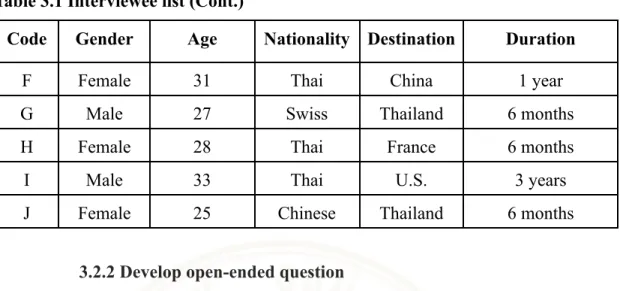
For this paper, the interviewees will consist of 10 people who have direct experience from studying abroad. Half of the interviewees will be Thai students who went abroad, and the rest will be foreigners who come to study in Thailand or another country.
Table 3.1 Interviewee list
Code Gender Age Nationality Destination Duration
A Male 28 Thai Australia 2 years
B Female 29 Turkish Korea 6 months
C Female 26 Canadian U.S. 1 year
D Male 26 Thai Switzerland 1 year 10 months
E Male 27 Italian Thailand 1 and half years
Code Gender Age Nationality Destination Duration
F Female 31 Thai China 1 year
G Male 27 Swiss Thailand 6 months
H Female 28 Thai France 6 months
I Male 33 Thai U.S. 3 years
J Female 25 Chinese Thailand 6 months
3.2.2 Develop open-ended question
To gain a wide answer from interviewees, the open-ended questions are meant to offer the interviewee the opportunity to respond based on their experience.
The table below presents a list of open-ended questions to determine the cultural shock factor for foreign students related to their direct experiences.
Table 3.2 Interview Question
Interview Question
1. How did you prepare yourself when going abroad?
2. How did you feel with a new culture or setting when you arrived? Were you surprised?
3. Did you experience the difficulties right away when you arrived or after sometimes?
4. How did you handle those difficult situations when you were feeling new at a place? (such as people or environment)
5. What strategies did you use to overcome the difficulties?
6. How did you adapt yourself with a new culture or setting?
7. What did you think that can help you to adapt with a new culture?
8. Which areas of life were difficult (private life or study life)?
Table 3.2 Interview Question (Cont.)
Interview Question
9. What did you like and dislike about the new culture?
10. What did you get from the new culture in terms of norm, social value, living and so on?
3.2.3 Develop probing technique
To ensure the validity of the data, a probing technique is adopted.
Following techniques from McDaniel & Gate (2015), the probing technique involves asking further questions after the interviewee has responded in order to delve deeper into the issue.
3.2.4 Conduct the interview
In terms of interviewing, having an interactive discussion in person is a good method to find out the information. The venue of the interview is anywhere interviewees are comfortable, as the topic is culture, so there is no specific area that can raise the topic more clearly because it depends on interviewees’ experience. The interviewees’ body language, gestures, and facial expressions have also been observed in addition to what they have said throughout the interview, and the answers from the interviewees will be varied and wider due to different experiences, so it can dig deeper and get fine information accordingly. The interviews are conducted for approximately 30 minutes, including an introduction and open-ended and probing questions. The conclusion will analyze and summarize the data from the literature review and the primary data from the interview.
3.2.5 Research framework
The research framework will describe how the in-depth interview data obtained connects to the findings of students who experienced culture shock.
According to Lysgaard’s framework (the U-shaped curve in figure 3.1), it will be mainly adopted in order to analyze data. As this research is related to culture, the conclusion will be combined with primary data, which is based on the U-shaped curve
students who experienced culture shock will be analyzed accordingly.
Figure 3.1 Lysgaard’s U-shaped curve
CHAPTER IV DATA ANALYSIS
Following the completion of the qualitative research, an analysis and classification of the data findings from the sample interviewees. There are four main issues that would be analyzed regarding the framework, which consist of Honeymoon, Crisis, Recovery and Adjustment.
4.1 Preparation
In order to know how interviewees prepare themselves before going abroad and how they defend themselves for upcoming unexpected situations when living in unfamiliar places.
4.1.2 Preparation before moving
The interviewees were asked about their preparations for going abroad. Of the 10 people interviewed, 7 said they had done some cultural preparation before going. Mr. D, who went to Switzerland, got ready for the local language because he heard that people there do not speak English well. Mr. E, who went to Thailand, said that “I always do some research about the culture, the habits of local people, and I make sure to follow the trends going on in the place”. One of the interviewees stated looking up information about culture on the internet before coming to Thailand. He claimed to be aware of the country's chilly food and used Google to educate himself before arriving. They were all mostly ready for everyday situations, including greetings, eating, dressing, and language. However, three of the ten interviewees—including Ms. F, a student who is half Chinese and half Thai—did not prepare for her first visit to China because they were already familiar with the local culture. This was despite the fact that she did not speak Chinese fluently. The same idea was shared by two other interviewees who were unprepared. They said that they
live in another country. In addition to culture, the interviewees also talked about transportation, weather, and even local trends. This point often indicates that those who have done their research will still be able to handle the difficulties they face. The difference between someone who prepared themselves and someone who was unprepared seemed to be slightly different, in that the person who prepared themself would know what to do more than the person who did not prepare, yet even the prepared person experienced cultural shock. Mr.E mentioned that he prepared himself both physically and mentally, but after arriving at the destination, he could not deny that he also got a culture shock as everything was new to him. However, he said he got a better situation quite fast because he knew the basics of people or the place where he lived. It can be indicated the interviewees who prepared themselves might have a bit better barrier than interviewees who was unprepared, eventually they all got culture shock.
4.2 Honeymoon (First Stage)
At the top of the U curve (Lysgaard, 1955), everything is exciting and new.
All of the interviewees had the same answer. They all got excited to see new people, new culture or new environments. They said they were having fun exploring and snapping pictures of every sign and corner of the place, including the road filled with trash. Mr. A, who went to Australia, said that this was the first time he had ever been interested in anything. “I was excited living in a new place and being curious about upcoming things, I want to know what I have not known before”. According to Mr. D, who became thrilled about seeing new people and cultures in Switzerland, “I would say I was not surprised but I felt excited to see new culture, new environment, and new unfamiliar people.” Two of the interviewees mentioned experiencing a new location, traveling around that country, and looking forward to discovering a new culture or food. In their efforts to integrate into a new culture and environment, two out of the 10 interviewees pointed out making new friends. Ms. B, who was very interested in the Korean language, traveled to Korea with the intention of making new friends and learning the local language and culture. On the other side, three out of ten interviewees
said that they were just attempting to be silent and do what the locals do because they did not want to stand out. Even though Mr. D was the one who became excited about a lot of things, he also mentioned being a black sheep “Actually I felt a bit nervous because I did not want to be like a black sheep so I tried to blend in their culture, just being quiet and following them were my choices to do such as local people only use fork and knife during meal time but I am not good at it but I still accept to use it.”This may show that people are interested in different cultures, but it does not necessarily guarantee that they will behave in a way that is in line with the locals. They could act in this way because they don't want to be a stranger. The interviewees all gave similar responses, which is consistent with Lysgaard's concept regarding the first stage of adjustment.
4.3 Crisis (Second Stage)
When they arrived in their host country where neither their language nor even English was an official language, seven of the interviewees experienced the same frustration due to the language barrier. Almost all interviewees seem to experience this kind of frustration; it becomes a significant issue if they need to interact with the community, especially when they need support. In addition, two of the interviewees described their negative experiences with locals' trickery because they couldn't communicate with them in their own language. Mr.E, who went to Thailand said “at the beginning of my experience I had trouble, from frustration for the language barrier to frustration for thinking that people wanted to scam or trick me and it happened”.
Two of the ten interviewees said that they were quite frustrated by this since they expected others to speak their language. Ms.H went to France and said that “I would say I got into a crisis right away because someone warned me before that French do not speak English but I didn’t know that it would be like 95% of them. Everyone expects me to speak French”.The answer given reflects the difficulties encountered by foreign students with this topic. She mentioned that her worst experience was being accused of not speaking French and asking politely about their English. They began to miss a cup of coffee at their home after they had all experienced new things.They go quickly down at the edge of the U curve (Lysgaard, 1955). Three out of the ten
which is related to the concept that they could experience loneliness or become lost.
Mr.G answered this question “Perhaps the biggest challenge was being far away from my family”. He also said that he is a family man. Mr. A said that “I am the one who is a homebody so I easily get homesick when living far away from home”. One of the interviewees who went to the U.S. said, “people there were superficial so I did not feel like home living here”. The other interviewees did not bring up similar concerns, whereas they did speak of the need to participate in group activities. Ms.B said “I joined a lot of clubs to make a friend and learn something new about Korean”. Mr. A mentioned talking to the locals, especially the elderly, because he said that the Australian elderly were very kind to him. It's probable that these things help people feel less alone. Mr.E who is Italian said something interesting as he did not have a culture shock at all “the complete absence of a knife in any set to eat a meal, you guys don’t cut your food?. Other aspects are surprisingly similar to my culture, thus I did not have a culture shock at all. One example in this sense is the use of the shower in the toilet for hygiene purposes, or not wearing shoes in the house.” Mr. E noticed that Thai and Italian cultures are pretty comparable, which is why he did not experience a culture shock. He performed extensive research before traveling to Thailand.
According to all of the responses, it can be concluded that at this point, depending on each person's background and experience, they may all encounter or feel various crises or feelings of dissatisfaction that they might not have expected previously.
4.4 Recovery (Third Stage)
The same kind of experiences were shared by all of the interviewees, who highlighted being open-minded, making new friends, attempting to interact with locals, or engaging in activities that locals would engage in. The way each interviewee responded suggests that after experiencing a culture shock during the second stage, or crisis stage, they were all attempting to fit into a new culture. This would serve as motivation for them to move on to the third stage, where they must gradually start to accept the new culture they are living in and start climbing the slope of the U curve.
Patience was noted by one of the interviewees. Mr. I said that “no matter what happened, you have to be patient or when I faced some problem, luckily that I had my friend there so I would tell or talk with them, not to stuck with it lonely and someone told me that if you could live at New York, you can live everywhere, that might be true”. One of the interviewees mentioned keeping yourself doing the same as living in his country. Mr. G said “establish a routine: always get up at the same time (7 a.m.), eat breakfast, and then work out. This helped me feel at home because I had the same routine in Switzerland”. Three of the interviewees talked about bringing themselves to a local place to get closer to local people and learn something. Mr. A said “I was trying to bring myself into a place where I was living to get closer with the local people and practice my language. For example, joining a volunteer group in Facebook to blend myself in the society”. Mr. D said “having local people as a friend is my strategy because they know more about their area than me”. One of the interviewees brought up the point of being aware of any situation because there are many different things about a host country that you might not be familiar with and coming to naturally accept them over time. She said that France is strongly nationalism and as a result, their culture is quite strong. Therefore, you must be mindful of your actions and ensure that you do not conflict with French, but with reality, you will become used to this. Two of the interviewees described their strategy as always joining several groups at school to meet new people, learn about other norms and cultures, and attempt to use this to their own benefit in order to maintain tight ties with the community. Ms. C, said that “I thought I have to get out of my comfort zone, really make an effort to make friends, so I joined a tennis club and that was so helpful because we practiced everyday and that could help me to know more people and have some friend ”.
Moreover, she also mentioned learning people's boundaries, “I have to learn that someone who is all smiles and looking friendly doesn’t mean that they are your friend”. The answer she gave may highlight how she got to know the locals, accepted the problem on her own, and avoided taking it personally, all of which helped her feel more at ease while living abroad.
4.5 Adjustment (Final Stage)
A different adjustment would be necessary depending on where they were living. You will now be capable of going through your host country with some ease and confidence. All of the interviewees' answers may be broadly summed up in terms of how to live in the area more contentedly. They acquired more knowledge and adapted to any local conditions, including those related to food, transportation, social norms, or values. Sometimes they felt like more local people and knew how to defend themselves from being strangers in society. According to Mr. E mentioned “I also learned that most people are kind with a good heart and there is a strong sense of community that keeps people together.” In reference to Mr. E, it can be shown that people will pick an act that they believe will benefit them, even if it is new or unfamiliar to them. The interviewees also emphasized the cultures, social norms, and values that they had picked up through time and saw as gifts from their host countries, for instance, Mr. G, "From Thai culture, I learned to be more patient in life.” or Mr. I mentioned about how his behavior or thoughts had changed after living in that place for a long time, “First, I became more punctual and disciplined as here is so strict and concerned with these issues, and I am more confident to speak out for what I am feeling at that moment without hesitation because here is more open for listening”.
Mr.A said that “I like the way they behave as they don’t cheat on anything, referring to my experience in terms of working, so I think I took that behavior with me also”.
Mr. D also said, “I became a more organized and planned person. I always have plans for everyday and organize my to-do list. For example, I have to check the weather forecast everywhere I go so I can prepare everything. Nevertheless, I have learned some specific things from each country I have been to. In Switzerland, I have been trained to be more punctual. I changed a lot since surrounding people influenced me to stick on time, and I still keep doing it”. Ms. F said about being ignorant “I became more overlooked at many things as Chinese sometimes don’t care about others so I chose to ignore them quite a lot when they did something that I didn’t like, such as talking over my head loudly and not caring at all”.
Most people at this stage of the U curve would feel more at home and satisfied living in the host country, and they would be less anxious than they would be at the first or second stage about making adjustments to a new environment.
Unexpectedly, one of the interviewees said she never made it through the second level or got stuck there, or better yet, she may have reached the third stage but never reached the final stage since she did not accept many things in the host country and was highly critical of things there. When Ms. H visited France, she said that the culture had never made her feel as at home as she had hoped it would, and that at times, living there had seemed strange. She adores the environment, the aesthetic, or the clothes, but she never advances in terms of actual culture “talking too much, take time in restaurant to talk so food is being served so slow, they mostly don’t want to try speaking English, chit chat during break is what make you being accept by the society.
Yes is not equal to agreeing”. Although she was making an effort to fit in with their culture, she worried that living in France would be too different from how she had lived in Thailand. She said that while she likes France, she is not satisfied with the culture. It was language-related for what she was having trouble with, but she gave up attempting to make adjustments since she said it was too challenging for her.
This answer may indicate that not everyone will be able to reach the last stage, and the U-curve's timing may change. The experience of each individual is one of several variables that determines this.
4.6 DMIS Model
The answers of each interviewee reflect the same pattern. All of them are Ethnorelative because they eventually overcame or reached the recovery stage, the third stage, and the final stage, which can show that every interviewee was able to accept the situation and adjust themselves to a new place and setting. However, there is one interviewee who was quite completely opposed to their host country's culture, but based on her response, she was at least able to accept some situations. Ms.H, said that “just be open-minded and aware of the upcoming situation” so it can be considered as Ethnorelative. Following the table below, the DMIS model would be examined:
Ethnocentric Ethnorelative
DENIAL DEFENSE MINIMIZATION ACCEPTANCE ADAPTATION INTEGRATION
My cultural experience is the only one that is real and valid. I have little to no thought of legitimizing other cultures.
We are superior and they are inferior, I am highly critical about their strangeness.
Other cultures are trivialized or romanticized.
I tend to deny differences and only seek similarities.
(E.g color blindness)
I accept but may not agree with other cultures.
Generally I am curious and respectful.
I see the world through different eyes and make intentional changes in my own behavior and values.
I easily move in and out of cultural worldviews.
Interviewees 1 4 5
All of the answers show that people who move abroad to live are typically able to adapt to a new environment, adopt new social norms or cultures, and eventually blend in, which may be a survival ability for those looking to survive in an unfamiliar environment. According to the table above, it may be divided into six groups that fall within Milton J. Bennet's DMIS model. For Acceptance, only one interviewee refused to adhere to the host culture since she did not feel at home there;
nonetheless, she was able to accept. She made it clear during the interview that she was not enjoying spending a half-year in France by the way she reacted and conveyed herself with her facial expression. She said “I was trying to be more open-minded but sometimes I just did not understand why they have to do this or that but I chose to respect and ignore it if it's not important to me”. Next is Adaptation, Four interviewees accepted change and adapted into a new culture. According to Ms. B, C, F, and Mr. G, whose general answer also went in that way, they said that in order to live more contentedly in that place, one should adopt different cultures or act like the locals. One interviewee said “I could eat everything in Thailand but not that spicy but even it was spicy I could try if I had a chance as I saw it as a new experience” or Ms. F said that when she was living in China, she transformed into a different person as she became one who spoke louder and was more confident to speak honestly with Chinese since it is just a culture or social norm for Chinese to speak loudly and without argument.
Integration, whereas five interviewees remained. Five of the interviewees are considered people who can integrate their own culture and a new culture together without any contrast. One of the interviewees said that “I am a person who is totally fascinated by new things including culture and experience. Therefore, I like every new
thing that comes to me at that time. I like to meet new people, to visit new places, to join new events, to learn new languages and so on.” This could be used as evidence that this interviewee is open to absorbing various cultures into his life and putting them into practice on his own, like when he stated that after relocating to Switzerland, where time is valued highly, he gradually became more timely and disciplined. Mr. A said that because Australians are known for their honesty, living there made him want to be like them. As a result, he adopted the local way of life and developed into a person who is genuinely honest in all aspects of life. Mr. E and I both answer that cultural integration has affected their personalities. Mr. I gained the confidence to speak up when he returned to his native country as he absorbed this confidence from living in the U.S. and became able to absorb more new cultures in many countries where he traveled, he said. Mr. E, for instance, learned to be more patient living in Thailand, where people might do something slowly, which is different in his country.
However, this model can help us understand how people approach new intercultural experiences. As you go through the stages of the DMIS, consider where you could fall while interacting with someone from a different culture. Thus, it will depend on who you meet and where you go because experience and situation might be different, and that can shift you from one stage to another.
CHAPTER V
RECOMMENDATION AND CONCLUSION
5.1 Conclusion
From the paper, as a research question, how foreign students handle culture shock when studying abroad was asked by ten interviewees, which was a mixed nation, and ten questions together with probing questions. The results are finalized in the research framework as follows:
There will be four stages of adjustment for culture shock, and each stage will have a particular significance, according to Lysgaard's U-curve model. During the honeymoon phase. All of the interviewees had the same feeling since they were all eager to experience new things and a new culture, and this feeling was reflected in all of their responses. In the second stage, interviewees are about to encounter or are already confronting an unanticipated problem. The language barrier was a common issue for the majority of them. One of the interviewees encountered issues with the locals after coming to the U.S. despite not having a language barrier. Finding some sort of activity, making a new connection, and interacting with locals were chosen by interviewees as the third stage activities. Those things will bounce back from the difficulties they were experiencing at the time. And in the final stage, their answers appeared to be consistent because they all recognized feeling more at ease living there despite encountering unexpected or unfamiliar circumstances along the way. Only one interviewee, however, has never adjusted to what she has gone through up to this point since she was unable to make the necessary adjustments to live in that place.
All interviewees are in Ethnorelative type, under the DMIS model. Four are Adaptation, five are Integration, and one of the interviewees represents Acceptance. Every person's experience will determine what they say. The possible results might have varied depending on where they lived.
5.2 Recommendation
According to what we discovered through the research, it can be suggested that the framework and model the researcher selected may be used to interpret the interviewees' answer. The advice given to foreign students on how to deal with culture shock when studying abroad may be summed up as follows:
● Before leaving your own country, conduct some research about the culture, habits, and traditions of the country where you will be studying.
Understanding cultural differences ahead of time will help you mentally prepare for the encounter and prevent culture shock.
● Make an attempt to meet and interact with local students or people who have lived in the country for some time. They may provide vital insights into the host country's culture and lifestyle, making you feel more at ease and integrated.
● Keep an open mind and attempt to accept variations in culture, food, and lifestyle. Be polite, show an interest in learning about the culture of the country where you're staying, and be prepared to change the way you act to fit in.
● Learn the language if the host country speaks a language other than your own, take some language lessons or practice communicating with locals. Being able to talk can make you feel more at ease and less alone.
● Accept new experiences, and don't be scared to explore new things and venture beyond your comfort zone. Join a club, go to cultural events, or travel throughout the country. These journeys will help you learn about the culture of the country you're staying in and create unforgettable memories.
● It takes time to adjust to a new culture, so be patient with yourself and don't expect to feel entirely at ease straight away. Take things one day at a time and be kind to yourself.
● Take care of yourself because moving to a new country may be stressful, so it's critical to look after yourself both physically and mentally. Get adequate sleep, exercise regularly, eat healthily, and get professional treatment if you are suffering from anxiety or depression.
● Only the qualitative method: It may give limited data because the researcher conducted an interview with a small sample, and that might cause less varied data to analyze.
● Self-report bias and lack of personal experience: Interviewees may give comments that are socially acceptable or may not exactly reflect their experiences. However, because of the possibility of subjectivity in their experience, there is a slight challenge for researcher in trying to uncover unbiased findings among the data. Furthermore, it could be difficult to comprehend and completely reflect the points of view of foreign students if the interviewees has not experienced culture shock or has not faced it themselves,
● Time constraints: The study's scope and depth could be constrained by the researcher's lack of time to conduct a comprehensive study on culture shock among foreign students.
5.4 Suggestion
● Utilize a mixed-methods strategy to collect qualitative and quantitative data, including surveys and interviews, to acquire an in-depth understanding of the experiences of foreign students studying abroad.
● Use a diverse sample of interviewees, including students from different countries, academic programs, and backgrounds. This study picked five Thai students to interview, and they all gave answers that were quite similar, which suggests that because they are Thai, they may have a certain mindset or point of view. However, further research should select more variety with the interviewee.
REFERENCES
Balls Organista, P., Organista, K. C., & Kurasaki, K. (2003). The relationship between acculturation and ethnic minority mental health. In K. M. Chun, P.
BallsOrganista, & G. Marin (Eds.), Acculturation: Advances in theory, mea- surement, and applied research (pp. 139-161). Washington, DC:
American Psychological Association.
Bennett, M. J. (2017). Developmental model of intercultural sensitivity. The International Encyclopedia of Intercultural Communication, 1–10.
https://doi.org/10.1002/9781118783665.ieicc0182
Berry,J.W.(2005).Acculturation: Living Successfully In Two Cultures.
InternationalJournalofInterculturalRelations,29, 697-712.
Berry, J. W., & Sabatier, C. (2011). Variations in the Assessment of Acculturation Attitudes: Their Relationships with Psychological Wellbeing. International Journal of Intercultural Relations, 35, 658-669.
https://doi.org/10.1016/j.ijintrel.2011.02.002
C. McDaniel Jr., R. Gates (2015). Marketing Research Essentials (9th Edition). John Wiley & Sons. https://www.wiley.com/en-us/Marketing+Research+
Essentials%2C+9th+Edition-p-9781119239451
Constantine, M.G., Anderson, G.M., Berkel, L. A., Caldwell, L.D., & Utsey, S.O.
(2005). Examining the cultural adjustments experiences of African international college students: A qualitative analysis. Journal of Counseling Psychology, 52, 3-13.
Kim, Y. Y. (2017). Cross-cultural adaptation. In J. Nussbaum (Ed.), Oxford research encyclopedia of communication. Oxford University Press.
https://doi.org/10.1093/acrefore/9780190228613.013.21
Kim, Y. Y. (2005) Adapting to a new culture: An integrative communication theory. In W. B. Gudykunst (ed.) Theorizing about Intercultural Communication, pp. 375–400. London: Sage.
REFERENCES (cont.)
Lysgaard, S. (1955). Adjustment in a foreign society: Norwegian Fulbright grantees visiting the United States. International Social Sciences Bulletin, 7, 45-51.
Oberg, K. (1960). Cultural shock: Adjustment to new cultural environments. Curare, 29(2): 142-146. https://doi.org/10.1177%2F009182966000700405
Poyrazli, S., Arbona, C., Bullington R., & Pisecco, S. (2001). Adjustment issues of Turkish college students studying in the U.S. Collegestudent Journal, 35, 52-62.
Poyrazli, S., & Grahame, (2007). Barriers to adjustment: Needs of international students within a semi-urban campus community. Journal of Instructional Psychology, 24, 28-45.
Reynolds, A. L., & Constantine, M. G. (2007). Cultural adjustment difficulties and career development of international college students. Journal of Career Assessment, 15, 338–350.
Rudmin, F.W. (2003) Critical History of the Acculturation Psychology of Assimilation, Separation, Integration, and Marginalization. Review of General Psychology, 7, 3-37. https://doi.org/10.1037/1089-2680.7.1.3 Sawir, E., Marginson, S., Deumert, A., Nyland, C., & Ramia, G. (2007). Loneliness
and international students: An Australian study. Journal of Studies in
International Education, 12(2), 148–180.
https://doi.org/10.1177/1028315307299699
Saylag, R. (2014). Culture shock an obstacle for EFL learners. Procedia - Social and
Behavioral Sciences, 114, 533–537.
https://doi.org/10.1016/j.sbspro.2013.12.742
Shapiro, S., Farrelly, R., & Tomas, Z. (2014). Fostering international student success in higher education. Alexandria, VR: TESOL press.
REFERENCES (cont.)
Taft, R. ( 1977 ). Coping with unfamiliar cultures. In N. Warren (Ed.), Studies in cross-cultural psychology, (Vol. 1., pp. 121 -153 ). London, UK : Academic Press.
Winkelman, M. (1994). Cultural shock and adaptation. Journal of Counseling &
Development, 73(2), 121–126.
https://doi.org/10.1002/j.1556-6676.1994.tb01723.x
Yang, B., & Clum, G.A. (1995). Measures of life stress and social support specific to an Asian student population. Journal of Psychopathology & Behavioral Assessment, 17, 51-67.