VARISA KAMTHORNTHIP
A THEMATIC PAPER SUBMITTED IN PARTIAL FULFILLMENT OF THE REQUIREMENTS FOR THE DEGREE OF MASTER OF MANAGEMENT
COLLEGE OF MANAGEMENT MAHIDOL UNIVERSITY
2021
COPYRIGHT OF MAHIDOL UNIVERSITY
entitled
HOW LEADERS MANAGE TEAM MEMBERS DURING THE COVID19 CRISIS
was submitted to the College of Management, Mahidol University for the degree of Master of Management
on
September 11, 2021
...
Miss Varisa Kamthornthip Candidate
... ...
Assoc.Prof. Astrid Kainzbauer, Assoc.Prof. Randall Shannon,
Ph.D. Ph.D.
Advisor Chairperson
... ...
Assoc.Prof. Vichita Ractham, Assist.Prof. Pornkasem Kantamara,
Ph.D. Ed.D.
Dean Committee member
College of Management Mahidol University
ACKNOWLEDGEMENTS
First of all, I would like to thank my advisor, Assoc. Prof. Dr. Astrid Kainzbauer, who guides me through this long process of my thematic paper. This paper cannot be completed without your advice. Besides, thanks to the committee members that include Assoc. Prof. Dr. Randall Shannon and Assist. Prof. Dr. Pornkasem Kantamara. Their suggestions guide me to improve my paper more comprehensively.
Also, many thanks to the College of Management Mahidol University to provide me with educated instructors that make me gain lots of knowledge as well as memorable experiences throughout my master's degree life.
Secondly, special thanks to my family who always support me throughout the project was done. Also, thanks to all managers who provide useful information for me. As a result, I am able to examine the answers of this paper and make effective recommendations that are useful for other leaders during the Covid19 crisis.
Varisa Kamthornthip
HOW LEADERS MANAGE TEAM MEMBERS DURING THE COVID19 CRISIS
VARISA KAMTHORNTHIP 6249078
M.M. ( ENTREPRENEURSHIP MANAGEMENT )
THESIS ADVISORY COMMITTEE: ASSOC.PROF. ASTRID KAINZBAUER, Ph.D., ASSOC.PROF. RANDALL SHANNON, Ph.D., ASSIST.PROF.
PORNKASEM KANTAMARA, Ed.D.
ABSTRACT
This study investigates the management style of leaders that they apply during the Covid19 crisis, which focuses on transformational leadership and emotional intelligence skills. There are many advantages to integrating two models based on gathering information from primary and secondary data, such as increasing team members' performance, increasing organization commitment, etc. Besides, qualitative research is conducted to answer the research questions and using an in-depth interview with ten managers in one entertainment company. All of the managers are working in the sales department, and have experience over the four years. After researching, it can be concluded that each of the managers has various aspects in management style and emotional intelligence skills based on their character and working experience. The final results show that managers aim to increase team members' capability and capacity to make the company go through a crisis, although they have a different style to mana
KEY WORDS: Leaders/ manage/ team members/ the Covid19 crisis
29 pages
CONTENTS
Page
ACKNOWLEDGEMENTS ii
ABSTRACT iii
LIST OF TABLES vi
LIST OF FIGURES vii
CHAPTER I INTRODUCTION 1 CHAPTER II LITERATURE REVIEW 4
2.1 Transformational leadership 4 2.1.1 Inspirational motivation 5
2.1.2 Idealized Influence 6
2.1.3 Intellectual stimulation 6
2.1.4 Individualized Consideration 7
2.2 Emotional intelligence 9 2.2.1 Self-awareness 10
2.2.2 Self-regulation 10
2.2.3 Social skill 10
2.2.4 Empathy 11
2.2.5 Motivation 11
CHAPTER III RESEARCH METHODOLOGY 13
3.1 Primary Data Collection Method 13
3.2 Interview method 13
3.2.1 Sample selection 14
3.2.2 Open-ended questions 14
3.2.3 Probing technique 16
3.2.4 Research framework 17
CHAPTER IV RESEARCH FINDING 18
4.1 Problems during working remotely 18
4.2 Transformational leadership 20
Page
4.2.1 Inspirational motivation 20
4.2.2 Idealized influence 21
4.2.3 Intellectual stimulation 22
4.2.4 Individualized Consideration 23
4.3 Emotional intelligence skills 24
4.3.1 Self-awareness & regulation 24
4.3.2 Social skills & empathy 25
4.4 Summary from primary data 26
CHAPTER V RECOMMENDATIONS AND CONCLUSIONS 29
5.1 Conclusion 29
5.2 Recommendations 29
5.2.1 Create the team vision statement 29
5.2.2 Increase team members’ capabilities 30
5.2.3 Weekly team meeting 31
5.2.4 Practice mindfulness skills 31
REFERENCES 33
BIOGRAPHY 34
LIST OF TABLES
Table Page
3.2.1 Sample selection 14
3.2.2 Interview questions 15
4.4 Interview summary 26
LIST OF FIGURES
Figure Page
2.1 Transformational leadership model 5
2.2 Emotional intelligence skill model 9
CHAPTER I INTRODUCTION
As Covid 19 pandemic has spread over the world, this circumstance affects every people. All people have to change the way of living and feel more concerned in many aspects, such as health, food, family members, finance and working. Then, one of the issues that make people struggle is working. All companies have to implement new strategies to maintain the business. Indeed, these new strategies include new working processes for employees. Therefore, everyone has to adapt themselves even if they do not get used to it, such as new working conditions, changed communication ways, changed working day and time, and reduced employee benefits. Thus, leaders play critical roles in managing team members through this challenging situation. The reason that companies need good leaders during the crisis. For example, leaders can build good relations among their teams to create rapport, lead everyone in the same direction.
Leaders can be role models that increase team members’ trust and ensure that they will go through a tough time together. Besides, they can increase team members’
understanding, such as pointing out why the company decides to use a new policy, what are new key performance indicators, and why they get benefit reduction. When team members understand leaders and companies truly, this will make them fully support their team and the company to get over challenges.
This paper focuses on investigating leaders’ management style to manage team members during the Covid19 crisis. Information will be gathered from leaders who work in one of the entertainment companies in Thailand. The company provides TV digital for audiences and produces other media such as online and offline for clients.
During the Covid19 crisis, all employees have to adapt themselves from working at the office to work from home. Therefore, the company has to provide new technologies and new systems to support employees during Covid 19 pandemic. This situation challenges
all employees, especially leaders who have to lead team members in the right ways.
Even if this crisis has not gotten better, all employees have to maintain their performance and enhance it to achieve the organization’s goal. For example, one of the challenge factors in managing process that includes new working condition and processes. Leaders and team members have to set a new way of communication because they cannot communicate face-to-face. As a result, new technology and systems will be implemented to make them work more smoothly. Some employees faced some problems because they are not used to the new system as well as new technology such as online conference platforms, e-document, and online payment systems. Not all employees can adapt themselves quickly, so that they struggled in the beginning. Some employees have spent much time getting used to them—especially older employees who do not learn new technology.
Therefore, in this situation, leaders have to make their teams work productively as a normal situation. To lead team members in the right way is significant and will be effective in the long run. The research will focus on finding challenges and strategies for how leaders manage team members during the Covid19 crisis. All data will be collected by interviewing managers from the sales department. Ten interviewees will give information about their working strategies and emotional skills during the Covid19 crisis. Besides, the interview questions will be created related to theories mentioned in literature reviews, namely transformational leadership and emotional intelligence.
This paper can be answered by asking interviewees from below research questions.
Research question 1: What are the problems that leaders encounter during the Covid19 crisis?
Research question 2: How they apply the transformational leadership style during the Covid19 crisis?
Research question 3: How leaders use emotional intelligence skills while working during the pandemic?
These theories help investigate leaders’ management styles and emotional skills, which are helpful to apply during Covid 19. Also, the result of the research can guide a company to have better management and provide some recommendations to leaders that make them perform better. To sum up, having good leaders is one factor that can make the company go through difficult situations and success in the long run
CHAPTER II
LITERATURE REVIEW
Due to the Covid19 pandemic, the organization has to cope with unpredictable circumstances, and no one will know when the situation becomes normal.
The crisis causes lots of adverse problems to organizations as well as employees. Then, leaders should decide and make new strategies to maintain the business and make everything organized smoothly. Additionally, leaders are one of the critical factors that enable the company to overcome obstacles. Therefore, leaders should concern about their management style and emotional skills that are proper to manage team members, and give benefits to the organization. As a result, their team members can work with total capacity, and produce excellent outcomes. These theories are selected that may help to investigate leadership in times of crisis namely transformational leadership and emotional intelligence.
2.1 Transformational leadership
This theory was proposed by James MacGregor Burns (Bass & Riggio, 2008), who differentiated between transactional leadership and transformational leadership. After that, the theory was extended by Bass (1995), which mentioned a leadership style that can motivate followers and also lead them to achieve performance beyond personal expectations. This paper will focus on the transformational leadership style because team members get high stress from both internal and external factors during the crisis so that followers will need high support and inspiration from leaders.
Applying this leadership style will benefit both leaders and team members, such as increasing team members' satisfaction, building teamwork, improving their capability, coming up with the best solutions, and increasing ownership.
Additionally, this leadership style refers to leaders who have high enthusiasm, motivation, and helpfulness. They will focus on helping every team
member to achieve the personal goals that align with organizational goals instead of exchanging something in return. According to Howard and Avolio (1993), transformational leaders focus on developing, intellectually stimulating, and inspiring followers to transcend their self-interests for a higher collective purpose. Also, they will give authority to workforces and let them choose their solutions to solve the problems that make team members increase confidence and improve their leadership skills in the future. Therefore, they will learn how to be a transformational leader in the future.
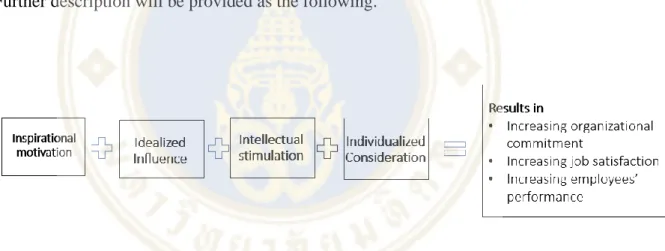
Transformational leaders can motivate employees and influence their members in positive ways. This theory consists of four components which are inspirational motivation, idealized influence, individualized consideration, intellectual stimulation.
Further description will be provided as the following.
Figure 2.1 Transformational leadership model
2.1.1 Inspirational motivation (IM)
Transformational leaders can set realistic expectations and demonstrate commitment to share the vision. According to Bass and Bass in 2009, a vision should
"Convey an image of what can be achieved, why it's worthwhile, and how it can be done"(Shadraconis, 2013). This component consists of speak optimistic about the future with high hope and encourage followers to get over challenging problems. Therefore, this can inspire and motivate team members than before (Oke et al., 2008). Because of compelling vision will create valuable meaning and obvious direction for followers.
Also, the vision can be a collaborative effort that enables employees to increase their
engagement for achieving ultimate goals. Also, this will make everyone be one part of the achievement. Then, influential leaders can monitor followers' performance whether it aligns with identified vision or not. If outcomes do not meet expectations, leaders should consider which part should be adjusted. Therefore, transformational leaders use vision to clarify objectives and goals to make companies successful in the future.
During crises, most companies have to change to survive. Creating a clear vision enables followers to work toward the same objectives that lead to the right direction, and they also set individual plans to assist in goal achievement. As a result, this can increase employee's engagement and commitment to organizations.
2.1.2 Idealized Influence (II)
Transformational leaders can influence followers by being role models so that they have to demonstrate the way of working along with high ethical and moral.
Thus, followers will admire, trust and respect leaders (Bass, Riggio, 2016). When they count on and believe in leaders, followers can overcome any challenging problems. In addition, leaders can convince team members to increase their motivation and identify personal goals that meet organizational goals. Being good leaders should continually signal followers to encourage followers’ loyalty, commitment, and respect. During crisis time, companies need high support from employees to run the business and overcome obstacles, so the idealized influence leaders can lead their team members to achieve organizational goals.
2.1.3 Intellectual stimulation (IS)
This component refers to leaders who can encourage followers and empower them to accomplish tasks in new ways. According to Bass and Bass (2009),
“Intellectually stimulating leaders help their followers more innovative and creative”(
Shadraconis, Sophon, 2013). Also, leaders can increase followers’ understanding of problems and open the chance to find solutions altogether. Everyone’s opinions will be significant that can lead the team to come up with better solutions. Different opinions between leaders and followers will be acceptable, and nobody is criticized because of a different perspective. In the rapidly changing environment, leaders must
be adaptive. When they face problems, they should reframe solutions and look at them in new ways.
2.1.4 Individualized Consideration (IC)
Transformational leaders focus on individuals' needs for growth and achievement (Bass, Riggio, 2016). Leaders can act as mentors/coaches to develop employees' potential and enhance their capabilities. Also, leaders' behaviors show acceptance of different followers. At first, leaders will analyze training needs for each follower and create developmental plans for them. For example, some followers might get more encouragement, while some get more autonomy based on the needs of followers. Another factor in this aspect is the two ways of communication. This communication is used to encourage followers to speak out and express their ideas.
When new learning opportunities are created, leaders can use individualized consideration to delegate a task to develop their capability. Then, leaders monitor delegated tasks but do not make followers feel pressure. Therefore, leaders can see what additional support that followers need.
The advantage of the transformational leadership style, this results in organizational commitment, job satisfaction, and employee performance (Thamrin, 2012). In terms of organizational commitment, transformational leaders try to develop follower's abilities such as creative thinking, innovative thinking that results in performance better, and increased ability, including personal ability and task ability.
Then, when they feel fully involve and committed to their organization, this will increase and make employees stay longer to help the company achieve the goal with their best capacity. Transformational leadership and employees will have a positive relationship as they follow support and influence to enhance their ability from their leaders. This reason affects their decision a lot. For instance, if they decide to resign from the organization, they will fear losing a great company's strong relationship and opportunities. Another advantage is employees' performance as transformational leaders pass vision on employees and perform better than before by activating them to reach performance beyond their expectations. Also, to keep inspiring employees can increase
their motivation and performances as well. Leaders can raise employees' performance by showing how are expected results from their work, asking them to prioritize other tasks, and responding to employees' needs. When they are willing to work, they will have positive attitudes that result in boosting performance to accomplish their task even they have not done before. Employees' performance will link with job satisfaction.
When people have high job satisfaction, it will increase employees' performance because they see value in what they do that benefits the organization. Job satisfaction means employees' positive feelings about their job. Also, this can show team members' attitudes toward their leaders. As a result of job satisfaction, employees will help leaders achieve team goals that align with the organization's objective. Engaged employees make the company survive in every circumstance and create growth for the company in the long run.
In conclusion, the pandemic causes many effects to organizations, such as changing the new environment and entire working processes. Leaders are one factor that helps the company go through a tough time, and the transformational leadership style could be a good way for leaders. Applying this style has many advantages to followers, such as increasing organizational commitment, job satisfaction, and employees' performance. In addition, during Covid 19, qualified employees can involve with leaders to create new strategies, plans, and practical solutions. Leaders can lead followers to have a clear vision, encourage them to learn, and come across these obstacles. Moreover, transformational leaders can empower team members by enhancing their thought, giving responsibility, and coping with new challenges. When everyone can adapt themselves to new environments and new challenges, these are reasons why the company can succeed and survive during the difficult time.
Another important skill that leaders consider is emotional intelligence, which is the critical factor of effective leadership. There are many advantages of these skills, for example, emotional control, recognize other's emotions and feeling, effective
communication, build and maintain the relationship, build teamwork, and adaptability to changing work situation.
2.2. Emotional intelligence
According to Salovey & Mayer (1990), they were among the earliest founders who defined the word "emotional intelligence". This word means "a subset of social intelligence that involves the ability to monitor one's own and others' feelings and emotions to discriminate among them and to use this information to guide one's
thinking and actions” (Dhani & Sharma, 2016). Leaders who have high emotional intelligence skills can know their emotions and recognize others' emotions to use this information to influence followers toward a desirable goal. After that, the model was improved by Daniel Goleman in 1995. He defined emotional intelligence as "abilities to be able to motivate oneself and survive in the face of frustrations; to control impulse and delay gratification; to manage one's moods and keep distressed from swamping the ability to think; to empathize and to hope". Leaders can stimulate team members to increase team effectiveness and performance. Also, this skill can increase interaction between leaders and team members, so this factor builds
interpersonal trust. Besides, leaders with emotional intelligence skills can inspire team members toward the articulated vision.
Figure 2.2 Emotional intelligence skill model
The five components of emotional intelligence according to Goleman in 1995 as follows (Goleman,1997).
2.2.1 Self-awareness
The ability refers to understand one’s self and other people in terms of emotions and feeling. Also, this element includes the ability to keep tracking self’s emotions and able to identify emotions at that moment accurately. Self-awareness people are easy to work with and solve problems quickly as they can see themselves as others see them. Plus, self-awareness is related to be open-minded to get different experiences and get new ideas from other people in society.
2.2.2 Self-regulation
The component refers to the ability that makes people control their
emotions in healthy ways. People who have this skill can adapt to changing situations well and able to take the initiative. They can see and control themselves, although they face the high emotional situation and recover more quickly from disappointments in life as Goleman's research (1996). Besides, people with this skill tend to be flexible, embrace change, and cope with disagreements. Also, this skill involves awareness of people's actions that can affect others and try to take control of these actions.
2.2.3 Social skill
This element refers to other skills that people can use to interact with other people in society, including verbal and non-verbal communication, active listening, developing harmony, and leadership. People who have social skills focus on
communicating clearly and able to build healthy relationships with others. People with this skill always express positive emotions and aim to support surrounding people.
Moreover, according to Goleman’s model (1996), social skills consist of four different skills: the ability to build and maintain a relationship, resolve conflicts, social analysis, and leadership.
2.2.4 Empathy
According to Goleman (1996), this component refers to 'Awareness of others' feelings, needs, and concerns". To some extent, this ability mentions about understand people's feelings truly. Also, people who have this skill will have rational reasons about why others take action and express emotions in this way. It enables the individual to understand the value of other people.
2.2.5 Motivation
The component refers to people’s instinctive emotions that guide them to reach the goals. This ability means to perform actions well and be driven by oneself without motivating by external factors. According to Goleman’s research (1996), motivative people are likely to be more productive and effective in an organization.
Besides, this skill also means self-induce emotions and positive moods such as enthusiasm, confidence, and optimism. Therefore, they can encounter the high- pressure situation and overcome it.
In companies, workers have various emotional states such as anxiety, nervousness, sadness, enthusiasm, joy, anger among the colleagues. According to emotional intelligence, this ability means involving understand every state of emotions from ones’ self and able to manage them. Especially for leaders, during the Covid19 pandemic, it is critical to control and manage emotions and feelings in this stressful situation; otherwise, lack of emotional intelligence can cause a block of communication with the works team, internal conflicts occurring, and destroy the relationship.
Therefore, leaders with high emotional intelligence can truly understand themselves and others in terms of emotion and feeling. Leaders can think carefully before taking action, resulting in smoother interaction among team members (Kerr et al., 2005).
According to Mayer et al. (2000), When leaders can identify members’
feelings accurately, they can take actions properly that lead team members to increase performance outcomes. Moreover, leaders with social skills are flexible and adaptive to respond to changing work situations to understand and support team members properly
in an ambiguous situation. This skill also builds teamwork and shapes team members to be the same group. Therefore, this can be the critical factor in overcoming the high- pressure situation in the Covid19 situation.
CHAPTER III
RESEARCH METHODOLOGY
3.1 Primary Data Collection Method
The literature review relates to leadership style as well as emotional intelligence skills. Also, the primary data will be gathered from personally interviewing ten managers in the sales department. As an interviewer working in this department for two years, she knows about the organizational working process. Her working experience helps her understand them deeply and get all information wholly. Therefore, qualitative research will provide information about managers’ strategies, management, and skills during Covid 19 crisis that enables the company to survive and overcome a difficult time. Apart from the interview, the interviewer will give information and analyze information from her experiencing to coordinate with these managers.
3.2 Interview method
Data will be collected by personal interviewing, and interviewees will be questioned with open-ended questions. The interviewee can observe interviewees’ body language and motivate them to give much information as needed from the interactive interview.
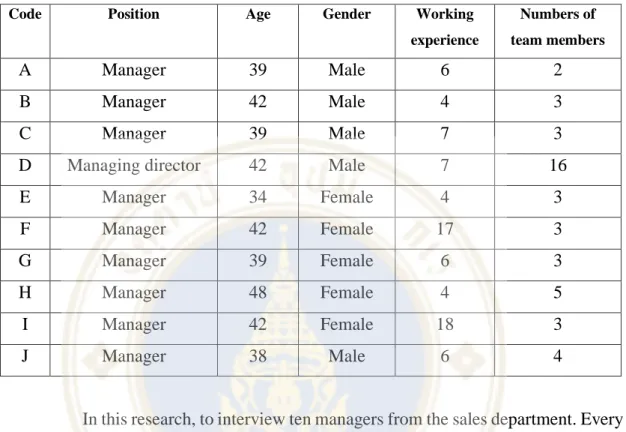
Table 3.2.1 Sample selection
Code Position Age Gender Working
experience
Numbers of team members
A Manager 39 Male 6 2
B Manager 42 Male 4 3
C Manager 39 Male 7 3
D Managing director 42 Male 7 16
E Manager 34 Female 4 3
F Manager 42 Female 17 3
G Manager 39 Female 6 3
H Manager 48 Female 4 5
I Manager 42 Female 18 3
J Manager 38 Male 6 4
In this research, to interview ten managers from the sales department. Every interviewee has team members, approximately three to four people, and all of them have been working in this position for over four years. From the interview, lots of information will be obtained, and asked questions focus on their management style and emotional intelligence skills.
3.2.2 Open-ended questions
To know which management style and skills that leaders apply during Covid 19 crisis. Using open-ended questions makes them speak freely and extend their information. The interviewer can ask more questions from their answers and clarify key ideas during the interview.
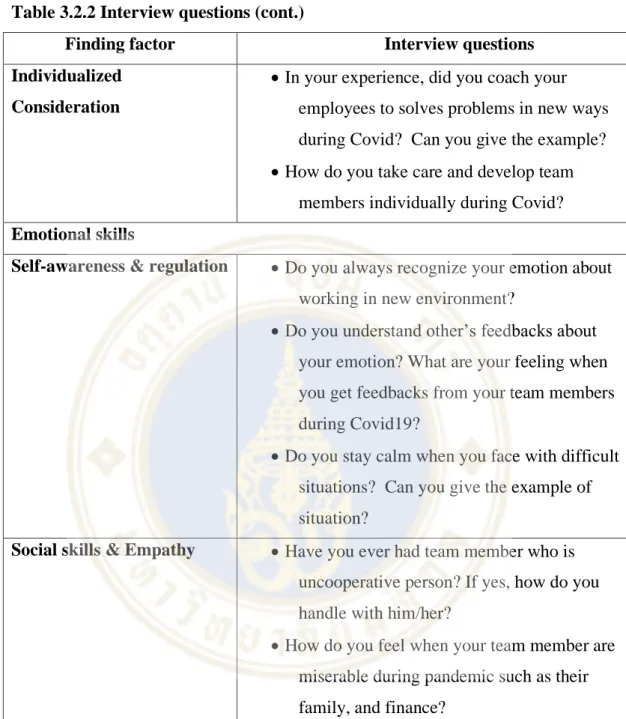
Table 3.2.2 Interview questions
Finding factor Interview questions
Problems • Have you faced with any problems that result from Covid 19? If yes, which part of your working process that has been changed because of the pandemic?
• What did you concern about your team
members who have to adapt themselves into new changing environment?
Transformational leadership
Inspirational motivation • What is your vision during this Covid19 situation?
• How do you communicate vision to your team members?
• How did you motivate and give inspiration to team members during the pandemic?
Idealized Influence • Have you tried to be a role model for your team during Covid? If yes, in which way?
• Do you encourage and support new ideas from team members? If yes, Why did you decide to do that?
Intellectual stimulation • Do you and your team members try to find solutions together?
If yes, what are advantages from making everyone be the part of solving-problems?
• Do you try to make open conversation with your team members in order to share opinions? If yes, why did you decide to do that?
Table 3.2.2 Interview questions (cont.)
Finding factor Interview questions
Individualized Consideration
• In your experience, did you coach your employees to solves problems in new ways during Covid? Can you give the example?
• How do you take care and develop team members individually during Covid?
Emotional skills
Self-awareness & regulation • Do you always recognize your emotion about working in new environment?
• Do you understand other’s feedbacks about your emotion? What are your feeling when you get feedbacks from your team members during Covid19?
• Do you stay calm when you face with difficult situations? Can you give the example of situation?
Social skills & Empathy • Have you ever had team member who is uncooperative person? If yes, how do you handle with him/her?
• How do you feel when your team member are miserable during pandemic such as their family, and finance?
3.2.3 Probing technique
The probing technique is adopted in order to gain insight valid data from interviewees. The probing technique is designed to elicit additional information from responses. Besides, the interviewer can ask further questions by using their replies to the interviewee as the key ideas and influence them to reply to more answers. This interview uses two-way communication so that the interviewer and interviewees can entirely exchange their information, experience, and knowledge. Also, this communication can reduce some misunderstanding during the interview.
3.2.4 Research framework
As collected data from literature reviews and in-depth interviews, the final results from this research will be analyzed from both primary and secondary data. Then, the data will be organized into two groups: current management style and recommendation from transformational leadership and emotional intelligence. A combination of two theories can give recommendations to leaders that will generate excellent results and effective working management during the Covid19 crisis. The framework is shown below.
CHAPTER IV RESEARCH FINDING
After concluding from qualitative research by in-depth interview ten interviewees, the data summary was gathered and divided into three main topics: the crisis, transformational leadership, and emotional intelligence during the crisis.
4.1 Problems during working remotely
According to interviewees’ responses, the problems resulting from work remotely can be divided into three main aspects: lack of team members’ motivation, lack of team members’ monitoring, and ineffective communication. More explanations are provided as follows.
4.2.1 Lack of team members’ motivation
Work from home is different from face-to-face working in various aspects.
For the first aspect, three respondents mentioned about lack of team members' motivation. Mr. A answered that "I was worried about my team members that they might lack motivation. When people work from home, the working environment will be less motivated because many factors can distract my team members easily while working such as family members, pets , so on." Another example from Ms. H, she said that "While people working from home, they tend to be more stressed that might decrease their work motivation. On the other hand, when we worked at the office, we stayed together and help each other to solve problems. Working face-to-face can increase motivation for each other, and build good work environment."
4.2.2 Inability to observe daily work
The second aspect is the lack of team members monitoring. Two
interviewees pointed out this aspect. Mr. D, who is the managing director, answered
that “Since I have to manage lots of sales team, I did not want to monitor them closely or make them feel uncomfortable. However, I sometimes had questions that what are they doing on a day-to-day basis?” for team members who seemed to disappear during the weekday. For example, they did not send E-mail to clients or sent reports to me on time. Hence, I had to call them for getting answers, but I could not know whether that was actual reasons or not. This was the one problem that I got as everyone worked from home.”
4.2.3 Ineffective communication
As Covid19 affects the organization directly, all team members have to change their working style that also changes communication ways. Interviewees currently work with their team remotely, so this results in less interaction with team members. Also, it will be more challenging than before to get information and discuss with each other, like face to face. There were four respondents who raised this issue.
According to Ms. G answer, she said that “In the beginning, when my team and I worked separately, sometimes it caused miscommunication. To give an example, we got a brief from the important account and had to help each other to create a
presentation for the pitching project. During the working presentation, some of my team did not understand our thinking concept clearly, even we discussed it in the online meeting. Therefore, this was one of the problems that I faced.” Besides, Mr. A also mentioned about ineffective communication issue, which is about communication delayed. He said that “In case of urgency situation, I needed to contact team members immediately to get the information, but not everyone stood by to respond my call at that time. Hence, this can cause work delayed that lead to being ineffective work if compared with face to face.” And Ms. I also mentioned the situation that was quite similar to Mr. A. “Due to work from home, everyone manages his/her working hours differently. When I contact my team members, some of them did other activities such as go outside to buy foods, take her mother to a hospital. So it was not convenient to communicate with them.”
4.2 Transformational leadership
The second topic can investigate how interviewees use transformational management style to manage their team members. Answers involve all components in the theory, namely inspirational motivation, idealized influence, intellectual
stimulation, and individualized consideration. Then, answers will be categorized into four aspects as follow.
4.2.1 Inspirational motivation
The second part is to find out about the vision of a leader, which is the central part of inspirational motivation. The answers are involved how they use vision to identify direction and work goal during the Covid19 crisis. Also, how they
communicate the vision to inspire team members and influence them toward the company goal. Eight out of ten respondents explained their vision clearly, and their vision statements are pretty similar to the company vision defined as to be the best provider of media and conglomerate. The example from Mr. A mentioned that "My vision is to serve the effective media that meet the clients' demand”. Also, Mr. D, as a manager, said that "To provide the best products and service that meet clients' demand.
Ms. F also provided her vision as "to be the best media provider that clients will think about our media first when they want to buy advertisement." All these answers can demonstrate that the leaders in this company have a vision aligned with the company vision and reach the ultimate goal in the same direction. Furthermore, respondents who have vision were asked how to communicate and use vision to inspire team members during the Covid19 crisis. Mr. A said that "I often express my vision to my team members. Especially in the crisis event, my vision can ensure them that our media is still effective and can meet clients' needs. Hence, we cannot give up, and have to find a new approach way to reach clients even media sales seemed to decrease lately." Also, Mr. D mentioned that "I always emphasize my vision during the
meeting. In the crisis time, we have to still believe in our organization in terms of product and service. Therefore, when we have confidence in our product and service, it can encourage us to put more effort to find a new purchaser and adjust sales
strategies to reach clients at this moment." Answer from Ms. F, she said, "Sometimes, I express my vision to team members during the online conference. My core vision is
to be the best media provider and then I always elaborate to team members. By becoming the number one media provider is not about the decent product, but also refers to serving the products as good solutions that can help clients gain the most advantages from their spending." These examples show how leaders use inspirational motivation with team members during the Covid19 pandemic. However, two
respondents do not have their vision, but they use goals to influence team members instead. For example, Mr. C said, "I do not have a vision, but my goal is to reach the sale target determined by my boss."
4.2.2 Idealized influence
This interview part researches how to be a good role model for team members during the Covid19 crisis. According to respondents’ answers, every interviewee describes their advantages and acts as a role model for their team members. As Mr. C mentioned that “During this event, I try to work hard as before because this is an unpredictable situation. Of course, due to getting lost, the company might lay off some employees although they did not want to do. Therefore, I have to put more effort into finding new clients as well as closing more deals so my members would be secure.” Besides, Mr. A answered that “Now I try to ensure my team that we can still work productively even in this crisis. Also, I am concerned about healthcare, so I try to let everyone work from home instead of working at the office to protect them from disease. As the manager, I offered my team to go to the office in an urgent meet and let my team members work from home. This action could show my effort and dedication for team benefit instead of personal benefit.” Another answer, Mr. J said that “While working remotely, I always show up myself, and keep
communicating with my team members via line group and E-mail. Besides, I try to follow up in order to check whether they face some problems or not. This action can show them that I am determined and ready to support my team in this crisis.” Ms. G also responded that “Because of Covid19 crisis, when I work from home, I have more time to learn new things that can enhance my works skill. For example, I searched on the internet and found a free online course about marketing. Not only can I enhance my skill, but I also share this knowledge with my team members. If you want to gain
trust and be the role model for your team members, you should not stop learning new things.”
4.2.3 Intellectual stimulation
The section is to find out how leaders encourage team members to accomplish tasks during the Covid19 pandemic. Also, how leaders change other member’s thoughts when they face problems. Due to different working styles, each respondent has their way to work with their team, such as problem-solving and decision-making techniques. To provide some examples, from interviewing Mr. A, he said that “When we do not work at the office, I try to empower my team to make their own decision. Before this crisis, my team members always consult with me, for example, how much should I give a discount for them? To work faster, I told my team members that they have the authority to give a discount maximum of 30% in this situation. They can give the highest discounts for clients who are our potentials depends on their assessment.” Another answer from Mr. F said that “During the Covid19 crisis, we have to approach direct clients more than before, such as government sector. These clients will offer big projects for us. Before this crisis, I volunteered to be the key person to get the projects done. However, currently, I delegated my team members to run these projects, so they were the key responsible person to coordinate with clients and cross-functional departments. This makes them more growth and can improve their skills in many aspects. For example,
communication skills will be improved because they have to contact colleagues and clients via E-mail, Line, and calls. Therefore, they have to prepare complete
information cautiously before they deliver information to other coordinators.” Mr. J mentioned about “Before the Covid19, I worked with my team closely, so problems seemed to be solved easily, for example, I made phone calls to clients directly to discuss and find the solutions. Lately, when my team members make mistakes during work at home, I tend to ask my team about what is your backup plans and solutions.
Then, I give them a suggestion and let them try to clear issues by themselves first, such as talking with clients and across departments. For the reason that I want them to learn and grow from coping with problems. Therefore, in the future, they can work effectively even they are in difficult situations like this moment.”
4.2.4 Individualized Consideration
The interviewees were asked about how they develop team members’
capabilities via training and coaching personally during the Covid19 crisis. Mr. A mentioned that “ I have to adapt sales strategies in my team, especially approaching new clients. To some extent, I told my team that now we have to focus on approach clients who are government sector during the Covid19. Since government clients have a year plan to buy the media, and still have a budget to purchase us, so at this
moment, try to approach them. Also, I train my team members about how to contact them. For example, going to their official website to see which upcoming project that we can pitch a job via online. Also, when we register to pitch a project, I train them how to interpret client’s requirement from terms of reference, and how to create media plan within their budget.” Mr.B also responded that “Because of Covid19, we have to conference with clients via online meeting, so presentation skill is important to increase clients’ purchase decision. I have coached my team members on creating an attractive presentation and the way to present their project to clients that make them understand all information within a short time. Having an online meeting with clients requires good presenters because they have to draw clients’ attention for the whole meeting time. After meeting with clients, I always give feedback to each team member about their strengths and weakness. Also, giving suggestions and compliments makes them enhance their skill and increase their confidence in the next meeting.” Ms. I described that “ l like the phrase as learning by doing, so I coach my team members by assigning new projects. When I close the deal with clients, I will set the meeting to assign a key responsible person and explain the clients’ brief to them. Therefore, they can learn every process to get the project done, such as explaining clients’
requirements with the production team and coordinating with admin teams to launch advertisements. When they need more support, I am willing to give suggestions and help them solve problems right away.” Mr. J responded that “During the Covid19 crisis, some of the team members feel discouraged. Due to refusal from clients, they have low performance that does not reach the team’s sales target. At this moment, I see team members’ attempt to perform their best, so I will not blame members who can sell less. Instead, I will give them more encouragement and coach them in terms of mindset. For example, one of my team has sales skills, but he seems to lack
self-confidence. For this case, I talked with him and tried to change his perspective about himself.
Additionally, I pointed out his contribution to the team goal in the past and taught him to systematize his working process. I focus on all of my team and intervene to support them. Therefore, we can overcome barriers that result from the crisis, and overall team performance still reach the sales target.”
4.3 Emotional intelligence skills
This interview part explores interviewees’ emotion while managing team members during the Covid 19 pandemic. The pandemic causes adverse effects to people dramatically, which makes people get high stress. Manage the emotion of a leader will be significant in order to build a healthy relationship with others. As a result, this factor can create a better working environment within the sales department.
4.3.1 Self-awareness & regulation
The Covid 19 situation causes the working process to change in many aspects, such as changing communication and work remotely. Leaders should know current emotions in order to control their emotions effectively in a difficult situation.
From interview ten managers, all of them answered that they understand themselves about emotional states such as feeling happy, moody, annoyed, etc. In addition, this interview part is to observe how they control different kinds of emotions while
working. Eight out of ten respondents answered that they try to control their emotions and express them positively during the Covid19 crisis. As they see advantages from controlling emotions more than disadvantages. Mr.J mentioned that "I admit that I feel upset easily while working remotely. For example, communicating with team
members is harder and slower. My team members sometimes do other activities apart from routine works, such as cooking and doing housework. Now I have changed my perspective to be more optimistic and avoid being angry. As a result, I set the rule within the team; for example, team members who reply to Line messages late have to call me right away as possible. When I can manage anger and focus on expressing
positive mood, I feel more energized and enjoy working with my team." Mr. D, as a managing director, responded that "I have to manage a fours sales team that consists of 4 managers and 12 salespersons. Of course, some different opinions occurred during the Covid19 crisis due to different team members' requirements. For example, team A requests to set the sales meeting on Monday while team B requests the meeting on Wednesday. As a leader, I have to manage my emotions when dealing with different kinds of people. When I start to get angry, I will ask myself what makes me angry, who does it, and what I should do next. Consequently, when I get all answers, I regain consciousness and do not express a negative mood to others. For this reason, I still have a close relationship with team members that can increase rapport in our team.
Ms. H said that "During the Covid19 situation, I understand that everyone has higher stress from concerning about health, family members and changing working. As a manager, controlling my emotions is critical. I do not want my emotion to decrease their respect and relationship within the team. For example, one of my team members had her personal issue, so she could not attend an online meeting; and did not also inform me before that time. I felt upset, but I did not condemn her immediately. I will ask to find true reasons first and want to teach her as a manager. Pointing out
disadvantages to her, such as our team, was waiting for you for one hour to create lesson learn for her. Therefore, I can gain their trust and consideration from my team members." Nonetheless, the remaining two respondents express their emotions straightforwardly. For example, Ms. G answered that "I think I can show what I am feeling to my team members because it is more comfortable to let them out. Also, every word or action that I express is triggered by some reasons. When I express my current emotions such as disappointed, annoyed, and angry, I feel done with that and will not mention to that situation again." This comment can support another aspect from the leader about expressing emotions and feeling instead of controlling.
4.3.2 Social skills & empathy
Apart from earlier, social skills and empathy are also crucial for leaders.
Since they have to manage and coordinate with lots of people, these skills can build a strong relationship and increase teamwork within the team. Many answers can reflect the social skill and empathy of leaders. For example, Mr. D as a managing director,
said that “During the Covid19 pandemic, I know this is the difficult time for everyone.
As I can do, I try to listen to my team members than before. I am trying to observe what they need additional support. For instance, I asked team members what they are concerned about in this situation, and I found that they were concerned about the unclear commission. Since their spouses were laid off from work, some team members have to subsidize the whole family. Hence, I decided to talk with my boss, and we ended up with a clear commission policy used particularly in Covid19 situation, which is fair for both company and team members.” Another answer from Mr. A, “During the Covid19 crisis, I always set meeting within the team to communicate with them.
To check whether they are struggling with some problems or not. If my team members need my support, for example, check formal E-mails before sending them to clients, close the government project, I am willing to assist them instantly.” These answers can demonstrate their social skills and empathy as leaders have in a crisis.
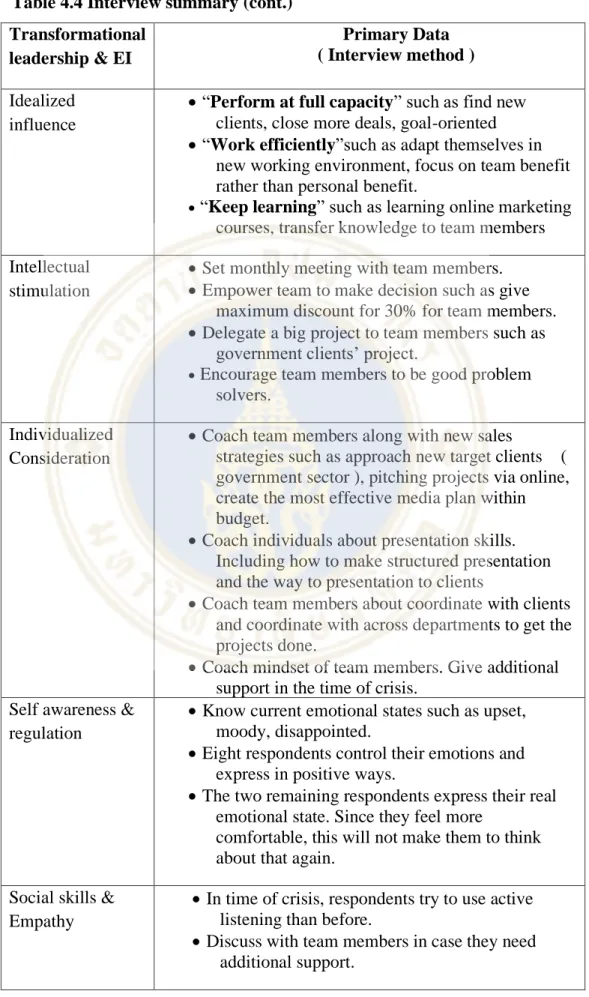
4.4 Summary from primary data
Table 4.4 Interview summary Transformational
leadership & EI
Primary Data ( Interview method )
Inspirational motivation
• Majority of respondents have vision that go the same direction with the company’s vision as“ To be the best provider of media and
conglomerate,”
• Also, they communicate the vision to inspire and motivate their team members during the Covid19 crisis.
• The remaining respondents do not have clear vision.
• They use mission to inspire team members instead, for example, motivate team members to reach sales target.
Table 4.4 Interview summary (cont.) Transformational
leadership & EI
Primary Data ( Interview method )
Idealized influence
• “Perform at full capacity” such as find new clients, close more deals, goal-oriented
• “Work efficiently”such as adapt themselves in new working environment, focus on team benefit rather than personal benefit.
• “Keep learning” such as learning online marketing courses, transfer knowledge to team members
Intellectual stimulation
• Set monthly meeting with team members.
• Empower team to make decision such as give maximum discount for 30% for team members.
• Delegate a big project to team members such as government clients’ project.
• Encourage team members to be good problem solvers.
Individualized Consideration
• Coach team members along with new sales
strategies such as approach new target clients ( government sector ), pitching projects via online, create the most effective media plan within budget.
• Coach individuals about presentation skills.
Including how to make structured presentation and the way to presentation to clients
• Coach team members about coordinate with clients and coordinate with across departments to get the projects done.
• Coach mindset of team members. Give additional support in the time of crisis.
Self awareness &
regulation
• Know current emotional states such as upset, moody, disappointed.
• Eight respondents control their emotions and express in positive ways.
• The two remaining respondents express their real emotional state. Since they feel more
comfortable, this will not make them to think about that again.
Social skills &
Empathy
• In time of crisis, respondents try to use active listening than before.
• Discuss with team members in case they need additional support.
For limitation of this research, primary data is gathered from small manager group in the company, and due to time limitation.
CHAPTER V
RECOMMENDATIONS AND CONCLUSIONS
5.1 Conclusion
From gathering primary data from an in-depth interview, this research can find the influential factors to manage team members during a crisis. We could analyze the current management style of leaders that links to raised theories as researched in this paper. Therefore, we can examine how they use transformational leadership along with emotional intelligence in their current management. After analyzing these factors, we can see which factors they should develop to be transformational leaders and high emotional intelligence. Therefore, we can give recommendations in order to lead them to manage team members better.
5.2 Recommendations
As we conclude from this research, we can understand how they use transformational leadership with emotional intelligence in their current management during the crisis. Hence, the recommendations will fulfill the gap that they did not use to manage their team. Hence, this research can help leaders increase employees’
capabilities as they aim to, and adjust working plans in the sales department to reach team goal and organization goal. The recommendations as follows.
5.2.1 Create the team vision statement
The research showed that having a clear vision within the team and organization is essential. Apart from the organization's goal, the vision can be set for the particular team that aligns with the organization's vision. Since each department has a different responsibility, the team vision statement can guide people in the department about which direction they should go, why they do this, and their actions
to contribute to the company’s vision. As interviewing ten managers, we could find that the vision from leaders is different even they work in the same department.
Therefore, the managing director can set the meeting to set the common vision. Firstly, he can involve everyone to be a part of this process. All team members can list their purpose and the core focus of working in the future before the meeting. Then, team leaders can gather all core focus in the meeting, choose them from the majority, and come up with two or three vision statements that should be attainable and clear for everyone. Lastly, to select the team vision should be gained from consensus so that everyone will accept this new vision, and set their plan to reach it, for example, the sales team vision could be “to meet clients’ need by providing the best media and service during the crisis.” To some extent, during the Covid19 pandemic, they can use this vision statement to emphasize customer-focused than before. To win clients’
hearts is important that makes them still purchase with us again and again. As a salesperson, they cannot only focus on selling media but also understand what their clients need and what the most advantages are from buying our products. If clients need some additional support, they should provide quality service instantly. Therefore, a good vision statement can challenge team members to reach the determined goal and increase their motivation during crisis time.
5.2.2 Increase team members’ capabilities
Sales team leaders can provide sales training programs for team members as well as team leaders. Because of the Covid19 effects, the salesperson cannot have an appointment with clients face to face, so they can spend this time to learn and develop knowledge about key sales skills. Providing sales training programs can improve their essential skills and enable them to reach the target. Team leaders can analyze members that what competencies they can improve better, and what are their current weaknesses. For example, they can consider the essential skills for
salespersons that include effective communication skills, digital sales, engaging presentation skills, relationship building, and demonstrate skill. During the unexpected situation, training courses can be conducted via the online platform, such as E-
learning, Zoom, and Google meet to prevent the spread of infection. They can use internal leaders who have expertise in these skills to be an instructor or hire external
instructors from time to time to transfer knowledge and skills for the sales team. Once team members improve these skills, they will have better performance and have sale techniques to convince clients than before. When team members have enough capabilities to work efficiently, they will be satisfied with themselves, raising self- motivation as well. Therefore, self-motivation will drive team members to accomplish the tasks without being forced by leaders.
5.2.3 Weekly team meeting
As interviewing ten managers, we found that they have an online meeting with team members monthly. It would be better if each of the leaders holds weekly team meetings with team members to measure and evaluate their performance more accurately. Team leaders can discuss how to set effective sales metrics and KPI during the pandemic so that these indicators can drive the team members to achieve a team goal. For example, apart from revenue goals, they can set sales metrics which are calls made, sales follow-up, the number of customer retention, numbers of emails sent, and sales forecast. These indicators should be clear and possible to accomplish based on the actual situation, and one should inform all team members. Also, weekly team meetings via online platforms can help the manager understand team members more about their thought. During the meeting, they can help each other review issues, improve sales strategies, train team members and highlight the team's success. When leaders get information from leaders completely, they can give suggestions and solve problems at the right point. Therefore, this can increase effective communication within the team.
5.2.4 Practice mindfulness skills
Since the Covid19 pandemic harms all people, this situation causes people to have high stress and depression. Especially for leaders in this crisis time, they get pressure from internal and external factors. As a result, they might have mood swings from time to time because of high responsibilities and many problems that must be solved. During crisis time, leaders can use mindfulness skills to manage and handle different emotions. To some extent, mindfulness refers to present-focused
consciousness that enables leaders to stay with the present moment without being in
the past or future. Leaders can understand the current situation more accurately without being judged or criticized. The way to practice mindfulness skills is easy and does not take much time. For example, the leaders can develop the skill by doing meditation in daily life such as eating, breathing, and walking. The important thing is trying to focus on what you are doing without letting other things distract your thought and mind. Also, they can handle high-pressure feelings and do not let emotion control them. For example, if team members explode and anger while working, leaders will not respond with the same emotion. Instead, they have self-consciousness to know their current emotion and give conscious responses back. Mindfulness leaders can understand other people well, such as team members’ reasons that lead them to take bad actions. This skill benefits all areas of emotional intelligence skill; for example, when leaders have mindfulness, they can directly increase their self-awareness and self-regulation. Then, when they can effectively manage their emotions, it increases relationship satisfaction with team members. Besides, leaders can understand and identify emotions precisely so that they can understand other’s emotions and feeling as they understand themselves, increasing leaders’ empathy.
REFERENCES
Bass, B., & Riggio, R. (2008). Transformational Leadership (2nd ed.).
LawrenceErlbaumAssociates.
https://books.google.co.th/books?hl=en&lr=&id=2WsJSw6wa6cC&oi=fnd
&pg=PT5&dq=transformational+leadership&ots=I74XlXMJxH&sig=fwd urHSQ3qaGmV0eeSm5UHLYBUs&redir_esc=y#v=onepage&q&f=
Dhani, P., & Sharma, T. (2016). Emotional Intelligence; History, Models and Measures. International Journal of Technology and Management, 5.
Goleman, D. (1997). Emotional Intelligence Why it can matter more than IQ. Bantam Books.
https://www.academia.edu/11160129/Emotional_Intelligence_Daniel_Gol eman_pdftsuff_blogspot_com_
Kerr, R., Garvin, J., Heaton, N., & Boyle, E. (2005). Emotional Intelligence and Leadership Effectiveness. School of Business Organisation and Management, University of Ulster.
Shadraconis, S. (2013). Organizational Leadership in Times of Uncertainty.
Claremont Graduate University.
Thamrin, H. M. (2012). The Influence of Transformational Leadership and Organizational Commitment on Job Satisfaction and Employee Performance. International Journal of Innovation.