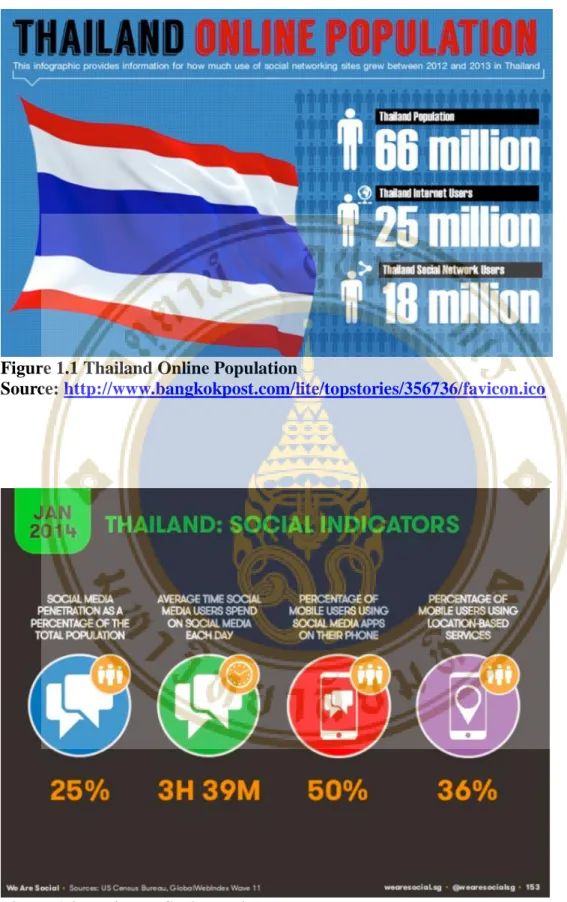
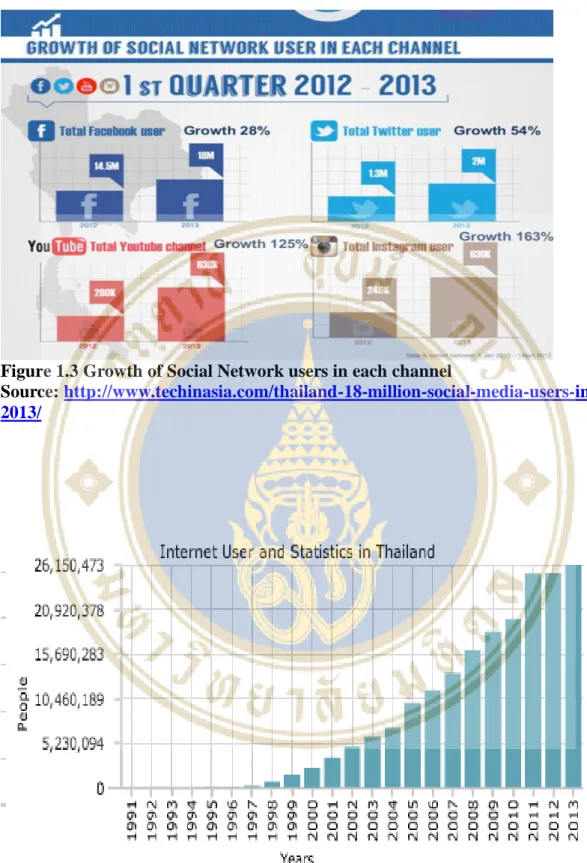
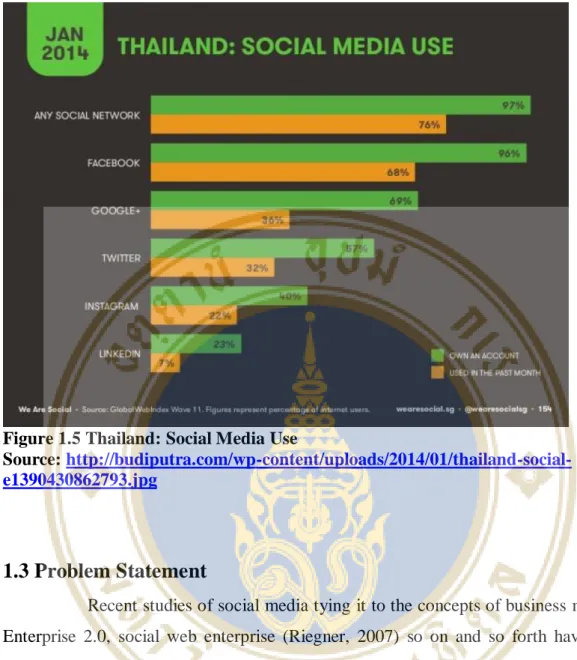
With the rise in popularity of social media, statistics have also shown a tremendous increase in the number of social media users over the years. Hence, creating good business opportunities through social media, mobile penetration and online media.

Problem Statement
Peer communication in social media is described as interactions between individual consumers regarding products or services through social networking channels (Moschis and Churchill 1978). Therefore, this paper would like to investigate the effects of online peer communication on social media and its impacts on consumer product attitudes and purchase intentions.
Topic Selection
The study, "Social Media Peer Communications and Impacts on Purchase Intentions: A Consumer Socialization Framework" Xia Wang, Chunling Yu and Yujie Wei, (2012) was focused on Chinese consumers and just social networking sites, but this paper would like to explore the behavior of Thai online consumers buying behavior on various online platforms including blogs, forums, YouTube, Facebook to gain a more in-depth understanding of how Thai consumers find information and how influential peers are in the decision-making process.
Research Scope
Research Question
LITERATURE REVIEW
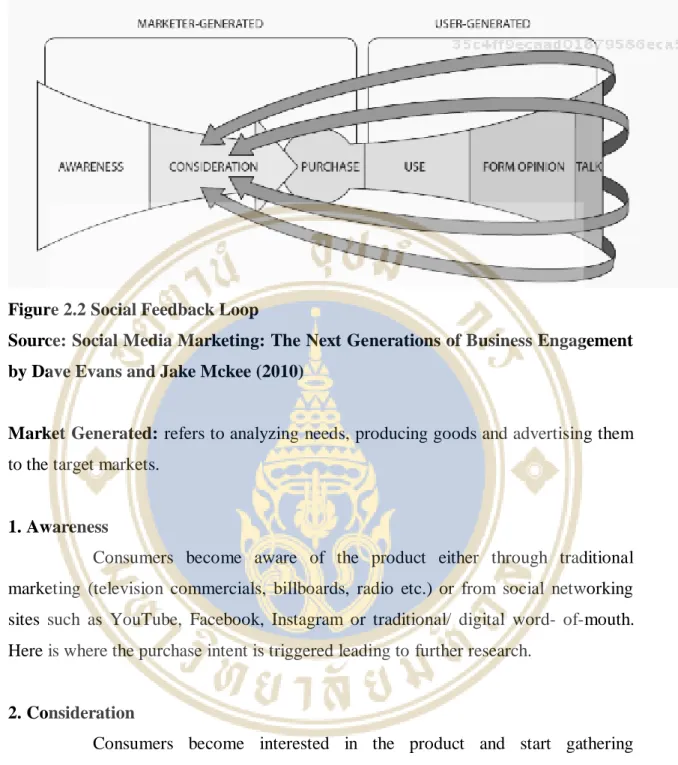
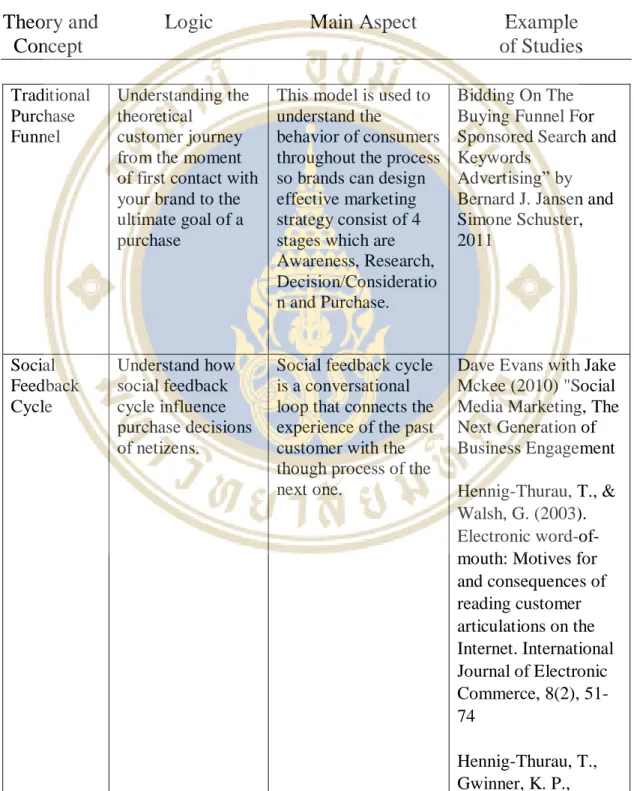
- Factors that influence purchase decisions on social media: Social Feedback Cycle
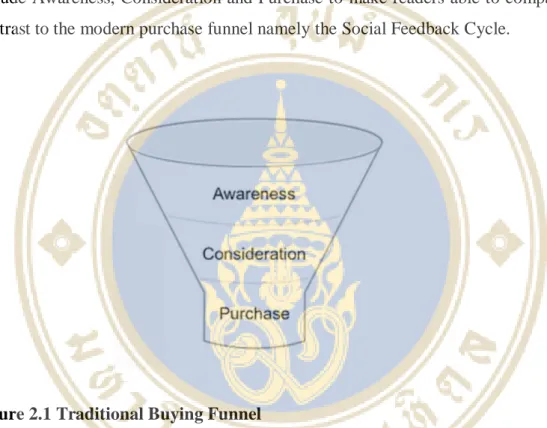
- Traditional Purchase Funnel
- Awareness
- Consideration
- Purchase
- Social Feedback Cycle
- Form Opinion
- Talk, Social networking (linked back to 2. Consideration)
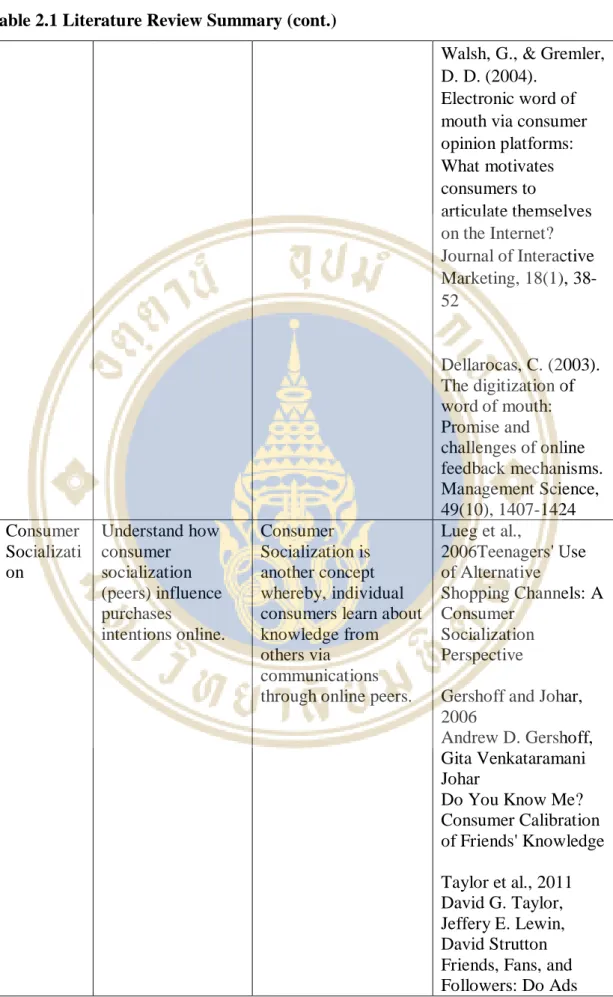
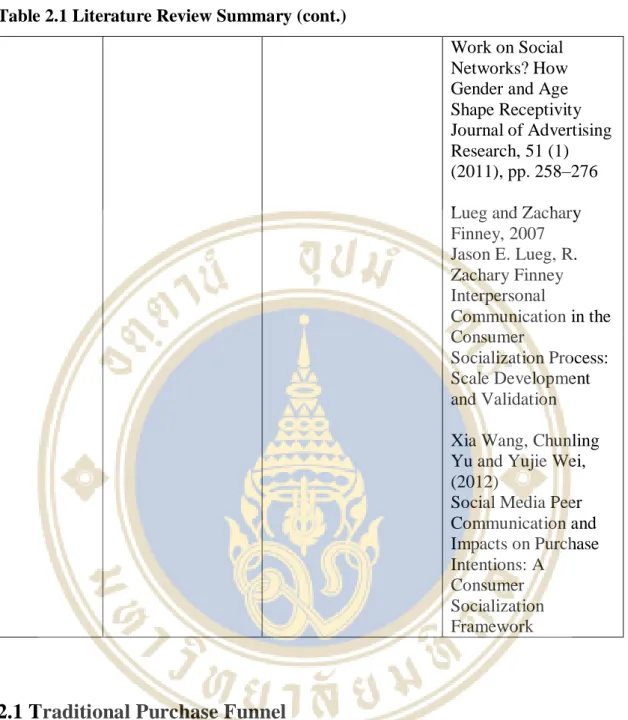
- Consumer Socialization
- Instant Messaging
- Boom of Social Media sites
- Secondary information
- Inside look at Social Consumers
Source: adapted from Bidding on the Buying Funnel for Sponsored Search and Keywords Advertising” by Bernard J. User Generated: refers to content generated by users on social media platforms on the Internet.
RESEARCH METHODOLOGY
Research Design
Data Collection Methodology
Small samples of social media users were selected in Bangkok, Thailand with the age group from 22 to 30 because the majority of these young adults tend to be active information seekers. The semi-structured schedule of interview questions was open-ended, allowing participants to elaborate on each question. After the end of the interview, similar aspects of the use of social media to connect and search for information were presented.
The interview was audio recorded with the consent of the participants and later transcribed for accuracy and analysis. All interviewees were informed that the interview would be recorded and used for educational purposes. The result will enable brands to understand how Thai consumers behave online and what actions would be needed when planning their social media strategies.
Instrument
Participants were asked as a side question whether they rated peer communication on what brands they were promoting and why. How often do you read articles, blogs and forums in a week and why do you read them? How you can learn more about the product by going to blogs and forums or on Facebook.
How likely or unlikely it is that mutual communication online will influence you to participate in the product. Do you believe that the opinions and thoughts of peers, such as comments and reviews on the Internet, are more credible than what brands advertise them to be.
DATA ANALYSIS
Observation findings
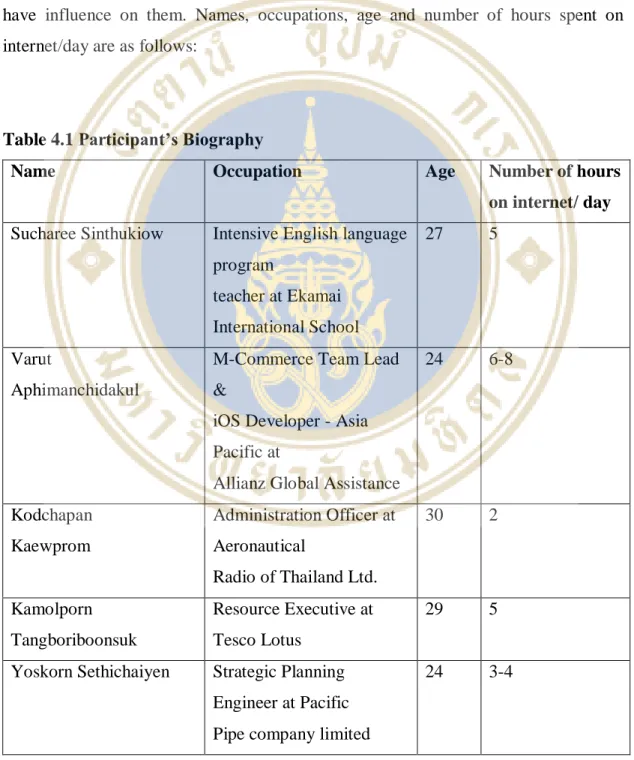
Demographic profiles of respondents
These participants were selected because some of their jobs required them to use social media as a means of communicating with customers, while most of them are exposed to using social networking sites and other online channels almost every day. As these participants are quite active on social media, it would therefore be interesting to see whether peer discussions on social media platforms and other online channels have an impact on them. All interviewed participants graduated from university with a bachelor's degree and some with a master's degree, while the other is in the process of obtaining a master's degree.
Thai consumers’ online behavior
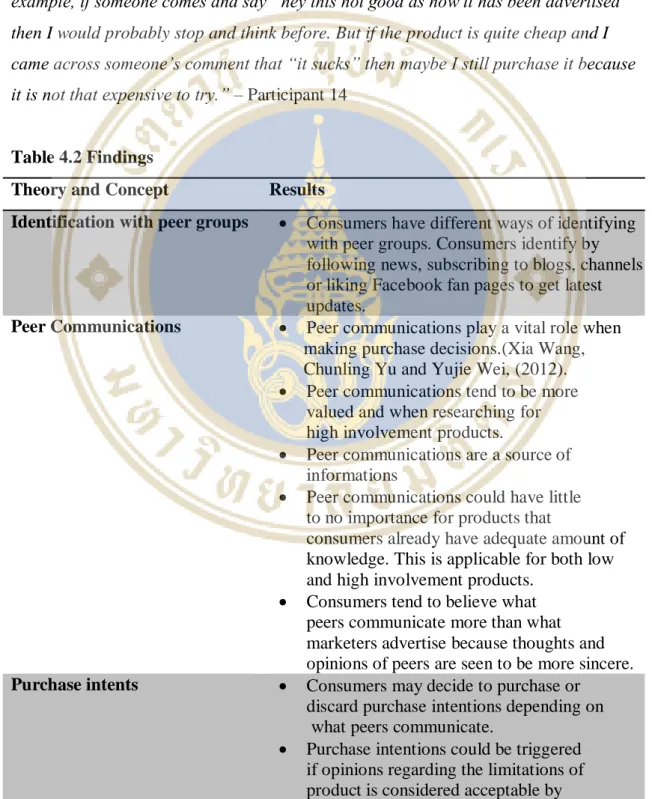
The majority of Thai consumers believe that peer communication is an important factor in purchasing decisions. In addition, for the majority of interviewees, the informants attributed mutual communication as an important factor in the search for products or services. However, peer communication, on the other hand, is expected to have little impact on consumers' purchase intentions because price.
Peer Communications Peer communications play a vital role when purchasing decisions are made. (Xia Wang, Chunling Yu and Yujie Wei, (2012). For example, if consumers were searching for low-involvement products, peer communication may not be an important agent. However, if the product being researched involves risks of high, then peer communication is very important.
DISCUSSIONS
Conclusion
The results also agree with Dave Ewans with Jake Mckee Social Media Marketing, The Next Generation of Business Engagement study, that the Social Feedback Loop, that the opinions and conversations of previous consumers in the form of opinions, comments have a great influence on the phrase of thought for the next group of potential buyers . The result is also consistent with The Science of Sharing, where the degree to which a consumer relies on mutual communication depends on the type of product they are researching. Therefore, interpersonal communication is more important when researching high-involvement products, while peer-to-peer communication is less or not important (depending on the product and the consumer's familiarity with the product) when consumers are considering purchasing a low-involvement good.
Recommendation
In summary, if the product has a high involvement such as smartphones, then marketers should focus on people who rate the quality of products and services on review sites and forums that can be easily found through search. However, if brands focus on fashion items such as clothing and jewelry, the use of social networking sites should be enough to drive the interests of consumers who are involved in such platforms. Additionally, brands such as cosmetics should consider using review sites and YouTube to remarket their product, focusing on influential individuals associated with that industry to comment on products.
Consequently, brands must design effective social strategy depending on the nature of their products and the target groups. Brands should also be aware that consumers talk positively and negatively about their products on the Internet, sharing their opinions as well as both good and bad experiences with the products. This also leads to business opportunities for online intelligence companies, such as Brandtology, iSentia and Social Bakers to monitor consumers.
Limitations and suggestions for future research
These experiences and opinions carry far more weight and value and are considered more trustworthy than any information from marketers, so brands need to keep an eye on the conversations, which can allow them to take the necessary actions quickly. It would be fruitful to expand the sample size by taking the research to a quantitative approach, taking into account the difference in sample size in demographics such as age group, baby boomers, generation X, generation Y, generation Z, occupation to investigate differences in other aspects of the use of social media as well as differences in age group and interests. Future research is needed to examine consumer decision-making with respect to different online channels, reflecting different levels of influence depending on the product type involved.
For example, when researching a high-involvement product like smartphone or cars, consumers are more likely to be influenced by review sites. Therefore, it is important for brands to be aware of the path consumers take to make decisions when conducting online research to influence brands' positive return on investment. This study provides a much-needed qualitative foundation for understanding Thai online consumer behavior; however, more empirical research is needed that focuses on theories and is applied to the decision-making process specifically in relation to industry-specific products and services and the impact of social media.
Journal of Consumer Research published by The University of Chicago Press "Do you know me?" Electronic word of mouth: Motives and consequences of reading customer articulations online. Electronic word of mouth via consumer opinion platforms: What motivates consumers to articulate themselves online.
Yeung (2010) Building character: Effects of lay theories of self-control on product selection for children. Word of Mouth on the Internet: The Impact of Web 2.0 on Consumer Purchasing Decisions, Journal of Advertising Research. Retrieved from http://www.slideshare.net/imcinstitute/thailand-ict-overview-q4-2013 Ward, (1974), Scott Ward Consumer Socialization Journal of Consumer Research, 1.
APPENDICES
APPENDIX A: Interviews
How you can know more about the product by reading the reviews as you mentioned. I can find out both the negative and positive sides of the product and what consumers who have already used the product think about it. How likely or unlikely online interactions are to affect your engagement with the product.
How by going to forums and blog sites you can learn more about the product. If more of my friends buy it and it's the latest trend, but if I don't like it, I wouldn't buy it. How likely or unlikely it is that peer-to-peer communication online regarding games affects your involvement with the product.
Let's say that you are currently interested in a product or service, how would you search for information about it. If the reviews say it's a great place to go then yes, then it should be my next destination. Some people say that it is a very nice place while some people say that it is not very nice then I have to do the research.
Since the reviews are from people who have actually used it and advertised it, they will not say that the products are not good. So you would say that people's reviews and opinions definitely have an impact in a way when researching or deciding to purchase goods. I just look for the limitation of the product and if it is acceptable then I buy it anyway because if the product is really bad I don't want it.
How to learn more about the product by liking the Facebook fan page or reading the blogs. Which channel do you visit to get the latest game updates and how can you learn more about the product. How you can learn more about the product by visiting gaming websites or review sites.
If someone raises the concern of the economy of the game, within the game, for example, when you trade something in the game, if it is not affective, I would be concerned. And then I'll try the game and if it can't do as promised, that's terrible. Yes, because if the product is important to me and it's quite expensive, if someone for example comes and says "hey it's not as good as it's advertised" then I'll probably stop and think first.