INNOVATIVE DESIGN FOR PET ZONE THAT INFLUENCES CUSTOMER BEHAVIOR IN TOPS MARKET
CHALIDA DATERAPEEPONG
A THEMATIC PAPER SUBMITTED IN PARTIAL FULFILLMENT OF THE REQUIREMENTS FOR THE DEGREE OF MASTER OF MANAGEMENT
COLLEGE OF MANAGEMENT MAHIDOL UNIVERSITY
2021
COPYRIGHT OF MAHIDOL UNIVERSITY
Thematic paper Entitled
INNOVATIVE DESIGN FOR PET ZONE THAT INFLUENCES CUSTOMER BEHAVIOR IN TOPS MARKET
was submitted to the College of Management, Mahidol University for the degree of Master of Management
September 12, 2021 on
...
Miss Chalida Daterapeepong Candidate
... ...
Assoc. Prof. Nathasit Gerdsri, Assoc. Prof. Winai Wongsurawat,
Ph.D. Ph.D.
Advisor Chairperson
... ...
Assoc. Prof. Vichita Ractham, Nisit Manotungvorapun,
Ph.D. Ph.D.
Dean Committee member
College of Management Mahidol University
ACKNOWLEDGEMENTS
I would like to express my sincere gratitude to Assoc. Prof. Dr. Nathasit Gerdsri for his insightful advice throughout this project. His advice and suggestions have enabled me to improve my research and valuable time to conduct research relevant to my interest and career.
Any attempt at any level cannot be completed satisfactorily without the help and guidance of my family and friends. I would also like to thank my family, friends, and colleagues for their assistance and participation in gathering information, collecting data, and providing opinions as needed to ensure the project's success.
Chalida Daterapeepong
INNOVATIVE DESIGN FOR PET ZONE THAT INFLUENCES CUSTOMER BEHAVIOR IN TOPS MARKET
CHALIDA DATERAPEEPONG 6249200
M.M (GENERAL MANAGEMENT)
THEMATIC PAPER ADVISORY COMMITTEE: ASSOC. PROF. NATHASIT GERDSRI, Ph.D., ASSOC. PROF. WINAI WONGSURAWAT, Ph.D., NISIT MANOTUNGVORAPUN, Ph.D.
ABSTRACT
In an increasingly competitive pet retail industry, Tops Market must rethink its strategy for marketing and sales to maximize customer satisfaction and loyalty. Pet ownership has rapidly increased in Thailand, prompting pet parents to seek out luxury products and healthy food in the market, as well as a pet-friendly environment in which to shop. The behavior of providing the best pet care is a sign of a developing economy, which leads to an increase in purchasing power. However, as far as business strategies go, these brick-and-mortar stores are primarily concerned with price and products commonly sold in the market rather than focusing on the design aspects. With the effective design criteria and strategy, the effect of a pleasant shopping experience induced by ambient factors leads to a higher number of purchases, time, and money spent in Tops Market. The quality of environmental factors includes store layout, shelving & fixtures design, product assortment, lighting, color & theme design, background music, and scent. Furthermore, its effect on the appearance of the retail areas is all reasons for successful sales resulting in customer loyalty and satisfaction.
KEY WORDS: Innovative Design/ Pet Zone/ Supermarket/ Design Criteria/
Consumer Behaviour
66 pages
CONTENTS
Page
A ACKNOWLEDGEMENTS ii
ABSTRACT iii
LIST OF TABLES vi
LIST OF FIGURES viii
CHAPTER I INTRODUCTION 1
1.1 Background 1
1.2 Problem Statement 2
1.3 Research Objectives 3
1.4 Research Questions 3
1.5 Research Scope 4
CHAPTER II LITERATURE REVIEW 5
2.1 Overview of Pet Industry and Ownership in Thailand 5
2.2 Overview of Tops Market and Pet Zone 6
2.3 Importance of Effective Retail Design 7
2.4 Consumer Behavior toward Retail Design 8
2.5 Ambient Factors That Influence Consumer Behavior 9
2.5.1 Store layout 9
2.5.2 Retail Shelving & Fixture design 11
2.5.3 Product Assortment 11
2.5.4 Lighting 12
2.5.5 Color & Design Theme 13
2.5.6 Background Music 14
2.5.7 Scent 14
2.6 Research Paradigm 15
2.7 Conceptual framework 16
CONTENTS (cont.)
Page
CHAPTER III METHODOLOGY 19
3.1 Research methodology 19
3.1.1 Exploratory Research 19
3.1.1.1 Secondary Research 20
3.1.1.1 Primary Research 20
3.1.2 Descriptive Research 21
3.2 Sampling Plan 21
3.3 Data Collection 24
3.4 Data Analysis Plan 25
CHAPTER IV FINDING AND ANALYSIS 26
4.1 Demographic Profile 26
4.2 Psychographics Profile 27
4.2.1 Individual’s Dependent variables 27 4.2.2 Individual’s Independent variables 29
4.2.3 Individual’s Recommendations 46
CHAPTER V CONCLUSIONS AND RECOMMENDATIONS 50
5.1 Conclusions 50
5.2 Recommendations 53
5.2.1 Design Criteria 54
5.2.2 Design Perspective 56
5.3 Limitations 62
REFERENCES 63
BIOGRAPHY 66
LIST OF TABLES
Table Page
2.1 Conceptual Framework 16
3.1 In-depth Interview Sampling plan 20
3.2 Outline of In-depth Interview Questions and Probes 22
3.3 Outline of Data Collection Plan 25
4.1 Participants’ profiles for in-depth interview 26 4.2 The impact of participants’ perspectives toward their pets. (n=10) 27 4.3 The impact of participants’ perspectives toward the design of a pet zone.
(n=10) 29
4.4 Participants’ purchasing pattern toward the design of a pet zone in Tops
Market and other pet shops. (n=10) 31
4.5 The impact of participants’ perspectives toward the ambient factors of design
aspects in terms of store layout. (n=10) 33
4.6 The impact of participants’ perspectives toward the ambient factors of design aspects in terms of shelving & fixtures design. (n=10) 35 4.7 The impact of participants’ perspectives toward the ambient factors of design
aspects in terms of shelving product assortment. (n=10) 38 4.8 The impact of participants’ perspectives toward the ambient factors of design
aspects in terms of lighting. (n=10) 40
4.9 The impact of participants’ perspectives toward the ambient factors of design aspects in terms of color & design theme. (n=10) 41 4.10 The impact of participants’ perspectives toward the ambient factors of design
aspects in terms of background music. (n=10) 43
4.11 The impact of participants’ perspectives toward the ambient factors of design
aspects in terms of scent. (n=10) 45
LIST OF TABLES (cont.)
Table Page
4.12 Top three factors that influence participants’ shopping behavior. (n=10) 48 5.1 The conclusion of Focus Area of The Ambient Factors In Design Aspects. 50 5.2 Design Criteria based on the ambient factors 52
LIST OF FIGURES
Figure Page
2.1 Pet Ownership in Asia 5
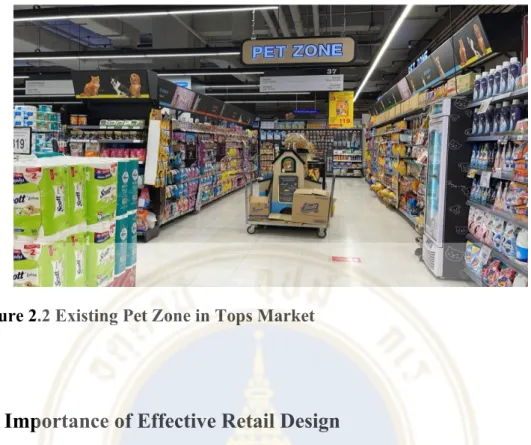
2.2 Existing Pet Zone in Tops Market 7
2.3 The Straight Store Layout 9
2.4 The Diagonal Store Layout 10
2.5 The Curved Store Layout 10
2.6 Color Temperature 12
2.7 Robert Plutchik’s Wheel of Emotions 14
2.8 Research Paradigm 15
3.1 Research Methodology 19
3.2 Data Analysis Plan 25
4.1 Store Layout 34
4.2 Participants’ Recommendations 47
5.1 Design Perspective 1 57
5.2 Design Perspective 2 57
5.3 Design Perspective 3 (The pet activity corner) 58 5.4 Design Perspective 4 (The premium products corner) 58
5.5 Design Perspective 5 (The pet clinic) 59
5.6 Design Perspective 6 (Gondola Shelving & Fixtures Design) 60
5.7 Design Perspective 7 (Top View) 61
CHAPTER I INTRODUCTION
1.1 Background
The pet community in Thailand has been steadily increasing as pet owners' attitudes shift from "pet lovers" to "pet parents" (Yanisa Dechwattanatam, 2020). Since the rise in the trend of DINKs (Dual Income, No Kids), pet parents are concerned about their pets' holistic well-being and treat them as human family members. According to research (Rakuten Insight, 2021), dogs are man's best friend in Thailand, with 47 percent owning one and 42 percent owning a cat. Smaller pets, such as birds, goldfish, hamsters, and rabbits, are less common. As a result, regardless of price, demand for pet-related enterprises such as premium pet food, accessories, healthcare services, grooming, or spa treatments drives the market growth. According to the survey, the market for pet cats and dogs is worth Bt40 billion per year, with an annual increase of at least 10%. (The Nation, 2020). However, because of various product brands and stores in the market, consumer behavior has changed under pet humanization.
Pet ownership has surged in Thailand rapidly, prompting pet parents to seek luxury products and healthy food in the market and a pet-friendly environment in which to purchase. The behavior of providing the best pet care is a sign of a developing economy, which leads to an increase in purchasing power. As a result, many retail stores and hypermarkets, for example, Chatuchak Weekend Market, have a large outdoor section with over 15,000 stalls dedicated to only pets and are well-known for their low prices. In addition, BigC is a sizeable Thai-owned supermarket chain with a pet section that sells inexpensive various pet products such as canned food, treats, accessories, toys, cleaning, and clothes. However, as far as business strategies go, these brick-and-mortar stores are primarily concerned with price and products commonly sold in the market rather than focusing on the design aspects. Aside from pet-specific online platforms and retail stores such as Manoon pet shops, there is still a shortage of one-stop pet zone service at hypermarkets, even though demand exists because hypermarkets are highly
efficient, they organize various sections such as grocery, meat & seafood, bakery, and cosmetics to make shopping convenient and easy. Thus, Tops Market, a well-known hypermarket that claims itself as Thailand's most comprehensive premium lifestyle supermarket (Michael Arnold, 2020), sees an opportunity to expand pet care growth, transforming the ordinary into a more special pet zone.
From the perspective of a retail designer, Tops Market has a high potential further to develop its store image in the pet zone. It has made design one of the factors that drive its retail business to align with the world and customer trends. Tops Market also prioritizes product development innovation and unique design to modernize its image in the pet zone. As a result, the concept of a food competition to find new sustainable products evolved, dubbed "Innovative Sustainable Food and FMCG" under the rubric "Innovation for Sustainability" (Polyplus PR, 2020). According to the research, the impact of the store environment can influence consumers' purchasing decisions and behavior (Louise Krümpelmann, 2018), which leads to successful sales and continuous growth in the long run. The physical environment consists of various factors regarding store environment elements and customer satisfaction (Bloemer, J., &
Odekerken-Schroder, G, 2002). With the design criteria and strategy, the effect of a pleasant shopping experience induced by store environment elements, the number of purchases, and time and money spent in a store may be higher.
1.2 Problem Statement
To survive in today's business world, the pet retail industry in hypermarkets must rethink its strategy for increasing customer satisfaction and loyalty. As the demand for pet food and products grows, Tops Market must adapt to the changing environment to maintain its market share in the pet industry. Many competitors, including BIG C, Tesco, Chatujak market, pet stores, and retailers, are developing marketing, product assortment, service, price, and promotion strategies. Only a few places focus a premium on the creative design of the store's appearance. Despite the advancement of internet technology and the growth of online shopping, the store image remains critical for brick- and-mortar retailers. Due to the high level of competition, the unique selling point becomes a critical factor in winning the market and attracting more customers. Only a
limited amount of literature is available about the store environment elements used in hypermarkets in pet zones and, as a result, the effect on customer behavior from their perspectives in design. In addition, the innovative design may improve the shopping experience for customers to stay longer, spend more money, and make repeat purchases.
1.3 Research Objectives
The primary goal of this study is to determine the impact of innovative design in the Tops Market pet zone on consumer behavior toward their perspectives.
Furthermore, the purpose of this research is to investigate the factors and elements of interior store design that can sustainably increase customer loyalty and satisfaction.
1. To determine the design criteria and strategies in the pet zone in the Tops Market based on customers’ perspectives align with their knowledge backgrounds, preferences, and experiences.
2. To analyze consumer profiles for their shopping behavior and preferences.
a. Demographics: gender, age, education level, occupation, and number of pets.
b. Psychographics: attitudes toward their pets, lifestyle, preferences, and expectations.
c. Behaviors in purchasing pattern, experiences, and preferences.
3. To critically analyze the image of the pet zone in the Tops Market related to the customer’s loyalty and satisfaction.
4. To recommend design approach and criteria to the Tops Market for pet zones.
1.4 Research Questions
1. What are the design criteria and perspective for the Tops Market's pet zone that influence customer behavior?
2. What are the design elements and factors of the pet zone's environment that will help integrate customer loyalty and satisfaction?
3. How do customers perceive the pet zone's image in the Tops Market?
4. What are the recommendations of the innovative design and design elements for the pet zone in the Tops Market?
1.5 Research Scopes
This study presents the scope of the Tops Market’s pet zone image integrated with various elements and factors through innovative design that influences consumer behavior based on ambient design factors, individual preferences, knowledge background, and perspectives.
CHAPTER II
LITERATURE REVIEW
The research of retail design focuses on the store image and environment by applying innovative design to increase a better shopping experience. Therefore, the impact of the store design is mainly from the customers' perspectives toward Tops Market in which they have different knowledge backgrounds, preferences, and experiences. As a result, seven central parts of the literature review are critically concerned about storing environmental factors of the Tops Market relevant to consumers' behavior.
2.1 Overview of Pet Industry and Ownership in Thailand
Thailand's pet-related industry is experiencing retail solid volume growth.
As a result, from the Statista in pet food Thailand (2021), volume in the Pet Food segment will continue to reach 1,381.8 million kg by 2025. In 2022, the forecast of the Pet Food segment will grow by 5.6 percent in terms of volume. According to the Thai Pet Products Association, Dogs are the largest market segment for pet food, both in revenue and volume holding. Also, based on the study (Rakuten Insight, 2021), dogs rank first among Thai households regarding pet ownership, with 47 percent, followed by cats with 42 percent. Birds and goldfish, on the other hand, rank third with 7 percent.
Figure 2.1 Pet Ownership in Asia Source: Rakuten Insight, (2021)
2.2 Overview of Tops Market and Pet Zone
Tops market is a retail store leader of the supermarket chains under Central Food Retail (CFR) in Thailand operating since 1996. Tops Market has a diverse selection of over 20,000 local and international products. (Central Food Retail, 2018).
In addition, Tops Market introduces various highlighted zones, including grocery, organic produce, bakery, seafood, snack, food to go, frozen food, wine, health & beauty, and pet. These zones, separated from the overall store layout to highlight the specific area of particular products, aim to appeal to many customers, particularly those in the middle and lower-income brackets. Operators in the hypermarket segment have primarily served these customer segments.
Tops Market sees opportunities to expand its business as the pet industry grows due to pet humanization. It has a diverse product assortment in the pet section under the bay-in-bay concept. According to the research, converting a pet section into a pet zone can increase sales and attract a group of pet parents. According to Figure 2.1, dogs and cats are the most popular pets among smaller pets, such as birds, fish, hamsters, and rabbits. As a result, the primary focus is to serve dog and cat lovers in terms of pet ownership by providing an appropriate product assortment and zone design.
With over 2,000 items, Tops Market offers premium products and food, such as Royal Canin, Hill's Science Diet, Pro Plan, natural and grain-free food made with natural ingredients free of grains, such as corn, and other additives for better health for pets (The Reporter Asia, 2020). For the products, various pet accessories such as beds, clothing, toys, bags, restrooms, and many more are available to meet pets' needs.
Because pet humanization is an essential factor in the pet industry, Tops Market must go above and beyond to capture this market by introducing a new concept of a pet zone in terms of retail design to influence consumer behavior.
Figure 2.2 Existing Pet Zone in Tops Market
2.3 Importance of Effective Retail Design
Brick-and-mortar retailers face stiff competition from e-commerce sites and other retailers in hypermarkets, thus stimulating design elements to tell a retailer's story are a gateway to success (Michael Solomon, 2020). The retail store environment serves as the ultimate showcase and physical point of contact between the retail brand and the customer. The goal of retail store design is to improve the customer experience and create value. Retail design can completely transform the mood and tone of an establishment. The environment in which customers find themselves can have a significant impact on their behavior in-store.
The retail design combines interior décor, physical layout, graphic communication, and advertising within a store altogether. Effective retail design results in an environment that can increase a better shopping experience for customers through creating a logical layout. The appropriate shelf layout, product assortment, fixtures, lighting, music background, and scent are critical factors that assist customers in making a purchase decision. This physical atmosphere can have a massive impact on consumer's behavior. Creating the right environment is critical for attracting customers and retaining their loyalty and satisfaction. In this digital era and high competition, competing through
effective design can provide a tremendous competitive advantage against other competitors besides the price and promotion.
To meet these evolving customer needs and expectations, retail designers must remove critical information from data collection to ensure stores are desirable for all consumers. As a result, retail designers will be more concerned with health and well- being, creating less cluttered, more flexible, modular, and simplified spaces. Aesthetic will also make a strong comeback. Sustainable materials will replace costly and lavish natural resources, and “high design” will lead to “innovative design.” (Kyle Jeffery, 2020).
2.4 Consumer Behavior toward Retail Design
There are two main focuses on consumer behavior in purchasing decision- making in terms of store design: dependent variables and independent variables.
Consumers' impulse buying behavior is dependent on their knowledge, background, preferences, experiences, and loyalty & satisfaction. On the other hand, independent variables include store layout, shelving & fixtures design, product assortment, lighting, color & theme design, background music, and scent. In this regard, customers' perspectives will lead to retail design based on dependent and independent variables.
These variables can reflect the impulse purchasing behavior of consumers, which retailers can use to design a better store environment and shopping experience to meet the most favorable preferences.
Pleasure induced by the store environment can positively correlate with consumer satisfaction (Donovan and Rossiter, 1982). Positive responses may include positive word-of-mouth, repeat visits, and increased time spent in the store, which has been shown in studies to increase the likelihood of purchasing (Donovan and Rossiter, 1982). According to studies, potential customers make a subconscious decision within 90 seconds of entering a store, and 73 percent of purchases occur in-store (Ingrid Velasquez, 2017). As a result, retail design is the first impression that influences customers to enter the shop.
2.5 Ambient Factors That Influence Consumer Behavior
The characteristics of the ambient factors can create the uniqueness of the store design to meet customers' needs. Briefly, the design mood theme implies the general store's image. Colors influence consumer perception of the store and the brand.
Store layout must correspond to the type of store, and choosing the suitable store layout is critical for presenting the merchandise that provides convenience to customers shopping. Therefore, this research proposes the following possible ambient factors that are basically from the human five senses are as follows:
2.5.1 Store Layout
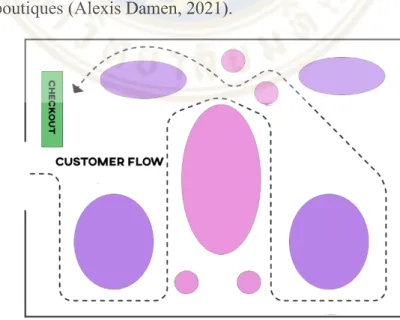
The retail store layout, also known as store design or layout design, refers to how retailers arrange product displays, fixtures, and merchandise in-store. It is critical in retail management because it creates efficient traffic flow for customers, retail convenience, and accident prevention. According to studies, most people turn right after entering a space, beginning a circulation trail through any designed layout (Alexis Damen, 2021). The most common store layout designs in hypermarkets are the straight store layout, diagonal store layout, and curved store layout.
The straight store layout is a simple straight design can entice customers to the store's back, ensuring that all featured merchandise is visible (Alexis Damen, 2021).
Figure 2.3 The Straight Store Layout Source: (Alexis Damen, 2021)
The diagonal store layout includes aisles placed at an angle to expose more merchandise to customers as they walk through the store. It is a grid layout variation that can help direct customers to the checkout counter. This layout is beneficial for space management, making it an excellent choice for retail stores with limited space (Alexis Damen, 2021).
Figure 2.4 The Diagonal Store Layout Source: (Alexis Damen, 2021)
The curved store layout focuses on placing rounded product displays, curved walls and corners, and other curved store fixtures to maintain the customer flow.
In addition, the layout uses free-standing product displays and can give the impression of higher-quality merchandise, making it an excellent retail design option for luxury retailers and boutiques (Alexis Damen, 2021).
Figure 2.5 The Curved Store Layout Source: (Alexis Damen, 2021)
2.5.2 Retail Shelving & Fixtures Design
Retail shelving is necessary for maximizing space by organizing and displaying products. The three most common types of shelving found in stores are wall shelving, gondola shelving, and racks. Wall shelving can save space while also providing more walking space for customers since it is against the wall. The location of the gondola shelving is mainly in the center of the store to direct traffic for customer flow. This shelving can be changed and rearranged to accommodate the specific retail store layout because it is self-contained. Racks are ideal for displaying small items, such as hair accessories, by hanging them. In addition, shelving design can add a unique look to the zone and the promotional display fixtures, which are an essential part of the store's overall sales strategy. Thus, choosing the right color, materials, and shape to apply to the shelving design can also increase store recognition.
2.5.3 Product Assortment
Product assortment, also known as merchandise mix, refers to the variety of products stocked and offered by a retailer. Merchandise is a product or service that is intended for sale and capable of satisfying the consumer (Paul Igbongidi, 2015).
According to Scorţar (2005), there are three levels to display goods, and each level has a different sales potential: the ground, eye level, and above eye level. The eye level is the most preferred position (1.2-1.5 m.) where the merchandise can mostly attract customers to increase product purchase.
The merchandise consists of two dimensions known as breadth and depth, which ultimately shape a customer's perception of a business (Halley Bondy, 2021). It is a product or service that is intended for sale and capable of satisfying the consumer.
A wide range of products (categories) and brands from domestic and import is essential for customers to choose from. Seasonal or highlighted products can increase customer traffic to purchase within a particular store. As a result, retailers can maintain a product assortment mix that suits their customers' needs and helps their businesses thrive by knowing their customers, remaining adaptable, and keeping an eye on trends (Halley Bondy, 2021).
2.5.4 Lighting
The role of lighting in retail design is critical in highlighting product characteristics and setting the atmosphere of the space to create a comfortable and casual shopping environment for customers. Many lighting manufacturers recently offer various lighting systems, such as track, beam, and recessed, to create a different store mood and keep modern (Conitech, 2018) based on the color temperature.
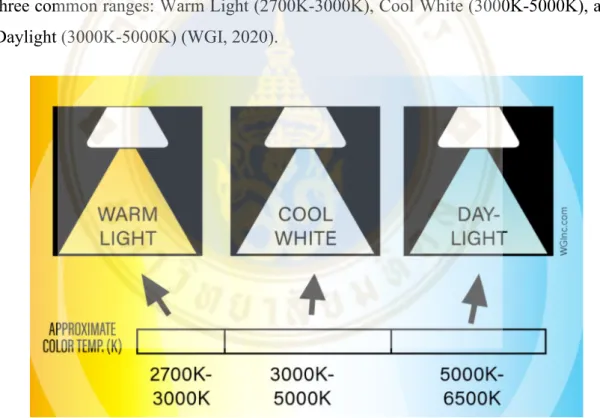
As LED lighting fixtures become more prevalent in terms of function and energy-saving, color temperature or CCT selection is increasingly critical in retail design that affects the overall mood of the store. According to this selection, the temperature and color of lighting can influence consumer perception, productivity, and emotion. The Kelvin (K) scale is the measurement of color temperature, and there are three common ranges: Warm Light (2700K-3000K), Cool White (3000K-5000K), and Daylight (3000K-5000K) (WGI, 2020).
Figure 2.6 Color Temperature Source: (WGI, 2020)
Warm light, which appears orange or yellow and is similar to incandescent light, is relaxing. The color temperature of cool white ranges from yellow-white (3000K) to white (4000K) and blue-white (5000K). The cool white makes it easier to
be attentive, focused, and productive. The color temperature of daylight ranges from blue-white (5000K) to bright blue (6500K) (WGI, 2020).
2.5.5 Color & Design Theme
In retail design, color and design theme refer to the overall mood and tone of the store and its brand image. Color has a strong influence on consumer perception, from the color of the logo to the color of the wall. Choosing the right colors and developing a consistent strategy can significantly impact customer engagement and ultimate sales. Using the right color and design theme based on pleasant preferences can create a unique retail store, such as playful themes, colorful themes, and minimal themes.
According to studies, color accounts for 62 percent to 90 percent of first impressions. If customers do not like the design of a store, 52 percent of customers will not return. Visual appearance also influences 93 percent of purchasing decisions. Color advertisements are more visible to read 42 percent more than black-and-white advertisements. (Ingrid Velasquez, 2017).
Color and design themes can evoke customer emotional responses and create brand recognition. According to Ph.D. Augustin (an environmental psychologist), elicits similar emotional responses in the majority of people. However, there are not always universal truths when it comes to color. Different cultures may have different feelings and thoughts about specific colors. In addition, a person's previous experience with color can influence their feelings about it (Amy Morin, 2014).
In 1980, Plutchik created an emotion wheel based on color to depict various emotions. Designers can use the wheel to investigate the complexities of emotion and to serve as a "color palette" for emotional design, with the idea being that blending different emotions will result in different levels of emotional response and intensities of that response (Interaction Design Foundation, 2021).
Figure 2.7 Robert Plutchik’s Wheel of Emotions Source: Wikipedia
2.5.6 Background music
Music is considered an essential element of store atmosphere that directly influences consumer buying behavior (Nishanov, B. & Ahunjonov, U, 2016). Matilla and Wirtz (2001) discovered that when there is good background music playing, customers are more likely to stay longer in the store and browse through the merchandise. According to the study, listening to appreciative music in a store influences 35 percent of the customers to stay longer, 31 percent of customers to return, 21 percent of people to recommend the place to a friend, and 14 percent of the customer to purchase more (VMSD Reader, 2016). As a result, good background music (genre of music) stimulates impulse buying by triggering the senses of consumers.
2.5.7 Scent
The use of scent in retail, also known as 'scent marketing,' is about transforming the customer experience. Retailers are attempting to capitalize on the power of fragrances, such as perfume in-store, to improve customer mood, feelings, and awareness of their surroundings. The scent is more closely associated with memory and emotion than any other sense. It has a greater chance of influencing a customer's attitude toward and perception of a brand. According to Nike research, using in-store scents can
increase customers' intent to purchase by up to 80 percent. A study conducted by Ambius Premium Scenting on the power of scent in stores found that it can increase consumer engagement with a retail experience by up to 38 percent (Barber, 2018). As a result, using the right scent can elicit a sense of quality and desirability in the store, increasing the number of times customers spend for a better pleasant shopping experience.
2.6. Research Paradigm
This research paradigm (Figure 2.6) focuses on the various ambient factors of store design, dependent variables, and independent variables that significantly impact consumer behavior. Knowledge, background, preferences, experiences, and loyalty &
satisfaction are the dependent variables. On the other hand, independent variables include store layout, shelving design & fixtures, product assortment, lighting, color &
theme, background music, and scent. Effective retail design can foster a positive attitude among customers in their purchasing decisions and the opportunity for customers to return for repeat purchases, which leads to brand loyalty and long-term satisfaction.
Figure 2.8 Research Paradigm
Source: (Mohammad Rasel Mia, 2021) Store layout
Retail Shelving Product Assortment
Lighting
Color & Theme Background Music
Scent
Consumers’
Preferences
Customer loyalty, long-term satisfaction, and repetitive purchase
2.7 Conceptual Framework
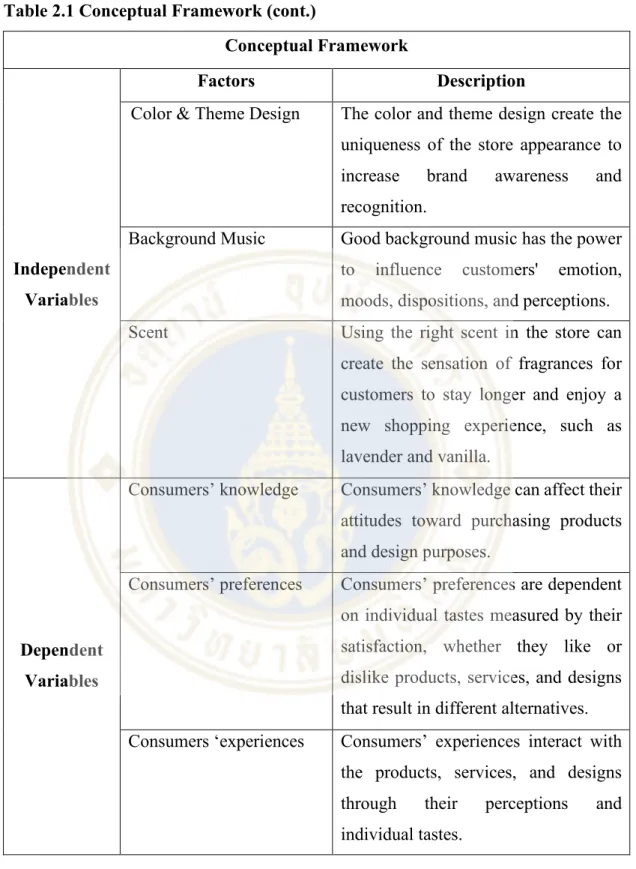
Table 2.1 Conceptual Framework
Conceptual Framework
Independent Variables
Factors Description
Store layout The store layout that organizes product displays, fixtures, and merchandise in- store to create the best customer flow.
Shelving & fixtures design Shelving, in this term, consists of gondola and wall shelves, which are mainly used in retailers to display merchandise, while fixtures refer to any pieces of equipment or furniture used to display products. Shelving and fixtures design, including the decoration, are made from wood or steel with various finishing surfaces, such as laminate and stainless steel.
Product assortment The position of the product arrangement and assortment from domestic and imported sources provides customers with various options for shopping at a one-stop service store at the reachable level.
Lighting Warm white, cool white, and daylight lighting temperatures and colors are related to consumers' emotional responses and behavior based on their preferences.
Table 2.1 Conceptual Framework (cont.)
Conceptual Framework
Independent Variables
Factors Description
Color & Theme Design The color and theme design create the uniqueness of the store appearance to increase brand awareness and recognition.
Background Music Good background music has the power to influence customers' emotion, moods, dispositions, and perceptions.
Scent Using the right scent in the store can create the sensation of fragrances for customers to stay longer and enjoy a new shopping experience, such as lavender and vanilla.
Dependent Variables
Consumers’ knowledge Consumers’ knowledge can affect their attitudes toward purchasing products and design purposes.
Consumers’ preferences Consumers’ preferences are dependent on individual tastes measured by their satisfaction, whether they like or dislike products, services, and designs that result in different alternatives.
Consumers ‘experiences Consumers’ experiences interact with the products, services, and designs through their perceptions and individual tastes.
Table 2.1 Conceptual Framework (cont.)
Conceptual Framework
Dependent Variables
Factors Description
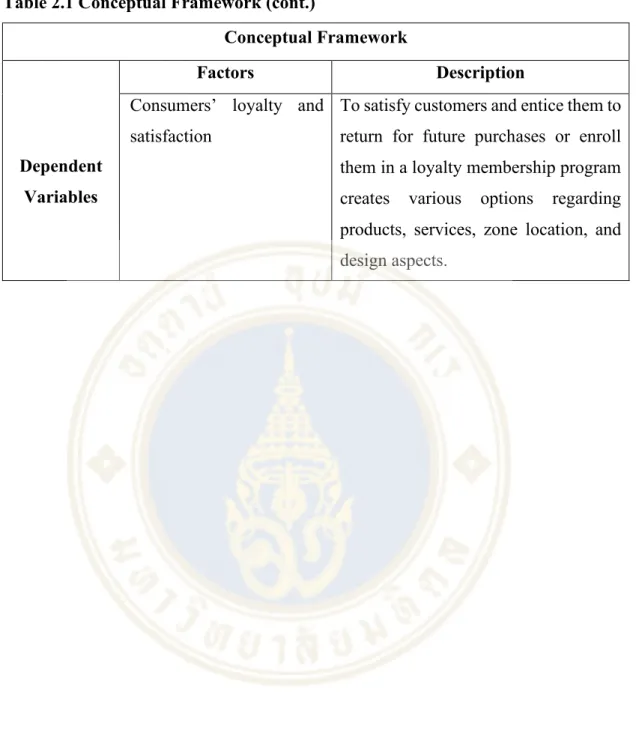
Consumers’ loyalty and satisfaction
To satisfy customers and entice them to return for future purchases or enroll them in a loyalty membership program creates various options regarding products, services, zone location, and design aspects.
CHAPTER III METHODOLOGY
3.1 Research Methodology
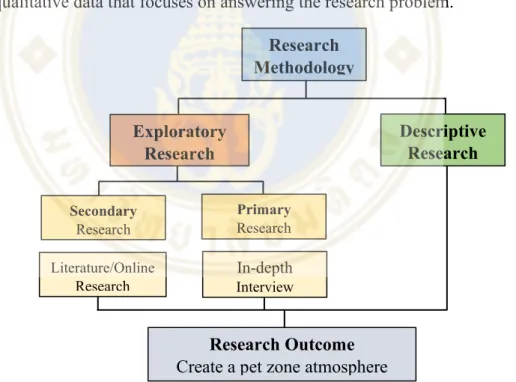
This chapter explains the research methodology categorized into two main parts, which are Exploratory Research and Descriptive Research. The purpose is to analyze the various factors and design elements for improving the in-store environment from customers' perspective in the pet zone in the Tops Market.
Exploratory Research consists of Primary Research through in-depth interviews and Secondary Research through literature/online research. Descriptive Research aims to analyze qualitative data that focuses on answering the research problem.
Figure 3.1 Research Methodology
3.1.1 Exploratory Research
Exploratory research is to analyze innovative design ideas in the area of the pet zone in Tops Market by adapting to the discovery of new data or insight from ambient factors. Conducting the data collection on consumers' behavior toward store
Research Methodology
In-depth Interview Secondary
Research Primary
Research
Descriptive Research Exploratory
Research
Literature/Online Research
Research Outcome Create a pet zone atmosphere
design for pet zones occurs in this stage, resulting in qualitative research to address the design criteria for further development. Exploratory research consists of two research methods are as follows;
3.1.1.1 Secondary Research
Secondary research mainly focuses on gathering information from previous published primary research. The purpose is to investigate how innovative design influences consumers' behavior in hypermarkets in pet zones from the pet parents' perspectives. Secondary research trusted sources include;
i. Published academic journals, case studies, websites newspapers related to pet parents' perspectives, knowledge, and experiences in terms of design aspects
ii. Statistical data from government websites and reliable online survey companies, for example, pet humanization trends, pet food market in Thailand, and pet ownership in Asia.
iii. Online discussion or comments on social media platforms, such as Facebook and blogs.
3.1.1.2 Primary Research
Primary research mainly focuses on gathering information through a target group of people to explore particular perception and perspectives which require in-depth interviews.
iv. In-depth interviews
Following the development of critical studies from secondary research, in-depth interviews aim to understand the relationship between demographics, psychographics, consumer behavior, and ambient factors influencing purchasing decisions, perceptions, and perspectives. The in- depth interview process allows a group of participants to understand the scope of the design aspects and elicit individuals' preferences based on ambient factors to prove a hypothesis that leads to design criteria
3.1.2 Descriptive Research
Descriptive research aims to conduct research based on the qualitative method integrated with some pictures to increase better understanding for those who have no knowledge background in design or Tops Market aspects. The purpose is to identify individual characteristics dependent variables, such as knowledge background, experiences, frequencies, trends, correlations, and categories. The purpose is to describe the research problem of integrating innovative design in the pet zone in Tops Market as a unique selling point in this highly competitive pet retail industry that influences consumers' behavior.
3.2 Sampling Plan
This study focuses on the behavior of pet parents in Thailand who are familiar with hypermarkets. In addition, participants from both genders who live in Thailand at the time and own at least one pet, such as dogs and cats, will be interviewed in-depth. The interviews consist of semi-structured and open-ended questions designed to elicit participants' specific attitudes, knowledge, experience, and perceptions in pet zone design. The sampling method adopts a non-probability convenience sampling method to collect the data within three months, from June to August 2021.
The In-depth interview sampling plan is a qualitative research method that focuses on both demographics and psychographics, as shown below;
Table 3.1 In-depth Interview Sampling plan
In-depth Interview Sampling plan a. Demographics
Gender All (female, male, and LGBT)
Age 25-45 years
Occupation Various occupation
Own pets At least one pet (any pets)
Table 3.1 In-depth Interview Sampling plan (cont.)
In-depth Interview Sampling plan a. Psychographics Attitudes/Perspectives
The focus area depends on individuals’
psychographic in relevant to pet parents in terms of store design aspects.
Preferences (Taste) Knowledge
Experience
Table 3.2 Outline of In-depth Interview Questions and Probes
Focus Area Examples of questions and probes
Study and participant introduction (for pilot interview only)
Q1: Do you understand the scope of the study, and explain why?
Q2: From your understanding, Can you describe the innovative design in a retail store?
Individual’s Attitudes, knowledge, preferences, and experience toward pets
Q3: What do you think about pet humanization in this century?
(for pilot interview only)
Q4: How do you treat your pet in terms of food and products used, and explain why?
Individual’s preferences and experiences toward pet zone in design aspects based on following ambient factors;
Q5: Do you find the retail design in the pet zone affects your purchasing decision behavior and explains why or why not?
Q6: Have you bought pet food and products at Tops Market? If not, where do you regularly purchase pet food and products, and explain why?
● Store layout
Q7: From the given picture (from Figure 2.2- 2.4), do you think store layout affects your behavior in purchasing decisions, and which one do you prefer and explain why?
● Traffic flow
Table 3.2 Outline of In-depth Interview Questions and Probes (cont.) Focus Area Examples of questions and probes
● Convenience
● Aesthetic
● Shelving & fixture design
Q8: Do you think shelving & fixture design affect your behavior in purchasing decisions, and what kind of shelving design & fixtures do you prefer?
● Shape/ form
● Material
● color
● Product Assortment
Q9: Do you think product assortment affects your behavior in purchasing decisions, and what kind of product assortment strategy do you prefer?
● Product variety
(Local and imported brands)
● Shelf position and level
● Lighting
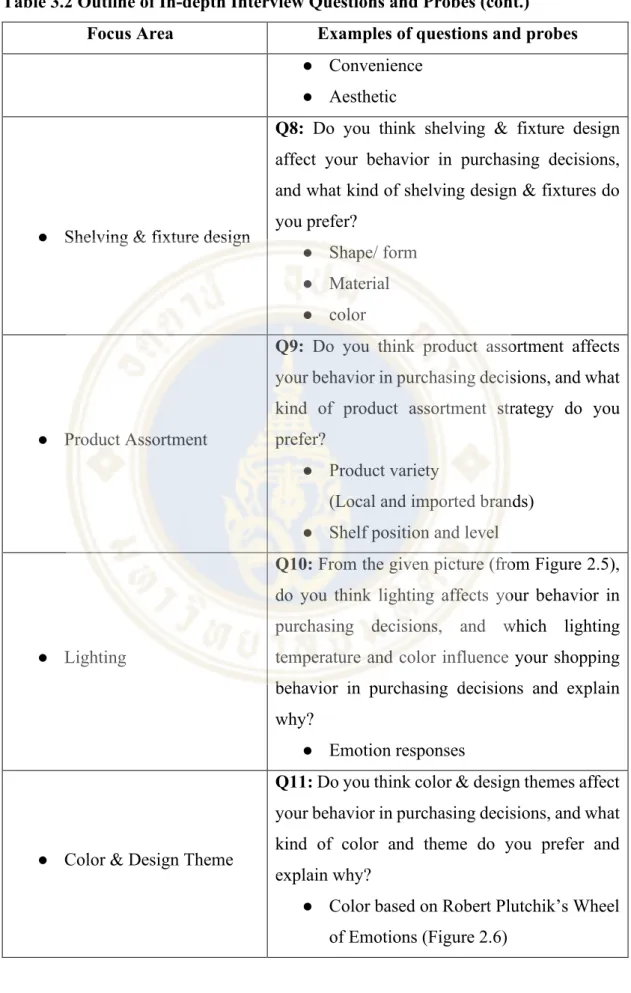
Q10: From the given picture (from Figure 2.5), do you think lighting affects your behavior in purchasing decisions, and which lighting temperature and color influence your shopping behavior in purchasing decisions and explain why?
● Emotion responses
● Color & Design Theme
Q11: Do you think color & design themes affect your behavior in purchasing decisions, and what kind of color and theme do you prefer and explain why?
● Color based on Robert Plutchik’s Wheel of Emotions (Figure 2.6)
Table 3.2 Outline of In-depth Interview Questions and Probes (cont.) Focus Area Examples of questions and probes
● Color & Design Theme ● Design Themes such as minimal, colorful, adventurous, etc.
● Background Music
Q12: Do you think background music affects your behavior in purchasing decisions, and what kind of background music do you prefer and explain why?
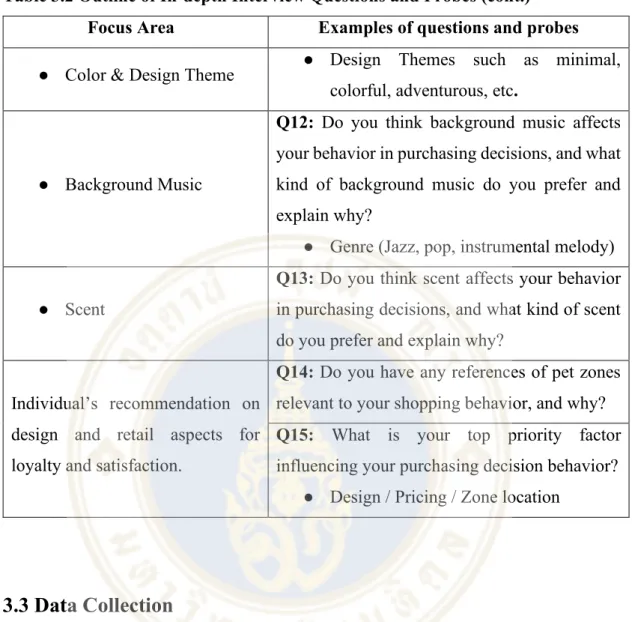
● Genre (Jazz, pop, instrumental melody)
● Scent
Q13: Do you think scent affects your behavior in purchasing decisions, and what kind of scent do you prefer and explain why?
Individual’s recommendation on design and retail aspects for loyalty and satisfaction.
Q14: Do you have any references of pet zones relevant to your shopping behavior, and why?
Q15: What is your top priority factor influencing your purchasing decision behavior?
● Design / Pricing / Zone location
3.3 Data Collection
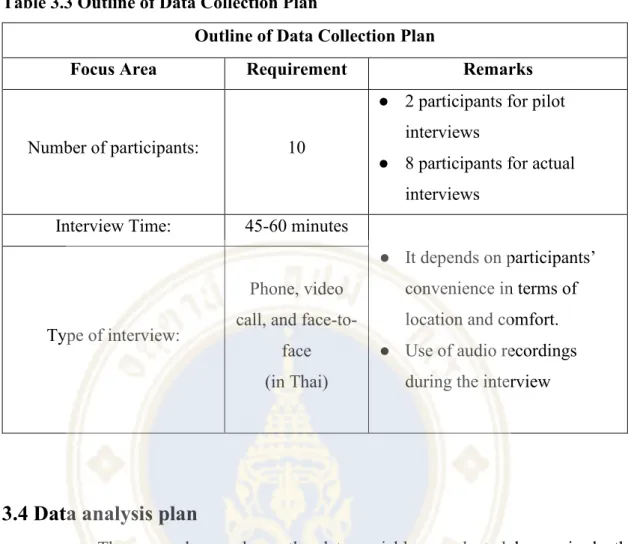
Data collection is a systematic process carried out by qualified participants following the sampling plan shown in table 3.1-3.2. Before conducting the actual interview, the two pre-pilot of an in-depth interview require approval of the efficiency of the questions in June 2021 that includes question 1-3. Participants are recruited through personal connections, such as friends, family members, or co-workers who meet the criteria.
The data collection method is qualitative data that focuses on participants’
in-depth insights under the given condition, as shown below;
Table 3.3 Outline of Data Collection Plan
Outline of Data Collection Plan
Focus Area Requirement Remarks
Number of participants: 10
● 2 participants for pilot interviews
● 8 participants for actual interviews
Interview Time: 45-60 minutes
● It depends on participants’
convenience in terms of location and comfort.
● Use of audio recordings during the interview Type of interview:
Phone, video call, and face-to-
face (in Thai)
3.4 Data analysis plan
The researcher analyzes the data variables conducted by an in-depth interview with ten participants. This qualitative analysis aims to investigate the comprehensive outcome of pet zone design images that affect consumers' behavior in purchasing decisions. Following semi-structured interview questions, the responses will be categorized and codified in the interview transcript and turn it into a criteria as a design guideline and perspective.
Figure 3.2 Data Analysis Plan In-depth interview
questions Interview
Transcript Design
criteria Design
perspective
Stage 1 Stage 2 Stage 3 Stage 4
(Conclusions and Recommendations) (Findings and Analysis)
CHAPTER IV
FINDINGS AND ANALYSIS
This chapter presents the main findings of the research after collecting detailed interview responses from the exploratory research; summarize the data using the conceptual framework of dependent and independent variables with ten participants relevant to their consumer behavior in purchasing decisions on the retail design aspect.
The demographics are to analyze the scope of participants’ profiles; in addition, the primary focus is to analyze the data divided into three main focus areas of the psychographics are as follows;
● Individual’s dependent variables
● Individual’s independent variables
● Individual’s recommendation on design and retail aspects.
4.1 Demographics Profile
To scope down the participants’ profile that most significantly matches the area of the research relevant to psychographics from their perspectives, preferences, knowledge, and experience.
Table 4.1 Participants’ profiles for in-depth interview
No. Gender Age Occupation & workplace Pet(s)
1 Female 27 Designer 1, CFR 1 cat
2 Male 30 Designer 2, EDL company 3 cats
3 Female 28 Tenant Coordinator, CFR 1 dog
4 Female 30 Accountant, Titikit Company 1 dog
5 Female 32 System Analyst, EGAT 2 cats
6 Female 29 Business Owner 4 parrots
Table 4.1 Participants’ profiles for in-depth interview (cont.)
No. Gender Age Occupation & workplace Pet(s) 7 Female 31 Key Account Executive, Abbott 1 cat 8 Female 45 Contractor, Cube Imagine company 3 dogs
9 Male 33 Project Engineer, CFR 2 cats
10 Female 38 Head of Looks, CFR 1 cat
4.2 Psychographics Profile
Psychographics is the qualitative method to analyze the insights of the participants' characteristics based on their attitudes, interest, knowledge, preferences, and experiences that influence purchasing decision behavior in the focus area questions.
4.2.1 Individuals’ Dependent Variables
The participants reflect their behavior based on their attitudes, knowledge, preferences, and experiences with how they treat their pets in the context of pet humanization, which is steadily growing in the twenty-first century. People, as pet parents, tend to remain single or raise their pets to fill their lives as family members before having children or turning their pets into children. They provide the best care for their pets by feeding them high-quality foods and providing them with beneficial products for their health.
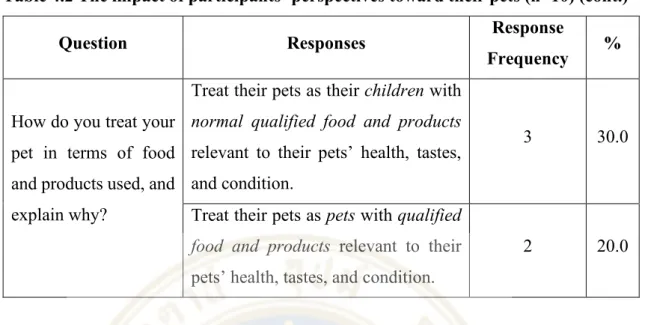
Table 4.2 The impact of participants’ perspectives toward their pets (n=10)
Question Responses Response
Frequency % How do you treat your
pet in terms of food and products used, and explain why?
Treat their pets as their children with unique qualified premium and organic food and products relevant to their pets’ health, tastes, and condition.
5 50.0
Table 4.2 The impact of participants’ perspectives toward their pets (n=10) (cont.)
Question Responses Response
Frequency %
How do you treat your pet in terms of food and products used, and explain why?
Treat their pets as their children with normal qualified food and products relevant to their pets’ health, tastes, and condition.
3 30.0
Treat their pets as pets with qualified food and products relevant to their pets’ health, tastes, and condition.
2 20.0
Most participants love and care for their pets (50%) as if they were children, providing the best premium food and products tailored to their pets' health, tastes, and conditions. Some breeds of pets, such as the mini-Pomeranian, are allergic to protein or shampoo. Thus, premium food and organic products are popular alternatives for pet parents. However, a few participants tend to choose normal qualified food and products since their pets are healthy (30%). Pets that have been adopted or are unable to play with are also considered pets, not children (20%).
● "I consider my dog to be my child, and we spend our days and nights for 24 hours together eating, sleeping, and even working. As a White Mini Pomeranian, my dog requires special care in consuming only premium low protein food to reduce tear strain and using only organic shampoo because it is easily allergic." – Accountant
● "My cats are my children, treated as a prince and princess of the house, and I am overly protective of them. Initially, I fed my two cats regular pet food and products before switching to premium food such as BAFT (high-quality raw meat) for their long-term kidney care and health." – Project Engineer
● "My cat is my child (16- year-old White Persia), and I intend to raise it as best as possible, paying particular attention to food quality. My cat is getting older and sicker, so it can only eat high-quality, low-sodium food
for kidney care and regular check-up at the vet." – Key Account Executive
● "I treat my cats as if they were pets because I adopted them. I don't spoil my cats and only feed them normal cat food and other products such as toys and CBD treats as needed." – System Analyst
● "I regard my four parrots as pets for which I am responsible. Since parrots are generally monogamous, they do not require the same level of care as other dog or cat pets. Because regular food is insufficient for their health, I must supplement their diet with high-quality bird food and dietary supplements such as vitamins and calcium." – Business Owner
4.2.2 Individuals’ Independent Variables
The study's primary focus is on many ambient factors in retail design. Based on preferences and experiences with pet stores, participants were evaluated to investigate the references as a design guideline and criteria. The impact of innovative retail design and purchasing behavior in Tops Market or other shops is a key to understanding participants' perspectives before delving deeply into the following ambient factors.
Table 4.3 The impact of participants’ perspectives toward the design of a pet zone.(n=10)
Question Responses Response
Frequency % Do you find the retail
design in the pet zone affects your purchasing decision behavior and explains
why or why not?
The retail design significantly affects their purchasing decision behavior, attracting them to enter the shop as their first impression.
2 20.0
Table 4.3 The impact of participants’ perspectives toward the design of a pet zone (n=10) (cont.)
The majority of participants (80%) discovered that a well-designed and exciting pet zone retail design moderately affects or influences them to enter the shop.
However, the design alone cannot guarantee that they will purchase until the price and product assortment is interesting. Only a few participants (20%) prioritize design when purchasing pet food and products because most participants consider price and promotion their first impression rather than design.
● "The retail design entices me to enter the store and persuades me to purchase products. Nevertheless, I don't need anything particularly; I will buy it if the retail design and packaging design are appealing, even if the price is high." – Accountant
● "The retail environment significantly influences my purchasing decisions. I expect the appealing shop or zone offers a wide range of excellent premium products at a higher price. I can ensure that I'll get the best products from these designed shops because they've put a lot of money into them." – Business Owner
● "The retail design, mainly the shop near my house with a garden for pets to play in, impacts my purchasing behavior at some point. The appealing shop can ensure that premium products are sold at a high price, so the design should not be too opulent." – Key Account Executive
Question Responses Response
Frequency % Do you find the retail
design in the pet zone affects your purchasing decision behavior and explains
why or why not?
The retail design barely affects or does not affect their purchasing decision behavior, attracting them to enter the shop as their first impression.
0 0.0
● "I haven't seen many cute pet shops yet, but I believe it will entice me to enter if it is well-designed. I can lose track of time looking for products, especially when special offers attract me to purchase more and stay longer in the store." –Designer 1
● "The most crucial factor is that I intend to purchase the product; thus, retail design has a moderate impact on my purchasing behavior.
However, purely based on innovative design, I will rush into the store because I expect it to stock a wide range of high-end products in a one- stop shop." –Designer 2
● "Retail design, in my opinion, has a moderate impact on purchasing decisions. If the shop isn't well designed, I get the impression that it may be dirty and sells low-quality goods." – Tenant Coordinator
Table 4.4 Participants’ purchasing pattern toward the design of a pet zone in Tops Market and other pet shops (n=10)
Question Responses Response
Frequency % Have you bought pet
food and products at Tops Market? If not, where do you regularly purchase pet food and products, and explain why?
Had purchased some pet food and products at Tops Market when immediately needed or convenient at the particular time.
6 60.0
Had never purchased any pet food and products at Tops Market but regularly shop at their location and convenience.
4 40.0
The majority of participants (60%) had purchased pet food and products at Tops Market when they were in a hurry or when it was convenient at the time. They happened to pass by or have the opportunity to purchase products because Tops Market is close to their workplace or home. The other participants (40%) had never bought pet food or products from Tops Market before. They prefer to shop at the pet store closest
to their home because it is convenient for them regarding product variety, prices, and loyalty membership.
● "I had purchased a few pet foods and supplies at Tops Market when I realized I was out of stock. I bought regular products that my pets can eat before buying more pet food at my favorite store near my house because they are cheaper and more convenient." – Designer 1
● "I used to buy pet food and supplies from Tops Market because it is close to my workplace. However, I intended to purchase pet foods and products because of the prices and availability. Pet food and products in Tops Market are more expensive and have a small range of product selection."
– Project Engineer
● "When I had an immediate need for pet food and products, I went to Tops Market. I prefer to buy dog food at my local pet store, specializing in dogs, because the store carries everything, including treats, food, and accessories." – Contractor
● "Because Tops Market is close to my workplace, I shopped there for pet food and supplies when necessary. My regular store is close to my home.
The pet store has a wide range of products purchased in small quantities or as a small complete package. It's intriguing because I can purchase various pet foods for my dog to try." – Tenant Coordinator
● "I've never bought pet food or supplies from Tops Market because it provides high-quality products, and prices are higher than at a wholesale market like Macro. I prefer to purchase pet foods and supplies at Chatujak instead because there are so many shops to choose from, and they sell at a lower price." – System Analyst
● "Only a few types of bird food are available at Tops Market. I used to buy regular mass-produced bird food, but my parrots aren't used to it. As a result, I had no choice but to buy bird food online because it has specific and imported premium bird food in small quantities for parrots." – Business Owner
Table 4.5 The impact of participants’ perspectives toward the ambient factors of design aspects in terms of store layout (n=10) (cont.)
Question Responses Response
Frequency % From the given picture
(from Figure 2.2-2.4), do you think store layout affects your behavior in purchasing decisions, and which one do you prefer and explain why?
• Traffic flow
• Convenience
• Aesthetic
The store layout design significantly affects their purchasing decision behavior regarding traffic flow, convenience, and aesthetic.
4 40.0
The store layout design moderately affects their purchasing decision behavior regarding traffic flow, convenience, and aesthetic.
6 60.0
The store layout design barely affects or does not affect their purchasing decision behavior regarding traffic flow, convenience, and aesthetic.
0 0.0
The store layout design consists of three different types of patterns in terms of traffic flow, convenience, and aesthetic: the straight store layout, the diagonal store layout, and the curved store layout. Most participants (60%) found that the store layout has a moderate impact on their purchasing decision behavior. A few participants (40%) believe that store layout significantly influences their shopping habits because it attracts them.
Figure 4.1 Store Layout
Figure 4.1 illustrates that the diagonal layout is preferred by 7 and 8 participants, respectively, for traffic flow and convenience, as shown in the graph. Both layouts are simple to use and well-organized for finding items. All participants prefer the curved layout in terms of aesthetic because it is more appealing and exciting, especially with curved fixtures to highlight the area.
● "The store layout significantly influences my purchasing behavior because it appeals to the linear structure for traffic flow but convenient for the diagonal design by separating the area for dog and cat. I believe the curved form is appropriate for emphasizing the space and creating a more exciting atmosphere." – Designer 2
● "The layout of the store heavily influences my purchasing habits. The straight layout is ideal for facilitating traffic flow and providing convenience like Tops Market layout. Still, the curved form is more exciting and different from other stores in terms of innovative design."–
Key Account Executive
● "The layout significantly influences my purchasing behavior. The diagonal design is ideal for improving traffic flow and allowing customers to see products from both sides. Customers are drawn to the curved layout because the fixture can be used as a showcase to prioritize product display"– Business Owner
0 2 4 6 8 10 12
Traffic Flow Convenience Authentic
Participants (n=10)
Store Layout
The Straight Layout The Diagonal Layout The Curved Layout
● "The store layout moderately influences my purchasing behavior. I prefer the diagonal form in terms of convenience and customer traffic flow because it appears to be easier to search for products, but it is not visually appealing. Thus, the curved layout is more suitable for creating gimmicks and attracting more customers to stop by."– Project Engineer
● "The store layout moderately influences my purchasing decision. In my opinion, most cheap shops or zones use a straight form to create traffic flow, so I prefer a diagonal format for flow and convenience. In terms of design, the curved layout is best suitable for the luxurious store and attracts customers." – Contractor
● "The store layout moderately influences my purchasing behavior. The diagonal form is best suited for the layout plan because it creates traffic flow and convenience. Still, it must be combined with the straight layout to move the highlighted area closer to the cashier. However, the curved design is not conducive to traffic flow, though it is visually appealing." – Head of Looks
Table 4.6 The impact of participants’ perspectives toward the ambient factors of design aspects in terms of shelving & fixtures design (n=10)
Question Responses Response
Frequency %
Do you think shelving &
fixtures design affect your behavior in purchasing decisions, and what kind of shelving design & fixtures do you prefer?
• Shape/form
• Material • Color
The shelving & fixtures design significantly affects their purchasing decision behavior regarding shape, material, and color.
4 40.0
The shelving & fixtures design moderately affects their purchasing decision behavior regarding shape, material, and color.
5 50.0
Table 4.6 The impact of participants’ perspectives toward the ambient factors of design aspects in terms of shelving & fixtures design (n=10) (cont.)
Question Responses Response
Frequency % Do you think shelving &
fixtures design affect your behavior in purchasing decisions, and what kind of shelving design & fixtures do you prefer?
• Shape/form
• Material • Color
The shelving & fixtures design barely affects or does not affect their purchasing decision behavior regarding shape, material, and color.
1 10.0
The majority of participants (50%) believed that shelving and fixture design can have a moderate impact on their purchasing decisions, particularly fixture design.
While forty percent (40%) of participants think it significantly influences them. Only one participant (10%) found that the shelving & fixtures design has the most negligible impact. The shelving design serves as a general gondola for the pet store's product display and stocking. The shape, material, and color used are determined by the overall image of the store. Still, participants prefer both light and dark colors such as light or dark grey integrated with colored decoration. The material is predetermined to be steel or wood, reflecting the texture and color of the store. Also, gondola shelves must be thick to separate the products from the other sides, not the grid ones. Fixture design must be carefully considered because it can create a focal point for promotional products. The shape can be a circle or an ovary with pet faces as a dump bin that customers can easily pick up. However, the most critical part is integrating the shape, material, and color as the store's design to create a friendly and attractive atmosphere.
● "The shelving and fixture design significantly impact my purchasing decision because well-designed fixtures can influence the chance of purchasing more products, particularly fixture designs that come in a curvy or exciting form and color for promotional products. The preferred
color and material for gondola shelves is light grey or wood because it looks clean and modern, but the decoration can be darker." – Business Owner
● "My purchasing decision is heavily influenced by the shelving and fixture design. Exciting shapes, such as a dog or cat, can be used in the design. The color or material should be dark, such as dark grey, with wooden embellishments. The curvy fixtures can make the shop more attractive." – Designer 2
● "The shelving and fixture design have a moderate influence on my purchasing decision. To make the gondola shelves more appealing with the pet graphic, they should be light grey with a yellow wooden decoration as a shelf cover. The fixture should be highlighted as a promotional area that can entice customers outside to come inside and purchase." – Designer 1
● "I believe that my purchasing decision is moderately based on the shelving and fixture design with any color that matches the overall image store design. I prefer wooden shelves with colorful decorations, such as pink combined with grey. Curvy or rectangular shapes with pet graphics and decorations can be used for fixture design." – Accountant
● "Gondola shelving has a moderate impact than the fixtures used to highlight promotional products to enhance the variety near the cashier.
The shelf should be thick and made of wood to appear soft and in line with the stores color theme design. To make the fixture more interesting, it should include a die-cut pet face." – Head of Looks
● "I believe that shelving and fixture design have little influence on my purchasing behavior because I am more concerned with the products than with the shelf design. It must have clear visibility to weigh products on shelves of any color, shape, or material. Still, it must also be open for easy access to pick up products. The store, on the other hand, must have fixtures that provide the highlighted display products."– System Analyst
Table 4.7 The impact of participants’ perspectives toward the ambient factors of design aspects in terms of shelving product assortment (n=10)
Question Responses Response
Frequency %
Do you think product assortment affects your behavior in purchasing decisions, and what kind of product assortment strategy do you prefer?
• Product variety (Local and imported brands)
• Shelf position and level
The product assortment significantly affects their purchasing decision behavior regarding product variety and shelf level.
8 80.0
The product assortment moderately affects their purchasing decision behavior regarding product variety and shelf level.
2 50.0
The product assortment barely affects or does not affect their purchasing decision behavior regarding product variety and shelf level.
0 0.0
The product assortment is the most influential factor influencing participants' purchasing decisions. Particularly the product variety that includes unique mixtures such as innovative products and cute accessories. Participants usually look for these items in pet stores other than Tops Market. Eighty percent (80%) of participants believed that product assortment has a significant impact on their purchasing behavior.
They enjoy the variety of products from various brands and the ability to compare prices and preferences. The gondola shelf level height should not exceed 1.60 meters to reach the products at a comfortable level.
● "The product assortment has a significant impact on how I buy products, particularly the variety and uniqueness of pet products such as automatic pet toilets. Tops market needs to focus more on product variety to attract