LINKING SMALL-SCALE FARMERS TO MARKET USING ICT
PEMA GYELTSHEN
MASTER OF SCIENCE IN DIGITAL TECHNOLOGY INNOVATION MAEJO UNIVERSITY
2019
LINKING SMALL-SCALE FARMERS TO MARKET USING ICT
PEMA GYELTSHEN
A THESIS SUBMITTED IN PARTIAL FULFILLMENT
OF THE REQUIREMENTS FOR THE DEGREE OF MASTER OF SCIENCE IN DIGITAL TECHNOLOGY INNOVATION
ACADEMIC ADMINISTRATION AND DEVELOPMENT MAEJO UNIVERSITY 2019
Copyright of Maejo University
LINKING SMALL-SCALE FARMERS TO MARKET USING ICT
PEMA GYELTSHEN
THIS THESIS HAS BEEN APPROVED IN PARTIAL FULFLLMENT OF THE REQUIREMENTS FOR THE DEGREE OF MASTER OF SCIENCE
IN DIGITAL TECHNOLOGY INNOVATION
APPROVED BY Advisory Committee
Chair
(Dr. Kittisak Osathanunkul) .../.../ ...
Committee
(Dr. Nasi Tantitaranukul) .../.../ ...
Committee
(Dr. Kittikorn Hantrakul) .../.../ ...
Program Chair, Master of Science
in Digital Technology Innovation (Dr. Kittikorn Hantrakul) .../.../ ...
CERTIFIED BY ACADEMIC
ADMINISTRATION AND DEVELOPMENT
(Associate Professor Dr. Yanin Opatpatanakit) Acting Vice President for the Acting President of
Maejo University .../.../ ...
C
ABSTRACT (THAI)
ชื่อเรื่อง การเชื่อมโยงเกษตรกรรายย่อยเข้ากับตลาดโดยใช้เทคโนโลยีสารสนเทศ ชื่อผู้เขียน Mr.Pema Gyeltshen
ชื่อปริญญา วิทยาศาสตรมหาบัณฑิต สาขาวิชานวัตกรรมเทคโนโลยีดิจิทัล อาจารย์ที่ปรึกษาหลัก กิติศักดิ์ โอสถานันต์กุล
บทคัดย่อ
ในประเทศพัฒนาน้อยที่สุด (LDCs) เกษตรกรส่วนใหญ่เป็นเกษตรกรรายย่อยและเผชิญ กับความท้าทายมากมายในการท าการตลาดผลิตภัณฑ์ของตน แม้ว่าเกษตรกรรายย่อย มีศักยภาพในการลดความยากจนในชนบทและบรรลุความมั่นคงด้านอาหารระดับโลก ได้ก็ตาม แต่ก็ขึ้นอยู่กับศักยภาพการผลิตและการเข้าถึงตลาด
นอกจากนี้ การเข้าถึงตลาดส าหรับเกษตรกรรายย่อยขึ้นอยู่กับข้อมูลการตลาดที่เชื่อถือได้
ทันเวลาและมีข้อสนเทศที่เกี่ยวข้อง ดังนั้น การศึกษ าจึงมุ่งเน้นที่การระบุความท้าทาย ที่เกษตรกรรายย่อยต้องเผชิญในการท าการตลาดผลิตภัณฑ์ของพวกเขา การรวมระบบ ดิจิทัลของเกษตรกร ผู้ใช้ระบบสารสนเทศการตลาด (MIS) และความต้องการของเกษตรกร ผู้ให้บริการโครงสร้างองค์กรของ MIS และความยั่งยืนเพื่อพัฒนากรอบการท างานเพื่อ ช่วยการออกแบบระบบเชื่อมโยงการตลาด (M LS) และตรวจสอบประโยชน์ของ MLS ที่ออกแบบโดยใช้กรอบการท างานของ MLS ผ่านการส ารวจผู้ใช้ MLS จุดประสงค์ของ MLS คือการเชื่อมโยงเกษตรกรรายย่อยเข้ากับตลาดเพื่อให้ความท้าทายทางการตลาด ที่ระบุแล้วสามารถแก้ไขได้ด้วยคุณสมบัติของ MLS
ผลการวิจัยชี้ให้เห็นว่าเกษตรกรและตัวแทนส่งเสริมมีความเห็นว่า MLS จะเป็นประโยชน์
ในการแก้ปัญหาความท้าทายทางการตลาดของเกษตรกรรายย่อย ในทางกลับกันแม้ว่า ผู้ค้ากว่าห้าสิบเปอร์เซ็นต์จะเห็นประโยชน์ในเชิงบวกของ MLS แต่เกือบสี่สิบเปอร์เซ็นต์
มีความเห็นเป็นกลาง และที่เหลือมีความเห็นในเชิงลบ
ค าส าคัญ : เกษตรกรรายย่อย, ระบบสารสนเทศการตลาด, ระบบการเชื่อมโยงตลาด
D
ABSTRACT (ENGLISH)
Title LINKING SMALL-SCALE FARMERS TO MARKET
USING ICT
Author Mr. Pema Gyeltshen
Degree Master of Science in Digital Technology Innovation
Advisory Committee Chairperson Dr. Kittisak Osathanunkul
ABSTRACT
In the least Developed Countries (LDCs) majority of the farmer are smallholders and they are confronted with numerous challenges in marketing their products. Although small-scale farmers have potential in reducing rural poverty and achieving global food sufficiency, it is dependent on their production potential and access to the market.
Access to market for small-scale farmers further depends on reliable, timely and relevant market information. Therefore this study focused on identifying challenges faced by small-scale farmers in marketing their products, develop a framework to help design electronic market linkage system (MLS) and validate the usefulness of the framework through MLS user survey. The aim of MLS is to link small-scale farmers with the market so that those identified marketing challenges could be solved through features in MLS.
The result indicates, farmers and extension agents had the view that MLS will be useful in solving small-scale farmer common marketing challenges. On the other hand, although over fifty percent of the vendors were positive that MLS would be useful, almost forty percent were neutral in their opinion and ten percent had a negative view.
Keywords : Small-scale farmer, Market linkage system, Market information system
E
F
ACKNOWLEDGE MENTS
ACKNOWLEDGEMENTS
The author would like to thank professors at Digital Technology Innovation, Faculty of Science, Maejo University for their guidance and support throughout this work. Author would also like to thank Graduate School, Maejo University for their preliminary research scholarships support.
Lastly author would like to thank Ministry of Agriculture and Forests (MoAF), Thimphu, Bhutan and European Union Technical Project EU-TCP for the scholarship.
Pema Gyeltshen
TABLE OF CONTENTS
Page ABSTRACT (THAI) ... C ABSTRACT (ENGLISH) ... D ACKNOWLEDGEMENTS ... F TABLE OF CONTENTS ... G List of Tables ... K List of Figures ... L
1. Introduction. ... 1
1.1 Background. ... 1
1.2 Problem statement ... 2
1.3 Objective of the study ... 3
1.4 Significance of the study ... 4
1.5 Scope and limitation of the study ... 5
2. Literature Reviews ... 7
2.1 Challenges ... 8
2.1.1 Small-Scale farmers’ marketing challenges ... 8
2.1.1.1 Market Information: ... 10
2.1.1.2 Market Access ... 10
2.1.1.3 Insufficient production ... 11
2.1.1.4 High transportation and transaction cost ... 11
2.1.1.5 Inconsistent supply ... 12
2.1.1.6 Poor marketing infrastructure ... 12
H
2.1.2 Digital Inclusion ... 13
2.1.2.1 Access ... 14
2.1.2.2 Adoption ... 16
2.1.2.3 Application ... 18
2.2 Users and their information needs ... 18
2.3 Trends of existing AMIS ... 21
2.3.1 The 1st Generation of AMIS ... 21
2.3.2 The 2nd Generation of AMIS ... 22
2.4 Implementation and sustainability. ... 23
2.4.1 Government (as owner) ... 23
2.4.2 Farmers and Vendors (as main user) ... 24
2.4.3 Extension agent (as a partner) ... 24
2.4.4 Sustainability ... 25
2.5 Summary of Gap analysis ... 26
Possible Solution ... 28
3. Methodology ... 30
3.1 Theoretical framework ... 30
3.2 Operational definition. ... 30
3.3 Research Design ... 32
3.4 Population, Sampling, and Data Collection. ... 33
3.5 Method of data analysis ... 34
4. MLS Framework ... 36
4.1 Planning ... 36
4.1.1 Project Sponsor: ... 36
I
4.1.2 Business needs: ... 37
4.1.3 Business requirements ... 37
4.1.4 Business value ... 39
4.1.5 Special issues and constraints (marketing Challenges) ... 40
4.2 Analysis ... 41
4.2.1 Technical feasibility (Digital Inclusion) ... 41
4.2.2 Economic feasibility ... 43
4.2.3 Organizational feasibility: ... 44
4.3 Design... 45
4.3.1 MLS Framework ... 45
4.3.2 MLS Framework Overview ... 45
4.3.3 MLS Framework Architecture ... 47
4.3.3.1 Public Layer ... 47
4.3.3.1.1 Farmer/farmers group Interface ... 48
4.3.3.1.2 Vendor Interface ... 51
4.3.3.2 Government layer ... 52
4.3.3.2.1 Extensions agents interface: ... 52
4.3.3.2.2 Policy Makers interface: ... 54
4.3.3.3 Feedback system ... 55
4.3.3.4 Search option. ... 56
4.3.4 Process of information flow. ... 56
4.3.5 Summary. ... 58
5. Results ... 59
5.1 Farmers’ perspective ... 59
J
5.2 Extension Agents perspective ... 62
5.3 Vendors’ perspective ... 64
6. Discussion and Conclusion ... 67
REFERENCES ... 73
CURRICULUM VITAE ... 82
List of Tables
Page
Table 1. Marketing challenges faced by the small-scale farmer. ... 9
Table 2. Factors that limit the use of ICTs by small-scale farmers ... 16
Table 3: Information need of Small-scale farmer ... 19
Table 4: Information needs of the vendor ... 20
Table 5: Information need of government (policy maker) ... 20
Table 6 Marketing challenges and solution. ... 58
Table 7 Digital inclusion challenges and solution ... 58
Table 8. Median and IQR values. ... 60
Table 9. Extension agents’ perspective ... 62
Table 10. Vendors’ perspective ... 64
List of Figures
Page
Figure 1. Region-wise average land holding (FAO, 2012) ... 1
Figure 2. Review approach conceptualized focused on small-scale farmers ... 7
Figure 3. Digital Inclusion concept diagram ... 13
Figure 4. Access Rainbow. Source:(Clement & Shade, 2000; Mcnamara et al., 2011). 15 Figure 5: Projection of 3G coverage, and mobile broadband price, and mobile cellular subscription in LDCs. ... 17
Figure 6. The implementation model of AIMS ... 28
Figure 7. Possible Solution with MLS ... 29
Figure 8. Theoretical framework ... 31
Figure 9: Framework Architecture for Market Linkage System ... 47
Figure 10: Information flow in conventional MIS ... 57
Figure 11: Information flow (Farmers with digital literacy and access to ICT) ... 57
Figure 12: Information flow (Farmers without digital literacy and access to ICT) ... 58
Figure 13: Respondents view on MLS providing market information ... 61
Figure 14. Respondents view on various challenges. ... 61
Figure 15: Extension Agents perspective. ... 63
Figure 16: Box plot for Extension agents’ perspective. ... 63
Figure 17: Box plot for vendors’ perspective ... 65
Figure 18: Vendors perspective. ... 65
Figure 19: ICT4D in Agriculture ... 71
In the Least Developed Countries (LDCs) and developing countries, the majority of the population depends on agriculture. There are some 500 million smallholder farms worldwide, and more than 2 billion people depend their livelihood on these farms. Small farms produce about 80 percent of the food consumed in Asia and sub- Saharan Africa (FAO, 2012, 2014; Nwanze, 2011). Whereas their contribution to the economy is minimal compared to other sectors. Statistic from FAO (UN, 2011) shows that 70% of the population in LDCs depends on agriculture, but their contributions to gross domestic product is less than 30%. In this study, the small-scale farmer is defined as those households who own less than two hectares (ha) of farmland. On average, small farmers in Asia and sub-Saharan Africa own less than 2 ha of land (FAO, 2012, 2014).
Figure 1. Region-wise average land holding (FAO, 2012)
1.6 1.6 1.8 5 7 11
0 2 4 6 8 10 12
(Developing)Asia Asia OECD (Japan & R.
Korea)
Africa (Sub- Saharan) without SA
Near East and
North Africa Pacific
(Developing) Africa (Sub- Saharan) with
SA Average size of land holding in Hectares(ha)
The global population will hit 9 billion by 2050 which will requires a 70 percent increase in food production (FAO, 2009) to be able to feed us all. Although, small- scale farms have potential to contribute towards achieving global food security (Jones, 2012; Magesa, Michael, & Ko, 2014, 2015), and reducing rural poverty (Thorp, Stewart, & Heyer, 2005), it is totally depending on production potential, capacity to innovate and access to market (FAO, 2014; IFAD, 2013; Matsane & Oyekale, 2014).
This study will emphasis on access to market aspect amongst the three through Market Information System (MIS). With the population growth, global demands for horticulture and livestock products are also growing. It is highlighted that the domestic market has high potential to fulfill those demands. Also, quality requirements for domestic markets are modest, which gives small-scale farmers an opportunity to compete in these markets (Poulton, Dorward, & Kydd, 2010).
1.2 Problem statement
Magesa et al. (2015) mentioned that with the growth in ICT, the agriculture marketing environment has changed in very diverse ways both locally and globally. While Industrial producer were able to leverage ICT in agriculture, small-scale farmers still depend on word of mouth and previous experience (Mcnamara, Belden, Kelly, Pehu,
& Donovan, 2011). The later still follows traditional farming methods mainly focused on supply-driven production which has to be replaced by demand-driven production (Shepherd, 2007) to ease their marketing challenges.
Demand-driven production mainly depends on market information. Agriculture productivity can be realized when farmers have access to market information (Masuki et al., 2010; Siyao, 2012). With the information, farmers will be able to reduce their transaction cost, improve transportation, enhance bargaining power and access more market for their products (Benfica & Mather, 2013; Jama & Pizarro, 2008; Jari & Fraser, 2009; Matsane & Oyekale, 2014; Rehman, Selvaraj, & Ibrahim 2012; Vadivelu & Kiran, 2013).
1.3 Objective of the study
Through literatures related to agriculture marketing, from Shepherd (1997) “Theory and Practice” to the latest review conducted by FAO (2017), it is evident that in last two decade MIS mainly focused on one-way flow of information, and Kizito (2011) used the term “vertical integration of MIS activities” for the same. MIS provider initially collects the data and transmits to the central database (mainly price data) then analyzes and later disseminates to the farmer through various mediums. While this study will look into two-way information flow, i.e. from vendors to farmers and vice versa. Where MIS providers need not collect, and disseminate data. Rather they can make use of data (quantity, quality, time, contacts, etc.) that flows between vendor and farmer for policy intervention and early warning.
Therefore the objective of this study is to develop a MLS framework to help design effective and sustainable ICT based Market Linkage System (MLS) incorporated with MIS functionality to promote small-scale farmers marketing by:
a) Identifying challenges faced by small-scale farmers in marketing and digital inclusion,
b) Exploring trends of existing agriculture MIS, c) Assessing users and their information needs and
d) Determining the implementation plan and sustainability.
1.4 Significance of the study
Having MLS combined with MIS functionalities will benefit small-scale farmers. With the information from the system, farmers can decide on what to produce, which technology to apply while producing, when to produce, whom to produce for, and what price to sell (Magesa et al., 2014; Mukhebi et al., 2007; Shepherd, 1997). Linkage components will help farmers and vendors to connect virtually. Furthermore, farmers will have a choice to do business directly with vendors reducing multi-layer of middleman resulting in a better price. Ultimately, access to the market by the small-scale farmer will promote subsistence to commercial farming, improve their income (CTA, 2006; Fafchamps & Vargas-Hill, 2005; Shepherd, 1997), food security, and provide rural employment (FAO, 2014; IFAD, 2013).
On the other hand, lack of market information can lead to farmers receiving an unfair price, and susceptible to several challenges during production, transportation, and marketing. Further trader exploits unaware farmers by paying a low price for their products (Kindness & Gordon, 2001; Magesa et al., 2014, 2015). Therefore, the focus of this study is on small-scale farmer’s access to the market through an ICT approach called Market Linkage System (MLS). The MLS is a linkage system combined with the functionality of MIS to improve market linkage between small-scale farmer and vendors virtually. The system will provide timely, accurate and relevant market- related information enabling them to participate in the domestic market.
1.5 Scope and limitation of the study
The study was conducted from small-scale farmers perspective based on secondary data consisting of journal articles, conference proceeding, dissertation, and international organizations publication, mainly focused on the small-scale farmer of LDC in Sub-Saharan Africa and Asia. Articles from 1997-2017 were considered from various databases and International organizations websites.
The purpose of this thesis is to identify an issues creating gap between small scale farmers and a market, and to study on how to tackle those issues to promote small- scale farmers marketing. The studies show one way to tackle the issues is through MIS, while reviewing trends of existing MIS it was evident that a linkage component to improve small-scale farmers marketing was missing, hence need for MLS was
observed. To develop effective and sustainable MLS there is a need for MLS development framework. The MLS framework proposed in this thesis is developed based on the theory of System Analysis and Design (SAD)(Dennis, Wixom, & Roth, 2012) with the System Development Life Cycle (SDLC) concept in specific. The study is focused on the development of a MLS framework to help design specific Information System (Market Linkage System). However, based on the SDLC, the scope of this thesis will cover only planning, analysis and design components. There will be no development/implementation included as it is beyond our scope of the thesis. If development/implementation component is to be considered, the financial implication and time required will be huge as it will be a life project involving various stakeholders covering a specific country for a few seasons. Instead, a survey approach was adapted to collect views from respective stakeholders’ in order to validate the MLS framework.
2. Literature Reviews
The review of the market information and linkage was focused on small-scale farmers in LDCs. The process of studying a solution of small-scale agriculture marketing can be summarized as shown in figure 2. Firstly, small-scale farmers marketing challenges has to be identified. Likewise, rural populations’ digital inclusiveness needs to be reviewed since most of the small-scale farmers are from a rural area. Digital inclusion can be crucial because the effectiveness of MLS is dependent on it.
Figure 2. Review approach conceptualized focused on small-scale farmers
Secondly, users has to be identified and their respective needs has to be explored as they are important. It should be focused on how small-scale farmers market their products, as well as on stakeholders involved in both supply and demand side (supply chain). Similarly, the needs of the MLS provider should be considered too.
2.1. Challenges 2.1.1 Marketing 2.1.2 Digital Inclusion
2.2 Users and their Information needs
2.3 Trend (Existing Market Information System)
2.4 Implementation Plan
Must review Review if available
The trends of the existing solutions has to be studied if available. Through these review, best practices and the knowledge on limitations of the existing system can be understood. Lastly, the organizational structure of MLS provider and sustainability aspects has to be reviewed.
2.1 Challenges
2.1.1 Small-Scale farmers’ marketing challenges
Agriculture activities are broadly classified into two categories: production and marketing. The production category consists of input, process, and output. The inputs can be seed seedling, fertilizers, machinery, etc. It is used to produce end products like cereal, vegetable, meat, fruits, etc. All those activities and sub-activities performed to produce end product are considered as in production categories.
Rehman et al. (2012) mentioned that “Agriculture marketing can be defined as the commercial functions involved in transferring agricultural products consisting of farm, horticulture and other allied products from producer to consumer”.
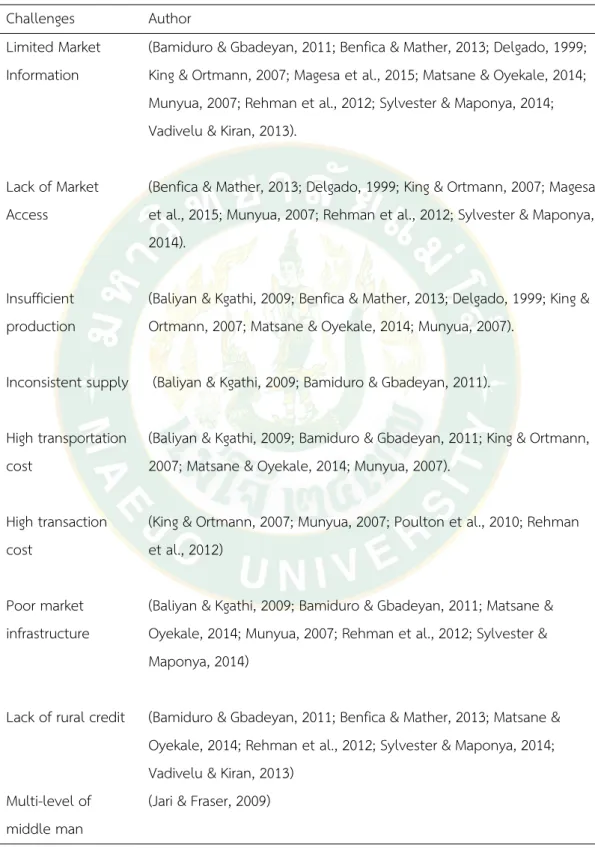
Agriculture Marketing has been changing and taking shape at the local, national and global arena with the development of ICT (Magesa et al., 2015). However small-scale farmers’ are still confronted by some challenges. The common marketing challenges are limited market information, lack of market access, insufficient production, inconsistent supply, high transportation & transaction cost, and poor marketing infrastructure. The lists of the challenges are as shown in Table 1.
Table 1. Marketing challenges faced by the small-scale farmer.
Challenges Author
Limited Market Information
(Bamiduro & Gbadeyan, 2011; Benfica & Mather, 2013; Delgado, 1999;
King & Ortmann, 2007; Magesa et al., 2015; Matsane & Oyekale, 2014;
Munyua, 2007; Rehman et al., 2012; Sylvester & Maponya, 2014;
Vadivelu & Kiran, 2013).
Lack of Market Access
(Benfica & Mather, 2013; Delgado, 1999; King & Ortmann, 2007; Magesa et al., 2015; Munyua, 2007; Rehman et al., 2012; Sylvester & Maponya, 2014).
Insufficient
production
(Baliyan & Kgathi, 2009; Benfica & Mather, 2013; Delgado, 1999; King &
Ortmann, 2007; Matsane & Oyekale, 2014; Munyua, 2007).
Inconsistent supply (Baliyan & Kgathi, 2009; Bamiduro & Gbadeyan, 2011).
High transportation cost
(Baliyan & Kgathi, 2009; Bamiduro & Gbadeyan, 2011; King & Ortmann, 2007; Matsane & Oyekale, 2014; Munyua, 2007).
High transaction cost
(King & Ortmann, 2007; Munyua, 2007; Poulton et al., 2010; Rehman et al., 2012)
Poor market infrastructure
(Baliyan & Kgathi, 2009; Bamiduro & Gbadeyan, 2011; Matsane &
Oyekale, 2014; Munyua, 2007; Rehman et al., 2012; Sylvester &
Maponya, 2014)
Lack of rural credit (Bamiduro & Gbadeyan, 2011; Benfica & Mather, 2013; Matsane &
Oyekale, 2014; Rehman et al., 2012; Sylvester & Maponya, 2014;
Vadivelu & Kiran, 2013) Multi-level of
middle man
(Jari & Fraser, 2009)
2.1.1.1 Market Information:
Market information according to Vadivelu and Kiran (2013) is meant to improve market efficiency, better price formulation, guide farmers on what to produce, when to produce, and when & where to sell (Vadivelu & Kiran, 2013). Small-scale farmers of LDCs and developing countries in Asia and Sub-Saharan Africa are still constrained with information related to agriculture produce such as availability, quantity, quality, and price. This will result in an uninformed decision from both vendor and farmers’
side, thus fluctuation in price and wastage of products are common. Xaba and Masuku (2013) stated that market information is important for the producer (farmers) to plan and identify what to produce, and where to market. In addition, Shepherd also mentioned that information on market condition at every point of market chain is important for deciding on where to market (Shepherd, 1997). Conventional marketing systems are still followed in these regions where stakeholders depend on their individual contacts for market information, which is not systematic and it fulfills the need of only few individuals.
2.1.1.2 Market Access
Market information is a key to market access. Without market information, the producer will have difficulty in planning on what to produce. Without production, no marketing activities will exist. This means that information is a barrier for both farmers and vendor (CTA, 2006). Without market information, farmers’ will not know where
to supply their products, therefore they sell directly from the farm or at the local market (Torero, 2011). Usually, they sell to the middleman and the price is comparatively low (Fafchamps & Vargas-Hill, 2005). On the other hand, vendors without information will have difficulty in gathering products. Whereby they depend on personal connection and relationship. Hence market access is dependent on market information.
2.1.1.3 Insufficient production
The production capacity of small-scale farmers is generally low. They produce in lesser quantities due to limited landholding. Practically it is not feasible and profitable for them to market in a smaller volume. Some authors in Table 1 pointed out that insufficient production as a major hurdle that ultimately hinders commercial business viability.
2.1.1.4 High transportation and transaction cost
Insufficient production will lead to high transportation cost. Logically transporting larger volume is more economical than transporting smaller volumes separately.
Ultimately for the small-scale farmer, product wastage occurs at farm level. As it is not cost-effective to transport their products to the market if they are not able to recover transportation cost. Furthermore, small-scale farmers marketing their products individually is inefficient both from sellers and buyers perspective, because it will lead to an increase in transportation cost (Delgado, 1999; Shepherd, 1997).
2.1.1.5 Inconsistent supply
An individual small-scale farmer producing on a seasonal basis without any demand information will have difficulty in meeting consumers’ need. Whereas vendors to sustain their business and to meet the demand of their customer they need a continuous supply. Further unorganized market and those farmers who do not depend their livelihood solely on farming tend to sell their product at any price offered by the vendor. Which is not good for the industry in the long run, as it promotes inconsistent supply and unrealistic pricing structure (Xaba & Masuku, 2013).
Insufficient production and inconsistent supply are also attributed to lack of cropping plan, soil fertility, finance, vulnerability to pest and disease, and expensive inputs (Baliyan & Kgathi, 2009).
2.1.1.6 Poor marketing infrastructure
Marketing infrastructure like storage facilities can be crucial for small-scale farmers.
Harvested crops should be transported and stored in appropriate facility. It is essential for perishable goods to maintain quality before selling. To store perishable goods is a difficult task. This is because perishable goods are likely to go bad quickly and it requires technical expertise and cold storage facilities to preserve quality (Markelova, Meinzen-Dick, Hellin, & Dohrn, 2009). Researchers found that one of the reasons behind market failure in Sub-Saharan region was due to poor market
infrastructures such as lack of storage facilities (Kidane, Maetz, & Dardel, 2006), and the poor state of road infrastructure (Baliyan & Kgathi, 2009).
2.1.2 Digital Inclusion
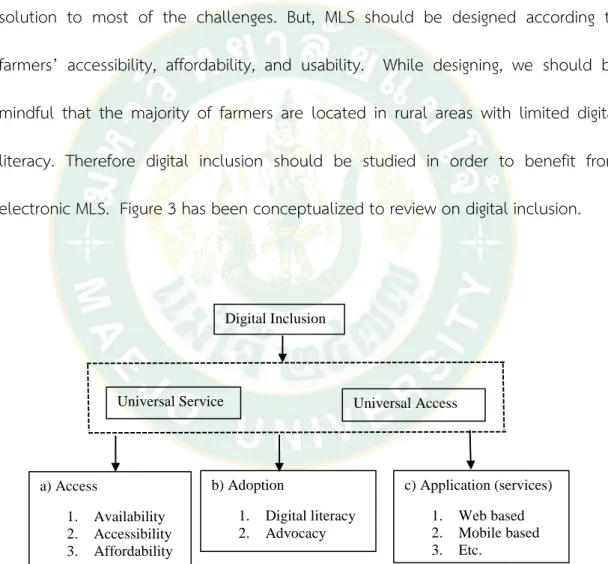
From the previous sections, it can be seen that small-scale farmers are facing several common marketing challenges. Having an effective MLS will provide a potential solution to most of the challenges. But, MLS should be designed according to farmers’ accessibility, affordability, and usability. While designing, we should be mindful that the majority of farmers are located in rural areas with limited digital literacy. Therefore digital inclusion should be studied in order to benefit from electronic MLS. Figure 3 has been conceptualized to review on digital inclusion.
Figure 3. Digital Inclusion concept diagram
According to the International Telecommunication Union, digital inclusion means empowering people through information and communication technologies (ICTs).
Digital Inclusion
Universal Service
a) Access
1. Availability 2. Accessibility 3. Affordability
b) Adoption
1. Digital literacy 2. Advocacy
Universal Access
c) Application (services) 1. Web based 2. Mobile based 3. Etc.
And the University of Maryland College defines digital inclusion as a framework used to study the readiness of communities so that ICT applications can be used to overcome the challenges faced by a conventional process.
Universal service means anyone or any household having opportunity to ICT service and universal access means anyone in the community can have access to publicly available ICT service (Dorward, 2013; ITU, 2008, 2013). Availability, affordability, and accessibility are the key components for universal access and universal services. And with the inclusion of Internet and broadband in universal access and services, ability (digital literacy) and awareness (advocacy) are becoming inevitable in the concept of Digital inclusion (ITU, 2013).
2.1.2.1 Access
Clement and shade’s conceptual model for access showcases seven interrelated layers which is necessary to accomplish proper service access (Clement & Shade, 2000). Further, Barrett and Slavova categorized these seven layers into three broader areas; access to service, appliances, and infrastructure (figure 4)
Figure 4. Access Rainbow. Source:(Clement & Shade, 2000; Mcnamara et al., 2011).
Access to services;
i) Governance represents decision-making bodies related to ICT infrastructure.
ii) Service/access provisions are those organizations (Internet Service Provider) that provide network access to the consumer.
iii) Content/Services are designed to fulfill a specific objective.
iv) Literacy/social facilitation serves as an educational and advocacy body to facilitate on complexities that arise while availing services.
Access to appliances;
i) Devices are hardware/equipment used to access the services.
ii) Software tools are software’s used to access the services and
Service/access provision
Content/services
Software tools
Devices
Access to services Governance
Literacy/social facilitation
Access to appliances
Access to infrastructure Carriage facilities
Access to infrastructure;
i) Carriage facilities are a physical network used to transfer data.
2.1.2.2 Adoption
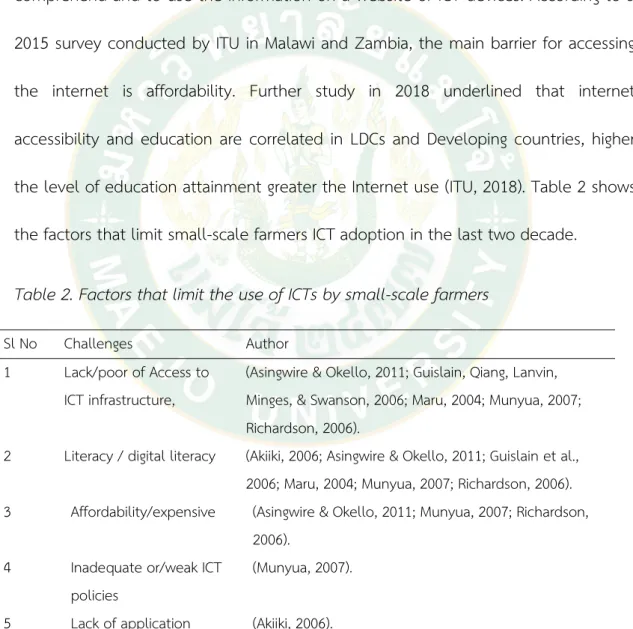
Adoption of ICT services depends on digital literacy and affordability. ITU defines digital literacy as the ability to carry out basic tasks on the internet such as read, comprehend and to use the information on a website or ICT devices. According to a 2015 survey conducted by ITU in Malawi and Zambia, the main barrier for accessing the internet is affordability. Further study in 2018 underlined that internet accessibility and education are correlated in LDCs and Developing countries, higher the level of education attainment greater the Internet use (ITU, 2018). Table 2 shows the factors that limit small-scale farmers ICT adoption in the last two decade.
Table 2. Factors that limit the use of ICTs by small-scale farmers
Sl No Challenges Author
1 Lack/poor of Access to ICT infrastructure,
(Asingwire & Okello, 2011; Guislain, Qiang, Lanvin, Minges, & Swanson, 2006; Maru, 2004; Munyua, 2007;
Richardson, 2006).
2 Literacy / digital literacy (Akiiki, 2006; Asingwire & Okello, 2011; Guislain et al., 2006; Maru, 2004; Munyua, 2007; Richardson, 2006).
3 Affordability/expensive (Asingwire & Okello, 2011; Munyua, 2007; Richardson, 2006).
4 Inadequate or/weak ICT policies
(Munyua, 2007).
5 Lack of application (Akiiki, 2006).
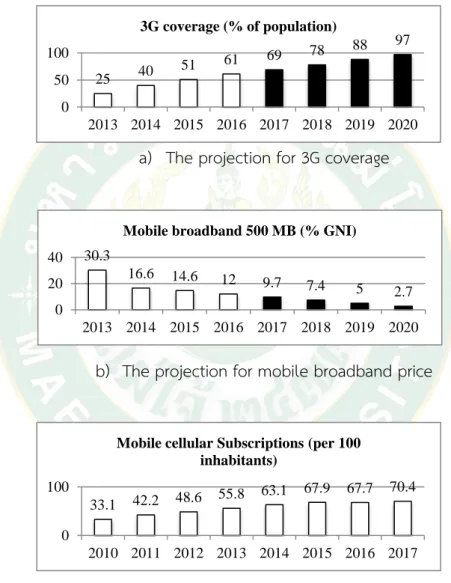
From the reviews, in the last two-decade, the main challenges faced in ICT adoption are lack of infrastructure, affordability and digital literacy. Figure 5 below shows a) the 3G coverage projection, b) mobile broadband price projection and c) mobile subscription trend in LDCs.
a) The projection for 3G coverage
b) The projection for mobile broadband price
c) Mobile cellular subscription.
Figure 5: Projection of 3G coverage, and mobile broadband price, and mobile cellular subscription in LDCs.
“Note: Projections (in black) are based on least square regression and not official estimates of the institutions from which the data is sourced”. Source (ITU, 2018)
25 40 51 61 69 78 88 97
0 50 100
2013 2014 2015 2016 2017 2018 2019 2020 3G coverage (% of population)
30.3
16.6 14.6 12 9.7 7.4 5 2.7
0 20 40
2013 2014 2015 2016 2017 2018 2019 2020 Mobile broadband 500 MB (% GNI)
33.1 42.2 48.6 55.8 63.1 67.9 67.7 70.4 0
100
2010 2011 2012 2013 2014 2015 2016 2017 Mobile cellular Subscriptions (per 100
inhabitants)
From figure 4 a) and b), Universal Access in terms of accessibility and affordability of the internet in LDCs are progressing. A per the projection 97 % of the population will have access to 3G signal by 2020. On the mobile broadband price, for 500MB it was 30.3% of monthly gross national income (GNI) in 2013 that will decrease substantially to 2.7% by 2020.
2.1.2.3 Application
An electronic system designed to fulfill a specific objective is called application. MIS is an application program designed to inform farmers on marketing aspects. As per CTA’s definition “Agricultural market information system collects, analyses, packages, stores and disseminate prices and other information relevant to farmers, traders, processors, and others interested in agriculture commodities”.
2.2 Users and their information needs
While designing MIS or MLS identifying users and their needs are primary. Deriving for whom it is being designed, what are their needs, how the objective will be fulfilled, and who will be involved are important. While gathering system requirement, we also have to identify, consult and involve stakeholders. Studying agriculture supply chain (considering the flow between farm and market) for gathering requirements is important, further integrating information required by the implementing institution (Binayee, 2005) and its institutional structure must be studied carefully.
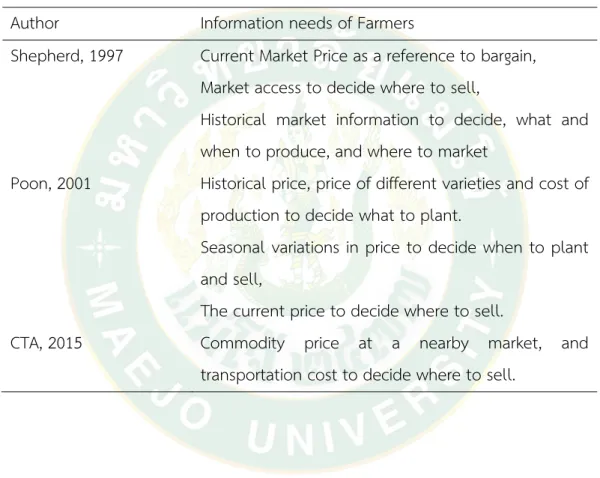
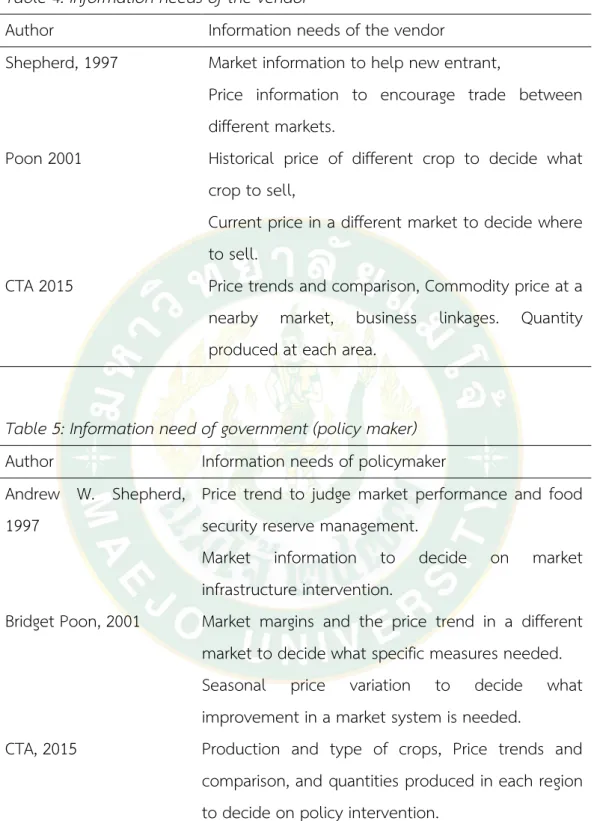
Poon (2001) stressed that the main users of MIS are farmers, vendor, and policymakers and the objective of the system should focus on the information needs of these users. Table 3, 4 and 5 show the information needs of small-scale farmers, vendors, and policymakers respectively.
Table 3: Information need of Small-scale farmer Author Information needs of Farmers
Shepherd, 1997 Current Market Price as a reference to bargain, Market access to decide where to sell,
Historical market information to decide, what and when to produce, and where to market
Poon, 2001 Historical price, price of different varieties and cost of production to decide what to plant.
Seasonal variations in price to decide when to plant and sell,
The current price to decide where to sell.
CTA, 2015 Commodity price at a nearby market, and transportation cost to decide where to sell.
Table 4: Information needs of the vendor
Author Information needs of the vendor
Shepherd, 1997 Market information to help new entrant,
Price information to encourage trade between different markets.
Poon 2001 Historical price of different crop to decide what crop to sell,
Current price in a different market to decide where to sell.
CTA 2015 Price trends and comparison, Commodity price at a nearby market, business linkages. Quantity produced at each area.
Table 5: Information need of government (policy maker) Author Information needs of policymaker Andrew W. Shepherd,
1997
Price trend to judge market performance and food security reserve management.
Market information to decide on market infrastructure intervention.
Bridget Poon, 2001 Market margins and the price trend in a different market to decide what specific measures needed.
Seasonal price variation to decide what improvement in a market system is needed.
CTA, 2015 Production and type of crops, Price trends and comparison, and quantities produced in each region to decide on policy intervention.
2.3 Trends of existing AMIS
Agriculture Marketing Information System (AMIS) is an information system that collects, analyzes and disseminates market-related information to the user (especially farmers). Information can be in the form of price details, quantity, vendor’s contact, transportation cost, etc. Effective MIS will help farmers assure market, better transportation plan, logistic decision, and can project market trends (Magesa et al., 2015).
In the 1980s, after the market liberalization, the first Generation of MIS was promoted in developing countries (David-Benz, Galtier, Egg, lancon, & Meijerink, 2011; Galtier, David-Benz, Subervie, & Egg, 2014) whereas it has been implemented for almost a century in developed countries (FAO, 2017; Magesa et al., 2014). From the literature, MIS is known to have evolved with the development of ICTs. Nowadays, AMIS can be classified into the 1st and the 2nd Generation (Chiatoh & Gyau, 2016; FAO, 2017;
Galtier et al., 2014; USAID, 2014).
2.3.1 The 1st Generation of AMIS
In the early stage of AMIS, it was mainly focused on the distribution of price information through radio, television and news bulletins. Almost all LDCs and developing countries followed the same model (CTA, 2008; Oluwatusin & Ojo, 2017).
The market information was limited to a small number of markets, and a few farmers (Magesa et al., 2014). This is because radio coverage was not large enough during those days, and disseminating information in a remote area was expensive. From the
study carried out in 1996 by FAO, out of 120 first generation MIS in developing countries, only 53 satisfied the minimum operation criteria. Although the requirement of policymakers was fulfilled, it did not meet the requirements of farmers (CTA, 2008). Kizitos case study also found that most of the MIS could only provide basic market information in terms of prices. Marketing information such as market analysis, availability of transportation and cost were missing (Kizito, 2011). Similarly, the studies (Galtier et al., 2014) found that the content and information disseminated was poor, as it focused mainly on the average price in the locality and disseminated throughout the country.
2.3.2 The 2nd Generation of AMIS
Information’s are no longer limited to the price of the product, but also include information on production, policy measures, and marketing such as storage facilities, credit line, buyer and sellers contact, etc. (FAO, 2017). The medium of information also shifted more towards mobile phone and internet. Despite several innovations, 2nd Generation MIS still face many challenges. The main challenge highlighted by authors are key information to decide on where and when to buy and sell is often missing or not reliable (Galtier et al., 2014). Further Agriculture MIS are categorized into 4 groups; Public MIS, Private MIS, MIS supported by NGO/donor project and Farmer Organization-Based MIS (Galtier et al., 2014; Kizito, 2011). From the review (USAID, 2014) donor supported MIS are most common but least sustainable.
2.4 Implementation and sustainability.
The ownership and financial sustainability of MIS are vital once the user and their needs are identified. The main challenge is matching the cost with its impact. Where an investment is huge and realizing its impact is difficult, because measuring the impact of MIS is not straightforward. For instance, the cost of data collection, transmission, processing, and dissemination are high, but the ability to access, afford and understand information by small scale farmers are very minimal (David-Benz et al., 2011). In this section, these issues are reviewed from the owner, users, sustainability, and stakeholders’ point of view.
2.4.1 Government (as owner)
Before developing MIS, it is wise to study whether the functionality and the objective of the existing systems have an advantage. This is to avoid duplication and to help decide whether to upgrade the existing system or to collaborate with other agencies currently providing the service to fulfill the current objective. Such prior information will extremely benefit in bringing down the cost of development of a new system (Poon, 2001).
Several researchers (Chiatoh & Gyau, 2016; Mcnamara et al., 2011; USAID, 2014) mentioned that social information including market information is public goods.
Therefore government agencies should be the first party to initiate and take ownership of the system fully, if not at least at the initial stage of implementation.
Moreover, a study conducted by Binayee (2005) indicates that those MIS developed
for farmer communities proved difficult to sustain if they are not integrated into an existing institutional system. The example of the institutional system could be the Ministry of Agriculture. For instance, MIS impact assessment conducted in Mozambique found that farmers gain was six times more than operational costs of MIS incurred by the government (Kizito, 2011; Kizito, Donovan, & Staatz, 2012).
2.4.2 Farmers and Vendors (as main user)
Farmers are the main beneficiaries of MIS. With an effective system in place, they can benefit from being able to market their product on time. But as per the review in the previous section, it is evident that small-scale farmers possess various challenges in marketing and accessing MIS due to remoteness, educational attainment, and low land holding.
On the other hand, vendors are the final interface from whom end-consumers buys the product. In the conventional marketing system, multiple layers of middleman exist between farmers and vendors (Magesa et al., 2015; Xaba & Masuku, 2013) resulting in a higher price. With MIS focusing on linking farmers directly to the vendor, it will benefit small-scale farmers and at the same time it will indirectly benefit end- consumers through cheaper price.
2.4.3 Extension agent (as a partner)
Extension agents are the main bridge between government and farmers. Food and Agriculture Organization of the United Nation defines extension as an informal
educational process directed toward the rural population. It is a process of working with rural people in order to improve their livelihoods. This involves helping farmers to improve their productivity and to develop their abilities for future development (FAO).
Extension agent provides technical advice and information to farmers based upon the finding of researchers. At the same time, they support researchers in implementing new technologies to solve the farming problem. On the other hand, extension agents have to implement the department’s development plans and report back frequently. Extension agents should focus on creating awareness related to marketing along with production services so that farmers can easily understand how marketing works. The extension agents can have a huge impact on agriculture marketing (Vadivelu & Kiran, 2013) as they can help disseminate information to the illiterate farmer who faces difficulties in using modern information dissemination mediums.
Poulton et al. (2010) states that “extension agents should act as both information
“nodes” and transactions’ fixer with smallholder communities facilitating market linkages (and perhaps also farmer group development) as well as technical change”
2.4.4 Sustainability
Since the development of MIS often requires huge capital investment, as mentioned earlier government agencies should initiate and take ownership of the system fully, if
not at least at the initial stage of implementation. Several papers reviewed shows that initial investments were sourced from NGOs and donor agencies in partnership with government agencies (Chiatoh & Gyau, 2016; FAO, 2017; Galtier et al., 2014;
Kindness & Gordon, 2001; Magesa et al., 2014; Shepherd, 1997) and regardless of MIS type they still heavily depend on donor fund for sustainability (Kizito, 2011). Medium- term financial commitment should be secured from local, national and donor agencies before venturing into the development project. Frequent consultation and reassessment of information needs of the user should also be conducted for long- term sustainability and benefit of MIS (CTA, 2006). Collaborating with other stakeholders who can provide contents will make the system rich in information, and more cost-effective in data collection and management (Binayee, 2005). The agency planning should make sure that an institution who manages the system should be well established with its sustainability well thought (CTA, 2006). This is to avoid establishing new and unsustainable institute which are not part of local institutional set-up (Kindness & Gordon, 2001).
2.5 Summary of Gap analysis
In “theory and practice” of Shepherd (1997), MIS concept focused on the collection of market data, processing of collected data, dissemination techniques and organizational structure of MIS provider to improve agriculture marketing through market information.
Poon (2001)“Guide to the Establishment of Market Information Service” also dealt on a similar model of data collection, processing, and dissemination of information.
Poon went step ahead in including supply data (commodity reaching the market), whereas the author stated it is easier said than done. This is because to estimate total supply reaching the market, there is a need for weighbridge or person stationed at all the entrance point to monitor incoming produce. Another issue was that even if the entry point can be monitored, a challenge arises from products being bought to market in mixed lots. Therefore the approach was complex and expensive.
Further in (CTA, 2015c, 2015d, 2015e, 2015f, 2015g) data were categorized into primary and secondary. Again the model for primary data collection (price and volume) was based on the same model, employing data collector to collect data, the transmission of data for processing and then disseminating to respective users through various medium.
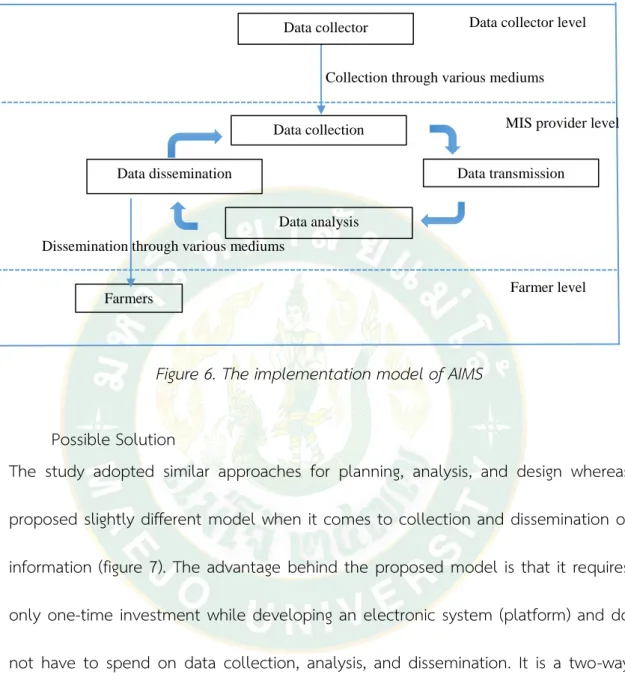
FAO (2017) discussed issues related to the overall design, planning, and implementation of AMIS in detail. However, the implementation model was still about data collection, transfer, analysis, and dissemination. Therefore almost all followed the same model as shown in figure 6, major challenges with this model was collecting data was expensive, meeting high-quality requirement was difficult and information dissemination was not effective.
Figure 6. The implementation model of AIMS Possible Solution
The study adopted similar approaches for planning, analysis, and design whereas proposed slightly different model when it comes to collection and dissemination of information (figure 7). The advantage behind the proposed model is that it requires only one-time investment while developing an electronic system (platform) and do not have to spend on data collection, analysis, and dissemination. It is a two-way information flow model. The reason for using this approach is to reduce the recurrent cost and solve various challenges confronted while collecting and dissemination of data for the sustainability of MLS from MIS providers view. And for farmers, it will solve their common marketing challenges. In theory, it is said that MIS should generate profit and should be independent of donor/government funding,
Data dissemination
Data collection
Data transmission
Data analysis
Farmers
Dissemination through various mediums
Data collector
Farmer level Collection through various mediums
Data collector level
MIS provider level
but in reality (practice) it has been difficult, if not impossible (FAO, 2017). The distinct feature of this model is it creates a platform where farmers and vendors can participate and exchange market information, rather than MIS provider collecting and feeding information to the farmers, which proved ineffective, and unsustainable.
Figure 7. Possible Solution with MLS
MLS
Farmers Vendors
MLS provider
3. Methodology
3.1 Theoretical framework
The study thematically reviewed on marketing and digital inclusion challenges faced by small-scale farmers, users of MIS and their information needs, trends of existing Agriculture MIS, Implementation, and sustainability of the system. The result of the reviews is a MLS framework that considered those aspects to tackle the challenges mentioned in the last chapter. The MLS framework is structured based on System Analysis and Design theory (Dennis et al., 2012) and adopted system development life cycle concept to design MLS framework. It is designed for small-scale farmer MIS developers and providers. The MLS framework is in line with “Framework for Accessing Agricultural Market Information” (FAAMI) (Magesa et al., 2015) which used the approaches from Making Market work for Poor (M4P) framework.
3.2 Operational definition.
The term vendor, extension agents, farmers group and contract farming used in this thesis will be defined as follows.
The vendor is referred to those who purchase agriculture products from farmers.
They can be retailers, educational institutes, hotel and restaurant, military organizations, central monastic bodies, charity organizations, hospitals, etc. However, linkage with a spot market, commodity exchange, and auction activities are not included in this study.
Users Survey to validate the framework
General MLS design Framework
Figure 8. Theoretical framework
The extension is an informal educational process directed toward the rural population, the extension is a process of working with rural people in order to improve their livelihoods. This involves helping farmers to improve their productivity and abilities, to direct their own future development (FAO). Extension agents is
Users and their information needs Digital Inclusion Challenges
Marketing Challenges
Trends of existing Agriculture MIS
Implementation and Sustainability SAD and SDLC
1. Planning
2. Analysis
3. Design
Theory and concepts as process
Review as input
Output
defined as an agent at the grass root level who implements activities planned by the government and disseminates new research developments from research centers.
Collective action or farmers group is defined by Stockbridge, Dorward, and Kydd (2003) as individual farmers working in-group to fulfill a common objective. Small- scale farmers can form a group and work together to participate in the market more effectively (Markelova et al., 2009)
Contract farming is defined as legal understanding between producers and buyers where quantity, quality, timing, and price are agreed before production starts (Eaton
& Shepherd, 2001; Ton, Vellema, Desiere, Weituschat, & D'Haese, 2018). Further practicing contract farming is considered as a device to link small-scale farmers to domestic markets which will ultimately reduce poverty (IFAD, 2003; WB, 2007).
3.3 Research Design
The exploratory research design was adopted for this study. Qualitative content analysis was conducted on literature such as journal articles, conference proceedings, dissertations, and international publication. An inductive approach was adopted to understand the phenomenon and to conceptualize the theoretical framework, with the theoretical framework (figure 8) in place further deductive approach was adopted to analyze the content based on themes outlined.
To validate the MLS framework developed for MIS designers/developer (the result of qualitative analysis), a survey (quantitative) was conducted to collect views from MLS
users (farmers, vendors and extension agents). The main objective of the survey was to validate the usefulness and appropriateness of the MLS framework in solving the respective users’ needs and challenges.
3.4 Population, Sampling, and Data Collection.
For qualitative data (secondary research): The review was conducted on secondary data both peer-reviewed article and international organizations publication. Peer- reviewed articles consist of conference proceedings and journals, and international organizations publication comprise of books, discussion papers, consultancy reports, proceeding of expert meetings, and annual reports.
An online manual search was adopted, online databases searched were IEEE explore digital library, ACM Digital Library, Elsevier Science Direct, Research gate, and Google Scholar for the peer-reviewed article. For international publication related to agriculture, telecommunication and ICTs, websites of an international organization such as Food and Agriculture Organization (FAO) of United Nation, International Fund for Agriculture Development (IFAD), World Bank, Technical Centre for Agricultural Rural Cooperation (CTA) and International Telecommunication Union (ITU) were searched.
This review covered only those articles that were published in the English language.
In order to capture different generations of MIS major articles dating back two decades was also included. As the focus of the paper is on small-scale farmers of
Least Developed Countries (LDC) especially in Asia and Sub-Saharan Africa only those article related to these two region were reviewed. To capture all major publication both forward and backward snowballing method of sampling where adopted.
For survey (to validate framework): Main MLS users were identified as a farmer, vendor, and extension agents. In order to validate the proposed MLS framework, a survey was conducted to collect the views of respective users on the MLS framework. The study used a purposive sampling method to identify farmers, agriculture vendor, and extension agents, among various vendors and extension agents. And the survey was conducted using convenience sampling method on a sample size of 30 farmers, 30 agriculture vendor, and 30 extension agents. The sample consists of farmers and agriculture extension agents from the western, eastern, central and southern region of Bhutan and vendors from the capital city and western region; Bhutan is a least developed country in South East Asia with 43.9% of the population dependent on agriculture (NSB, 2018).
3.5 Method of data analysis
For qualitative data, online databases were explored, collected relevant literature to understand the phenomenon and theories on the topic, and then the theoretical framework was prepared. Based on themes further, literature was surveyed and according analyzed and structured in-line with existing theories and concept.
For survey the main purpose was to capture farmers, vendors and extension agents’
views towards the proposed MLS framework so descriptive analysis was conducted.
While conducting descriptive analysis, literature pointed out that mean and standard deviation was not recommended for central tendency and variance in the dataset for Likert item questions. Therefore the median and Inter Quartile Range (IRQ) were analyzed to present dispersion in the dataset. SPSS was used for statistical analysis.
4. MLS Framework
The aim of the study was to help/promote small-scale farmers marketing through farmers and vendors’ market linkage system, therefore MLS framework to help design MLS is being proposed in this thesis. To develop a MLS framework, a comprehensive literature survey was conducted to get the overviews of
a) Challenges faced by small-scale farmers in marketing and digital inclusion b) Trends of existing agriculture MIS
c) Users and their information needs d) Implementation plan and sustainability.
The summary of the related literatures is discussed using the concept of SDLC (Dennis et al., 2012). It is categorized into planning, analysis, and design, and discussed as followed.
4.1 Planning
The planning section of MLS Framework consists of the project sponsor, business needs, business requirements, business value, and special issues or constraints.
4.1.1 Project Sponsor:
It is advisable for a government agencies to initiate MIS than a private organization.
MIS developed for farmer communities proved difficult to sustain, if it is not integrated into one of the existing institutional system (Binayee, 2005; Kindness &
Gordon, 2001). Since it entails huge capital while establishing, it is recommended that
the government should partner with a donor for initial setup. And for sustainability, they should further partner with other agencies such as Internet Service Provider (ISP), media agencies and those agencies that will benefit from MIS, therefore their needs have to be incorporated in the system while designing. Such prior information will benefit in sustaining (Poon, 2001) and reducing recurrent cost. While the common issue with most of the MIS is that they tend to collect lots of information, however poor in disseminating those information to farmers (Shepherd, 2011). MIS with other agriculture-related information such as pest and disease, weather forecast, advisory services, and input (seed, fertilizer, etc) will make MIS more sustainable and cost-effective (USAID, 2014) as stakeholder responsible for providing such information can share recurrent expenses.
4.1.2 Business needs:
For this study, the business need is to improve small-scale farmers marketing, which will have a positive impact in achieving food security and reducing rural poverty.
4.1.3 Business requirements
No MIS or MLS development project should start without thoroughly studying users and their needs. It has been pointed out that the common mistake made by designers is concentrating solely on technology aspects, rather than focusing on challenges that technology is used to solve (Shepherd, 2016). If MIS is developed focusing only on the technology aspect, the system might be in place but users may not need those components or may not afford it. This will lead to unnecessary
expenses and unsustainable project. On the other hand, if users are identified and their needs studied well, sometimes a simple and low-cost system can serve their needs better than a complex and expensive system.
For MIS, getting price data is easy, while getting some data such as volume and quality are easier said than done. Moreover, getting accurate data is neither possible nor necessary as these data keeps on changing from time to time and dependent on various extraneous factors. Therefore, it is important to advocate farmers and vendors that price and volume information is tentative and they can be used only as a reference to guide the current situation.
Information to promote demand-driven production seems to be the most critical information required by farmers to ease their marketing. If production is planned as per quantity and timing of demand, marketing the products will be easier. At the same time vendors also need production information in advance, so that they can plan and maintain the consistency in fulfilling end customers demand, which will have a great impact on the stability of market price. Further, Chiatoh and Gyau added additional information like historical price data and contact information of farmers and vendor is important. These historical data will be useful to vendors, farmers, and policymaker (Chiatoh & Gyau, 2016) in making an informed decision.
Therefore, an electronic system that can provide demand information, production information, farmers and vendors contact should be in place to promote small-scale
farmers marketing. Since the government was identified as key MIS provider, incorporating information required by the government such as price trends to judge market performance and food security reserve management, and quantities produced in each region to decide on policy and market infrastructure intervention has to be considered.
4.1.4 Business value
While disseminating market information, selecting the proper medium will have a wider reach. Regardless of MIS types, the common mediums adopted for information dissemination are radio and mobile phone. With internet charges getting cheaper and its coverage getting wider, it will be wise and timely to shift the conventional method of data collection and dissemination to more interactive system using ICT.
From the study carried out in 1996 by FAO, out of 120 first generation MIS in developing countries only 53 satisfied the minimum operation criteria, although the requirement of policymakers was fulfilled, it did not meet the requirement of farmers (CTA, 2008). Kizito’s case study found that most of the MIS provided basic market information on prices. Although most of the MIS was useful to users, product information such as quantity, quality, and standard measurement are an issue raised by vendors.
Therefore having a system that can provide information on estimated quantity, quality, time of harvests and transportation details in advance (from production