Insights into CEFR and its implementation through the lens of preservice English teachers in Thailand. TITLE Insights into CEFR and its implementation through the lens of English teachers in Thailand.

INTRODUCTION
- Background of the study
- Purposes of the study
- Scopes of the study
- Significance of the study
- Definitions of terms
- Organization of the thesis
The current study focused on the perspectives of pre-service English teachers regarding the implications of the CEFR in Thailand. Understanding the CEFR refers to Thai pre-service English teachers' general understanding of the CEFR framework.
LITERATURE REVIEW
The CEFR and its importance
Davidson & Fulcher (2007) also noted that the quality and validation of the CEFR descriptive scales could influence the development of language tests. Furthermore, McNamara (2011) argued that the CEFR did not take into account sets of cultural values and the objectives of the language curriculum.
Theoretical framework
- Principles for teaching and learning
- The use of CEFR in designing curricula and syllabuses
- The use of CEFR in the classroom: teaching and lesson planning
- Principles for assessment
- The use of CEFR to select appropriate assessments
- The use of CEFR in the development of assessments
- Principles for the use of reference level descriptions
- The use of resources from reference level descriptions in learning,
- The use of the CEFR to develop reference level descriptions
- Implementation of the CEFR in practice
- An action-oriented approach
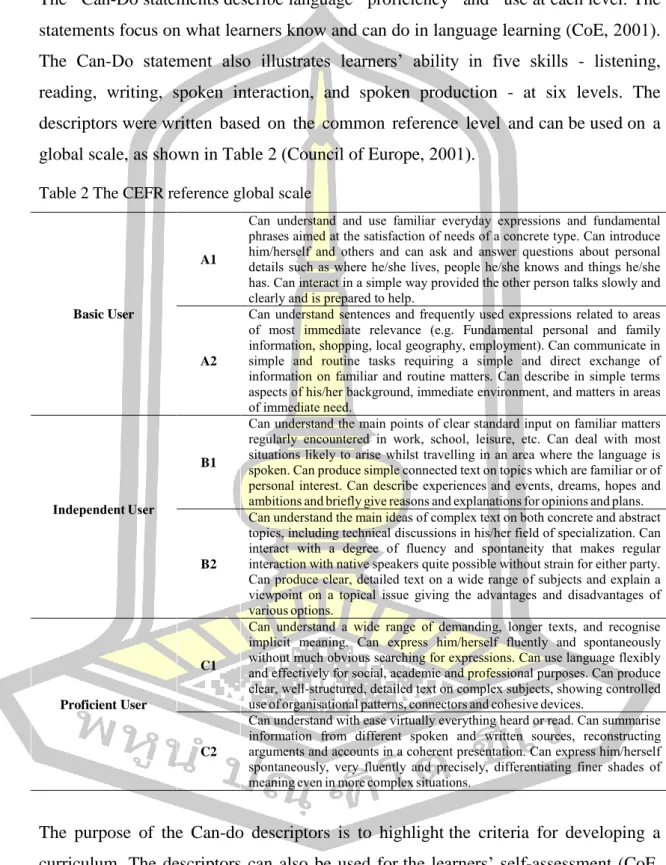
- Can-Do descriptors
The test must adopt the descriptions of the CEFR reference levels to fit the context, which will ensure the quality of the tests (Cambridge ESOL, 2011). The Council of Europe (2001) recommended that test results refer to CEFR reference level descriptions.
Limitations of the CEFR
CEFR in Thailand
The findings highlighted the suitability of the ten-level frame of reference used to assess Thai learners' English language skills to classify them into the appropriate group in their fields. In addition, teacher development in English language teaching has been assisted by the British Council in Thailand to enhance the ability of English teachers.

Related studies
- In EFL/ ESL contexts
- In Thai EFL contexts
The results revealed that the teachers had adopted the CEFR adapted curriculum in test assessment (Hai, 2018). Furthermore, Franz & Teo (2017) studied secondary teachers' perceptions of the CEFR and English teaching.
Summary of the chapter
METHODOLOGY
- Participants and setting
- Research instruments/techniques
- Questionnaire
- Semi-structured interview
- Data collection procedure
- Data analysis
- Ethical considerations
- Summary of the chapter
Semi-structured interviews explored what perceptions English language teachers have about the implementation of the CEFR in their teaching practice for content analysis. The duration of the conversation was 15-20 minutes and it took place after they completed the questionnaire. Next, semi-structured interviews were conducted to collect in-depth data about English teachers' perceptions of CEFR implementation in English language classes from 15 participants who were randomly selected to be representative of all participants. .
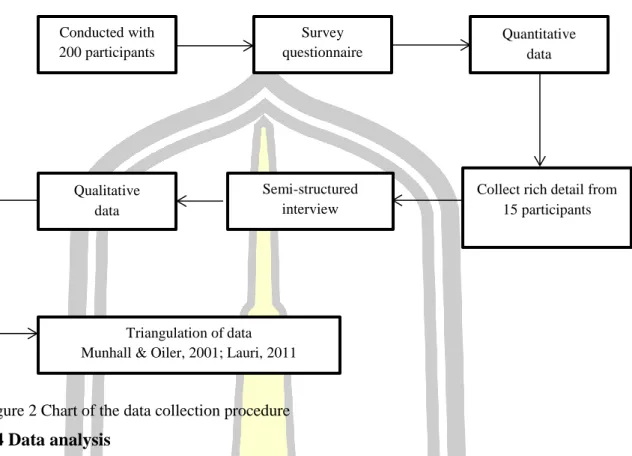
Furthermore, the use of triangulation ensured the study's validity, reliability and understanding (Munhall & Oiler, 2001; Lauri, 2011). Permission was also sought from the head of the English department at the participants' university.
Quantitative results
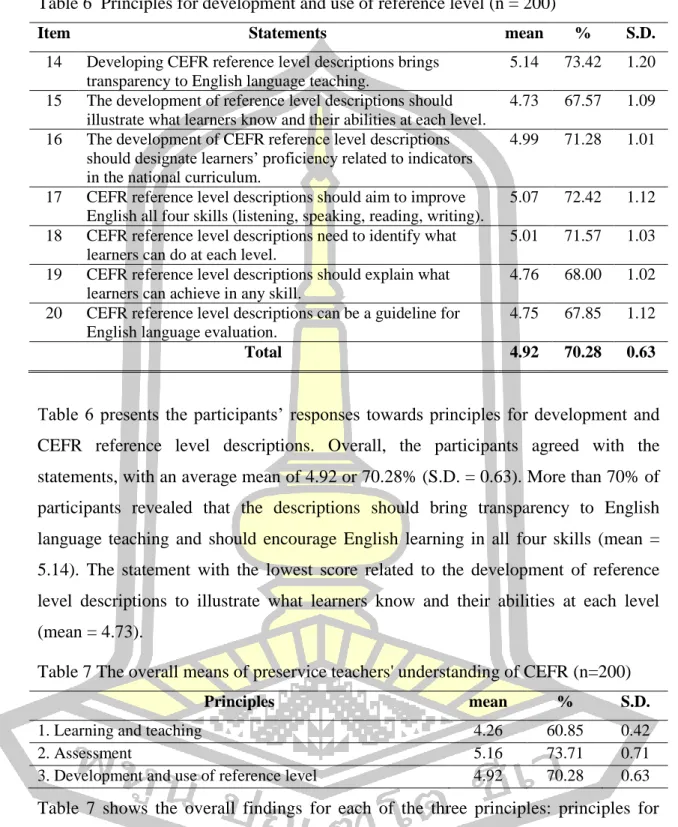
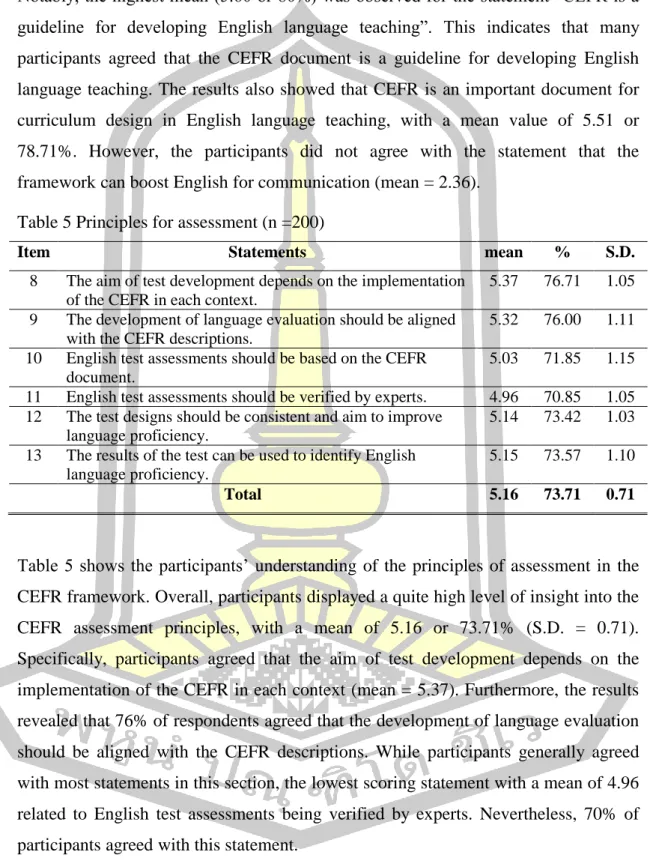
Specifically, participants agreed that the purpose of test development depends on the implementation of the CEFR in each context (mean = 5.37). 17 CEFR reference level descriptions should aim to improve all four English skills (listening, speaking, reading, writing). The statement with the lowest score relates to the development of reference level descriptions to illustrate what learners know and their abilities at each level (mean = 4.73).
Development and use of reference level Table 7 shows the overall results for each of the three principles: principles of teaching and learning, principles of assessment, principles of development and use of reference level descriptions. In addition, the results also showed that the statements regarding the development and use of reference level scored an average of.
Qualitative results
The interview results showed that the participants saw the CEFR as a criterion for assessing language tests. Most interviewees also mentioned that the CEFR is used to assess language learners' language proficiency at six levels (A1-C2). Furthermore, one participant highlighted that the use of the CEFR was quite limited in the Thai context (Nadia).
As shown in Table 10, most participants knew very little about the descriptions of the CEFR reference levels. However, some participants expressed their understanding of the descriptions and indicated that the CEFR reference.

Conclusion
Maria When I was a fourth-year student, my teacher mentioned the concept of Can-Do Descriptors on the topic of Developing the English Curriculum. I also try to adapt the approach to designing learning activities in my classroom because I teach the supplementary English for Communication course. Nadia The descriptions can be used to identify what language learners can do in each skill.
Only three of the 15 participants mentioned an action-oriented approach and Can-Do descriptors. Therefore, it can be concluded that they did not engage in the CEFR and had fewer opportunities to use the document in their teaching practice.
Summary of the current study
Preservice English teachers’ understanding of CEFR
The quantitative results showed that Thai pre-service teachers had a moderate level of understanding of CEFR principles of learning and teaching. I think the CEFR framework is used to set learning objectives in terms of learning and teaching.” (Ema). I understand that the CEFR is a guideline for teaching and learning English that focuses on communication.
Overall, the current results suggest that the participants had little knowledge of the CEFR as a teaching and learning aid. The quantitative data analysis revealed that the participants had a moderate level of understanding of the CEFR reference level descriptions.
CEFR implementation of preservice teachers in the classroom
Furthermore, the results revealed that four out of thirteen participants never adopted the CEFR in practice. I never used the CEFR in my classroom because I think the framework is outdated." (Flower). Therefore, the current results suggest that the participants have a poor understanding of the CEFR in learning and teaching approaches because they are inexperienced with the document.
This finding contrasts with the quantitative findings which indicated that participants had a high level of understanding regarding the use of the CEFR in assessment. Indeed, the present results suggest that participants simply know the descriptions of the CEFR reference level but lack practice in natural settings.
Conclusion
In summary, the results of the qualitative analysis revealed that Thai pre-service English teachers had insufficient knowledge of CEFR implementation. The findings also revealed that trainee teachers do not have opportunities to put the CEFR into practice because they are still trainee teachers. Together, these findings suggest that pre-service English teachers need further training in assessing language learning and teaching in relation to the CEFR.
Limitations for the current study
Implications for pedagogical strategies
CEFR training programs should also be offered to ensure that all stakeholders, including pre-service teachers, understand how the CEFR can be used in all areas.
Suggestions for further research
ทำได้และไม่สามารถทำได้ – การสอบและการประเมินที่ได้รับแรงบันดาลใจจาก CEFR ในบริบทการศึกษาระดับอุดมศึกษาของสวีเดน มุมมองของอาจารย์ EFL มหาวิทยาลัยไทยเกี่ยวกับผลกระทบของ CEFR ต่อหลักสูตรภาษาอังกฤษและการฝึกสอน ทำความเข้าใจและประยุกต์ใช้กรอบ CEFR ในบริบทของนักศึกษาครูในประเทศไทย คำอธิบาย: แบบสอบถามนี้เป็นการสำรวจความคิดเห็นของนักเรียนครูสอนภาษาอังกฤษเกี่ยวกับความเข้าใจและการประยุกต์ใช้กรอบ CEFR ในบริบทภาษาไทย ส่วนที่ 2: ความคิดเห็นของผู้ตอบเกี่ยวกับความเข้าใจและการประยุกต์ใช้กรอบ CEFR ในบริบทไทย แบบสอบถามนี้ใช้ระดับ Likert 7 ระดับในการรวบรวมข้อมูลแบบสอบถาม ในด้านการเรียนการสอนภาษาอังกฤษตามกรอบมาตรฐาน CEFR
กรอบมาตรฐาน CEFR เป็นแนวทางสำหรับการพัฒนาการสอนภาษาอังกฤษ 2 กรอบมาตรฐาน CEFR เป็นแนวทางที่สำคัญสำหรับการออกแบบแผนการสอน กรอบมาตรฐาน CEFR ภาษาอังกฤษเป็นแนวทางในการออกแบบสื่อการสอนภาษาอังกฤษ 4. กรอบมาตรฐาน CEFR สามารถใช้เป็นแนวทางในการปรับปรุงการสอนภาษาอังกฤษได้ 6. กรอบมาตรฐาน CEFR เป็นแนวทางที่ช่วยให้นักเรียนเรียนรู้ภาษาอังกฤษ 7. กิจกรรมการสอนภาษาอังกฤษตามกรอบมาตรฐาน CEFR เน้นย้ำนักเรียน เป้าหมายของการพัฒนาแบบทดสอบขึ้นอยู่กับการนำ CEFR ไปใช้ในแต่ละบริบท คุณมีความเข้าใจเกี่ยวกับกรอบ CEFR จากมุมมองของการสอนภาษาอังกฤษอย่างไร หัวข้อที่ 2: การใช้กรอบ CEFR ในห้องเรียน
คำอธิบาย: แบบประเมินนี้ใช้สำหรับ ให้กับท่านที่เป็นผู้เชี่ยวชาญ โปรดพิจารณาบริบทของคำถามที่จะใช้ในแบบสอบถาม (1) การจัดการการเรียนการสอนภาษาอังกฤษตามกรอบมาตรฐาน CEFR (2) การประเมินของ ทักษะทางภาษาตามกรอบมาตรฐาน CEFR (3) ด้านการพัฒนาและการใช้คำอธิบายของกรอบ CEFR สำหรับระดับความสามารถทางภาษา (4) การนำกรอบ CEFR ไปใช้ในห้องเรียน และ (5) คำถามปลายเปิด โดยคำนึงถึง พิจารณาว่าแต่ละคำถามมีความเกี่ยวข้อง ถูกต้องและเหมาะสมหรือไม่? หลังจากพิจารณาแล้ว.