The purpose of this research is to determine the organizational design for new product development. Thai organizations must become an innovative organization with effective coordination of marketing, production and R&D. The information and data are studied and collected through literature review to find out key factors affecting the new product development process and discussions with the top management of manufacturing units. The results of this study show the advantages and disadvantages of these three models for organizing new product development.
In addition, we recommend that the new product development organization is studied and discussed in detail, how this organization is able to manage and effectively increase the production of a packaging paper manufacturer in Thailand.
INTRODUCTION 1
Therefore, the purpose of this study is to determine the organizational design for new product development. The results of the organizational design for new product development show the advantages and disadvantages of these three models for organizing new product development.
LITERATURE REVIEW 3
- Functional Organization 4
- Project Organization 5
- Project Matrix Organization 7
- Contingency of Organizational Forms 8
- Relevant Empirical Studies 9
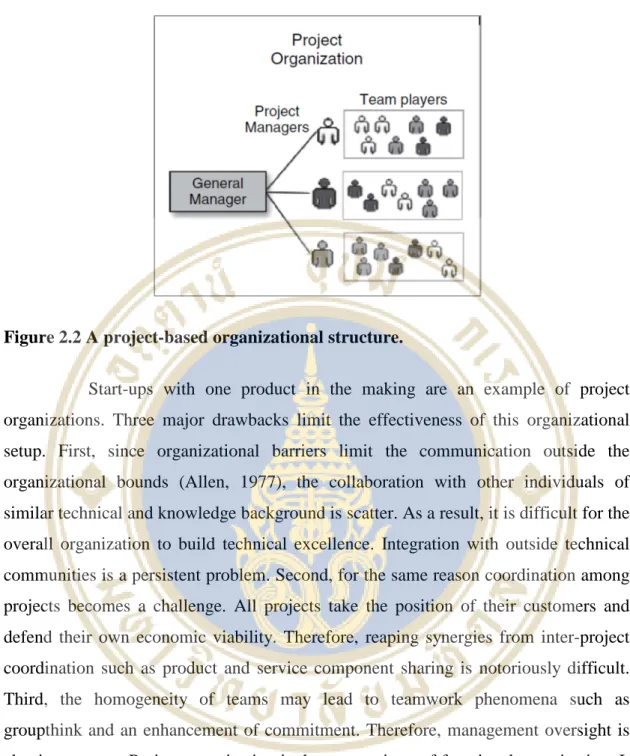
The main mechanism for achieving integration is process – determining who should contribute what information at a given time. The project manager is responsible for the study of feasibility and economics of the project, thus balancing the interests of the company and the client. Thus, high external cooperation with the market, rich focus on the timeline and overall profitability of the project are strong points of the project organization.
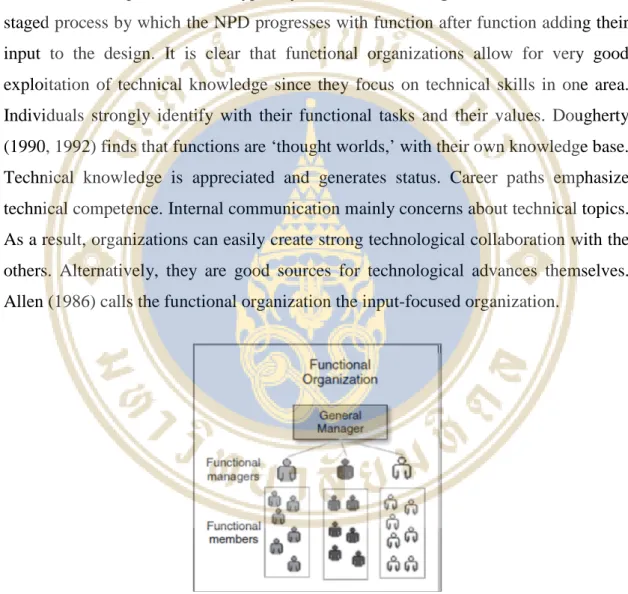
Functional organizations, in contrast, focus on building technological excellence, neglecting product cohesion. It appears that collaboration in the first phase of the project is more related to project success than in later phases (Olson et al., 2001). Thus, organizational structures are good to the extent that they 'fit' the task demands of the groups they form.
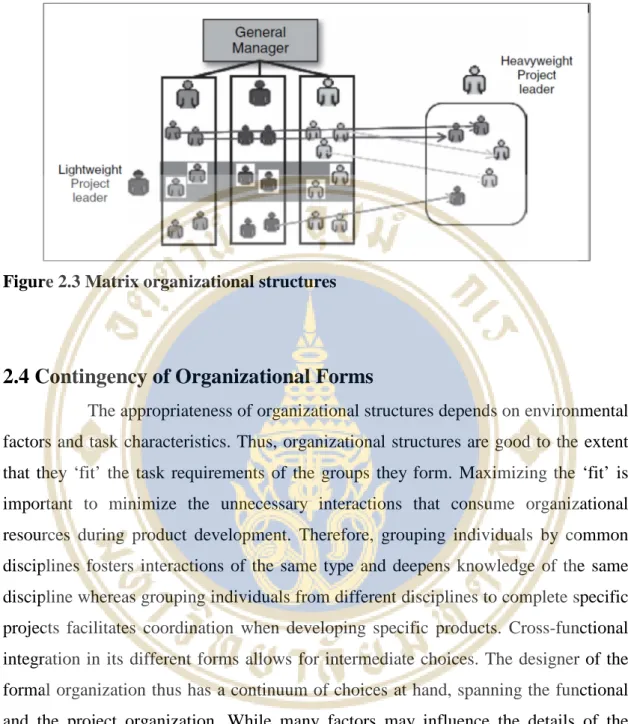
The designer of a formal organization thus has a continuum of choices available, covering functional and project organization. The effectiveness of project planning as an early cross-functional integration mechanism is positively related to 1) the level of representation of production in terms of resources, 2) the definition of the duration of the planning phase and 3) the availability of historical data of the NPD process. The effectiveness of the early mission as a cross-functional integration mechanism is positively related to 1) available productivity data, 2) experience of project team members, 3) documented guidelines for conducting reviews, and 4) analytical skills of project team members and representatives of line organizations.
The effectiveness of the individual integrator and the cross-functional team as an early integration mechanism is positively related to 1) a clear distinction between NPD and operational activities, 2) the ability of integrators to break away from previous projects, 3) planned transitions between projects , and 4) balance in recruitment between R&D and production. The lack of correlation between the level of formalization and the size of the cross-functional integration gap may be due to the cultural background of the studied economy.
RESEARCH METHODOLOGY 13
Research Design 13
Population and Sample 13
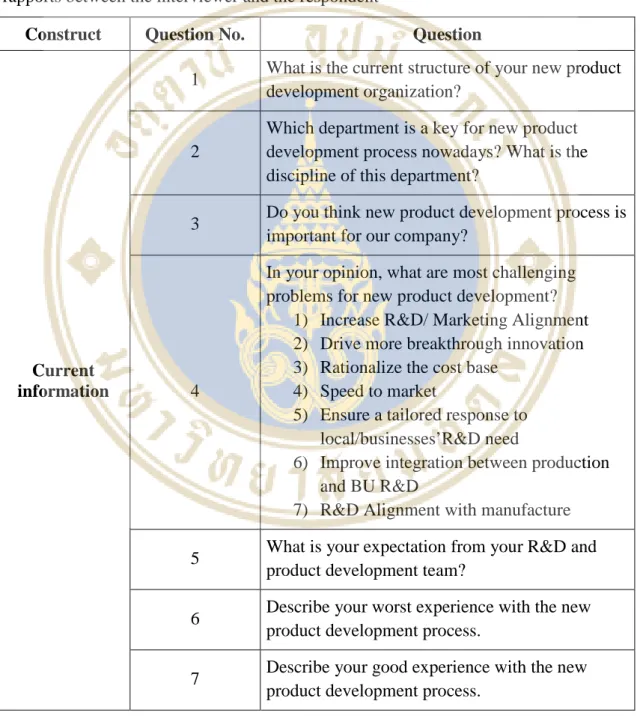
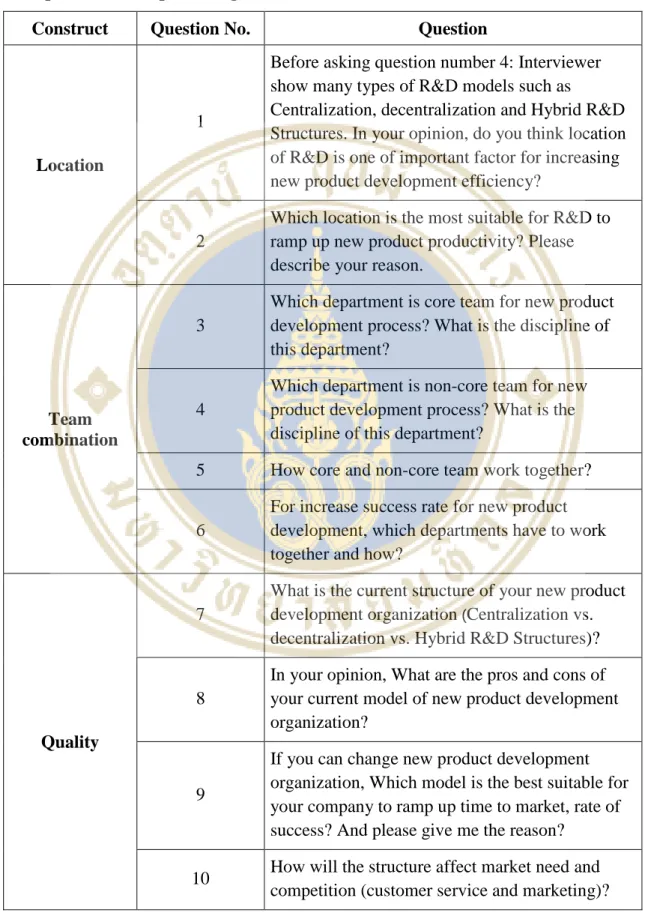
In your opinion, do you believe that the location of R&D is an important factor to increase the efficiency of the development of new products. In your opinion, what are the advantages and disadvantages of your current model for developing new products. If you can change new product development organization, Which model is best suited for your business to increase time to market, success rate.
How will the R&D structure affect key processes for new product development and decision-making (processes and coordination). Marketing, Production, Business unit R&D and central R&D are the core team for new product development, since the majority of new product development is market pull, then the marketing team receives the voice of the customer; they will identify and evaluate market opportunities. Business unit R&D hosts integration production, central R&D and business unit marketing of new products.
After the interview, there are many strategic objectives for the new product development team in the current situation, such as location of R&D, clear function &. Short time and flexibility in launching a new product are of utmost importance to increase competitive advantage. Therefore, the time-to-market will be shorter and more efficient due to the development of new products.
RESEARCH FINDINGS 18
Location 18
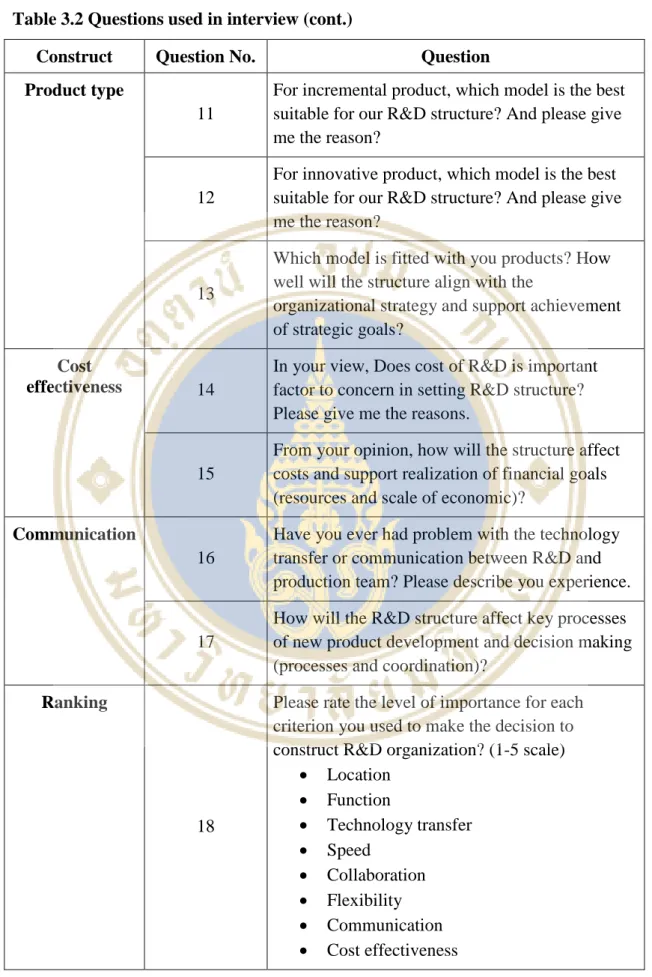
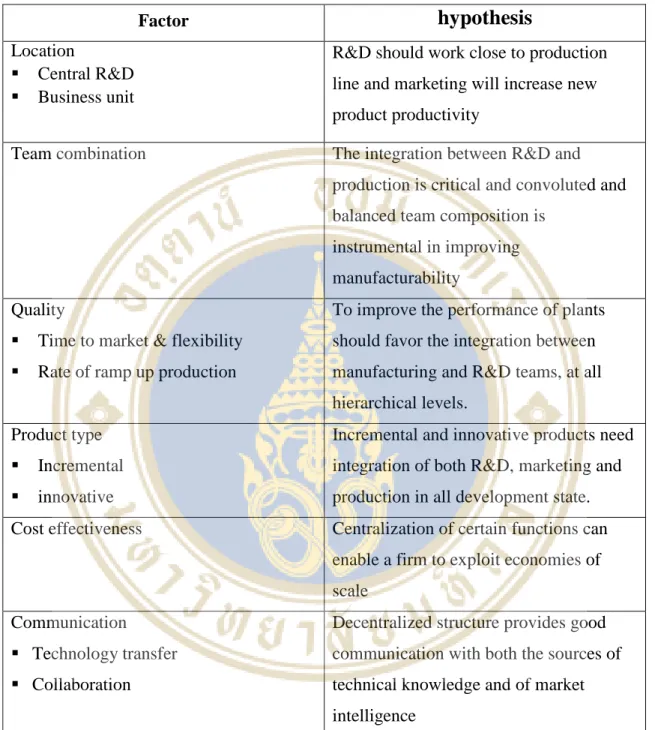
Determining the most promising R&D locations for the construction of new product organization is the first thing to be concerned, as there are many types of R&D models such as centralization, decentralization and hybrid R&D structures. Its location is crucial for the development of company-level technology capabilities and competitive advantage. The results of the interviews show that more than half of the respondents agree that location is important in setting up new product development team and they do agree that specifying location helps to classify the function and responsibility of each team in new product development team.
For a hybrid structure, location is one of the factors for separating and classifying the responsibilities and functions of core R&D and business R&D. Core R&D should focus on research for medium to long-term projects and in-depth basic knowledge and technology to supply each business unit and new business for sustainability. Business R&D should work to link central R&D, manufacturing and marketing for short-term product and technology development.
The reason business R&D should work for the current product and technology is so that researchers working close to the production line will have a better understanding of the machine configuration, the state of the processes and the current competition in doing so. Location is not a key factor for setting up R&D, because although the R&D center is centralized, a researcher can work anywhere and everywhere, but the researchers must understand and have a good command of the current machines, technology, processes and facilities. In addition, researchers should be well aware of the distinction between laboratory factors and mill factors in order to increase the speed of new product launch and reduce the cost and time for testing new products and processes.
Team Combination 20
Central R&D and BU unit R&D have a different focus on platform development or product function development depending on the product type. BU unit R&D hosts incremental product feature development because they understand more in current processes and issues. However, Central R&D hosts innovative products and new platform technology that are not used by the BU unit's R&D.
Central R&D would like to create new products with added value, but use time to do research and development. BU unit R&D is responsible for the integration and compromise of the requirement to get the most suitable solution. BU unit R&D shares information, configuration and condition of current machines to raise awareness about the mill factors so that Central R&D can conduct the research based on current equipment and technology.
The R&D group should operate as a hybrid function with an established business unit R&D for each of its respective business units and a central R&D which is expertise in core technology and advanced technology. The R&D center should be located in a key area which is the center of the business and maintain close working relationships with Business Unit R&D working with similar product categories. Each team consists of production, marketing and technology people selected from Central R&D, Business unit R&D.
Quality 21
Type of Product 21
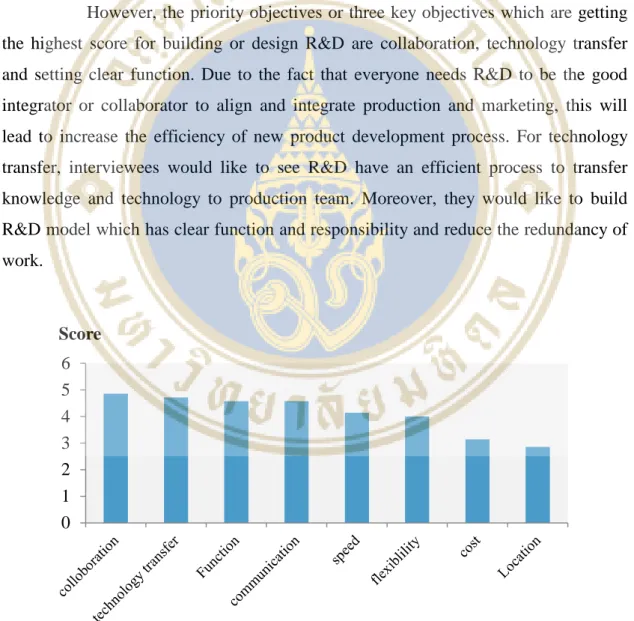
Significant findings showed that the communication between the central R&D and the production team is still problems due to the conflict of interest. Due to the fact that everyone needs R&D to be the good integrator or collaborator to adapt and integrate production and marketing, this will lead to increasing the efficiency of the new product development process. For technology transfer, the interviewees would like to see that R&D has an effective process to transfer knowledge and technology to the production team.
Moreover, they would like to build an R&D model with a clear role and responsibility, and reduce work redundancy. The results of the analysis are useful for companies looking to build or change their R&D organization. However, the optimal R&D model is not a guideline and shows the best results for every company, because every company has a different parameter.
The business unit's R&D should be located in the most important current locations and is responsible for carrying out research and development to support entire product areas or industries and adapt technologies to their product chain. In addition, business units can receive research and technology that is applicable from other business areas via Central R&D. To take and use technologies developed in the central R&D and combine them in product programs.
Cost 21
Communication 22
On the other hand, manufacturing would like technology which can be implemented immediately and they would like to solve the problem faced and release the product in quick time based on the lowest cost and minimization of losses during mill trial.
Key Strategic Objectives 23
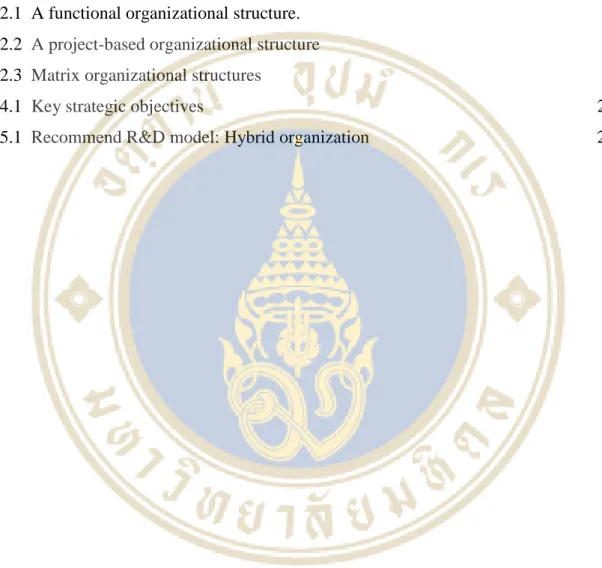
The main objective of this study is to determine the organization design for new product development, influencing Thai organizations to become an innovative organization by effectively aligning marketing, production and R&D. After we have seen the whole result of all the factors, the suitable model for this company is the hybrid structure (Figure 5.1) because this company has both short team and long term goal to initiate a new product to support the sales direction and marketing. Their main focus is to integrate all the functions to be borderless and study the marketing possibility, financial feasibility, technical approach as well as opportunities to expand the business to lead the product and technology that is the direction of new product development. of this company.
This R&D model will increase technology specialization and breakthroughs in line with the company's strategy, reduce layoffs, and increase knowledge and technology transfer in the extended technology organization. First, due to time constraints, this research was only conducted on a small number of the population who are managers or department heads in production lines.
DISCUSSION AND LIMITATIONS OF THE STUDY 24
Recommendation 24
Limitation 26
Future Research 27