BREASTFEEDING &
MATERNAL HEALTH
Breastfeeding Benefits:
Claim or Over Claim
พ.อ.หญิง ผศ.ปริศนา พานิชกุล กองสูตินรีเวชกรรม รพ.พระมงกุฎเกล้า
NO CONFLICT OF INTEREST
Breastfeeding
& Maternal Health
SCOPE of TODAY
• Maternal brain health
• Lactational amenorrhea
• Maternal bone health
• Cancer risk
• Metabolic & Cardiovascular risk
Breastfeeding
& Maternal Health
Schwarz EB, Nothnagle M. The Maternal Health Benefits of Breastfeeding.
www.aafp.org2afp/2015/0501/p602.pdf
BF & Maternal Health
During pregnancy & lactation:
Numerous changes on the physiological, cellular, and molecular level occur
distinguish lactating mother from nulliparous female
prepare the female
for the challenges of motherhood
Hillerer KM, Jacobs VR, Fischer T, Aigner L. The maternal brain: an organ with peripartal plasticity.
Neural Plasticity 2014, Article ID 574159. Available from: http://dx.doi.org/10.1155/2014/574159
BF & Maternal Health:
Maternal BRAIN
Those dramatic changes in maternal physiology,
plasticity of maternal brain, & maternal behavior
Help to ensure survival of the offspring
Act in concert for physiological & mental health of the mother
Hillerer KM, Jacobs VR, Fischer T, Aigner L. The maternal brain: an organ with peripartal plasticity.
Neural Plasticity 2014, Article ID 574159. Available from: http://dx.doi.org/10.1155/2014/574159
BF & Maternal Health:
Maternal BRAIN
Maternal brain regions changes
Particularly affected by peripartum-associated modifications - can be summarized as
“maternal circuitry”
Some of these brain regions -crucial for onset, maintenance, & regulation of maternal behavior
Hillerer KM, Jacobs VR, Fischer T, Aigner L. The maternal brain: an organ with peripartal plasticity.
Neural Plasticity 2014, Article ID 574159. Available from: http://dx.doi.org/10.1155/2014/574159
BF & Maternal Health:
Maternal BRAIN
Anatomical changes
Several brain regions involved in maternal motivation and reward processing, & in processing sensory
information and empathy exhibited structural growth
Regions associated with
regulating emotions, showed structural ↑
No neural regions showed reduction in grey matter during this time period
BF & Maternal Health:
Maternal BRAIN
Kim P, Strathearn L, Swain JE. The maternal brain and its plasticity in humans. Horm Behav. 2016; 77: 113–23.
https://www.ncbi.nlm.nih.gov/pmc/articles/PMC4724473/pdf/nihms699965.pdf
Grattan D. A Mother’s Brain Knows. In: Neuro-endocrinology, briefing.
J Neuroendocrinol. 2011;23(11):1188-9. doi: 10.1111/j.1365-2826.2011.02175.x.
BF & Maternal Health:
Maternal BRAIN
Maternal behavior
Adult neurogenesis
Reduced anxiety
Increased aggression to protect young
Adaptation in
maternal brain
Prolactin
Stimulate onset of maternal behavior after birth
Stimulate neurogenesis in maternal brain
may promote appropriate changes in mood & maternal behavior
Grattan D. A Mother’s Brain Knows. In: Neuro-endocrinology, briefing.
J Neuroendocrinol. 2011;23(11):1188-9. doi: 10.1111/j.1365-2826.2011.02175.x.
BF & Maternal Health:
Maternal BRAIN
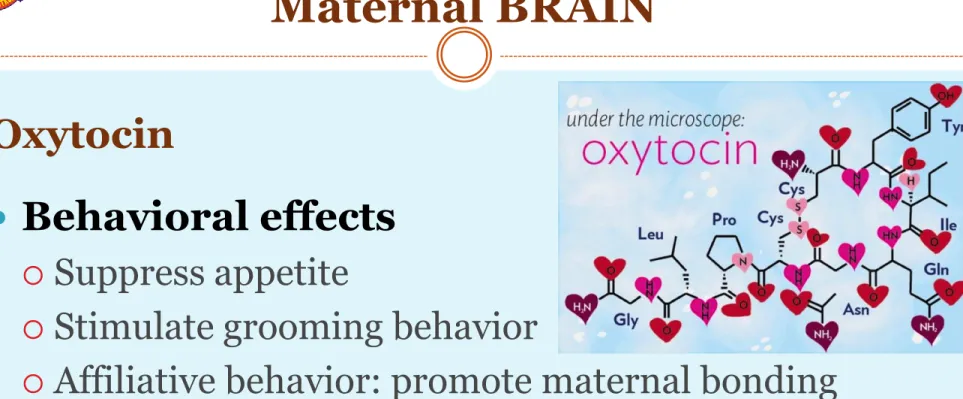
Oxytocin
Behavioral effects
Suppress appetite
Stimulate grooming behavior
Affiliative behavior: promote maternal bonding
Oxytocin functions = directly associated with mother’s ability to provide optimal caregiving
BF & Maternal Health:
Maternal BRAIN
Illustration from: HTTPS://NEUWRITESD.ORG/2014/02/13/OXYTOCIN-BONDING-AND-BREASTFEEDING/
PROLACTIN
OXYTOCIN
Other
hormones Route of
delivery
Exposure to
stress Other factors
EMPOWERMENT
BF & Maternal Health:
Maternal BRAIN
Empowerment
BF women change their behavior
Develop self-esteem & assertiveness
Interact more maturely with their infants
BF & Maternal Health:
Maternal BRAIN
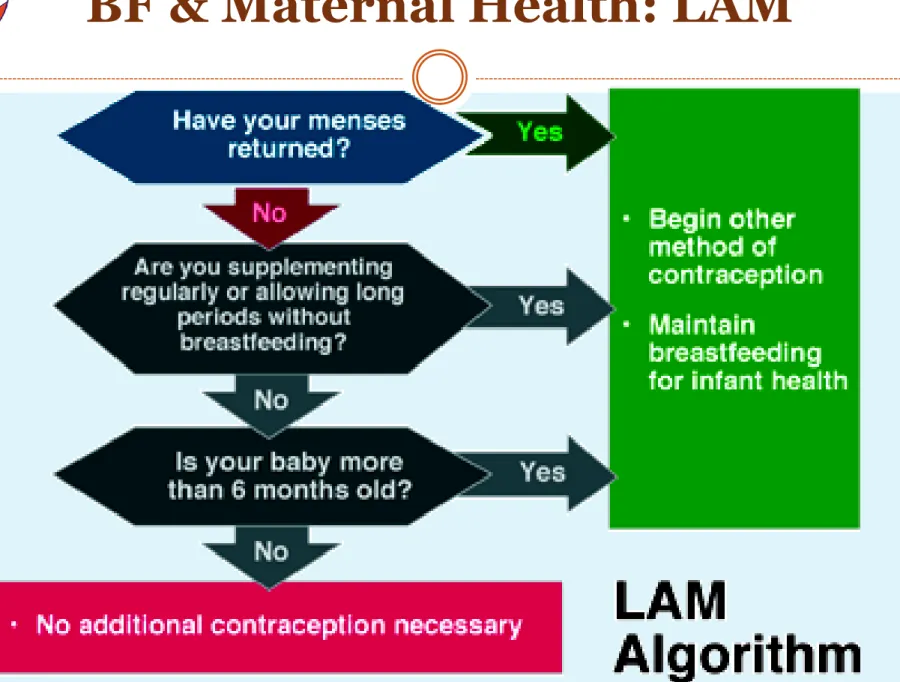
BF & Maternal Health: LAM
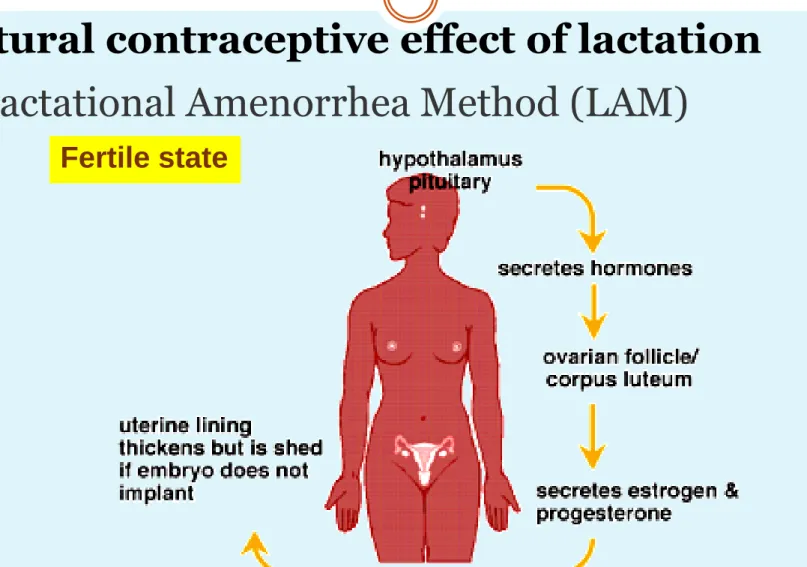
Natural contraceptive effect of lactation
•
Lactational Amenorrhea Method (LAM)
Fertile state
Illustration from: https://www.fhi360.org/sites/default/files/webpages/Modules/LAM/goals.htm
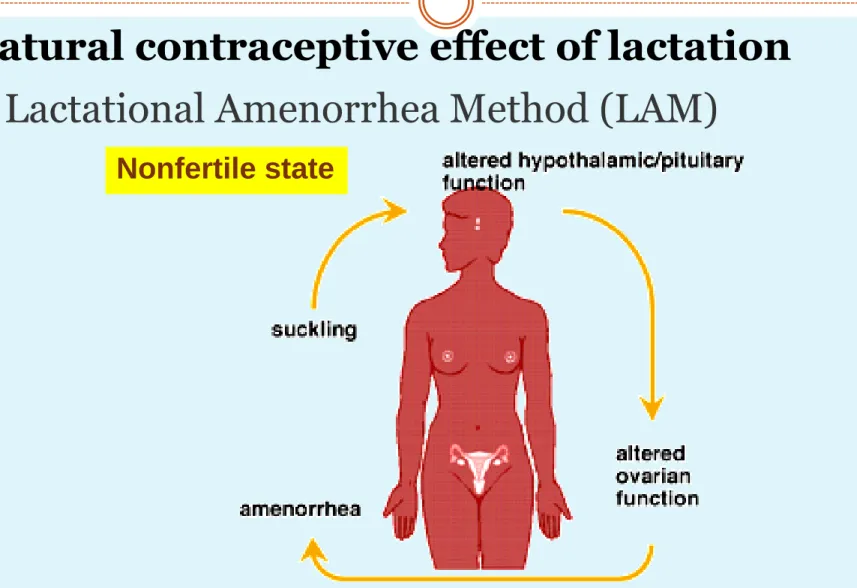
Natural contraceptive effect of lactation
•
Lactational Amenorrhea Method (LAM)
BF & Maternal Health: LAM
Nonfertile state
Illustration from: https://www.fhi360.org/sites/default/files/webpages/Modules/LAM/goals.htm
Lactational Amenorrhea Method (LAM)
criteria are:
1.
Lactation: woman must fully or nearly fully breastfeed, and
2.
Amenorrhea : breastfeeding woman must be without menses since delivery, and
3.
Months: infant must be <6 months old
BF & Maternal Health: LAM
Lactational Amenorrhea Method (LAM)
Interval between feedings:
SHOULD NOT > 4-hr during the day or 6-hr @ night
Supplemental feedings:
SHOULD NOT > 5-10%of the total
BF & Maternal Health: LAM
Special report from ACOG. Breastfeeding: Maternal & Infant aspects. 2007
Lactational Amenorrhea Method (LAM)
ACOG (special report 2007) – most appropriate for women who plan to BF exclusively for 6 months
Efficacy: 6-month pregnancy rate averaging 1-2%
acceptable, learnable, user-friendly, & as effective as many other alternatives (levels of evidence II-2)
Cochrane literature review (2015) - fertility rates = low among fully BF, amenorrhic ♀
BF & Maternal Health: LAM
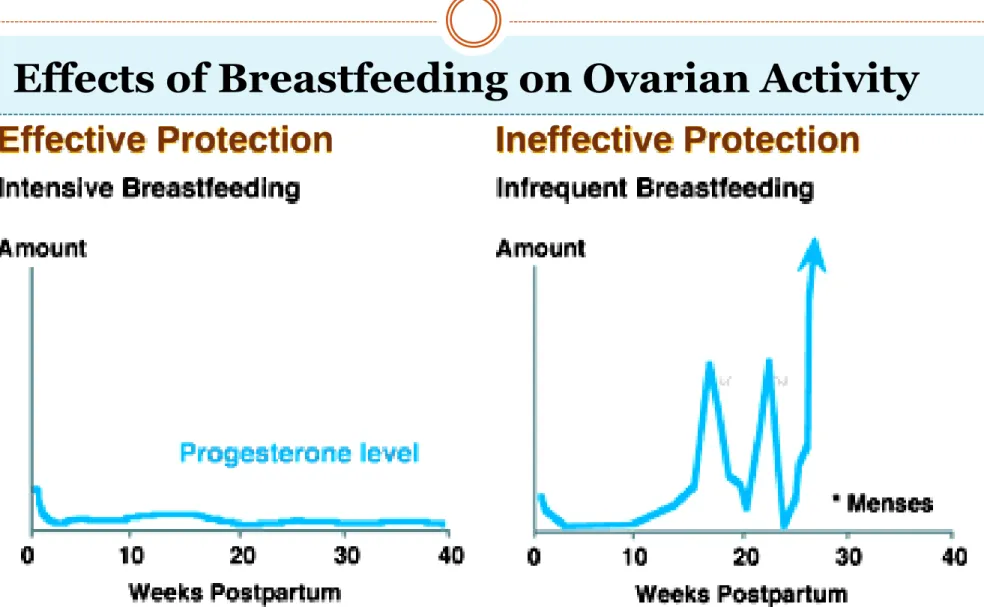
Effects of Breastfeeding on Ovarian Activity
BF & Maternal Health: LAM
Effective Protection Ineffective Protection
Illustration from: https://www.fhi360.org/sites/default/files/webpages/Modules/LAM/goals.htm
Bellagio Consensus
“A postpartum woman has at least 98% protection from pregnancy
for 6 months when she remains amenorrhic and fully or nearly fully breastfeeds.”
An international panel of experts met in Bellagio, Italy
August 1988
BF & Maternal Health: LAM
LAM Disadvantages
Breastfeeding pattern may be difficult to maintain
No STD or HIV protection
Duration of method limited
Only useful for breastfeeding women
BF & Maternal Health: LAM
BF & Maternal Health: LAM
Illustration from: https://www.fhi360.org/sites/default/files/webpages/Modules/LAM/goals.htm
Osteoporosis risk in later life of women
Lawrence RA, Lawrence RM. Breastfeeding: a guide for medical profession. 7th ed.
BF & Maternal Health: BONE
Never borne
infant women Borne infant
women Borne & breastfed Infant women
Bone mineral loss experienced during pregnancy & lactation = TEMPORARY
Bone mineral density return to normal after pregnancy and even after extended lactation
when mineral density are exceed original baseline
Lawrence RA, Lawrence RM. Breastfeeding: a guide for medical profession. 7th ed.
BF & Maternal Health: BONE
Maternal bone health
Calcium metabolism & bone metabolism
= substantially altered with ↑ calcium demands during lactation
High calcium demand during lactation
makes ♀ more prone to bone resorption
& subsequent osteoporosis
Bone densities can ↓ by between 3-10%
in the span of a few months in healthy mother
BF & Maternal Health: BONE
Pregnancy & lactation - proposed as 2 risk factors for postmenopausal osteoporosis
Although hormonal changes cause calcium loss &
result in ↑ bone resorption, bone resorption may be reversed after delivery
Salari P, Abdollahi M, Pharm D. The Influence of Pregnancy and Lactation on Maternal Bone Health: A Systematic Review. Journal of Family and Reproductive Health 2014; 8(4):135-48.
BF & Maternal Health: BONE
There did not appear to be a significant effect of breastfeeding on the risk of osteoporosis.
BF & Maternal Health: BONE
Chowdhury R, Sinha B, Sankar MJ, Taneja S, BhandariN, Rollins N, Bahl R, Martines J. Breastfeeding and maternal health outcomes: a systematic review and meta-analysis. Acta Pædiatrica 2015 ;104: 96–113.
BF & Maternal Health: BONE
Numerous studies have investigated on the issue
but there is no consensus about the contributory effect of pregnancy & lactation
on osteoporosis.
The review shows that despite of controversial results, pregnancy may have protective effect on bone
especially if followed by lactation.
BF & Maternal Health: BONE
Salari P, Abdollahi M. The influence of pregnancy & lactation on maternal bone health.
J Fam Repro Health 2014; 8: 135-48.
Breast cancer
Breast cancer = more common among non-BF mothers
Meta-analysis of 47 studies - for each year a mother BF, her risk of invasive breast cancer is ↓ by >4%
BF & Maternal Health:
Breast cancer
Schwarz EB, Nothnagle M. The Maternal Health Benefits of Breastfeeding.
www.aafp.org2afp/2015/0501/p602.pdf
Food, Nutrition, Physical Activity,
And Cancer of The Breast (Premenopause)
STRENGTH OF CURRENT EVIDENCE
DECREASES RISK
INCREASES RISK
CONVINCING Effect on Risk:
Adult attained height
PROBABLE Effect on Risk:
Vigorous physical activity Lactation
Alcoholic drinks Greater birthweight
Source: AICR/WCRF Diet, nutrition, physical activity and breast cancer, 2017
BF & Maternal Health:
Breast cancer
Food, Nutrition, Physical Activity,
And Cancer of The Breast (Postmenopause)
STRENGTH OF CURRENT EVIDENCE
DECREASES RISK
INCREASES RISK
CONVINCING Effect on Risk:
Body fatness
Alcoholic Drinks Adult weight gain Adult attained height PROBABLE
Effect on Risk:
Physical activity Lactation
Body fatness as young adult
Source: AICR/WCRF Diet, nutrition, physical activity and breast cancer, 2017
BF & Maternal Health:
Breast cancer
The risk reduction for breast carcinoma
= 8% among ever BF mothers when finely adjusted for parity
Longer duration of BF (>12 months) - associated with more protection of breast carcinoma
than shorter duration of BF (<6 and 6–12 months) when compared to never BF
BF & Maternal Health:
Breast cancer
Possible biological protection mechanisms:
May occur through parity-specific changes in levels of circulating hormones (estradiol, prolactin &
growth hormone) = associated with breast cancer risk
Parous mammary gland may contain epithelial cells
with more differentiated & less proliferative character which = less susceptible to transformation
Shedding of breast tissue after lactation may also help rid cells with DNA damage
BF & Maternal Health:
Breast cancer
http://www.aicr.org/cancer-research-update/2017/10_4/cru_breastfeeding-protects-moms-from-breast-cancer.html
Ovarian cancer
Also more common among mothers who do not BF
Meta-analysis of 5 prospective cohort studies &
30 case-control studies, never BF mothers
= 32% more likely to develop ovarian cancer
BF & Maternal Health:
Ovarian cancer
BF women for >12 months
= associated with 35% ↓ in ovarian cancer (compared with women who not BF)
BF & Maternal Health:
Ovarian cancer
Schwarz EB, Nothnagle M. The Maternal Health Benefits of Breastfeeding.
www.aafp.org2afp/2015/0501/p602.pdf
Physiological protective effect mechanisms:
May account for BF against ovarian cancer through modulating ovarian cycle length
Longer duration of BF suppresses ovulation longer &
causes suppression of gonadotropins, resulting in depressed production of plasma estradiol
Possibly less ovulation when pregnancy or BF
BF & Maternal Health:
Ovarian cancer
Ever BF - associated with 11% ↓ in risk of endometrial cancer
Longer average duration of BF per child - associated with lower risk of endometrial cancer
Breastfeeding and Endometrial Cancer Risk: An Analysis From the Epidemiology of Endometrial Cancer Consortium Obstetrics & Gynecology: June 2017 - Volume 129 - Issue 6 - p 1059–1067
BF & Maternal Health:
Endometrial cancer
Duration of total and exclusive BF - significantly associated with ↓ risk of endometriosis
For every additional 3 months of total BF per pregnancy,
♀ experienced 8% lower risk of endometriosis &
14% lower risk for every additional 3 months of EBF per pregnancy
BF women for ≥36 months in total across reproductive lifetime had 40% ↓risk of endometriosis compared with women who never BF
History of breast feeding and risk of incident endometriosis: prospective cohort study.
BMJ. 2017; 358: j3778. Published online 2017 Aug 29.
BF & Maternal Health:
Endometriosis
The protective association with BF was strongest among women who gave birth within the past 5 years
Association with total BF & exclusive BF on endometriosis - partially influenced by postpartum amenorrhea
History of breast feeding and risk of incident endometriosis: prospective cohort study.
BMJ. 2017; 358: j3778. Published online 2017 Aug 29.
BF & Maternal Health:
Endometriosis
Maternal long term metabolic health
Milk production, requires 500 kcal/day for EBF infant,
↓ maternal obesity in later life
↓maternal risk of DM & hyperlipidemia
Longer duration of BF - ↓ risk of development of DM type 2
by 32%, and in linear dose–response analyses, there was 9% reduction in relative risk for each 12- month
↑ in lifetime duration of BF
Chowdhury R, Sinha B, Sankar MJ, Taneja S, BhandariN, Rollins N, Bahl R, Martines J. Breastfeeding and maternal health outcomes: a systematic review and meta-analysis. Acta Pædiatrica 2015 ;104: 96–113.
BF & Maternal Health:
Long-term metabolic Health
Potential mechanisms:
Lactation may
"reset" maternal metabolism after pregnancy
improve beta cell function
suppress HPA-axis activity through action of oxytocin and other lactogenic hormones
be a marker for other maternal health behaviors
Stuebe A. Associations between lactation, maternal carbohydrate metabolism, and cardiovascular health.
Clin Obstet Gynecol. 2015 December ; 58(4): 827–839.
BF & Maternal Health:
Long-term metabolic Health
Cardiovascular risk
Compared with parous never BF ♀, ever BF ♀ = associated with significant lower risk of CVD (coronary HD, stroke)
BF ♀ ≥ 24 months - 18% lower risk of coronary HD
& 17% lower risk of stroke (compared with never BF ♀)
BF = associated with 10% lower risk of several major CVDs in later life
Breastfeeding & the risk of maternal CVD: a prospective study of 300,000 Chinese women.
J Am Heart Assoc. 2017;6:e006081
BF & Maternal Health:
Cardiovascular disease
Hypertension & Cardiovascular risk
♀ never BF - 29% more likely to develop hypertension, even after adjustment for lifestyle factors & family history
Women’s Health Initiative - ♀ who BF for 7-12 months after their 1st delivery
28% less likely to develop cardiovascular disease than mothers who never BF
BF & Maternal Health:
Cardiovascular disease
Benefits during lactation
Postpartum recovery
Uterine involution
Reduce maternal response to stress
Weight loss
Prolongation of postpartum anovulation - LAM
BF & Maternal Health:
TAKE HOME MESSAGE
Long-term benefit
Reduce risk of
Breast cancer
Ovarian cancer
Endometrial cancer
Endometriosis
Diabetes mellitus
Cardiovascular disease
Osteoporosis – unclear
BF & Maternal Health:
TAKE HOME MESSAGE
Economic benefit
Familial benefit
Saving accrued
NOT buying formula ($1,000 per year)
↓ out-of-pocket expenditures for medical care &
↓ work absences
Social benefit- economic savings & ↓ mortality