I would like to thank you for your encouragement in the area of pre-purchase intention for fast fashion. The purpose of this thematic article is to investigate and identify the intention of young Thai female consumers before purchasing fast fashion. There are several factors that indicate the intention before purchasing fast fashion products in Thailand.
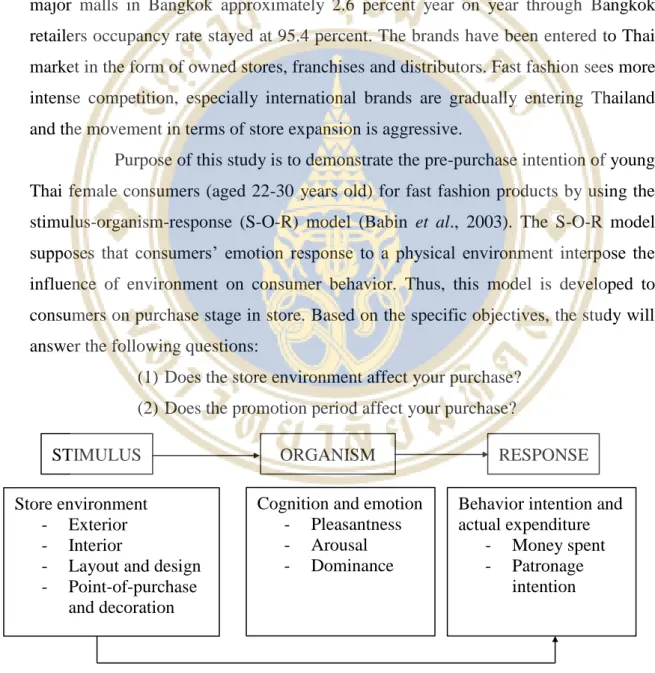
In the first part, these young Thai women who normally buy fast fashion and factors that should be purchased according to S-O-R model. The thematic article aims to identify through survey method among young Thai female respondents who are between 22 and 30 years old and wear fast fashion products. This article examines the prepurchase intention of young Thai female consumers aged 22 to 30 years old for fast fashion products.
Because of the Thai market, most of the fast fashion stores located in department stores, which provided the stores regulation. The previous study is carried out store exterior in small clothing stores, which have less reputation, but in this research is focused on fast fashion clothing brands in Thailand. Fast fashion is a contemporary term used by fashion retailers to express that designs move from the catwalk quickly to capture current fashion trends.
LITERATURE REVIEW
- Fast fashion
- Fashion consumers
- Store environment
- Fashion trends and consumer demand
- Emotional and affective responses
Fast fashion in Thailand, international brands in the fast fashion categories continued to enter the Thai market or increase the number of stores both in Bangkok and other countries due to the strong retail market by entering the market for in terms of owned stores, franchises and distribution agreements. The fast fashion market in Thailand has increased the demand for new trends and styles influenced by Thai celebrities. Female fashion consumers are generally attracted to shop in fast fashion stores (Barnes and Lea-Greenwood, 2006).
We defined fast fashion consumers into the following groups: fashion innovators, fashion opinion leaders, innovative communicators and fashion followers (Workman and Caldwell, 2007). Innovative communicators are among the first to adopt styles and also influence the fashion decisions of others. In addition, fashion consumers are most likely to be concerned about value for money, due to the trend of fashion changes all the time.
According to the 4 characteristics of fashion consumers, there are many celebrities in Thailand who influence fashion followers to buy fast fashion brands. Fashion followers are target consumers who buy fast fashion products by following their favorite celebrities. The product display associated with the stylistic coordinate is organized by specific styles due to the uniqueness of the brand, which the consumer perceives by the overall presentation of coherence, rather than by individual components (Bell et al., 1991).
Fast fashion is about immediacy in relation to trends and consumer demand, and so the window display is the first point of contact and communication. Signage helped to warn customers about fast fashion represented the second category, which includes signage that is more flexible and has immediacy to provide information and promote purchase, so known as "point of purchase", which provides advertising signs, posters, graphics, etc. The PLCs of fashion products have decreased from months to weeks and even days (Sull and Turconi, 2008; Barnes et al., 2007).
In addition, fast fashion is driven by catwalk styles, celebrities and the desire for novelty, and it is especially important that these items are determined by the media, which creates interest and stimulates a high level of consumer demand. Mood-based evaluations are in the individual judgment of products or services (Isen et al., 1978; Schwarz, 1997). The positive effect of emotional enjoyment can increase time spent in store and shopping time in terms of consumer involvement (Holbrook and Gardner, 1993) and acquisition of customer share (Babin and Attaway, 2000).
Once consumers have a certain belief about a store's characteristics, this completely influences the time they spend in the store (Stoel et al., 2004).
METHODOLOGY
Research design
Respondents freely interpret, share their experiences, suggest and recommend information about the fast fashion retail environment. In this paper, the quantitative method is a tool to investigate the behavior of consumers who frequently shop in fast fashion. In this survey, 10 questions supporting the environment of fast fashion stores were divided into 3 different types of questions.
It is useful when researchers are gathering information about numbers, quantities, or amounts of something or someone. Respondents are given a scale from 1 to 10, which they apply to the participants' answers and which can be calculated into the total contribution.
Sample selection
Research instrument
But there are also the limitations and lack of interviewer experience, which makes the answers too broad and not to the point. The quantitative research using the statistical methods starts with the collection of data based on the hypothesis or theory. Furthermore, this study provided quantitative questions that created the number and percentage of consumer behavior in the fast fashion retail environment.
Key elements of good research are usability refers to the ease with which an instrument can be administered, interpreted by the participant. Validity is the degree to which an instrument measures what it is supposed to measure and does. This model can be explained both in the open question in the personal interview and in the closed question in the questionnaires using this model included in the environment of fast fashion stores.
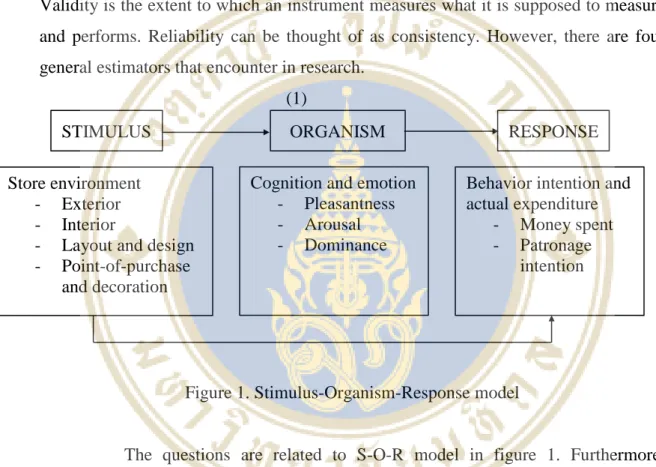
FINDING
Stimulus variable
In previous study, it was claimed that larger window display was more successful in attracting consumers' attention compared to the small window display. Additionally, sales increased when stores used window displays compared to no window display (Edward and Shackley, 1992). The result in this research found that young Thai female consumers are more inclined to window display with nice decoration and display new arrivals, which is the same as existing research.
These elements attract consumers to enter the stores; at least they have a positive experience with the store. Brands are also related to commerce, as each brand has its own identity and fast fashion consumers have different lifestyles. Fiore et al. (2002) reported a positive effect of store environment on pleasant experiences and approach responses, and S-R, O-R, and S-O-R links were supported in their study.
In addition, this research found that young Thai female consumers prefer the style coordination store made it easy to browse and mix and match well. Moreover, the good combinations of mix and match with store decoration and fast fashion items get consumer's intention to buy more. In this study we focus on store environment to promote the store campaign not the other media.
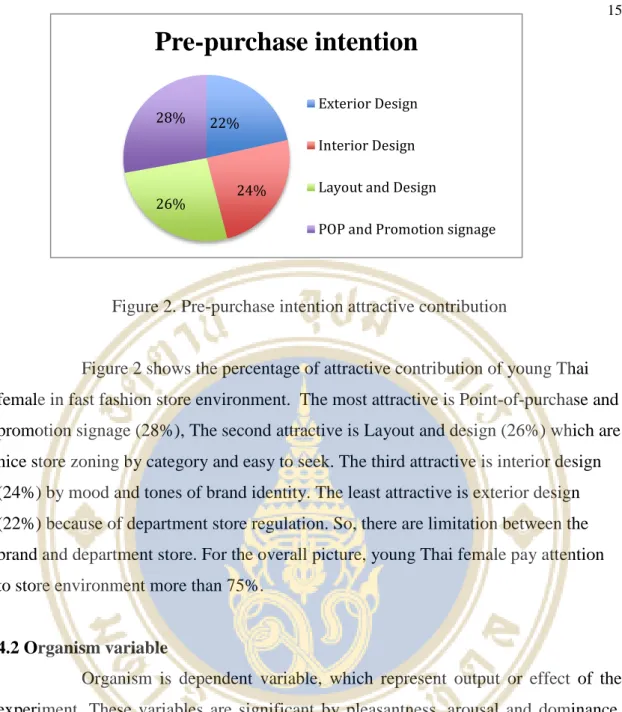
Young Thai woman chose to shop in this period and store should be well prepared. In addition, quantitative results, the most attraction for young Thai consumers in fast fashion products are promotional signage, layout and design of the store, interior design and the least attraction is exterior design. Due to the regulation of department store, exterior design such as, window display and entrance have a limitation on design.
It is not likely that in other countries some of the fast fashion stores are located outside department stores and these stores have the least restriction compared to the department store. The most attractive is Purchase and promotional signs (28%), The second attractive is Layout and design (26%) which is nice store zoning by category and easy to search.
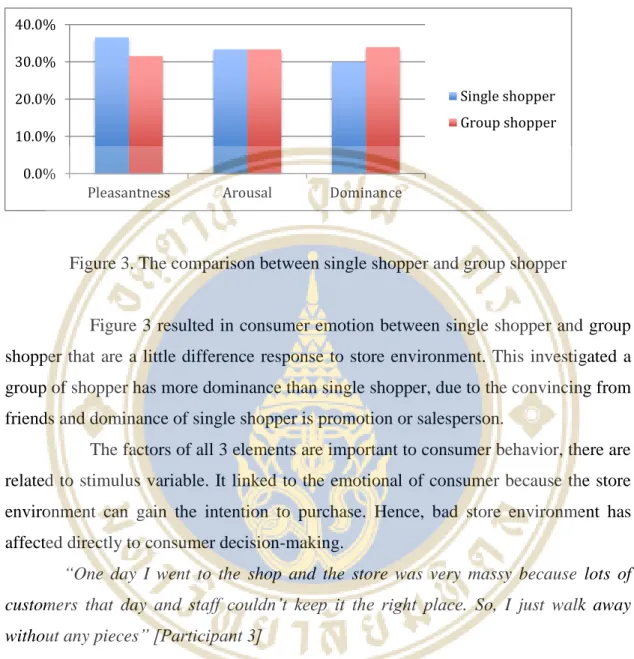
Organism variable
Pre-purchase intention
Response variable
The response variable is an effect of the stimulus and the organism, and results from the purchase of the product or the intention to purchase. Excitement positively affected money and time spent and the number of items purchased in the store. The promotional period has made consumers buy more than regular, because of the cheaper prices make consumers impulse buy.
As a result, consumers are willing to spend longer in the store and this creates an opportunity to buy. Therefore, signage and merchandise in the promotional period are important and produce effect that consumer finds easily. Sometimes I just want to buy a shirt, but at the store it matches skirt and scarf.
Point of purchase and decoration are the stimulus variables and are important success factors during the promotional period. Due to the price during the promotional period, it is very attractive to consumers, but P-O-P aims to support both consumers and sales staff to increase sales. The important purchase intention of fast fashion is good products and can be supported in the trend by celebrities or models.
The second important purchase intention is a nice promotion, the consumer prefers to buy with a reasonable price, sometimes the fast fashion product in Thailand is more expensive compared to the cost of living and also different from other countries because the fashion fast is cheap compared to their cost of living.
Recommendation
Sales staff should have knowledge of the products and arrange the goods in the right place. In addition, window display should be concentrated because the cycle of fast fashion is very fast and releases many collections during the quarter. Sales staff are responsible for changing new arrival collections on window display or during the promotional period.
Labels are another tool for direct communication with consumers; brands must provide clear signs with good design that match the products. The recommendation is useful for the brand to develop and improve its store and focus on exterior, interior, layout and design, point of purchase and decoration to support consumers. In addition, brands need to hire more staff to care for and serve consumers during the promotion period.
Research limitations and further studies
CONCLUSION
Store atmosphere: an environmental psychology approach ”, Psychology of Store Atmosphere , Vol. 2006), “Supplier management in fast-moving fashion retail”, Journal of Fashion Marketing and Management, Vol. 1992), “Measuring the effectiveness of retail window displays as part of the marketing mix”, International Journal of Advertising, Vol. 1993), “An approach to examining the emotional determinants of consumption duration: why do people consume what they consume, as long as they consume it?, Journal of Consumer Psychology, Vol.2, pp. 1978), “Affect, material accessibility, and behavior: a cognitive loop?”, Journal of Personality and Social Psychology, Vol.36, pp. -Greenwood, G., (1998) “Visual merchandising: a neglected area in British fashion marketing?”, International Journal of Retail Distribution and Management, Vol.