The purpose of this study was to investigate 1) perceptions of airline passengers and educators regarding the importance of soft skills for advancement in ground passenger service;. Most airlines and instructors agreed that soft skills are essential for career advancement in passenger ground handling positions.
Background Information
Introduction to Airline Business in Thailand
To ensure that the airports can accommodate the incredibly increasing number of airlines and number of flights operating, there are currently several expansion plans in place for many of the airports. Suvarnabhumi Airport, which inherited the airport code BKK from Don Mueang, is also known as Bangkok International Airport (BKK).
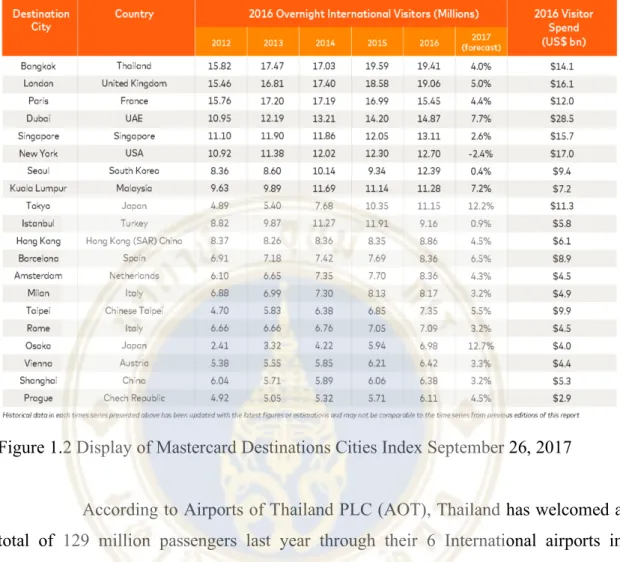
Introduction to Ground Passenger Service
Ground handling agents are the first impression on a passenger during the passenger's arrival and departure. Due to the booming business of the airline industry, carriers have been looking for ways to improve their competitiveness in the market.
The needs of the business sector towards labor market
Ground passenger service is a unit that airlines need to focus on and highly skilled workforce with good knowledge is required in this part. A ground handling agent will necessarily need to have various types of non-routine skills, e.g.
Aviation schools and universities with undergraduate programs related to Aviation Business
According to the perspective and experience of the airlines, their regular staff evaluation has clearly shown that their employed staff trained in aviation business studies show great competence in technical skills, professional knowledge and functional ability. Therefore, a common understanding and commitment between the two major stakeholders, which were the educational institutions, the supplier of the workforce to the industry and the airlines, the users of the workforce in the market, was necessary and very beneficial to the company.
Objectives of the Research Study
The World Economic Forum (2014) mentioned that skills were a critical asset for individuals, businesses and societies and matching skills and jobs had become one of the high priority policy concerns. This purpose of this study is ultimately to develop an assessment tool in the form of the personality test to assess the skills possessed by candidates for career advancement.
Expected Benefits
In order to better understand the context of soft skills and career advancement in Ground Passenger Service, this chapter presented the background information on each factor as a basis for this research. 2.2) Employer perception of soft skills needed in today's workplace (2.3) Incorporation of soft skills into the curriculum.
The various definition of Soft Skills
Hence, "soft skills" was an umbrella term that covers various essential skills such as personality traits, communication skills, interpersonal skills, social skills, leadership skills, emotional intelligence (EQ), negotiation skills, ethics, teamwork and more that drive people to work. (Deepa & Manisha, 2013). After several attempts to clarify, they finally defined the term "soft skills" as those skills that were important work-related skills but had no interaction with machines.
The essence of Soft Skills
Soft Skills as Key Element of Graduate’s Employability
Over the past decades, it has been emphasized that soft skills have played a crucial role in increasing graduate candidates' chances of obtaining employment. To ensure success, graduate students entering the 21st century labor market will inevitably need to possess 'soft skills' in addition to their technical competence (PCBEE, 2000, cited in Deepa and Manisha, 2013).
Employer’s Perception of Soft Skills needed in today’s workplace
Soft skills were essential, as they were generally number one, and extremely important for potential employability in jobs in many occupations and industries (Sutton, 2002). Based on his survey of approximately 57 executives in the US, it was found that while employers were extremely confident in hiring new employees who had strong soft skills, e.g.
Incorporating Soft Skills into the Curriculum
Seven soft skills are communication skills, critical thinking and problem-solving skills, teamwork, lifelong learning and. The three most important soft skills you need to have to succeed in the workplace are communication skills, teamwork and time management.
The definition of Job Performance
Reliability of criteria is included as an important consideration by all authors writing about job performance measurement. Of the various methods of measuring job performance of each individual employee, performance ratings have been the most widespread.
Considerations in organizational career advancement
Modelling the promotional process
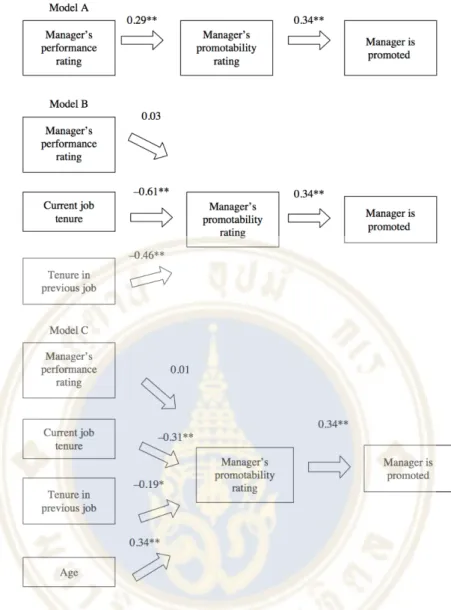
Given its importance, it was surprising that few empirical studies have focused on the employee promotion process. To provide a general basic framework for future research, Figure 3 provided a model of how the promotion process would likely unfold in many organizations (Breaugh, 2011).
Criteria related to promotion
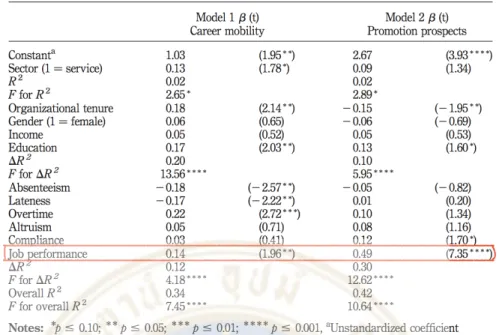
Based on Figure 2.4, the result showed that job performance was significantly related to promotion opportunities. To conclude this section, the results of several studies confirm that job performance was the only significant predictor of promotion prospects.
Soft Skills needed for Career Advancement
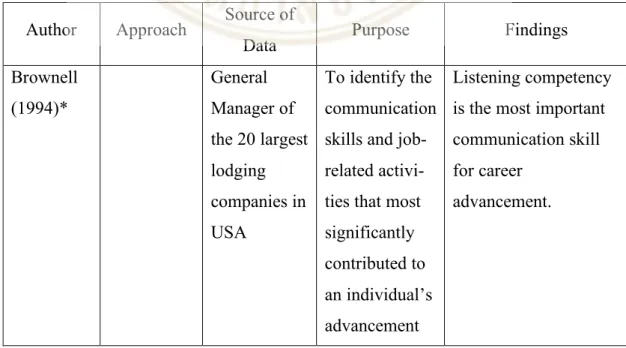
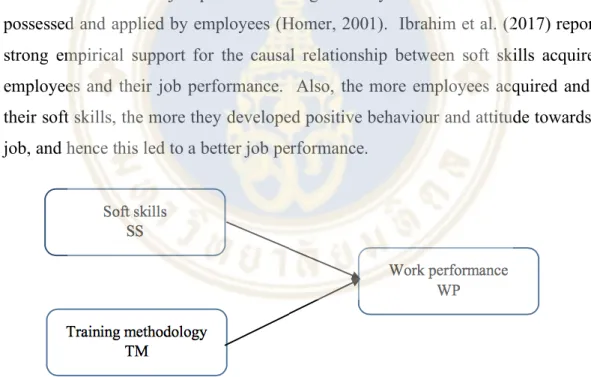
Heimler, Rosenberg, and Morote (2010) found that soft skills were found to be predominant contributors to graduates' career advancement potential. Although the work performance is the criteria that is always considered, the soft skills are also one of the most important criteria in the organization to find the suitable and qualified person to be selected for career advancement (Meenakshi, 2009; Robles, 2012) . The same survey was also distributed to the educators to find the gaps between identified essential soft skills of practitioners and educators.

Overview of the Research Process
Study on
Essential Soft -
Comparative Studies of Airliners’ and Educators’ Perceptions Towards Soft Skills Essential for Career Advancement in Ground Passenger Service
Study on Ranking Essential Soft Skills by Airline Groups
Essential Soft-Skill Assessment Tool Development to Identify Potential Candidates for Career Advancement in Ground Passenger Service
Type of Research
Quantitative research is the systematic empirical study of observable phenomena via statistical, mathematical or computational techniques (Given, 2008). The purpose of quantitative research is to develop and apply mathematical models, theories and hypotheses regarding phenomena. Therefore, to achieve all the objectives of this study, both quantitative research methodology and qualitative approach were used in the research as follows.
Population, Sampling, Samples
- Airliners with high-level management position
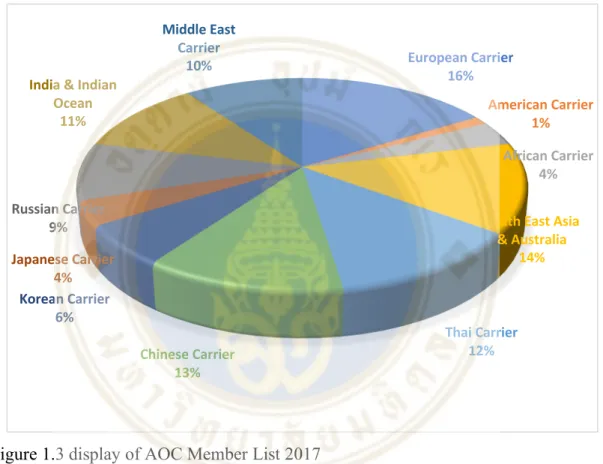
Based on the Airline Operators Committee member list data, Bangkok Suvarnabhumi International Airport, 2017, the total population is 80 airlines. To facilitate the data analysis process and to analyze the difference between the perceptions of aircraft in each group of airlines, the researcher grouped all 70 airlines that operate passenger flights for the entire year, based on their country of origin. To obtain reliable data, the researcher increased the sample size to 60 people.
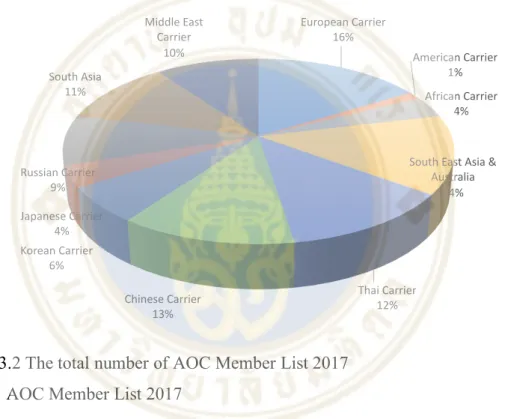
70 AIRLINES
Educators in Aviation Program
In this study, the minimum number of 5 lecturers per university was used to estimate the sample size. Þ Based on the above assumption, the calculation of the number of participants is presented as follows; Based on the above sample size calculation by substituting the numbers in the formula, the sample size is 115 people.
Airliners with first-level management position
Step 1: Comparative Studies of Airliners’ and Educators’
Step 2: Study on Ranking Essential Soft Skills by Airline Groups The time taken for this step of data collection was around one month from
Step 3: Essential Soft-Skill Assessment Tool Development to Identify Potential Candidates for Career Advancement in Ground Passenger
Research Instrument
- Research Instrument
- Testing of Research Instrument: Validity Test
Item-Objective Congruence (IOC) was used to evaluate the items in the study based on the score range from -1 to +1. All evaluators gave a score of 1.0 for questions number 3-6, while the average score on the first question was 0.80 and the average score on the second question was 0.60. In conclusion, the researcher scored 1.00 for the first part, 0.90 for the second part and 0.95 for the third part of the first survey, which made the first survey a valid and reliable tool to collect data in the first stage of the research.
Data Collection
It was decided not to include the outcome of the educators in the second study as the researcher intends to identify the essential soft skills that the practitioners need in this research study. In addition, the researcher would also like to investigate the gaps between identified essential soft skills of practitioners and educators for further conclusion of the research study. In this step, the final survey in the form of the assessment sheet was designed and developed based on the results of the first survey of the practitioners.
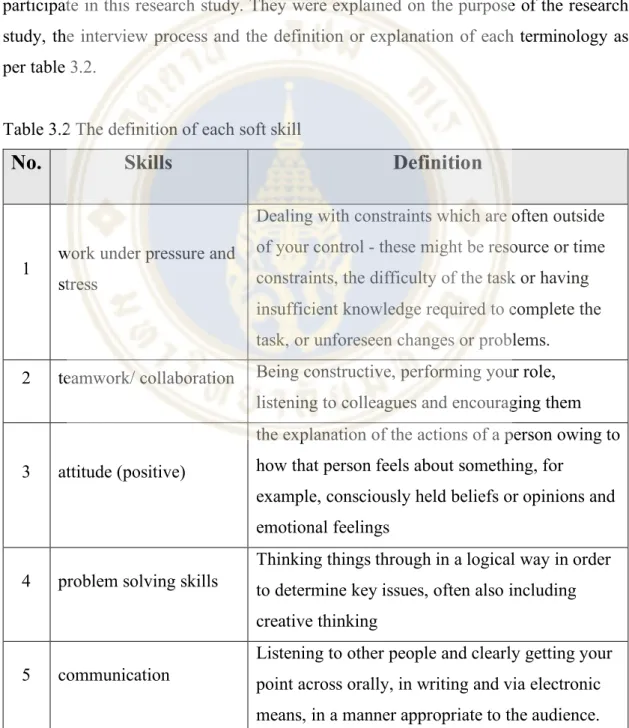
Data Analysis
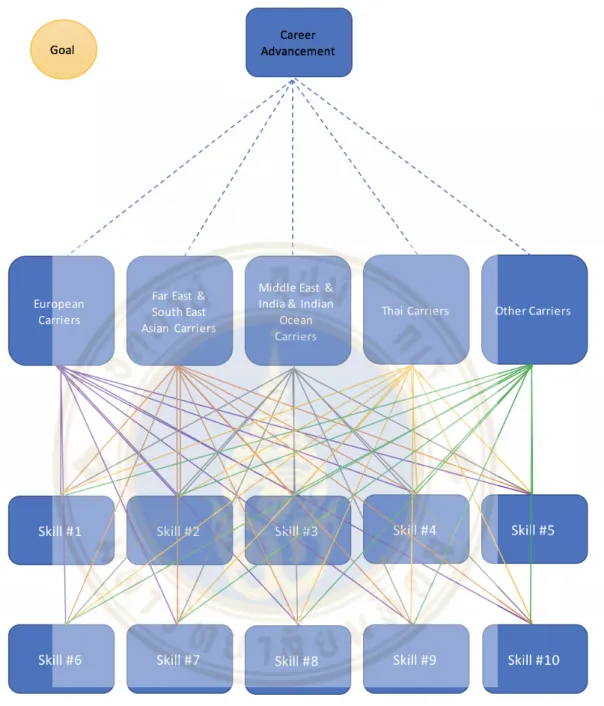
In addition, in Saaty's book Analytical Hierarchy Process, he also developed the hierarchy for the position selection and promotion of academic staff. In this research step, the objective of the problem was defined and the criteria in determining the objective of the problem were also identified. With the data analysis already described, the top ten essential soft skills for career advancement in Ground Passenger Service were identified to the perceptions of airmen and educators, leading to the construction of the development of the soft skills assessment instrument to reflect level of owners. soft skills from entry-level airline managers.
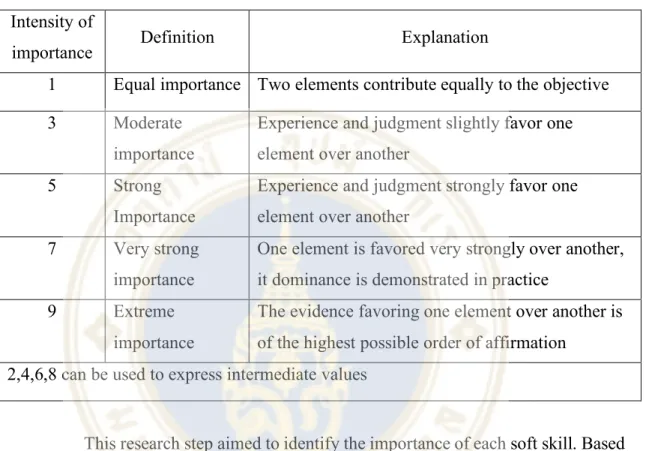
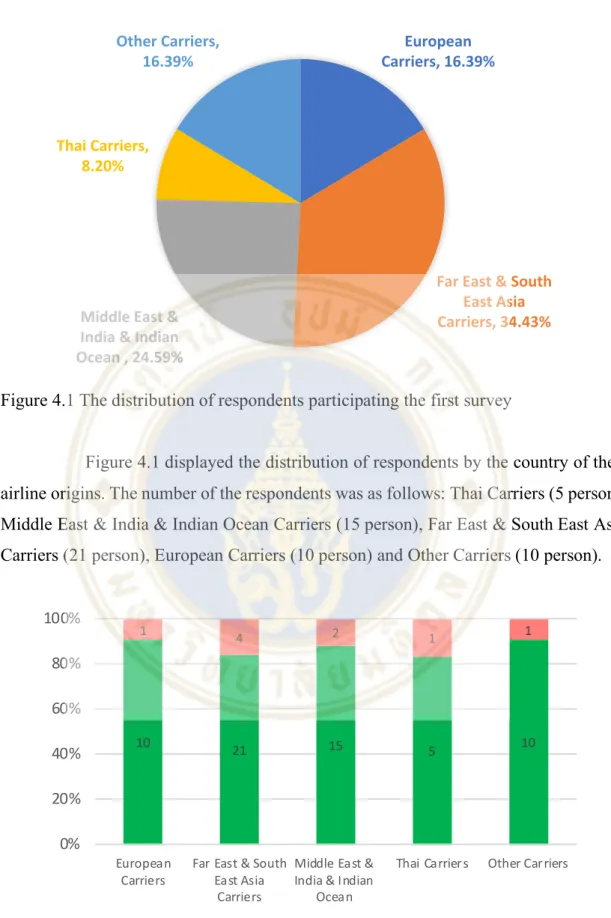
Profile of Respondents
- High-level airline managers
- High-level airline managers
- Entry-level airline managers
- General Perceptions towards Soft Skills
- The top ten Soft Skills in the perception of airliners and educators
- The discrepancy among perceptions of the airliners and educators
- The ranking of top ten Soft Skills in the perception of each airline group
- The discrepancy among perceptions of each airline group Though the consolidated data being derived from AHP model was sufficient
- The comparison between the consolidated top ten Soft Skills of all 61 airlines and the top ten Soft Skills of Thai Carriers
- The comparison between the consolidated top ten Soft Skills of all 61 airlines and the top ten Soft Skills of top 5 Skytrax Carriers
- The comparison between the top ten Soft Skills being ranked based on popularity method in the first survey and the consolidated top ten Soft
The other seven essential soft skills were 'problem-solving skills', 'communication skills', 'decision-making skills', 'ability and willingness to learn', 'emotionally stable'. Based on Figure 4.11 (left), the consolidated top 10 essential soft skills for practitioners' perception were as follows: “ability to work under pressure and stress”, “teamwork”, “positive attitude”, “problem-solving skills ” , “communication skills”, “decision-making skills”, “ability and willingness to learn”, “emotionally stable”, “interpersonal skills” and “negotiation skills”. Goepel (2017) consolidated top 10 essential soft skills for practitioners' perception were as follows: “positive attitude”, “problem-solving skills”, “decision-making skills”.
The radar chart shows the ranking of the top 10 most essential soft skills as perceived by Skytrax's top 5 aviation managers. In the perception of a high-ranking Qatar Airways manager: 'communication'. 0.1743) was ranked as the most important soft skills for career development.
Score Range
Summary
- General perceptions towards soft skills
- The discrepancy among perceptions of the airliners and educators
- The ranking of top ten Soft Skills in the perception of each airline group
- The comparison between the top ten Soft Skills being ranked based on popularity method in the first survey and the consolidated top ten Soft
- The discrepancy among perceptions of each airline group
- The comparison between the consolidated top ten Soft Skills of all 61 airlines and the top ten Soft Skills of Thai Carriers
- The comparison between the consolidated top ten Soft Skills of all 61 airlines and the top ten Soft Skills of top 5 Skytrax Carriers
- General Soft-Skill Assessment Score
- The level of possessed top ten Soft Skills of the entry-level airline managers
- The discrepancy among possessed Soft Skills of the entry-level airline managers and the expectation and needs of high-level airline managers
High-level airline executives and university teachers agreed that soft skills are essential for success in a career in ground passenger transport. The consolidated top ten soft skills identified by airmen were 1) positive attitude, 2) problem-solving skills, 3) decision-making skills, 4). Airlines have found that these ten soft skills are important for the career advancement of ground crew.
Implications and Recommendations
- Managerial Implication for academic sector
- Managerial Implication for aviation industry
- Practical Implication for individual graduates
To ensure success of the students in the 21st century, the students must be equipped with the right skills. The interview should be intensive and should include questions that show the level of soft skills of the applicants. Soft skills should be one of the main criteria for promotion selection to ensure that the right person will be promoted.
The limitation of the research
In order to avoid any major loss of investment in human capital and productivity of the airlines, the current training solution must be in accordance with the international protocol. In addition, the researcher was also aware of the discrepancy in perceptions between airlines in the same group. One of the possible barriers could be understanding the definition or defined scope of each soft skill and each respondent's perception of each soft skill.
Scope for Future Research
The IUP Journal of Soft skills, Vol 7, No. Soft skills and Long-run Labor Market Success”, Research in Labor Economics, Vol. 1991), "The performance measurement manifesto", Harvard Business Review, pp. International Journal of Academic Research in Business and Social Sciences Proactive personality and career success”, Journal of Applied Psychology, Vol. 2001), “The five-factor model of personality and career success”, Journal of Vocational Behavior, Vol. A longitudinal model linking proactive personality and career success”, Personnel Psychology, Vol. 2001), “A social capital theory of career success”, Academy of Management Journal, Vol.