And I would like to thank him for allowing this article to be my own work, but for always guiding me in the right direction when he thought I needed it. This thematic article attempted to find out the factors that influence the success of Thai social entrepreneurs by looking at the identified factors that were concluded and summarized which consisted of 13 factors, and tested which factors can be applied and that influence the success of can influence Thai social entrepreneurs. using a case study of a social enterprise in Thailand, Farmto Co.,Ltd. There are only seven factors that influence the success of Thai social entrepreneurs; (i) Presence of demonstrated need and identifiable group of beneficiaries (ii) Community acceptance and involvement of beneficiaries (iii) Social capital (Structural capital, Relational capital, Cognitive capital) (vi) Sound finances and reliable source of funding (v) Commitment of the leadership team (vi) Organized structure with well-defined responsibilities (vii) Emphasis on learning and improvement.
As public concern for social and environmental increase, there is a need for companies to take responsibility more proactively for a sustainable development pattern (Seelos & Mair, 2005). To tackle social and environmental problems, we create a non-profit organization, charity, non-governmental organization (NGO), or specific government department to monitor activities, set regulations, impose laws, and provide resources to help mitigate the aforementioned problems. Many companies have taken social activity as CSR, but it is not enough to tackle the social and environmental problems we are currently facing.
Regardless of their efforts, several issues remain unnoticed due to the focus of the companies only addressing these issues related to their activities (Zahra et al., 2008). An entrepreneur who focuses on making social and environmental impact while simultaneously discussing the business purpose is a social entrepreneur. The concept of social entrepreneurship is still young, but has received a lot of interest from scientists around the world.
In this article, we will explore how a social entrepreneur becomes successful by looking at factors that contribute to the success of a social entrepreneur in Thailand.

LITERATURE REVIEW
- Definition of Entrepreneur & Social Entrepreneur
- Definition of Success to Social Entrepreneur
- Success Factors
- Social Impact
- Implementation/Survival
- Growth, Expansion, and Development
- Definition of Organic
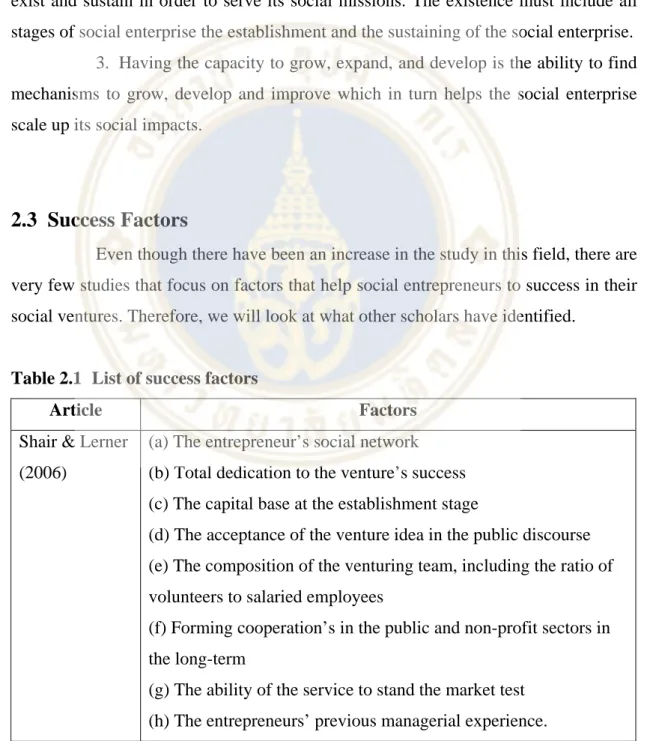
The existence must include all stages of social enterprise the establishment and the maintenance of the social enterprise. Even if there are several factors identified by several many scholars, we will take the factors compiled by from Gumaste (2010) due to their relation with the definition of success of social enterprise which in turn contributes by social entrepreneur . He studied to identify whether these 13 factors are really related to the success of the social enterprises.
Favored are the important factors that affect the company's position, as it is one of the components of the company's structure. The recipient can be suppliers, customers, employees or beneficiaries depending on the venture that the social entrepreneur has created. Therefore, identifying the needs of the specific recipient group that the company is targeting is necessary in order to sustain the company.
Acceptance by society includes recognition and support of the project by the community and the beneficiary. Beneficiary involvement, according to Gumaste (2010), will rebuild the community through the development of their families and societies. As for structural capital, it refers to the network ties that an individual has to people and resources, while relational capital refers to the quality of the network.
The level at which the entrepreneur sees himself as a member of the community or involvement in it; the extent to which the social entrepreneur has implanted. This is because it determines the existence of a social enterprise to achieve the social mission it has set for itself. It is therefore essential that these sound financial resources help explain the survival of a social enterprise.
In this context, the leadership team's dedication means the management's commitment in the form of time, money and willingness to sacrifice (Gumaste, 2010). Gumaste (2010) cited from a study by Sharir that the managers' experience in management or something related to the venture is one of the contributing factors that lead to the success of social venture. This applied to managers as well as staff in the organization and related stakeholders.
This is because the bigger the venture, the bigger the venture alleviates the social problems it is trying to solve. Since there are different standards for organic agricultural products in different countries, it makes more sense to take the definition in the context in which the company operates to ensure consistency of the definition.
RESEARCH METHODOLOGY
- Selected Social Entrepreneur
- Interview Questions
- The Company Background
- Success Factors
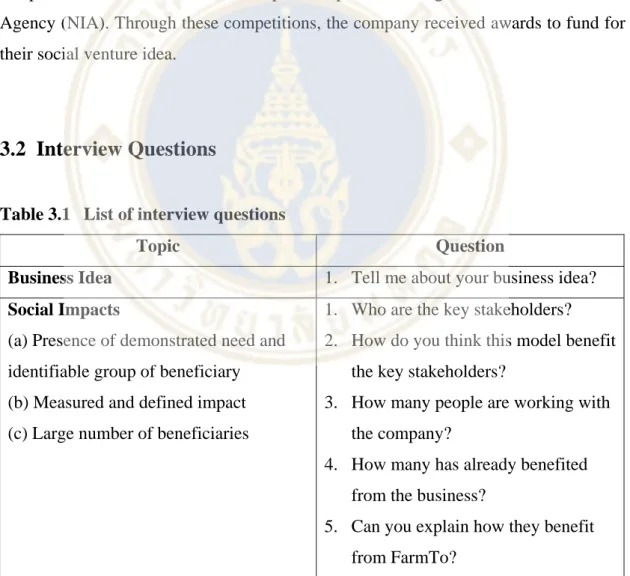
- Social Impacts
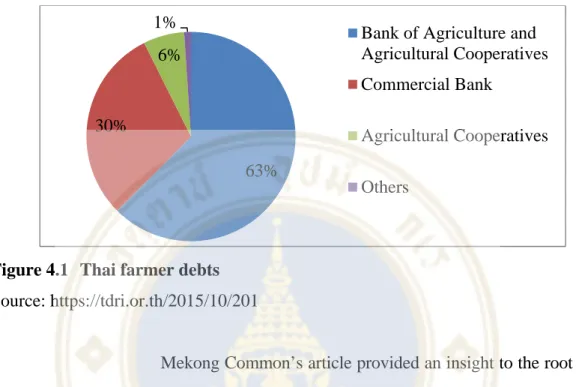
- Implementation/ Survival
- Growth, Expansion, and Development
There are currently five members in the company; four co-founders and a part-time administrator. This also ties in with the company's mission; to alleviate farmers' debt and promote the organic farming community. The opportunity identified by the company can solve farmers' problems by increasing profit margin by reducing the use of chemicals by promoting organic farming.
There are currently 3,000 farmers interested in joining the company, while more than 1,000 consumers are sending inquiries to the company. Therefore, the company has to wait until the mobile application is ready to enable data entry for 3,000 farmers. Because the application the company wanted to implement was not yet completed, Farmer To reported that the lives of only 500 farmers have been improved (via FarmTo's website).
When asked about the key stakeholders, farmers were the company's biggest concern when the company initially started. Therefore, community acceptance is crucial for both the founding phase and the survival of the company. The involvement of the beneficiary, in this case a farmer, also requires determining the success and failure of the business.
When asked about the company's financial position, it was surprising to find that the company managed its finances very well. To complete the project, the company draws funds from competition, investments from co-founders and FarmTo profits. For FarmTo, it is difficult to conclude that the company has a reliable source of funding, since the funds were obtained through competition.
Despite this, the company has been able to survive thanks to the positive financial performance it has generated. Conclusion: It is difficult to measure this factor from the case of FarmTo as the company still consists of very few members. The company is willing to share information so that farmers can achieve the standards required for organic farming.
For cooperation with other social enterprises, the company is looking for a partnership with those who support the work and concept of the company. When Farmer was asked where they see themselves going in the future, he wished that the company could transform society's behavior.
CONCLUSION AND RECOMMENDATION
Conclusion
However, there are several factors that the study did not consider, such as those suggested by Almeida (2010). Therefore, the purpose of this study is not to pinpoint the exact factors, but to examine a successful case and generally derive the factors that influence the success of social entrepreneurs in Thailand.
Limitation in the Scope of the Study
Recommendation
Retrieved March 23, 2018, from http://www.mekong commons.org/organic-rice-northeast-thailand-improving-farmers-livelihoods- environment/. Retrieved March 10, 2018, from https://blog.ted.com/got- social-problems-business-can-help-michael-porter-at-tedglobal-2013//. Retrieved April 15, 2018, from https://www.theguardian.com/social- enterprise-network/2014/feb/17/social-enterprises-must-prioritise-viability.