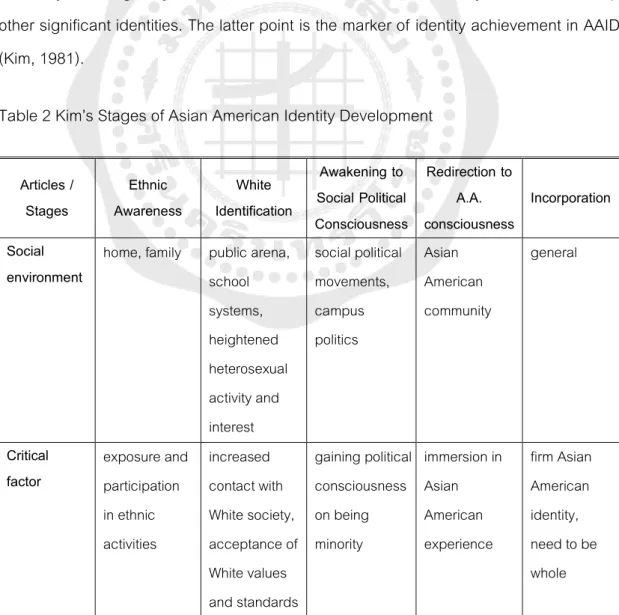
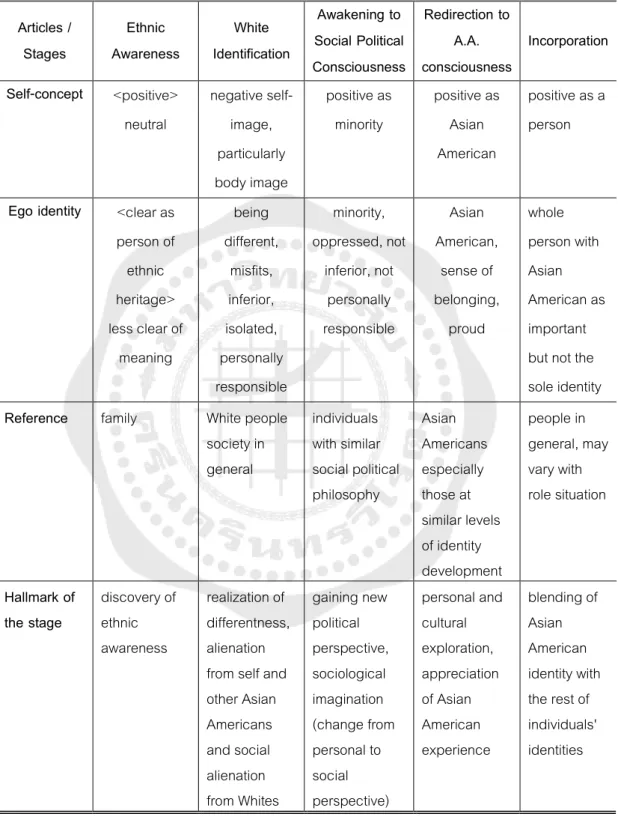
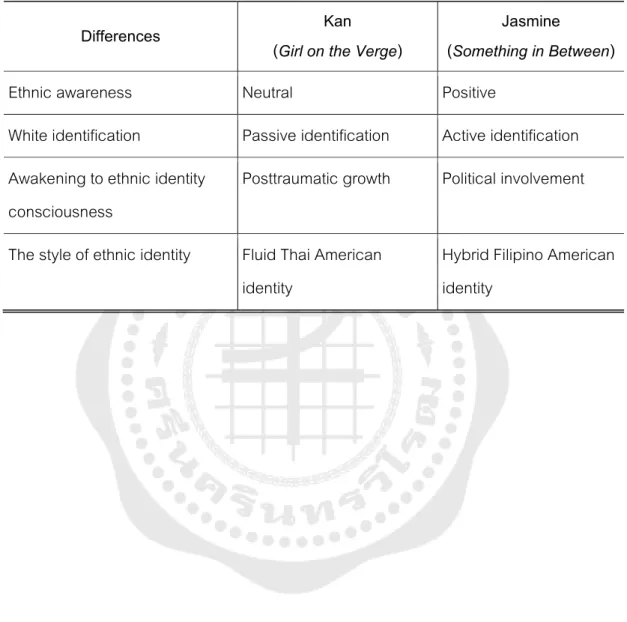
The results showed that Kan in Girl on the Verge and Jasmine in Something in Between developed their ethnic identities in line with Kim's Asian-American identity development. For example, studying the ethnic identity development of young Southeast Asian American characters in YA novels. This research proposes to study the ethnic identity development of young Southeast Asian American characters in two YA novels.
The newly released Girl on the Edge and Something in Between can be good sources for studying the ethnic identity development of Southeast Asian American characters for a variety of reasons. With these points in mind, this study aims to explore and analyze the ethnic identity development depicted in Girl on the Verge and Something in Between using Jean Kim's Asian American identity development framework. The overall aim of the study is to focus on the ethnic identity development of Southeast Asian American characters in two selected YA novels.
To compare the main character's ethnic identity development in Girl on the Verge and Something In Between.
REVIEW OF THE LITERATURE
Identity
- Definition of Identity
- Identity in Adolescence
Although Erikson's theory provides a valuable and useful framework, critics of Erikson's theory believe that the theory is more practical for examining the developmental history of identity than for analyzing the contemporary context of identity development. In addition, Erikson's theory is based on infants and pre-adolescents, with a greater focus on boys (Crammer, Flynn, & LaFave, 1997). Based on Erik Erikson's theory of identity and psychosocial development, James Marcia extends Erikson's theory of identity and psychological development by proposing four identity statuses: identity diffusion, identity exclusion, identity moratorium, and identity attainment.
Accordingly, Marcia (1980) develops Erikson's theory by using four identity states that refer to the occurrence of exploration and commitment. Rooted in Erikson's psychological adolescence phase (identity versus role confusion), Marcia's identity states give a clearer range of identity previously established in the earlier related works. Much of the psychological research on identity makes use of Marcia's identity states because they offer a wider range of styles in dealing with identity problems and focus exclusively on adolescents (Cote, 2009).
Although they influence many studies, these identity states are criticized for lacking underlying elements of identity development (Klimstra & van Doeselaar, 2017).
Ethnic Identity
- Ethnic Identity Development
- Asian American Identity Development (AAID)
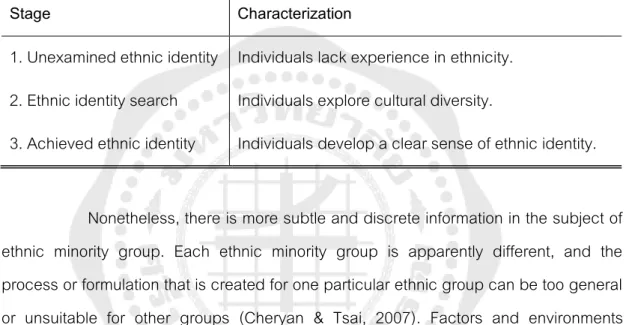
To overcome this limitation, many scholars propose new concepts and models of ethnic identity development. In the communities where diversity is visible, the topic of ethnic identity development becomes prominent for both ethnic minority groups and the majority. Among these models, Phinney's stages of ethnic identity development are the most widely recognized in studies on ethnic identity development (Cote, 2009).
The first stage is "unexamined ethnic identity." At this initial stage, young ethnic minorities have no experience of exploring ethnicity. Since they are the core contexts of ethnic identity, reflection and evaluation are the two aspects that Kim emphasizes in examining the process of Asian American identity development (AAID) (Kim, 1981). It is clear that there are connections and similar features among these concepts in the context of ethnic identity development theory.
Kim considers identity conflict to be the key input to the process of Asian American identity development, which is related to Erikson's stage of identity role vs.
Related research on ethnic identity in literature
In "Incorporation," minorities not only internalize the uniqueness of their group, but also engage with other modes of self-identity by staying true to who they are. In summary, this study of Southeast Asian American characters in young adult novels is designed to analyze the Thai American character in Pintip Dunn's Girl on the Verge and the Filipino American character in Melissa de La Cruz's Something in Between using Asian American Identity Development (AAID ). ). Tan, 1989), Novitasar, Sunggingwati and Lubis (2018) focus on the hybrid identity of the main character in the remarkable novel Joy Luck Club.
Three different characters in the critically acclaimed graphic novel American Born Chinese are analyzed using Frantz Fanon's, Jean Phinney's, Jean Kim's, and Sue and Sue's models of ethnic identity development. Additionally, Somchai Watcharapunyawong, "The Development of Racial Identity in Two Short Stories of Son of Far: Pat and Pan and His Fluctuating Image," uses William Cross's development of racial identity to analyze the protagonists in Pat and Pan and His Fluctuating Image (Watcharapunyawong, 2007). The research findings show that Pat developed his American identity and denied his Chinese identity in Pat and Pan.
Therefore, this study aims to investigate the ethnic identity development of the Southeast Asian American main characters in Pintip Dunn's Girl on the Verge and Melissa de la Cruz's Something in Between.
RESEARCH METHODOLOGY
The ethnic identity development of the main characters in Girl on the Verge and Something in Between was analyzed using Jean Kim's Asian American Identity Development (AAID) as a framework. A comparison of the development of the ethnic identity of the two main characters in the selected was illustrated. Ethnic identity development in Girl on the Verge and Something in Between was analyzed using Jean Kim's Asian American identity development (AAID) framework.
The availability of certain articles that influence each stage in development was also explored to reveal Southeast Asian American identities in the discussion.
THE ANALYSIS OF GIRL ON THE VERGE AND SOMETHING IN BETWEEN
In Kan's situation, she is perceived as a different and exotic woman compared to the beauty standards of the majority. On the contrary, in Thailand, Kan's body is considered big and strong - the opposite of the traditionally revered bodies of Thai women. In Kan's case, her negative view of being different leads her to believe that she is inadequate.
In Kan's case, however, there is no appearance of social and political activity to be an opportunity to understand the meaning of an ethnic minority and to move from the stage of. White identification.” Nevertheless, Kan's ability to gain consciousness about being an ethnic minority is not hindered. Another opportunity that Kan's awareness of her ethnic identity provides occurs in the face of post-traumatic growth.
This strange reciprocal relationship between trauma and positive development is shown in Kan's achievement of ethnic identity. However, Kan's awareness of being an ethnic minority is ultimately acquired after critical and traumatic events that become a life-changing moment. In Kan's case, it is noticeable that her openness to the opposite side of adversity allows room for re-evaluation of self and beliefs.
Post-traumatic growth in Kan's case is a kind of social awakening for Kan's ethnic identity development. In the final developmental stage, Kan's Thai-American identity functions as a life director that leads to the other identities and aspects of life. Kan's revelation shows that her Thai-American identity is becoming stronger and installing her confidence to move forward with her life.
By Girl on the Verge author Pintip Dunn, Kan's sense of not belonging is grounded in her experiences of marginalization. Khan's Thai American identity can be seen as a compromise where the two cultures are the “homes” of the identity (as cited in Schumann, 2011). Although Kana's Thai American identity is a blend of her two cultural elements, similar to Jasmine's Filipino American identity, Kana's Thai American identity is neither rigidly placed in a precise position nor does it remain in one limited location, which is similar to the idea of Castanheira, Green, Dixon, and Yeagerb (2007).
In this way, Kan's Thai American identity can refer to an alternating identity in which she allows herself to move and fluctuate her Thai and American selves in context.

CONCLUSION AND DISCUSSION
However, their sense of ethnic identity is awakened by the romantic relationship and traumatic life events, which makes them appreciate being an ethnic minority. This opportunity allows Kan to rethink the value of belonging to an ethnic minority and the equality of white and Thai cultures. That is, Kan rewrites the definition of being an ethnic minority and establishes its Thai-American identity in a unique way.
Similarly, Jasmine's ethnic identity development in Melissa de la Cruz's Something in Between is consistent with Kim's Asian American identity development. But Jasmine's attitude towards being an ethnic minority changes after significant contact with the white majority. Jasmine struggles with the clash between self (American) and other (Filipino) in her ethnic identity development.
Socializing with people involved in political movements strengthens Jasmine's understanding of the ethnic minority. Hearing the stories of Jasmine's political participation also offers new perspectives on being an ethnic minority. This means that the Southeast Asian American identities of Kan and Jasmine are gradually and sequentially established in the same way as the ethnic identity development of Japanese American women studied by Kim.
Similarly, in Something in Between, the disorienting immigrant experiences become valuable, leading to Jasmine fully understanding being an ethnic minority and developing her hybrid Filipino American identity. The concept of Othering is also depicted in Jasmine's ethnic identity development in Something in Between. She despises being different and the value of being an ethnic minority, causing her to lose her sense of ethnic identity.
Kan and Jasmine's ethnic identity development in Pintip Dunn's Girl on the Verge and Melissa de la Cruz's Something in Between can be helpful in multiple ways. By studying Kan and Jasmine's ethnic identity development, readers also have the opportunity to promote their knowledge in the field of ethnic studies and respect between ethnic groups.
Meaning in life as a mediator of ethnic identity and adjustment among adolescents from Latin American, Asian, and European American backgrounds. Processes of Asian American identity development: A study of Japanese American women's perceptions of their struggle to achieve a positive identity as an Asian American woman. Retrieved from Retrieved from http://everydayfeminism.com/2016/01/calling-woc-exotic-is-racist/. The hour when I first believed: Roman.
Ethnic identity and acculturation in Hispanic early youth: Mediated relations to academic grades, prosocial behavior, and externalizing symptoms. Srinakharinwirot University, Retrieved from Retrieved from http://thesis.swu.ac.th/swuthesis/Eng(M.A.)/Watcharapipat_S.pdf.
VITA