THE MODEL OF SUCCESS FACTORS AFFECTING CONSUMER PURCHASE INTENTION BY VIDEO
ADVERTISING VIA ONLINE INFLUENCERS
Maythaya Preeyanon
A Dissertation Submitted in Partial
Fulfillment of the Requirements for the Degree of Doctor of Philosophy (Communication Arts and Innovation) The Graduate School of Communication Arts and Management
Innovation
National Institute of Development Administration 2021
THE MODEL OF SUCCESS FACTORS AFFECTING CONSUMER PURCHASE INTENTION BY VIDEO
ADVERTISING VIA ONLINE INFLUENCERS Maythaya Preeyanon
The Graduate School of Communication Arts and Management Innovation
Major Advisor (Professor Patchanee Cheyjunya)
The Examining Committee Approved This Dissertation Submitted in Partial Fulfillment of Requirements for the Degree of Doctor of Philosophy (Communication Arts and Innovation).
Committee Chairperson (Associate Professor Asawin Nedpogaeo, Ph.D.)
Committee (Associate Professor Kuntida Thamwipat, Ph.D.)
Committee (Professor Patchanee Cheyjunya)
Dean (Professor Yubol Benjarongkij, Ph.D.)
_____/_____/_____
ABSTRACT
ABSTRACT
Title of Dissertation THE MODEL OF SUCCESS FACTORS AFFECTING CONSUMER PURCHASE INTENTION BY VIDEO ADVERTISING VIA ONLINE INFLUENCERS
Author Maythaya Preeyanon
Degree Doctor of Philosophy (Communication Arts and Innovation)
Year 2021
The study was mixed-method research of both qualitative and quantitative, aimed 1) to study the development of advertising using an online influencer from the past to the present, and 2) to test a structural equation model of success factors affecting consumers’ purchase intention by video advertising via online influencers.
The research was conducted into two parts. Part 1: Qualitative research was conducted by descriptive research methodology, which was documentary research of information or articles on websites within 10 years from 2011 – at present (2021) and in-depth interview with three groups of experts in digital marketing: 1) marketers working on digital marketing using online influencers for no less than five years, 2) online-influencer platform administrators or managers with no less than 3-year experience, and 3) successful online influencers being awarded at the national level.
Part 2: Quantitative research was conducted by the survey research method with 365 Gen-Y consumers, born between 1981-2000, who were exposed to online-influencer information and might or might not have bought products or services after viewing online-influencer advertisements. The collected data were applied for data analysis for developing a structural equation model (SEM).
The findings showed that the development of online-influencer advertising from the past to the present can be divided into 6 periods. Period 1 was Before the Emergence of Online Influencers (approximately before 2012), Period 2 Organic Online Influencers (approximately 2013-2014), Period 3 Power of Online Influencer Turn to Marketing (approximately 2014-2015), Period 4 Widely Emerging Micro- and Nano Influencers (approximately 2016-2017), Period 5 Booming Influencer Marketing (approximately 2018-2019), and Period 6 Transparent Influencer Economy (approximately 2020-2021). On the other hand, the experts classified online
iv
influencers by 2 main methods, namely by the number of followers and types of influencers’ expertise. For the analysis of the structural equation model, it is found that the model of success factors affecting consumers’ purchase intention by video advertising via online influencers, developed by the researcher, is congruent with the empirical data since 10 indices or more than 3 indices pass the determined criteria, as follows: Chi-square/df = 1.244 (< 5.00), p-value = 0.056 (> 0.05), GFI = .970 (> .90), AGFI = .995 (> 0.90), CFI = .995 (> 0.90), NFI = .978 (> 0.90), IFI = .996 (> 0.90), RFI = .955 (> 0.90), RMR = .021 (< 0.05), and RMSEA = .026 (< .05) at a statistical significance level of 0.001. From analyzing the effect or causal relationship and path coefficients, it is found that Online Influencer Credibility has a positive direct effect on Attitude towards Advertising and Attitude towards Brand with the path coefficients = 0.964 and 0.762 respectively, Attitude towards Advertising has a positive direct effect on Purchase Intention with the path coefficients = 0.452 and Attitude towards Brand has a positive direct effect on Purchase Intention with the path coefficients = 0.413. The findings of all positive effects can explain the value of Purchase Intention from Squared Multiple Correlations (= 649).
ACKNOWLEDGEMENTS
ACKNOWLEDGEMENTS
This dissertation has been well accomplished because of the kindness of Professor Patchanee Cheyjunya, who kindly accepted to be my main advisor despite my cross-discipline study from the area of Business Administration and inadequate research background. Professor Patchanee kept assisting me through her guidance, knowledge provision, and research advice from the beginning with her high generosity until this dissertation was formed and completed eventually. She also advised the publication of my academic article, my work, and my ways of living. I also feel grateful to Associate Professor Asawin Nedpogaeo, Ph.D., my thesis chairperson, who kindly gave useful recommendations for my research, especially the naming of online influencer periods in the qualitative research, including his caring and encouragement all the time. My high appreciation is also given to Associate Professor Kuntida Thamwipat, who kindly accepted to be the external committee, for her thorough and worthwhile recommendations to make my research more complete and her support for the correction of this dissertation constantly. I would like to highly express my deep gratitude for all these three persons herewith.
I would like to express my sincere thankfulness to the National Institute of Development Administration for the financial support (annual government statement of expenditure) for this dissertation, which helped to facilitate the conduct of this research greatly.
Sincere appreciation is also given to the awarded online influencers and marketers, including influencer management platforms, who gave their time for being the samples and key interviewees for this study. They are comparable to be fuel, the origin of the knowledge, applied for the quantitative research.
Also, I would like to express my special thanks to all friends and classmates of the doctoral program in Communication Arts and Innovation, NIDA, especially the ninth class and other classes who always assisted and gave consultation to me during my coursework until the completion of my dissertation, including the publication in an academic journal. I truly feel thankful to all of them who accompanied me, reminded me of having the presence of mind, and encouraged me warmly all through my study.
Besides, thank you very much for all the good support from the old friends, i.e.,
vi
the multimedia group (CMM10), business administration (Starbucks), Satha group, and Yada, who kept asking about my well-being and encouraged me, including accompanying me to a temple for wishes, listening to me, and assisting me during my miserable time. Thanks to all my friends for their support. It is my great pleasure to know all my friends and have them nearby whenever any help is needed.
Finally, deeply heartfelt gratitude and appreciation to “Romrak” family: dad, mom, brother, Auntie Boy, and Auntie Aew who always give me an opportunity, encouragement, and strong support, including financial support for furthering the doctoral degree. I will never have had today without a warm family. Thank you so much for all understanding, consolation, and confidence in this daughter more than she has in herself. Thank you so much indeed.
Maythaya Preeyanon October 2021
TABLE OF CONTENTS
Page
ABSTRACT ... iii
ACKNOWLEDGEMENTS ... v
TABLE OF CONTENTS ... vii
LIST OF TABLES ... x
LIST OF FIGURES ... xii
CHAPTER 1 INTRODUCTION ... 1
Background and Significance of the Problem ... 1
Research Questions ... 11
Research Objectives ... 11
Research Hypothesis ... 11
Scope of the Study ... 12
Operational Definitions ... 12
Expected Benefits ... 16
CHAPTER 2 CONCEPTS, THEORIES, AND RELATED STUDIES ... 17
Media Exposure ... 17
Concepts of Social Media ... 20
Definitions of Social Media ... 20
Online Video Marketing ... 20
Concepts of Online Influencers and Influencer Marketing ... 21
Concepts of Influencers ... 21
The Concept of Influencer Marketing ... 25
Concepts and Theories of Attitude ... 40
Attitude Components ... 40
Attitude towards Advertisement ... 43
Attitude towards a Brand ... 46
Concepts and Theories on Consumer Behavior ... 48
A Theory of Reasoned Action (TRA) ... 49
Theory of Planned Behavior (TPB) ... 52
Concepts and Theories on Purchase Intention ... 53
Related Studies ... 55
Studies on Online Influencers and Purchase Intention ... 56
The Studies on Factors Related to Product Purchase Decisions through the Analysis of Structural Equation Model ... 61
Research Conceptual Framework ... 66
CHAPTER 3 RESEARCH METHODOLOGY ... 67
Population and Samples ... 68
Population of the Qualitative Research ... 68
Population and Samples of the Quantitative Research ... 74
The Construction of the Research Instrument ... 77
Qualitative Research ... 77
Quantitative Research ... 78
The Validation of the Research Instrument ... 89
The Validation of the Questionnaire ... 89
Data Collection ... 92
Data Collection of the Qualitative Research ... 92
Data Collection of the Quantitative Research ... 93
Data Analysis ... 93
Data Analysis of the Qualitative Research ... 93
Data Analysis of the Quantitative Research ... 94
CHAPTER 4 QUALITATIVE RESEARCH FINDINGS ... 97
The Findings of the Qualitative Research ... 97
The Development of Online-influencer Advertising from the Past Up to the Present ... 98
CHAPTER 5 RESEARCH FINDINGS ... 161
Findings of the Quantitative Research ... 161
Part 1: Descriptive Analysis ... 162
Part 2: Inferential Statistics ... 171
CHAPTER 6 SUMMARY, DISCUSSION, AND RECOMMENDATION ... 197
Research Summary ... 197
The Findings of Qualitative Research ... 197
A Summary of Quantitative Research ... 207
Discussion ... 216
Part
1:
Discussion on the Development of Online-influencer Advertising from the Past to the Present ... 216Part 2: The Congruence of the Structural Equation Model of Success Factors Affecting Consumers’ Purchase Intention by Video Advertising through Online Influencers and the Empirical Data ... 222
Recommendation ... 232
General Recommendations ... 232
Research Recommendations ... 233
Academic Recommendations ... 233
BIBLIOGRAPHY ... 234
APPENDIX ... 247
APPENDIX A The Interview Recording Sheet ... 248
APPENDIX B The Evaluation of IOC of the Research Tool ... 253
BIOGRAPHY ... 264
LIST OF TABLES
Page
Table 2.1 A Summary of the Theories or Concepts related to the Measurement of Celebrity Endorser Effectiveness ... 36 Table 2.2 A Synthesis of Components of Latent Variables of the Use of Celebrity
Endorsers Found in the Literature Review ... 38 Table 3.1 An Outline and Sources of Information for Designing the Questions for
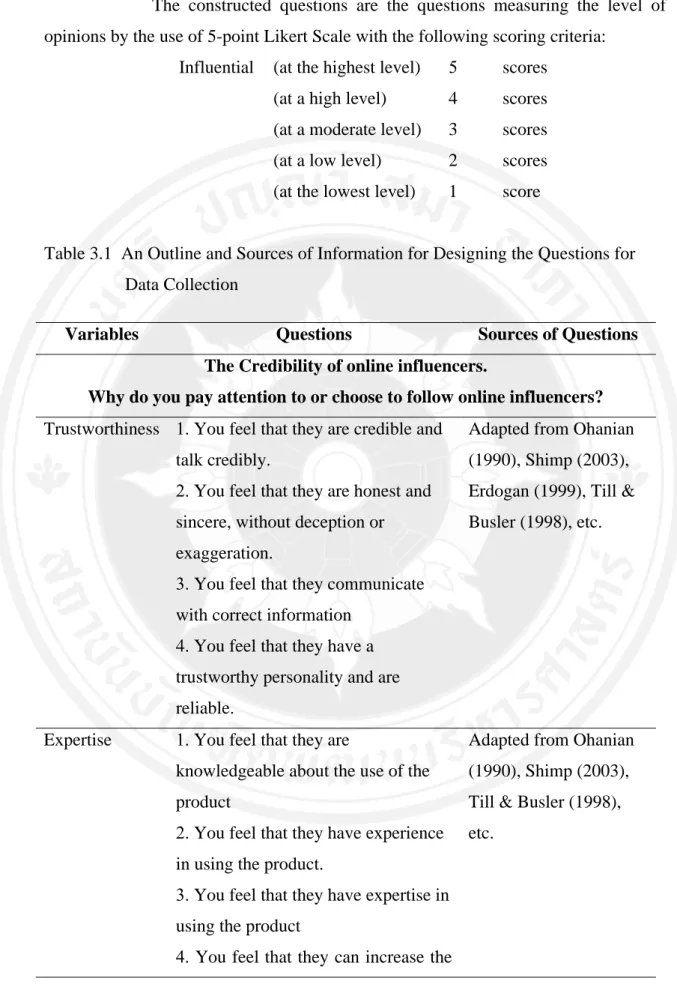
Data Collection ... 81 Table 3.2 The Findings of Indexes of Item-Objective Congruence (IOC) Examined
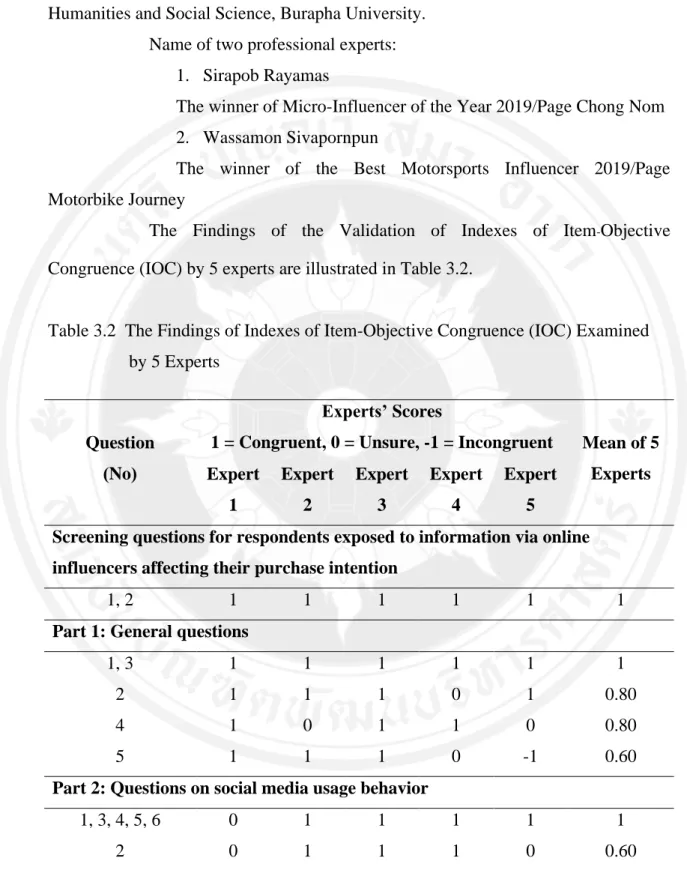
by 5 Experts ... 90 Table 3.3 The Results of the Reliability Test of the Questions in Part 3, Which are
Questions on the Level of Opinions towards Major Factors of each
Variable Leading to Purchase Intention ... 92 Table 4.1 A Summary of the Classification of Online Influencers Based on Aptitude
and Expertise, Classified by Experts and Websites ... 127 Table 4.2 A Summary of Major Factors for Selecting Online Influencers from the
Perspectives of the Experts Obtained from all Interviews ... 154 Table 5.1 Frequency and Percentage of the Respondents’ General Information ... 164 Table 5.2 Frequency and Percentage of the Respondents Classified by their Social
Media Usage Behaviors ... 165 Table 5.3 Mean and Standard Deviation of the Level of Respondents’ Opinions
towards Components of Online Influencer Credibility, Comprising Trustworthiness, Expertise, Physical Attractiveness, Similarity, and Relevance ... 167 Table 5.4 Mean and Standard Deviation of the Level of Respondents’ Opinions
towards Components of Attitude towards Advertising, Comprising Extensive Advertising, Recreational Message, Utilitarian Message,
Involvement in Advertising, and the Overall Advertising ... 168
Table 5.5 Mean and Standard Deviation of the Level of Respondents’ Opinions towards Components of Attitude towards Brand, Comprising
“Interestingness, “Classiness,” “Credibility,” “Better Quality,” and
“Increased Branded Product Needs” ... 168 Table 5.6 Mean and Standard Deviation of the Level of Respondents’ Opinions
towards Components of Purchase Intention, Comprising “Attention,
“Interest,” “Search,” “Action,” and “Share.” ... 170 Table 5.7 Pearson's Correlation Coefficient of Observed Variables between the
Factors of an Independent Variable, Namely Online Influencer Credibility (IOC), and Dependent Variable, Namely Purchase Intention (PI) ... 173 Table 5.8 Pearson’s Correlation Coefficient between the Factors of Mediators or
Mediating Variables, Comprising Attitude towards Advertising (AD) and Attitude towards Brand (AB) ... 174 Table 5.9 Pearson’s Correlation Coefficient of all Observed Variables of the Study
... 175 Table 5.10 Statistical Test of KMO and Bartlett’s Test of Sphericity ... 177 Table 5.11 Criteria for Testing the Congruence between the Structural Equation
Model and the Determined Empirical Data ... 179 Table 5.12 The Effect or Causal Relationship and Statistics of Latent Variables in the Structural Equation Model and other Statistics ... 187 Table 5.13 The Findings of the Analysis of Direct, Indirect, and Total Effect of the
Variables in the Structural Equation Model of Success Factors Affecting Consumers’ Purchase Intention by Video Advertising via Online
Influencers, calculated by AMOS Program ... 190 Table 5.14 The Mediator Test, Divided into 4 Models ... 193 Table 5.15 The Findings of the Standardized Indirect Effect of Online Influencer
Credibility and Purchase Intention ... 196 Table 6.1 A Summary of the Classification of Online Influencers Based on Aptitude
and Expertise, Classified by Experts and Websites ... 204 Table 6.2 A Summary of the Classification of Online Influencers Based on Aptitude
and Expertise, Classified by Experts and Websites ... 205
LIST OF FIGURES
Page
Figure 1.1 Advertising Spending on Digital Media ... 3
Figure 1.2
The Top Circles People Perceived Influencers’ Review the Most in the Cyber World ... 6
Figure 1.3 The Product Groups Bought the Most by Consumers after Seeing Influencers’ Reviews ... 6
Figure 1.4 A Comparison of Purchase Decision Influences between Gen X and Gen Y ... 7
Figure 1.5
The Classification of Four Types of Influencers ... 8
Figure 1.6 The Pattern of Reach and Engagement Compared with the Number of Followers ... 9
Figure 2.1 A diagram ofFisherman's Influence Model ... 26
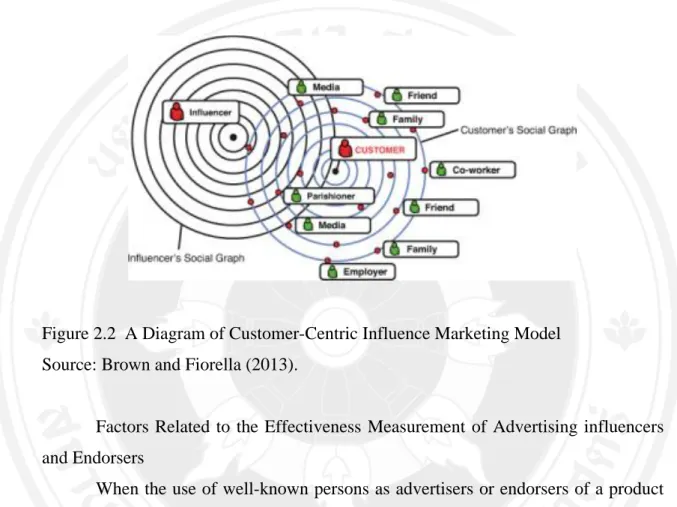
Figure 2.2 A Diagram of Customer-Centric Influence Marketing Model ... 27
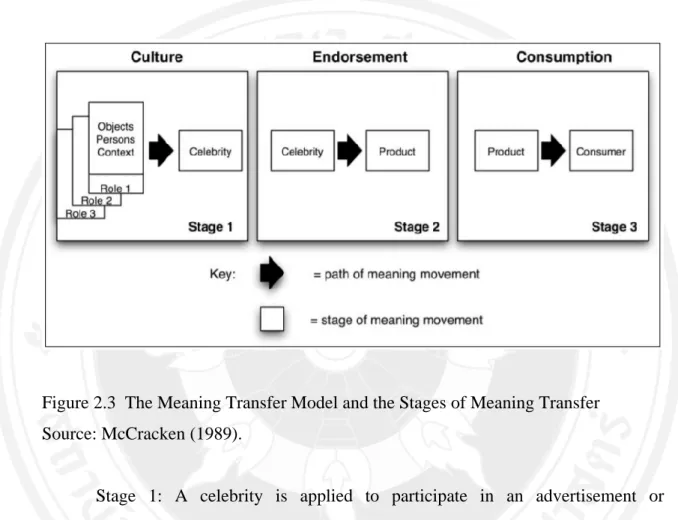
Figure 2.3 The Meaning Transfer Model and the Stages of Meaning Transfer ... 29
Figure 2.4 Factors for Measuring Source Credibility, Presented as a Source Credibility Model ... 31
Figure 2.5 Tri-component Attitude Model ... 41
Figure 2.6 A Model of a Cognitive Response Process ... 42
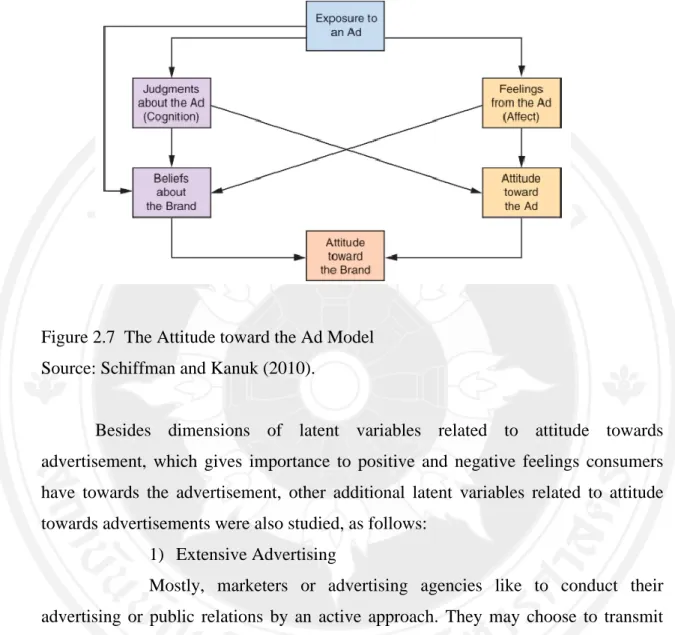
Figure 2.7 The Attitude toward the Ad Model ... 44
Figure 2.8 A Model of Consumer Behavior ... 49
Figure 2.9 Theory of Reasoned Action ... 50
Figure 2.10 Theory of Reasoned Action (TRA) ... 51
Figure 2.11 The Theory of Planned Behavior (TPB) ... 52
Figure 2.12 TheAISAS Model ... 55
Figure 2.13 Research Conceptual Framework ... 66
Figure 3.1 A Diagram of Advertising through Online Influencers through the Use of the Platform ... 69
Figure 3.2 A Diagram of Advertising through Online Influencers by Direct Contact
with Each Influencer ... 70
Figure 3.3 Population of Thailand, Classified by Age ... 74
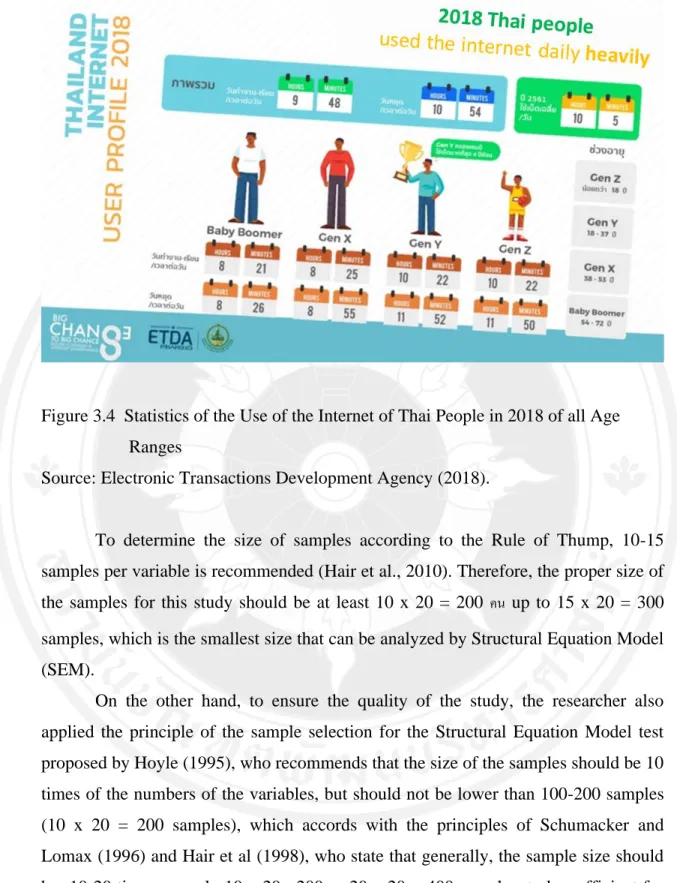
Figure 3.4 Statistics of the Use of the Internet of Thai People in 2018 of all Age Ranges ... 76
Figure 4.1 Timeline of Social Networking Sites ... 101
Figure 4.2 A Comparison of Organic Reach Levels of Online Influencers with Different Numbers of Followers ... 111
Figure 4.3 The Classification of Online Influencers by Tellscore ... 112
Figure 4.4 The Classification of Four Types of Online Influencers ... 113
Figure 4.5 The Classification of Online Influencers by Casting Asia ... 114
Figure 4.6 The Classification of Online Influencers by Primal ... 115
Figure 4.7 The Classification of Online Influencers into 5-tiers by YDM Thailand 116 Figure 4.8 Types of Influencers Classified by the Number of Followers and the Nature of the Use to Respond to Certain Needs ... 117
Figure 4.9 Differences of Each Type of Influencers, Based on the Number of Followers ... 120
Figure 4.10 A Summary of the Classification of Online Influencers Based on the Number of Followers, Classified by Experts and Websites ... 123
Figure 4.11 Influencers No. 1 in Each Category of Thailand ... 124
Figure 4.12 The Measurement of Social Media Towards the Marketing Campaign Success ... 129
Figure 4.13 The Level of Objectives in Conducting Marketing and Advertising .... 133
Figure 4.14 Marketing Objectives and Pyramid of Influence ... 134
Figure 4.15 An example of Online Influencer Platforms of Heroleads ... 140
Figure 4.16 An Example of Online Influencer Platform of Heroleads ... 141
Figure 4.17 12 Lines of Influencers One Should Know: Golden Opportunity of Marketers and Advertisers in 2021 ... 143
Figure 4.18 Thailand’s Influencer Performance Report ... 146
Figure 4.19 An Example of Crossbreeding Communication by Kaykai Salaider to Persuade New Generations to Use Solar Cells ... 152
Figure 5.1 The First-step Confirmatory Factor Analysis of Latent Variable: Online
Influencer Credibility ... 178
Figure 5.2 The First Step of the Confirmatory Factor Analysis of the Latent Variable: Attitude towards Advertising ... 180
Figure 5.3 The First Step of the Confirmatory Factor Analysis of the Latent Variable: Attitude towards Brand ... 181
Figure 5.4 The First Step of the Confirmatory Factor Analysis of the Latent Variable: Purchase Intention ... 182
Figure 5.5 Structural Equation Model (Before the Modification) ... 184
Figure 5.6 The Structural Equation Model (After the Modification) ... 185
Figure 5.7 The Illustration of Research Hypothesis Test ... 188
Figure 6.1 A Summary of Online-Influencer Advertising Development from the Past to the Present ... 198
Figure 6.2 A Summary of the Classification of Online Influencers Based on the Number of Followers, Classified by Experts and Websites ... 202
Figure 6.3 The Classification of Online Influencers Based on the Number of Followers ... 203
Figure 6.4 The Structural Equation Model Modified as Recommended by Modification Indices (MI) ... 216
Figure 6.5 Fisherman's Influence Model ... 221
Figure 6.6 Customer-Centric Influence Marketing Model ... 222
Figure 6.7 The Measurement of the Online Influencer Credibility Scale ... 227
CHAPTER 1
INTRODUCTION
Background and Significance of the Problem
In the globalization era, a social network is a common communication phenomenon. Therefore, major factors affecting consumers’ purchase intention of any product or service are not only the positioning strategy of product or service quality, reasonable prices, and distribution channels, but also marketing promotion in communicating to create value for brands and products. Accordingly, advertising and public relations thus have been frequently selected since the early stage of traditional media up to the period of internet media. All of these media influence consumers' perceptions, attitudes, and trust. From the data from Acumen Report, it was found that 62% of the consumers aged 18-24 years old decided to buy products endorsed by celebrities on YouTube, and 49% by advertising on television or movie since most viewers of YouTube clips perceived clip generators or online influencers were alike their trusted friends, not unreachable artists or celebrities. ("Why is influencer," 2016)
From the information of Digital Advertising Association of Thailand (DAAT) in collaboration with Kantar TNS (Thailand), a leading research company, the total spending on digital advertising in 2016 was over 9,477 million baht, or 17% growth from the previous year, and expectedly no lower than 24% continuing growth in 2017.
(Brandbuffet, 2017)
Besides, several surveys on the study of consumers’ changing purchase decision-making behaviors displayed similar results. For instance, the research of Nielsen Global Online Consumer Survey (2009) found that consumers believed in the traditional media, namely television, newspaper, and radio decreasingly, or only 62, 61, and 55% respectively, while they relied on the advice of their acquaintance 90%, and 70% of them believed in the opinions of people in the online world. (Manager Online, 2010)
Normally, consumers tend to expose to several communication channels, both online and offline, for making their buying decisions by comparing them and finalizing each product or service. Nowadays, online video viewers are often influenced by several sources of influencers, i.e., family, friends, or ideal groups since they and their reference groups often exchange their information in the form of pictures and texts of opinions. Their forwarding of ideas, beliefs, norms, attitudes, and behaviors between consumers and surrounding people leads to behavioral imitation.
Thus, consumers tend to rely on their reference groups to make their purchase decisions. (Seri Wongmontha, 1999). Moreover, as each consumer has a different role and status, which involves a variety of groups, i.e., family, reference groups, organizations, institutes, etc.; such a consumer will have a different status in each group. Therefore, consumers play several connected roles and their purchase decisions are associated with other reference groups as well. (Kotler, 1994)
Both traditional and online influencers are caused by emerging behaviors intrinsically driven by needs for help without expected benefits or so-called “word-of- mouth (Kozinets, De Valck, Wojnicki, & Wilner, 2010, as cited in Sudarat Saengkaew, Piyawan Siriprasertsil, & Preeda Srinaruewan, 2018). Word-of-mouth is a kind of effective strategy in disseminating any information, especially if such disseminated information is transmitted from consumers with direct experience with a certain product or service or an expert with high source credibility. Such word-of- mouth can exert influence in persuading or changing consumers' beliefs, attitudes, or behavior towards purchase decision-making increasingly.
Moreover, there have been reports on how advertising adjusts itself to serve consumers' changing behaviors. DAAT specified that the total spending on online platforms was 3.5 times higher (or approximately 10,000 million baht) and the growth tended to continue in 2019. Rathakorn Surbsuk, Vice-President of Media Agency Association Thailand (MAAT) and Group M Trading Partner, an agency of strategic advertising and communication, evaluated the overall of advertising-industry spending to be 1.16 hundred billion baht with 4% growth. The media with the highest growth rate was still digital or online media, and in 2019, the overall spending was expected to be 1.21 ten billion baht with 4%. Only digital advertising was expected to
be 1.87 ten million baht with 25% growth, compared with other media due to consumers’ changing consumption behaviors nowadays. (Rattiya Angkulanon, 2019)
Figure 1.1 Advertising Spending on Digital Media
Source: Digital Advertising Association Thailand (2018, as cited in Rattiya Angkulanon, 2019).
From the point of view of Rathakorn Surbsuk, the Vice President of Media Agency Association Thailand (MAAT), the continuing growth of digital advertising is due to five factors, as follows:
1) Media producers and content generators have adapted themselves by extending the use of traditional media to online channels increasingly.
Remarkably, every television medium has its online platform for viewers to view on websites, applications, and social media. Similarly, radio and newspapers also extend to online channels so that consumers can access their content conveniently anywhere and anytime.
2) The growth of social media users in combination with the influence of influencers and key opinion leaders (KOL) who review content and present products in calling high attention from consumers encourages various brands to spend more advertising budgets on this kind of media.
3) E-commerce markets have a high tendency towards growth, including continuing marketing of foreign entrepreneurs.
4) Artificial Intelligence plays a role in increasing the effectiveness of using social media and creating good experiences for consumers, including the opening of new tools and features of Google and Facebook, which are used by marketers for accessing consumers more easily.
5) More than 1 million entrepreneurs of over 3 million entrepreneurs of SME in Thailand are active users who learn to use digital media, especially social media, for doing business and communicating with consumers increasingly, as witnessed by the continual expansion of E-commerce in Thailand.
Linqia, a company providing platform services and content marketing, conducted research “The State of Influencer Marketing 2018” for exploring guidelines of influencer marketing planning for brands and agencies in 2018 from 181 marketers.
The research found that 39% had plans to increase their budgets for using influencer marketing campaigns in that year, and only 5% would increase their budgets. Besides, 51% of marketers agreed that content from influencers was more influential than that of each brand itself. Moreover, 86% of marketers used this strategy for doing business in 2017 and found that influencer marketing campaigns helped to increase their effectiveness tremendously or 92%. (“Catch a trend of influencer,” 2018).
Furthermore, from the study of One Production in the U.S.A., it was found that 90% of consumers trust products or services advised by their friends or influencers. At the same time, only 33% trusted in regular advertisements. Therefore, it is not surprising why at present a lot of organizations turn to use influencer marketing, especially persons trusted by consumers and who can narrate about their products, services, or brands attractively. Besides, from the research of Nielsen, marketing through influencers yielded eleven times higher ROI than regular digital marketing (Pasu Decharin, 2018). From the above-mentioned information, business groups have to adjust their marketing plans to accord with consumers' changing behaviors. Moreover, from the online marketing research of the College of Management, Mahidol University (CMMU), it was found that the recent brand marketing preferred using influencers on social media or online influencers to promote their products, which can persuade consumers better than the traditional
marketing. Therefore, it is very common to see artists, actors, and celebrities, including bloggers, YouTubers, and net idols review products by focusing on their direct experience of using each specific product to assure consumers. (“CMMU reveals online,” 2019).
Boonyong Kongarchapatara, Ph.D., the Head of Marketing Department, the College of Management, Mahidol University (CMMU), expressed his idea that influencer marketing is a top-trend to watch out for as it does not only create perception and access consumers via a review, influencers can also enhance confidence for consumers and persuade them towards purchase decisions eventually.
The products frequently found to be reviewed by influencers are tourism, food, fashion, beauty, health, finance, and investment circles. Besides, previous research also confirmed that this kind of marketing was successful since it was found that over 75% of consumers used to buy products after perceiving influencers' reviews. The supporting factors are the influence of review images and videos, which can create a common feeling more than general advertisements. The top three social media found to access consumers the most were Facebook, Instagram, and YouTube. Tracing back to statistics of the spending on digital marketing, it was found that the investment on online platforms grew more than 3.5 times (approximately 10,000 million baht) and had a tendency to grow continually in 2019 (“CMMU reveals online,” 2019).
Besides, from the opinion survey of online marketing research by the College of Management, Mahidol University, conducted with 1,031 consumers, 20% of whom were Gen X (born between 1965-1979, and 80% were Gen Y (born between 1980- 1986), it was found that the top five circles people perceived influencers' review the most in the cyber world were tourism, food, fashion and beauty, health, finance, and investment respectively.
Figure 1.2 The Top Circles People Perceived Influencers’ Review the Most in the Cyber World
Source: “Why is influencer,” (2016).
Moreover, among over 75% of consumers who used to buy products after seeing influencers' reviews, the product groups they bought the most were cosmetics, food and drinks, restaurants, tourist attractions, and fashion products.
Figure 1.3 The Product Groups Bought the Most by Consumers after Seeing Influencers’ Reviews
Source: “Is it true “influencers”,” (2019).
Notably, business whose products and service are quite complicating and hard to understand while requiring high trust from consumers, i.e., finance and investment, health, and IT groups, tends to use influencer marketing increasingly since it can provide insightful information, in combination with communication that is easier to understand than traditional marketing communication. Most of all, it requires less investment and costs.
Figure 1.4 A Comparison of Purchase Decision Influences between Gen X and Gen Y
Source: “Is it true “influencers”,” (2019).
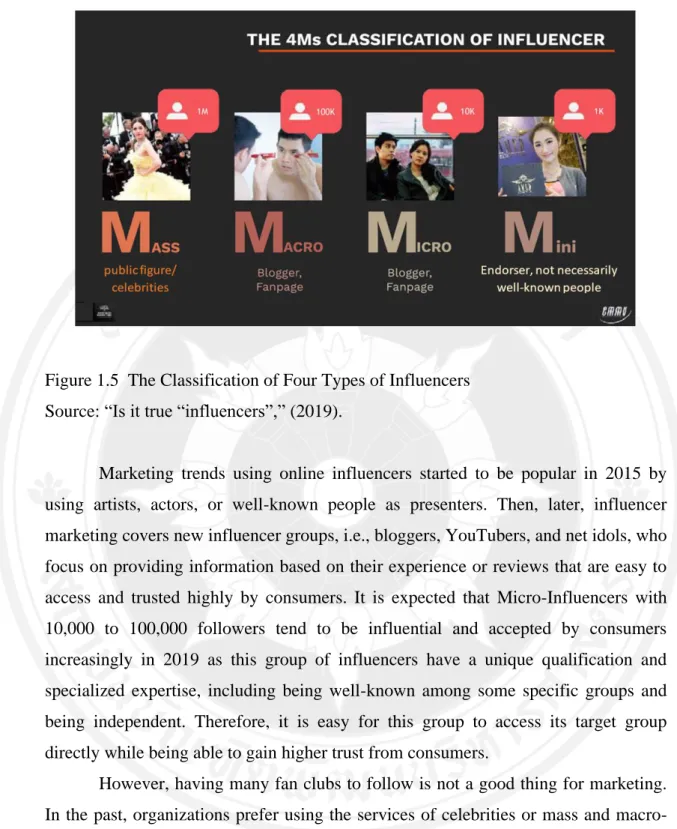
From the marketing seminar entitled, “Such Seed Marketing: 2019 Influencers Ruling the Country,” organized by the College of Management, Mahidol University, in which four kinds of influencers were classified, it was found that Type 1) “Mass”
or “public figures,” had over 1 million followers, 2) “Macro-influencers” (i.e., bloggers, fan pages) over 100,000 followers, 3) “Micro-influencers” over 10,000 followers, and 4) “Mini Influencers” over 1,000 followers. The influencers may not be known but must be credible.
Mean
Figure 1.5 The Classification of Four Types of Influencers Source: “Is it true “influencers”,” (2019).
Marketing trends using online influencers started to be popular in 2015 by using artists, actors, or well-known people as presenters. Then, later, influencer marketing covers new influencer groups, i.e., bloggers, YouTubers, and net idols, who focus on providing information based on their experience or reviews that are easy to access and trusted highly by consumers. It is expected that Micro-Influencers with 10,000 to 100,000 followers tend to be influential and accepted by consumers increasingly in 2019 as this group of influencers have a unique qualification and specialized expertise, including being well-known among some specific groups and being independent. Therefore, it is easy for this group to access its target group directly while being able to gain higher trust from consumers.
However, having many fan clubs to follow is not a good thing for marketing.
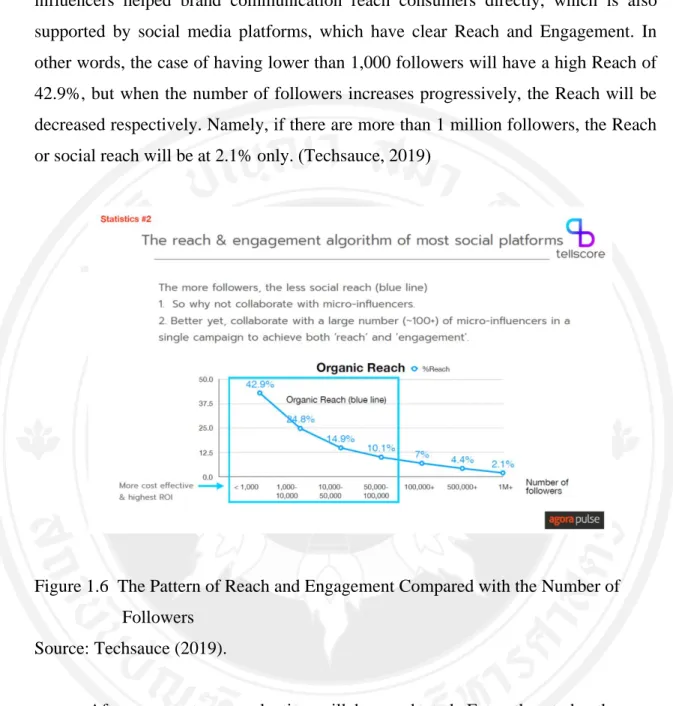
In the past, organizations prefer using the services of celebrities or mass and macro- influencers, which have a lot of followers. However, to use services of these groups have high costs and the engagement rate of the group with lots of fan clubs cannot compete with that of the group with fewer fan clubs. Some research found that influencers with 10 million followers on IG had a rate of likes per post at 1.6%, while micro-influencers with only 1,000 followers had a rate of likes per post at 8%. (Pasu
Decharin, 2018). Moreover, information from Agora Pulse indicated that micro- influencers helped brand communication reach consumers directly, which is also supported by social media platforms, which have clear Reach and Engagement. In other words, the case of having lower than 1,000 followers will have a high Reach of 42.9%, but when the number of followers increases progressively, the Reach will be decreased respectively. Namely, if there are more than 1 million followers, the Reach or social reach will be at 2.1% only. (Techsauce, 2019)
Figure 1.6 The Pattern of Reach and Engagement Compared with the Number of Followers
Source: Techsauce (2019).
After payment, an evaluation will be conducted. From the study, the way marketers choose to measure the effectiveness of the use of influencers the most was
“engagement,” i.e., the number of likes, comments, and shares mainly (61%), followed by the increased sales (20%), and the number of accesses (12%), while small-sized business tends to measure by the number of sales mainly. Moreover, large or big brands perceive that no matter how large the amount of sales the spending on influencers will yield is not as important as using influencers as a tool in creating brand perception and its influence on consumers directly, which is contrary to small
brands that aim towards sales amount mainly. Moreover, small brands may not be able to set a goal to create brand perception owing to their limit of marketing budgets relatively. (“Is it true “influencers”,” 2019)
Consumers' behaviors nowadays are moving towards digital citizenship of the 21st century fully. From the information of We Are Social (2020) reporting on the statistics of the internet and social media usage behaviors around the world, including Thailand, in 2020, Thailand had 52 million social media users or 75% of the national population. 90% of Thai people found to have purchasing behaviors through E- Commerce or online services tended to search for information about products and services on the internet before making their purchase decisions. Furthermore, the acknowledgment of new brands of worldwide consumers still came from their search on the internet 33%, TV advertisements 31%, word-of-mouth 27%, and social media advertisements 26% (We Are Social, 2020).
From the above information, it reflects that the use of advertising through online influencers has been responded to satisfactorily and is considered as an effective tool in communication; thus, it gains more popularity. Hence, nowadays many online influencers emerge in the cyber world to respond to timely opportunities to create their income from reviewing and presenting products. However, from the standpoint of brand owners or marketers, it is a great challenge for them since there have been more alternatives, a question marketing communication is “how they can decide which online influencer is appropriate or suitable for their product or brand and which factors they should consider,” to make their consumers trusted and persuaded by such advertising. Sometimes, there may be some other latent factors, i.e., consumers' predisposed attitude towards advertising and attitude towards product brands, which may affect their purchase decisions. Thus, the consideration of all of these considerations will help to maximize the effectiveness of their advertising and investment.
Accordingly, it leads to an interesting question of how advertising via online influencers has been developed from the past up to the present. Besides, due to problems of the selection of online influencers in advertising and some latent factors as abovementioned, success factors affecting consumers' purchase intention by video advertising via online influencers, the researcher intends to study them by reviewing
related concepts, theories, and studies and testing with consumers of Gen Y, who is the group born between 1981-2000 (Electronic Transactions Development Agency, 2018) and accesses the internet the most. The samples must be able to access the internet and be exposed to advertising through online influencers. The obtained data then are developed to construct a structural equation model of success factors affecting consumers’ purchase intention by video advertising via online influencers.
The results of the study are expected to reflect consumers’ echoes and thus help to yield effective communication strategy planning guidelines, which cover major success factors, used for selecting proper online influencers in advertising or communicating a brand worthily and more effectively.
Research Questions
1) How has advertising with an online influencer been developed from the past to the present?
2) What is a model of success factors affecting consumers’ purchase intention by video advertising via online influencers?
Research Objectives
1) To study the development of advertising using an online influencer from the past to the present.
2) To test a structural equation model of success factors affecting consumers’
purchase intention by video advertising via online influencers.
Research Hypothesis
The model of success factors affecting consumers’ purchase intention by video advertising via online influencers, developed by the researcher, is congruent with the empirical data.
Scope of the Study
The research aims to study the development of online-influencer advertising or in the form of influencer marketing, including factors affecting consumers’ purchase intention influenced by online influencers, both Micro-Influencers who are not celebrities, and Macro-influencers, on video advertising since it is a very popular channel for both consumers and marketers. Besides, the exposure to online advertising and the roles of YouTubers or bloggers have been growing tremendously.
In combination with marketing in which branded content is created and integrated into online videos, marketers can identify their target consumers clearly and can work with credible influencers trusted by their followers easily. Therefore, branded content via influencers is more successful than advertising on brands themselves (“Why is influencer,” 2016).
The samples of the study were consumers of Gen-Y, who were born between 1981-2000, and accessed the internet the most (Electronic Transactions Development Agency, 2018). The samples must be able to access the internet and be exposed to advertising through online influencers.
Operational Definitions
In this study, the following technical terms are defined to create a common understanding:
Online Influencer: A person who can transmit information, persuade, or induce other people to believe and comply with his/her idea. In the case of advertising, an influencer, no matter who used or never uses the reviewed product or service, narrates or transmits his/her experience, experiment, and properties of a product, including his/her opinions towards such a product through online media, either his/her online channels or public online platforms, in the form of statements or texts, images, and videos.
1) Influencers in a broad circle are the group of people who can transmit information, persuade, or induce a lot of people or a huge number of people to believe or comply with their ideas widely. Typically, they are online influencers
with lots of follows. They are “Mega Influencers” with more than 1,000,000 followers, so mostly they are stars, actors, singers, artists, celebrities, well-known people or “Macro-influencers” with 100,000-1,000,000 followers, so mostly they are well-known people, net idols, bloggers, YouTuber, and Facebook Fan Page.
2) Influencers in a narrow circle are persons who can transmit, persuade, or induce other people to believe or comply with their idea in a smaller circle. Thus, influencers of this group may be specialized experts or specific groups, but have some intimacy with followers. This group of online influencers comprises
“Micro-influencers” with 10,000-100,000 followers, so mostly they are net idols, bloggers, YouTubers, and Facebook fan page or general online users, and “Nano Influencers” with 1,000-10,000 followers. The influencers may be net idols, bloggers, YouTubers, Facebook fan pages, or general online users but the number of followers is not huge.
Success Factors or Credibility Factors of Online Influencers: mean components or factors enhancing the effectiveness of online influencers. For this study, the factors were synthesized from related concepts and theories, in combination with the findings from the qualitative research. These success factors are used to construct a model called “The TERAS model” as a measurement of the effectiveness of online influencers, consisting of the following five factors or components:
1) Trustworthiness. The first letter “T” means components or factors that make a person look credible, namely “honesty,” “integrity,” and “believability.”
All these three factors are perceived by consumers and are the factors involving the verification of information or the guarantee of products by well-known persons towards the products perceived by consumers.
2) Expertise. “E” means each person's specialization or expertise connected directly with the advertised products. A sender verifies the correctness of the information that may be confirmed by a sender’s experimental use of such a product or shared experience in using such a product.
3) Relevance. “R” means the connection or the relations between famous certifiers or endorsers and certified or endorsed products. Well-known endorsers must be representatives of some lifestyles, images, reputations, and should have congruent values with the endorsed products to ensure consumers. Besides, there
must be relevance or connection between famous endorsers and the target consumers, i.e., consumers may want to have a lifestyle or an image like a famous endorser.
When there is a connection, it will make consumers interested and accept persuasive communication more easily.
4) Attractiveness “A” means the perceived interestingness of the information source, which means online influencers. Attractiveness can occur from the appreciation of physical appearances, i.e., charming, good-looking, elegant, graceful, modern, etc. Attractiveness can increase the level of persuadability and enable consumers to accept the behaviors or attitudes of the persons who are information sources.
5) Similarity “S” means the similarity between endorsers and viewers or receivers in terms of age, sex, race, social class, etc. The similarity is a major component since it tends to promote the connection more easily for consumers and endorsers who are connected with some similarities. Generally, famous endorsers will be perceived as more credible if they possess some similarities with the receivers or viewers, such as same hometown or region, same age, etc. Thus, it helps to enhance a positive attitude towards the advertised brand as well.
Attitude towards Advertising: means consumers’ initial feeling or response towards advertising in the form of like or dislike. Attitude towards Advertising is divided into “attitude towards extensive advertising,” “attitude towards the recreational message,” “attitude towards utilitarian content,” “attitude towards involvement in the content,” and “attitude towards the overall advertising.”
1) Attitude towards extensive advertising means consumers’ negative attitude towards the excessive advertising that a product company or an advertising agency launches to communicate to consumers. It is an active strategy often used by advertisers on social media because of its low cost. However, it makes consumers feel that they are intruded on or it is a disturbance of social media usage.
2) Attitude towards recreational message means attitude towards content in the uploaded videos on social media with entertaining and amusing content, including the presentation of being oneself.
3) Attitude towards utilitarian message means attitude towards the content in the uploaded videos on social media that provides information about the
properties, usage methods, utilities, i.e., product details, maintenance or preservation, product quality, reliability, price, etc.
4) Attitude towards involvement in the content means the need to participate in advertising, caused by advertising exposure in two ways: positive and negative attitude towards advertising. If receivers have a negative attitude, they will have an anti-thought or conflict against the exposed advertising. However, if they have a positive attitude towards advertising, they will need to participate in the content of exposed videos, i.e., the level of attention, video-sharing, re-play, and may lead to purchase decisions.
Attitude towards Brand: means each consumer's overall evaluation of a brand.
Each person will perceive a product differently, which causes a different attitude towards the product as well, either positive or negative. For instance, an evaluation if a product is interesting or not, if he/she likes the brand or not, if the brand reflects a good taste, or he/she has a good or bad feeling towards the brand. Consumers' attitude towards brand affects their trust in the brand, brand evaluation, and a tendency to purchase a product or not.
Purchase Intention: means a consumer’s possibility to buy a product or service, or a process involving a consumer's psychological state reflecting his/her planning to buy products of a certain brand at a certain time. In this study, Dentsu’s AISAS Model of purchase intention was used. The model was modified from the AIDMA Model, namely Attention, Interest, Demand, Memory, and Action, which was a model of purchase decision-making of the traditional marketing. However, in the internet era, consumers can access or share information easily via social networks on the internet; thus, the model changed to the AISAS model, namely Attention, Interest, Search, Action, and Share). The model starts with consumers' attention to a product, service, or advertising, then interest is created towards the need to search about the product. Then, consumers evaluate the overall information that has been collected and make purchase decisions (action). After buying, consumers will become communicators by posting their opinions and impressions for sharing on the internet.
Expected Benefits
1) Academic Benefits
(1) The findings can help to know the development of online-influencer advertising and a tendency of changes from the past to present, which will be useful for the academic circle to know about marketers’ communication strategies and their adaptation to catch up with consumers’ changing behaviors with media literacy and effectively.
(2) The findings bring about the understanding of consumers' attitudes and major factors affecting advertising and public relations via online influencers to extend the concept of marketing strategy using online influencers with more understanding.
(3) The findings can help to search for proper guidelines in designing more effective advertising and public relations.
2) Application Benefits
(1) The results of the study will be beneficial for entrepreneurs or marketers to apply the findings on marketing communication by using online influencers for their businesses or agencies. The findings are like an echo of consumers that can be used as guidelines for planning communication strategies properly. Besides, they will help to know major success factors used for selecting online influencers for the advertisements or brand communication in the circumstance where most consumers try to avoid viewing too much advertising.
(2) The findings can help to increase the ability to persuade consumers and increase business competitiveness nowadays towards accomplishment worthily and more effectively.
CHAPTER 2
CONCEPTS, THEORIES, AND RELATED STUDIES
The study, “The Model of Success Factors Affecting Consumer Purchase Intention by Video Advertising Via Online Influencers,” applied the following concepts, theories, and related studies as a research framework and guideline:
2.1 Media Exposure Theory 2.2 Concepts of Social Media
2.3 Concepts of Influencers and Influencer Marketing 2.4 Attitude Concepts and Theories
2.5 Concepts and Theories of Consumer Behavior 2.6 Related Studies
2.7 The Research Conceptual Framework
Media Exposure
Berelson and Steiner (n.d., as cited in Patchanee Cheyjunya, Metta Kritivith,
& Tiranan Anawasiriwongse, 1998, p. 3) define “communication” as “behavior” or “a process of transmitting information, idea, emotion, feeling, and skills through the use of symbols, which can be words, letters, pictures, figures, graphs, etc.” Therefore, in a communication process, a person who creates the origin message plays a role as a sender and conveys a message in the form of symbols, i.e., words, letters, figures, etc.
via media and channel to another person at the destination, or so-called “a receiver.”
Information in a communication process is an essential component used by human beings for considering final decisions in doing some activities. The need for information will be increased when a person needs it for making decisions or when a person is unsure of something. Atkin (1973) states that a person who is highly exposed to media or information tends to have a far sight, be knowledgeable in the surrounding environment, and be more updated than a person with low exposure to
media or information. Since nowadays, it is the information age in which communication is rapid and diverse; thus, due to a huge amount of information, receivers cannot be exposed to all that comes towards them. Accordingly, they need to have a selective perception of only what serves their purpose, satisfies them, or responds to their needs. Klapper (1960) explains that a process of perception is like a filter in human perception, comprising four steps as follows:
1) Selective Exposure is the first stage of communication channel selection. Generally, a person can select to be exposed to media and information from several sources, i.e., buying some newspapers, listening to some radio stations based on his/her interest and needs, etc. Moreover, people's skills and expertise in exposure to media are different. Some are good at listening more than reading, so they prefer listening to the radio or watching TV more than reading, etc.
2) Selective Attention. Exposed persons tend to be interested in news from certain sources based on their opinion and interest to support their predisposed attitude and avoid any dissonance with their existing knowledge, understanding, and attitude to keep their psychological state balanced or avoid facing cognitive dissonance.
3) Selective Interpretation. When persons are exposed to media, they do not always perceive all information as intended by a sender since they tend to selectively perceive and interpret the received message differently based on their interest, attitude, experience, belief, needs, expectation, motivation, physical or psychological or mental condition. Therefore, each person may interpret only the information that accords with their attributes while some parts of information will be omitted towards their desired direction.
4) Selective Retention. Persons tend to select to retain information that is congruent with their interest, needs, attitude, etc., and often forget or not transmit the parts of information in which they are not interested, disagree, or which contradicts with their cognition. Therefore, what they selectively memorize seems to strengthen each person’s predisposed cognition, attitude, value, and belief, which will be harder to change. All retained information will be used in the future and parts of them may be used when any conflicting feeling or discomfort occurs.
Nevertheless, despite each person’s different needs in exposing to different information, different media exposure behaviors, and different goals, three typical characteristics of a person’s media exposure are: (Duangrutai Pongpaitoon, 2001)
1) Exposure to mass media. Receivers expect from their exposure to mass media to get some information to respond to their needs, which can cause some attitudinal, behavioral, or personality change. The selective mass media consumption depends on receivers' needs or motivation since each of them has a different purpose and intent in using the received information.
2) Exposure to personal media. Personal media means persons who carry a message from one person to another person in the context of interpersonal communication with mutual response or interactions. Rogers and Shoemaker (1971) propose that in the case that a person wants other people to accept his/her conveyed message, interpersonal communication should be chosen by having personal media to transmit the intended information. Personal media plays a very significant role, especially in the case that a sender expects a receiver to understand the message clearly and deeply and to decide to receive the message with more confidence.
3) Exposure to specialized media. Specialized media means the media intentionally created with some specific content aimed towards some specific target receivers. Examples of specialized media are newsletters, brochures, posters, leaflets, handbooks, exhibitions, etc. Thus, in exposure to specialized media, receivers will obtain information or knowledge of specific subjects.
The concept of media exposure behaviors reflects that information is a major factor helping a person to make some decisions. The more uncertainty a person has about something in which he/she is interested, the more desire the person has to eradicate such uncertainty. Moreover, the person can selectively be exposed to a variety of media, i.e., mass media, personal media, or specialized media, but will choose to be exposed to only the subjects or content of his/her interest only since nowadays information is too overwhelming to get all; thus, a selective media exposure process occurs. Still, each person will have some criteria for the selection based on his/her characteristics, social environment at that time, goals, or needs of each person for media exposure. Thus, each person's media exposure behavior is different.
The researcher thus applied the concept of media exposure behaviors as the research conceptual framework to indicate the exposure to internet behaviors depends on each person's selective media exposure.
Concepts of Social Media
Definitions of Social Media
Safko and Brake (2009; Weber, 2009, as cited in Ladaamphai Kimkaew, 2017) define social media as a two-way communication pattern in which users can access in various forms conveniently and rapidly. Users can share their knowledge, information, news, and exchange their attitudes and idea freely, while they can interact or respond to the received opinions instantly, which are the eminent characteristics of social media differently from the traditional media.
Kaplan and Haenlein (2010) define social media as a group of applications, whose base is on the internet, providing service for users to generate their content and exchange their content or opinions on such applications. Thus, social media is an online network in which there are connected groups with similar interests.
Online Video Marketing
Chen and Xie (2008) state that there are two kinds of advertising channels nowadays, namely advertising by sellers and by consumer reviews. Advertising by sellers emphasizes the predominance of a product or a comparison with their product in the past, which has high production costs. On the other hand, advertising by consumer reviews explains what happens after the usage of a product, which is easier to understand. Thus, it is the advertising created by consumers or by online influencers with similar behaviors to the target group who help to promote the product and to ensure information to reach consumers as much as possible by generating content on online video marketing.
Concepts of Online Influencers and Influencer Marketing Concepts of Influencers
1) Definitions of Influencers, Reference Groups, and Opinion Leaders Some scholars define the term “influencer” as follows:
Chattraporn Samerjai and Matthaneeya Sommi (2002) define
“influencer” as “a person whose behavior can arouse or motivate others, either intentionally or unintentionally, which influences others’ purchase decisions or their use of products or services.
Yorburg (1982) defines a “reference group” as “an individual or a group of individuals, who are like-minded people and representatives of values and norms.
Besides, it is a group of standards people use to compare to evaluate human actions.
Reference groups may possess some distinguished characteristics specifically, which may or may not draw others' attention, or maybe an intimate group.
2) Characteristics of Social Influence
Social influence plays a great role in determining people's attitudes, behaviors, and decision-making since during a decision-making process, there are some factors caused by social pressure enabling people to comply with their reference groups according to the Theory of Rational Action (TRA), which indicates that people's behavioral changes are a consequence of their belief and behaviors based on the assumption that it is something deserves to do. Typically, people will always consider reasons and causes before their actions. The main factor that determines people's actions or behaviors directly is “intention.” According to the Theory of intention, there are two main factors: attitude towards the behavior and subjective norm. In some cases, people’s norms may comply with their reference groups. Lamb, Hair, and McDaniel (1992, as cited in Ladaamphai Kimkaew, 2017) divide reference groups into two types direct and indirect reference groups.
(1) Direct Reference Groups are groups of people relating to group members directly either as a face-to-face membership or direct relationships. These groups are also classified into two sub-groups: primary and secondary groups.
(1.1) Primary Membership Groups: groups in which members have close relationships and intimacy. They are often small groups, i.e., family, close friends, lovers, etc. Primary groups influence highly consumers’ purchase behaviors.
(1.2) Secondary Membership Groups: large groups in which people involving in the group as formal members, without close relationship or intimacy, i.e., friends of the same institute, club, occupation, religion, etc. Still, they also influence consumers' purchase decisions and persuade them to comply.
(2) Indirect Reference Groups: groups without a direct relationship, but persons may have the desire or dream to participate as a part of a group in the future. On the other hand, they may be groups that people try to avoid or with which people do not want to involve. Thus, these reference groups can be divided into two groups: ideal or desirable groups and undesirable groups.
(2.1) An Aspirational Group is a group in which persons desire or dream to participate as a part of a group. However, for persons to participate as group members, they are required at least to behave or act following group norms.
Typically, group norms mean values or attitudes accepted and adhered to by the group as a scheme for their practice. (Kotler & Keller, 2011)
(2.2) A Non-Aspirational or Dissociative Group is a group that influences consumers' behaviors greatly since it is an undesirable group that people want to avoid behaving like it or being classified under this group. Therefore, consumers may not use or buy the brands following these people.
In short, online video viewers from diverse channels will get influence from influencers, i.e., family, friends, and aspirational groups since the viewers and reference groups will exchange their information all the time in the form of images and texts, which display opinions towards the viewed videos. The transmission of ideas, beliefs, norms, attitudes, or behaviors will occur when there is communication between consumers and surrounding people, which leads to imitation behaviors.
Then, consumers will use their reference groups for evaluating products and making their purchase decisions. (Seri Wongmontha, 1999).
3) Persons used as reference groups
There are several ways for using reference groups for persuading people in society. From the data of E-Learning of Nakhon Sawan Rajabhat University,
persons used as reference groups can be divided, as follows: (Nakhon Sawan Rajabhat University, n.d.)
(1) Celebrities, i.e., stars, singers, athletes, spokespersons, celebs, or high-class people who are often in the news, etc. When these people consume any product, consumers will follow them.
(2) Testimonial. These people are a group of persons who had consumed a certain product before so they are used as a reference of using or having experience with the product. Thus, they may be invited to advertise products or to distribute samples for those people to publicize products or interview about the product's properties, etc.
(3) Endorsement. They are persons who certify or guarantee products, who have used or never use such products. However, they claim to guarantee the quality of those products.
(4) Actors. It is the use of well-known persons in society to play roles in advertising to persuade consumers or group members.
(5) Spokespersons. It is the use of speakers of certain products, i.e., the use of stars to advertise or speak for some products to make the products more well-known, etc.
(6) Experts. It is the use of some experts in particular professions, i.e., physicians, dentists, academicians, scientists, etc., whose expertise must be related to the products and can have some influence on the target groups.
(7) Common Man or Jack Next Door. It is the use of general people who are not well-known in society but possess some attributes with the target group, to direct the use of products, based on assumption that the product will be perceived as appropriate for them since the persons in advertising have similar lifestyles and environment to theirs.
(8) The Executive Spokespersons. In some cases, where high credibility is required, marketers may ask the executive of the products to be influencers as it means the executive comes out to guarantee.
(9) Authorities. It is the use of scholars or knowledgeable persons to influence consumers as consumers tend to accept the opinions of people with high knowledge.
(10) Opinion leaders. In every sector of society, there are some people whose opinions are accepted by people in society. When these people say or express any attitude towards something, listeners will follow their ideas. Thus, they can influence others’ consumption behaviors.
(11) Social engineers. They are a group of people who try to impose social structure and guide society in which direction they should go. If people accept their principles of ideas, these social engineers then can become influencers on consumers as well.
4) Characteristics of influencer
People who are influential in persuading others or make them comply tend to have the following distinguished characteristics different from others:
(1) Adhere to group norms more than others.
(2) Have expertise or experience in certain areas
(3) Make use of mass media fully, i.e., having a high degree of reading, viewing, listening, acquiring knowledge.
(4) Have a consistent attitude towards the subject or issue and be persistent strongly in his/her ideas, which he/she tries to influence.
(5) Be extrovert in fighting for keeping group norms.
(6) Express group values more strongly than others.
(7) Be charming, powerful, and credible enough to exert influence on others.
From the above mentioned, influencers, reference groups, and opinion leaders are all crucial persons who play a great role in influencing consumers' ideas, attitudes, values, and purchase behaviors of products and services, both directly and indirectly.
Accordingly, it is not surprising to see a lot of consumers who buy products or services following these people who communicate through social media. Thus, the application of the concepts and theories on influencers and reference groups in inducing consumers’ purchase behaviors of products and services can increase consumers’ behaviors effectively towards utmost marketing benefits and persuading people in society broadly.
The Concept of Influencer Marketing
Influencers are individuals or a group of individuals who are consumers’
sources of information in determining their value, attitude, and behavior, or any (Shiffman & Kanuk, 2004), while online influencers are individuals who influence others’ ideas in the online media by publicizing information of a product or service widely in many forms. (Natta Auimanachai & Thida Tonpongsathorn, 2012).
Seri Wongmontha (1999) and Lalita Puangmaha (2020) classify influencers into three types:
1) Celebrities. They are a group of powerful people, i.e., actors, athletes, high-class people, who can persuade consumers to imitate their use of products easily. Especially, if these people have ever used a certain product, it can increase consumers' trust in the product. Accordingly, one way used widely by a brand in creating currents to consumers via these celebrities is to disclose their confidential tied with the brand to consumers.
2) Experts or authorities. The persons must have congruent expertise or authority, i.e., scholars or knowledgeable persons, related to the use of a product.
Especially, if consumers can compare their use of the product with the experts' experience, it can make consumers feel to have some participatory roles and hence can induce more credibility and compliance with the experts. Therefore, generally, the knowledge and expertise of an expert often gain trust and accountability from consumers.
3) Amateur reviewers. They are the general people who like to share their stories and experiences until they get some consumers to follow them. (Seri Wongmontha, 1999; Ratima Srisomwong, Pimnalin Komolruji, Thiwaporn Rongnawa, Bunthita Sudmee, & Phallapa Petison, 2012). In other words, they are the general people who are interested in some particular issues and like to transmit and share their interesting stories to others, or to form a group of people with experiences of using the same product or service (User group) through web board or on Facebook, as a space for sharing opinions. The currents of this mass of people thus can influence other users due to the perception that these people are actual users. On the other hand, it can be a formation of a group of consumers with a negative attitude towards a