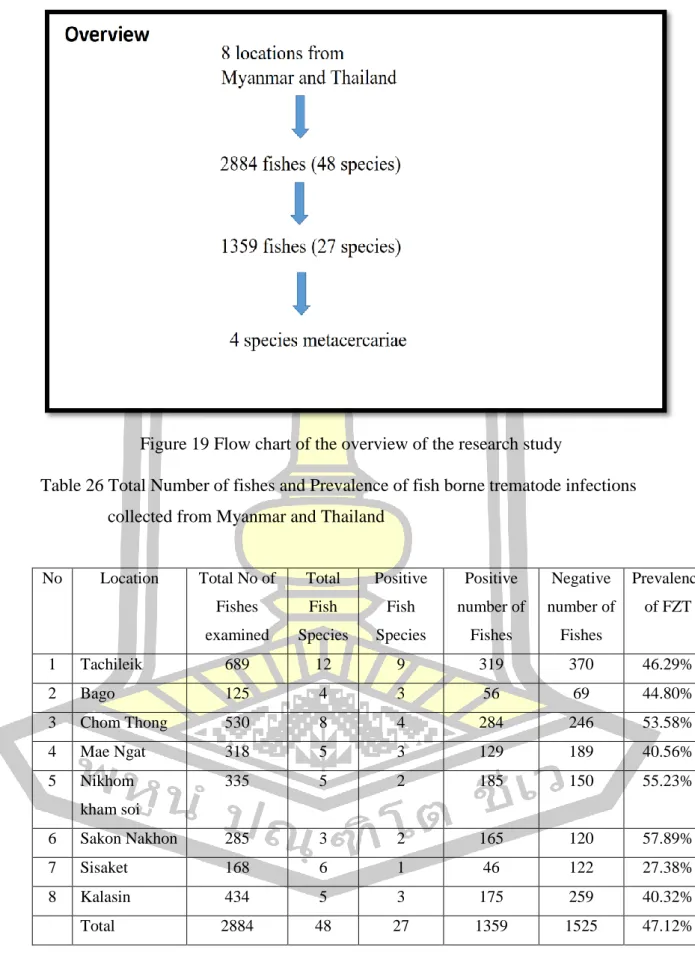
Control of fish-borne parasites in other intermediate hosts from the Mekong region of Myanmar, northern and northeastern Thailand. TITLE Control of fish-borne parasites in other intermediate hosts from the Mekong region of Myanmar, north and northeast of. A total of 2884 fish (48 species) were surveyed from a total of 8 locations from the Mekong region of Myanmar, the central region of Myanmar, north of Thailand and northeast of Thailand, viz. Tachileik, Bago, Chom Thong, Mae Ngat, NikhomKham Soi, Sakon Nakhon, Sisaket, Kalasin.
89 Figure 36 Flow diagram of the overview of the research study of Sakon Nakhon, Northeast of Thailand.
INTRODUCTION
Backgrounds
Fish-borne zoonotic trematodes (FZT), especially small liver flukes (Opisthorchiidae) and small intestinal flukes (Heterophyidae), are common in those regions (Jeon et al., 2012). The first intermediate hosts are snails and the second intermediate hosts are small freshwater fish (Dao et al., 2017). Severe chronic infection is a strong risk factor for cholangiocarcinoma (Honjo et al., 2005) (Zheng et al., 2017).
Identification of the parasite in Myanmar was based on faecal examination and molecular identification of eggs (Aung et al., 2017).

Research Objectives
LITERATURE REVIEW
Classification of human parasites
Classification of fish borne parasites
Trematodes
One species of fish may be contaminated with more than one species of fish-borne Trematodes metacercaria (figure). Opisthorchis liver flukes and heterophyid intestinal flukes are very common fish-borne trematodes in the Southeast Asian countries. Fish-borne trematodiasis caused by liver or small intestinal fluke (MIF) can cause chronic diseases.
Opisthorchis viverrini
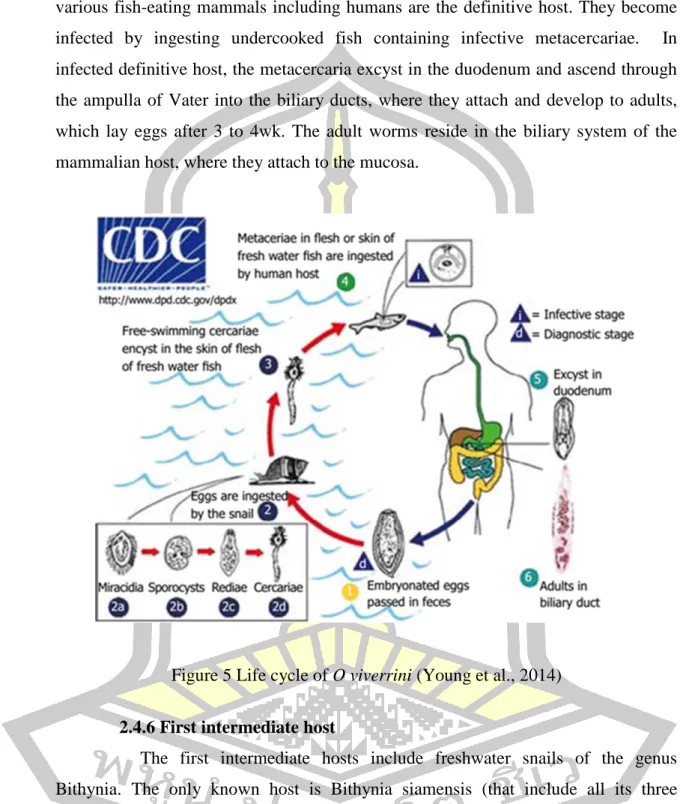
Metacercariae of all opisthorchiid species have similar morphology. The cyst is oval, there are metacercarial body folds, and the metacercariae are actively moving (Boonmekam et al., 2017). After being ingested by a suitable snail, the eggs release miracidia, which in the snail undergo several stages of development: sporocysts, rediae, cercariae. The adult worms reside in the biliary system of the mammalian host, where they attach to the mucous membrane.
The adult worms live primarily in the bile duct, gall bladder and sometimes in the pancreas.
Heterophyid Infections
Many of the original genera have subsequently been excluded due to morphological differences that were unknown at the time and because new ones had been included in the family. The outer cyst wall is thick with star-shaped melanin pigment granules and the inner cyst wall is thin. The encapsulated metacercariae are round and have a diameter of 200-280 µm (Shameen, Madhavi, 1988). Oral sucker well developed. The ventral sucker is armed with spines arranged in 3 groups, in the ventro-genital sac (figure).
The number 3 encysts as metacercariae in the tissues of a suitable fresh/brackish water fish (second intermediate host).
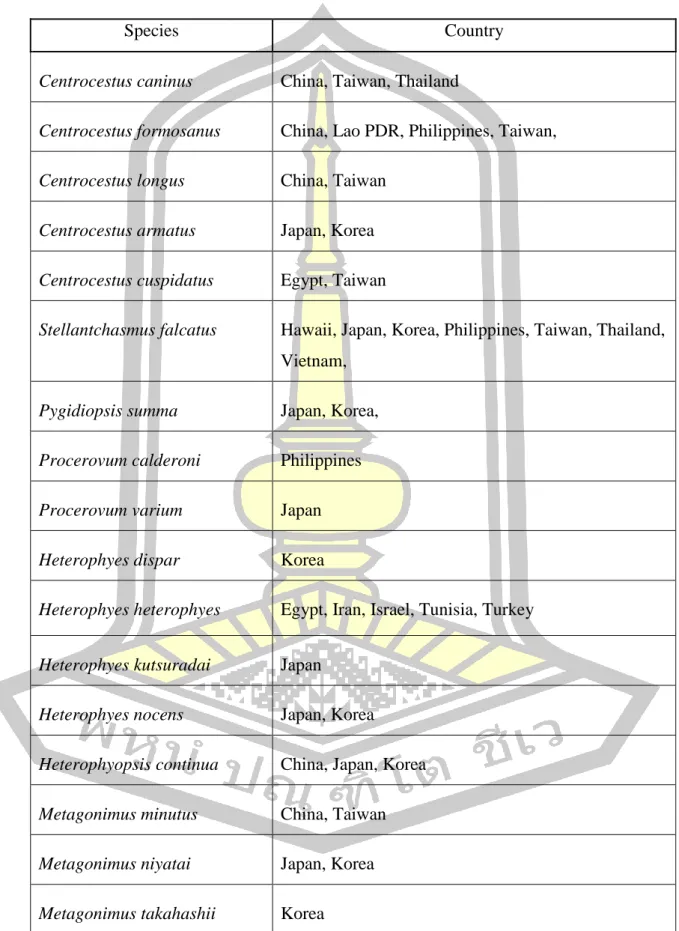
Species of cyprinoid fishes that found in Mekong basin countries
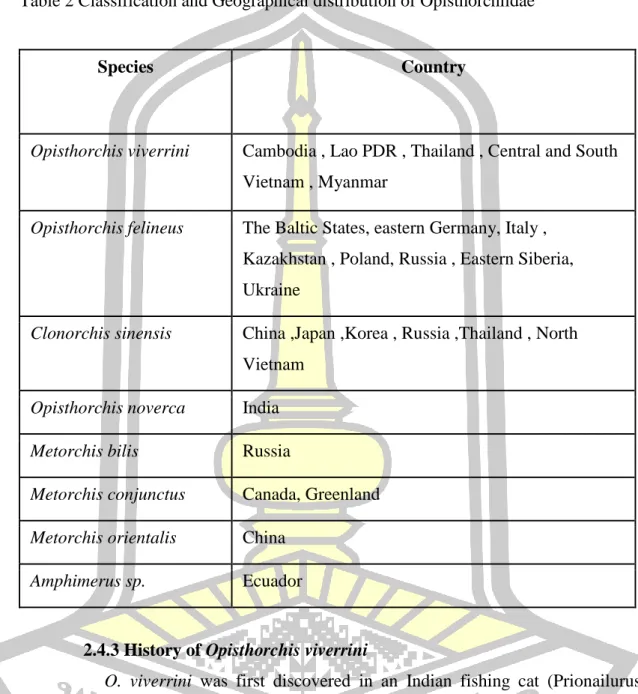
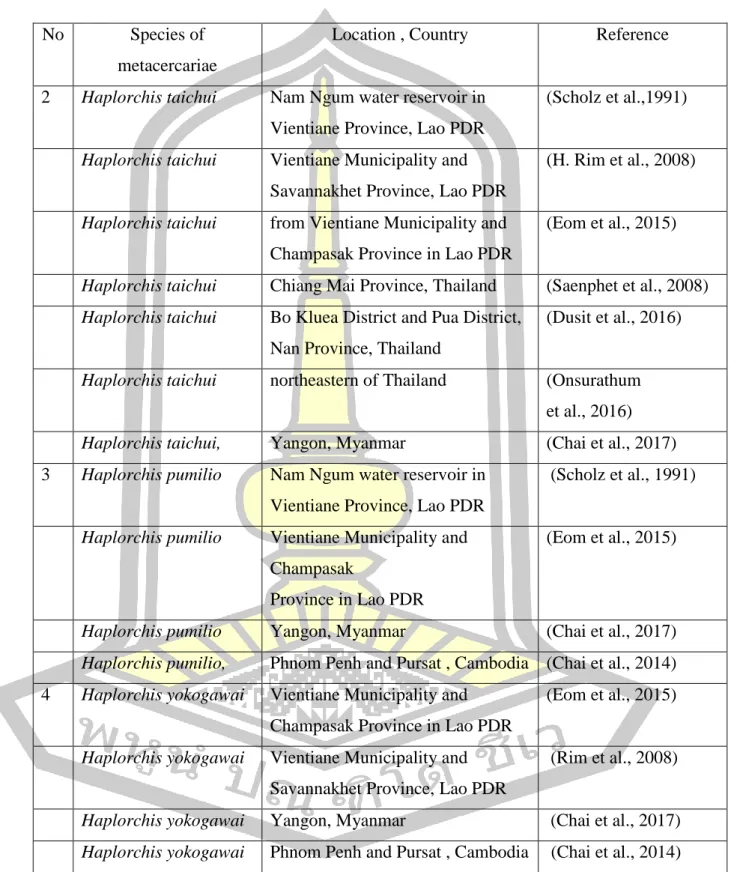
List of species of metacercariae that found Mekong river basin of Southeast
Haplorchis taichui Probinsia ti Chiang Mai, Tailandia (Saenphet et al., 2008) Distrito ti Haplorchis taichui Bo Kluea ken Distrito ti Pua,. Haplorchis taichui idiay amianan a daya a Tailandia (Onsurathum et al., 2016) Haplorchis taichui idiay Yangon, Myanmar (Chai et al., 2017) 3 Pamilia ti Haplorchis iti Pagurnongan ti Danum ti Nam Ngum. Haplorchis pumilio Yangon, Myanmar (Chai ken dagiti kakadua, 2017) Haplorchis pumilio, Phnom Penh ken Pursat, Cambodia (Chai ken dagiti kakadua, 2014) 4 Haplorchis yokogawai Munisipalidad ti Vientiane ken.
Haplorchis yokogawai Yangon, Myanmar (Chai ken dagiti kakadua, 2017) Haplorchis yokogawai Phnom Penh og Pursat, Cambodia (Chai ken dagiti kakadua, 2014).
Morphologically differential diagnosis of fish borne trematode metacercariae in
Secondary prospective study about the association of fish species (Host),
Carcinogenic parasite
The high mortality rate of CCA was reported in the northeastern areas where Opisthorchis viverrini infection was commonly found (Sripa et al 2011). Heavy infections can cause problems such as fibrosis in the liver, gallbladder and bile ducts (Hitanant et al., 1987). Pathological effects on the bile ducts including inflammation, epithelial desquamation, goblet cell metaplasia, epithelial and adenomatous hyperplasia, and periductal fibrosis jointly promote.
Although not immediately life-threatening, cancer develops after 30-40 years, and subsequent death is rapid - within 3-6 months of diagnosis (Sripa et al., 2007).
Geographic Information Systems (GIS)
Two monitors, extra storage space and sharp graphics cards are also must-haves in GIS.
Drive Decisions with Spatial Analysis
MATERIAL AND METHODS
- Materials and research instruments
- Chemical reagents
- Methods
- Geographic Information Systems (GIS) of Fish- borne trematodes
Location -1; A total of 689 fish (12 different cyprinoid fish species) were collected in Tachileik, Lower Mekong region of Myanmar (Table 18). Location -2; A total of 125 fish (4 different species of cyprinoid fish) were collected in Bago in the central region of Myanmar (Table 19). Location - 3; A total of 530 fish (8 different cyprinoid fish species) were collected from a local market in Chiang Mai, north of Thailand (Table 20).
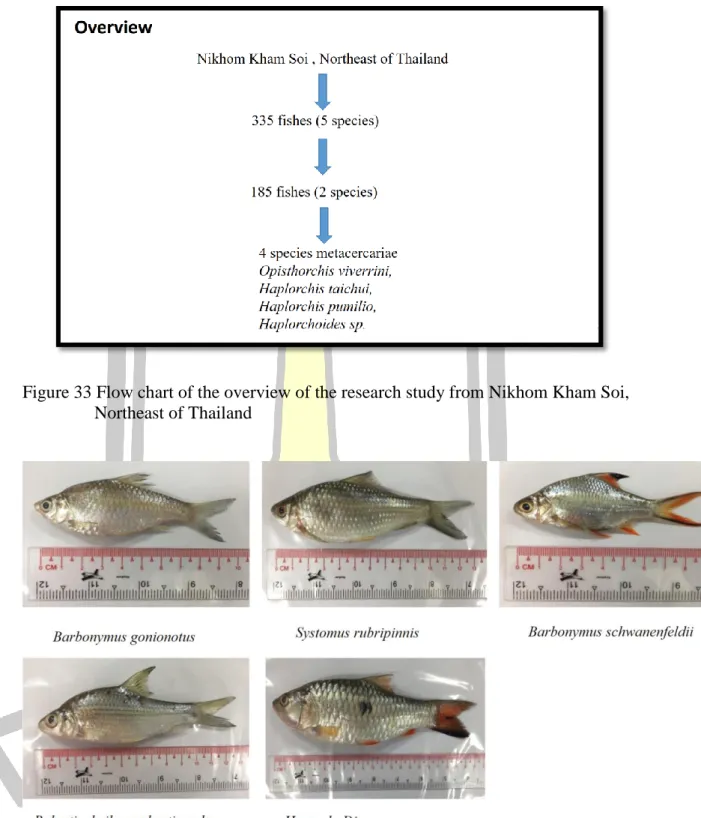
Position -4; A total of 318 fish (5 different species of cyprinoid fish) were collected Mae Ngat reservoir, Chiang Mai, northern Thailand (Table 21). Location-5; A total of 335 fish (5 different species of cyprinoid fish) were collected from Nikom KomeSoi, northeast of Thailand (Table 22). Location-6; A total of 285 fish (3 different species of cyprinoid fish) were collected from Sakon Nakhon, northeastern Thailand (Table 23).
Location-7; A total of 168 fish (6 different species of cyprinids) were collected from Sisaket, Northeast, Thailand (Table 24). Location-8; A total of 434 fish (5 different species of cyprinids) were collected in Kalasin, northeast of Thailand (Table 25). All collected fish were transferred on ice to the laboratory of the Tropical and Parasitic Diseases Research Unit, Faculty of Medicine, Mahasarakham University.
All the collected fish were ground one by one in a mortar with a pestle, and then the soil samples were transferred into a beaker and mixed with artificial gastric juice. In this study, after fish were examined for the presence of metacercariae by the digestion technique, observed results were then summarized as cumulative incidence for fish-borne trematodes Metacercariae infections in a tube form.

RESULTS
Occurrence of fish borne trematode infections in freshwater fishes from
Out of a total of 689 fish, 319 fish were infected with fish-borne trematode infections, with a total prevalence of 46.29%. In some fish species, simultaneous infections of one fish with two or more trematode species have been recorded, e.g.

Occurrence of fish borne trematode infections in freshwater fishes from Bago,
In a total of 125 fish, 56 fish were infected with fish-borne trematode infections and the overall prevalence was 44.8. Simultaneous infections of a fish with two or more trematode species have been recorded in several fish species, i.e., C.

Occurrence of fish borne trematode infections in freshwater fishes from Chom
Of the total 530 fish, 284 fish were infected with fish-borne trematode infections, and the overall prevalence was 53.58%. The highest prevalence was detected in Thynnichthys thynnoides (65.33%, n = 150), and the lowest prevalence was observed in Barbonymus schwanenfeldii (58.06%, n = 93) and the others were found in M. Concomitant infections of one fish with two or In some fish species more trematode species were recorded, namely Mystacoleucus marginatus, Systomus orphoides, Barbonymus schwanenfeldii and Thynnichthys thynnoides (Table 36).

Occurrence of fish borne trematode infections in freshwater fishes from Mae
In the total of 318 fish, 129 fish were infected with the fish-borne trematode infections, and the overall incidence was 40.56. Among the 5 different species, 3 species were cyprinoid fishes, i.e. Systomus orphoides, Barbonymus schwanenfeldii, Thynnichthys thynnoides infected with the infective stage of trematode parasites, metacercariae (Table 41). Simultaneous infections of trematode species have been recorded in some fish species, i.e. Barbonymus schwanenfeldii, Thynnichthys thynnoides (Table 41).

Occurrence of fish borne trematode infections in freshwater fishes from
Of the total 335 fish, 185 fish were infected with fish-borne trematode infections, and the overall prevalence was 55.22. Of the five different species, two species of cyprinid fish, namely Barbonymus goninotus and Balantiocheilos ambusticauda, were infected with the infective stage of trematode parasites, metacercariae (Table 2). In some fish species, simultaneous infections of one fish with two or more trematode species were recorded, namely Barbonymus goninotus and Balantiocheilos ambusticauda (Table 44).
Occurrence of fish borne trematode infections in freshwater fishes from Sakon
In the total of 285 fish, 165 fish were infected with the fish-borne trematode infections, and the overall prevalence was 57.89%. Among the 3 different species were 2 species of cyprinoid fish, i.e. Mystacoleucus marginatus, Henicorhychus siamemsis, contaminated with the infective stage of trematode parasites, metacercariae (Table 2). Simultaneous infections of a fish with two or more trematode species were recorded in some fish species, viz. Mystacoleucus marginatus, Henicorhychus siamemsis (Table 49).

Occurrence of fish borne trematode infections in freshwater fishes from
Out of a total of 168 fish, 46 fish were infected with fish-borne trematode infections, with a total prevalence of 27.38. Among the 6 different species, only Barbonymus schwanenfeldii was contaminated with the infective stage of trematode parasites, metacercariae (Table 54).

Occurrence of fish borne trematode infections in freshwater fishes from
Of the total 434 fish, 175 fish were infected with fish-borne trematode infections, and the overall prevalence was 40.32%. Cyclocheilichthys repasson, Barbonymus goninotus and Puntioplites facifer were infected with the infective stage of trematode parasites, metacercariae (Table 56).

Morphology of detected metacercariae
Geographic Information System of Fish- borne trematodes Metacercariae
A geographic information system showing the distribution of detected metacercariae, i.e. Opisthorchis viverrini, Haploris taichui, Haplorchis pumilio and Haplorchoides sp. Figure – 4 shows that the Geographic Information System showing O.viverrini in people from Myanmar and Northeast Thailand collected data from reported articles with associated population density generated by ArcGIS 10.5. A GIS database for the study of fish-borne metacercariae implemented with ArcGIS Desktop by ESRI, Bangkok, Thailand.
In our study, we examined environmental factors that influence fish-borne metacercariae. The GIS database was overloaded with GIS datasets for population density and precipitation.

DISCUSSION
As the water recedes, it migrates back into canals and streams and back into the Mekong (Ref. 37770). Like other members of the genus, it probably feeds mainly on plant matter and occasionally on insects and insect larvae (Ref. 12693). It has been reported to migrate laterally from the main stream of the Mekong or other permanent water bodies to flooded areas during the flood season and return to permanent water bodies at the onset of the dry season (Ref. 37770).
During the dry season, they stay in pools associated with submerged forests and bushes (Ref. 37770). It is usually sold live in markets where it is kept alive for several days by keeping it moist (Ref. 12693). Head large and broad; body relatively deep, snout not or weakly projected; plain silver body (Ref. 43281).
Undertakes lateral migrations from the Mekong Mainstream or other permanent water bodies to flooded areas during the flood season and returns to the permanent water bodies at the beginning of the dry season (Ref. 37770). Feeds on phytoplankton, but mainly on small crustaceans, rotifers, insects and their larvae (Ref. 12693). Large individuals are silvery or golden yellow in life with their dorsal fin red and caudal fin orange or blood red (Ref. 2091) Biology.
Largely herbivorous, consuming aquatic macrophytes and submerged land plants, as well as filamentous algae and occasionally insects (Ref. 12693). Very few tubercles on the snout that are not visible without magnification; snout length much less than width of eye socket (Ref. 37768). Large individuals silver or golden yellow in life with its dorsal fin red and tail fin orange or crimson (Ref. 2091).
Last simple dorsal ray not reaching caudal fin in adults; Anal, caudal and dorsal fin dark gray (Ref. 43281).