EFFECTS OF SOCIAL MARKETING ON CONSUMER ATTITUDE AND PURCHASE DECISION CASE STUDY: A DIETARY SUPPLEMENT. This thematic paper examines the effects of social media marketing on consumer attitudes and decisions to purchase a dietary supplement. As well as the trend of social media playing an important role in people's lives and business.
It drives companies to do social media marketing and advertising, which is also known as social media marketing. To reach a mass audience, marketers and companies are marketing on social media to promote products and provide information to consumers. Social media marketing is easy for people and companies to independently create content on social media, so information on social media can be both accurate and inaccurate information, which affects consumer attitudes and drives the decision to purchase.
Currently, social media marketing is more confusing when it provides access to people even if they are not looking for it.
Research Scope
LITERATURE REVIEW
- Definition
- Social Media Marketing (SMM)
- Consumers’ Attitude and Purchasing Decision
- Dietary Supplement
- Situation and Market Analysis
- Dietary Supplement Trend
- Social Media Marketing Trend
- Consumers’ Attitude and Purchasing Decision on Social Media Marketing
- Attractiveness
- Brand Recognition
- Credibility
- Shareablility
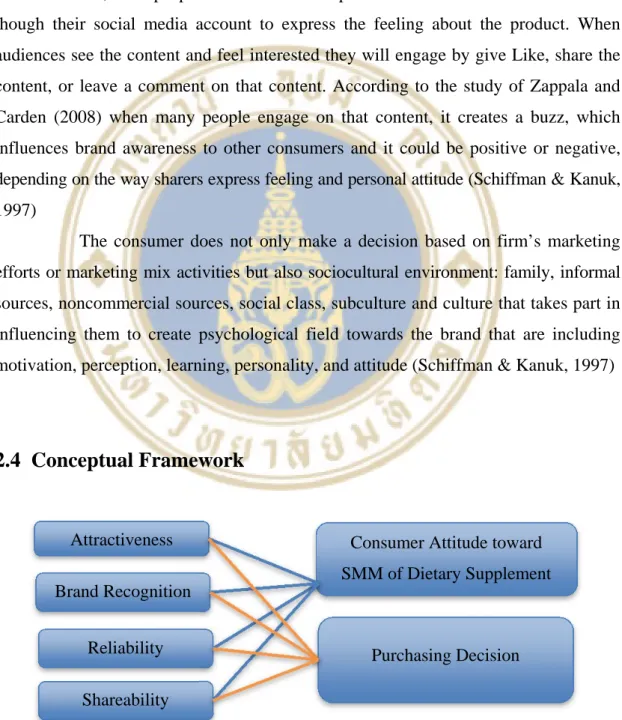
- Conceptual Framework
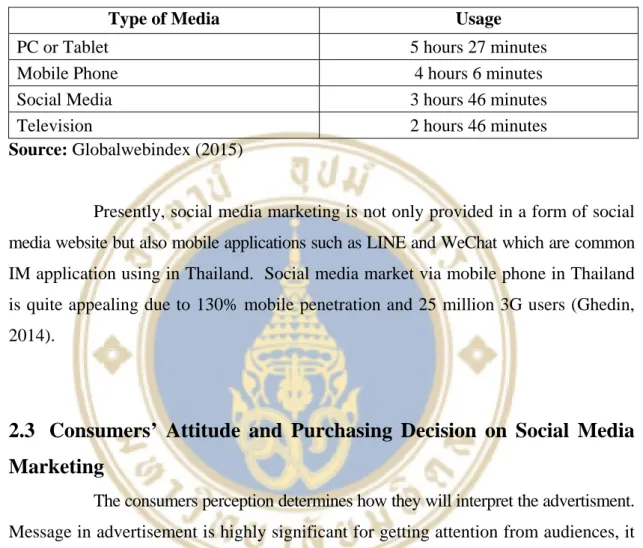
Social media is a powerful tool for businesses, allowing users to share stories freely and globally and providing low-cost global access and real-time events. According to a 2014 Globalwebindex survey, the top three motivations for users to use social media are following celebrities and celebrity news, staying up-to-date, and networking for work (Globalwebindex, 2014). Common social media apps that Thai people use a lot are Facebook, Youtube, Twitter and Instagram.
Currently, social media marketing is provided not only in a form of social media website, but also mobile applications such as LINE and WeChat, which use common IM applications in Thailand. Social media market via mobile phone in Thailand is very attractive due to 130% mobile penetration and 25 million 3G users (Ghedin, 2014). Social media marketing also has an ability to build a relevant connection between advertising content and audience that convinces them to take action (Sharma & Sign, 2010).
Social media advertising not only provides a benefit of reaching a large number of target audiences at a lower cost than traditional advertising, but also increases consumer attitude, which increases brand recognition (Gupta, 2009). According to Hajli (2015), social media marketing activities have positive impacts on brand awareness because it builds better relationships with customers and customers are able to remember the brand when they are interested in the content. Social media marketing creates trust and credibility for the brand when people who have direct and indirect experience with brand knowledge pass the message to others, this influences the receivers to believe in the message (Bulter & Butman, 2005).
The social media marketing campaign will reach a large number of people very quickly when the content goes viral, which happens when the audience is sharing the content with others. Content sharing on social media is now being massively accelerated through mobile technology, people are constantly connecting to the internet within seconds and sharing information such as retweeting message, sharing location and sharing photos and videos (Hallam, 2013). In social media, these people are also known as product testimonials who create content through their social media account to express the feeling about the product.
RESEARCH METHODOLOGY
- Research Design
- Populations and Sampling
- Data Collection
- Demographic Question 1. Name
- Data Analysis
This study collects data from 12 respondents according to the representative number of representative samples in qualitative analysis of Guest et al. 2006), the representative sample size for individual interviews is twelve, in terms of respondents who use social media and are between 19 and 35 years old are; the average age of people consuming social media in Thailand. The interviewer started the interview by greeting the respondent and talking about general topics to make him/her feel more comfortable, and then started to provide information about the research topic, questions and the time taken for the interview, which took about 20 minutes lasted and started. to ask the respondent's understanding of the topic and check whether he/she has seen the social media marketing of nutritional supplements before and then check his/her knowledge about social media marketing; if he/she did not understand, the interviewer explained, asked his/her demographic questions, and went straight to the attitudinal questions. Depending on the size of the sample, age between 19 and 35 years old who has seen social media marketing of nutritional supplements, the demographic questions and introductory questions are intended for screening target group respondents. The interview will end if they are not the target.
The first part of the question is about exploring consumer attitudes towards the marketing of nutritional supplements through social media and the part of the question. Have you seen social media marketing such as advertisements or product reviews of nutritional supplements on social media before? What do you think are the most important types of information that advertising content should provide in nutritional supplement advertisements?
Do you think social media marketing makes a nutritional supplement brand more interesting than traditional marketing? Do you think it is important for nutritional supplement advertising to include examples of other consumers' results after using the product? If you find nutritional supplement marketing content on social media that interests you, whether you want to share that content on social media apps.
Have you ever purchased any nutritional supplement that you saw advertised on social media? Researchers can start asking broad questions, such as social media usage habits, popular bloggers, or common search terms, to analyze social media usage behavior. Axial coding aims to organize the data in a meaningful way by looking for associations between categories, for example the age of the respondents and the factors that influence their decision to purchase a dietary supplement, or identifying the factors that influence the decision to purchase.
FINDINGS AND DISCUSSION
Demographic Data
Factors towards Purchasing Decision on Dietary Supplement
- Consumers’ Attitude towards Social Media Marketing of Dietary Supplement
- Shareability
- Attractiveness
- Brand Recognition
- Credibility
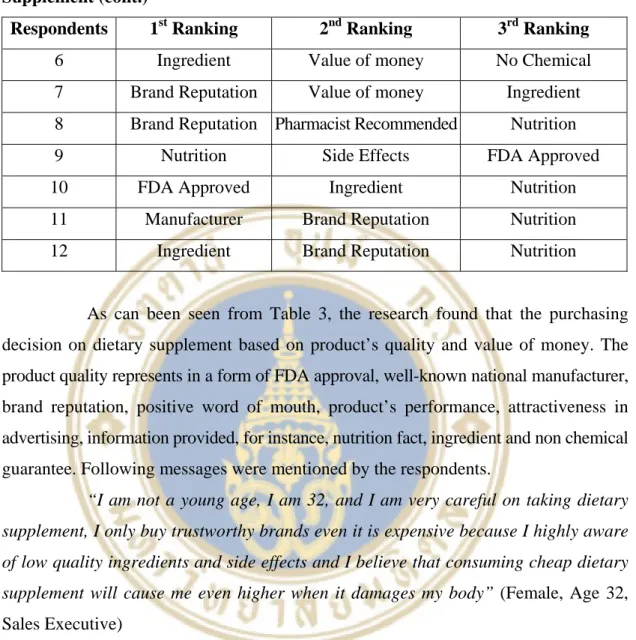
Findings show that consumers are quality conscious when choosing a dietary supplement as they are aware of side effects more than price. I'm more comfortable sharing information about dietary supplements on social media because it's more comfortable and I believe it's helpful to many of my Facebook friends when they read it” (Male, Age 24, Tutor). Findings show that consumers are more comfortable sharing content about dietary supplements on social media than face-to-face (Haji, 2015).
There are too many nutritional supplement brands on social media, it's hard to remember all those brands I've seen unless everyone talks about it and it automatically becomes one of my brand choices” (Female, 34 years old, sales manager) . I want to try one product that I have always seen on social media because everyone is talking about it, it must be a good product.” (Woman, 25 years old, HR manager). The survey found that all respondents think social media marketing is important for the nutritional supplement brand, and there are eleven respondents who think social media marketing is more attractive than traditional marketing.
The findings show that marketing on social networks has more attractive content than traditional marketing due to greater informativeness, up-to-dateness, and it is also more interesting if the content is created by real users or well-known bloggers who use the product (Macnamara, 2010). Consumers are likely to spend more time on social media if they can access it via mobile. I'm sure I've seen many ads for nutritional supplements, but I can only remember one beauty supplement because I'm interested in the product.
I've seen too many dietary supplement ads on social media, but I can't even remember one, they all look the same” (Female, Age 25, HR Administrator). I just know that I've seen a lot of ads for dietary supplements on social media, but I don't remember the brand or nutrition or anything because it always comes up when I don't need it” (Male, Age 27, Engineer). The research found that eight respondents agree that information from social media is reliable, four respondents never believe information about dietary supplements on social media, they are more likely to consult a doctor, pharmacist and people they know, such as friends and family who use the product, to trust
The results indicate that information about dietary supplements from social media is reliable because it is up-to-date, shared by real users or people known to consumers (Bulter & Butman, 2005). The ads on social media may look very tempting, but I will consult with my mother if she has taken these supplements before, if my mother has it and says it is good, I will buy it” (Female, 26 years old , display manager).
RECOMMENDATIONS
Practical implications
Genuine experience sharing or testimonials also attract attention and gain credibility from consumers when it provides useful facts and information to consumers. Using celebrity bloggers or creating a marketing campaign that asks participants to share their experience using the product is a way to create viral content in order to gain brand recognition and try to get influencers like the dietary supplements to be included in advertising or activities related to family or friends to get more engagement as a dietary supplement will be more credible when a member of the consumer's family uses it because it makes them feel more familiar and more safe. In conclusion, the company should create content that provides product facts and useful information to gain consumer trust.
The content should be related between brand and audience or give something to the sharer, such as very new information or new research about the nutritional supplement, to create more appeal and influence the consumer to share the content with others, turning others into consumers who see the content. viral content remember the brands. Moreover, product reviews from real users are very important, it makes consumers perceive the product better.
Limitations of the Study and Suggestions for Future Research Limitations of this research are sampling; too small sample size and narrow
In future research, the researcher should increase the sample size and expand the range of respondents and categorize them into characteristics such as generational or consumer behavior to better understand the characteristics of value consumers who are likely to use social media and the product and the characteristics of people who are less likely , that they will spend in order to better understand their attitude and purchase decision.
Digital Business Start-Up (prva izdaja, The Ultimate Step-by-Step Guide to Succeed Online Online from Start-Up to Exit).
APPENDICES
Appendix A: Interview Question