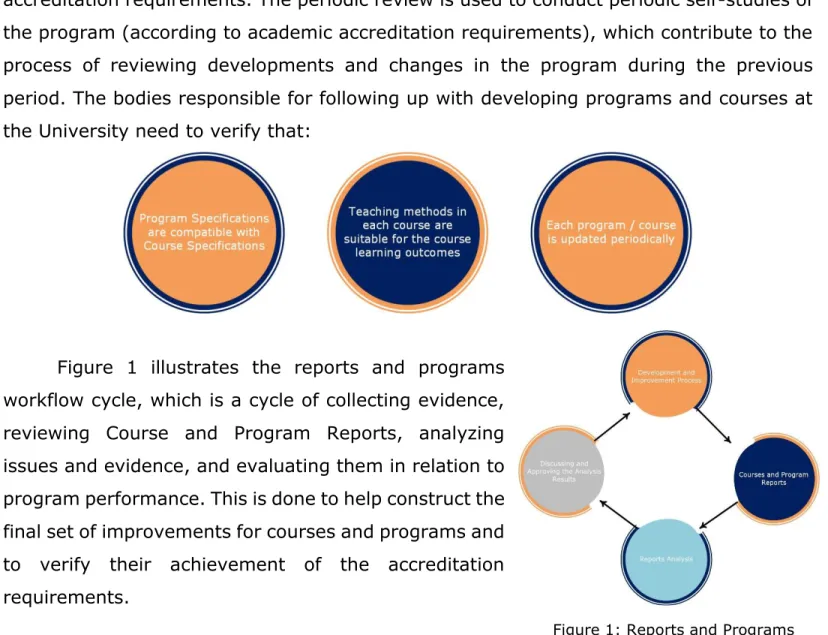
As a culmination of the University's quality assurance efforts, which have begun since its inception, comes this Quality Assurance Guide, which has been developed to complement these efforts by documenting and developing the existing practices to conform to prevailing statutes, regulations and academic accreditation requirements. . International standards have been taken into account in developing this guide, in particular the principles of the Quality Assurance Agency for Higher Education (QAA) in the UK, as well as the requirements of the National Center for Academic Accreditation and Evaluation (NCCA). In addition, the Guide has been developed to ensure ease of use by providing a concise, easy-to-follow guide that covers the key elements of the practice, while referencing appendices with detailed policies and procedures.
It is about evaluating the quality of a specific educational program for a specific period of time in accordance with the standards of the targeted academic accreditation authority.
INTRODUCTION
BASIC PRINCIPLES FOR BUILDING AND DEVELOPMENT PROGRAMS AND STUDY PLANS
Monitoring the Quality of Teaching and Learning (Periodic Review)
It also promotes efforts to maintain the quality of teaching and learning through periodic review of its programs and ensuring compliance with the requirements of the National Center for Accreditation and Academic Assessment. These requirements are the basis for achieving the main quality requirements and, thus, verifying all aspects of the program and ensuring its quality. Course reports and field experience reports are completed at the end of the semester and submitted at the beginning of the following semester.
A program report must also be prepared at the end of the academic year, which includes the achievements of students and faculty members.
PERIODIC REVIEW OF PROGRAMS AND COURSES
PERIODIC COURSE REVIEW
The subject holder then collects all comments and suggestions and submits them as a compiled Integrated Report to the Council of the Science Department at the Faculty to make recommendations regarding the necessary changes.
PERIODIC PROGRAM REVIEW
CHANGING AND MODIFYING CONTENTS OF EXISTING PROGRAMS AND COURSES
PERIODIC SELF-EVALUATION OF THE PROGRAM
The periodic self-study report includes an explanation of all aspects of the program, such as current processes, developments over a period with reasons for these developments and planning for recommended changes. It also considers changes in the environment and feedback from faculty members and students. The scope of the achievement of program goals is also documented with special consideration of all branches and departments of the university.
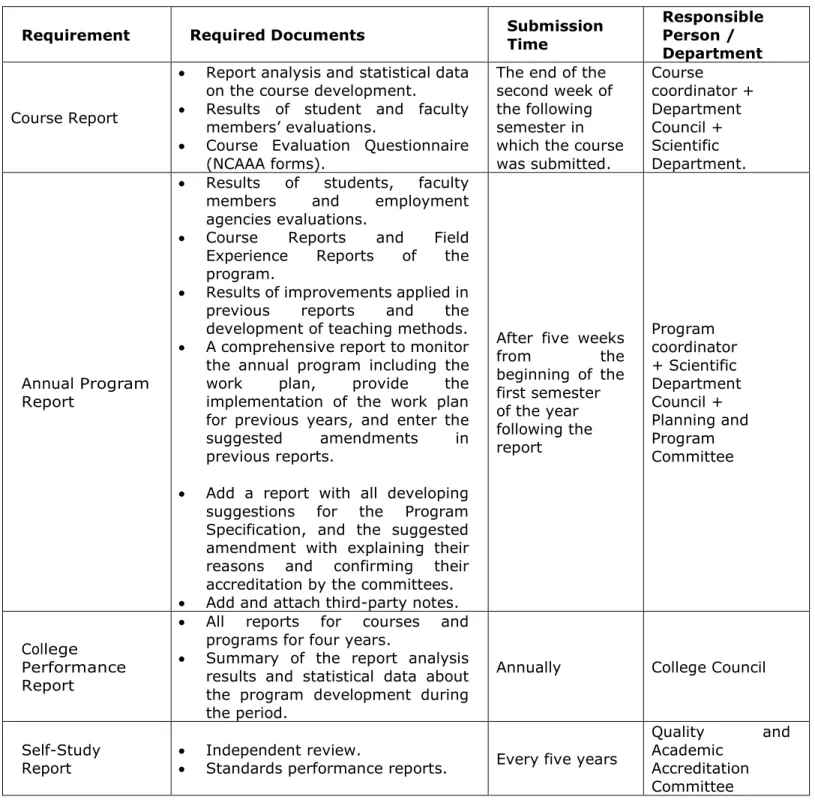
The Self-Study Report should address all sections clearly and comprehensively, with emphasis on the description, analysis and use of evidence and its sources. Thus, it becomes a comprehensive document that examines quality and indicates best practices and improvement methods for programs. The end of the second week of the following semester in which the subject was submitted.
A comprehensive report to monitor the annual program including the work plan, to display the implementation of the work plan for previous years and to record the proposed changes in previous reports. Include a report with any development suggestions for the Program Specification, and the proposed change explaining the reasons and confirming their accreditation by the committees. Summary of report analysis results and statistical data on program development during the period.
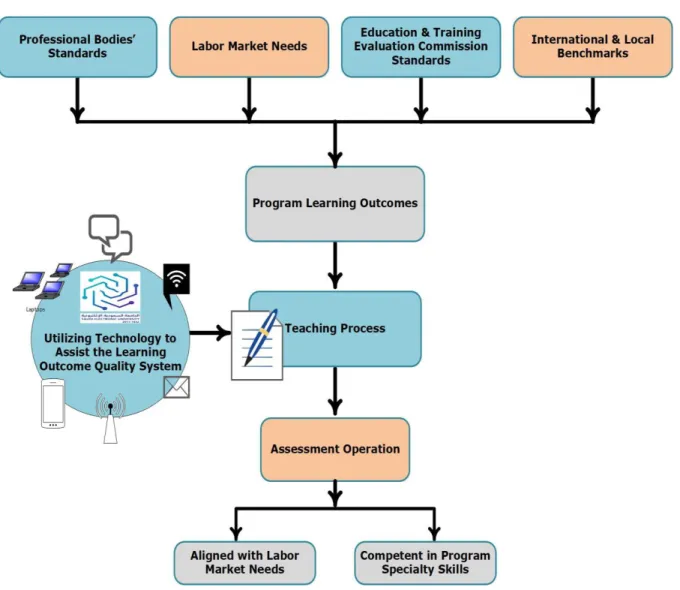
LEARNING OUTCOME ASSESSMENT PLAN
ROADMAP FOR QUALITY ASSURANCE
The importance of this process lies in the assessment of the current status of the program from the point of view of the stakeholders, as well as the understanding of what affects the satisfaction of the stakeholders to help in the continuous effort to improve it.
IMPROVEMENT PROCEDURES
It is important that all CCI stakeholders are able to present their views and comments through channels so that their voices are heard. Saudi Electronic University is considered the only public university specializing in the blended learning model in Saudi Arabia. The university adopts an educational model based on face-to-face teaching, supplemented by the use of information and communication technology to enrich the educational experience and impart characteristics of self-learning and lifelong learning to SEU graduates.
SEU has carefully selected academic programs that are not only compatible with the blended learning model, but also enhanced by this model. These improvements are reflected in the outcome of the technology-dependent programs (eg Bachelor of Information Technology, Health Informatics and Digital Media). SEU students will therefore be able to identify various possibilities of using technology to deliver educational programs that will help them expand their skills and perspectives, as well as enable them to utilize technology to its full potential in their field of study.
Finally, SEU contacted the national regulatory authorities of each available program to determine the accreditation requirements. Some successful professional accreditation examples are the accreditation of the Bachelor's Program in Health Informatics, the Bachelor's Program in Public Health and the Master's Program in Healthcare Administration by the Saudi Commission for Health Specialties.
MEASURING TEACHING EFFECTIVENESS AT THE IT Program
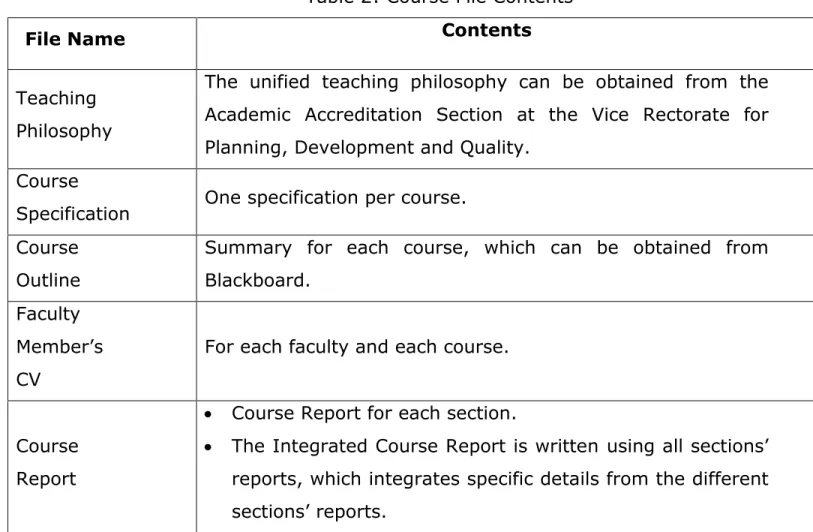
COURSE FILE CONTENT
Samples of student assignments for each section (three samples for the lower grade, three samples for the middle grade, and three samples for the upper grades), totaling nine samples per section.
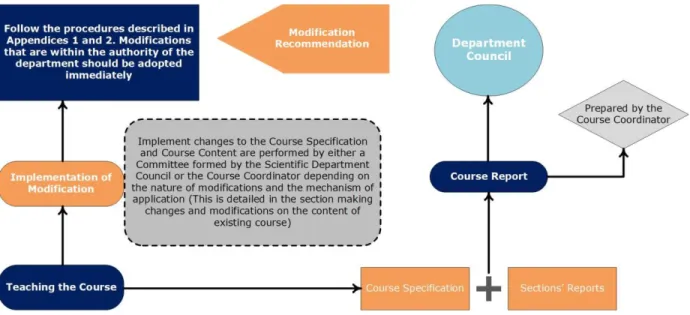
COURSE SPECIFICATION AND COURSE REPORT PROCEDURES
The changes proposed in course reports are discussed by the scientific department ideally before the start of the semester, but no later than the first week. The academic department approves what it deems appropriate taking into account what was reviewed in the previous semester regarding the scope of changes and units with. As this is the first version of the Quality Manual, the Quality & Academic Accreditation Committee appreciates your feedback at [email protected].
It aims to contribute to the improvement of quality and excellence in higher education institutions and programs through academic evaluation and accreditation. Mission: To support, evaluate and accredit higher education institutions and programs through the implementation of objective and transparent systems and procedures with the aim of ensuring local and international confidence in the results of these institutions and programs. The latest NCAAA forms can be accessed at https://www.seu.edu.sa/vropdq/en/quality-formsncaaa-forms.
Example below shows the mapping of the CLOs of IT242 to their corresponding IT PLOs. The mapping of all CCI courses is available on the Quality Portal (http://tawkeed.seu.edu.sa). For instructors: CV, examples of Assessment 1 (high, middle and low) and Mid-Term Exam (high, middle and low) (7 files in total).
For instructors: samples of Assessments 2 and 3 (high, medium and low), Final Exam samples (high, medium and low), Student Attendance, Course Report (CR) and student survey. The deadline to upload Phase-2 files is four days after the course final exam.
UPLOADING THE QUALITY FILES
Course Contact Hours B.2 Topics not Covered
Activities/Assessment Methods
Verification of Credibility of Students’ Results The list of CLOs and the Target Level (70%) in D.1
The form must be completed in accordance with the course details available from the IT Study Plan. For "Other teaching hours" enter the relevant hours for your course depending on the college. Parts B.1 and B.2: Set out the course description and main course objectives as shown in the Study Plan (or previous Course Specifications report).
Part B.3: Enter all relevant GLOs and their aligned PLOs from the Study Plan (or previous Course Specifications). Part C: Fill in the topics of the course for each week and include the number of contact hours. The contact hours must be 4 hours for each week, excluding week 8, which must be zero hours.
Part D.1: Enter all CLOs and specify the teaching strategies and assessment methods that will be used to achieve each CLO. All assessment samples must include the course title and code, and the student's name, ID, and CRN. All course CLOs must be linked to one (or more) questions from the midterm or final exam.
You reflect your section's details, marks, analysis and recommendations to the CR you will receive from the Course Coordinator. In Part A, the number of students who completed the course (appears in Part C.1) = the number of pass and fail students (i.e. all students except the withdrawn.
Important instructions when preparing the Quality Files
The exam file you export from the exam system must be readable, in Portrait format, and contain all questions. The attendance report should be legible, in horizontal format and show all columns on one sheet. In Part A, the number of students completing the course (shown in Part C.1) = the number of students who pass and fail (ie, all students excluding withdrawn students.).
The number of students who have started the course and students who have completed the course (Part A) must match the corresponding values given in the Results part (Part C.1). The number of students who have started the course must match the total number of students in the attendance report (including withdrawn students). The number of students who have completed the course must match the total number of students in the attendance report (excluding withdrawn students).
This includes the following parts: B.1 (Course Contact Hours), B.2 (Topics Not Covered), B.3 (Teaching Strategies), B.4 (Assessment Activities/Methods), B.5 (Authentication Check Results students), (List of CLOs and target level (70%) in D.1), E.2 (Other evaluations) and G.1 (Measures for course improvement). Do not remove the Excel sheet embedded in Part C.1 (just double-click to edit and add scores). Complete Part E (Evaluation of Course Quality) correctly and upload the Course Evaluation Survey, which you will receive at [email protected].
If the survey report is not available, then your students have not completed it, please write "students in this section did not complete the survey report". If the prompts are in Arabic, then refer to the course coordinator if you need any help with translation.
Appendix A: Sample of Online Quiz’s Cover Page
Student Details
CRN: ###
Appendix B: Teaching Strategies and Assessment Methods
Part A: Suggested Teaching Strategies
Inquiry-Based Instruction Students learn by asking questions, investigating, exploring, and reporting what they see. Consider a 'flipped' approach by asking students to watch video content before the class session and spend class time on exercises, projects and discussions. Please refer to the SC office at SEU (Ms. Amal Alshathri, [email protected]) if you wish to suggest/use any other teaching strategies not mentioned in the table above.
Part B: Suggested Assessment Methods
Part C: Example