AUMJ is indexed by the three major players in the world of academic library discovery services: EBSCO Discovery Services (EDS), OCLC (Worldcat Discovery) and ProQuest (SUMMON). To develop AUMJ as a reliable academic reference within the international databases for researchers and professionals in the medical arena. To the best of my knowledge, no previous studies in the Qassim region have investigated BF knowledge, practices and factors that may influence BF.
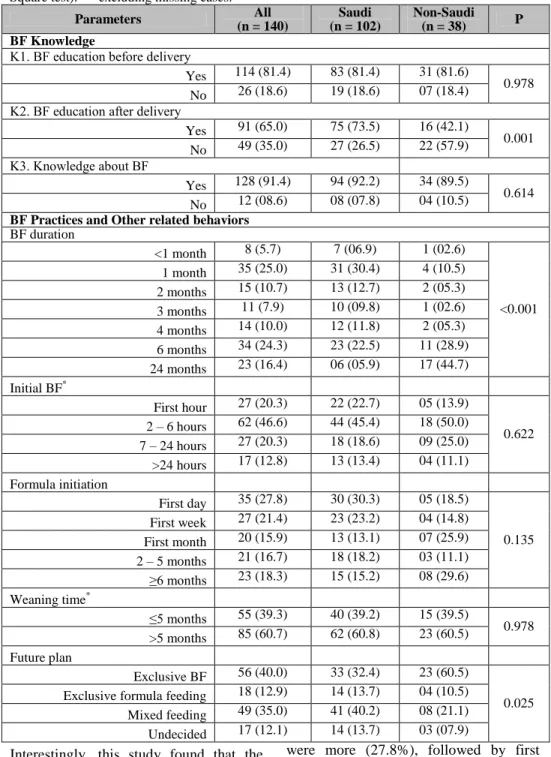
Objectives: This study aimed to investigate BF knowledge and practice among mothers attending outpatient clinics in the Qassim region. There was a significant difference in the exclusive BF rate in Saudi mothers (15%) compared to non-Saudi mothers (30%). Partial BF and exclusive formula feeding are the trends for feeding in the first 6 months of life.
Although studies have addressed BF in another region of Saudi Arabia in terms of BF practice, factors affecting BF, and attitudes toward BF (5–11), there was insufficient data on BF among mothers in the Qassim region.
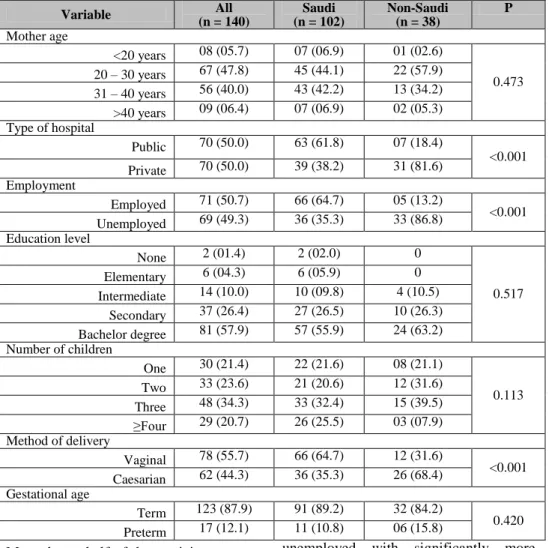
Majority of the respondents were
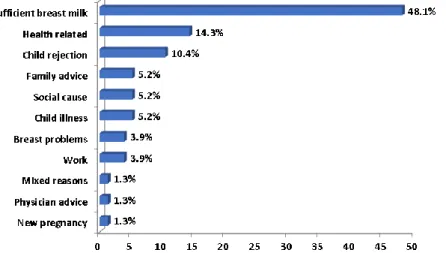
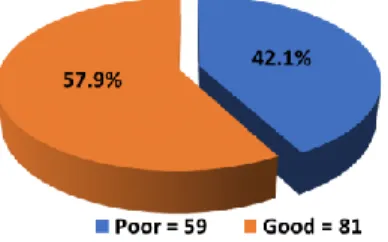
In this study, only 27% attended prenatal BF education, while 65% attended postpartum. Al Ketbi et al(14), reported a prevalence of poor knowledge in only 5.5%, fair in 43.3% and good knowledge was reported in 51.2% of participating mothers. In a study involving female teachers, insufficient breast milk and work-related problems were the cause of discontinuation of BF(8).
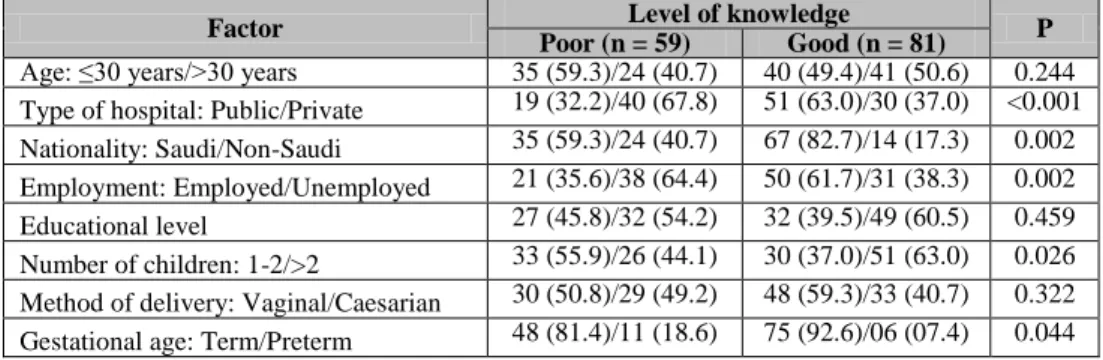
However, this study shows a lower average duration (4 months) among Saudi mothers who studied in the Al-Qassim region. Although this factor was not well identified in previous studies, a recent study in Saudi Arabia confirmed this finding (4). Parity was the third factor associated with BF duration, as multiparity was correlated with longer duration and higher prevalence of BF.
Early initiation of infant formula, mainly in primigravida mothers, likely indicates poor prenatal and postnatal BF education.
WHO and UNICEF recommend the
Does caesarean section affect successful initiation of breastfeeding in Saudi Arabia. Breastfeeding knowledge, attitudes and practices among women attending primary health care clinics in Abu Dhabi Island, United Arab Emirates.
Original Article
While Cryptosporidium may cause
Regarding the prevalence of Cryptosporidium infection in this study, it was found that the infection rate in children using the modified Z-N stool examination was 40%. A similar report from Alexandria University Children's Hospital, Alexandria, Egypt presented a rate of Cryptosporidium parasitic infection among children of 22.1% (13). Other studies in Alexandria and from Turkey showed high rates of infection reaching 40.6% and 41.9% respectively (14,15).
An overall Cryptosporidium parvum infection was 42.6% in a study conducted to compare four diagnostic techniques, namely acid-fast staining, direct immunofluorescent assays. Several studies from Egypt conducted in Alexandria, Cairo and Zagazig among immunocompromised children reported higher rates of Cryptosporidium infections ranging from 30 - 58% respectively. Differences between these studies in the rate of infection can be attributed to sampling, sampling season, the use of different staining and assessment techniques(17).
In agreement with the present study, Flanigan and Soave, 2002(18) established a rate of Cryptosporidium spp.

Due to funding limitations, larger participant sample sizes and multiple sampling per participant and molecular characterization studies became difficult. The samples were not evenly distributed among the seasons of the year making the comparison somewhat limited for extrapolation. This project was funded by a research grant from the Grants Office, Faculty of Medicine, Assiut University, Assiut, Egypt (Grant #1237).
Calves as source of an outbreak of cryptosporidiosis among young children in a closed farming community. Preventing Community-Wide Transmission of Cryptosporidium: A Proactive Public Health Response to a Swimming Pool-Related Outbreak - Auglaize County, Ohio, USA. Identification of species and sources of Cryptosporidium oocysts in storm waters with an rRNA-based small subunit diagnostic and genotyping tool.
Prevalence of zoonotic parasites in drinking water in three districts of Khyber Pakhtunkhwa Province, Pakistan.
Mothers' Attitude and Practice toward Child Physical Punishment as a Discipline Strategy in Saudi Arabia
The Anderson questionnaire includes mothers' opinions and attitudes towards the use of corporal punishment using a Likert scale (strongly agree, agree, disagree, strongly disagree) and includes nine items. The answers were scored in such a way that the higher the score, the higher the score and the attitude that supports physical punishment of children and vice versa. Mothers had a positive attitude toward physical punishment (encouraging) if their scores were equal to or above the median value, and mothers had a negative attitude toward physical punishment (against) if their scores were below the median value.
Regarding the attitude towards corporal punishment of children, 30.7% agree that the use of corporal punishment is a useful and effective educational tool if the child is naughty or annoying. 26.8% disagreed that there should be a law or system that prohibits the use of corporal punishment of children. Overall, a positive attitude (encouragement) of physical punishment was observed in more than half of the mothers (54.2%).
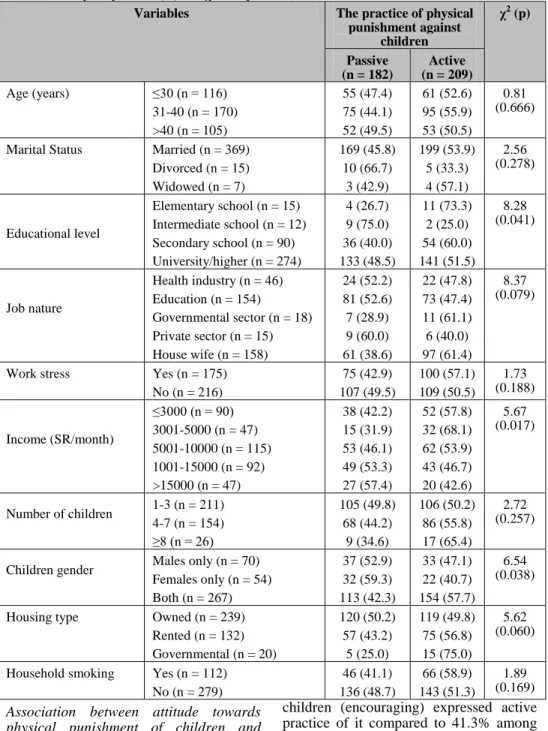
Among the studied factors that could influence the mother's attitude towards physical punishment of children, only income and type of house were statistically significant. Mothers who live in state-owned houses (85%) had the most positive attitude towards corporal punishment of children, compared to 52.7% and 52.3% of those who live in owned or rented houses (p = 0.018) (Table 1) . Overall, active corporal punishment of children was mentioned by more than half of the mothers (53.2%).
Nearly two-thirds (63.7%) of mothers had a significantly higher positive attitude towards physical punishment. According to our results, it is noted that 54.2% of Saudi mothers encourage physical punishment as a method of discipline. The findings of the study by Qasem et al. of Kuwait found that physical punishment for children as a discipline strategy was encouraged by 86%(16).
Our study showed that mothers who had a significantly higher positive attitude towards corporal punishment of children (encouraging) expressed active practice of it more than the mothers who had a negative attitude. This illustrates that the perception and attitudes towards discipline play an important role in the practice of corporal punishment of children as a discipline strategy.

Residents’ Perceptions and Attitudes Regarding the Half-Day Release Course in the Family Medicine Residency Program
The HRDC is one of the elements of this training and is mandatory for all family medicine residents(12). A study evaluating the satisfaction of an HDRC in the Makkah region showed varying levels of resident satisfaction for different components of the course. The results of this study can improve the quality of the course and provide possible solutions to the relevant issues.
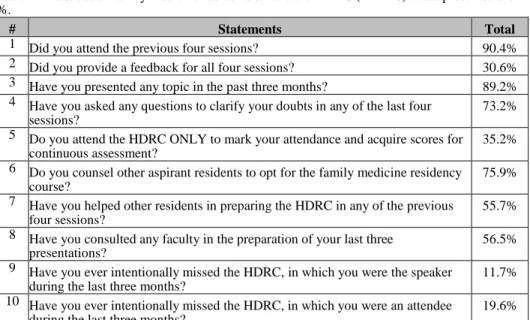
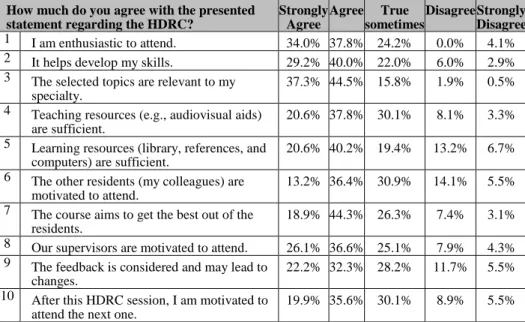
Regarding their attitude towards HDRC, 90% of participants attended all of the previous four sessions; however, only 30% of participants provided feedback. In the three domains motivation, perceived benefit and quality of the course, on a scale from 0 to 5, average motivation, average perceived benefit and average quality score was 4. 4 Have you asked questions to clarify your doubts about of the last four sessions.
7 During any of the previous four sessions, did you help other residents prepare for the HDRC? Apart from the quality of the course and the negative attitude, a significant difference was observed between the men. In addition, 82% of the participants indicated that the topics presented are relevant, while 62% of the participants believed that HDRC brings out the best in residents.
Similarly, in the previous survey, residents were satisfied with the quality of the program to understand the degree of satisfaction with the degree of family medicine(16). In the previous studies, the quality of the course and the availability of the resources were satisfactory(12,16). Involving the residents in selecting the topics of presentation, mode of delivery and presentation technique can improve the HDRC.
A qualitative component to understand the reasons for differences between the scores of the third year and other residents is required. Cross-sectional longitudinal study of the academic half-day format in a hematology-oncology fellowship training program.
AUMJ Comprehensive Instructions For Authors and Reviewers
At the same time, the scientific consequences of the case ("suspicion of minor plagiarism"), which were also assessed by reviewers and editors. All authors should have made substantial contributions to all of the following: (1) study design and design or acquisition of data or analysis and interpretation of data, (2) drafting of the article or its critical revision for important intellectual content. , (3) final approval of the version to be submitted. List all links with a superscripted Arabic number immediately after the author's name and before the appropriate title.
For parametric data, the variance should be reported as 95% confidence limits or standard deviations rather than the standard error of the mean. The statistical analysis used must be appropriate for the objectives of the study and the type of data analyzed. This should explore the meaning, interpretation and justification of the results of the work compared to.
Acknowledgments and Funding Collect the acknowledgments in a separate section at the end of the article before the references. The purpose of the miniview is to provide a very up-to-date concise summary of the. The author(s) must be the sole authors of the article and must have full authority to enter into the agreement and grant rights to the journal, which are not inconsistent with any other obligations.
High-quality manuscripts are peer-reviewed by at least two experts in the same field together with a biostatistician if the study requires it. A one-month review process cycle is the goal of the journal from submission to final acceptance. Continued open peer review after publication is highly recommended by submitting comments to the editor on any published article that will appear with the author's reply in the next issue of the journal.
The editor-in-chief of the journal has exclusive authority to make the final decision of acceptance or rejection during any dispute. Please rate the manuscript from 0 to 4 (highest) for each of the following elements and sum the total score. The corresponding author will be provided with a PDF file of the article via email at no cost (the PDF file is a watermarked version of the published article and includes a cover sheet with the journal cover image and a disclaimer detailing terms and conditions of use) .
I understand that material published in the Aljouf University Medical Journal will be included in any reprints of the published article.
Manuscript Submission and Copyright Transfer Form